Thought for the Day – 31 July – Meditations with Antonio Cardinal Bacci (1881-1971)
Entrusting Ourselves to God
“St Joseph is only one example. He had the joy of seeing the Son of God born of his Immaculate spouse but he also saw Him being born on a cold dark night in the most squalid conditions. He heard the choirs of Angels praising God above the lowly manger and saw the shepherd and the Magi adoring the Divine Child. But soon afterwards, he heard from a heavenly messenger that Herod was seeking to put Jesus to death and that, it would be necessary, to flee into exiles in Egypt.
This holy Patriarch was as resigned to the poverty of the manger and the discomforts of exile, as he was grateful to God for the wonderful gifts and joys which he had been granted. He knew that God could have solved, by a single act of His Divine Will, all the problems which he encountered throughout life. But he never asked for such a favour. His only desire was to do God’s Will perfectly.
Let this be our desire too and let us never cease to ask God for this grace.”
Thought for the Day – 30 July – Meditations with Antonio Cardinal Bacci (1881-1971)
Knowledge and Sanctity
“We have no right to speak evil of human learning and industry, which are a gift from God. But we must recognise that goodness is more important than knowledge. The devil’s intellect is superior to ours but, he has lost God and in losing God, has lost everything which is good.
“Knowledge puffs up” writes St Paul (1 Cor 8:1). Pride and presumption can easily spring from a little learning, whereas the fruits of holiness are always beneficial to ourselves and to others.
Let us be humble in our scientific studies and use the results which we obtain, for our own progress in sanctity.”
Thought for the Day – 29 July – Meditations with Antonio Cardinal Bacci (1881-1971)
Little Things
“Our eternal salvation will probably be determined by these ordinary acts of virtue and these ordinary sins. Jesus compared the Kingdom of Heaven to a mustard seed which grows into a tree. Similarly, many Saints began their spiritual ascent, by following one simple inspiration and many souls, perhaps, have found themselves condemned as a result of having neglected the commonplace virtues and inspirations.
Ordinary virtue may develop into heroic virtue but, if a man has neglected to train himself to act well in small matters, how will he behave in a time of great spiritual trial? Experience also teaches us that smaller vices can develop into great vices. “He who wastes the little he has, will be stripped bare” (Ecclus 19:11). A man who is not faithful to God in little things, will not be faithful in greater things.
We are either going up, or down, in the way of perfection – it is almost impossible to stand still! If we sincerely wish to make progress, let us resolve to avoid the least suggestion of sin and to enrich ourselves daily, by tiny acts of virtue.”
Thought for the Day – 28 July – Meditations with Antonio Cardinal Bacci (1881-1971)
Other Ways of Resisting Temptation
“The third method, is to avoid the occasions of sin. Anyone who places himself without grave reasons, in the proximate occasions of sin is certain to fall. “He who loves danger,” the Holy Spirit warns us, “will perish in it” (Ecclus 3:27). It is useless for a man to pray, when he is exposing himself needlessly and voluntarily to the danger of sinning. He cannot expect God to hear his prayers, for this is presumption!, not confidence in God.
On the other hand, a man may be obliged to expose himself to the risk of temptation, in the course of his work, or for some other strong reason. In this case, he can be sure of God’s assistance but, he should fortify himself by fervent prayer and by taking all the precautions necessary to minimise the danger.
Where temptations against holy purity are involved, it is especially necessary to avoid, even the slightest occasion of sin, when that is possible. As St Francis de Sales was accustomed to say, there are certain battles which can only be won by soldiers, who are prepared to retreat!”
Thought for the Day – 27 July – Meditations with Antonio Cardinal Bacci (1881-1971)
The Main Ways to Conquer Temptation
“The masters of the spiritual life suggest various ways of combating temptation. As St Alphonsus de Liguori points out, however, “the first way is absolutely essential and that is, to pray to God for the light and strength, to conquer. Without prayer, it is impossible to overcome temptation, whereas with prayer, we are sure of victory” (Al Servizio Divino p 22, c 6).
The reason is obvious. Prayer is not simply a verbal address to Almighty God but is, an elevation of the mind and heart, a conversation with God. Let us pray. therefore, with confidence and with love!”
Quote/s of the Day – 26 July – St Anne, Mother of the Blessed Virgin Mary, Grandmother of Jesus.
St Anne, through her constant prayer, received, the Mother of God and then, became the Grandmother of God!
“God accepts our desires as though they were of great value. He longs ardently for us to desire to and love Him. He accepts our petitions for benefits, as though we were doing Him a favour. His joy in giving, is greater than ours in receiving. So let us not be apathetic in our asking, nor set too narrow bounds to our requests; nor ask for frivolous things unworthy of God’s greatness.”
St Gregory Nazianzen (330-390) Father & Doctor of the Church
“Prayer is the place of refuge for every worry, a foundation for cheerfulness, a source of constant happiness, a protection against sadness.”
“When you are weary of praying and do not receive, consider how often you have heard a poor man calling and have not listened to him.”
St John Chrysostom (347-407) Father and Doctor of the Church
“Fasting is the soul of prayer, mercy is the lifeblood of fasting. Let no-one try to separate them, they cannot be separated. If you have only one of them, or not all together, you have nothing! So if you pray, fast; if you fast, show mercy; if you want your petition to be heard, hear the petition of others. If you do not close your ear to others, you open God’s ear to yourself.”
St Peter Chrysologus (c 400-450) Father & Doctor of the Church
“Realise above all, that you are in God’s presence and stand there with the attitude of one, who stands before the Emperor.”
St Romuald (c 951-1027)
“The spirit of prayer is the spirit of the love of God and this should inspire all our vocal prayers. Flowery petitions are no use if our minds and hearts are turned away from God. God wants our hearts. Let us pray often but let our prayers be sincere acts of the love of God, coming from the heart.”
Thought for the Day – 25 July – Meditations with Antonio Cardinal Bacci (1881-1971)
Purification
“We should also value Indulgences as a means of spiritual purification. They ought not to be treated lightly. Jesus gave His Church, the power of loosing and binding every bond of sin. As long as we have the necessary dispositions, therefore, it can draw on the merits of Christ and of the Saints, to release us from the temporal punishment due to the sins which have already been forgiven us. It achieves this by the concession of Indulgences. These require, on our part, the fulfilment of certain conditions, a sincere sorrow for sin and, a strong resolution never to offend God again.”
Thought for the Day – 24 July – Meditations with Antonio Cardinal Bacci (1881-1971)
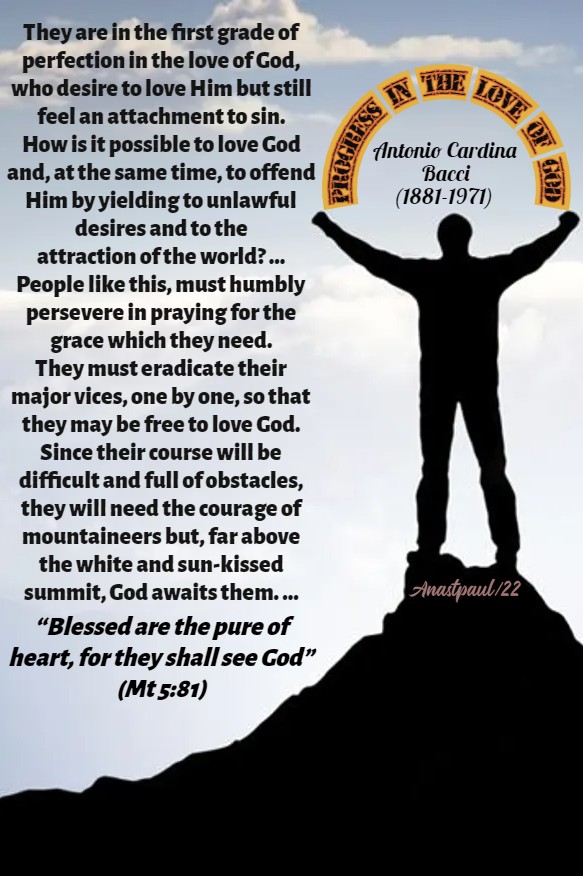
Progress in the Love of God
“They are in the first grade of perfection in the love of God, who desire to love Him but still feel an attachment to sin. How is it possible to love God and, at the same time, to offend Him by yielding to unlawful desires and to the attraction of the world? This is a mystery of the human heart which can experience, simultaneously, the desire to love God and the disturbance of the flesh.
People like this, must humbly persevere in praying for the grace which they need. They must eradicate their major vices, one by one, so that they may be free to love God. Since their course will be difficult and full of obstacles, they will need the courage of mountaineers but, far above the white and sun-kissed summit, God awaits them. Only toil and sacrifice can bring them there but when they arrive, they will know real happiness, for they will see God. “Blessed are the pure of heart, for they shall see God” (Mt 5:81).”
Thought for the Day – 23 July – Meditations with Antonio Cardinal Bacci (1881-1971)
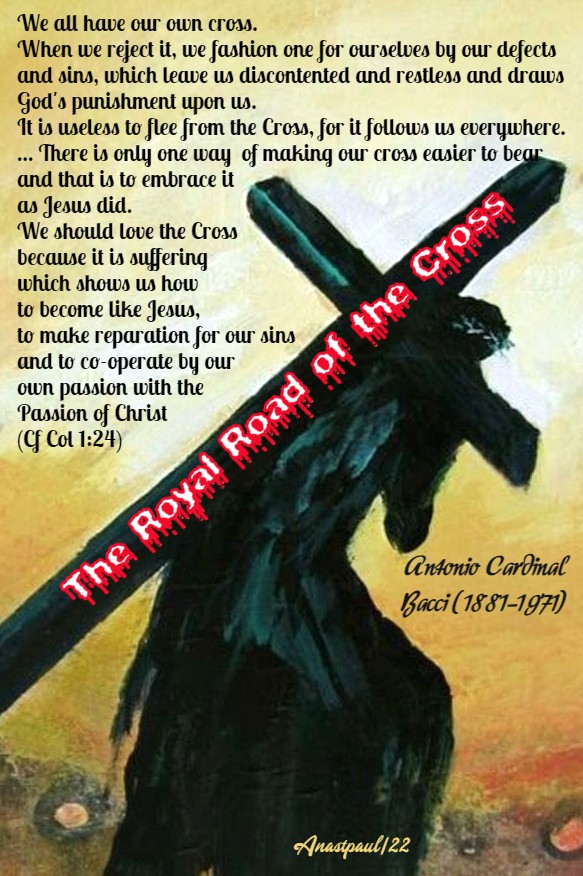
The Royal Road of the Cross
“We all have our own cross. When we reject it, we fashion one for ourselves by our defects and sins, which leave us discontented and restless and draws God’s punishment upon us.
It is useless to flee from the Cross, for it follows us everywhere. If we refuse to accept the cross which God has given us, we take upon ourselves, one which is heavier than the first. Worldlingscan bask for a moment in their pleasures but, it soon passes and is replaced by bitterness and sorrow. Their suffering is deeper than that of a good Christian, who places his trust in God. There is only one way of making our cross easier to bear and that is to embrace it as Jesus did. We should love the Cross because it is suffering which shows us how to become like Jesus, to make reparation for our sins and to co-operate by our own passion with the Passion of Christ (Cf Col 1:24).”
Thought for the Day – 22 July – Meditations with Antonio Cardinal Bacci (1881-1971)
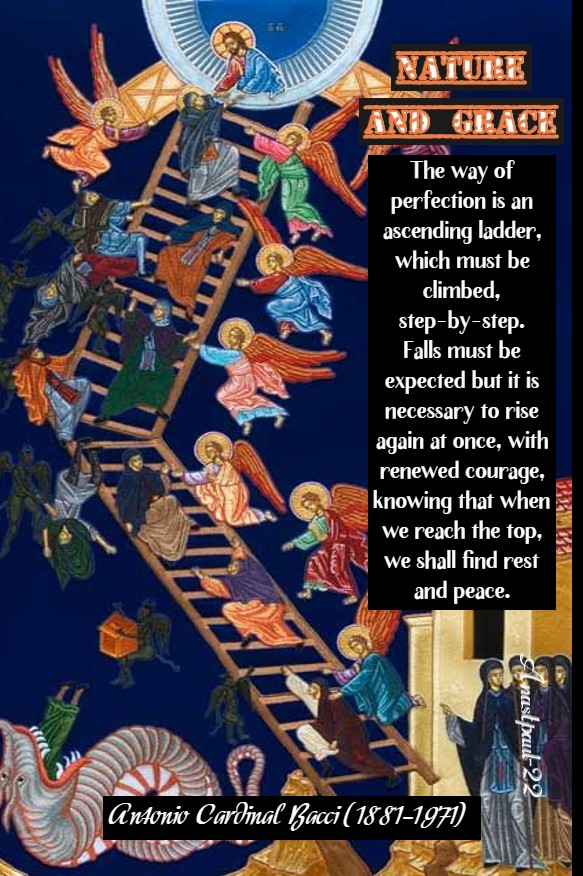
Nature and Grace
“Two extremes must be avoided in the relationship between nature and grace. The first is that of the regorists, who see, in human nature, nothing but confusion and the propensity towards evil and, therefore, advocate an iron domination completely lacking in any understanding of human frailty. They believe that perfection must be achieved swiftly, by means of the most ferocious privations and penance. This excessively severe approach to the spiritual life, can lead to discouragement and eventual collapse.
The way of perfection is an ascending ladder, which must be climbed, step-by-step. Falls must be expected but it is necessary to rise again at once, with renewed courage, knowing that when we reach the top, we shall find rest and peace.
The other extreme is an attitude of superficial ease. There is no emphasis on the necessity of grace, nor on the need for prayer and faithful co-operatin with God’s grace, in order to perform good works. Instead, there is a kid of natural decency and lukewarm virtue, which, ignores the necessity for mortification and the spirit of sacrifice. Anyone who sets out on this path, can never be a fervent and active Catholic.”
Quote/s of the Day – 22 July – St Mary Magdalen (1st Century) Penitent – Song 3:2-5; 8:6-7, Luke 7:36-50.
“Wherefore I say to you, her sins, many as they are, shall be forgiven her because she has loved much. But he, to whom little is forgiven, loves little.”
Luke 7:47
“A servant of the Lord stands bodily before men but mentally, he is knocking at the gates of Heaven. with prayer.”
St John Climacus (c 525-606) Father of the Church
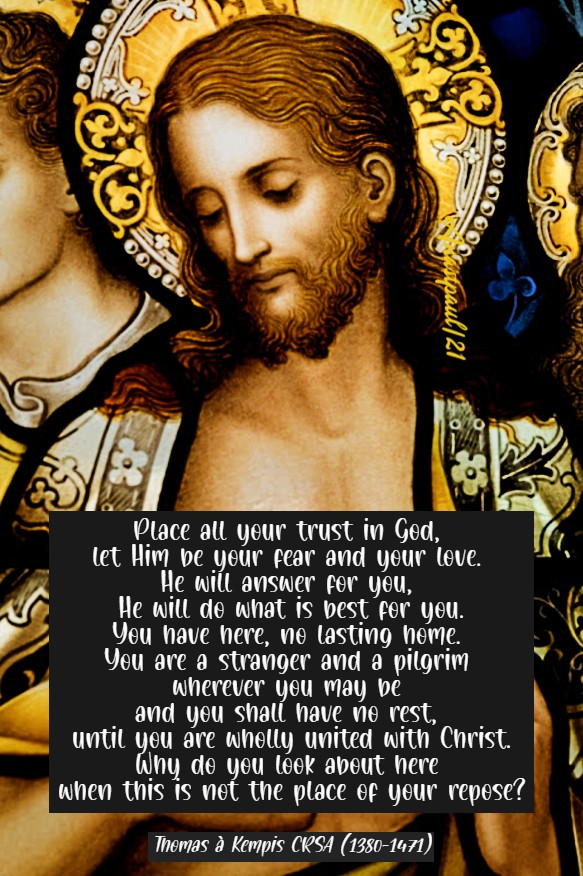
“Place all your trust in God, let Him be your fear and your love. He will answer for you, He will do what is best for you. You have here no lasting home. You are a stranger and a pilgrim wherever you may be and you shall have no rest, until you are wholly united with Christ. Why do you look about here when this is not the place of your repose?”
Thomas à Kempis CRSA (1380-1471)
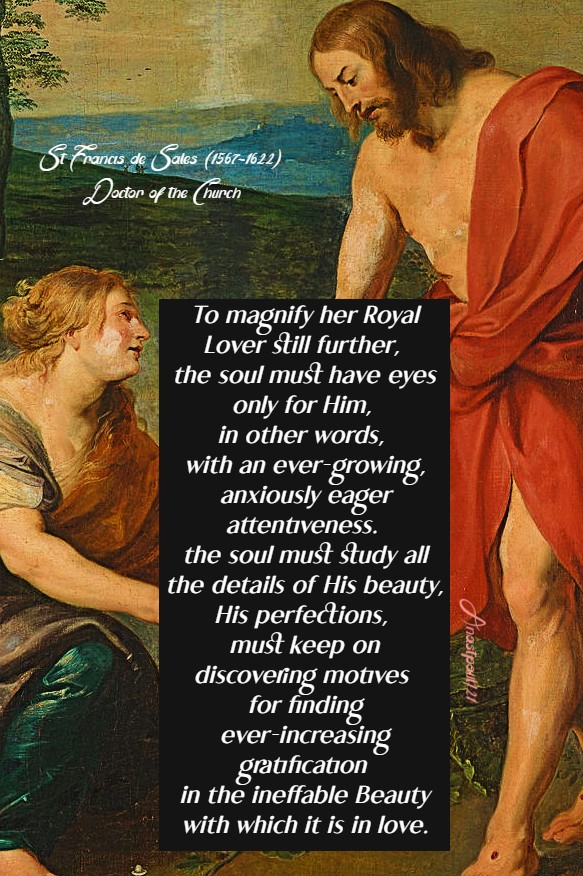
“To magnify her Royal Lover still further, the soul must have eyes only for Him, in other words, with an ever-growing, anxiously eager attentiveness. the soul must study all the details of His beauty, His perfections, must keep on discovering motives for finding ever-increasing gratification in the ineffable Beauty with which it is in love.”
St Francis de Sales (1567-1622) Doctor of the Church
“Love tends towards an intimate union with the person loved and does not rest, until this union is achieved. This is the unity of love. “It is now, no longer I that live,” exclaimed St Paul, “but Christ lives in me” (Gal 2:20). If only we could succeed in achieving such a complete and lasting union with God, any sacrifice would seem easy and we should certainly grow in sanctity.”
Thought for the Day – 21 July – Meditations with Antonio Cardinal Bacci (1881-1971)
Our Dominant Passion
“Holy and God-fearing people know their own particular weakness. They accept it as a cross and will not rest until they have conquered it with God’s help, The battle cannot be won in a day but, in most cases, takes a great many years. Often the ultimate victory is not gained until the hour of death.
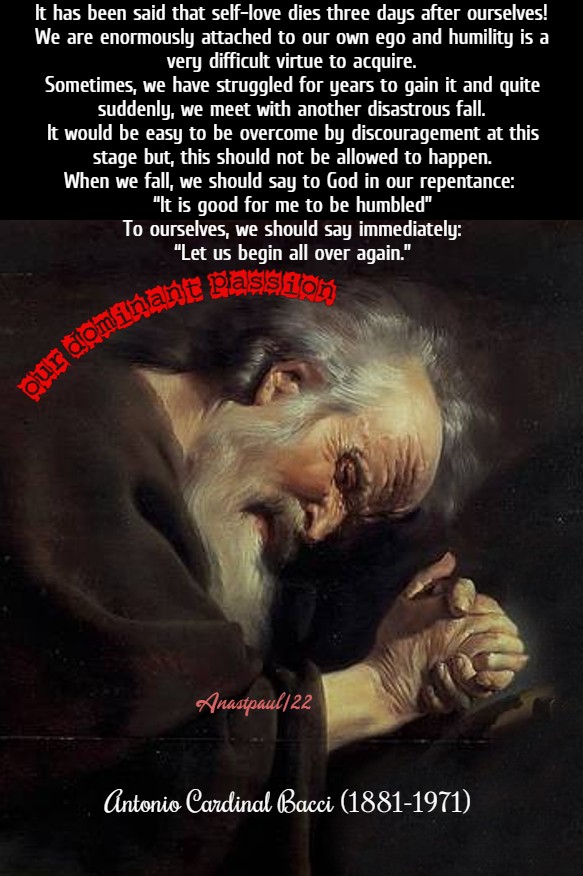
It has been said that self-love dies three days after ourselves! We are enormously attached to our own ego and humility is a very difficult virtue to acquire. Sometimes, we have struggled for years to gain it and quite suddenly, we meet with another disastrous fall. It would be easy to be overcome by discouragement at this stage but, this should not be allowed to happen. When we fall, we should say to God in our repentance: “It is good for me to be humbled.” To ourselves, we should say immediately: “Let us begin all over again.”
St Francis de Sales was endowed by nature with a sharp and hasty temperament, against which he fought for many years with great determination and reliance on God’s help. Finally, he conquered and came to regarded as an angel of peace. Nevertheless, even in the late years of his life, he still experienced inward tendencies towards anger, so that his exterior gentleness, was really a supreme act of victory!
Thought for the Day – 20 July – Meditations with Antonio Cardinal Bacci (1881-1971)
Our Passions
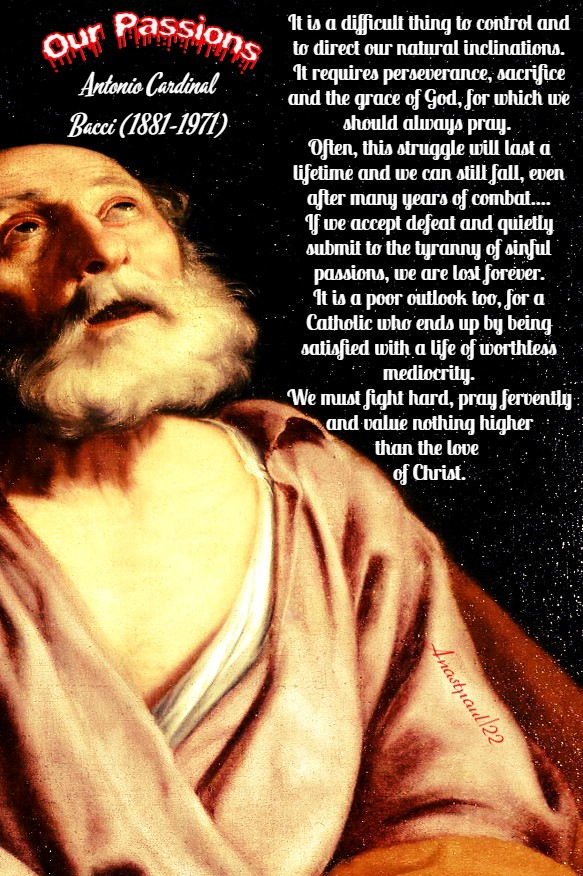
“It is a difficult thing to control and to direct our natural inclinations. It requires perseverance, sacrifice and the grace of God, for which we should always pray.
Often, this struggle will last a lifetime and we can still fall, even after many years of combat. It is important, however, never to give up. If we accept defeat and quietly submit to the tyranny of sinful passions, we are lost forever. It is a poor outlook too, for a Catholic who ends up by being satisfied with a life of worthless mediocrity. We must fight hard, pray fervently and value nothing higher than the love of Christ. When we are finally victorious, our joy will be greater than any happiness which the world can give.”
Thought for the Day – 19 July – Meditations with Antonio Cardinal Bacci (1881-1971)
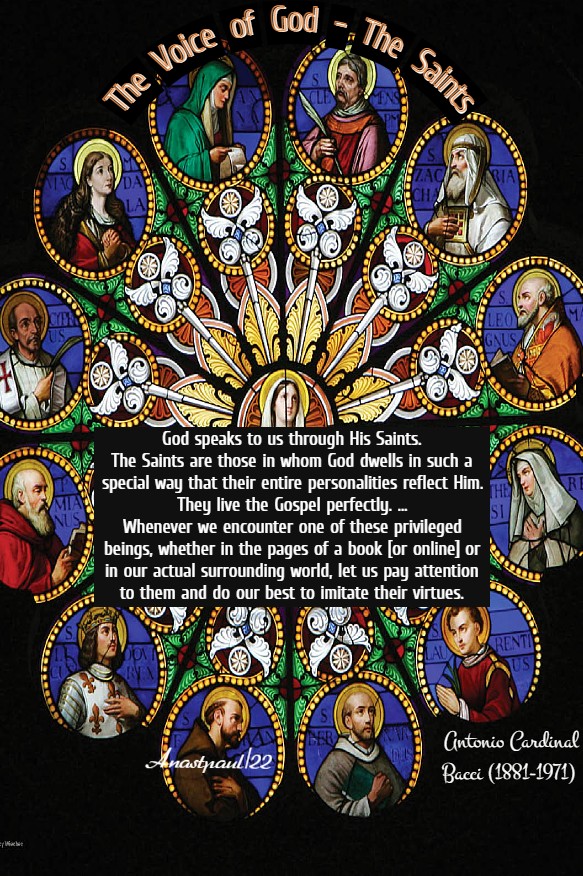
The Voice of God – The Saints
“God speaks to us through His Saints.
The Saints are those in whom God dwells in such a special way that their entire personalities reflect Him. They live the Gospel perfectly. They have renounced themselves in order to belong completely to God. Not only have they overcome their evil inclinations but, they have conquered themselves in the process of that Christian annihilation which, sublimates human nature, rather than destroys it. They have enthroned God in the place of their own will and of their own ego, so that, like St Paul, they can claims: “It is no longer I that live but Christ lives in me.”
God still speaks to us through His Saints, for even in this troubled and [digital] age, there are pure and humble souls declared to God and the service of their fellowmen. Whenever we encounter one of these privileged beings, whether in the pages of a book [or online] or in our actual surrounding world, let us pay attention to them and do our best to imitate their virtues.”
Thought for the Day – 17 July – Meditations with Antonio Cardinal Bacci (1881-1971)
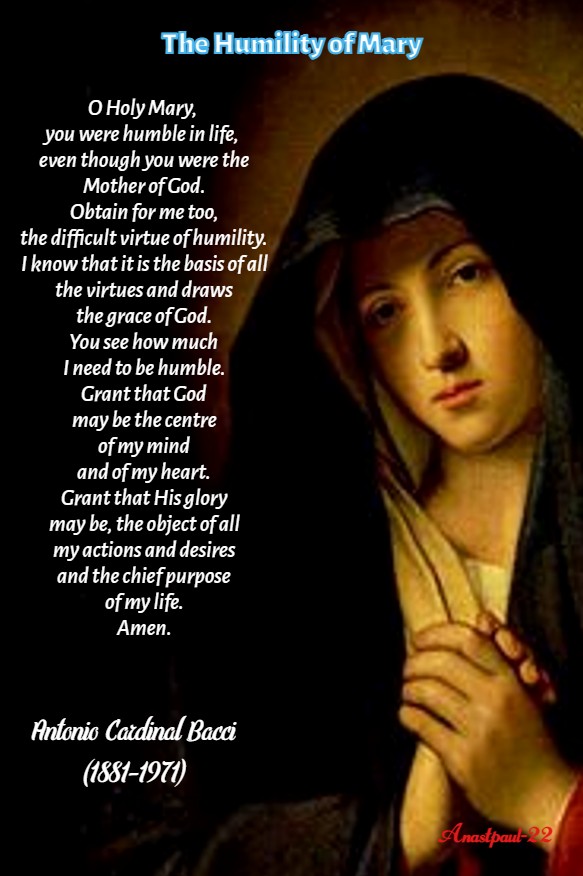
The Humility of Mary
“O Holy Mary, you were humble in life, even though you were the Mother of God. Obtain for me too, the difficult virtue of humility. I know that it is the basis of all the virtues and draws the grace of God. You see how much I need to be humble. Grant that God may be the centre of my mind and of my heart. Grant that His glory may be, the object of all my actions and desires and the chief purpose of my life. Amen.”
Thought for the Day – 15 July – Meditations with Antonio Cardinal Bacci (1881-1971)
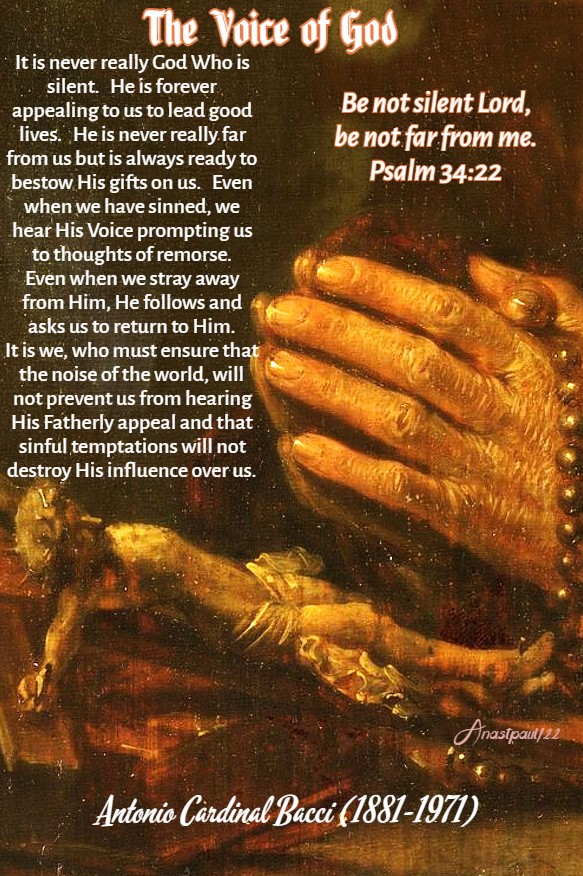
The Voice of God
“Be not silent Lord, be not far from me” (Ps 34:22).
It is never really God Who is silent. He is forever appealing to us to lead good lives. He is never really far from us but is always ready to bestow His gifts on us. Even when we have sinned, we hear His Voice prompting us to thoughts of remorse. Even when we stray away from Him, He follows and asks us to return to Him. It is we, who must ensure that the noise of the world, will not prevent us from hearing His Fatherly appeal and that sinful temptations will not destroy His influence over us.
Let us continually implore His graces because we are always in need of them. Let us use them well, so that they will enable us to gain everlasting life.”
Thought for the Day – 14 July – Meditations with Antonio Cardinal Bacci (1881-1971)
The Enemies of the Soul
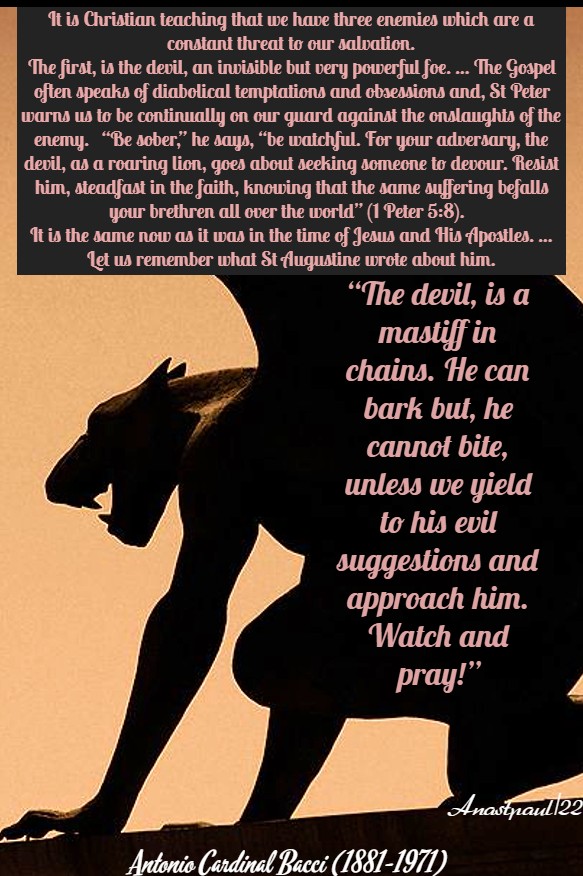
“It is Christian teaching that we have three enemies which are a constant threat to our salvation. The first, is the devil, an invisible but very powerful foe.
The devil was once an Angel of beauty. He had gifts superior to those of men and was in a state of happiness. But God required from him, a proof of his fidelity before he could merit the everlasting reward for which he had been destined.
Lucifer was proud of his beauty and power. Believing that he was equal to the Most High God, he rebelled against his Creator and drew with him, into eternal ruin, innumerable bands of disloyal Angels. Their sin was greater than ours because they had been endowed with a superior intellect and their will was not subject to the pull of the sensitive appetites of a material body. This is why God did not give them time to repent but condemned them immediately to the everlasting torments of Hell. It is false to imagine, however, that they are confined, as it were, in one place. Being pure spirit, they can, with God’s permission, wander throughout the world, carrying their hell within themselves. Moreover, they can endanger, in a thousand ways, our eternal salvation. The Gospel often speaks of diabolical temptations and obsessions and, St Peter warns us to be continually on our guard against the onslaughts of the enemy. “Be sober,” he says, “be watchful. For your adversary, the devil, as a roaring lion, goes about seeking someone to devour. Resist him, steadfast in the faith, knowing that the same suffering befalls your brethren all over the world” (1 Peter 5:8).
It is the same now as it was in the time of Jesus and His Apostles.
We do not see this infernal spirit but, we feel his presence. Let us remember what St Augustine wrote about him. “The devil,” he said, “is a mastiff in chains. He can bark but, he cannot bite, unless we yield to his evil suggestions and approach him. Watch and pray!””
Thought for the Day – 13 July – Meditations with Antonio Cardinal Bacci (1881-1971)
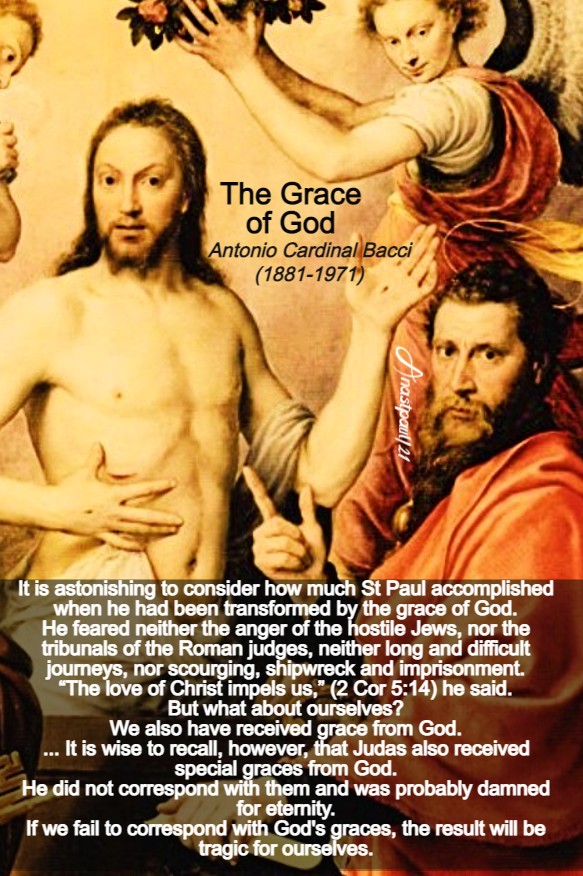
The Grace of God
“It is astonishing to consider how much St Paul accomplished when he had been transformed by the grace of God. Formerly, a persecutor of Christians, he became the Apostle of the Gentiles. Enlightened by faith and inspired by charity, he travelled the globe, spreading everywhere, the religion of Jesus Christ.
He feared neither the anger of the hostile Jews, nor the tribunals of the Roman judges, neither long and difficult journeys, nor scourging, shipwreck and imprisonment. “The love of Christ impels us,” (2 Cor 5:14) he said. It was the love of God which drove him on and on, until he met his martyrdom. But what about ourselves? We also have received grace from God. Often we hear His voice appealing to us to abandon our sinful ways, to practise virtue, to love Him more ardently and to prove our love, by deeds. If we co-operate, we shall be able to say with St Paul: “by the grace of God, I am what I am and his grace in me has not been fruitless,” (1 Cor 15:10) and “I have laboured … yet, not I but the grace of God with me” (ibid).
It is wise to recall, however, that Judas also received special graces from God. He did not correspond with them and was probably damned for eternity. If we fail to correspond with God’s graces, the result will be tragic for ourselves.”
Thought for the Day – 12 July – Meditations with Antonio Cardinal Bacci (1881-1971)
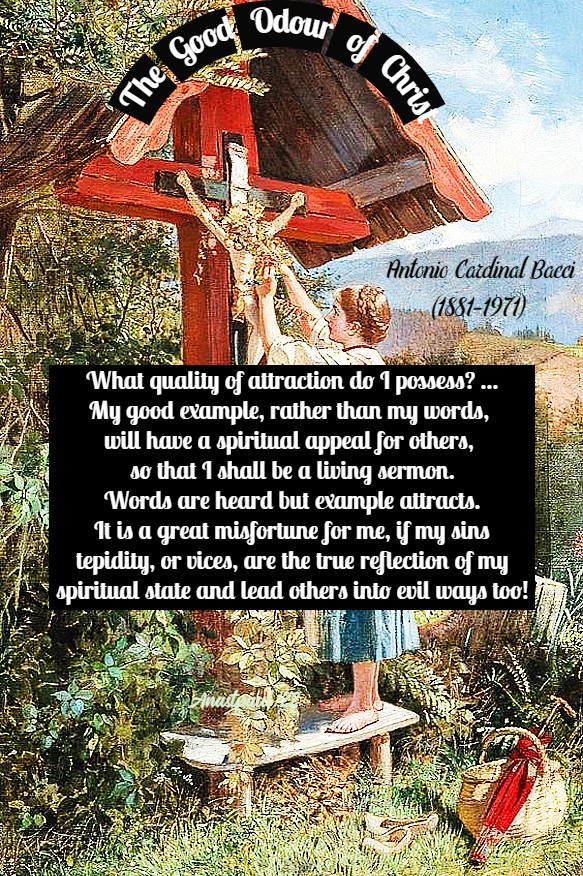
The Good Odour of Christ
“What quality of attraction do I possess? My behaviour is the mirror of my spiritual life. If I love God and am detached from the world, especially from sin and, if I practise mortification and strive to advance in the way of Christian perfection, my personality, will influence others to do good. My good example, rather than my words, will have a spiritual appeal for others, so that I shall be a living sermon.
Words are heard but example attracts. It is a great misfortune for me, if my sins tepidity, or vices, are the true reflection of my spiritual state and lead others into evil ways too!”
Thought for the Day – 11 July – Meditations with Antonio Cardinal Bacci (1881-1971)
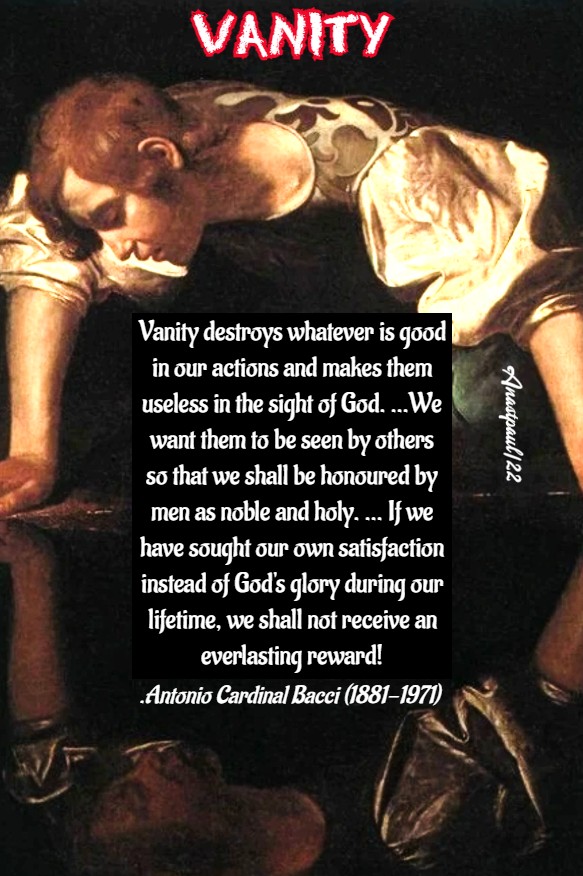
VANITY
“Vanity destroys whatever is good in our actions and makes them useless in the sight of God. It robs our good actions of all merit because they should be done only for the glory of God, whereas we are performing them for our own glory. We want them to be seen by others so that we shall be honoured by men as noble and holy.
If our actions have been motivated by self-interest, rather than by the desire for the glory of God, we shall hear, at the judgement seat of God the terrible condemnation: “You have received your reward” (Cf Mt 6:2).
If we have sought our own satisfaction instead of God’s glory during our lifetime, we shall not receive an everlasting reward!”
Thought for the Day – 10 July – Meditations with Antonio Cardinal Bacci (1881-1971)
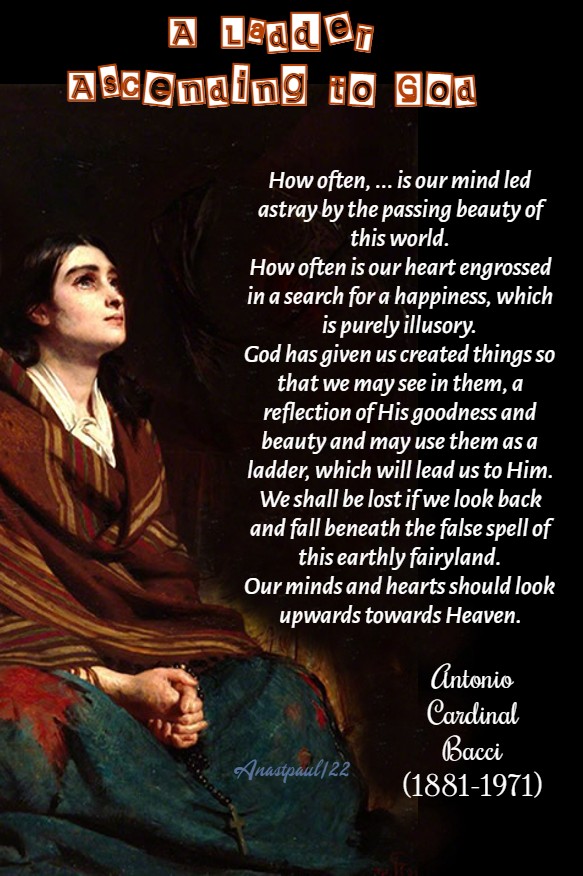
A Ladder Ascending to God
“How often, nevertheless, is our mind led astray by the passing beauty of this world. How often is our heart engrossed in a search for a happiness, which is purely illusory. God has given us created things so that we may see in them, a reflection of His goodness and beauty and may use them as a ladder, which will lead us to Him. We shall be lost if we look back and fall beneath the false spell of this earthly fairyland. Our minds and hearts should look upwards towards Heaven.
God alone can satisfy the infinite desires of the soul. Let us never lose sight of Him. Everything else passes but God does not change. He will be our sure guide in this life and our everlasting happiness in the next.”
Thought for the Day – 9 July – Meditations with Antonio Cardinal Bacci (1881-1971)
Falling into Sin
“The second extreme to be avoided is discouragement, which can lead us to despair, as Judas did. We know that God is entirely good and merciful. We know that Jesus died on the Cross for our salvation. How can we doubt that He will welcome us if we repent and return to Him?
No matter how grave and how numerous our sins may be, let us remember that the Mercy of God is Infinite. Let us remember that He is waiting for us, as his father waited for the prodigal son and, that He is following us like a shepherd who is searching for his lost sheep. He allowed us to fall, in order to humble us and help us to realise that we are incapable of doing anything good by ourselves.
Let us go to Him humbly and penitently, trusting He will give us the kiss of peace and forgiveness.”
Thought for the Day – 8 July – Meditations with Antonio Cardinal Bacci (1881-1971)
Uncharitableness
“The tendency to complain about others, is a most insidious cancer which can corrode all that is good in our conversation, making it harmful and even gravely sinful. Grumbling is always, more or less sinful, according to the circumstances. It may be a sin against charity, which demands that we love our neighbour as ourselves and help him as much as possible, by word and by deed. It may be a sin of scandal because the person to whom we are complaining maybe provoked to throw stones in his turn at the subject of our detraction. It maybe a sin of theft because it takes away the reputation of the person whom we are criticising. This could carry with it, the obligation to make restitution by withdrawing what we have said, if it is false or doubtful or by speaking charitably of the person whom we have wronged in order to restore his good name. Uncharitableness in speech, is also a sin of injustice, when it involves calumny, in which case, there is an obligation to repair the damage done in the best way possible.
Since criticism of others can be such an evil thing, we should take care not to form the habit of employing it as a means of making our conversation more lively and acceptable. The life of a Catholic, should be governed by charity and grumbling about others, is always an offence against charity!”
Thought for the Day – 7 July – Meditations with Antonio Cardinal Bacci (1881-1971)
THE SALVATION OF SOULS
“If you still belong to the category of those who desire to be good and virtuous, remember that your obligations do not stop at this. You are obliged to work as hard as possible, for the return of sinners to the fold and for the reawakening of the faith of the indifferent.
A man who really loves God, cannot remain inactive when he witnesses the desertion of so many of his fellow-men, the corruption of public and private morals and the continuous insults offered to the Creator of the human race. ANYONE WHO REMAINS INACTIVE BECOMES AN ACCOMPLISH!
Everyone is obliged to do his best to prevent the spread of such errors and evils. Do NOT make the excuse that there is very little which you can do. Although the resources of those who are still faithful, may be individually insignificant, they become, when combined, an irresistible force.
Remember that you have three invincible weapons – prayer, mortification and sacrifice. These are the weapons which can and should be employed in order to convert the world and to establish the Kingdom of God.
Remember the countless conversions effected by the Saints as a result of their prayer, mortications and heroic sacrifices. No-one can call himself a Catholic, who does not love, in a practical manner, his fellowmen, especially unfortunate sinners. Make up your mind to offer up your prayers and sacrifices for their conversion.”
Thought for the Day – 6 July – Meditations with Antonio Cardinal Bacci (1881-1971) – Octave Day of Saints Peter and Paul
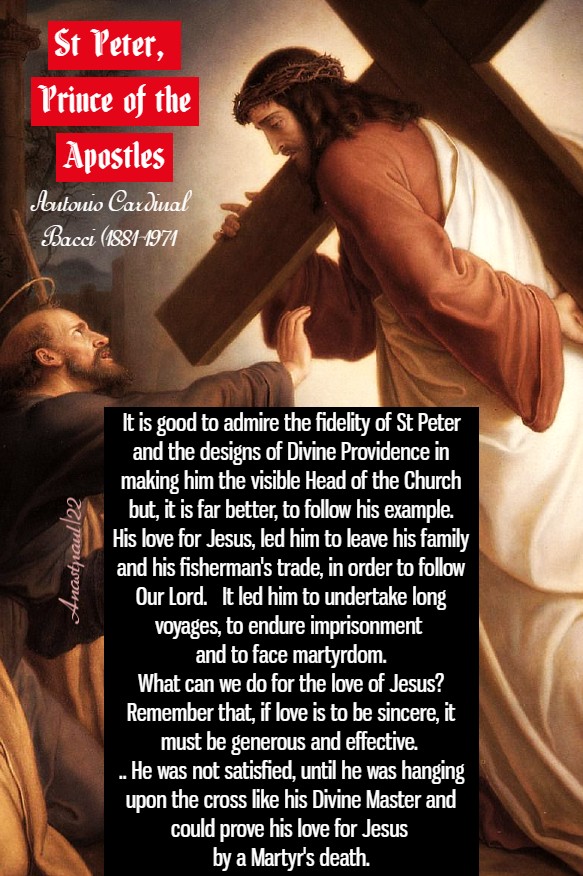
St Peter, Prince of the Apostles St Paul, the Apostle to the Gentiles
“It is good to admire the fidelity of St Peter and the designs of Divine Providence in making him the visible Head of the Church but, it is far better, to follow his example. His love for Jesus, led him to leave his family and his fisherman’s trade, in order to follow Our Lord. It led him to undertake long voyages, to endure imprisonment and to face martyrdom. What can we do for the love of Jesus? Remember that, if love is to be sincere, it must be generous and effective.
Secondly let us meditate on and imitate, the ardent and fearless faith of St Peter. He was not afraid to preach the teaching of Christ before the Sanhedrin. He was not afraid of Herod, who cast him into prison.
He was not afraid of the Roman Emperor, who caused him to be crucified. Our faith should be steadfast and lively, like his!
Finally, let us imitate Peter in his repentance. Although he loved Jesus very much and had such great faith in Him, in a moment of weakness and of imprudence, he denied Him three times. All his life, however, be wept bitterly for this sin. Whenever he heard a cock crowing, it was as if an arrow had pierced his heart. He was not satisfied, until he was hanging upon the cross like his Divine Master and could prove his love for Jesus by a Martyr’s death.”
St Paul, the Apostle to the Gentiles
We can learn many other virtues from St Paul, besides his zealous love for God and for his fellowmen. We can also learn from him, the virtues of humility and of apostolic fervour. The Apostle of the Gentiles reached such heights of sanctity, as to feel himself transformed into Christ Himself and to deserve to be taken up into the third Heaven, where he enjoyed a foretaste of eternal happiness. Nevertheless, he considered himself unworthy to be called an Apostle and he realised, that all his gifts came to him from God. “Not that we are sufficient of ourselves, to think anything as from ourselves but our sufficiency, is from God” (2 Cor 3:5). Whenever we succeed in any project, we should think on the same lines because, it is only when we are humble and depend on the grace of God, that the success of our actions will redound to the glory of our Creator. If the cancer of ambition or of self-love, should corrupt our purity of intention, our work would not be blessed by God and would not make us worthy of everlasting life. Let us repeat often: “All for You, with You and in You, my God.”
Quote/s of the Day – 6 July – Octave Day of Saints Peter and Paul
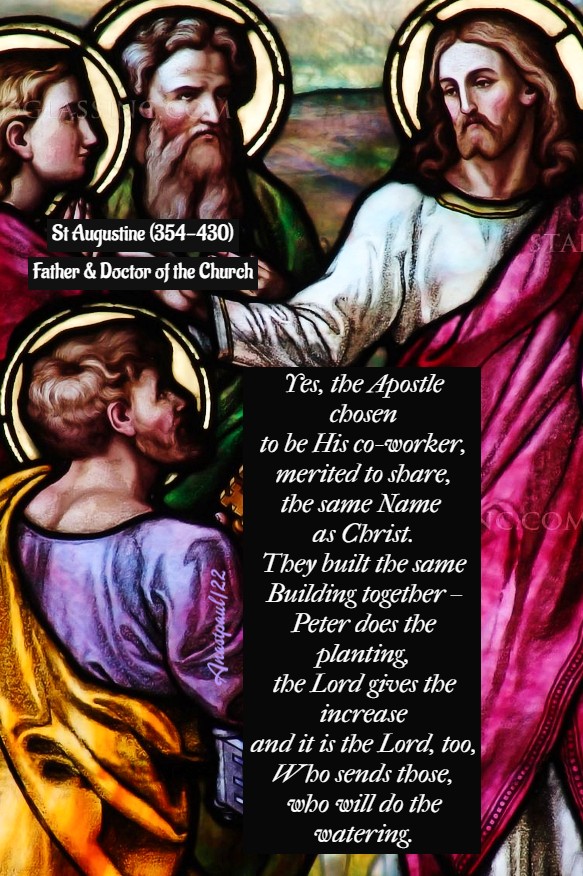
“Yes, the Apostle chosen to be His co-worker, merited to share, the same Name as Christ. They built the same Building together – Peter does the planting, the Lord gives the increase and it is the Lord, too, Who sends those, who will do the watering (cf 1 Cor 3:6f).”
St Augustine (354-430) Father & Doctor of the Church
“Nothing escaped the Wisdom and Power of Christ, the elements of nature lay at His service, spirits obeyed Him, Angels served Him. … And yet, out of all the world, Peter alone was chosen to stand at the head, for the calling of all the peoples and the oversight of all the Apostles and Fathers of the Church.”
St Pope Leo the Great (400-461) Father and Doctor of the Church
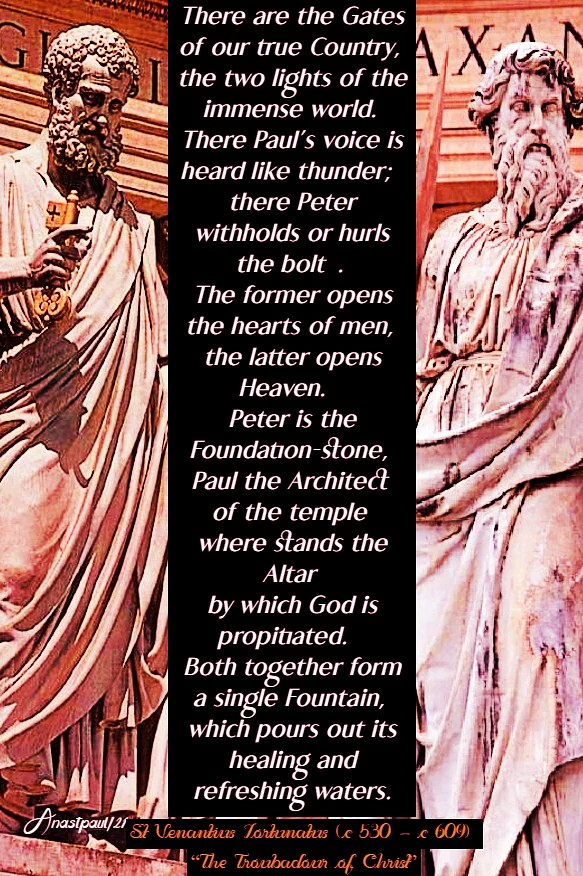
“There are the gates of our true country, the two lights of the immense world. There Paul’s voice is heard like thunder; there Peter withholds or hurls the bolt . The former opens the hearts of men, the latter opens Heaven. Peter is the Foundation-stone, Paul the Architect of the temple where stands the Altar by which God is propitiated. Both together form a single Fountain, which pours out its healing and refreshing waters.”
St Venantius Fortunatus (c 530 – c 609) “The Troubadour of Christ”
St Paul’s Prayer – Ephesians 3:14-21
For this reason, I bow my knees before the Father, from Whom every family in heaven and on earth takes its name. I pray that, according to the riches of His glory, He may grant that you may be strengthened in your inner being with power through His Spirit and that Christ may dwell in your hearts through faith, as you are being rooted and grounded in love. I pray that you may have the power to comprehend, with all the Saints, what is the breadth and length and height and depth and to know, the love of Christ that surpasses knowledge, so that you may be filled with all the fullness of God. Now to Him Who, by the power at work within us, is able to accomplish abundantly, far more than all we can ask or imagine. To Him be glory in the Church and in Christ Jesus, to all generations, forever and ever. Amen.
Thought for the Day – 24 June – Meditations with Antonio Cardinal Bacci (1881-1971)
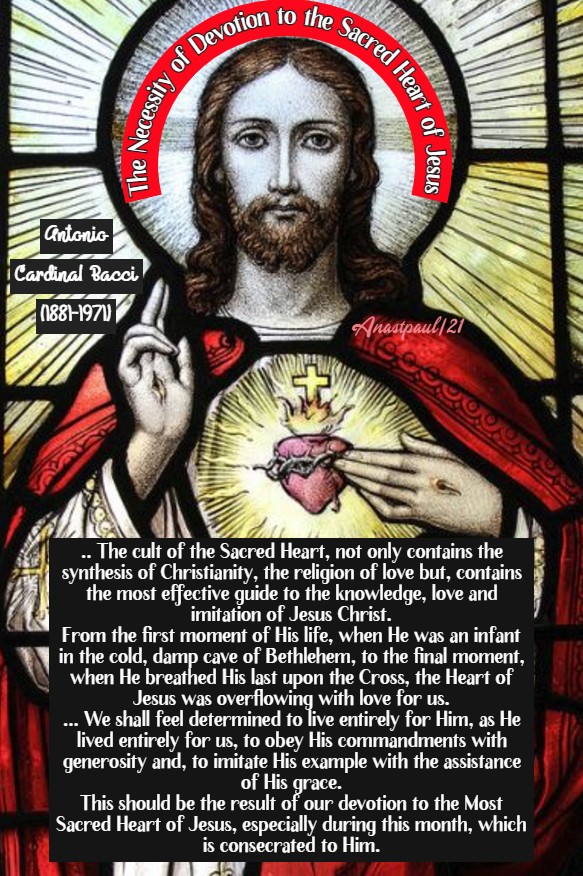
The Necessity of Devotion to the Sacred Heart of Jesus
“It is necessary to develop and meditate on these words of Pius XI, (see Part One) from which, it is clear, that the cult of the Sacred Heart, not only contains the synthesis of Christianity, the religion of love but, contains the most effective guide to the knowledge, love and imitation of Jesus Christ. From the first moment of His life, when He was an infant in the cold, damp cave of Bethlehem, to the final moment, when He breathed His last upon the Cross, the Heart of Jesus was overflowing with love for us. We can learn from this, to know our Divine Saviour better, so that appreciating more fully His infinite love for us, we shall feel an upsurge of gratitude and, of love. We shall feel determined to live entirely for Him, as He lived entirely for us, to obey His commandments with generosity and, to imitate His example with the assistance of His grace. This should be the result of our devotion to the Most Sacred Heart of Jesus, especially during this month, which is consecrated to Him.”
Thought for the Day – 23 June – Meditations with Antonio Cardinal Bacci (1881-1971)
Spiritual Communion
“St Thomas Aquinas calls the Eucharist “the Sacrament of love” (Opuse 38:25). When love is ardent and sincere, it longs for constant contact with the beloved. Spiritual Communion can be made in a single instant, for it requires only an Act of Faith and an Act of Love. Jesus, come into my heart, for I have need of You. I love You, my Jesus, keep me close to You always.
Aspiration: O Jesus, I cling to You, with all my heart!”
Thought for the Day – 22 June – Meditations with Antonio Cardinal Bacci (1881-1971)
Frequent Communion
“For the practice of daily Communion, however, we should have the approval of our Confessor. We should be fully determined to preserve ourselves free from every sin, especially from grave sin, for otherwise, we could not approach the Eucharistic banquet (if anyone receives Jesus with mortal sin on his soul, he commits a terrible sacrilege). This practice, moreover, should help us to avoid every deliberate imperfection and venial sin and should inspire in us, a lively spirit of Christian charity. “Receive Communion everyday,” said St Augustine, “because it will help you everyday … but you must live in a manner which will entitle you to communicate daily” (De Verbo Domini – Sermon 28).
Frequent Communion, therefore, will enable us to set out upon the road to perfection, without relaxing in our resolution and without any false scruples. “Two kinds of people,” wrote st Francis de Sales, “should receive Communion frequently – the perfect and the imperfect; the perfect in order to preserve their holiness; the imperfect, in order to reach perfection.” (Introduction to the Devout Life c 2).
Let us ask the advice of our regular Confessor. We shall be fortunate if we can approach the Sacred Banquet everyday, or at least very often, for we shall be sure that we are on the path to holiness.”
Thought for the Day – 21 June – Meditations with Antonio Cardinal Bacci (1881-1971)
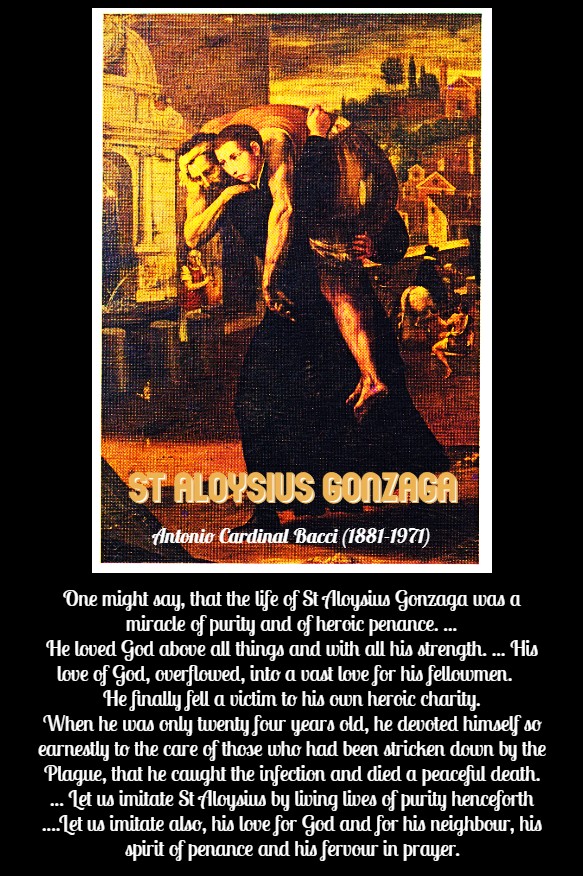
St Aloysius Gonzaga
“One might say, that the life of St Aloysius Gonzaga was a miracle of purity and of heroic penance. The source of his sanctity was the ardent love of God which he cherished from his childhood days. He loved God above all things and with all his strength. Therefore, long hours of prayer were a joy to him, the service of God in the Society of Jesus was his main desire and, mortification, was a loving offering, which he made in expiation of the sins of men.
The heart of St Aloysius, was not closed to men because of its supreme love of God. His love of God, overflowed, into a vast love for his fellowmen. He finally fell a victim to his own heroic charity. When he was only twenty four years old, he devoted himself so earnestly to the care of those who had been stricken down by the Plague, that he caught the infection and died a peaceful death. In his final moments, he smiled and announced that he was happy to be leaving the world.
Do we desire to merit as peaceful and holy a death as this? Let us imitate St Aloysius by living lives of purity henceforth, even if we have not always been as faithful as he was in this regard. Let us imitate also, his love for God and for his neighbour, his spirit of penance and his fervour in prayer.”
































 AnaStpaul
You must be logged in to post a comment.