Posted in PRACTISING CATHOLIC, SAINT of the DAY

Thought for the Day – 1 July – Charity … the Mirror of the Church

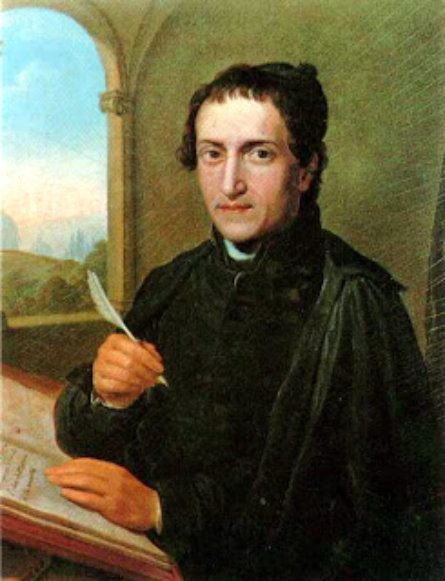
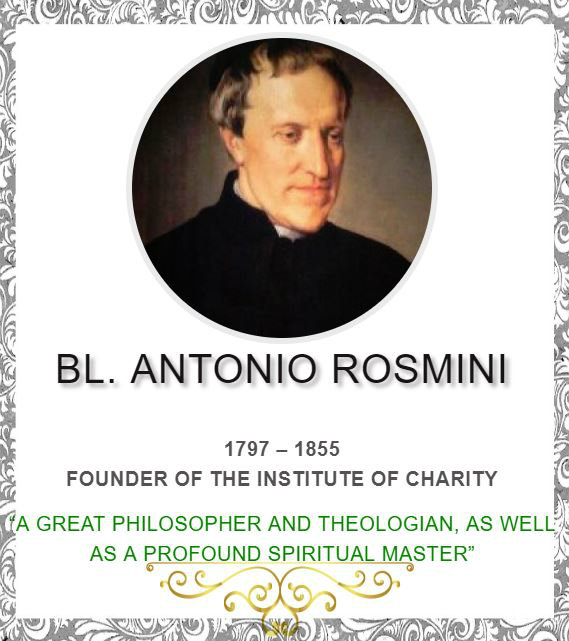
Thought for the Day – 1 July – The Memorial of Bl Antonio Rosmini (1797-1855) and the first day of the Month of the Most Precious Blood

The Pope’s invitation to write books to present, in a modern language, the doctrine of the Church was accomplished by publishing works that were destined to produce fruits well into the future. His prodigious act  ivity in many fields was supported by a mystical life of prayer, which included the daily offering of his blood in union with the precious Blood of JESUS.   On 18 November 2007, he was proclaimed a Blessed and was presented as a luminous model of intellectual charity.

In his exhortation, Veritatis Gaudium of 29 January 2018, Pope Francis, quoting words from the book The Five Wounds of Holy Church, published by Rosmini in 1848, issued an invitation to follow Rosmini’s recommendations for the formation of clergy and of the faithful.

The fundamental dimensions of the charism
The Institute, as a religious family born of Charity, offers God’s help for sanctification in the perfection of charity.   It is a gift for all categories of people, because God does not exclude anyone from His love.   In practice, the following groups belong to the Institute: brothers and priests with vows (Rosminians), the Sisters of Providence (Rosminian Sisters), Adopted Sons and Ascribed members.   These latter do not live in communities but participate in the charism while following their chosen way of life.   They can be men and women, married couples, diocesan priests, even bishops!

Rosmini did not receive from God a call to any specific work of charity, like many other founders and thus the Institute is meant to mirror the Church in its identity and in its mission of universal charity.   The development of our charism has been conditioned and slowed down by historical and ecclesial events but in recent years it has begun to increase.

The fundamental dimensions of the spirituality of our charism
Union with God begins with justice, that is, with the commitment to personal purification and detachment from sin.  It grows into adherence to grace in such a way that we desire only and in an orderly fashion, to do the will of God, manifested through the duties of our state of life, the voice of the Church, the indications of superiors and the demands of our neighbours.   All this is masterly expressed in the pages of Maxims of Christian Perfection.   Since Rosmini affirms the supreme value of the person, the Rosminian way enhances and directs a conscious and mature Christian witness.

The fundamental dimensions of our specific charismatic mission
Indifference to one’s own choices becomes total openness to calls from God and from the Church.   Both Rosminian brethren and Sisters put their total being at the disposal of charity.   Thanks to the marvellous conjunction of consecrated and lay life, the Rosminian charismatic Family is the mirror of the Church.   It tends to promote and develop works of charity that reach the most important places of the Church and society.
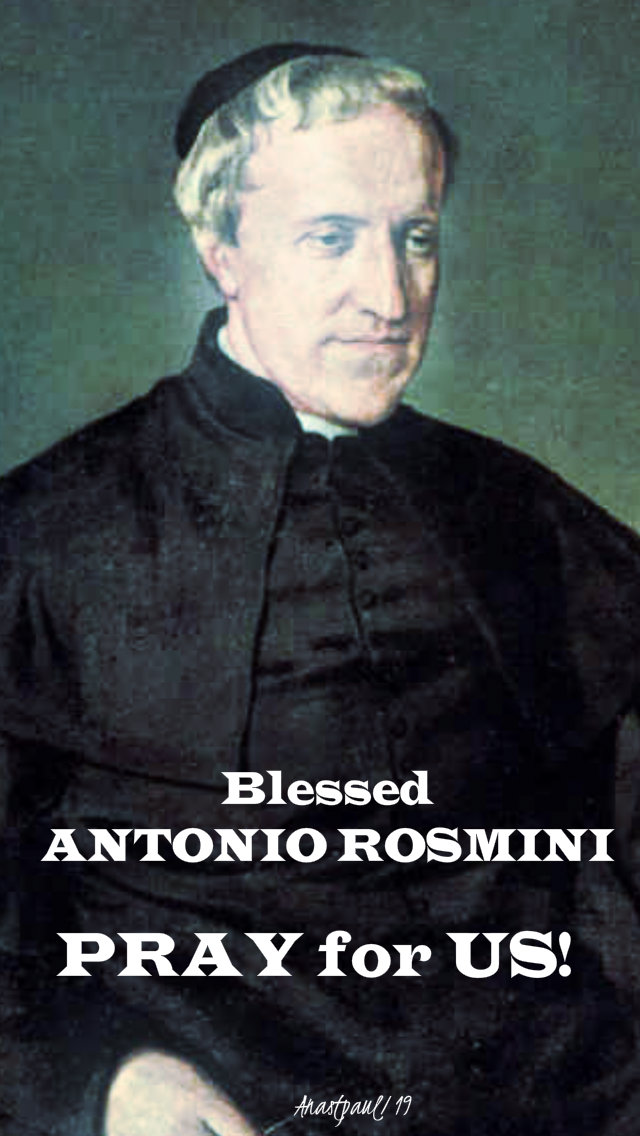
Blessed Antonio Rosmini, Pray for us!bl antonio rosmini pray for us no 2 - 1 july 2019.jpg

Posted in PRAYERS to the SAINTS, SAINT of the DAY, VATICAN Resources

Saint of the Day – 1 July – Blessed Antonio Rosmini (1797-1855)

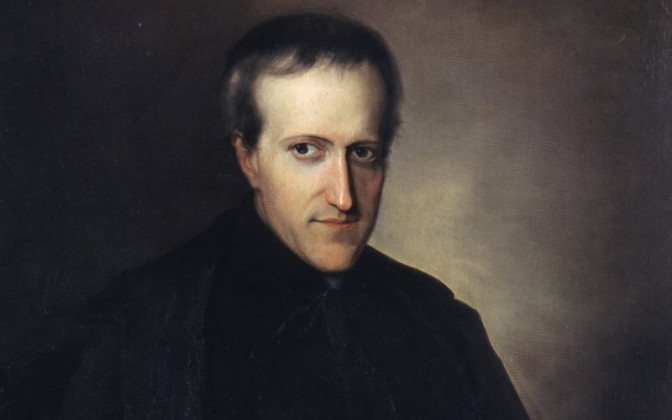
Saint of the Day – 1 July – Blessed Antonio Rosmini (1797-1855) aged 58 – Priest, Founder of the Institute of Charity (also known as the Rosminians), Philosopher, Writer, pioneer of the concept of social justice and was a key figure in Italian Liberal Catholicism.   Born on 24 March 1797 in Rovereto, Austrian Tyrol (modern Trent, Italy) and died on 1 July 1855 in Stresa, Viterbo, Italy of natural causes.   bl-rosmini-ritratto-2-800x500-d0bad0bed0bfd0b8d18f1.jpg

Antonio Rosmini was born on 24 March 1797 to Pier Modesto and Giovanna dei Conti Formenti di Riva at Rovereto, a very “Italian” town although part of the Austrian Empire since 1509.   He was baptised the following day and received his early education locally.

In 1816 he enrolled at the University of Padua, Italy, where he received doctorates in theology and canon law.   After his studies he returned to Rovereto to prepare for Holy Orders.

In February 1820 he accompanied his sister, Margherita, to Verona where the Marquess Maddalena of Canossa (now Blessed) had founded a religious institute.   During the visit Maddalena invited him to found a male religious institute as a twin to her own institute. While the young man politely declined, her invitation in time proved prophetic.

Antonio was ordained a priest on 21 April 1821 at Chioggia, Italy.  bl antonio rosmini.jpgIn 1823 he travelled to Rome with the Patriarch of Venice, who arranged an audience for him with Pope Pius VII.   In that audience the Pontiff encouraged him to undertake the reform of philosophy.
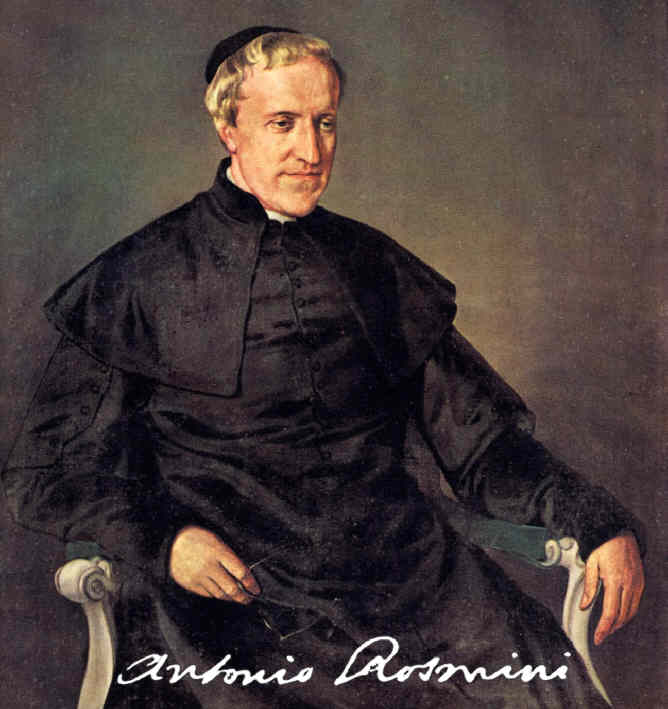
In 1826 he went to Milan to continue his research and publish the results of his philosophical studies.   He wrote on many subjects, including the origin of ideas and certitude, the nature of the human soul, ethics, the relationship between Church and State, the philosophy of law, metaphysics, grace, original sin, the sacraments and education.

On Ash Wednesday, 20 February 1828, Fr Rosmini withdrew to write the Constitutions of the budding Institute of Charity, in which he incorporated the principle of passivity (to be concerned with one’s personal sanctification until God’s will manifests itself to undertake some external work of charity) and the principle of impartiality (to free one of any personal preference in assuming a work of charity).

To assure himself of God’s will in his philosophical and foundational work, Rosmini went to Rome a second time, in November 1828 and there received Pope Leo XII’s support.   On 15 May 1829 he met with the new Pope, Pius VIII, who confirmed his double mission as philosopher and founder.   During this visit to Rome, Fr Rosmini published “Maxims of Christian Perfection” and “Origin of Ideas”, winning the admiration of many scholars.

By 1832 the Institute of Charity had spread to Northern Italy and by 1835 it reached England, where the community enjoyed substantial growth.   In England the Rosminians are credited with introducing the use of the Roman collar and cassock and the practice of wearing the religious habit in public.   They were known for preaching missions, the practice of the Forty Hours, May devotions, the use of the scapular, novena celebrations, public processions and the blessing of throats on the feast of St Blaise.bl antonio rosmini.header.jpg

Pope Gregory XVI approved the Constitutions of the Institute of Charity on 20 December 1838.   On 25 March 1839 vows were taken by 20 Italian and 6 British priests  . On 20 September 1839 Fr Rosmini was appointed provost general for life.

This happy period of growth and apostolic success, however, was tempered by opposition to his intellectual and philosophical writings from 1826 until his death.

Primarily his “Treatise on Moral Conscience” (1839) led to a sharp, 15-year controversy which required more than one Papal injunction to silence the “Rosminian Question”. Another important, controversial work was “The Five Wounds of the Church” (1832).

Fr Rosmini found himself wedged between the obligation to renew Catholic philosophy and finding his works on the Index.   But his obedience to the Church was admirable: ” In everything, I want to base myself on the authority of the Church and I want the whole world to know that I adhere to this authority alone” (Congregation for the Doctrine of the Faith, “Note on the Force of the Doctrinal Decrees”, L’Osservatore Romano English edition [ORE], 25 July 2001, p. 9).

To close the issue definitively, the Pontiff submitted all Rosmini’s works to examination by the Congregation of the Index.   On 3 July 1854, it was decreed:  “All the works of Antonio Rosmini-Serbati that have recently been examined are to be dismissed [from the Index or any error] and this examination in no way detracts from the good name of the author, nor of the religious Society founded by him, nor from his life and singular merits towards the Church” (R. Malone, “Historical Overview of the Rosmini Case”, ORE, 25 July 2001, p. 10).

Less than a year after this Decree Fr Antonio Rosmini died on 1 July 1855 at Stresa, Italy, at age 58…Vatican.va

He was Beatified on 18 November 2007 by Pope Benedict XVI.

400px-9350_-_Milano_-_Giardini_Pubblici_-_Monumento_ad_Antonio_Rosmini_-_Foto_Giovanni_Dall'Orto_22-Apr-2007
Monument to St Antonio Rosmini in Milan (1896).

His body is interred in the Church of the Santissimo Crocifisso built by him in Stresa.

This slideshow requires JavaScript.

Today the Rosminians operate on 5 continents and continue to flourish.

O God, light of the faithful and shepherd of souls,
who set blessed Antonio in the Church
to feed your sheep by his words and form them by his example,
grant that through his intercession
we may keep the faith he taught by his words
and follow the way he showed by his example.
Through our Lord Jesus Christ, Your Son,
who lives and reigns with You in the unity of the Holy Spirit,
one God, forever and ever. Amen

(from The Roman Missal: Common of Pastors)BL ANTONIO SNIP FROM THE ROSMINIANS.JPG