
Posted in MARIAN TITLES, SAINT of the DAY

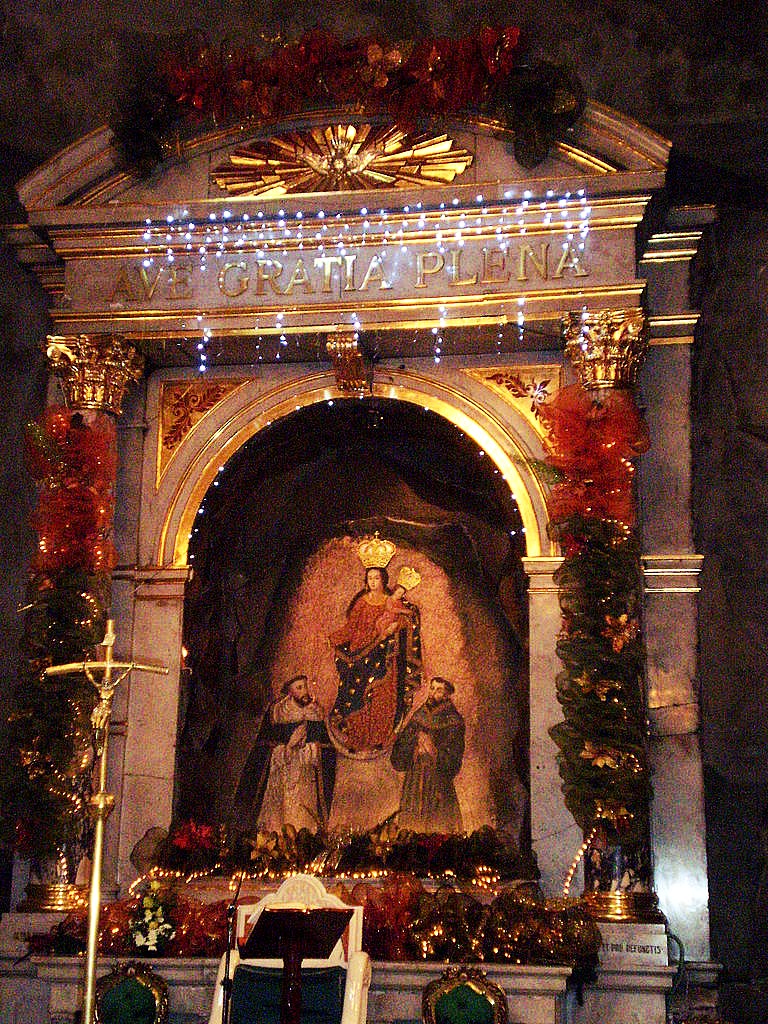
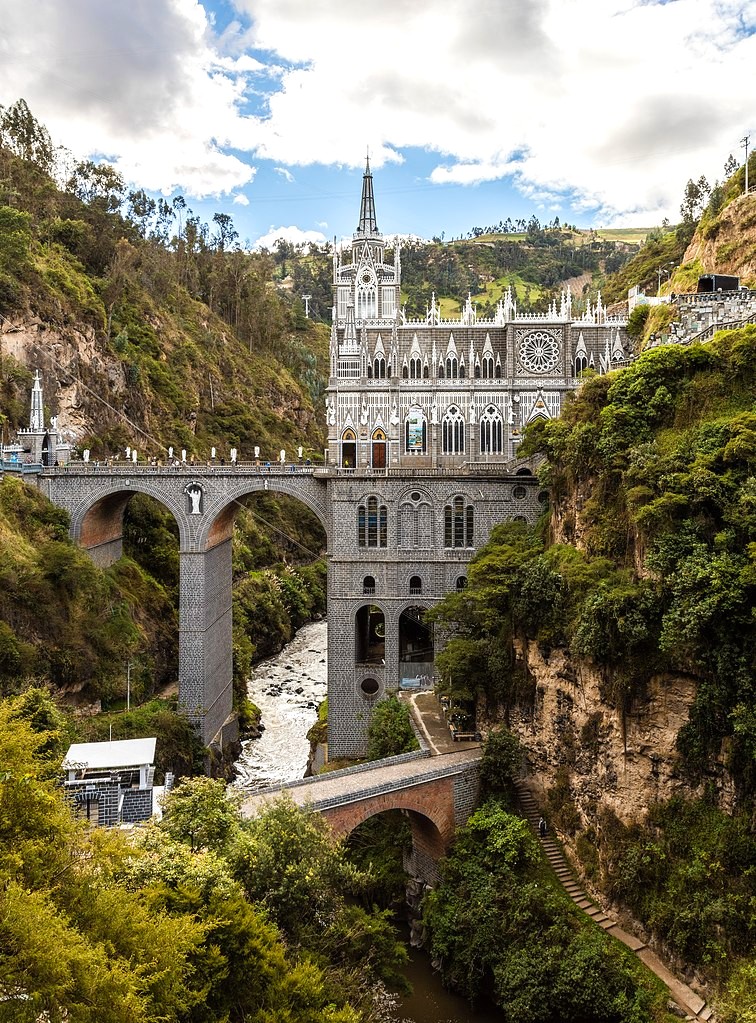
Nuestra Señora de las Lajas / Our Lady of the Flagstones, Potosí, Caldas, Colombia (1754) and Memorials of the Saints – 16 September

Nuestra Señora de las Lajas / Our Lady of the Flagstones, Potosí, Caldas, Colombia (1754) – 16 September:

In 1754, Maria Mueses de Quinones, an Indian woman from the village of Potosi, Colombia and her deaf-mute daughter, Rosa, were caught in a very strong storm. They sought refuge in a cave in the gigantic Lajas mountains. To Maria’s surprise, her mute daughter, Rosa exclaimed with her first words “the mestiza is calling me…” Maria did not see the figures of a woman and child that the girl described and fearfully ran back with her daughter to Ipiales and told the townspeople. After later returning to the spot, the woman saw an apparition of Our Lady and Child. Some months later, Rosa died and was returned to life when her mother prayed again at the cave. The townspeople came to see this place and encountered the miraculous image burned into the rocks!

The congregation celebrated the first Mass in the Pastarán river cave – it was 16 September 1754 and they built a straw grotto. With the endorsement of the ecclesiastical authorities, who declared the event as a miracle on 15 September 1754. Very soon, the image began to be venerated with great fervour and many miraculous events occurred there.
Around the image the faithful devotees have erected four successively larger Churches, until culminating in the current Sanctuary whose construction lasted 30 years and was completed in 1949.
In 1952 , Pope Pius XII granted the image the canonical coronation and in 1954 he granted the Sanctuary, the title of Minor Basilica.
St Pope Cornelius (Martyred in 253) (Memorial)
St Cyprian of Carthage (190-Martyred in 258) (Memorial)
Saints Cyprian and Cornelius:

https://anastpaul.wordpress.com/2017/09/16/saints-of-the-day-16-september-st-pope-cornelius-and-st-cyprian-of-carthage-martyrs/

St Abundantius of Rome
St Abundius of Rome
St Andrew Kim Taegon
St Cunibert of Maroilles
St Curcodomus
Bl Dominic Shobyoye
St Dulcissima of Sutri
St Edith of Wilton
St Eugenia of Hohenburg
St Euphemia (c 290-c 305) Virgin Martyr
St Geminianus of Rome
St John of Rome

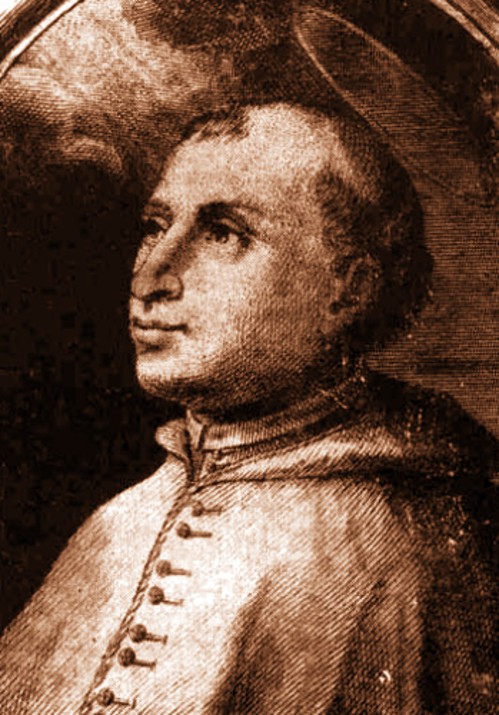
Blessed Luigi Ludovico Allemandi (c 1390-1450) Bishop and Cardinal, called “The Cardinal of Arles.” Blessed Luigi was a Priest driven by immense love for the Holy Mother of God and for the Church. His involvement in various Councils and Papal dissentions, were the result of his great desire to maintain the purity of the Chair of Peter. He was Beatified in 1527 by Pope Clement VII.
His Life;

https://anastpaul.com/2020/09/16/saint-of-the-day-blessed-luigi-ludovico-allemandi-c-1390-1450/

St Lucy of Rome
St Ludmila
St Marcian the Senator
Bl Martin of Huerta
Bl Michael Himonaya

St Ninian (Died 432) “Apostle to the Southern Picts,” Bishop, Missionary, Monastic Founder, Wonderworker.
Biography:

https://anastpaul.com/2018/09/16/saint-of-the-day-16-september-st-ninian-c-360-died-432-apostle-to-the-southern-picts/

Bl Paul Fimonaya
St Priscus of Nocera
St Rogellus of Cordoba
St Sebastiana
St Servus Dei
St Stephen of Perugia

Blessed Pope Victor III OSB (1027-1087) Known as “the Gentle Pope,” Prince, Benedictine Abbot, Monk, Advisor, diplomat, reformer – Papal ascension – elected 24 May 1086 and enthroned on 9 May 1087 – until his death. Few have been more reluctant to accept the Papacy than the humble Monk and Hermit, who became Victor III.
About Pope Victor III:

https://anastpaul.com/2019/09/16/saint-of-the-day-16-september-blessed-pope-victor-iii-1027-1087/
St Vitalis of Savigny

Martyrs of the Via Nomentana: Four Christian men martyred together, date unknown – Alexander, Felix, Papias and Victor. They were martyred on the Via Nomentana outside Rome, Italy.

Martyred in the Spanish Civil War:
• Blessed Antonio Martínez García
• Blessed Ignasi Casanovas Perramón
• Blessed Manuel Ferrer Jordá
• Blessed Pablo Martínez Robles
• Blessed Salvador Ferrer Cardet

Posted in SAINT of the DAY

Saint of the Day – Blessed Luigi Ludovico Allemandi (c 1390-1450)

Saint of the Day – Blessed Luigi Ludovico Allemandi (1390-1450) Bishop and Cardinal – often called “The Cardinal of Arles.” Born in c 1390 possibly in Arbent, Bugey, Kingdom of France and died on 16 September 1450 (aged 60) Arles, Kingdom of France. Blessed Luigi was a Priest driven by immense love for the Holy Mother of God and for the Church. His involvement in various Councils and papal dissentions, were the result of his great desire to maintain the purity of the Chair of Peter. He is also known as Louis Allemand, Louis Alamanus, Louis Alemanus, Louis Almannus, Louis Alamandus.

The noble Germanic family of Allemandi moved, at the time of the Ottoni emperors, to Piedmont and more precisely to San Michele di Prazzo, in Val Maira. Most likely the present Blessed was born here, although according to other hypotheses he would have been born in the nearby French region of Bugey. What is certain, however, is the Saluzzo origins of the family, given the future good relations that Ludovico had with Cardinal Amedeo of the Marquises of Saluzzo.

He embarked on an ecclesiastical career at a very young age and, having entered the Canons of Lyon, he was elevated to the dignity of Prior of Piellonez and Contamines-sur-Arles. At the University of Avignon, he graduated in law in 1414. He received various positions as a teacher at Abbeys in Tours, Valenza and Barbona.

He took part in the councils of Pisa and Constance, both aimed at a positive conclusion of the Western schism. Pope Martin V then assigned him to the Episcopal chair of Maguelonne in 1418 and of Arles in 1423.

Awarded the Cardinal’s purple, in 1424 he became governor of Bologna, where he had to face the ongoing struggle between Guelphs and Ghibellines. Here he was imprisoned for several long days by the powerful Guelph family of the Canetoli. When released, he moved to Rome where he worked at the Papal Court.

He was a prominent member of the Council of Basel in 1432 and together with Cardinal Julian Cesarini led the forces that maintained the power of the general councils over the Pope’s own control of the Church. It was while the council was proceeding, that he tended to victims of the plague. He later led opposition to the Pope but Cesarini was reconciled with Pope Eugene IV and had a prominent part in the Pope’s convoked Council of Florence. In 1439 he led the effort to depose Eugene IV and the election of a successor. In 1440 he placed the tiara upon Antipope Felix V and Consecrated him as a Bishop. This was a misguided attempt at reforming the Church which Blessed Luigi believed was vital. Eugene IV responded to this and excommunicated the antipope while also depriving Luigi of all his Ecclesiastical dignities. This occurred on 11 April 1440 – he was stripped of Arles as his Archdiocese and was stripped of his Titular Church.

Antipope Felix V made him the legate to the Diet of Frankfurt to the Court of Emperor Friedrich IV. He was further involved in the unsuccessful efforts to win over Europe’s Princes to Basel’s antipope. In order to make an end of the schism, the former cardinal advised Felix V to abdicate, at which stage Pope Nicholas V restored the Cardinal to all his honours and appointed him as a Papal Legate to the German kingdom; his full restoration was on 19 December 1449. He was restored to his Titular Church as well and from that moment, until his death served as the Protopriest of the College of Cardinals. It was due to his estrangement to the Roman See that he was not permitted to participate in the conclave of 1447.

He returned to his former Archdiocese of Arles, where he dedicated himself with great zeal, to the catechetical formation of the people. Death reached him in 1450 at the Franciscan convent of Salon. He was buried in his Cathedral and his tomb did not take long to become a pilgrimage destination and a miraculous place.

The historian, Saxius, summarised his life as follows: “Angelicam vitam duxit,” that is, “he led an angelic life,” characterised by a marked Marian devotion embodied in support of the dogma of the Immaculate Conception.

In 1527, Pope Clement VII officially confirmed his cult by declaring him “Blessed.”