St Projectus St Sabinian of Troyes St Suranus of Sora St Thyrsus Bl essed William Ireland SJ (1636-1679) Priest Martyr
Martyrs of Asia Minor – 4 Saints: A group of ChristiansMmartyred together for their faith. The only details to survive are four of their names – Eugene, Mardonius, Metellus and Musonius. They were burned at the stake in Asia Minor.
Martyrs of Antioch: Babylas Epolonius Prilidian Urban
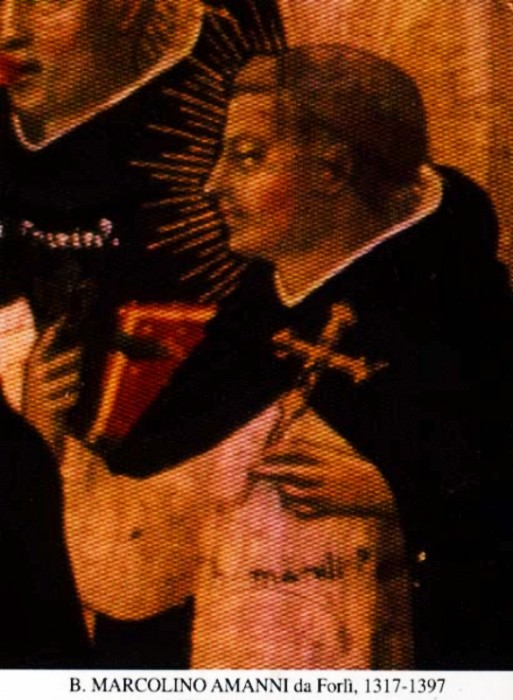
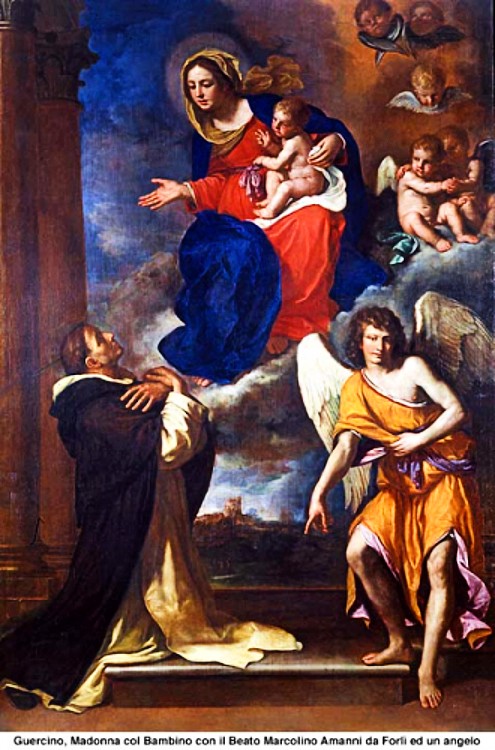
Saint of the Day – 24 January – Blessed Marcolino Amanni of Forli OP (1317-1397) Priest and Friar of the Dominican, the Order of Preachers, Mystic, Assistant Prior and Procurator of his Convent. Born in 1317 in Forli, Emilia, Italy and died on 24 January 1397 in Forli, Emilia, Italy of natural causes, seventy years after his entry into the Order of Preachers. Blessed John Dominici (1356-1419), Archbishop and Cardinal, wrote the life of Blessed Marcolino of Forlì . Also known as – Marcolinus of Forli, Marcolino Amannai da Forli.. Additional Memorial – 21 January in the Diocese of Forli, in order not to clash with the Novena to the Madonna del Fuoco (Our Lady of Fire).
The Roman Martyrology reads: “In Forlì, blessed Marcolino Amanni, Priest of the Order of Preachers, who lived his whole life in great humility and simplicity, in silence, in solitude, in the service of the poor and in the care of children.”
Born in Forli, Italy in 1317, Marcolino Amanni entered the Dominicans at the tender age of 10 years. He occupies a place unique in Dominican annals because he was almost purely contemplative . There is outwardly little to record of Marcolino;s life within the Order, except that for 70 years he kept the Dominican Rule in all its rigour. That is a claim to sanctity that can be made by very few, and is of itself enough to entitle him to sainthood. He did accomplish the reform of several Convents which had fallen from their primitive fervour but this he did by his prayers and his example, rather than by teaching or preaching.
However, from 1367 to 1370, he acted as Procurator and also as Assistant-prior of San Giacomo. Between 1371 and 1395 he is attested as a participant in Chapter assemblies or as a witness in notarial deeds concerning the life of the Convent.
But, for the most part, it is said that Marcolino was most at home with the lay brothers, or with the neighborhood poor, the sick, the needy and children, who enjoyed talking to him. He seldom went out of his cell, neither did he leave any writings. His work was the unseen labour presided over by the Holy Spirit, the work of contemplation. “To give to others the fruits of contemplation,” is the Dominican motto and one might be curious to know how Blessed Marcolino accomplished this.
In order to understand the need for just such a type of holiness, it is well to remember the state of the Church in the 14th Century. Devastated by plague and schism, divided and held up to scorn, preyed upon by all manner of evils, the Church militant was in need, not only of brave and intelligent action but also of prayer. Consistently through the Centuries, God has raised up such saints as could best avert the disasters that threatened the world in their day, and Marcolino was one answer to the need for mystics who would plead ceaselessly for the Church.
Marcolino’s interior life was not recorded by himself or by others. He lived the mystical life with such intensity that he was nearly always in ecstasy and unconscious of the things around him. One of his fellow friars recorded that he seemed “a stranger on earth, concerned only with the things of Heaven.” Most of his brethren thought him merely sleepy and inattentive but actually he was, for long periods, lost in converse with God. Some had heard him talking earnestly to the statue of Our Lady in his cell; some fortunate few had heard Our Lady replying to his questions, with the same simplicity.
At the death of Marcolino, on 24 January, 1397, a beautiful child appeared in the streets, crying out the news to the little town that the saintly friar was dead. As the child disappeared when the message was delivered, he was thought to have been an Angel. Many miracles were worked at Marcolino’s Tomb. One was the miraculous cure of a woman who had been bedridden for 30 years. Hearing of the death of the blessed, she begged him to cure her so that she could visit his Tomb.
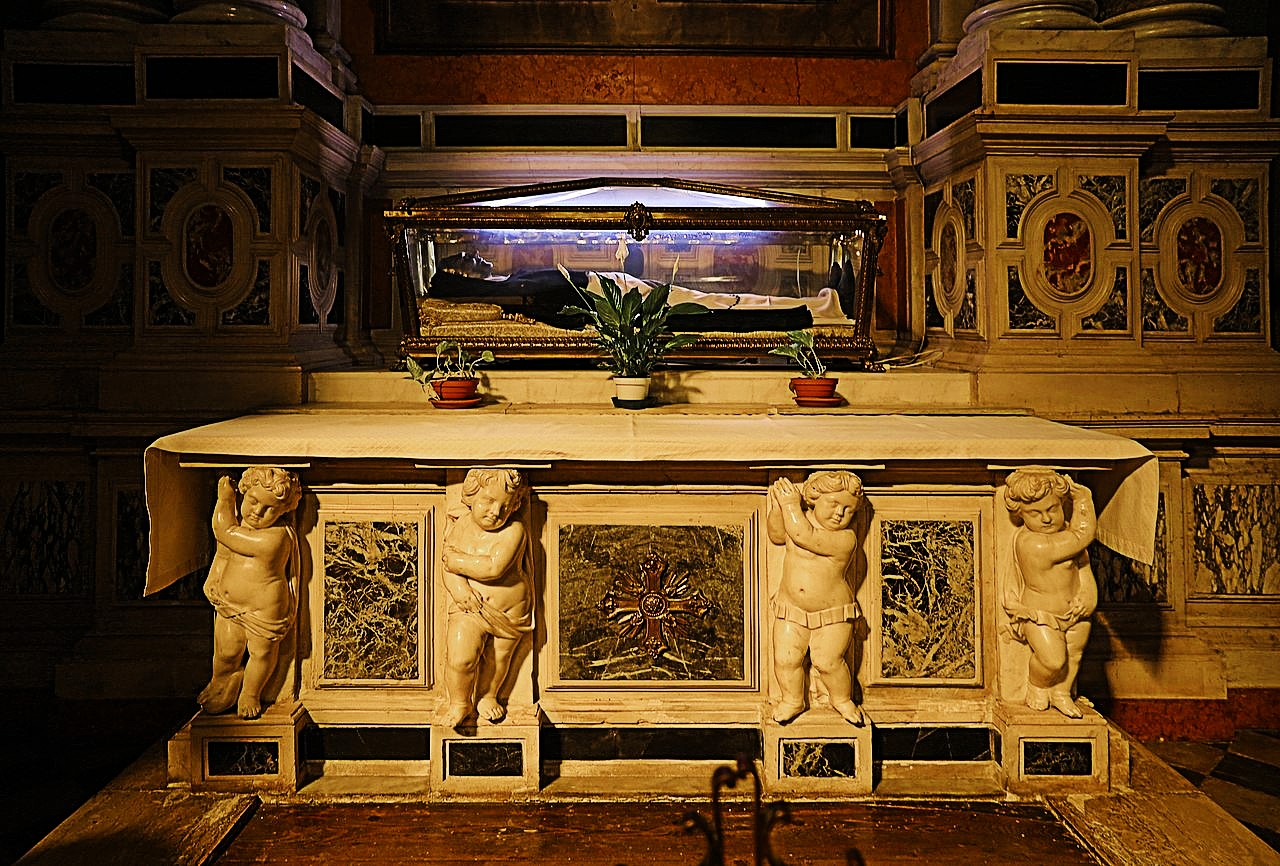
Upon his death, popular devotion, which considered him a saint, obtained that Marcolino, after a solemn funeral, was buried in the Dominican Church and for two months, it was not possible to close the Church, day or night, due to the large influx of faithful .
A little less than a month after Marcolino’s death, on 20 February 1397, Bello de’ Giuliani da Forlì, Vicar of the Bishop of Forlì Scarpetta Ordelaffi, sent a letter to Leonardo Dolfin, Bishop of Castello, informing him of the death of the Dominican religious, who he was described as a brother of exemplary life and full of charity.
Bello also gave news of about fifty miraculous cures performed by the intercession of Marcolino. Subsequent investigations brought this exceptional series of miracles up to 80 (report to Raimondo da Capua, general of the Order, who had been spiritual director and then biographer of Saint Catherine of Siena) and then to 188 (report from Forlì notaries to the Bishop of Forlì, Scarpetta Ordelaffi).
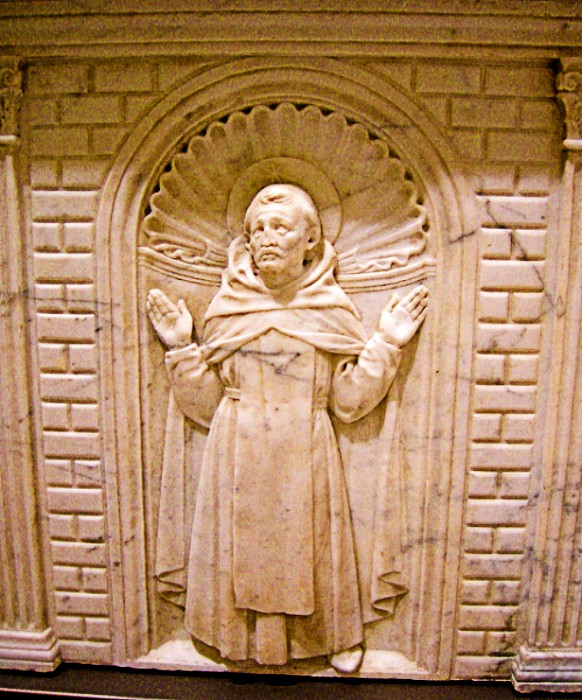
In 1457 Marcollino’s body was transferred to a marble monument by Antonio and Bernardo Rossellino, which had been commissioned by the fellow citizen of Forlì, Nicolò Dall’Aste, Bishop of Recanati. Marcolino’s body was then enshrined in the Forli Cathedral.
He was confirmed as a saint on 9 May 1750 by Pope Benedict XIV.
St Filip Geryluk St Guasacht St Ignacy Franczuk Bl John Grove St Julian Sabas the Elder St Macedonius Kritophagos Blessed Marcolino Amanni of Forli OP (1317-1397) Priest and Friar of the Order of Preachers, the Dominicans, Mystic.
St Projectus St Sabinian of Troyes St Suranus of Sora St Thyrsus Bl William Ireland
Martyrs of Asia Minor – 4 Saints: A group of ChristiansMmartyred together for their faith. The only details to survive are four of their names – Eugene, Mardonius, Metellus and Musonius. They were burned at the stake in Asia Minor.
Martyrs of Podlasie – 13 Beati: Podlasie is an area in modern eastern Poland that, in the 18th-century, was governed by the Russian Empire. Russian sovereigns sought to bring all Eastern-rite Catholics into the Orthodox Church. Catherine II suppressed the Greek Catholic Church in Ukraine in 1784. Nicholas I did the same in Belarus and Lithuania in 1839. Alexander II did the same in the Byzantine-rite Eparchy of Chelm in 1874 and officially suppressed the Eparchy in 1875. The Bishop and the Priests who refused to join the Orthodox Church were deported to Siberia or imprisoned. The laity, left on their own, had to defend their Church, their liturgy and their union with Rome. On 24 January 1874 soldiers entered the village of Pratulin to transfer the parish to Orthodox control. Many of the faithful gathered to defend their parish and Church. The soldiers tried to disperse the people but failed. Their commander tried to bribe the parishioners to abandon Rome but failed. He threatened them with assorted punishments but this failed to move them. Deciding that a show of force was needed, the commander ordered his troops to fire on the unarmed, hymn-singing laymen. Thirteen of the faithful died, most married men with families, ordinary men with great faith. We know almost nothing about their lives outside of this incident. Their families were not allowed to honour them or participate in the funerals and the authorities hoped they would be forgotten. Their names are:
Anicet Hryciuk
Bartlomiej Osypiuk
Daniel Karmasz
Filip Geryluk
Ignacy Franczuk
Jan Andrzejuk
Konstanty Bojko
Konstanty Lukaszuk
Lukasz Bojko
Maksym Hawryluk
Michal Wawryszuk
Onufry Wasyluk
Wincenty Lewoniuk Martyrdom:
shot on 14 January 1874 by Russian soldiers in Podlasie, Poland
buried nearby without rites by those soldiers.
Martyrs of Antioch: Babylas Epolonius Prilidian Urban
St Filip Geryluk Bl Francesc de Paula Colomer Prísas St Guasacht St Ignacy Franczuk Bl John Grove St Julian Sabas the Elder St Luigj Prendushi St Macedonius Kritophagos Blessed Marcolino Amanni of Forli OP (1317-1397) Bl Marie Poussepin
St Projectus St Sabinian of Troyes St Suranus of Sora St Thyrsus Bl William Ireland
Martyrs of Asia Minor – 4 Saints: A group of Christians martyred together for their faith. The only details to survive are four of their names – Eugene, Mardonius, Metellus and Musonius. They were burned at the stake in Asia Minor.
Martyrs of Podlasie – 13 Beati: Podlasie is an area in modern eastern Poland that, in the 18th-century, was governed by the Russian Empire. Russian sovereigns sought to bring all Eastern-rite Catholics into the Orthodox Church. Catherine II suppressed the Greek Catholic Church in Ukraine in 1784. Nicholas I did the same in Belarus and Lithuania in 1839. Alexander II did the same in the Byzantine-rite Eparchy of Chelm in 1874 and officially suppressed the Eparchy in 1875. The Bishop and the Priests who refused to join the Orthodox Church were deported to Siberia or imprisoned. The laity, left on their own, had to defend their Church, their liturgy and their union with Rome. On 24 January 1874 soldiers entered the village of Pratulin to transfer the parish to Orthodox control. Many of the faithful gathered to defend their parish and Church. The soldiers tried to disperse the people but failed. Their commander tried to bribe the parishioners to abandon Rome but failed. He threatened them with assorted punishments but this failed to move them. Deciding that a show of force was needed, the commander ordered his troops to fire on the unarmed, hymn-singing laymen. Thirteen of the faithful died, most married men with families, ordinary men with great faith. We know almost nothing about their lives outside of this incident. Their families were not allowed to honour them or participate in the funerals and the authorities hoped they would be forgotten. Their names are: • Anicet Hryciuk • Bartlomiej Osypiuk • Daniel Karmasz • Filip Geryluk • Ignacy Franczuk • Jan Andrzejuk • Konstanty Bojko • Konstanty Lukaszuk • Lukasz Bojko • Maksym Hawryluk • Michal Wawryszuk • Onufry Wasyluk • Wincenty Lewoniuk Martyrdom: • shot on 14 January 1874 by Russian soldiers in Podlasie, Poland • buried nearby without rites by those soldiers Beatified – 6 October 1996.
Martyrs of Antioch: Babylas Epolonius Prilidian Urban



 AnaStpaul
You must be logged in to post a comment.