
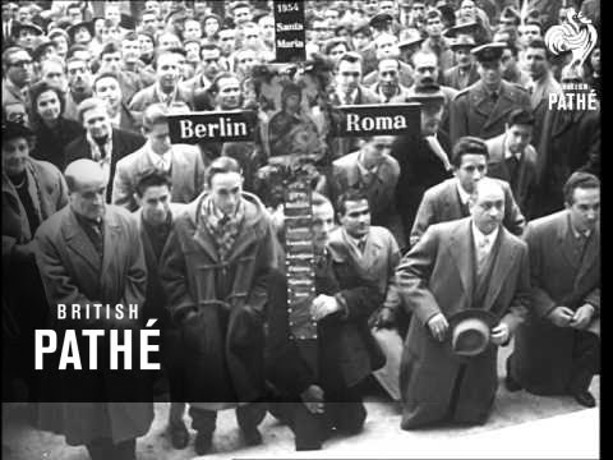
Saint of the Day – 25 March – Blessed Placido Riccardi OSB (1844-1915). Priest and Friar of the Order of St Benedict. He founded a branch thereof known as the Cassinese Congregation, a reform of the standard way of life of the Monasteries. Born on 24 June 1844 as Tommaso Riccardi in Trevi, Umbria, Italy and died aged 70 in Rome, on 25 March 1915. PATRONAGES – against Malaria, against all bodily illnesses. Also known as – Tommaso Riccardi, Thomas Riccardi. He was Beatified on 5 Dercember 1954 by Pope Pius XII.

Tommaso Riccardi was born in Trevi on 24 June 1844 to Francesco and Maria Stella Paoletti, the third of ten children. He was Baptised in the nearby Church of St Emilian and, as soon as he was reborn with Baptism, he was placed on the Altar of Our Lady of Sorrows, in an act of consecration.
In 1853 he entered the Lucarini College where he distinguished himself as attested by numerous mentions and medals, awarded to him. In 1862, when the Lucarini College was closed for political reasons, he placed himself under the spiritual direction of Don Ludovico Pieri, a holy Priest from Trevia, spiritual father and inspiration of Blessed Pietro Bonilli. In 1865, in the the act of resigning from Pieri to continue his studies in Rome, the latter prophesied his future vocation but Tommaso made a gesture of rebellion and, throwing the hat he was holding in his hand, to the ground and stepping on it, exclaimed:
“If this vocation comes to me, I drown!”
Just a year later, 1866, after a pilgrimage to Loreto and a course of spiritual exercises, he knocked on the door of the Abbey of St Paul. Admitted to the Novitiate on 5 January 1867 with the name of Placido, he was Ordained Subdeacon on 2 April 1870 and Deacon on 224 September 1870.
Called up for Military Service, he took a few days to finish his exams but was immediately declared a deserter because of this delay! Having arrived in Spoleto to plead his case, since in the meantime, the Piedmontese government which also dominated Rome, had decreed an amnesty, it was discovered that his case did not fall within it and, therefore, he was arrested at the Fonti del Clitunno, while returning to Trevi. Transferred to Florence, he was tried and sentenced to one year’s imprisonment, then pardoned and sent to the Regiment in Pisa but, after medical tests, declared unfit, he was discharged on 27 January 1871. On 7 February he returned to St Paul’s where, on 10 March he made his Solemn Profession and on 25 March he was Ordained a Priest.
He held various positions: Deputy Master of Students, Master of Novices, Abbey Vicar of the Benedictines of St Magno in Amelia in two different periods. In 1994, while he was leaving the Amelia Monastery to return to Rome due to his poor health, a Nun wrote about him as follows:
“Don Placido left leaving everyone in the deepest pain.
Austere with himself but all charity for us, especially the sick.
His charity also extended to the poor in Amelia.
His virtues have aroused the admiration of the whole City!”
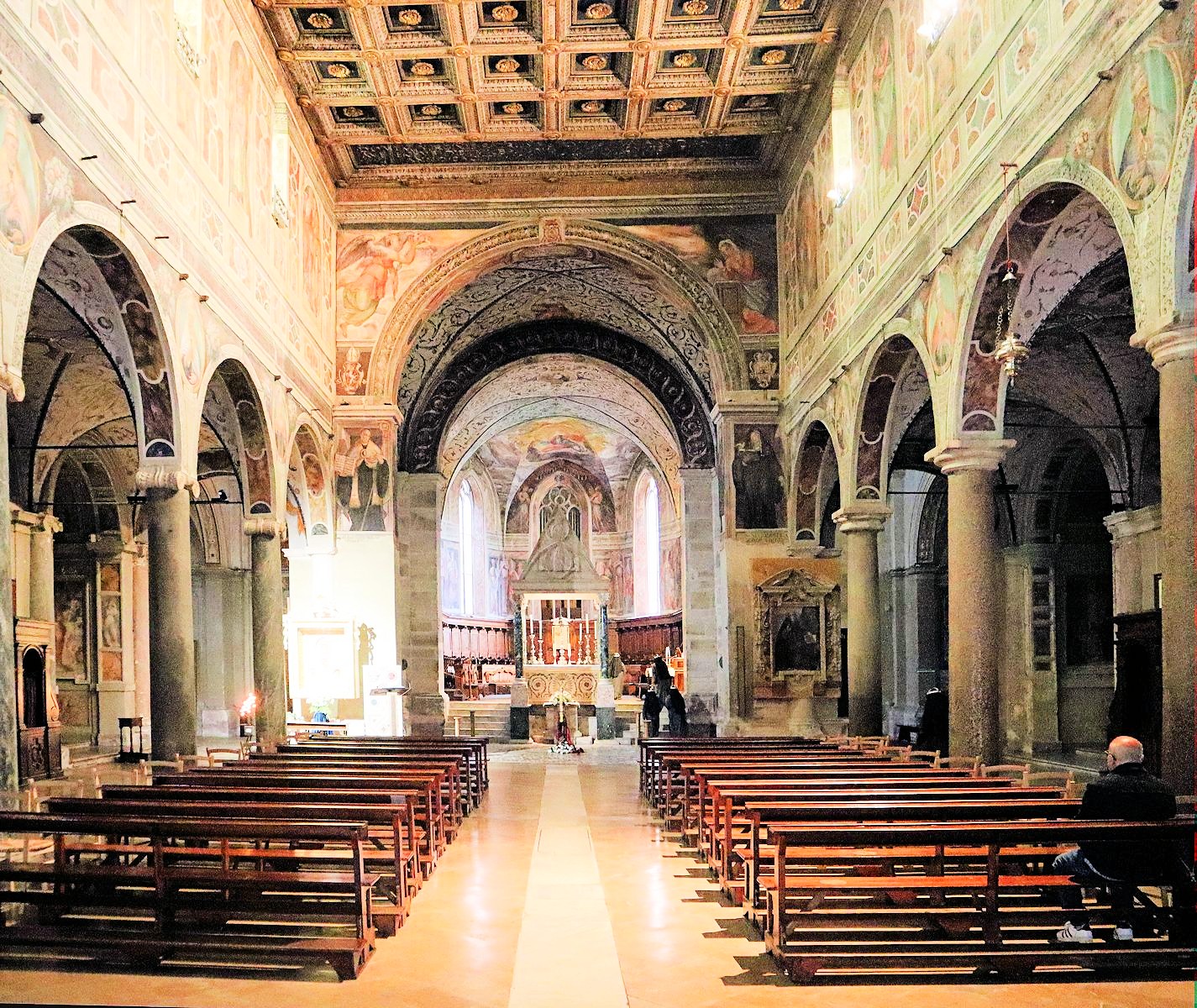
But the apotheosis of the humiliation and triumph of Don Placido’s sanctity occurred in Farfa, where he was sent to try to save what could be saved. The glorious Abbey, already powerful in the time of the Lombards, was reduced to miserable conditions. Overwhelmed by the latest political events and its assets passed to private individuals, the Abbot’s residence itself was absolutely uninhabitable! Don Placido turned his attention to the people, generally poor shepherds who came to him after Sunday Mass. In their extreme need, they were helped spiritually and materially. In his prodigality Don Placido regretted that he no longer even had his own personal effects to donate to the poor, since those he possessed were rejected several times because they were too poor. It is said that he also provided suggestions and medicinal remedies described in the ancient codes.
In 1912, after almost twenty years of staying in Farfa, his body, which had always been in poor health, further weakened by a life of penance and deprivation, was so weakened he contracted Malaria and the holy man had to be brought back to Rome. He lived for another two and a half years, assisted by his disciple and friend Don Idelfonso Schuster, later Cardina, Bishop of Milan and his Biographer.
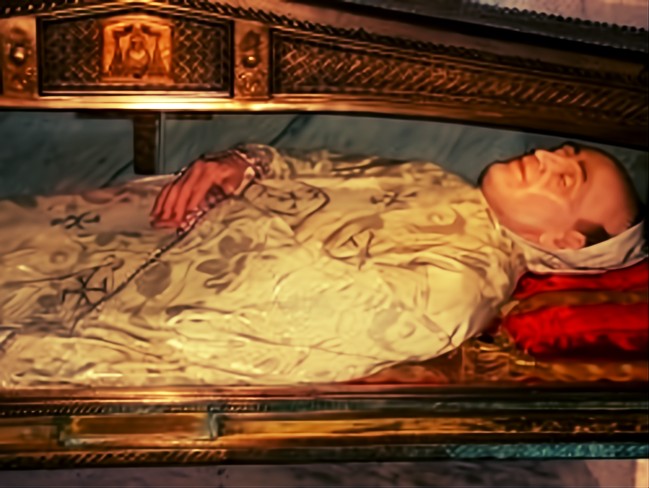
He passed away on the evening of 25 March 1915 and the following day, when his body was transported to the Basilica, the bells rang out without assistance.
In 1925 the body was moved to Farfa Monastery and in 1928 the process of Canonisation began band in the 1950s Pope Pius XII proclaimed him Blessed. .
On 5 December 2008, a day of study was dedicated to the Blessed.
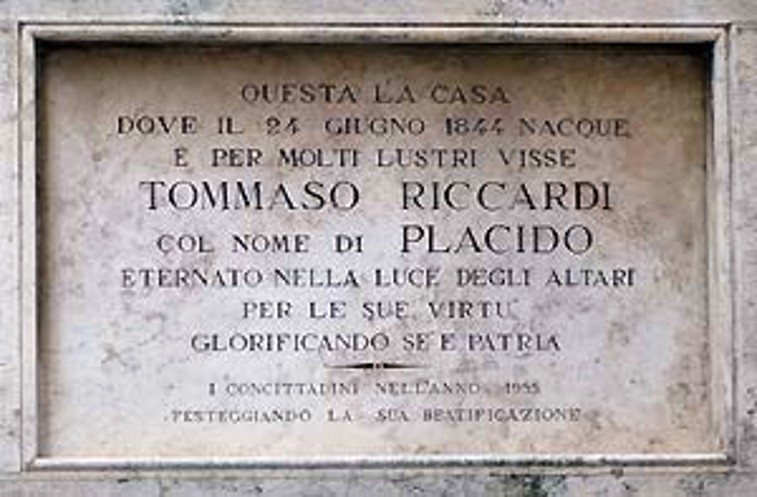
In Trevi the road which goes from Piazza del Comune up towards the Church of St Emilian, where our Saint was Baptised and which was since named after him, passing in front of his house, where a plaque was placed. The large square behind the Basilica of St Paul in Rome also bears his name and in Milan, a central street, parallel to Via Palmanova.
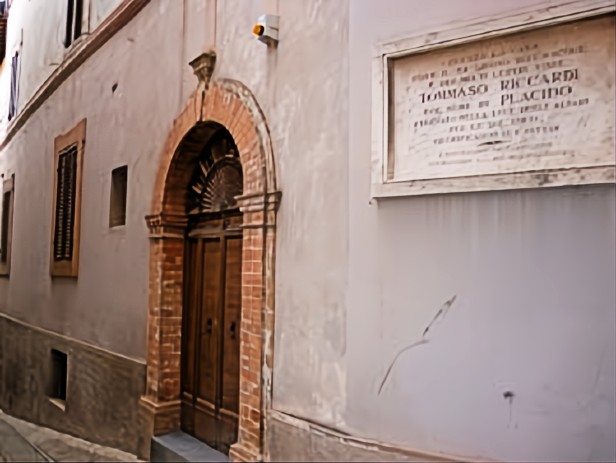
THIS IS THE HOUSE
WHERE HE WAS BORN,
ON 24 JUNE 1844
AND HE LIVED, FOR MANY YEARS,
TOMMASO RICCARDI.
WITH THE NAME OF PLACIDO
ETERNATED IN THE LIGHT OF THE ALTARS
FOR HIS VIRTUES – GLORIFYING SELF AND HOMELAND
FELLOW CITIZENS IN THE YEAR 1955
CELEBRATING HIS BEATIFICATION

 AnaStpaul
You must be logged in to post a comment.