St Alcmund of Hexham Bl Alexander of Milan St Augustalus St Balin St Carissima of Albi St Chiaffredo of Saluzzo Bl Claude-Barnabé Laurent de Mascloux St Desiderio of Benevento St Dinooth Bl Eugenia Picco St Eupsychius of Caesarea St Eustace of Beauvais St Evortius of Orleans (Died c340) Bishop St Faciolus St Festo of Benevento Bl François d’Oudinot de la Boissière St Giovanni of Lodi St Goscelinus of Toul St Gratus of Aosta St Grimonia of Picardy St Hiduard Bl John Duckett Bl John Maki Bl John of Nicomedia Bl Ludovicus Maki Soetsu Madalberta Bl Maria of Bourbon Blessed Marko Križevcanin (c1588-1619) Priest Martyr St Melichar Grodecký St Memorius of Troyes St Pamphilus of Capua Bl Ralph Corby
Martyrs of Noli: Four Saints: Christians who became soldiers and were martyred together for their faith. A late legend makes them member of the Theban Legend who escaped their mass martyrdom but that’s doubtful – Paragorius, Partenopeus, Parteus and Severinus. They were born in Noli, Italy and martyred in Corsica, France. Attribute – soldiers with a banner of NoliM
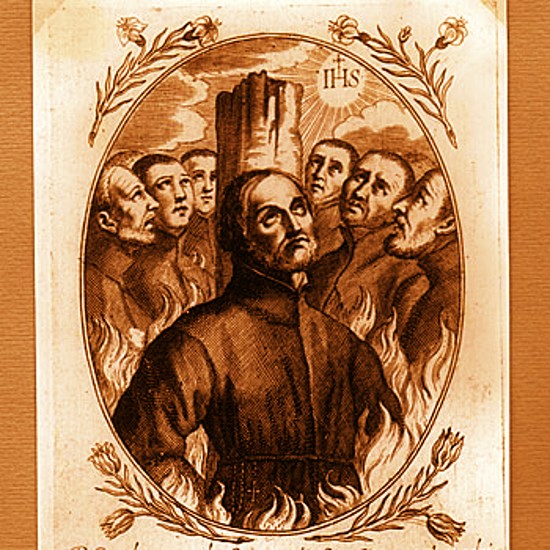
Saint of the Day – 7 September – Blessed Thomas Tsuji SJ (1570-1627) Priest of the Society of Jesus, Martyr. Born in c1571 in Sonogi, Nagasaki, Japan and died by being burned at the stake on 7 September 1627 at Nagasaki, Japan. Additional Memorial – 7 May together with the Martyrs of Japan. Also known as – Thomas Tsugi, Thomas Tsughi, Thomas Tzugi.
Thomas Tsuji was born in Sonogi, near Omura of a noble family. He received his early education from the Jesuits in Arima and entered the Society in January 1589. He was Ordained a Priest in Nagasaki sometime before 1613. He was an excellent preacher and became well known throughout southern Japan. He was transferred to Hakata after he became too outspoken in his condemnation of the scandalous conduct of some Christian Japanese in the City. While exercising his priestly ministry in Hakata, the edict of 1641 which ordered the banishment of all Catholic Priests from Japan was enacted. In obedience to the order, Fr Tsuji and the other eighty Priests left for Macau and remained there for four years.
In August 1618, Fr Tsuji,disguised as a merchant, returned to Japan and secretly resumed his apostolic work. Unlike the European Jesuits who could only minister at night, Fr Tsuji worked day and night, achieving great results, disguised sometime as a prosperous Japanese gentleman and at times, as an artisan. His favourite disguise was as a humble wood seller who could knock at the doors of Christian homes without being noticed.
As the persecution against Christians intensified and his workload increased, Fr Tsuji found his energy waning as he began to doubt whether he could match the heroic example of his brother Jesuits who were being martyred. This uncertainty of himself, led him to be depressed and as he found it difficult to continue living up to the ideals that the Society demanded of its men, he was released of his religious vows in late 1619.
Within a short time of his departure from the Society, he requested to be readmitted but while immediate readmission was not possible, the Jesuit superiors allowed him to go through a period of probation. This lasted six years, during which time he demonstrated more zealously, by exposing himself to many dangers, in order to help other Christians. After his readmission in 1626, Fr Tsuji was assigned to Nagasaki where he continued his apostolic duties until his capture the same year.
Fr Tsuji had been living with a devout Christian, Louis Maki and his son John. On the morning of 21 July 1626, just after he had celebrated Mass, which the Makis attended, the house was invaded by soldiers and the three were arrested. Fr Tsuji appeared before the district judge and when asked who he was and what he was doing, he responded: “For many years the people of Nagasaki have seen Thomas Tsuji, a religious of the Society of Jesus and have heard him preach the Christian message. I am he and I am prepared to uphold. with my life and to testify with my blood. to the truths that I have faithfully taught.” He was found guilty and imprisoned at the Omura prison. The Makis were also imprisoned for collaborating with a Priest and offering him hospitality.
While in prison, Fr Tsuji had to endure the visits of his family who endlessly asked him to think of them and not to bring shame upon them. They appealed to him to renounce his Christian religion and return to live with them. His reply was: “What you ask me to do is wrong and even if you offered me a thousand Japans, or the whole world, I could not do it.” After thirteen months of incarceration the three prisoners were taken to Nagasaki to receive the death sentence
On 7 September 1627 they were led to the Martyrs’ Hill, made holy by many Martyrs and there, they were tied to stakes. Fr Tsuji comforted his two companions and urged them to think of Christ’s passion. When the stakes were on fire, he blessed his companions, raised his eyes to heaven and prayed silently. When the flames twirled and wrapped about his body, he chanted the psalm: “Praise the Lord, All You Nations.”
Many witnesses have attested that few moments before his death, his breast burst open and from it there issued a flame that rose upwards and upwards until it was lost in sight. They believed that the sacrifice offered by Fr Tsuji and his companions was found to be most pleasing to God.
Fr Tsuji, Louis and John Maki were beatified by Pope Pius IX together with other Japanese martyrs on 7 May 1867.
Vigil of the Nativity of the Nativity of the Blessed Virgin Mary, instituted by Pope Gregory II (722):
The day destined for the parturition of Saint Anne and for the birth of her, who was consecrated and sanctified to be the Mother of God, had arrived – a day most fortunate for the world. This birth happened on the eighth day of September, fully nine months having elapsed since the Conception of the soul of our most holy Queen and Lady.
Saint Anne was prepared by an interior voice of the Lord, informing Her, that the hour of her parturition had come. Full of the joy of the Holy Spirit at this information, she prostrated herself before the Lord and besought the assistance of his grace and his protection for a happy deliverance.
Presently she felt a movement in her womb similar to that which is proper to creatures being born to the light. The most blessed child Mary was at the same time, by divine providence and power, ravished into a most high ecstasy. Hence Mary was born into the world without perceiving it by her senses, for their operations and faculties were held in suspense. As She had the use of her reason, she would have perceived it by her senses, if they would have been left to operate in their natural manner at that time. However, the Almighty disposed otherwise, in order that the Princess of heaven might be spared the sensible experience, otherwise connected with birth. she was born pure and stainless, beautiful and full of grace, thereby demonstrating, that she was free from the law and the tribute of sin. Although she was born substantially like other daughters of Adam, yet her birth was accompanied by such circumstances and conditions of grace, that it was the most wonderful and miraculous birth in all creation and will eternally redound to the praise of her Maker.
At twelve o-clock in the night this divine child issued forth, dividing the night of the ancient Law and its pristine darknesses from the new day of grace, which now was about to break into dawn. She was clothed, handled and dressed like other infants, through she excelled all mortals and even all the angels in wisdom. Her mother did not allow her to be touched by other hands than her own but she, herself, wrapped her in swaddling clothes: and in this Saint Anne was not hindered by her present state of incapacity, for she was free from the toils and labours, which mothers endure in such circumstances.
So then Saint Anne received in her arms she, who was her Daughter but at the same time, the most exquisite treasure of all the universe, inferior only to God and superior to all other creatures. (The City of God, by Venerable Mary of Jesus of Agreda OIC (1602-1665) [Her body is incorrupt].
St Alcmund of Hexham Bl Alexander of Milan St Augustalus St Balin St Carissima of Albi St Chiaffredo of Saluzzo Bl Claude-Barnabé Laurent de Mascloux
St Desiderio of Benevento St Dinooth Bl Eugenia Picco St Eupsychius of Caesarea St Eustace of Beauvais St Evortius of Orleans St Faciolus St Festo of Benevento Bl François d’Oudinot de la Boissière
St Giovanni of Lodi St Goscelinus of Toul St Gratus of Aosta St Grimonia of Picardy St Hiduard Bl Ignatius Klopotowski Bl John Duckett Bl John Maki Bl John of Nicomedia Bl Ludovicus Maki Soetsu Madalberta Bl Maria of Bourbon St Marko Križevcanin St Melichar Grodecký St Memorius of Troyes St Pamphilus of Capua Bl Ralph Corby
St Sozonte Blessed Thomas Tsuji SJ (1570-1627) Priest of the Society of Jesus, Martyr.
St Tilbert of Hexham — Martyrs of Noli: Four Christians who became soldiers and were martyred together for their faith. A late legend makes them member of the Theban Legend who escaped their mass martyrdom but that’s doubtful – Paragorius, Partenopeus, Parteus and Severinus. They were born in Noli, Italy and martyred in Corsica, France. Attribute – soldiers with a banner of Noli.
Martyred in the Spanish Civil War: • Blessed Antoni Bonet Sero • Blessed Ascensión Lloret Marcos • Blessed Gregorio Sánchez Sancho • Blessed Félix Gómez-Pinto Piñero




 AnaStpaul
You must be logged in to post a comment.