Saint of the Day – 1 January – Feast of the Circumcision of the Lord
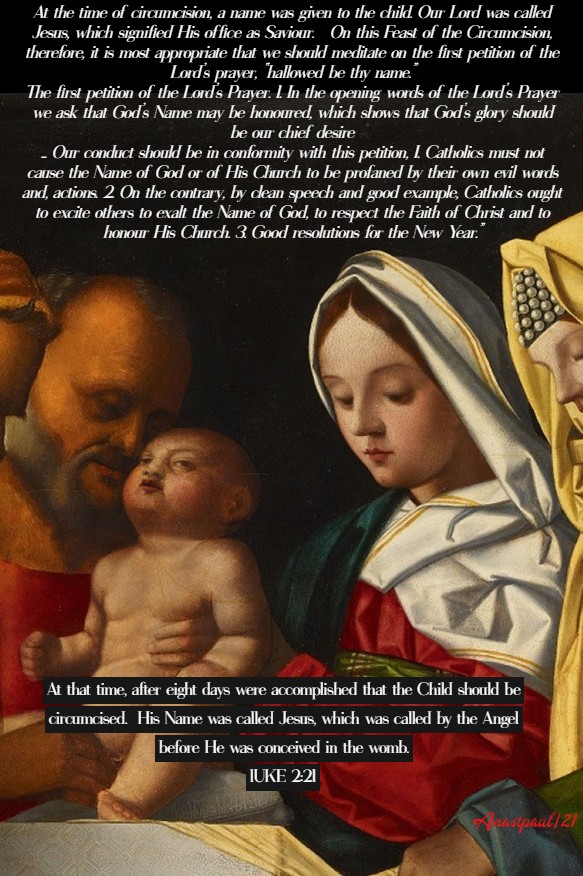
“At that time, after eight days were accomplished that the Child should be circumcised; His Name was called Jesus, which was called by the Angel, before He was conceived in the womb.” – Luke 2:21
Excerpt from the Catechism of the Council of Trent, (Part IV – “Hallowed be Thy Name“”)
In the Old Law (Gen. 17:12), it was required that every male child should, on the eighth day after his birth, be circumcised and thus admitted among God’s chosen people. The rite of circumcision in the Old Law corresponded to the Sacrament of Baptism in the New Law and was the means of remitting original sin. Our Lord, although free from every sin, submitted to this rite, in order to show that He was a true Son of Abraham, to manifest respect and obedience to the established law and, to prove that He had a real human body. At the time of circumcision, a name was given to the child. Our Lord was called Jesus, which signified His office as Saviour. On this Feast of the Circumcision, therefore, it is most appropriate that we should meditate on the first petition of the Lord’s prayer, “hallowed be thy name.”
I. The first petition of the Lord’s Prayer. In the opening words of the Lord’s Prayer we ask that God’s Name may be honoured, which shows that God’s glory should be our chief desire. This petition does not mean that God’s essential glory or perfection should be increased, nor that the honour given Him on earth, should be equal to that shown Him in Heaven.
II. The objects of this petition. We ask: That we may praise God with our hearts and lips; That those in error may be brought to recognise and revere His Church; That sinners may be converted to His service; That men may learn to refer all blessings to Him as to their Author and source.
CONCLUSION. Our conduct should be in conformity with this petition. Catholics must not cause the Name of God or of His Church, to be profaned by their own evil words and actions. On the contrary, by clean speech and good example, Catholics ought to excite others to exalt the Name of God, to respect the Faith of Christ, and to honour His Church. Good resolutions for the New Year!
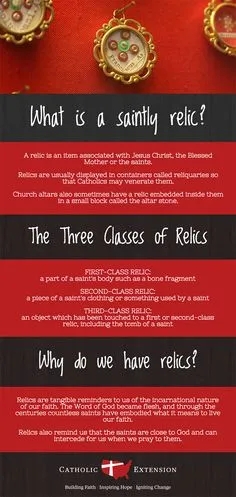
Feast of the Holy Relics – 5 November – From the Liturgical Year, 1901.
Relics of the Passion conserved in the Roman Basilica of Santa Croce in Jerusalem
Had we Angels’ eyes, we should see the earth as a vast field sown with seed for the Resurrection. The death of Abel opened the first furrow and ever since, the sowing has gone on unceasingly, the wide world over. This land of labour and of suffering, what treasures it already holds laid up in its bosom! And what a harvest for Heaven, when the Sun of Justice, suddenly darting forth His rays, shall cause to spring up, as suddenly from the soil, the elect ears ripe for glory! No wonder that the Church herself blesses and superintends, the laying of the precious grain in the earth.
But the Church is not content to be always sowing. Sometimes, as though impatient of delay, she raises from the ground the chosen seed she had sown therein. Her infallible discernment preserves her from error and, disengaging from the soil the immortal germ, she forestalls the glory of the future. She encloses the treasure in gold or precious stuffs, carries it in triumph, invites the multitudes to come and reverence it; or, she raises new temples to the name of the blessed one and assigns him the highest honour of reposing under the Altar, whereon she offers to God, the tremendous Sacrifice.
Religuary of St Anthony of Padua
“Let your charity understand,” explains St Augustine (Aug. Sermo cccxviii, de Stephano Mart. V): “it is not to Stephen we raise an Altar in this place but of Stephen’s relics, we make an Altar to God. God loves these Altars and, if you ask the reason – Precious in the sight of the Lord is the death of His saints (Ps. cxv, 15).” In obedience to God “the invisible soul has quitted its visible dwelling. But God preserves this dwelling; He is glorified by the honour we pay to this lifeless flesh and, clothing it with the might of His Divinity, He gives it the power of working miracles” (Aug. Sermo cclxxv, de Vincentio Mart. II). Hence the origin of pilgrimages to the Shrines of the Saints.
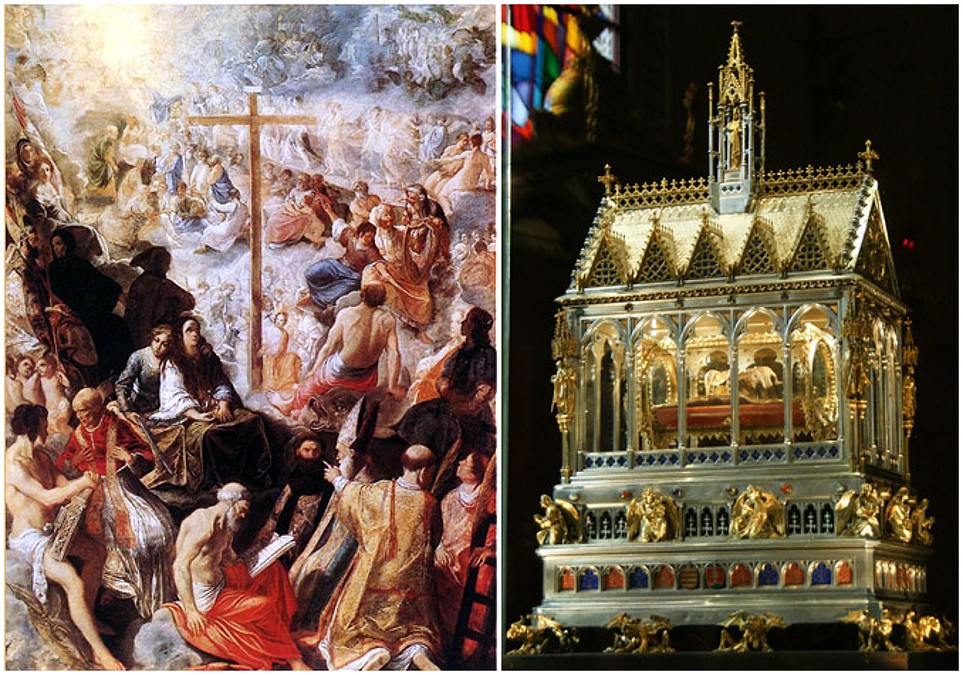
Left–Adoration of the Holy Cross by the Saints in Heaven; Right– Reliquary of St Stephen
“Christian people,” says St Gregory of Nyssa, “wherefore are you assembled here? A tomb has no attractions, nay, the sight of its contents inspires horror! Yet, see what eagerness to approach this sepulchre! So great an object of desire is it, that a little of the dust from around it is esteemed a gift of great price. As to beholding the remains it conceals, that is a rare favour and an enviable one, as those can testify who enjoy the privilege: they embrace the holy body as though it were yet alive, they press their lips and their eyes upon it, shedding tears of love and devotion. What emperor ever received such honour ”(Greg. Nyssa de Theodoro Mart)?”
“Emperors!” rejoins St John Chrysostom; “as the porters at their gates, such have they become with regard to poor fishers. The son of the great Constantine deemed he could not pay a higher honour to his father, than to procure him a place of sepulture in the porch of the fisherman of Galilee” (Chrys. in Epist. II. ad Cor. Hom. xxvi). And again, concluding his commentary on St Paul’s admirable Epistle to the Romans, the golden-mouthed Doctor exclaims: “And now, who will grant me to prostrate myself at Paul’s sepulchre, to contemplate the ashes of that body which, suffering for us, filled up what was wanting of the sufferings of Christ? The dust of that mouth, which spoke boldly before kings, and, showing what Paul was, revealed the Lord of Paul? The dust of that heart, truly the heart of the world, more lofty than the heavens, more vast than the universe, as much, the heart of Christ as of Paul and wherein might be read, the book of grace, graven by the Holy Spirit? Oh! that I might see the remains of the hands, which wrote those Epistles; of the eyes, which were struck with blindness and recovered their sight for our salvation; of the feet which traversed the whole earth! Yes. I would fain contemplate the tomb where repose these instruments of justice and of light, these members of Christ, this temple of the Holy Ghost. O venerable body, which, together with that of Peter, protects Rome more securely, than all ramparts” (Chrys. in Epist. ad Rom. Hom. xxxii)
Chains of St Peter
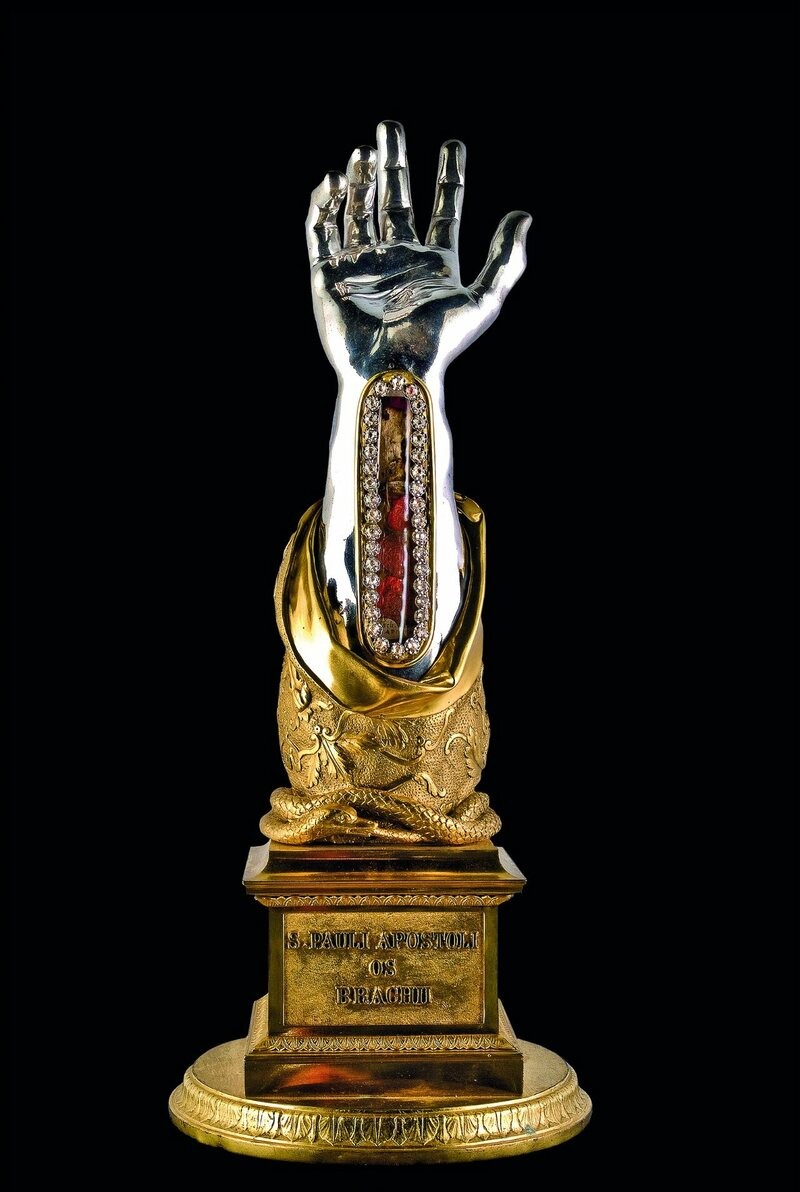
The wrist bone of St Paul held in Goza, Malta
In spite of such teachings as these, the heretics of the sixteenth Century profaned the tombs of the Saints, under pretext of bringing us back to the doctrine of our forefathers. In contradiction to these strange reformers, the Council of Trent expressed the unanimous testimony of Tradition, in the following definition, which sets forth the theological reasons of the honour paid by the Church, to the relics of Saints:,
“Veneration ought to be shown, by the faithful, to the bodies of the Martyrs and other Saints, who live with Jesus Christ. For they were His living members and the temples of the Holy Ghost; He will raise them up again to eternal life and glory and through them, God grants many blessings to mankind. Therefore, those who say that the relics of the Saints are not worthy of veneration, that it is useless for the faithful to honour them, that it is vain to visit the memorials or monuments of the Saints, in order to obtain their aid, are absolutely to be condemned and, as they have already been long ago condemned, (Conc. Nic. II. cap. vii), the Church now condemns them once more” (Conc. Tird. Sess. xxv. De invocatione, veneratione et reliquiis Sanctorum).
One Minute Reflection – 1 January – “Month of the Most Holy Name of Jesus” – – The Octave Day of the Nativity of Jesus and the Feast of the Circumcision of the Lord, Readings: Titus 2:11-15; Luke 2:21.
“At that time, after eight days were accomplished that the Child should be circumcised. His Name was called Jesus, which was called by the Angel before He was conceived in the womb.” – Luke 2:21
REFLECTION – “In the Old Law (Gen 22;12), it was required that every male child should, on the eighth day after his birth, be circumcised and thus admitted among God’s chosen people. The rite of circumcision in the Old Law, corresponded to the Sacrament of Baptism in the New Law and was the means of remitting original sin. Our Lord, although free from every sin, submitted to this rit,e in order to show, that He was a true Son of Abraham, to manifest respect and obedience to the established law and to prove that He had a real human body. At the time of circumcision, a name was given to the child. Our Lord was called Jesus, which signified His office as Saviour.On this Feast of the Circumcision, therefore, it is most appropriate that we should meditate on the first petition of the Lord’s prayer, “hallowed be thy name.” I. The first petition of the Lord’s Prayer. 1. In the opening words of the Lord’s Prayer we ask that God’s Name may be honoured, which shows that God’s glory should be our chief desire. 2. This petition does not mean, that God’s essential glory or perfection should be increased, nor that the honour given Him on earth, should be equal to that shown Him in heaven. II. The objects of this petition. We ask: 1. That we may praise God with our hearts and lips; 2. That those in error may be brought to recognise and revere His Church; 3. That sinners may be converted to His service; 4. That men may learn to refer all blessings to Him as to their Author and Source. CONCLUSION. Our conduct should be in conformity with this petition, I. Catholics must not cause the Name of God or of His Church to be profaned by their own evil words and, actions. 2. On the contrary, by clean speech and good example, Catholics ought to excite others to exalt the Name of God, to respect the Faith of Christ and to honour His Church. 3. Good resolutions for the New Year.” Excerrpt Catechism of the Council of Trent, (Part IV – Hallowed be Thy Name).
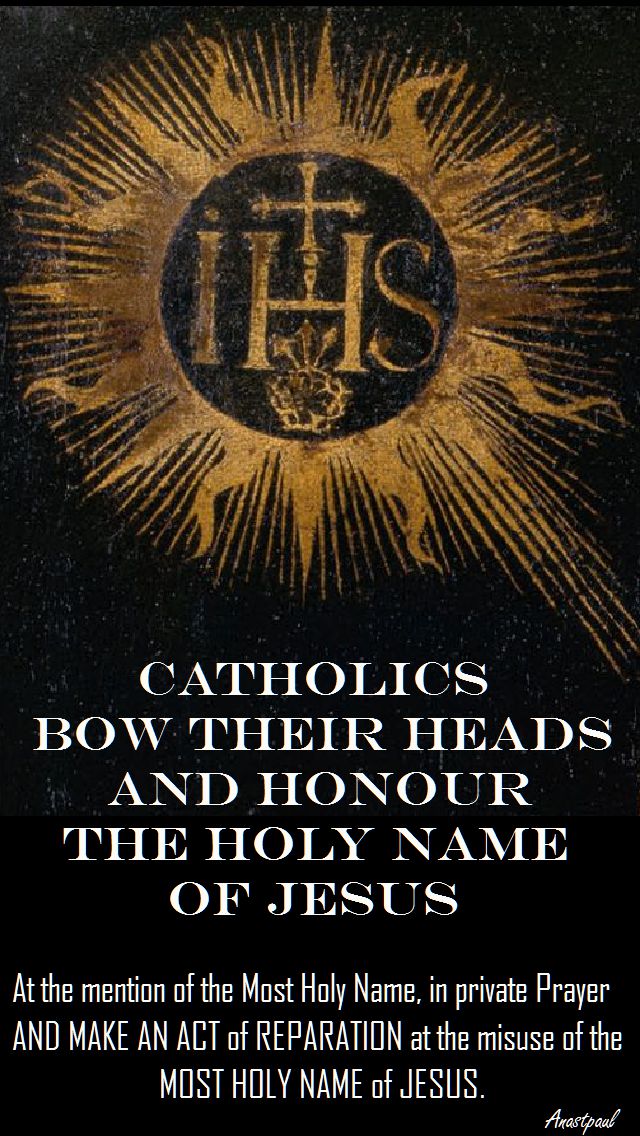
PRAYER – Almighty God and Father of our Lord Jeus Christ, may Your Name be hallowed on earth as it is in Heaven. May we bow our heads and revere and honour the Holy Name and teach others to do the same. We offer our hearts and penances in reparation to You for the blasphemies suffered each moment of each day and we resolve to do all in our power to amend this evil. We make our prayer, through Your Son, Jesus our Saviour in union with the Holy Spirit, God now and for all eternity, amen.
Sunday Reflection – 10 February – Fifth Sunday in Ordinary Time, Year C
Canons and Decrees of the Council of Trent Session the Thirteenth
Being the third under the Sovereign Pontiff Julius III., celebrated on the eleventh day of October, 1551.
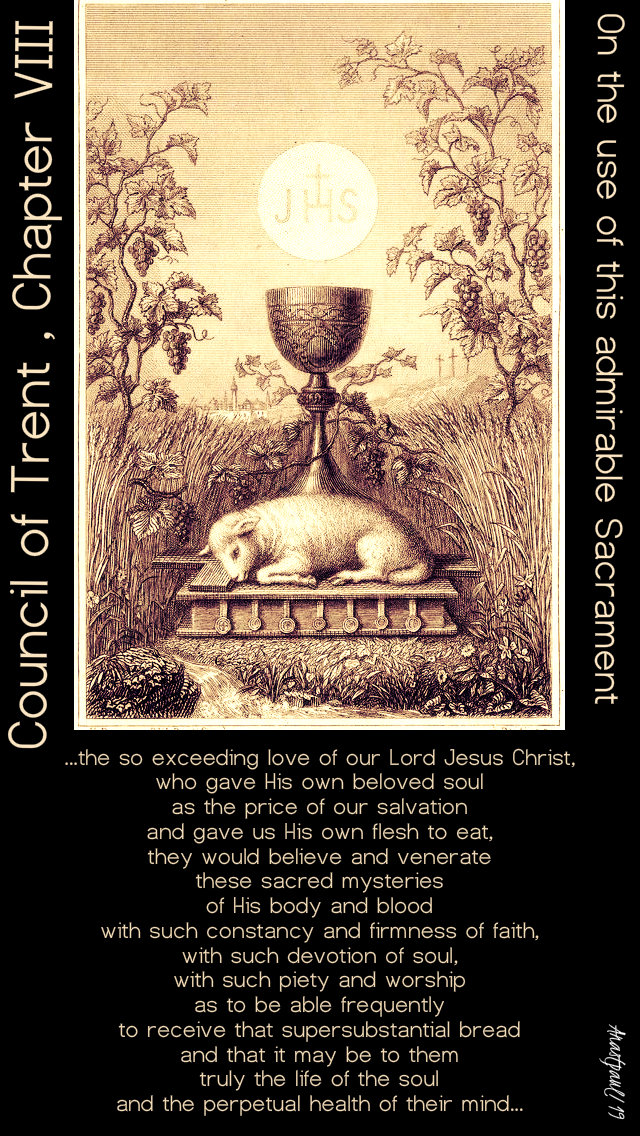
CONCERNING THE MOST HOLY SACRAMENT OF THE EUCHARIST Chapter VIII
On the use of this admirable Sacrament
…Finally this holy Synod with true fatherly affection admonishes, exhorts, begs and beseeches, through the bowels of the mercy of our God, that all and each of those who bear the Christian name would now at length agree and be of one mind in this sign of unity, in this bond of charity, in this symbol of concord and that, mindful of the so great majesty and the so exceeding love of our Lord Jesus Christ, who gave His own beloved soul as the price of our salvation and gave us His own flesh to eat, they would believe and venerate these sacred mysteries of His body and blood with such constancy and firmness of faith, with such devotion of soul, with such piety and worship as to be able frequently to receive that supersubstantial bread and that it may be to them truly the life of the soul and the perpetual health of their mind, that being invigorated by the strength thereof, they may, after the journeying of this miserable pilgrimage, be able to arrive at their heavenly country, there to eat, without any veil, that same bread of angels which they now eat under the sacred veils.




 AnaStpaul
You must be logged in to post a comment.