Posted in MARIAN REFLECTIONS, MOTHER of GOD, The IMITATION of MARY, Thomas a Kempis

Thought for the Day – 20 May – The Grandeurs and Tenderness of Mary

Thought for the Day – 20 May – The Imitation of the Blessed Virgin Mary By Thomas à Kempis (1380-1471)

Extracts from The Imitation
of the Blessed Virgin Mary
By Thomas à Kempis CRSA (1380-1471)
Imprimatur 17 February 1947
SERMON (VII)
The Eminent Dignity of the Mother Of God

I. In the suggestive language of poetry, when we compare God to the sun, we liken Mary to the moon, as the planet which comes immediately after the greatest.
Thus it is in reality – Mary is, after God, the most beautiful and the greatest marvel of the universe.
The dignity and the grandeur of a being is due to its functions.
What grandeur more sublime, what dignity more striking
than those of “Mother of God?”
The Greeks had created purposefully, in order to designate it, a word which applies only to Mary –Theotokos, “she who has brought forth God.

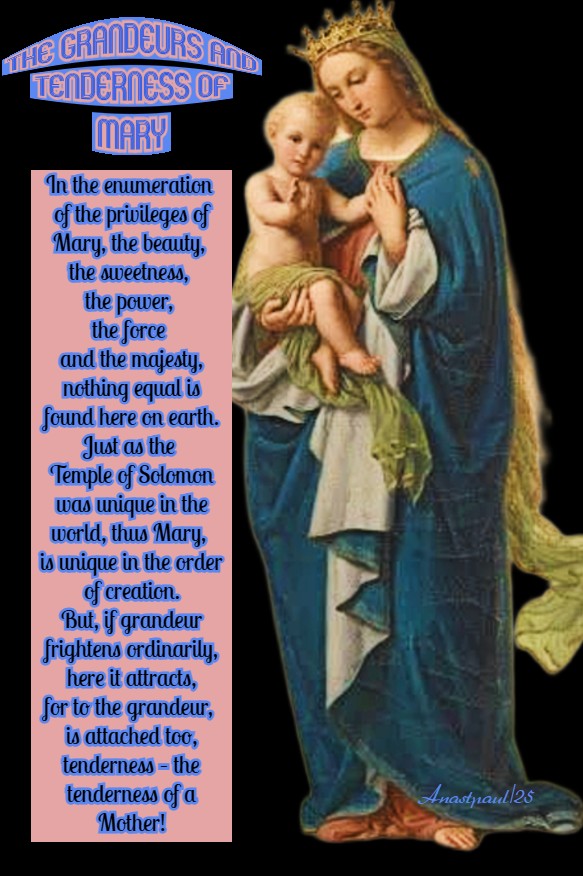
II. In the enumeration of the privileges of Mary, the beauty, the sweetness, the power, the force and the majesty, nothing equal is found here on earth.
Just as the Temple of Solomon was unique in the world, thus Mary, is unique in the order of creation.
But, if grandeur frightens ordinarily, here it attracts, for to the grandeur, is attached too, tenderness – the tenderness of a Mother
!

III. Hence, the Author asks Mary, in the final prayer, for the assistance of her power and the protection of her love – “Tutamen et solomen.”

MEDITATION
The Grandeurs and Tenderness of Mary

The enumeration of the privileges of Mary is her most beautiful eulogy, says St Germain.
Thou art, O my Mother, the panegyric of all the ages and of all spheres.
Thou ary great and thou art powerful, yjou art sovereign and thou art mistress, thou art Queen and thou art woman, thou art she, who is always named and thou
art she, who cannot be named at her worth.
Thou art the Mother and thou art the ineffable.
Thy tenderness is that of a virginal heart, inserted into the flesh of a Mother.
Just as the mother gives us both of her soul and of her body in forming us within her womb, thus thou gives us of thy heart and of thy substance when we receive Jesus, thy Son, in the Eucharist.
O inaccessible grandeur, O ineffable tenderness!

Practice:
Often recite the Litanies of the Holy Virgin which are
a summary of her privileges.

Thought:
O Mary, thou surpassest in greatness and sweetness, all
creatures – “Tn snpergressa es universas, O Maria! Thy sweetness extends throughout the universe, o Mary
!

Fr & Dr Célestin Albin de Cigala (1865-1928)
Faculty of Paris (1947)
Doctor of Theology and Philosophy

Posted in DANTE ALIGHIERI!, DOCTORS of the Church, FATHERS of the Church, MARIAN QUOTES, MARIAN REFLECTIONS, The IMITATION of MARY, Thomas a Kempis

Thought for the Day – 16 May – The Imitation of the Blessed Virgin Mary – The Beauties of Mary

Thought for the Day – 16 May – The Imitation of the Blessed Virgin Mary By Thomas à Kempis (1380-1471)

Extracts from The Imitation
of the Blessed Virgin Mary
By Thomas à Kempis CRSA (1380-1471)
Imprimatur 17 February 1947

SERMON (V)
Duty

I. Duty is a harsh word, when it designates the obligation which binds a man to his post.
It becomes a word full of sweetness, when it is applied to the voluntary attentions which the heart suggests for a loved one.
Our duties to Mary should be of this type.
These duties, extremely pleasing, are those of a son to his mother, of a friend to his friend.

The thought of Heaven is a force, as the thought of love is an allurement.
To raise one’s thoughts, is to raise oneself completely –Altius cogita (think higher).

II. It is in the life of the soul, as in the present life; to think
well, is the beginning of doing well.
To have great thoughts is to prepare for great actions. Mary’s example, in this case, is more than a demonstration, it is an attraction and an aid.
Mary, says the Gospel, kept all these things in her heart. As Pascal said, great thoughts come from the heart, it is they that create the action.
Too often has mysticism been reproached as being only a dream.
The mysticism of the Imitation, is an action, for it is perfection!

III. This action is arduous and often discouraging; besides, the soul begs Mary for confidence to be able to attain the goal of the spiritual life which is Heaven.

MEDITATION
The Beauties of Mary

The dream of every soul would be to see Mary in her heavenly splendour – Dante had this dream and tried to translate it into his Paradise. He represents Mary to us under the symbol of an aureole of pure gold and he refers to her only, by the names of flowers and nature – “blooming rose” “lily full of whiteness”, “perfumed stem” “fragrant tree”, “singing lyre” “sparkling sapphire” “soaring flame” “arc which riseth.”
He sees her only in the midst of flowers, surrounded by stars, crowned with splendours.
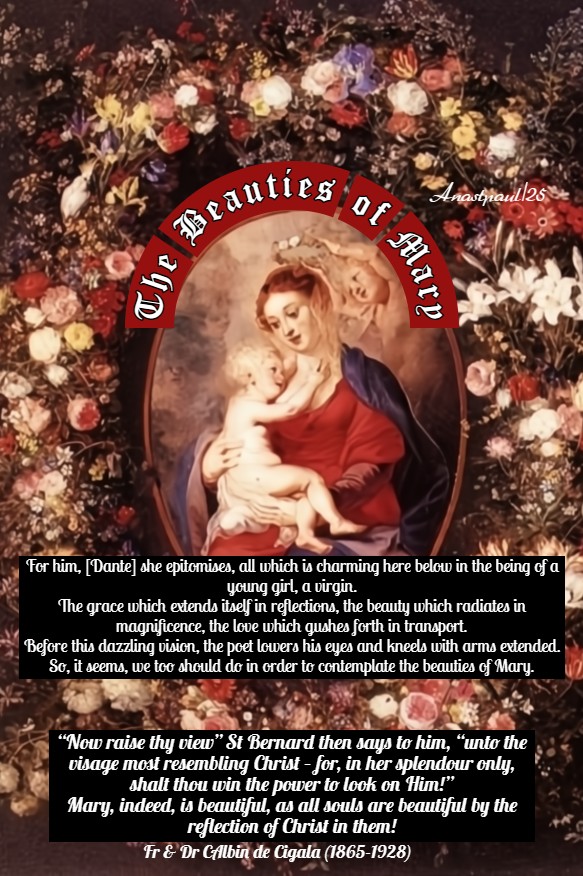
For him, she epitomises, all which is charming here below in the being of a young girl, a virgin.
The grace which extends itself in reflections, the beauty which radiates in magnificence, the love which gushes forth in transport.
Before this dazzling vision, the poet lowers his eyes and kneels with arms extended.
So, it seems, we too should do in order to contemplate the beauties of Mary.

“Now raise thy viewSt Bernard then says to him, unto the visage most resembling Christ – for, in her splendour only, shalt thou win the power to look on Him!”
Mary, indeed, is beautiful, as all souls are beautiful by the reflection of Christ in them!

Practice:
Imitate the Saints, who wore the shield and insignia of Mary, like the Scapular and the Rosary.

Thought:
The remembrance of Mary is an aid and a support –
Adjuvat et sublevat – it aids and consoles.

Fr & Dr Célestin Albin de Cigala (1865-1928)
Faculty of Paris (1947)
Doctor of Theology and Philosophy

Posted in MARIAN REFLECTIONS, MOTHER of GOD, QUOTES on TIME, St Francis de Sales, The IMITATION of MARY, Thomas a Kempis

Thought for the Day – 14 May – The Eminent Dignity of the Mother of God

Thought for the Day – 14 May – The Imitation of the Blessed Virgin Mary By Thomas à Kempis (1380-1471)

Extracts from The Imitation
of the Blessed Virgin Mary
By Thomas à Kempis CRSA (1380-1471)
Imprimatur 17 February 1947

SERMON
The Eminent Dignity of the Mother of God

I. The dignity of a person or of a being, is measured by its
function.
There is not on earth, nor even in Heaven, a function equal to that of the Divine Maternity of Mary.
Mary is truly Theotokos, Mother of God and, at the same time, Mother of the Saviour because, in Jesus, the Divinity and the Humanity are substantially united.
There is, therefore, no dignity superior to the dignity of Mary.

II. This eminent maternal dignity confers, on Mary, divine
prerogatives, at the same time, it infuses into her, human
tenderness superior to the most exquisite tenderness of mothers on earth.
Even from the viewpoint of the physical function, of the beauty of the woman and of the mother, Mary is, above all those who have been outstanding in the world by their charms and attractions.
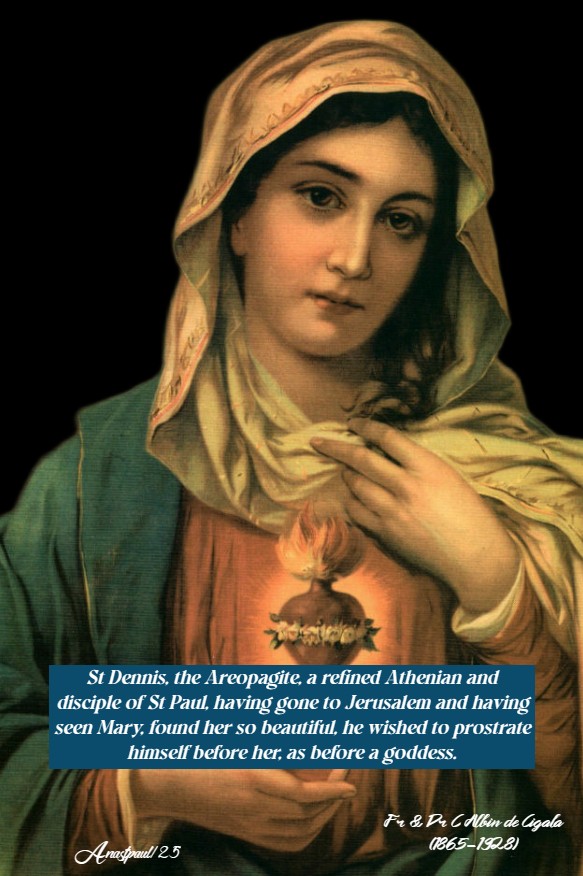
St Dennis, the Areopagite, a refined Athenian and disciple of St Paul, having gone to Jerusalem and having seen Mary, found her so beautiful, he wished to prostrate himself before her, as before a goddess.
Thus should we do in spirit!

III. It is what the disciple promises enthusiastically in the prayer addressed to Mary.

MEDITATION
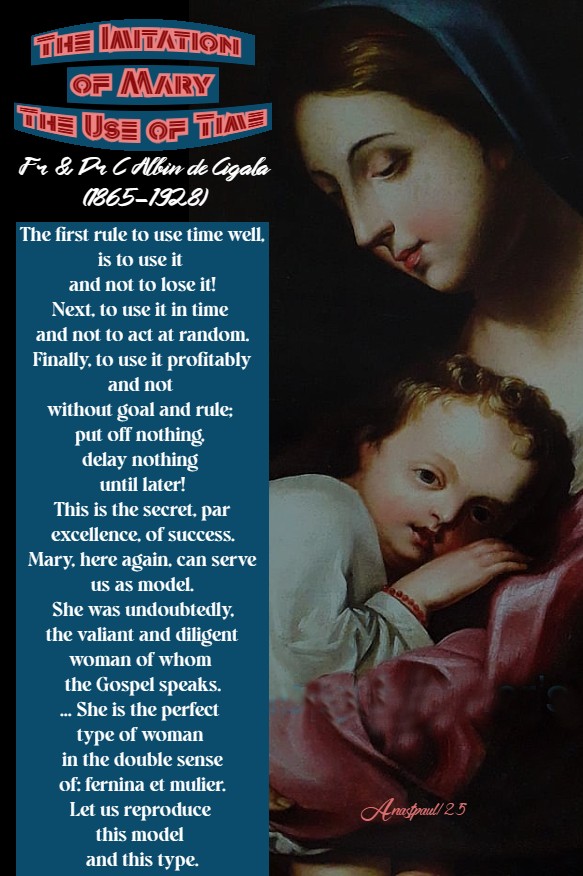
The Use of Time

Between the past which escapes us and the future which does not belong to us, there is the present which alone we possess.
This is the time of action and of duty.
To employ the present well, is to enrich your life; to waste it, is to die with it.
The first rule to use time well, is to use it and not to lose it!
Next, to use it in time and not to act at random.
Finally, to use it profitably and not without goal and rule; put off nothing, delay nothing until later!
This is the secret, par excellence, of success.
Mary, here again, can serve us as model.
She was undoubtedly, the valiant and diligent woman of whom the Gospel speaks.

She fulfilled, with perfection, the motto of the noble Romans.
Mary, indeed, was at once Israelite by birth and Roman by adoption.
She is the perfect type of woman in the double sense of: fernina et mulier.
Let us reproduce this model and this type.

Practice:
St Francis de Sales purchased by an alms, each hour
which he thought to have lost or misused – imitate
him!

Thought:
The thought of Mary is a consolation and a protection: “Solamen et dictarnen – Comfort and diration.

Fr & Dr Célestin Albin de Cigala (1865-1928)
Faculty of Paris (1947)
Doctor of Theology and Philosophy
Posted in MARIAN POETRY, MARIAN PRAYERS, MARIAN REFLECTIONS, The IMITATION of MARY, Thomas a Kempis

Thought for the Day – 13 May – The GRANDEURS and GLORIES of MARY

Thought for the Day – 13 May – The Imitation of the Blessed Virgin Mary By Thomas à Kempis (1380-1471)

Extracts from The Imitation
of the Blessed Virgin Mary
By Thomas à Kempis CRSA (1380-1471)
Imprimatur 17 February 1947

Chapter IV
The GRANDEURS and GLORIES of MARY

i. Who is she who rises from the emptiness of this world steeped in the delights of Paradise?
O Mary, greater than the heavens, thou hast the world under thy feet and thou art seated close to God, on the throne of honour which Jesus gave to thee.
Thy mercy which surpasses all mercy, draws me to thee, for thou art ever the aid and consolation of those who suffer.
I have need, O Mother, of being consoled and fortified. More than that, I have need of the grace of thy Son because I know, without it, I can accomplish nothing.
Thou art able, O my Mother, if thou wish, to lift me up and help me with thy powerful succour.
Thou canst comfort me with thine abundant consolation.
I feel myself engulfed by temptation, so I run to thee, since I feel that, near to thee, I shall find help as well as pity.

ii. And if I may approach thy majesty and greet thee with reverence and honour, I feel that I must approach thee with love.
There is no praise which I can offer thee; rather, I am forced to present to thee, supplication.
He who wishes to come near thee irreverently, will be confounded, therefore, I wish to come to thee, O Mother, with confidence, with respect, with humility, so as to merit thy clemency and thine aid.
Yes, it is with respect, with love and confidence I come, O Mary, to offer to thee, in my turn, the salutation the kneeling Angel offered thee.
I offer it to thee, arms extended and hands upraised, I offer it to thee, thousands and thousands of times and I beg everyone to offer it for me because, I know of nothing sweeter that I may give.

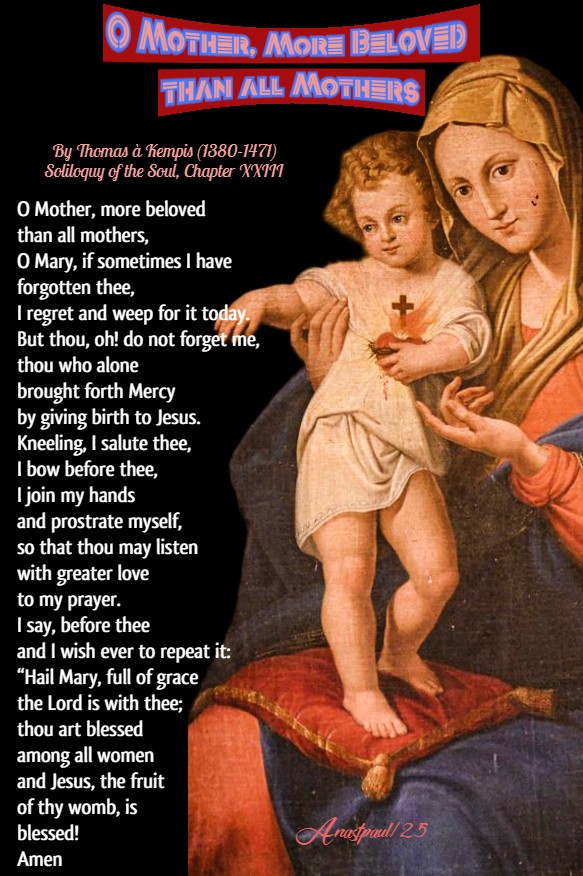
iii. Prayer: O Mother, More Beloved than All Mothers

O Mother, more beloved than all mothers,
O Mary, if sometimes I have forgotten thee,
I regret and weep for it today.
But thou, oh! do not forget me,
thou who alone brought forth Mercy
by giving birth to Jesus.
Kneeling, I salute thee,
I bow before thee, I join my hands
and prostrate myself,
so that thou may listen
with greater love to my prayer.
I say, before thee and I wish ever to repeat it:
“Hail Mary, full of grace the Lord is with thee;
thou art blessed among all women
and Jesus, the fruit of thy womb, is blessed!

(By Thomas à Kempis (1380-1471)
Soliloquy of the Soul, Chapter XXIII)

Translated by:
Fr & Dr Célestin Albin de Cigala (1865-1928)
Faculty of Paris (1947)
Doctor of Theology and Philosophy
Posted in MARIAN QUOTES, MARIAN REFLECTIONS, QUOTES on GOOD WORKS, QUOTES on Lukewarmness, The IMITATION of MARY, Thomas a Kempis

Thought for the Day – 12 May – The Active Life

Thought for the Day – 12 May – The Imitation of the Blessed Virgin Mary By Thomas à Kempis (1380-1471)

Extracts from The Imitation
of the Blessed Virgin Mary
By Thomas à Kempis CRSA (1380-1471)
Imprimatur 17 February 1947

SERMON
The Virtues a Good Servant of Mary
Ought to Practice
and the Offices He Ought to Fulfil

I. The Latins have two words to designate the good actions
to be accomplished in life. The word “virtus” in order to designate an action made with effort and goodwill and, the word “officium” in order to characterise an action accomplished as a duty but, without attachment of the heart.
That which is required here of a good servant of Mary, are virtues, which is to say, meritorious acts, élan of the heart and not only works which, domestics themselves can fulfil. There are firstly, the interior virtues – humility, patience and purity.

II. Afterwards there are the exterior virtues or virtues of action – effort in work, elevation of the mind, union in mental prayer, zeal in vocal prayer.

III. These united virtues ought to animate all practices of
devotion, if we wish these practices become spiritual acts of meritorious virtue and not only material offices of remunerated work.
Thus Mary acted; thus we ourselves should act.

IV. The servant, therefore, asks of Mary, who is a mother and a model, to aid him in this work and to console him amid the difficulties of the work.

MEDITATION
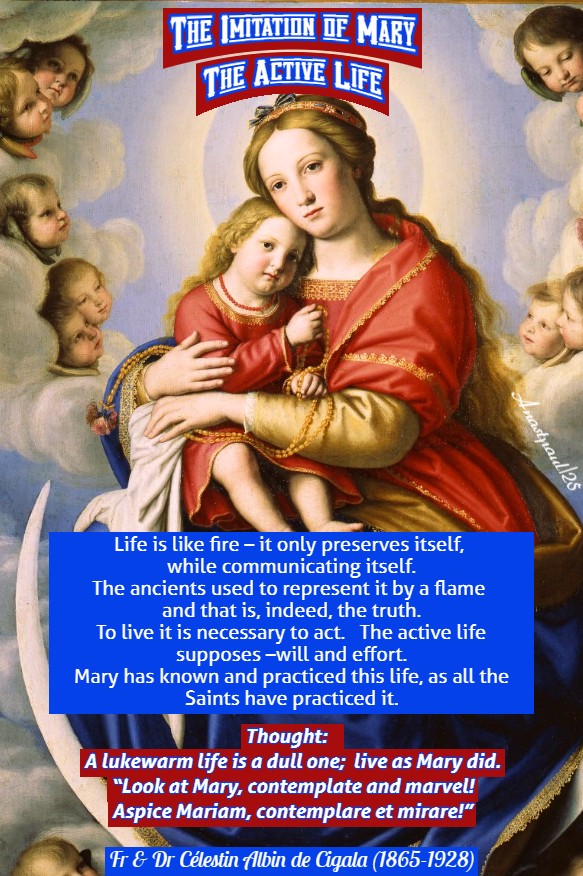
The Active Life

Life is like fire – it only preserves itself, while communicating itself.
The ancients used to represent it by a flame and that is, indeed, the truth.
To live it is necessary to act. The active life supposes –will and effort.
Mary has known and practiced this life, as all the Saints have practiced it.

Life which passes selfishly by, disillusions and engenders boredom; “taedium vitae.”
Unfortunate is the soul who permits himself to live, without rising! He will have lived most, who will have acted most, through his heart, through his soul and through his body, through love, through the mind and through works.
Is there a more beautiful model than Mary, in the Temple, at Nazareth, on Calvary, with St. John?
Such a one has lived long, who has lived little, said a wise man. Let us live like Mary and with Mary.

Practice: Do not allow a single day to pass without having
made an effort in at least one small thing.

Thought: A lukewarm life is a dull one; live as Mary did.
Look at Mary, contemplate and marvel!
Aspice Mariam, contemplare et mirare!

Fr and Dr Célestin Albin de Cigala (1865-1928)
Faculty of Paris (1947)
Doctor of Theology and Philosophy
Posted in MARIAN REFLECTIONS, MARIAN TITLES, OCTOBER - The HOLY ROSARY and The HOLY ANGELS, QUOTES on ETERNAL LIFE, QUOTES on HEAVEN, ROSARY QUOTES, ROSARY REFLECTIONS and QUOTES, The HOLY ROSARY/ROSARY CRUSADE, The IMITATION of MARY

Thought for the Day – 10 May – The Titles and Functions of Mary

Thought for the Day – 10 May – The Imitation of the Blessed Virgin Mary By Thomas à Kempis (1380-1471)

Extracts from The Imitation
of the Blessed Virgin Mary
By Thomas à Kempis CRSA (1380-1471)
Imprimatur 17 February 1947

PART ONE
THE JOYFUL MYSTERIES
Chapter II
OUR DUTIES TO MARY

SERMON
The Titles and Functions of Mary

I. Our duties toward Mary flow from the titles and functions of Mary herself. Her titles are the most beautiful and the most sweet – firstly, that of mother which one lovingly says at any age;
next, the title of model which one considers with admiration and joy.

II. Her functions are, in relation to her titles – the names
given by God are, at once, an evocation and a creation of the qualities signified by the names and titles themselves. Thus Mary, in virtue of her titles, exercises her functions of mother
who consoles, supports and nourishes, of advocate who counsels, directs and defends and lastly, of model, who exalts and attracts.

III. In a prayer exultant with joy and full of love, the faithful beg Mary to teach them to pray, as the Angels pray.
Prayer, here on earth, cries, weeps or is silent; prayer, in Heaven, is a vision, a contemplation and an ecstasy.

MEDITATION
The Supernatural Life

To live is to rise, it is to rise above the earth – see the flowers which live and those which are dead. Man loves to live so fully that he wishes to live a double life – hence, arises love which is the most beautiful possession on the earth.
This earthly existence is not, however, all of life.
There is the life of the soul, without which love itself is nothing.
Love which seems not to be immortal, does not satisfy the heart. The life which does not die is the supernatural life, the life of grace.
Mary has been given to us for a model and for a mother in this new life added to the earthly life.
He, who has not known this desire to rise still higher, has not as yet lived.
Let us live then, not in order to die but in order to attain immortality.

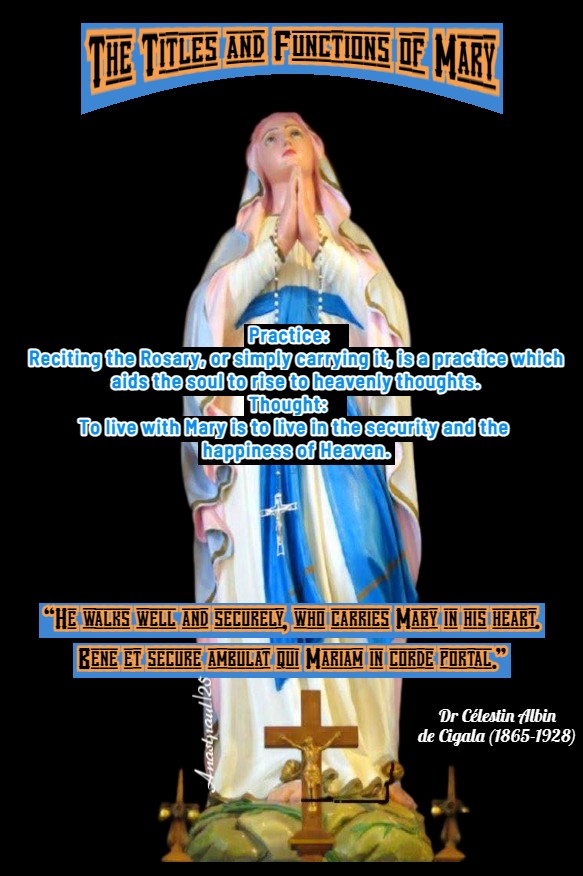
Practice: Reciting the Rosary, or simply carrying it, is a practice which aids the soul to rise to heavenly thoughts.

Thought: To live with Mary is to live in the security and the happiness of Heaven.
He walks well and securely, who carries Mary in his heart.
Bene et secure ambulat qui Mariam in corde portal.

Fr and Dr Célestin Albin de Cigala (1865-1928)
Faculty of Paris (1947)
Doctor of Theology and Philosophy
Posted in MARIAN REFLECTIONS, ON the SAINTS, QUOTES on LOVE, QUOTES on SANCTITY, QUOTES on SUFFERING, QUOTES on VICE, QUOTES on VIRTUE, The IMITATION of CHRIST, Thomas a Kempis

Thought for the Day – 8 May – The Model and Imitation – The Work of Sanctification

Thought for the Day – 8 May – The Imitation of the Blessed Virgin Mary By Thomas à Kempis (1380-1471)

Extracts from The Imitation
of the Blessed Virgin Mary
By Thomas à Kempis CRSA (1380-1471)
Imprimatur 17 February 1947

PART ONE
THE JOYFUL MYSTERIES
Chapter I

SERMON
The Model and Imitation

I. To imitate is to reproduce a model – but, the model can be larger or smaller than the reproduction. Thus, it is in the imitation of Jesus, of Mary and of the Saints.
The models in this case are greater than nature.
We can, nevertheless, succeed in resembling them by reproducing their life.

II. Life is a complexity of virtues and of faults, of forces and of instincts. Nothing is evil by nature but, according as one rises or falls, one becomes good or bad. It can be said that a middle way does not exist. One must choose vice or virtue.
To practice virtue an effort must be made; such is the meaning of the Latin word – “virtus.”

III. The Christian soul, in the face of the Divine model, Mary, exalts itself to the practice of the virtues which it admires in her, who is, at the same time, a sublime model and an admirable mistress, an example and a mother.

MEDITATION
The Work of Sanctification

It is a science, to know how to regard a model; it is an art, to be able to reproduce it. This art and this work, contain the whole secret of the spiritual life.
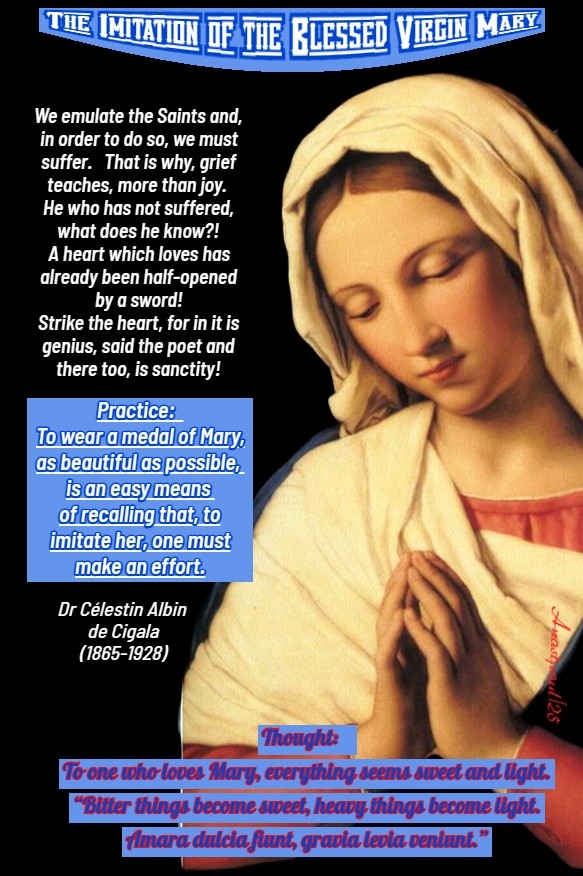
Consideration is meditation or contemplation, the study of Divine harmonies. We emulate the Saints and, in order to do so, we must suffer. That is why, grief teaches, more than joy. He who has not suffered, what does he know?!
A heart which loves has already been half-opened by a sword!
Strike the heart, for in it is genius, said the poet and there too, is sanctity
!

Practice: To wear a medal of Mary, as beautiful as possible, is an easy means of recalling that, to imitate her, one must make an effort.

Thought: To one who loves Mary, everything seems sweet and light.
Bitter things become sweet, heavy things become light.
Amara dulcia fiunt, gravia levia veniunt.

Dr Célestin Albin de Cigala (1865-1928)
Faculty of Paris
Doctor of Theology and Philosophy
Posted in MARIAN REFLECTIONS, The IMITATION of MARY

Thought for the Day – 5 May – The Imitation of the Blessed Virgin Mary

Thought for the Day – 5 May – “The Month of the Blessed Virgin Mary” – Extracts from The Imitation of the Blessed Virgin Mary
By Thomas à Kempis CRSA (1380-1471)

I am thrilled to explore this little book with you during Our Lady’s Month of May.

Extracts from The Imitation
of the Blessed Virgin Mary
By Thomas à Kempis CRSA (1380-1471)
Imprimatur 17 February 1947

PREFACE TO THE FRENCH EDITION

The Imitation of Christ, the most beautiful of books coming from the hand of man, ought to have, as a counterpart, The Imi¬ tation of Mary. However, we do not have it in a completely finished form; we only possess it scattered throughout the works of Thomas à Kempis.
The century which brought forth The Imitation of Christ— the 15th—is the century which saw completed, the greater part of the Gothic Churches dedicated to the Virgin in France and the Low Countries, from Notre Dame of Paris to the Cathedral of Cologne.
This is the most flourishing epoch of the cult of the Virgin, the golden age of devotion to Mary. The name of Mary is found ever at the side of that of Jesus, as, for example, on the standard of Jeanne d’Arc.

Besides, we notice with sorrow that the Author of The Imitation of Christ, does not speak a single te time of devotion to the Virgin Mary in this divine book which treats of all the subjects of Christian Mysticism.

Was it forgetfulness or negligence? Neither one nor the other.
Thomas à Kempis, Canon of Cologne and Abbe of Mount St Agnes, whose Church is dedicated to the Virgin, has written entire chapters on devotion to Mary in his divers works.
But the copyists who transcribed the first Books of The Imitation, finished by Kempis, thus leaving the fourth incomplete, did not know how to arrange the passages treating of the devotion to the Virgin Mary in the immense production of the Author.

The present work which is only the work of an analyst, we
have undertaken. We have been able to extract from the different works of Kempis, whole chapters on the devotion to Mary written in the same poetic and rhythmic language as is The Imitation. Everything seems to indicate that they were destined to form a Fifth Book of the Treatise on the Interior Life, following that of the Eucharist. One finds in it, the same doctrine of elevated theology and the same grace of poetry in its forms.

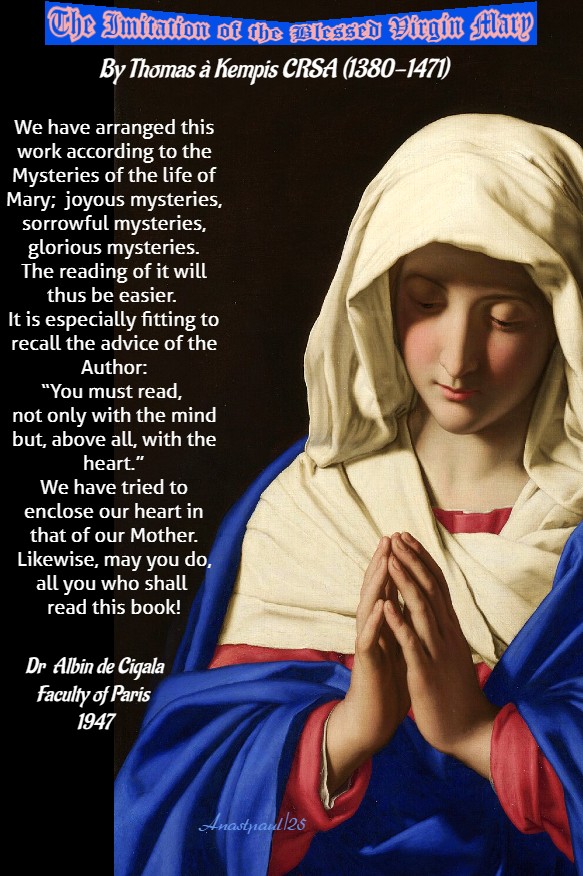
We have arranged this work according to the Mysteries of the life of Mary; joyous mysteries, sorrowful mysteries, glorious mysteries.
The reading of it will thus be easier. It is especially fitting to recall the advice of the Author: “You must read, not only with the mind but, above all, with the heart.
We have tried to enclose our heart in that of our Mother.
Likewise, may you do, all you who shall read this book!

Dr Albin de Cigala
Faculty of Paris, 1947
Doctor of Theology and Philosophy
NOTE: The sermons and meditations are the work of Dr de Cigala who comments on the Extract of Kempis in order to aid the reader to more fully derive its fruits.