Thought for the Day – 9 November – Meditations with Antonio Cardinal Bacci (1881-1971)
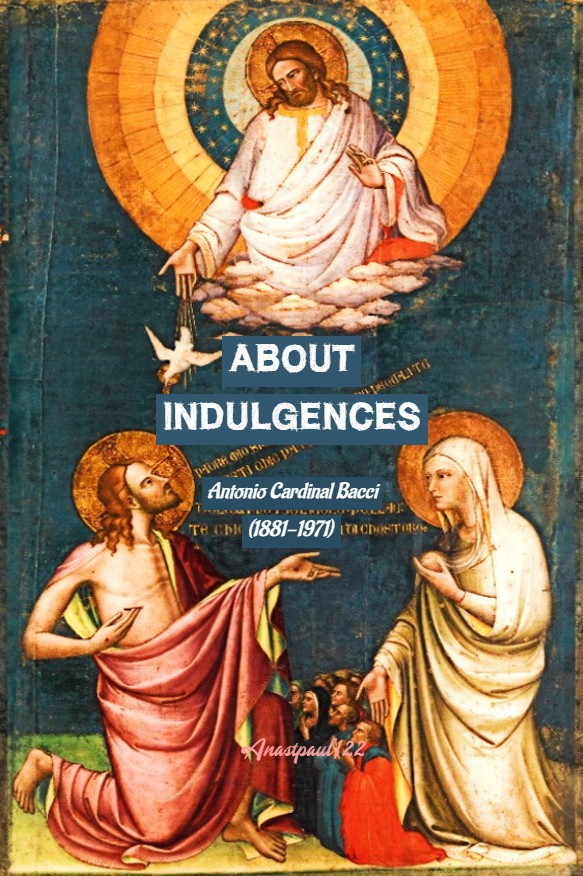
INDULGENCES
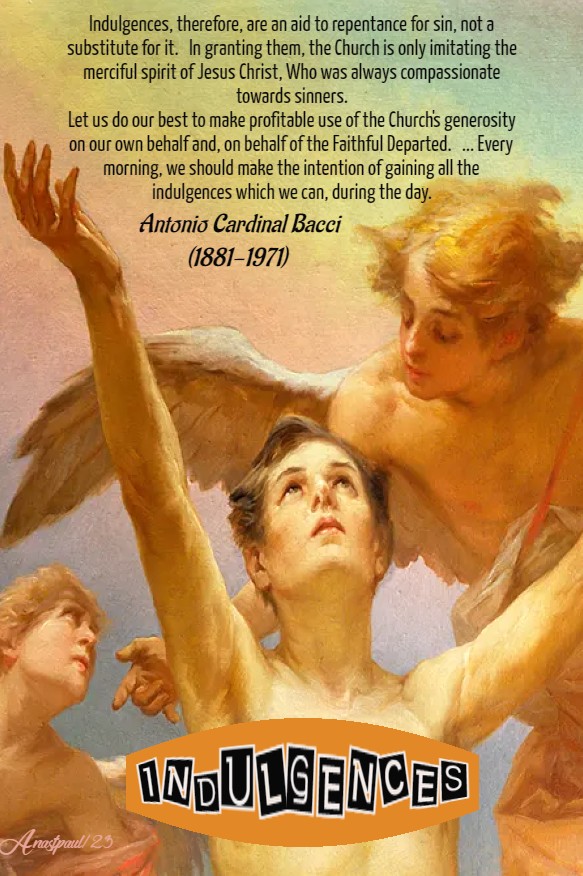
“Indulgences, therefore, are an aid to repentance for sin, not a substitute for it. In granting them, the Church is only imitating the merciful spirit of Jesus Christ, Who was always compassionate towards sinners.
Let us do our best to make profitable use of the Church’s generosity on our own behalf and, on behalf of the Faithful Departed. Let us observe the necessary conditions in order to gain as many Indulgences as possible.
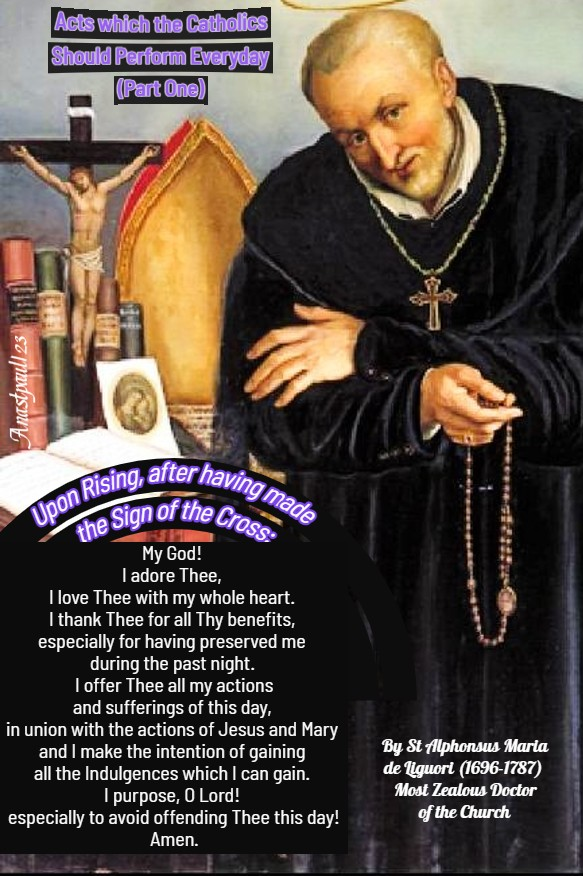
Every morning, we should make the intention of gaining all the indulgences which we can, during the day.”
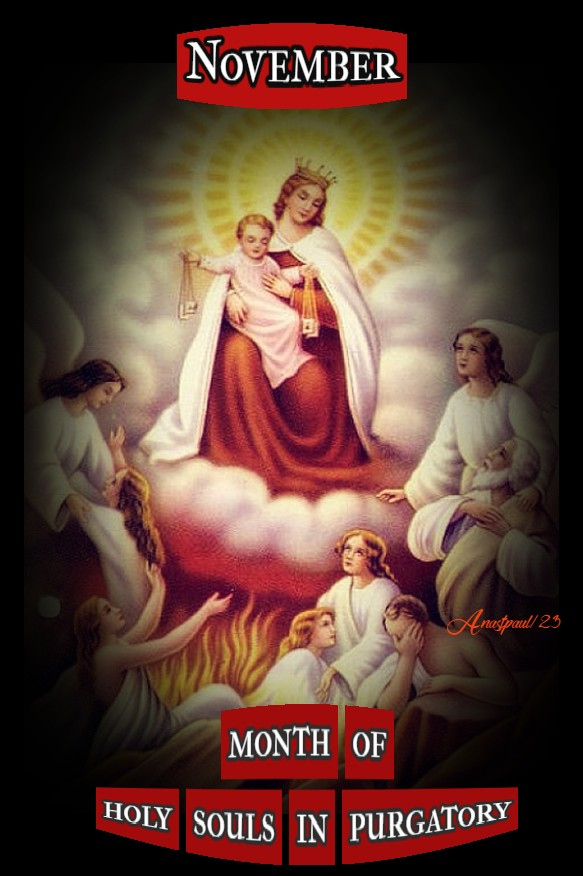
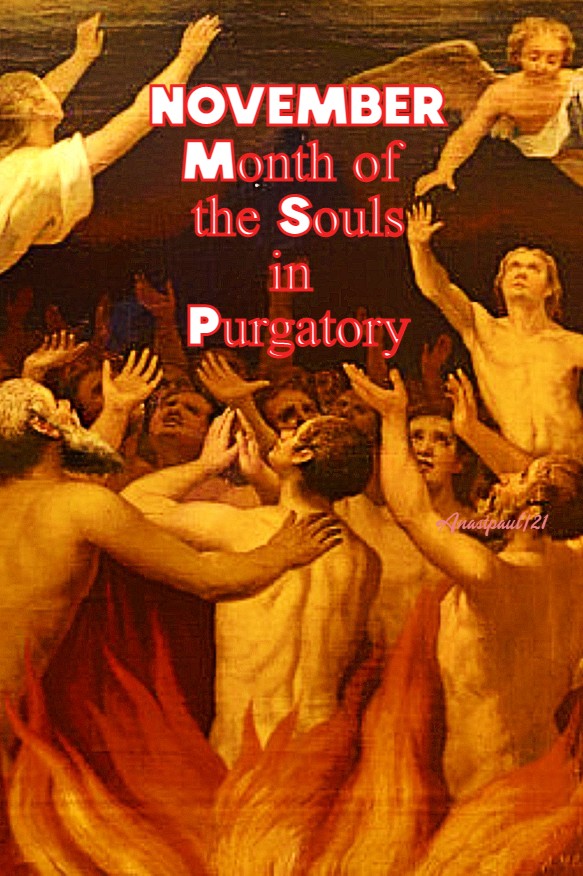
November The Month of “The Holy Souls in Purgatory” or of “The Church Suffering” or “The Faithful Departed”
Pope Clement XII. was the first who, in order to move the piety of Christians to pray for the souls in Purgatory, granted, by a Brief of 4 August 1736, Coelestes Ecclesiae thesauros – i. The Indulgence of 100 days to all the faithful, everytime that, at the sound of the bell, at the first hour after the evening Ave Maria, they say devoutly, on their knees, the psalm De profundis, with a Requiem Aeternamat at the end of, it. (The evening Ave Maria in Rome varies with the season; it is commonly taken as 6 o’clock.) ii. A Plenary Indulgence to those who perform this pious exercise, for a year, at the hour appointed, once in the year, on any one day, after Confession and Holy Communion. Those who do not know by heart the De Profundis, may gain these Indulgences by saying, in the way already mentioned for the De profundis, one Pater Noster and one Ave Maria, with the Requiem Aeternam. Observe also, that the aforesaid Clement XII. declared, on 12 December 1736, that these Indulgences might be gained by saying the De Profundis etc, as above, although, according to the custom of a particular Church or place, the “signal for the dead,” as it is called, be given by the sound of the bell either before, or after one hour after the evening Ave Maria. Pope Pius VI, by a Rescript of 18 March 1781, granted the above-named Indulgences to all the faithful, who should chance to dwell in any place where no bell for the dead is sounded and who, shall say the De Profundis or Pater Noster, as aforesaid, about the time specified above.
Applying Indulgences to the Faithful Departed
“By the practice of Indulgences, the Church places at the charitable disposal of the faithful, the inexhaustible treasure accumulated, from age to age, by the superabundant satisfactions of the Saints, added to those of the Martyrs and united to those of our Blessed Lady and the infinite residue of our Lord’s sufferings. These remissions of punishment, she grants to the living, by her own direct power but, she nearly always approves of and permits, their application to the dead, by way of suffrage, that is to say, in the manner in which, as we have seen, each of the faithful may offer to God, Who accepts it, for another, the suffrage or succour of his own satisfactions.” (The Liturgical Year,Abbot Prosper Guéranger OSB (1805-1875).
A Partial Indulgence may be obtained, by devoutly visiting a Cemetery and praying there for the departed, mentally or vocally. One may gain a Plenary Indulgence visiting a Cemetery each day, between 1 November and 8 November. These Indulgences are applicable only to the Souls in Purgatory.
A Plenary Indulgence, again applicable only to the Souls in Purgatory, is also granted when the faithful piously visit a Church or a public Oratory on 2 November. In visiting the Church or Oratory, it is required, that one Our Father and the Creed be recited and then the usual conditions are fulfilled, within 20 days.
A Partial Indulgence, applicable only to the Souls in Purgatory, can be obtained when the Eternal Rest (Requiem Aeternam) is prayed:
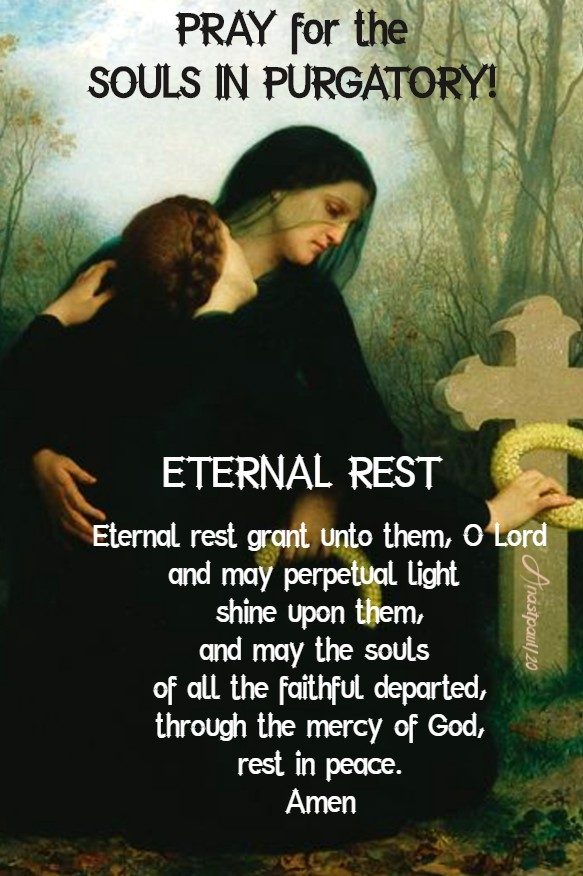
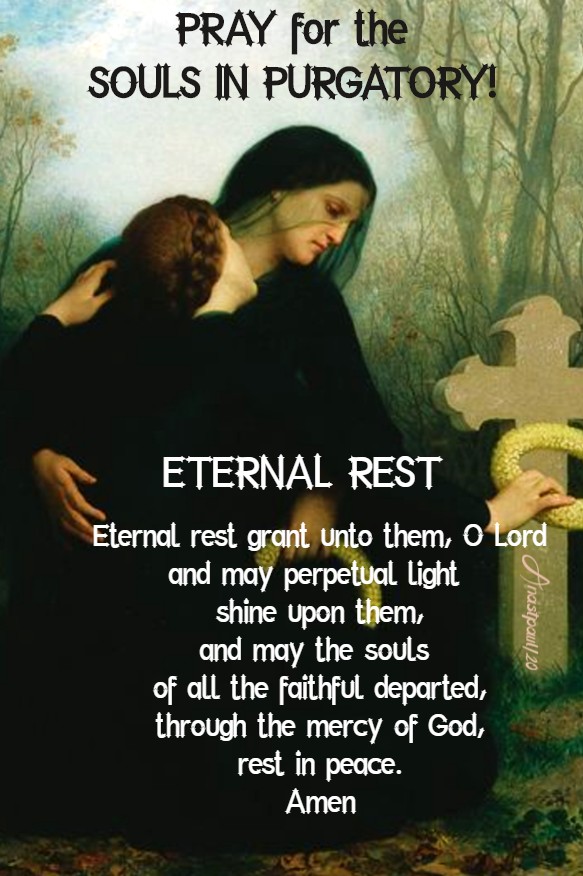
ETERNAL REST
Eternal rest grant unto them, O Lord and may perpetual light shine upon them and may the souls of all the faithful departed, through the mercy of God, rest in peace. Amen
1 June – Devotion for June – THE MONTH OF THE MOST SACRED HEART of JESUS
In 1899, Pope Leo XIII Consecrated the world to the Sacred Heart of Jesus. Since then, his successors have exhorted the faithful to turn to the Sacred Heart and make Acts of personal Consecration. They have also begged the faithful to offer prayers and penances to the Sacred Heart in reparation for the many sins of the world.
In his Encyclical on the Sacred Heart entitled Haurietis Aquas (“You Will Draw Waters”) Pope Pius XII notes that the genesis of the devotion to the Sacred Heart lies in the Covenant of Love from the Old Testament. He writes that “in the New Testament, the love which breathes from the Gospel, from the letters of the Apostles and the pages of the Apocalypse, all portray the Love of the Heart of Jesus.” He is linking this devotion to the Old Testament which was brought to life in Christ in the New Testament.
In the early 17th Century, Devotion to the Sacred Heart was given considerable attention in the preaching and writings of St John Eudes, known as “The Apostle of the Two Holy Hearts.”
St Francis (1567-1622) in his “Treatise on the Love of God,” lays out the foundation of the Devotion to the Sacred Heart. St Francis would greatly influence St Jane Frances de Chantal who was the Foundress of the Sisters of the Visitation of the Blessed Virgin Mary, the very Order which St Margaret Mary Alacoque VHM. (1647-1690), the Visionary of the Sacred Heart, would later join.
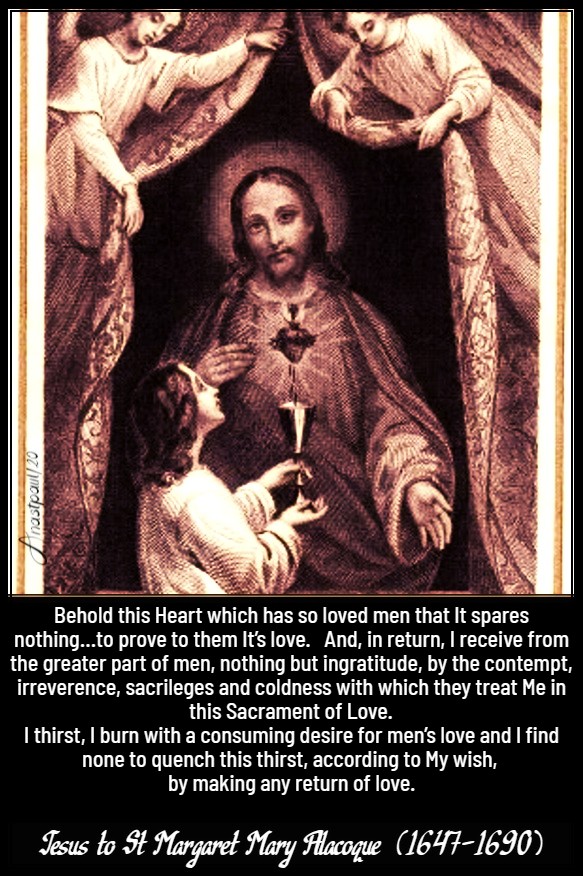
Our Lord appeared to St Margaret Mary, perhaps close to forty times. The first apparition occurred in the Visitation Chapel at Paray-le-Monial on 27 December 1673. The last apparition occurred less than two years later in June 1675. She saw His heart engulfed in flames and surrounded by thorns and heard His gentle voice:
“Behold this Heart which has so loved men that It spares nothing…to prove to them It’s love. And, in return, I receive from the greater part of men, nothing but ingratitude, by the contempt, irreverence, sacrileges and coldness with which they treat Me in this Sacrament of Love.
I thirst, I burn with a consuming desire for men’s love and I find none to quench this thirst, according to My wish, by making any return of love.”
From her cloister, St Margaret Mary promoted the Feast of the Sacred Heart of Jesus, First Friday Devotion, The Twelve Promises and the Holy Hour of Reparation.
The Sacred Heart Enthronement desires to follow in the footsteps of Saints who came before and hold true to the basic request of Jesus to St.Margaret Mary, “I will bless the home in which the Image of My Sacred Heart shall be exposed and honoured.”
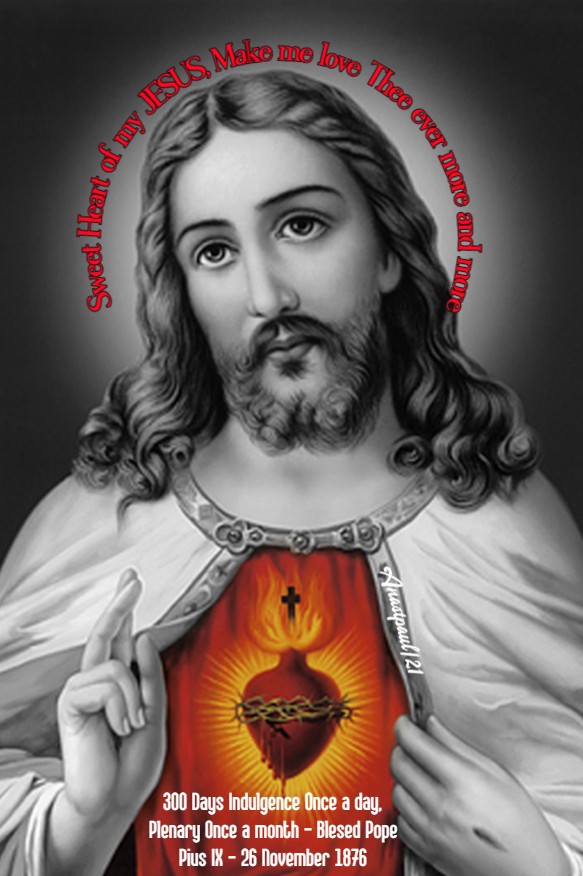
Sweet Heart of my JESUS, Make me love Thee ever more and more! –300 Days Indulgence Once a day, Plenary Once a month – Blessed Pope Pius IX – 26 November 1876
Thought for the Day – 9 November – Meditations with Antonio Cardinal Bacci (1881-1971)
INDULGENCES
“Indulgences, therefore, are an aid to repentance for sin, not a substitute for it. In granting them, the Church is only imitating the merciful spirit of Jesus Christ, Who was always compassionate towards sinners.
Let us do our best to make profitable use of the Church’s generosity on our own behalf and, on behalf of the Faithful Departed. Let us observe the necessary conditions in order to gain as many Indulgences as possible.
Every morning, we should make the intention of gaining all the indulgences which we can, during the day.”
Thought for the Day – 9 November – Meditations with Antonio Cardinal Bacci (1881-1971)
INDULGENCES
“Throughout the Centuries, Indulgences have been regulated by the authority of the Church which, in the course of the Council of Trent, (Session XXV Decr. de Indulg.) sanctioned their lawfulness and usefulness, for the Faithful, both living and dead. There is no question of innovation. It cam be said quite truly that the first Indulgence was granted by Jesus Himself, to the repentant thief! “This day,” He told him, “thou shalt be with me in Paradise.” By these words, Our Lord remitted, not only the sin and the eternal punishment, due to it but, also all temporal punishment. In the same way, an Indulgence was granted by St Paul, when he mitigated the punishment inflicted on the offender at Corinth (2 Cor 6-8).
Indulgences are called Plenary, when they remit all the temporal punishment due to sin and Partial, when it is the intention of the Church to release the sinner from whatever penalties would have been expiated, if he had done penance for a certain period of time, in accordance with the ancient discipline. No essential relaxation of practice is intended because the Church always demands that the sinner should first ensure that he is in the state of grace, by making a good Confession. As the Council of Trent insists, he should be sincerely repentant. The Church requires, moreover, that in order to gain a Plenary Indulgence, the penitent should be detached from all affections, even towards deliberate venial sin!”
“By the practice of Indulgences, the Church places at the charitable disposal of the faithful, the inexhaustible treasure accumulated, from age to age, by the superabundant satisfactions of the Saints, added to those of the Martyrs and united to those of our Blessed Lady and the infinite residue of our Lord’s sufferings. These remissions of punishment, she grants to the living, by her own direct power but, she nearly always approves of and permits, their application to the dead, by way of suffrage, that is to say, in the manner in which, as we have seen, each of the faithful may offer to God, Who accepts it, for another, the suffrage or succour of his own satisfactions.” (The Liturgical Year,Abbot Prosper Guéranger OSB (1805-1875).
A Partial Indulgence may be obtained, by devoutly visiting a Cemetery and praying there for the departed, mentally or vocally. One may gain a Plenary Indulgence visiting a Cemetery each day, between 1 November and 8 November. These Indulgences are applicable only to the Souls in Purgatory.
A Plenary Indulgence, again applicable only to the Souls in Purgatory, is also granted when the faithful piously visit a Church or a public Oratory on 2 November. In visiting the Church or Oratory, it is required, that one Our Father and the Creed be recited and then the usual conditions are fulfilled, within 20 days.
A Partial Indulgence, applicable only to the Souls in Purgatory, can be obtained when the Eternal Rest (Requiem aeternam) is prayed:
ETERNAL REST
Eternal rest grant unto them, O Lord and may perpetual light shine upon them and may the souls of all the faithful departed, through the mercy of God, rest in peace. Amen
Thought for the Day – 9 November – Meditations with Antonio Cardinal Bacci (1881-1971)
INDULGENCES
“Indulgences are among the means by which we can help to satisfy the Divine Justice for our own offences and for those of the faithful depared.
Unfortunately, very few Christians understand the true nature of indulgences. As a result, they neglect to fulfil the conditions necessary to gain them.
Canon Law defines an indulgence as “the remission in the sight of God of the temporal punishment due to sins already forgiven, which, the proper ecclesiastical authority concedes from the treasury of the Church, for the living, by way of absolution and for the dead, by way of suffrage” (Canon 911). The main requirement is to be in the state of grace, which sinners can attain by means of the Sacrament of Penance, or by an Act of PERFECT CONTRITION. If properly made, Confession takes away sin and eternal punishment but, not temporal punishment. This may be cancelled by means of penance, prayer and good works. In the early days of the Church, the penitential system was most severe (I wish it were so again!) According to the degree of gravity, different sins drew penances of days, weeks or months of fasting on bread and water. As times changed, the Church reduced these penalties and granted indulgences instead.
What we may ask, is the theological basis for these indulgences? It is the spiritual treasury which is at the disposal of the Church, made up of the infinite merits of our Redeemer and added to, by the merits of the Blessed Virgin and the Saints. These merits are communicated to us by the Church by reason of the consoling Dogma of the Communion of Saints, according to which, the Church Militant, Suffering and Triumphant, constitutes one Mystical Body of which Jesus Christ is the Head.
The Church has power to dispose of this immense treasure by reason of the injunction given to her by her Founder, when He said to St Peter: “Whatever thou shalt bind on earth shall be bound in heaven and whatever thou shalt loose on earth shall be loosed in heaven” (Mt 16:19). There are no reservations – the injunction applies, not only to sin but, also to its punishment. It is clear that indulgences are not merely a dispensation from the penitential discipline in the eyes of the Church, as certain heretics held and still hold but also, in the sight of God. Indulgences reflect, both the mercy and the justice of God. They reflect His justice because complete satisfaction is rendered by the merits of Jesus Christ. They reflect His mercy because these merits are applied to us poor sinners and also, by way of suffrage, to the souls of our departed friends.”
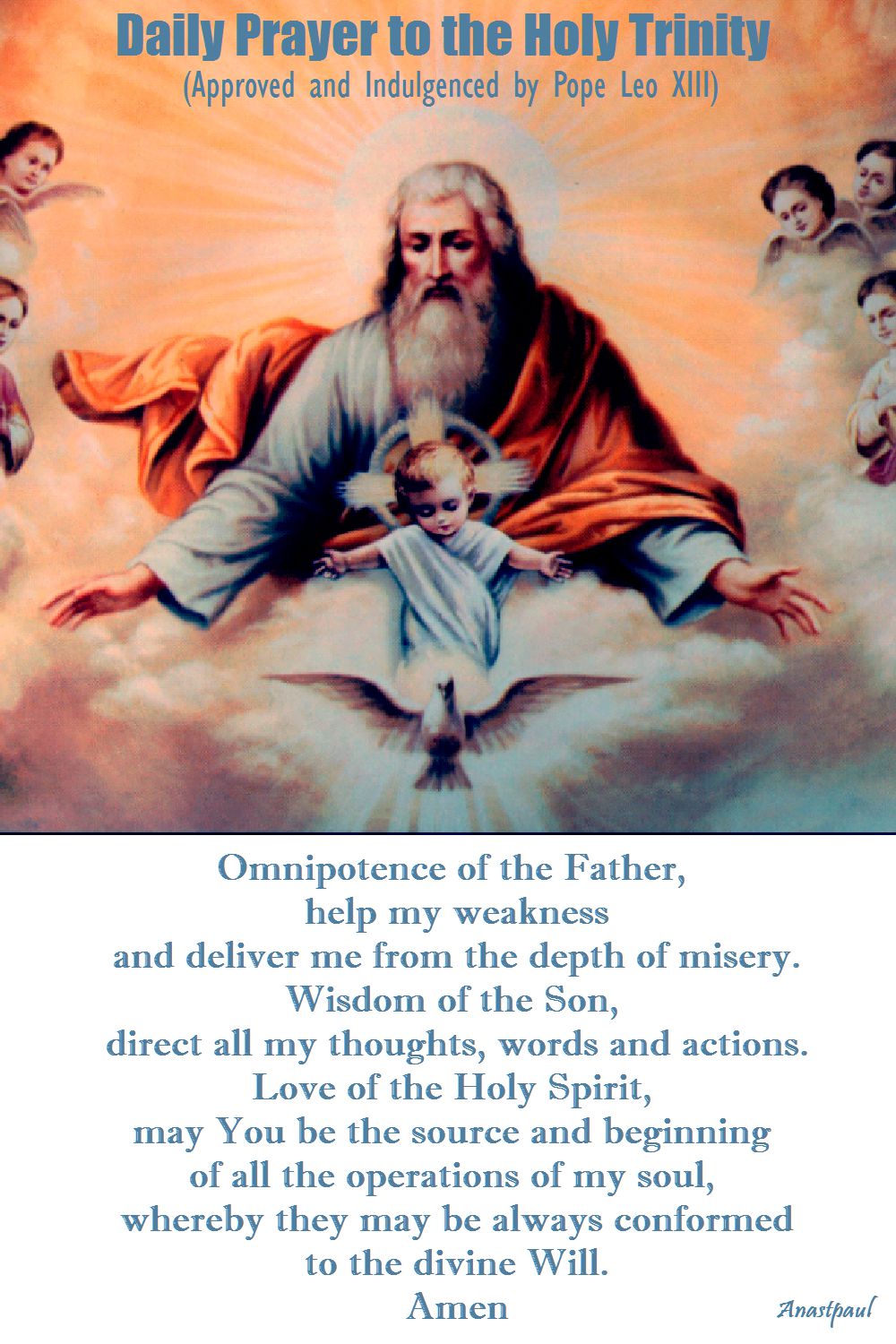
Omnipotence of the Father,
help my weakness
and deliver me from the depth of misery.
Wisdom of the Son,
direct all my thoughts, words and actions.
Love of the Holy Spirit,
may You be the source and beginning
of all the operations of my soul,
whereby they may be always conformed
to the divine Will.
Amen






 AnaStpaul
You must be logged in to post a comment.