Solemnity of The Nativity of Saint John the Baptist – 24 June
Ordinarily the Church observes the day of a saint’s death as his feast, because that day marks his entrance into heaven. To this rule there are two notable exceptions, the birthdays of Blessed Mary and of St John the Baptist. All other persons were stained with original sin at birth, hence, were displeasing to God. But Mary, already in the first moment of her existence, was free from original sin (for which reason even her very conception is commemorated by a special feast) and John was cleansed of original sin in the womb of his mother. This is the dogmatic justification for today’s feast. In the breviary St. Augustine explains the reason for today’s observance in the following words:
“The Church observes the birth of John as in some way sacred; and you will not find any other of the great men of old whose birth we celebrate officially. We celebrate John’s, as we celebrate Christ’s. This point cannot be passed over in silence and if I may not perhaps be able to explain it in the way that such an important matter deserves, it is still worth thinking about it a little more deeply and fruitfully than usual.

John is born of an old woman who is barren; Christ is born of a young woman who is a virgin. That John will be born is not believed and his father is struck dumb; that Christ will be born is believed and he is conceived by faith.
I have proposed some matters for inquiry and listed in advance some things that need to be discussed. I have introduced these points even if we are not up to examining all the twists and turns of such a great mystery, either for lack of capacity or for lack of time. You will be taught much better by the one who speaks in you even when I am not here; the one about whom you think loving thoughts, the one whom you have taken into your hearts and whose temple you have become.
John, it seems, has been inserted as a kind of boundary between the two Testaments, the Old and the New. That he is somehow or other a boundary is something that the Lord himself indicates when he says, The Law and the prophets were until John. So he represents the old and heralds the new. Because he represents the old, he is born of an elderly couple; because he represents the new, he is revealed as a prophet in his mother’s womb. You will remember that, before he was born, at Mary’s arrival he leapt in his mother’s womb. Already he had been marked out there, designated before he was born; it was already shown whose forerunner he would be, even before he saw him. These are divine matters and exceed the measure of human frailty. Finally, he is born, he receives a name and his father’s tongue is loosed.
Zachary is struck dumb and loses his voice, until John, the Lord’s forerunner, is born and releases his voice for him. What does Zachary’s silence mean but that prophecy was obscure and, before the proclamation of Christ, somehow concealed and shut up? It is released and opened up by his arrival, it becomes clear when the one who was being prophesied is about to come. The releasing of Zachary’s voice at the birth of John has the same significance as the tearing of the veil of the Temple at the crucifixion of Christ. If John were meant to proclaim himself, he would not be opening Zachary’s mouth. The tongue is released because a voice is being born – for when John was already heralding the Lord, he was asked, Who are you and he replied I am the voice of one crying in the wilderness.
John is the voice but the Lord in the beginning was the Word. John is a voice for a time, but Christ is the eternal Word from the beginning.”
This reading on the Birth of John the Baptist is taken by a sermon of St. Augustine (Sermo 293, 1-3; PL 38, 1327-1328) that compares and contrasts Christ, the Word, with John, the voice who is the boundary between New and Old Covenants. It is used in the Roman Office of Readings for June 24, the Solemnity of the Birth of John the Baptist.

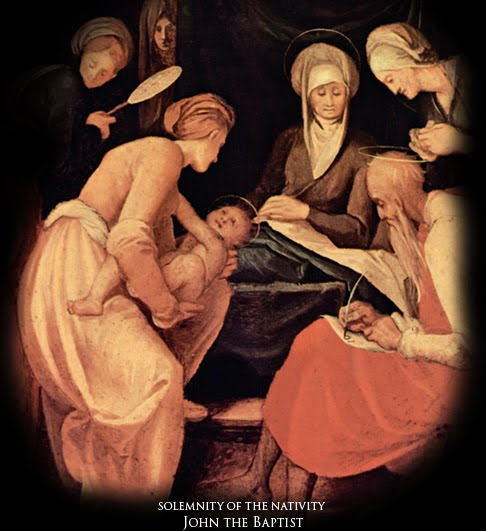
AII78336 The Birth of St. John the Baptist; by Bugiardini, Giuliano (1475-1554); Galleria e Museo Estense, Modena, Italy; Italian, out of copyright
In other words, today’s feast anticipates the feast of Christmas. Taking an overall view, we keep during the course of the year only two mysteries, that of Christ’s Incarnation and that of His Redemption. The Redemption mystery is the greater of the two; the Incarnation touches the human heart more directly. To the Redemption mystery the entire Easter season is devoted, from Septuagesima until Pentecost; and likewise every Sunday of the year, because Sunday is Easter in miniature.
The Christmas season has for its object the mystery of God-become-Man, to which there is reference only now and then during the remaining part of the year, e.g., on Marian feasts, especially that of the Annunciation (March 25) and today’s feast in honour of the Baptist. In a sense, then, we are celebrating Christ’s incarnation today. The birth of Jesus is observed on December 25 at the time of the winter solstice, while the birth of His forerunner is observed six months earlier at the time of the summer solstice. Christmas is a “light” feast; the same is true today. The popular custom centering about “St. John’s Fire” stems from soundest Christian dogma and could well be given renewed attention. St. John’s Fire symbolizes Christ the Light; John was a lamp that burned and shone. We Christians should be the light of the world.
Excerpted from The Church’s Year of Grace, Pius Parsch







 AnaStpaul
You must be logged in to post a comment.