
Passion Wednesday – 25 March – Our Lenten Journey With St Thomas Aquinas (1225-1274) Doctor of the Church
Passion Wednesday
On Being Buried Spiritually
“You are dead with Christ, to the things which are vain and fleeting and your life is hidden with Christ in God”
Col iii. 3
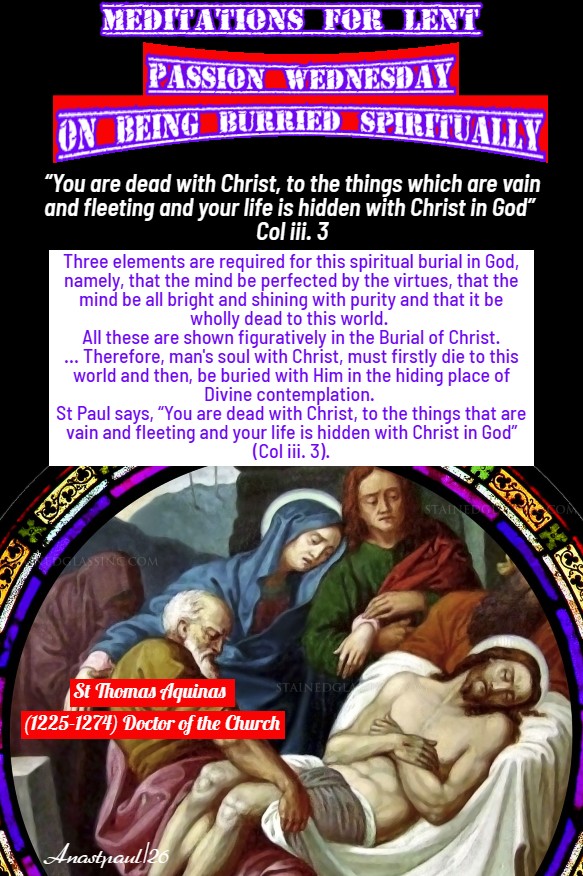
Col iii. 3
The Sepulchre is a figure by which is signified the contemplation of heavenly things.
So, St Gregory, commenting on the words of Job (iii. 22), They rejoice exceedingly when they have found the grave, says, “As in the grave the body is hidden away when dead, so in Divine contemplation, there lies concealed the soul, dead to the world. There, at rest from the world’s clamour, it lies, in a three days burial through, as it were, its triple immersion in Baptism. Thou shalt hide them in the secret of Thy Face from the disturbance of men (Ps xxx. 21). Those in great trouble, tormented by the hates of men, enter the Presence of God in spirit and then, are at rest.”
Three elements are required for this spiritual burial in God, namely, that the mind be perfected by the virtues, that the mind be all bright and shining with purity and that it be wholly dead to this world.
All these are shown figuratively in the Burial of Christ.
The first is shown in St Mark’s Gospel where we read how Mary Magdalene anointed Our Lord for His Burial by anticipation, as it were. “She hath done what she could, she is come beforehand to anoint My Body for the Burial” (Mark xiv. 8).
The ointment of precious spikenard (ibid iii) stands for the virtues, for it is a thing very precious and, in this life, nothing is more precious than the virtues.
The soul who wishes to be holy and to be buried in Divine contemplation, must first then. anoint itself by the exercise of the virtues.
Job (v. 26) says, “Thou shalt enter into the grave in abundance and the Gloss explains the grave as meaning here, ‘divine contemplation’ as a heap of wheat is brought in its season and the explanation given in the Gloss is that eternal contemplation is the prize of a life of action and, therefore, it must be that the perfect, first of all, exercise their souls in the virtues and then, afterwards, bury them in the barn where all quiet is gathered.
The second of the three elements required, is also noted in St Mark, where we read (xv. 46) that Joseph bought a winding sheet that is, a sheet of fine linen which is only brought to its dazzling whiteness with great labour.
Hence, it signifies that brightness of the soul, which also is not perfectly attained except with great labour. “He who is just, let him be justified still”(Apoc xxii. 11).
“Let us walk in newness of life” (Rom vi. 4), going from good to better, through the justice inaugurated by faith to the glory for which we hope.
Therefore, it is that men, bright with a spotless interior life, should be buried in the sepulchre of Divine contemplation. St Jerome, commenting on the words, “Blessed are the clean of heart, for they shall see God” (Matt v. 8), says, “The clean Lord, is seen by the clean of heart.”
The third point for consideration is given by St John where, in his Gospel (xix. 30), he writes, “Nicodemus came too, bringig a mixture of myrrh and aloes, about a hundred pound weight.”This hundred pounds weight of myrrh and aloes, brought to preserve the Dead Body, symbolises that perfect mortification of the external senses, the means by which the spirit, dead to the world, is preserved from the vices which would corrupt it.
Although our outward man is corrupted, yet the inward man is renewed day by day (2 Cor. iv. 16), which is as much as to say, the inward man is most thoroughly purified from vices by the fire of tribulation.
Therefore, man’s soul with Christ, must firstly die to this world and then, be buried with Him in the hiding place of Divine contemplation.
St Paul says, “You are dead with Christ, to the things which are vain and fleeting and your life is hidden with Christ in God” (Col iii. 3).
ST THOMAS AQUINAS (1225-1274)
Priest, Theologian, Dominican
Doctor Angelicus (Angelic Doctor)
Doctor Communis (Common Doctor)
Added by Pope Saint Pius V in 1568

 AnaStpaul
You must be logged in to post a comment.