St Nostrianus of Naples St Theodosius of Vaison St Valentine of Terni
St Vitale of Spoleto
Martyrs of Terni: Three Christians who gave proper burial to Saint Valentine of Terni. Martyred in the persecutions of Aurelius. 273 in Terni, Italy – Apollonius, Ephebus, Proculus.
Martyrs of Alexandria: A group of Christians murdered in various ways for their faith in Alexandria, Egypt. We know the names and a few details about 16 of them – Agatho, Agatone, Ammonio, Ammonius, Antonius, Bassiano, Bassianus, Cirione, Cyrio, Dionysius, Dionysius, Lucio, Moses, Moses, Proto and Tonione.
St Cuán of Airbhre St Elilantus St Etto Bl Euménios St Lantfrid Bl Marie-Gertrude de Ripert d’Alauzier Bl Parthenios St Pascharius of Nantes St Peter Vincioli St Sylvanus of Pisidia Bl Sylvie-Agnès de Romillon St Waltram
Martyrs of Africa – 4 Saints: A group of Christians Martyred together in Africa. The only information that has survived are four of their names – Felix, Januarius, Marinus and Nabor.
Martyrs of Antioch – 10 Saints: A group of ten Christians Martyred together. We have no details about them but the names – Diogenes, Domnina, Esicius, Macarius, Maxima, Maximus, Rodigus, Timoteus, Veronia and Zacheus. They were martyred in Antioch, date unknown.
Martyrs of Damascus – 11 Beati: A group of Franciscans and laymen ordered by Druz Muslims to convert to Islam. They refused and were hacked to pieces. • ‘Abd Al-Mu’ti Masabki • Carmelo Bolta Bañuls • Engelbert Kolland • Francisco Pinazo Peñalver • Fransis Masabki • Juan Jacobo Fernández y Fernández • Manuel Ruiz López • Nicanor Ascanio de Soria • Nicolás María Alberca Torres • Pedro Soler Méndez • Rufayil Masabki They were cut to pieces on 9-10 July 1860 in Damascus, Syria. Beatified on 10 October 1926 by Pope Pius XI.
Martyrs of Nicopolis – 45 Saints: A group of 45 Christians tortured and Martyred together in the persecutions of emperor Licinius. We know nothing else but six of their names – Anicetus, Anthony, Daniel, Leontius, Mauritius and Sisinno. c 329 in Nicopolis, Armenia (modern Koyulhisar, Turkey).
Martyrs of Nitria – 5 Saints: Fathers of Nitria – Four Monks and the Bishop of Alexandria, Egypt who were Martyred by heretics. Saint John Chrysostom wrote about them but their names have not come down to us. They were martyred in the 4th century in Nitria, Egypt.
St Cyril (827-869) (Memorial) “Apostles to the Slavs,” Sibling Brother Bishops, Confessors, Theologians, Missionaries, Writers, Preachers, Patrons of Europe. Creators of the Glagolitic alphabet, the first alphabet used to transcribe Old Church Slavonic and Cyrillac Alphabet, which was developed from it. St Methodius (826-885) (Memorial) Their Feast Day is 7 July (moved in 1969) The great Saints Cyril & Methodius: https://anastpaul.wordpress.com/2018/02/14/saints-of-the-day-14-february-sts-cyril-827-869-methodius-826-885/
20 Mercedarians of Palermo Martyrs of Alexandria – 16 saints Martyrs of Rome Felicula Vitalis Zeno
Martyrs of Terni: Three Christians who gave proper burial to Saint Valentine of Terni. Martyred in the persecutions of Aurelius. 273 in Terni, Italy – Apollonius, Ephebus, Proculus.
Martyrs of Alexandria: A group of Christians murdered in various ways for their faith in Alexandria, Egypt. We know the names and a few details about 16 of them – Agatho, Agatone, Ammonio, Ammonius, Antonius, Bassiano, Bassianus, Cirione, Cyrio, Dionysius, Dionysius, Lucio, Moses, Moses, Proto and Tonione.
Sixth Sunday in Ordinary Time +2021 Quinquagesima Sunday (Traditional Calendar) +2021 – From Latin quinquagesimus meaning “fiftieth,” therefore, this is the period of fifty days before Easter. It begins with the Sunday before Ash Wednesday, called Dominica in Quinquagesima or Esto Mihi from the beginning of the Introit of the Mass; it is a Sunday of the second class and the colour the Mass and Office is violet.
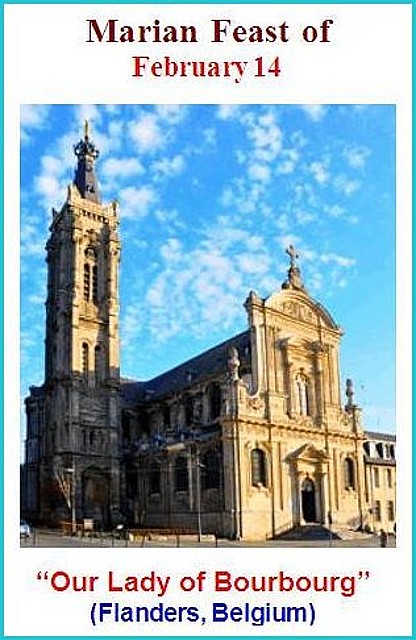
Notre-Dame de Bourbourg /Our Lady of Bourbourg, Flanders (1383) – 14 February:
Jean Froissart, born in the 1330s, was a man devoted to literature. His famous Chronicles was aimed at a knightly and aristocratic audience and was devoted to “the honourable enterprises, noble adventures and deeds of arms, performed in the wars between England and France…to the end that brave men taking example from them may be encouraged in their well-doing.” His history is one of the most important sources for the first half of the Hundred Years’ War, and certain events of the era, such as the battles of Crecy and Poitiers and the English Peasant Revolt of 1381. He was also an eyewitness to the miracles of Our Lady of Bourbourg that occurred in the year 1383. “When the king of France came before Bourbourg there were never seen such fine men at arms nor such numbers as he had with him. The lords and their men were all drawn up, and eager for the attack. Those who had reconnoitred the place, said it could not hold out long. The Bretons, Burgundians, Normans, Germans and others, who knew there was much wealth in the place, which, if taken by storm, would probably fall to their share, began to skirmish with the infantry at the barriers, without waiting for orders from the constable or marshals of the army. This skirmish increased so much that the French set fire to the town by means of fire-arrows and cannons, so that such a flame and smoke came from the houses of Bourbourg as might have been seen forty leagues off. Many gallant deeds were done and the assailants leaped cheerfully into the mud of the ditches above the knees when they engaged with the English at the palisade and barriers. The garrison defended themselves handsomely, indeed, they had need of their exertions, for they knew not on which side to turn themselves. They were attacked on all part and the houses of the town were blazing with fire, which more confounded the English than anything else. This, however, did not throw them off their guard, nor cause them to quit their posts. Sir Matthew Redman and Sir Nicholas Drayton, with their men, in the centre of the town, endeavoured to check the progress of the fire but it was such a dry season, that the smallest spark set the houses in flames. It is certain, that if the attack had begun earlier, or had not the night come on soon, the town must have been taken by storm but the approach of night put an end to it. On the attack ceasing, the French retired to their quarters, to attend the sick and bury the dead. They said that on the morrow they would renew the attac, and it should be irresistible. The English were employed in repairing the palisades which had been broken, in putting all things in a good state and in extinguishing the fires in the town. They were in a most perilous situation, being surrounded on all sides, without means of escaping by flight. The Duke of Brittany, who was on the opposite side of the town to the King, entered into negotiations with the English, aware of the peril they were in. He advised them to surrender the town, on their lives and fortunes being spared. This they were very willing to do and they entreated the Duke, through love of God and in honour of his gentility, to undertake the business. The King of France replied, that, in God’s name, he would willingly agree to a treaty. The English had been much renowned for gallantry and deeds of arms and it was settled that the English should depart from Bourbourg and Gravelines and carry away with them as much of their wealth as they could. Several of the Bretons, French, Normans and Burgundians were much vexed at this treaty, for they thought of partaking of the spoils but the King and his council had ordered it otherwise. The whole of Tuesday they employed in shoeing their horses and in packing up all their wealth, of which they had much and in making preparations for their departure. On the Wednesday morning they loaded their baggage-horses and began their march, passing through the army with passports from the King. The Bretons were much exasperated when they saw them so loaded, waiting at Calais for a favourable wind to return to England. The King of France and all the lords of his army, with their attendants, entered Bourbourg on Thursday morning. The Bretons began to plunder it, without exception, even the Church of St John. In that Church a pillager stood upon an Altar with the intent of forcing out a precious stone that was in the crown of an image of Our Lady. As he reached to steal the stone, the image suddenly turned about and the pillager in his fright, fell from the Altar and was instantly struck dead. This is a certain truth, for many persons were witnesses of it. Shortly afterwards, another pillager came with a similar intent of robbing the image but all the bells began a peal without anyone touching them, for no-one could have rung them, the bell-ropes being drawn up and fastened. On account of these miracles, the Church was visited by large crowds. The King made a handsome present to the Church, as did all the lords, so that the amount of their gifts was upwards of three thousand francs.” __
Martyrs of Terni: Three Christians who gave proper burial to Saint Valentine of Terni. Martyred in the persecutions of Aurelius. 273 in Terni, Italy – Apollonius, Ephebus, Proculus.
Martyrs of Alexandria: A group of Christians murdered in various ways for their faith in Alexandria, Egypt. We know the names and a few details about 16 of them – Agatho, Agatone, Ammonio, Ammonius, Antonius, Bassiano, Bassianus, Cirione, Cyrio, Dionysius, Dionysius, Lucio, Moses, Moses, Proto and Tonione.




 AnaStpaul
You must be logged in to post a comment.