Feast of the Most Holy Redeemer – The Feast of the Most Holy Redeemer is a Catholic liturgical feast. It is celebrated in Venice as the Festa del Redentore. It is also celebrated by the Redemptorists and was celebrated in the City of Rome. The feast is found only in the special calendar of some Diocese and religious Orders and is celebrated with proper Mass and Office either on the third Sunday of July or on 23 October. https://anastpaul.com/2019/10/23/the-feast-of-the-most-holy-redeemer-23-october/
St Anthony Mary Claret CMF (1807-1870) Known as “The Spiritual Father of Cuba.” In the first years, records show, that he Confirmed 100,000 people and performed 9,000 Sacramental Marriages.Archbishop of Cuba, one of the Fathers of the First Vatican Council,Confessor to the Queen of Spain, Missionary, Founder of the Congregation of Missionary Sons of the Immaculate Heart of Mary, commonly called the Claretians, Confessor, Mystic, Social Reformer, Spiritual Director, Writer, Publisher, Preacher, Apostle of Charity. He was declared venerable by Pope Leo XIII in 1899. He was Beatified in 1934 and in 1950, Canonised by Pope Pius XII. His heart is incorrupt. The 1969 revision of the calendar moved St Anthony Feast to the day of his death, 24 October (from the 23rd) which had been the Feast of Saint Raphael the Archangel since 1921. About St Anthony Mary here: https://anastpaul.wordpress.com/2017/10/24/saint-of-the-day-24-october-st-anthony-mary-claret-1807-1870-cmf/
Bl Anne-Joseph Leroux St Amo of Toul St Arethas of Negran St Benedict of Sebaste St Clether St Domitius St Elfleda St Ethelfleda Saints Germanus and Servandus of Cadiz St Gratien of Amiens St Henry of Cologne St Ignatius of Constantinople
Bl John Buoni St John of Syracuse St Oda of Aquitaine St Romanus of Rouen Blessed Severinus Boethius (c 475-524) Martyr St Severinus of Cologne St Syra of Faremoutiers St Theodoret of Antioch Bl Thomas Thwing St Verus of Salerno
Martyrs of Nicaea – 3 Saints Euerotas Socrates Theodota
Martyrs of Valenciennes – 6 Beati: A group of Urusuline and Briggittine nuns murdered together in the anti-Christian excesses of the French Revolution. They were guillotined on 23 October 1794 in Valenciennes, Nord, France and Beatified on 13 June 1920 by Pope Benedict XV. • Anne-Joseph Leroux • Clotilde-Joseph Paillot • Jeanne-Louise Barré • Marie-Augustine Erraux • Marie-Liévine Lacroix • Marie-Marguerite-Joseph Leroux
St Bagne of Thérouanne St Edburga of Caistor St Florentia of Seville
Blessed Francisco Pacheco SJ (1566-1626) Martyr, Priest of the Society of Jesus, Missionary to India, China and Japan, Provincial Superior. Fr Pacheco and his eight Jesuit companions, together with the nine lay Christians, were included among the 205 Martyrs Beatified by Blessed Pope Pius IX on 7 May1867. His Life and Death: https://anastpaul.com/2021/06/20/saint-of-th-day-20-june-blessed-francisco-pacheco-sj-1566-1626/
St Gemma of Saintonge St Goban of Picardie St Helen of Öehren
St Macarius of Petra St Methodius of Olympus Blessed Michelina of Pesaro TOSF (1300-1356) Widow, Religious of the Third Order of the Friars Minor. St Novatus of Rome
Martyred in London: Bl Anthony Turner Bl John Fenwick Bl John Gavan BL Thomas Whitbread Blessed William Harcourt
Irish Martyrs – 260 Beati – This is the collective title given to the 260 or more persons who are credited with dying for the Faith in Ireland between 1537 and 1714.
Martyrs of Lower Moesia: Martyred on the Black Sea at Lower Moesia (in modern Bulgaria), date unknown. St Cyriacus St Paul
Martyred in Nagasaki: 9 Beati : burned alive on 20 June 1626 in Nagasaki, Japan. Their ashes were thrown into the sea and no relics remain. They were Beatified on 7 May 1867 by Pope Pius IX. • Blessed Baltasar de Torres Arias • Blessed Francisco Pacheco • Blessed Gaspar Sadamatsu • Blessed Giovanni Battista Zola • Blessed Ioannes Kisaku • Blessed Michaël Tozo • Blessed Paulus Shinsuke • Blessed Petrus Rinsei • Blessed Vincentius Kaun
St Theodulus of Thessalonica St Theonas of Egypt St Tigernach of Clogher St Zosimus of Palestine
Martyred in Cairo François de la Terre de Labour Nicolas of Montecorpino
Martyrs of Thessalonica – 14 Saints: Fourteen Christians who were Martyred together, date unknown. No other information, except the names of 12 of them, has survived – Ingenuus, Julianus, Julius, Matutinus, Orbanus, Palatinus, Paulus, Publius, Quinilianus, Saturninus, Successus, Victor and two whose names have not come down to us. Agathopus the Deacon, Theodulus the Lector.
Fourth Sunday after Pentecost (Traditional Calendar) +2021 Twelfth Sunday in Ordinary Time +2021
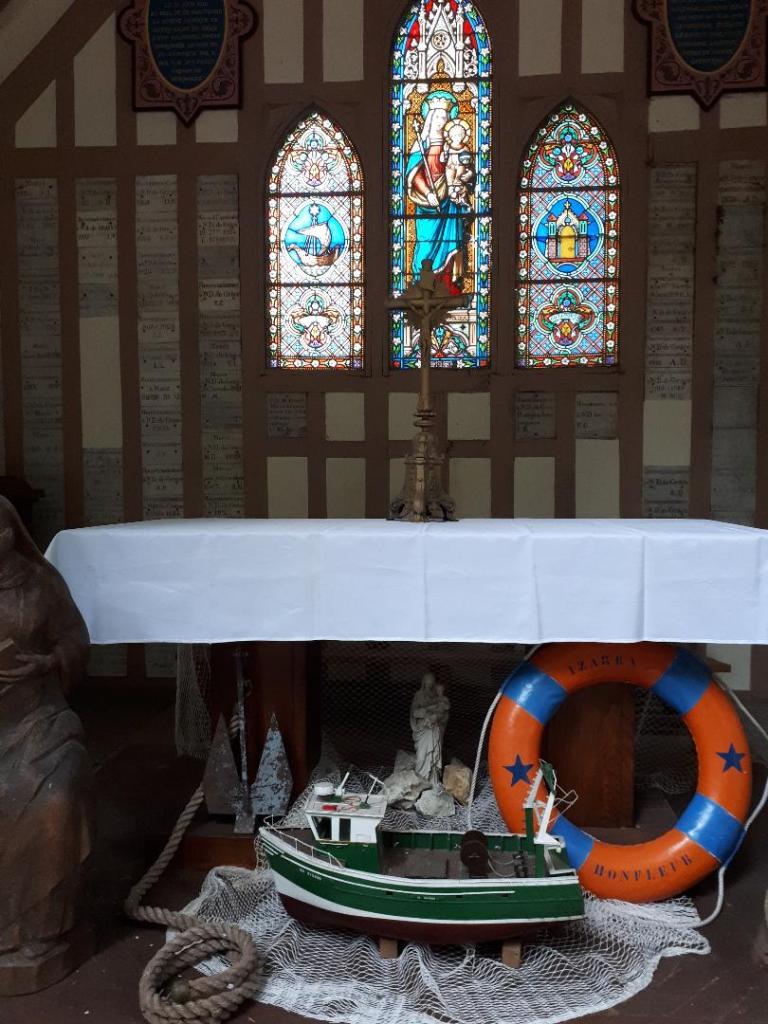
Notre-Dame-de-Grace / Our Lady of Grace in Equemauville, Honfleur, France – also known as Our Lady of Consolation (1524) 20 June (The Crowning) and 23 October:
The Abbot Orsini wrote: “Our Lady of Consolation, near Honfleur. This Chapel is much frequented; two children have been raised to life there, in memory of which ,their figures are there in silver.”
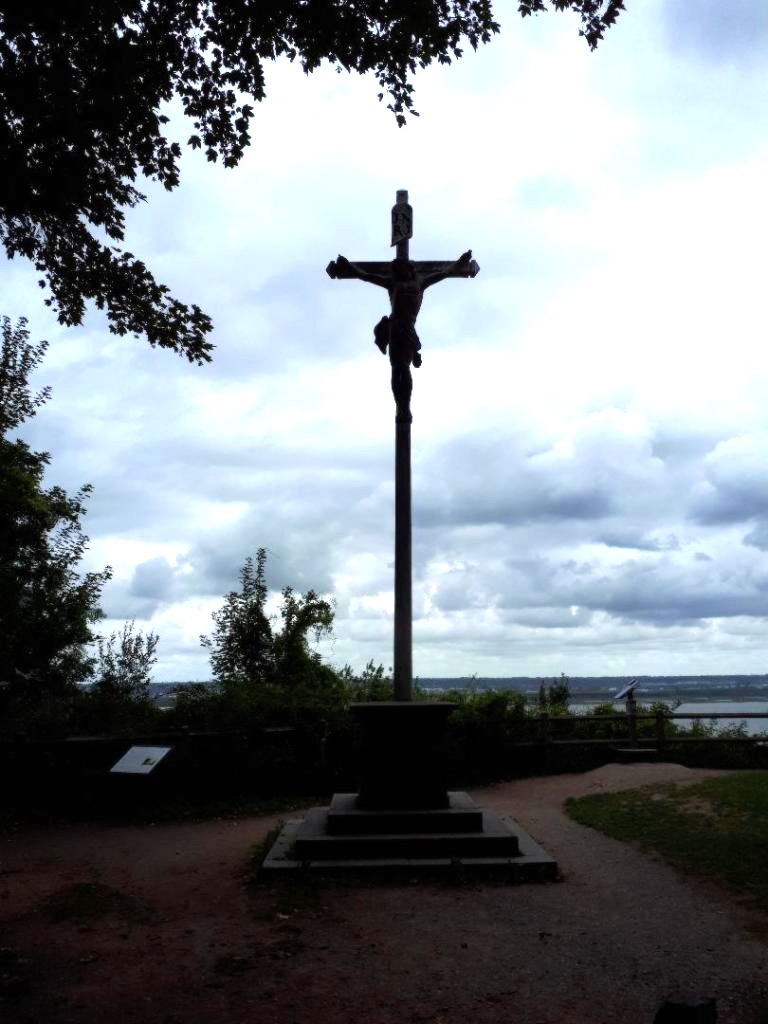
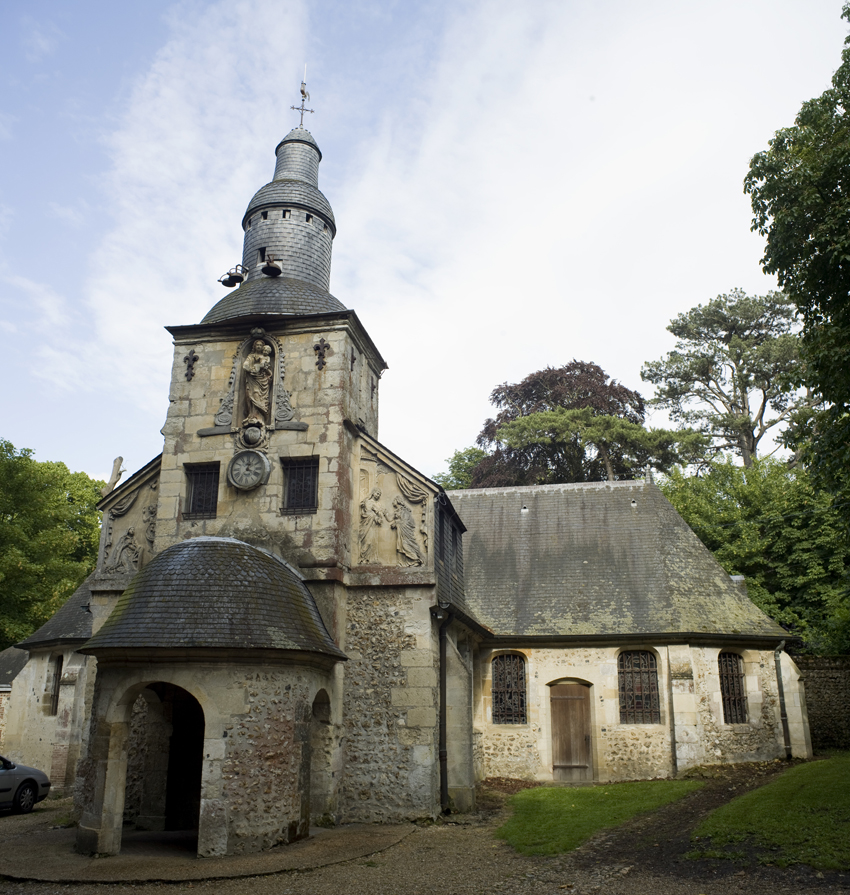
Also known as Our Lady of Grace, or Notre-Dame-de-Grace, the first thing that can be seen among the trees upon the height is a large Crucifix that seems to bless the sea, although the Chapelle Notre-Dame-de-Grace is still invisible, hidden under the old trees that surround it. The present Chapel is a small one, located a short distance from that Crucifix and the tall trees and lawns that surround the Church are in stark contrast to the Church’s humble dimensions.
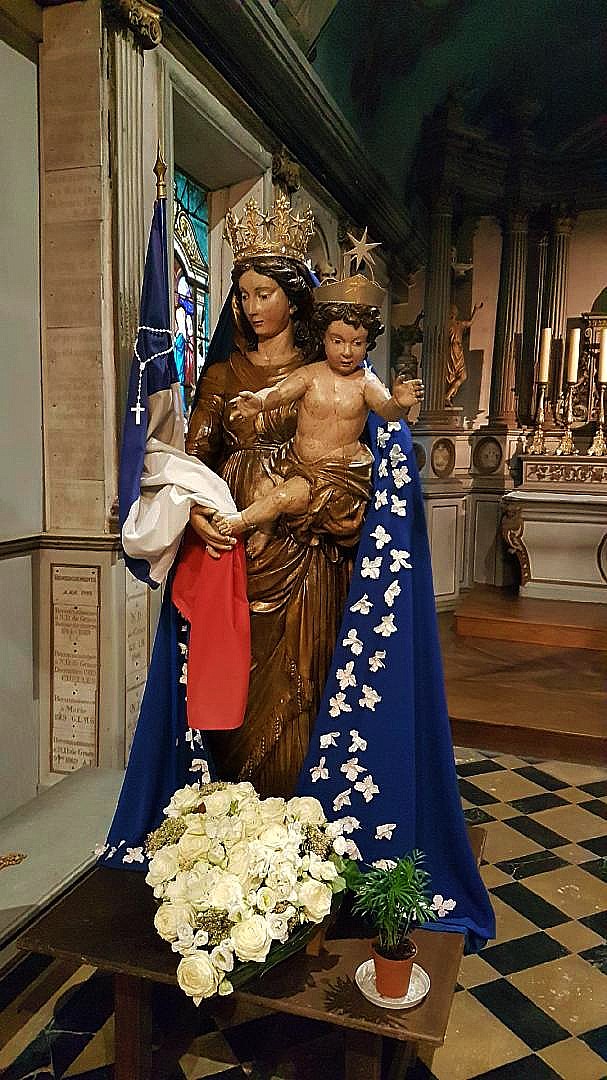
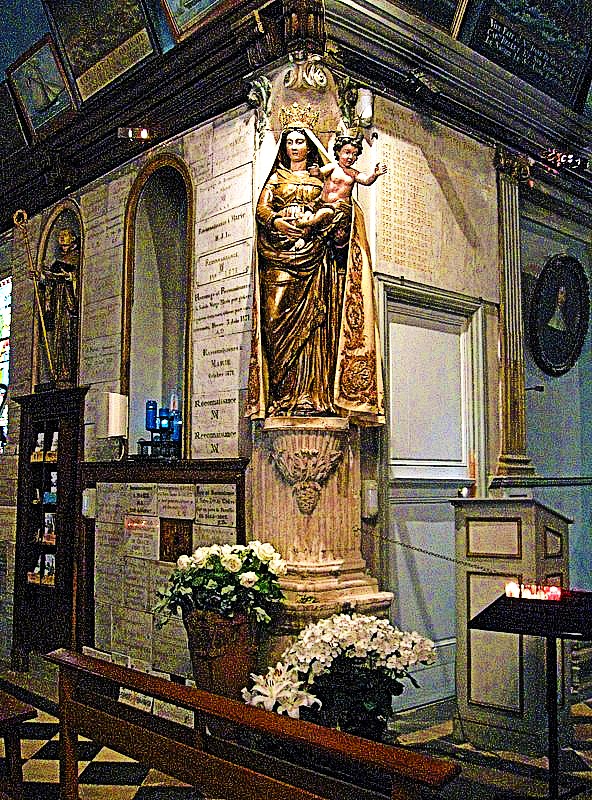
Once inside, everything is modest but exudes an atmosphere of holiness. There is a low arch, and passing beneath it, the view from the windows inside, is obscured by the thick foliage of the surrounding trees. On the Gospel side is the Statue of the Blessed Virgin on a short pillar. A fabric canopy frames the Statue which depicts the Mother of God holding her Divine Child. At the feet of Our Lady are placed small anchors and hearts of silver gilt that shine on the dais and we see a small amount of flowers that are the humble obeisance’s of children and the poor. There are votive offerings hundreds of years old, and paintings of ships battered by storms, or broken upon the rocks, beneath which are brief accounts of the perils and the salvation sent after prayer to Notre-Dame-de Grace. Crutches lean against the wall as trophies demonstrating the victorious prayers of the healed cripples who now walk, and burning candles, are constantly renewed beneath the holy image, exhibiting the persevering ardoUr of the faithful. It is a collective testimony of piety and edification from the servants of Mary.
The origin of the pilgrimage to Notre-Dame de Grace goes back to the eleventh century. According to tradition, in the year 1034, Robert the Magnificent, Duke of Normandy, was sailing to England. He was suddenly assailed by a violent storm and at the height of the danger he promised to build three Chapelsdevoted to the Blessed Virgin if he returned safely to his lands. The storm ended at once and the Prince immediately returned home to take care of his vow. He built one of the Chapels promised near his Castle, and dedicated it to Our Lady of Mercy. Another he built near Caen, which he called Notre-Dame de la Deliverance,and the third he built on the plateau in Equemauville overlooking Honfleur, which was named Notre Dame de Grace. This Chapel near Honfleur, soon became a busy place of pilgrimage. There is an authentic document at the Church from King Louis XI dated 28 January 1478 and letters showing that the Chapel was endowed with a certain tract of land containing a house, a barn, etc.
The Chapel partially collapsed and the sea swallowed part of the cliff near the Church during a violent earthquake that occurred on 29 September 1538. Only a section of one wall, the Altar, and the Statue of the Virgin Mary remained standing but such was the devotion of the people to this special place that many pilgrims continued to come and pray kneeling amid the debris. Unfortunately the landslides did not cease, so finally, in 1602, the last vestiges of the Sanctuary were removed to prevent the faithful from exposing their lives to the unremitting danger. The faithful regretted the loss of their Chapel, and one of them, Mr. Gonnyer, undertook to raise a new one. He dug the foundations one hundred paces from the old Church to the south-west but he was forced to stop at that point for lack of money. Offerings from the inhabitants of Honfleur did the rest and in 1613 the Chapel was acquired. It was a small building three times as long as it was wide;,thatched, isolated among the heather and looked more like a barn than a chapel. The Capuchins took possession on 16 March 1621, and they planted a large wooden Crucifix amid the ruins of the old chapel. They eventually replaced it with a stone Crucifix that they placed closer to the chapel than the old one had been. In the Middle Ages people understood that the Church provided for the moral and physical welfare of the people, as well as, the state. They knew that the apostolate of the monastic orders was necessary to form and maintain the ties of charity between the rich and poor, adjust the opulent life of one to soften the sufferings of others and to communicate to all, through preaching and by the Sacraments and example, the secret of living and dying well. When the Revolution erupted there was wide-spread desecration throughout France and all religious communities were dissolved. In vain the faithful recipients of so many graces endeavoured to protect their Sanctuary and the religious who served there. At one time it was hoped Honfleur could keep the Capuchins and so, a petition was drafted for that purpose in 1790. “Through the removal of religious communities,” said the petitioners, “we fear being deprived of the significant relief that we receive from the Capuchins. These men are religious at all times, labour for the good of the City and the neighbouring countryside and through the uprightness of their intentions and the justice of their actions, they have earned public esteem and confidence. They have a small Chapel, located on the coast under the invocation of the Blessed Virgin, which is held in great reverence throughout the Country and we urge its conservation.” The petition was sent to the National Assembly, who refused it. The Chapel was plundered and converted into a tavern. The old Statue was destroyed and sadly “those who were but lately to pray and ask for graces forgot themselves to commit orgies in a place where everything, even the walls, reproached them for their apostasy.” That was so long ago and now the tides of commercial prosperity have come to caress the people and promote the development of the City and the Port of La Havre. Hanfleur possesses all the signs of a prosperous City that is increasing in wealth and population, regardless of the attendant demoralisation and miseries of every kind, that accompany the seeming prosperity. La Havre is the seat of business where speculators contest in the commercial sphere where they work without ceasing to earn their fortune and contribute to each other’s ruin. Without the aid of the Blessed Virgin, there was no longer any hope for relief. After the atrocities had subsided the Chapel was restored and a copy of the original Statue created from Church records.
It was on 15 February 1912 that the Chapter of Saint Peter in Rome awarded the Golden Crown to the sSatue of Our Lady of Grace. The solemn Feasts of her Coronation were celebrated on 20 June 1913. Many people from Honfleur think that it is thanks to the intercession of Notre Dame de Grâce that Honfleur is the only Norman city not to have been bombed during the Second World War. The Chapel was classified as a historical monument in 1938.
Still, it was here, at this remote Chapel about 5 kilometers from Honfleur, that Marie-Francoise-Therese Martin came with her father and sister Celine in July of the year 1887 to pray to Notre-Dame-de Grace that she might be able to enter Carmel. That woman is better known today as Saint Therese of the Child Jesus and the Holy Face, or simply Therese of Lisieux, the “Little Flower.”
Irish Martyrs – 17 beati – This is the collective title given to the 260 or more persons who are credited with dying for the faith in Ireland between 1537 and 1714. Seventeen of them were beatified together on 27 September 1992 by St Pope John Paul II. • Blessed Conn O’Rourke• Blessed Conor O’Devany• Blessed Dermot O’Hurley• Blessed Dominic Collins• Blessed Edward Cheevers• Blessed Francis Taylor• Blessed George Halley• Blessed John Kearney• Blessed Matthew Lambert• Blessed Maurice Eustace• Blessed Patrick Cavanagh• Blessed Patrick O’Healy• Blessed Patrick O’Loughran• Blessed Peter Higgins• Blessed Robert Meyler• Blessed Terrence Albert O’Brien• Blessed William Tirry
Martyrs of Lower Moesia: Martyred on the Black Sea at Lower Moesia (in modern Bulgaria), date unknown. St Cyriacus St Paul
Martyred in Nagasaki: 9 Beati : burned alive on 20 June 1626 in Nagasaki, Japan. Their ashes were thrown into the sea and no relics remain. They were Beatified on 7 May 1867 by Pope Pius IX. • Blessed Baltasar de Torres Arias • Blessed Francisco Pacheco • Blessed Gaspar Sadamatsu • Blessed Giovanni Battista Zola • Blessed Ioannes Kisaku • Blessed Michaël Tozo • Blessed Paulus Shinsuke • Blessed Petrus Rinsei • Blessed Vincentius Kaun







 AnaStpaul
You must be logged in to post a comment.