One Minute Reflection –28 May – Pentecost Sunday – Acts 2:1-11. John 14:23-31. – Scripture search here: https://www.drbo.org/
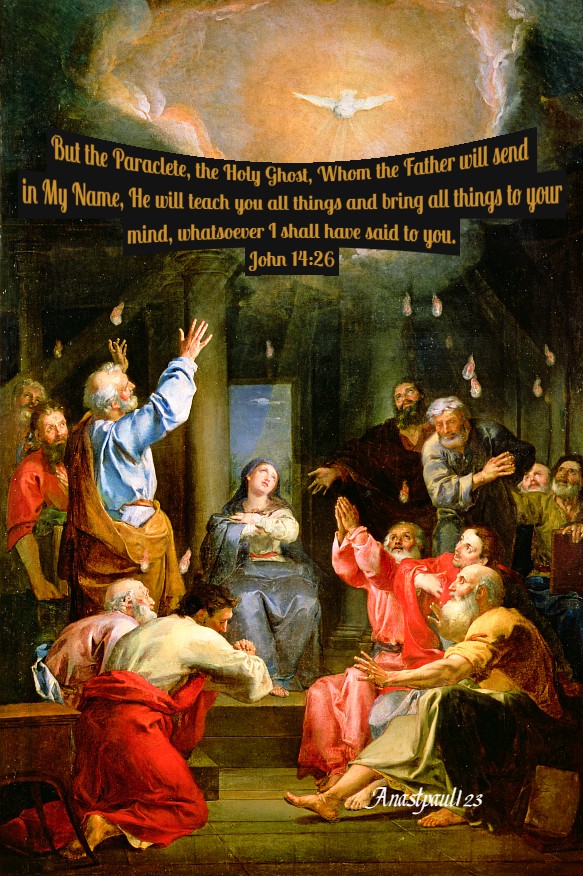
“But the Paraclete, the Holy Ghost, Whom the Father will send in My Name, He will teach you all things and bring all things to your mind, whatsoever I shall have said to you.” – John 14:26
REFLECTION – “The Apostles were sitting there in the Cenacle, the Upper Room, waiting for the Holy Ghost’s coming. Like torches, they were present there, ready and waiting to be set alight by the Holy Ghost so as to illumine the whole creation with their teaching… They were there like farm hands carrying seed in their coat pocket, waiting for the order to go out and sow. They were there like sailors whose boat is tied up in the harbour of the Son’s commandment and who are waiting for the gentle wind of the Spirit. They were there like shepherds who have just received their staff from the Chief Shepherd of the fold and who are waiting for the flock to be divided among them.
“And they began to speak in different tongues as the Spirit enabled them to proclaim.” O Cenacle, kneading trough into which has been thrown the leaven, leavening the whole world! O Cenacle, mother of all the Churches, who have witnessed the miracle of the burning bush (Ex 3). O Cenacle, amazing Jerusalem with a wonder far greater than that of the burning furnace which astonished the inhabitants of Babylon (Dn 3). The fire of the furnace burned all those around it but protected those in its midst – the flames of the Cenacle gather together those outside who wish to see them, while bringing comfort to those who receive them. O fire, whose coming is word, whose silence is light! O fire, establishing hearts in thankfulness!…
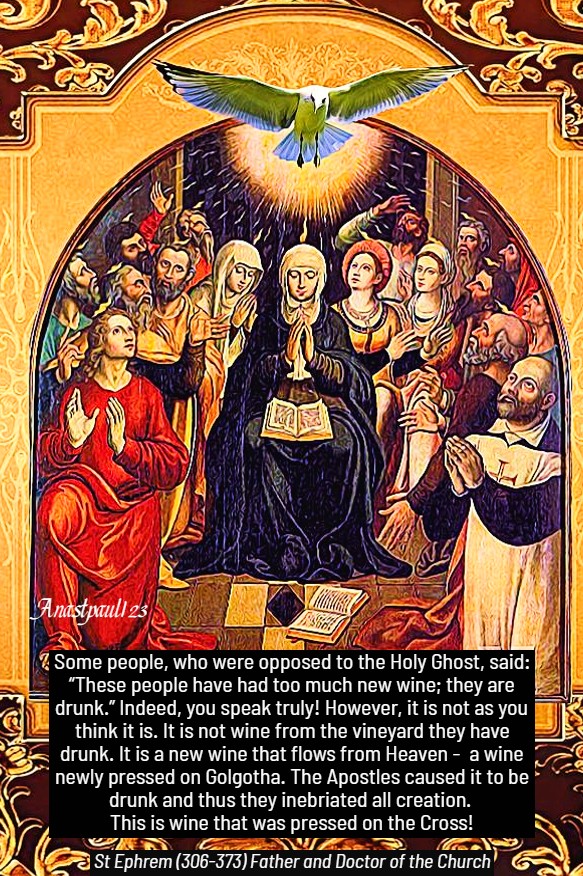
Some people, who were opposed to the Holy Ghost, said: “These people have had too much new wine; they are drunk.” Indeed, you speak truly! However, it is not as you think it is. It is not wine from the vineyard they have drunk. It is a new wine that flows from Heaven – a wine newly pressed on Golgotha. The Apostles caused it to be drunk and thus they inebriated all creation. This is wine that was pressed on the Cross!” – St Ephrem (306-373) Deacon in Syria, Father and Doctor of the Church [Added by Pope Benedict XV in 1920] – (On the outpouring of the Holy Ghost).
PRAYER – O God, Thou Who on this day have taught the hearts of the faithful by the Light of the Holy Spirit, grant us by that Holy Spirit Himself, to know what is right and ever to rejoice in His consolation. Through Jesus Christ, Thy Son our Lord, Who lives and reigns with Thee, in the unity of the Holy Ghost, God, world without end. Amen (Collect).
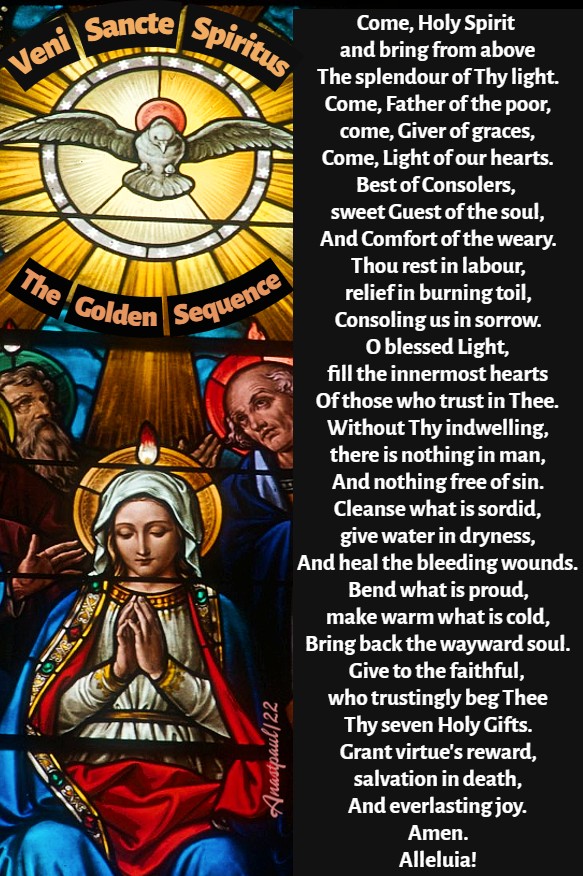
Veni Sancte Spiritus The Golden Sequence
Come, Holy Spirit and bring from above The splendour of Thy light. Come, Father of the poor, come, Giver of graces, Come, Light of our hearts. Best of Consolers, sweet Guest of the soul, And Comfort of the weary. Thou rest in labour, relief in burning toil, Consoling us in sorrow. O blessed Light, fill the innermost hearts Of those who trust in Thee. Without Thy indwelling, there is nothing in man, And nothing free of sin. Cleanse what is sordid, give water in dryness, And heal the bleeding wounds. Bend what is proud, make warm what is cold, Bring back the wayward soul. Give to the faithful, who trustingly beg Thee Thy seven Holy Gifts. Grant virtue’s reward, salvation in death, And everlasting joy. Amen. Alleluia!
“Veni Sancte Spiritus,” the “Golden Sequence”, is a sequence prescribed in the Roman Liturgy for the Masses of Pentecost and its Octave, exclusive of the following Trinity Sunday. It is usually attributed to either the Thirteenth-Century Pope Innocent III (c1160 – 1216) or to the Archbishop of Canterbury, Cardinal Stephen Langton (c1150 – 1228).
By Servant of God Abbot Prosper Guéranger OSB (1805-1875) – Excerpt Abbot of Saint-Pierre de Solesmes, France.
Come, O Holy Spirit, fill the hearts of Thy faithful and enkindle within them, the fire of Thy Love.
The great day, which consummates the work that God had undertaken for the human race, has, at last, shone upon the world. The days of Pentecost, as St Luke says, are accomplished (Acts. ii. 1). We have had seven weeks since the Pasch and now, comes the day, which opens the mysterious number of Fifty. This day is the Sunday, already made holy by the Creation of the Light and by the Resurrection of Jesus – it is about to receive its final consecration and bring us the fullness of God (Eph. iii. 19).
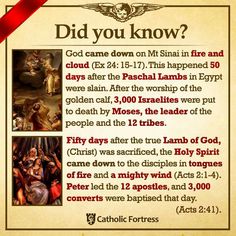
In the Old and figurative Law, God foreshadowed the glory that was to belong, at a future period, to the Fiftieth Day. Israel had passed the waters of the Red Sea, thanks to the protecting power of His Paschal Lamb! Seven weeks were spent in the Desert, which was to lead to the Promised Land and the very morrow of those seven weeks, was the day, whereon was made the alliance between God and His people. The Pentecost (the Fiftieth Day) was honoured by the promulgation of the Ten Commandments of the Divine Law and every following year, the Israelites celebrated the great event by a solemn Festival. But their Pentecost was figurative, like their Pasch, there was to be a second Pentecost for all people, as there was to be a second Pasch for the Redemption of the whole world. The Pasch, with all its triumphant joys, belongs to the Son of God, the Conqueror of death: Pentecost belongs to the Holy Ghost, for it is the day whereon He began His mission into this world, which, henceforward, was to be under His Law.
But, how different are the two Pentecosts! The one, on the rugged rocks of Arabia, amidst thunder and lightning, promulgates a Law that is written on Tablets of Stone; the second is in Jerusalem, on which God’s anger has not as yet been manifested because it still contains, within its walls, the first-fruits of that new people, over whom the Spirit of love is to reign.
In this second Pentecost, the heavens are not overcast, nor is the roar of thunder heard; the hearts of men are not stricken with fear, as when God spake on Sinai; repentance and gratitude, these are the sentiments which are now uppermost. A Divine Fire burns within their souls and will spread throughout the whole world. Our Lord Jesus had said: ‘I am come to cast fire on the earth and what will I, but that it be kindled’ (St. Luke, xii. 49). The hour for the fulfillment of this Word is come: the Spirit of Love, the Holy Ghost, the eternal uncreated Flame, is about to descend from Heaven and realise the merciful design of our Redeemer.
Jerusalem is filled with pilgrims, who have flocked there from every country of the Gentile world: they feel a strange mysterious expectation working in their souls. They are Jews and are come from every foreign land where Israel has founded a Synagogue; they are come to keep the feasts of Pasch and Pentecost. Asia, Africa, and even Rome, have here their representatives. Amidst these Jews, properly so called, are to be seen many Gentiles, who, from a desire to serve God more faithfully, have embraced the Mosaic law and observances; they are called Proselytes. This influx of strangers, who have come to Jerusalem out of a desire to observe the Law, gives the City a Babel-like appearance, for each nation has its own language. They are not, however, under the influence of pride and prejudice, as are the inhabitants of Judea; neither have they, like these latter, known and rejected the Messias, nor blasphemed His Works, whereby He gave testimony of His Divine Character. It may be that they took part with the other Jews in clamouring for Jesus’ death but they were led to it by the Chief Priests and Magistrates of the Jerusalem, which they reverenced as the holy City of God and to which nothing but religious motives have brought them.
It is the hour of Tierce, the third hour of the day (Our nine o’clock. Acts, ii. 15), fixed from all eternity, for the accomplishment of a Divine Decree. It was at the hour of midnight, that the Father sent into this world, that He might take flesh in Mary’s womb, the Son, eternally begotten of Himself: so now, at this hour of Tierce, the Father and Son, send upon the earth the Holy Spirit, Who proceeds from them both. He is sent to form the Church, the Spouse and Kingdom of Christ; He is to assist and maintain her; He is to save and sanctify the souls of men and this, His Mission, is to continue unto the end of time. Suddenly is heard, coming from heaven, the sound of a violent wind: it startles the people in the City, it fills the Cenacle with its mighty breath. A crowd is soon round the house that stands on Mount Sion; the hundred and twenty Disciples that are within the building, feel that mysterious emotion within them, of which their Master once said: The Spirit breatheth where He will, and thou hearest His voice (St. John, iii. 8). Like that strange invisible creature, which probes the very depth of the sea and makes the waves heave mountains high, this Breath from heaven will traverse the world from end to end, breaking down every barrier that would stay its course.
The holy assembly have been days in fervent expectation; the Divine Spirit gives them this warning of His coming, and they, in the passiveness of extatic longing, await his will. As to them that are outside the Cenacle, and have responded to the appeal thus given, let us, for the moment, forget them. A silent shower falls in the House; it is a shower of Fire, which, as holy Church says, “burns not, but enlightens, consumes not, but shines (Responsory for the Thursday within the Octave).” Flakes of fire, in the shape of tongues, rest on the heads of the hundred and twenty Disciples: it is the Holy Ghost taking possession of all and each. The Church is now, not only in Mary but also in these hundred and twenty Disciples. All belong now to the Spirit that has descended upon them; His Kingdom is begun, it is manifested, its conquests will be speedy and glorious.
But let us consider the symbol chosen to designate this Divine change. He Who showed Himself under the endearing form of a Dove, on the occasion of Jesus’ Baptism in the Jordan, now appears under that of Fire. He is the Spirit of Love and love is not only gentle and tender, it is, also, ardent as fire. Now, therefore, that the world is under the influence of the Holy Ghost, it must needs be on fire and the fire shall not be checked. And why this form of Tongues? To show that the Heavenly Fire is to be spread by the word, by speech. These hundred and twenty Disciples need but to speak of the Son of God, made Man and our Redeemer; of the Holy Ghost, Who renews our souls; of the Heavenly Father, Who loves and adopts us as His children; their word will find thousands to believe and welcome it. Those that receive it, shall all be united in one faith; they shall be called the Catholic Church, that is, universal, existing in all places and times. Jesus had said – ‘Go, teach all nations ‘ (St. Matth xxviii. 19)!–the Holy Ghost brings from Heaven, both the tongue that is to teach and the fire, (the love of God and mankind,) which is to give warmth and efficacy to the teaching. This Tongue and Fire are now given to these first Disciples, who, by the assistance of the Holy Spirit, will transmit them to others: so will it be to the end of time!
But, in the crowd, there are some who are shocked at witnessing this heavenly enthusiasm of the Apostles. These men, say they, are full of new wine! It is the language of rationalism, explaining away mystery by reason. These Galileans, these drunken men, are, however, to conquer the whole world to Christ, and give the Holy Ghost, with His inebriating unction, to all mankind. The holy Apostles feel that it is time to proclaim the new Pentecost; yes, this anniversary of the Old is a fitting day for the New to be declared. But, in this proclamation of the law of mercy and love, which is to supersede the law of justice and fear, who is to be the Moses? Our Emmanuel, before ascending into heaven, had selected one of the Twelve for the glorious office: it is Peter, the Rock on whom is built the Church. It is time for the Shepherd to show himself, and speak, for the Flock is now to be formed. Let us hearken to the Holy Ghost, Who is about to speak, by his chief organ, to this wondering and attentive multitude. The Apostle, though he speaks in one tongue, is understood by each of his audience, no matter what his country and language may be. The discourse is, of its own-self, a guarantee of the truth and divine origin of the new law.
St Adalar of Erfurt Bl Adalbert Radiouski Bl Adam Arakawa St Austrebertus of Vienne St Claudius of Egypt and Companions St Ðaminh Huyen St Ðaminh Toai St Dorotheus of Tyre St Elleher St Eoban of Utrecht St Eutichius of Como St Evasius of Africa St Felix of Fritzlar
Blessed Ferdinand of Portugal (1402-1443) “The Holy Prince.” Blessed Ferdinand spent as much time as he could in adoration of the Most Blessed Sacrament especially during the Easter Triduum when his habit was to be constantly in adoration, from Holy Thursday to Easter. He was the youngest of the “Illustrious Generation” of 15th-century Portuguese Princes of the House of Aviz and lay Master of the Knightly Order of Aviz. About Blessed Ferdinand: https://anastpaul.com/2021/06/05/saint-of-the-day-5-june-blessed-ferdinand-of-portugal-1402-1443-the-holy-prince/
St Franco of Assergi St Genesius, Count of Clermont St Gregory of Lilybaeum St Gundekar St Hadulph St Luke Loan Bl Meinwerk of Paderborn St Privatus of Africa St Sanctius of Córdoba St Tudno of Caernarvon St Waccar
Martyrs of Caesarea: A group of Christians who converted together, were imprisoned together, tortured together, and martyred together. We know nothing more about them but their names – Cyria, Marcia, Valeria and Zenaides. Died Caesarea, Palestine, date unknown.
Martyrs of Egypt: A group of Christians martyred together in the persecutions of Galerius Maximian. The only other information was have is three of their names – Apollonius, Marcian and Nicanor. Died in Egypt, date unknown.
Martyrs of Perugia: A group of Christians Martyred together in the persecutions of Decius. We know little more than their names – Cyriacus, Faustinus, Florentius, Julian and Marcellinus. Died beheaded in 250 in Perugia, Italy
Martyrs of Rome: 26 Christians Martyred together. We have no details about them but their names – Candida, Castula, Fappa, Felician, Felicitas (2 of), Felicula, Fortunatus, Gagus, Gregor, Hilarius, Ingenuus, Juliana, Martialis, Maurus, Mustilus, Nicander, Prima, Rogata, Rutianus, Sacrinus, Saturnin, Secundian, Secundus, Urbicus, Victurus. Died • Rome, Italy, date unknown • relics transferred to Antwerp, Belgium, date unknown.
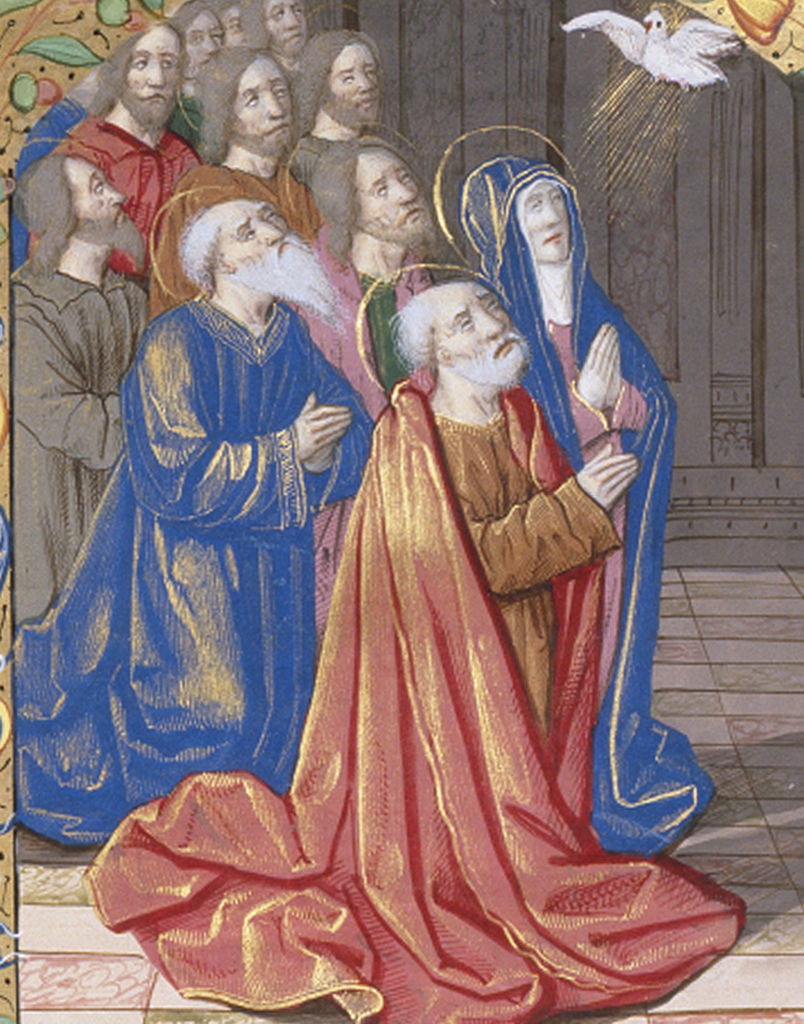
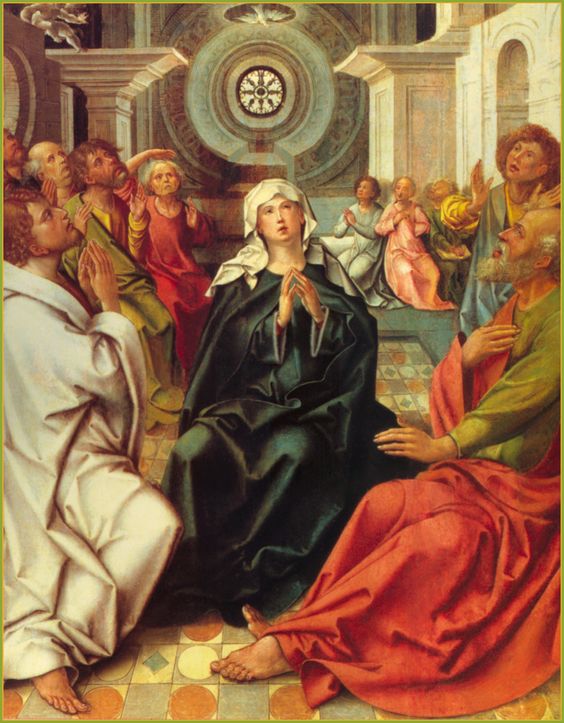
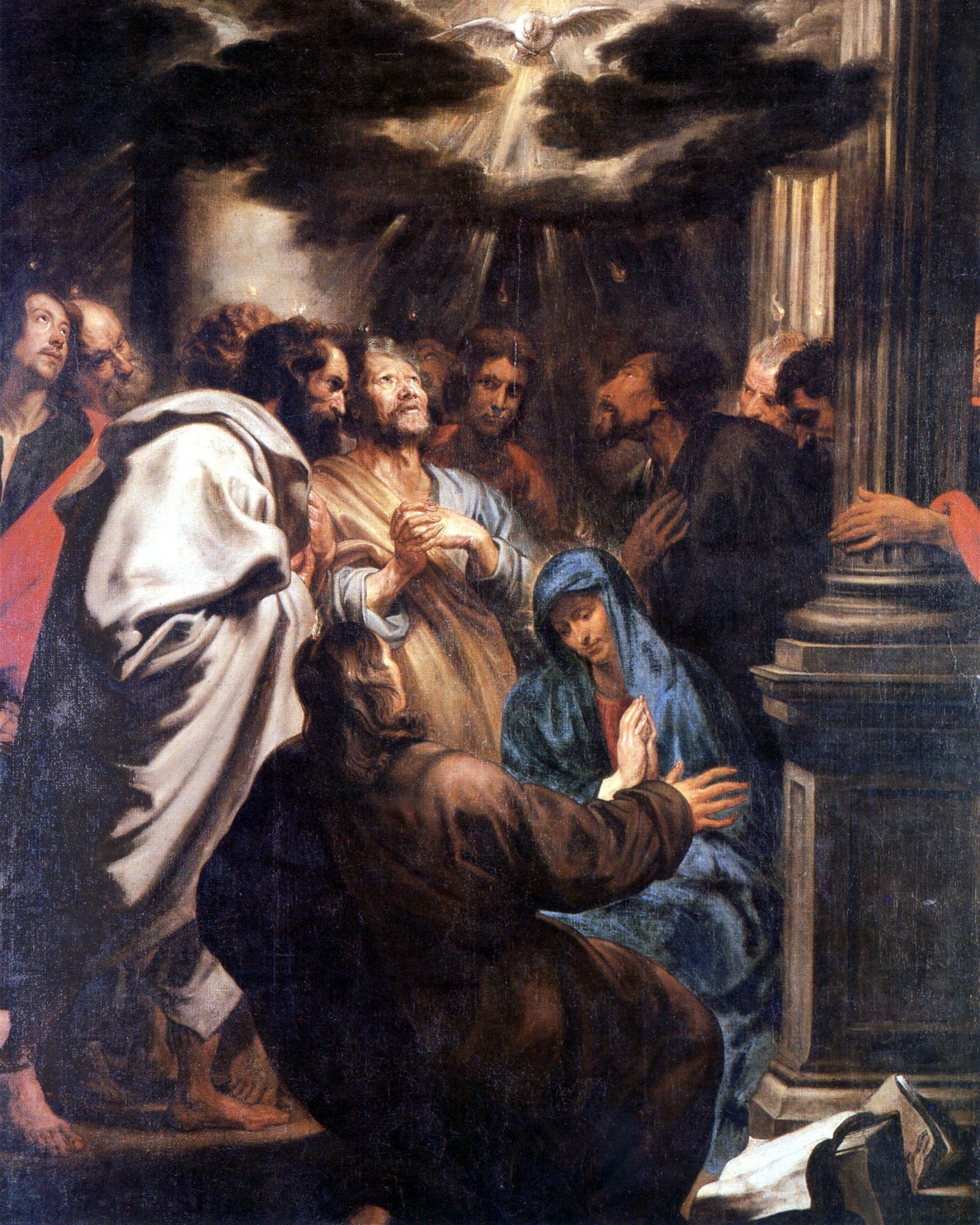
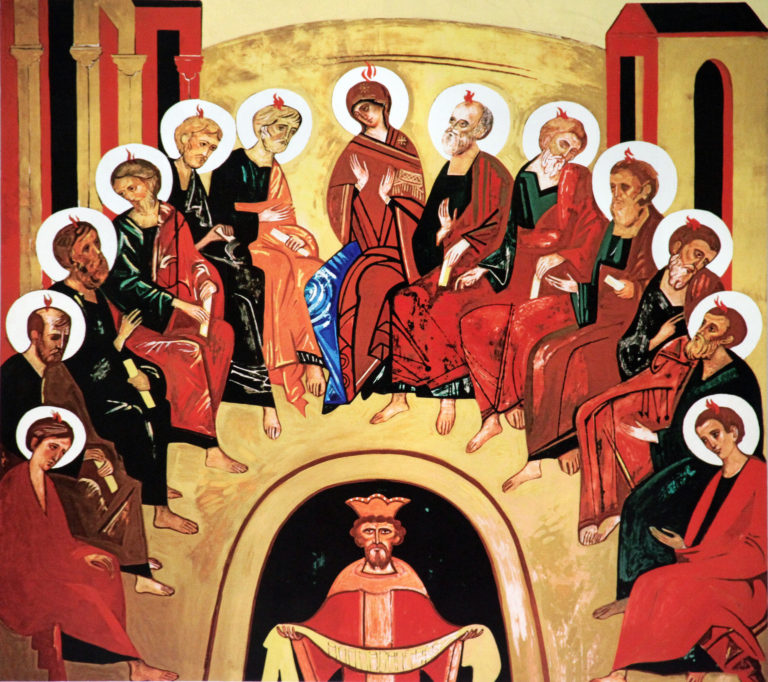
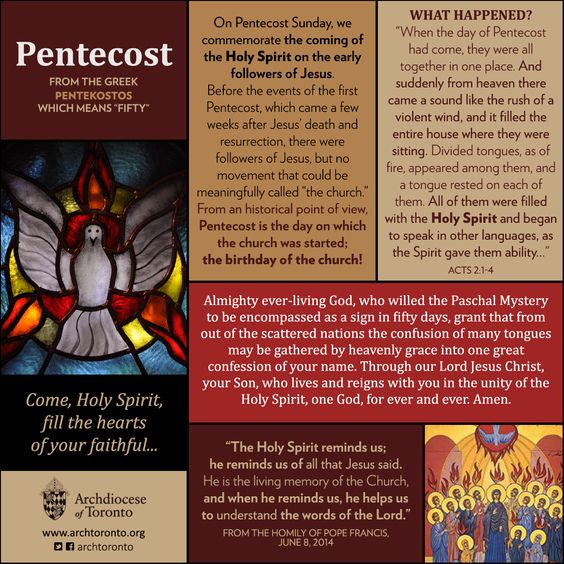
And when the days of Pentecost were drawing to a close, they were all together in one place. And suddenly there came a sound from heaven, as of a violent wind coming and it filled the whole house where they were sitting. And there appeared to them parted tongues as of fire, which settled upon each of them. And they were all filled with the Holy Spirit and began to speak in foreign tongues, even as the Holy Spirit prompted them to speak... (Acts 2, 1-4).
After Jesus had ascended to heaven, the apostles and disciples returned to the Holy City. They remained together in the Upper Room or Cenacle, the place where Jesus had appeared to them and which may well be called, the first Christian church. About a hundred and twenty persons were assembled there. They chose Matthias as an apostle in place of the unhappy Judas; they prayed and waited for the Paraclete.
The Cenacle
Ten days had passed, it was Sunday, the seventh Sunday after the resurrection. At about nine o’clock in the morning, as they were together praying fervently, the Holy Spirit descended upon them. Note how all the great theophanies in Christ’s life occurred during the course of prayer. After His baptism, for instance, when Jesus was praying the heavens opened and the Holy Spirit descended in the form of a dove; likewise, it was during prayer at night, that the transfiguration took place on Tabor. Surely too, it was while Mary was praying, that Gabriel delivered his message and the Holy Spirit overshadowed her. Pentecost followed precedent. The small community of Christians had prepared themselves through prayer for the coming of the Paraclete. The same is true at Mass today, every day; through prayer we ready our souls for the advent of the Spirit.
The descent upon the apostles was internal and invisible in nature although accompanied by certain visible phenomena. There came a mighty roar, like the onrush of a violent wind. It came suddenly, from heaven but unlike storms that strike a structure from without, this one penetrated and filled the room where the disciples were gathered. Therefore it was not a natural wind, it was a miracle peculiar to the occasion. A second visible sign consisted in tongues of fire, that descended upon each one present. These fiery tongues gave visible evidence that the Holy Spirit had descended upon them.
Louis Galloche – The Descent of the Holy Spirit
Today at Mass, particularly at holy Communion, the power of the Holy Spirit will come down upon us, fiery tongues will not be seen but invisible tongues of fire will not be absent. There was still another external manifestation of the Holy Spirit, the apostles and disciples were enabled to speak various languages.
After the roar of the wind many of Jerusalem’s pilgrims hurried to the Cenacle. Pentecost was one of the three festivals which obliged all Jews to be present in Jerusalem. Jews from distant lands and Jewish converts from paganism too, attended these feasts. As a result, a colourful crowd, speaking a variety of languages, surrounded the house. Now the apostles, who so shortly before had hid in fear behind locked doors, came forth and courageously walked among the multitude, speaking to each in his native tongue. It was indeed amazing! Galileans, and multilingual?
But the malicious too were present, they had the answer. Nothing marvellous at all! Those Galileans were simply drunk and their drunken babble sounded like a foreign language! Peter showed no hesitation in answering the charge. None of their number, he said, were intoxicated, it was but nine o’clock in the morning and at that hour men usually are sober. What the multitude saw was, in fact, the fulfilment of Joel’s prophecy: In those days (of the Messiah), God will pour forth His Spirit upon men and they will prophesy. . . . Then the apostle pointed his words more directly against the accusers, they had killed Jesus, had nailed Him to the Cros; but God had awakened Him and after His departure to heaven, He sent the Holy Spirit.
BEN63198 St. Peter Preaching in Jerusalem (detail of 63197) c.1427 (fresco) by Masolino da Panicale, Tommaso (1383-c.1447) Brancacci Chapel, Santa Maria del Carmine, Florence, Italy Italian, out of copyright
The pilgrims who had heard Peter give this first Pentecostal sermon “were pierced to the heart and said, Brethren, what shall we do? But Peter said to them, Repent and be baptised and you will receive the gift of the Holy Spirit.” Three thousand responded.
One final question, why the miracle of tongues? In answer, recall the story regarding the tower of Babel. Puffed up by pride, men attempted to build a tower that would touch the heavens. To punish their sin, God confused their speech. Sin causes confusion and division. Now Christ came to gather all men into His Church and thereby to unite them to Himself. This should result in creating but one family of nations again. To this blessed state the miracle of tongues points.
Yes, even we as individuals have a gift of tongues which all men can understand. It is the gift of love infused into us by the Holy Spirit. Love unites, love is a common language, by means of love we can speak to all nations…Excerpted from The Church’s Year of Grace, Pius Parsch
Wishing Holy Mother Church and
you all a Blessed, Holy and love-filled Pentecost! Alleluia!










 AnaStpaul
You must be logged in to post a comment.