Posted in CONSECRATION Prayers, MARIAN PRAYERS, MARIAN QUOTES, MORNING Prayers, OPEN HOUSE...Conversations with..., PRACTISING CATHOLIC, PRAYERS of the SAINTS, QUOTES of the SAINTS, SAINT of the DAY, St Louis-Marie Grignion de MONTFORT, The BLESSED VIRGIN MARY

Open House… Conversations with … St Louis Marie Grignion de Montfort (1673-1716)

Open House… Conversations with …
St Louis Marie Grignion de Montfort (1673-1716)

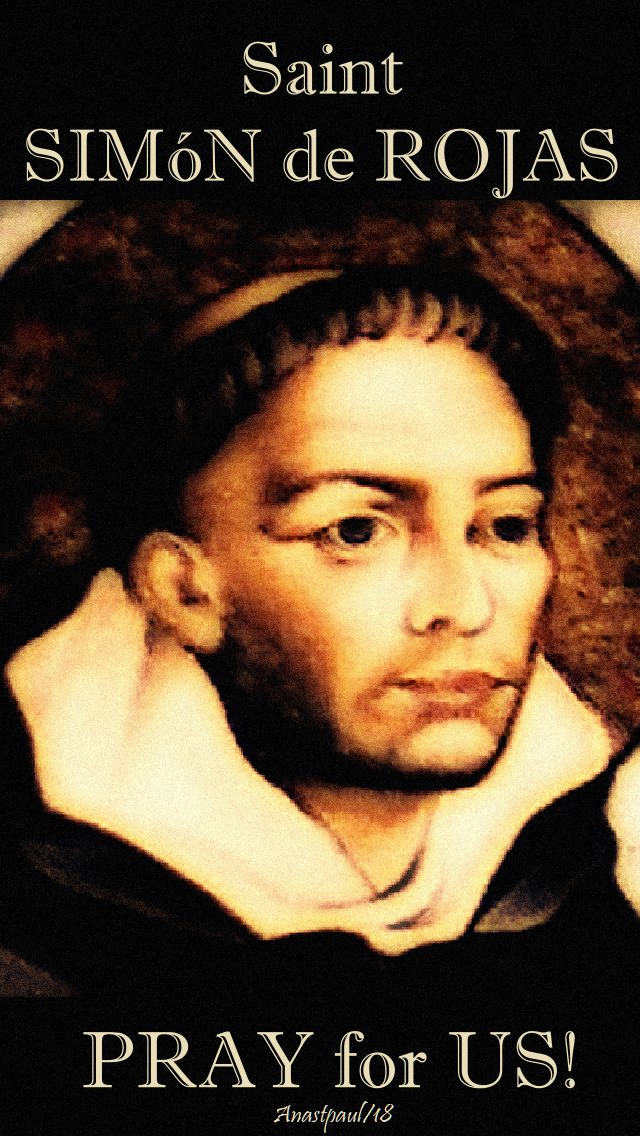
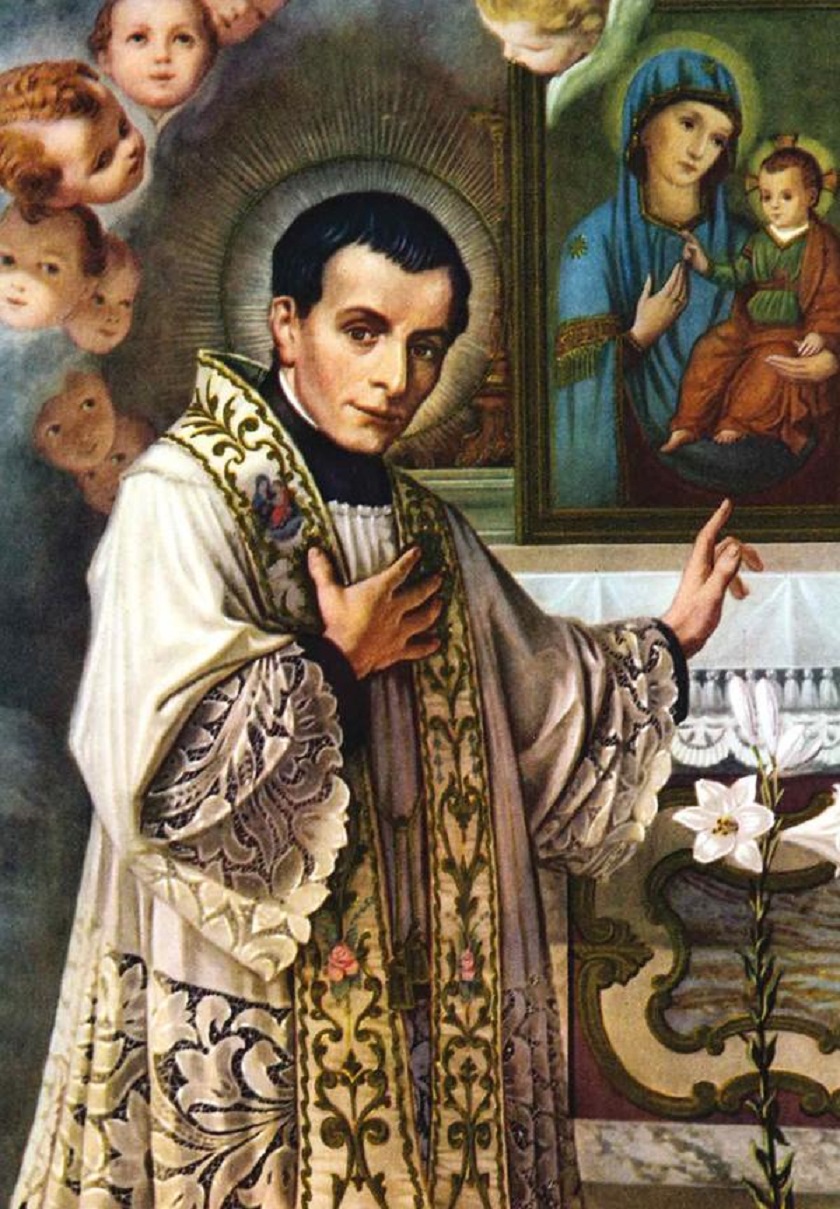
On The Memorial of St Simón de Rojas O.SS. (1552-1624) known as “Father Ave Maria” and the “Apostle of the Ave Maria”, we learn a little from St Louis.

How do I find the Grace of God?

TO FIND THE GRACE OF GOD, WE MUST DISCOVER MARY
(Excerpt from The Secret of Mary by St Louis Marie de Montfort)

The difficulty, then, is how to arrive at the true knowledge of the most holy Virgin and so find grace in abundance through her.   God, as the absolute Master, can give directly Hhat he ordinarily dispenses only through Mary and it would be rash to deny that He sometimes does so.   However, St Thomas assures us that, following the order established by His divine Wisdom, God ordinarily imparts His graces to men through Mary  . Therefore, if we wish to go to Him, seeking union with Him, we must use the same means which He used in coming down from heaven to assume our human nature and to impart His graces to us.   That means was a complete dependence on Mary His Mother, which is true devotion to her.

28. Chosen soul, this devotion consists in surrendering oneself in the manner of a slave to Mary and to Jesus through her and then performing all our actions with Mary, in Mary, through Mary and for Mary.   Let me explain this statement further.

29. We should choose a special feast day on which to give ourselves.   Then, willingly and lovingly and under no constraint, we consecrate and sacrifice to her unreservedly our body and soul.   We give to her our material possessions, such as house, family, income, and even the inner possessions of our soul, namely, our merits, graces, virtues and atonements.   Notice that in this devotion we sacrifice to Jesus through Mary all that is most dear to us, that is, the right to dispose of ourselves, of the value of our prayers and alms, of our acts of self- denial and atonements.   This is a sacrifice which no religious order would require of its members.   We leave everything to the free disposal of our Lady, for her to use as she wills for the greater glory of God, of which she alone is perfectly aware.

30. We leave to her the right to dispose of all the satisfactory and prayer value of our good deeds, so that, after having done so and without going so far as making a vow, we cease to be master over any good we do.   Our Lady may use our good deeds either to bring relief or deliverance to a soul in purgatory, or perhaps to bring a change of heart to a poor sinner.

31. By this devotion we place our merits in the hands of our Lady but only that she may preserve, increase and embellish them, since merit for increase of grace and glory cannot be handed over to any other person.   But we give to her all our prayers and good works, inasmuch as they have intercessory and atonement value, for her to distribute and apply to whom she pleases.   If, after having thus consecrated ourselves to our Lady, we wish to help a soul in purgatory, rescue a sinner, or assist a friend by a prayer, an alms, an act of self-denial or an act of self-sacrifice, we must humbly request it of our Lady, abiding always by her decision, which of course remains unknown to us.   We can be fully convinced that the value of our actions, being dispensed by that same hand which God himself uses to distribute His gifts and graces to us, cannot fail to be applied for His greatest glory.

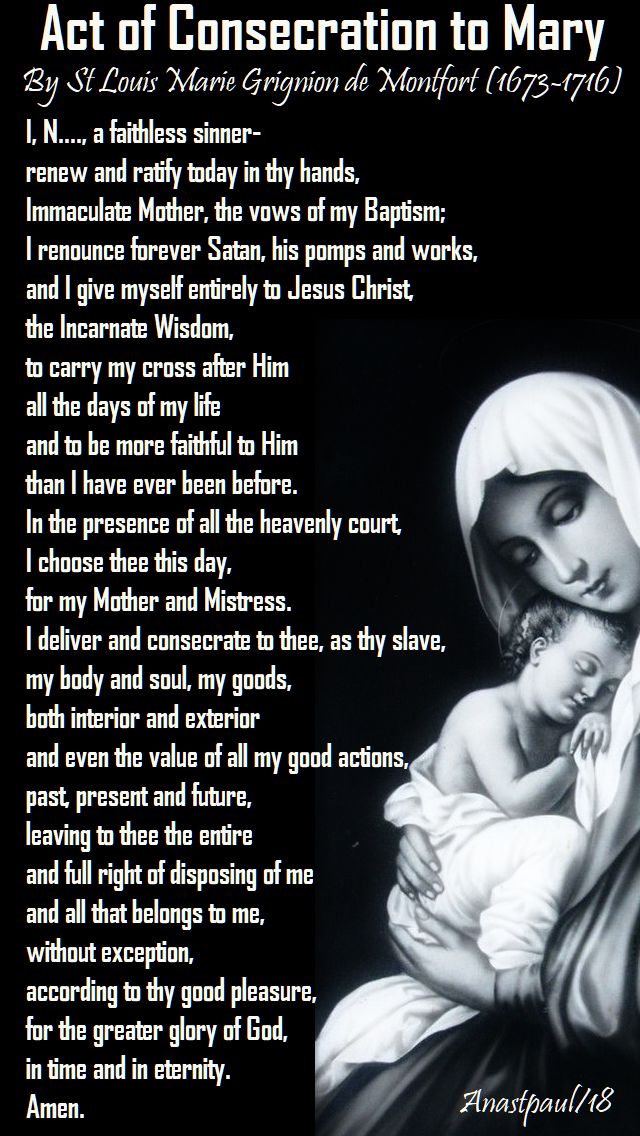
Act of Consecration to Mary
By St Louis Marie Grignion de Montfort (1673-1716)

I, N…., a faithless sinner-
renew and ratify today in thy hands,
Immaculate Mother, the vows of my Baptism;
I renounce forever Satan, his pomps and works,
and I give myself entirely to Jesus Christ, the Incarnate Wisdom,
to carry my cross after Him all the days of my life
and to be more faithful to Him than I have ever been before.
In the presence of all the heavenly court,
I choose thee this day, for my Mother and Mistress.
I deliver and consecrate to thee, as thy slave,
my body and soul, my goods, both interior and exterior
and even the value of all my good actions, past, present and future,
leaving to thee the entire and full right of disposing of me
and all that belongs to me, without exception,
according to thy good pleasure,
for the greater glory of God, in time and in eternity.
Amenact of consecration to mary by st louis de montfort - open house conversations with - how to become a slave of mary - 28 sept 2018

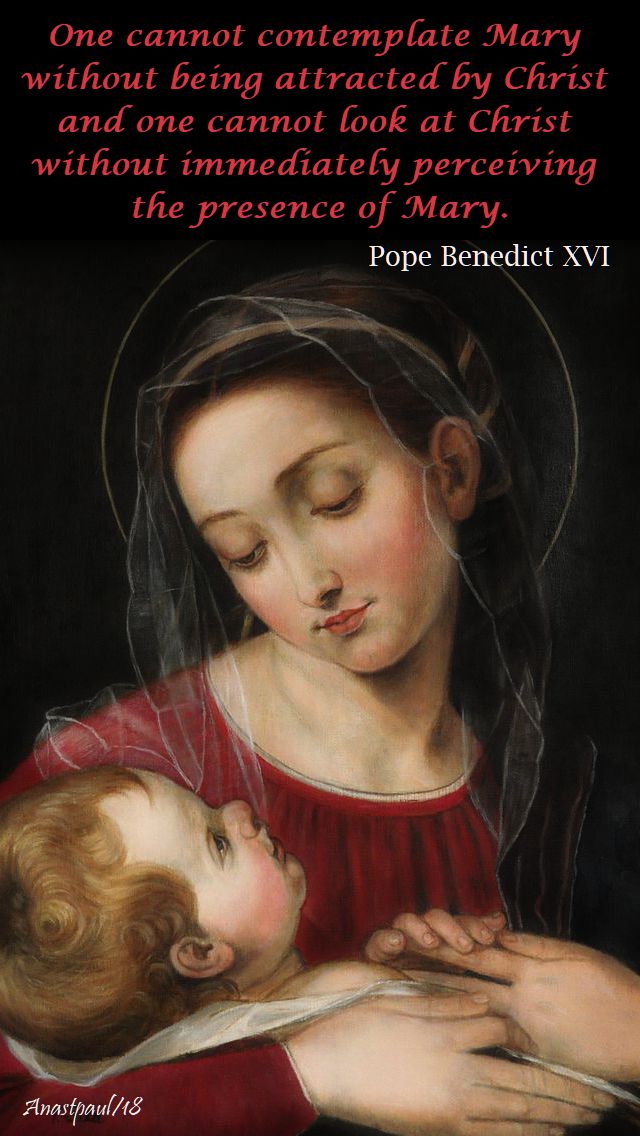
“One cannot contemplate Mary
without being attracted by Christ
and one cannot look at Christ
without immediately perceiving
the presence of Mary.”

Pope Benedict XVIone cannot contemplate mary - pope benedict - open house conversations with st louis de montfort - the secret of mary - 28 sept 2018

“Those who would receive Christ and bring Him forth must become like her . . .
her soul was virginal, so well cut loose from everything of earth,
so humble before God, that He could wholly fill her.”

(D Aemiliana Löhr, The Mass Through the Year)

Posted in MARIAN DEVOTIONS, MARIAN PRAYERS, MORNING Prayers, PAPAL SERMONS, QUOTES on CONVERSION, QUOTES on FAITH, QUOTES on the CROSS of CHRIST, SAINT of the DAY, The BLESSED VIRGIN MARY, The WORD

One Minute Reflection – 28 September – Today’s Gospel: Luke 9:18-22

One Minute Reflection – 28 September – Today’s Gospel: Luke 9:18-22 – Friday of the Twenty-fifth week in Ordinary Time and the Memorial of St Simón de Rojas O.SS. (1552-1624) known as “Father Ave Maria” and the “Apostle of the Ave Maria”

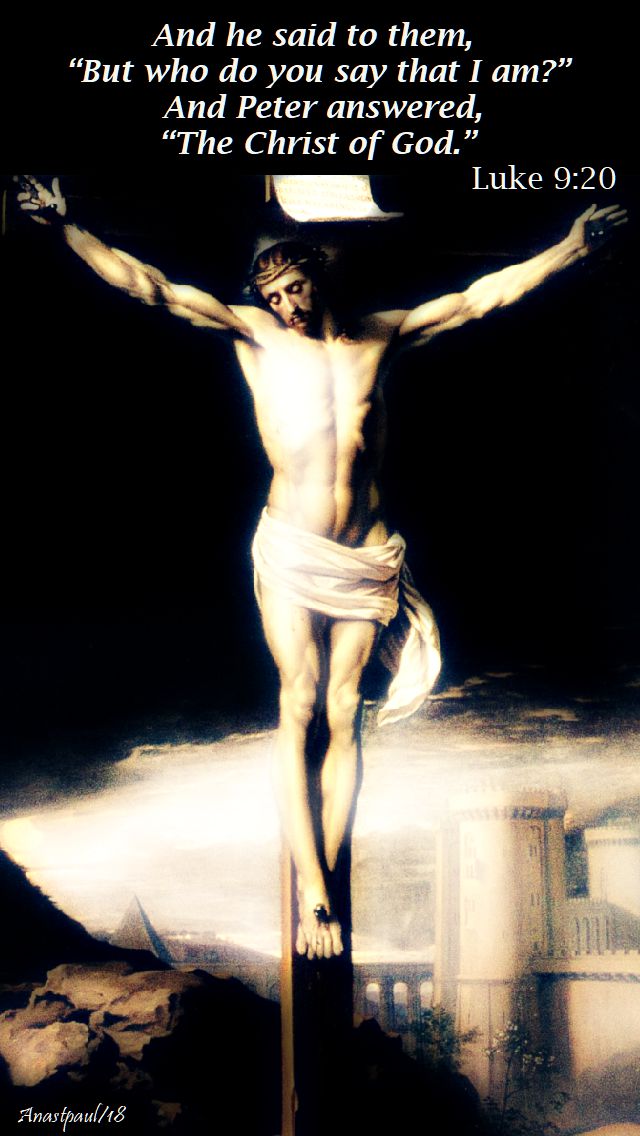
And he said to them, “But who do you say that I am?”   And Peter answered, “The Christ of God.”...Luke 9:20but who do you say - luke 9 20 - 28 sept 2018

REFLECTION – “In fact, there are two ways of “seeing” and “knowing” Jesus one – that of the crowd – is more superficial, the other – that of the disciples – more penetrating and genuine.   With His twofold question:  “What do the people say?” and “who do you say that I am?”, Jesus invited the disciples to become aware of this different perspective.   The people thought that Jesus was a prophet.   This was not wrong but it does not suffice, it is inadequate.   In fact, it was a matter of delving deep, of recognising the uniqueness of the person of Jesus of Nazareth and His newness.   This is how it still is today, many people draw near to Jesus, as it were, from the outside….Let us make Peter’s answer our own…..
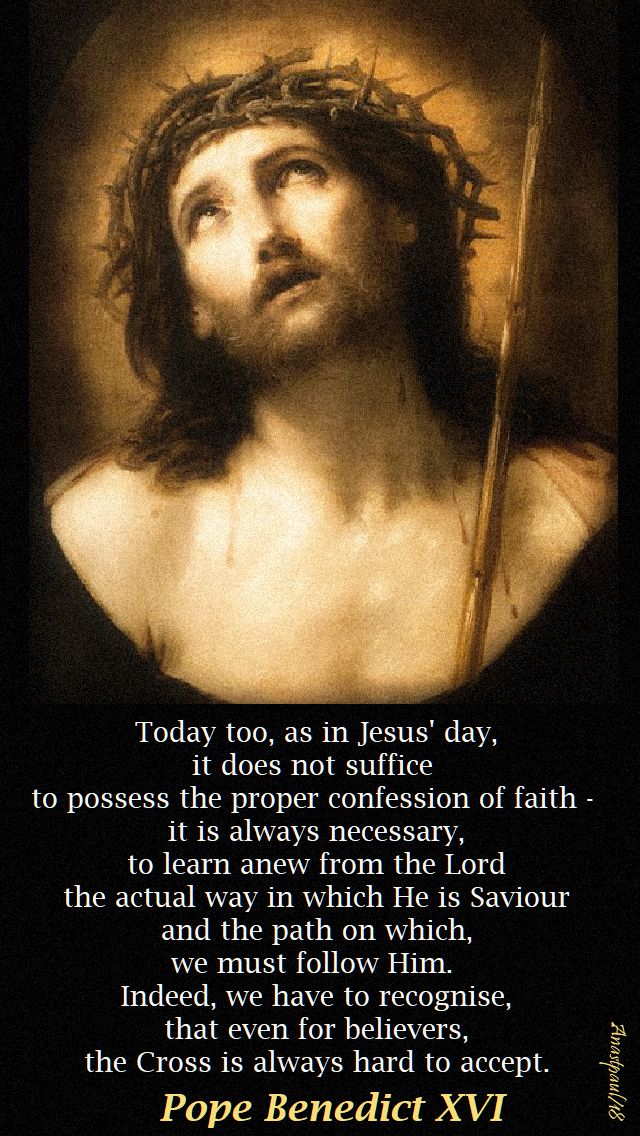
Today too, as in Jesus’ day, it does not suffice to possess the proper confession of faith – it is always necessary to learn anew from the Lord the actual way in which He is Saviour and the path on which we must follow Him.   Indeed, we have to recognise that even for believers, the Cross is always hard to accept.”…Pope Benedict XVI – 29 June 2007today too, as in Jesus' day - pope benedict - 28 sept 2018

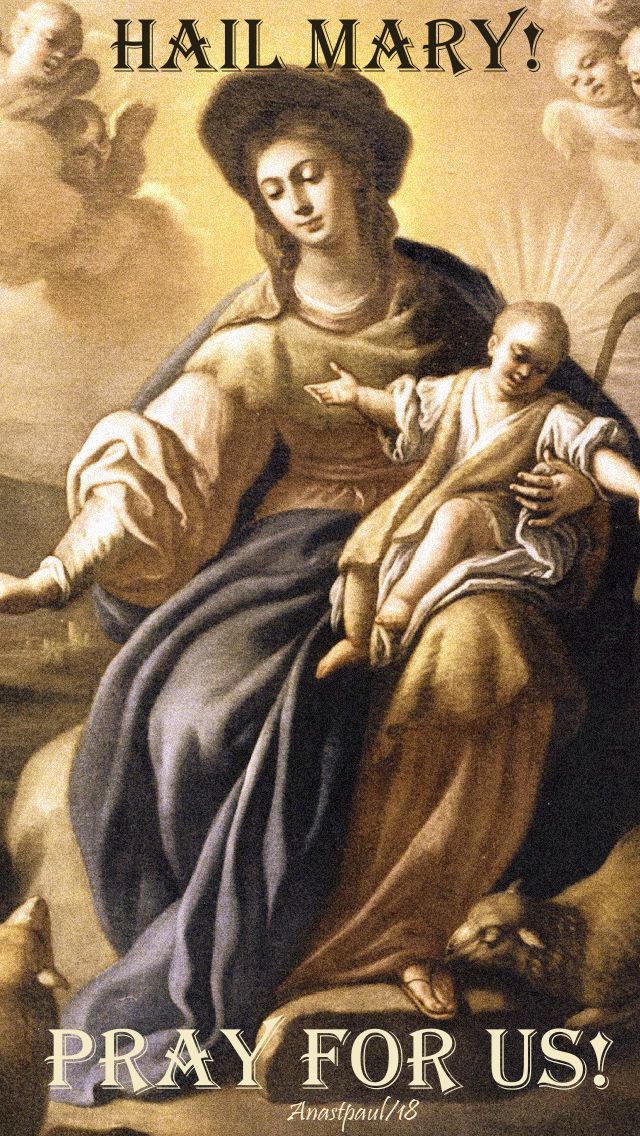
PRAYER – Lord God, You hold out the Light of Your Word to those who do not know You. Strengthen in our hearts, the faith You have given us and the Credo we profess, so that no trials may quench the fire Your Spirit has kindled in us.   May the intercession of St Simon de Rojas, grant us the grace of following the way of the Cross, to stand beneath it with our Mother, the Mother of God, Ave Maria!   We make our prayer through Jesus Christ with the Holy Spirit, one God forever, amen.hail mary pray for us - 28 sept 2018st simon de rojas pray for us - 28 sept 2018

Posted in Our MORNING Offering, PAPAL PRAYERS, The HOLY FACE, Uncategorized

Our Morning Offering – 24 September – Monday of the Twenty-fifth week in Ordinary Time, Year B

Our Morning Offering – 24 September – Monday of the Twenty-fifth week in Ordinary Time, Year B

May We Seek Your Face
By Pope Benedict XVI

Lord Jesus, grant us restless hearts,
hearts which seek Your Face.
Keep us from the blindness of heart
which sees only the surface of things.
Give us the simplicity and purity
which allow us to recognise
Your presence in the World.
When we are not able to accomplish great things,
grants us the courage
which is born of humility and goodness.
Impress Your Face on our hearts.
May we encounter You along the way
and show forth Your image
to the world.
Amenmay we seek your face - pope benedict - lord jesus, grant us restless hearts - 24 sept 2018

Posted in MORNING Prayers, PAPAL SERMONS, SAINT of the DAY, The WORD

One Minute Reflection – 20 September – Today’s Gospel: Luke 7:36–50

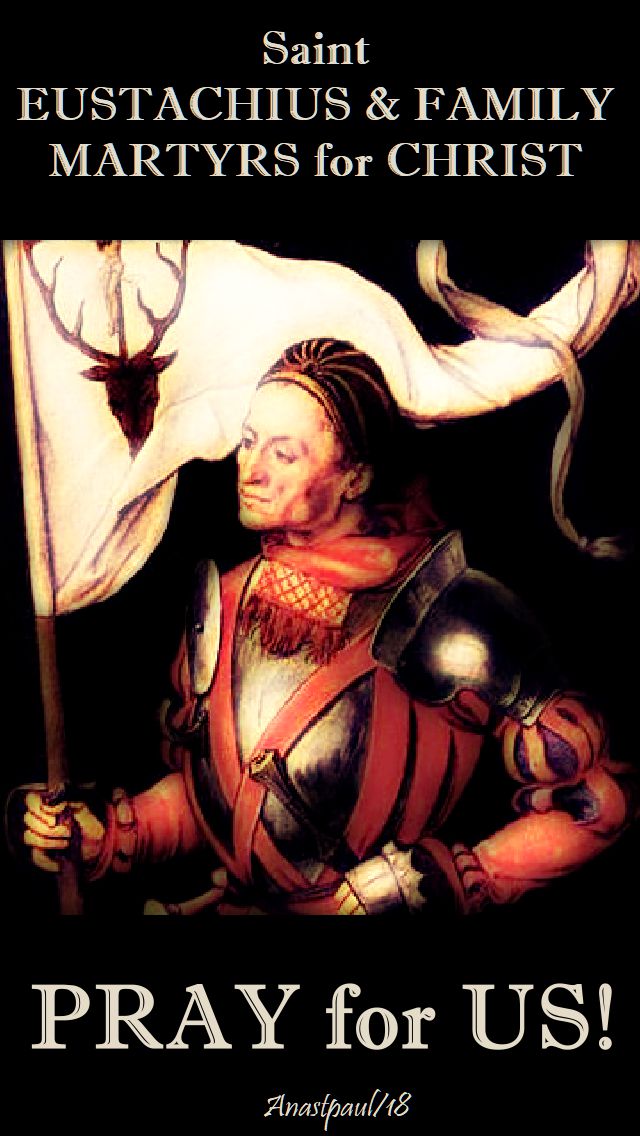
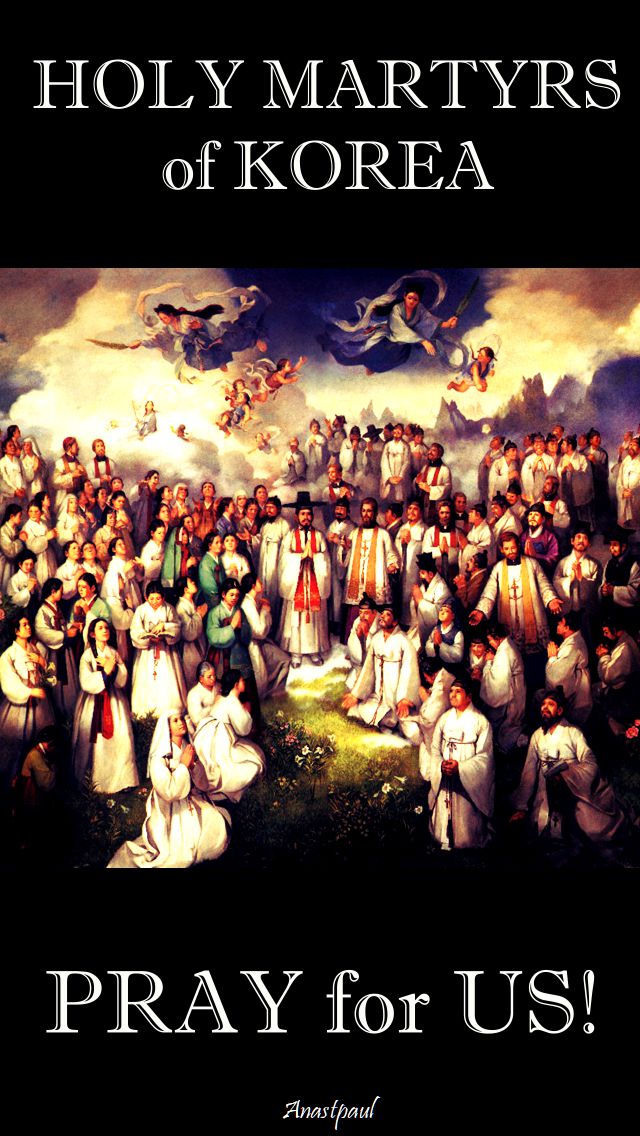
One Minute Reflection – 20 September – Today’s Gospel: Luke 7:36–50 – Thursday of the Twenty-fourth week in Ordinary Time, Year B and The Memorial of the Korean Martyrs – Sts Andrew Kim Taegon, Paul Chong Hasang & Companions – 103 saints and beati & St Eustachius & family (died 2nd century) – Martyrs

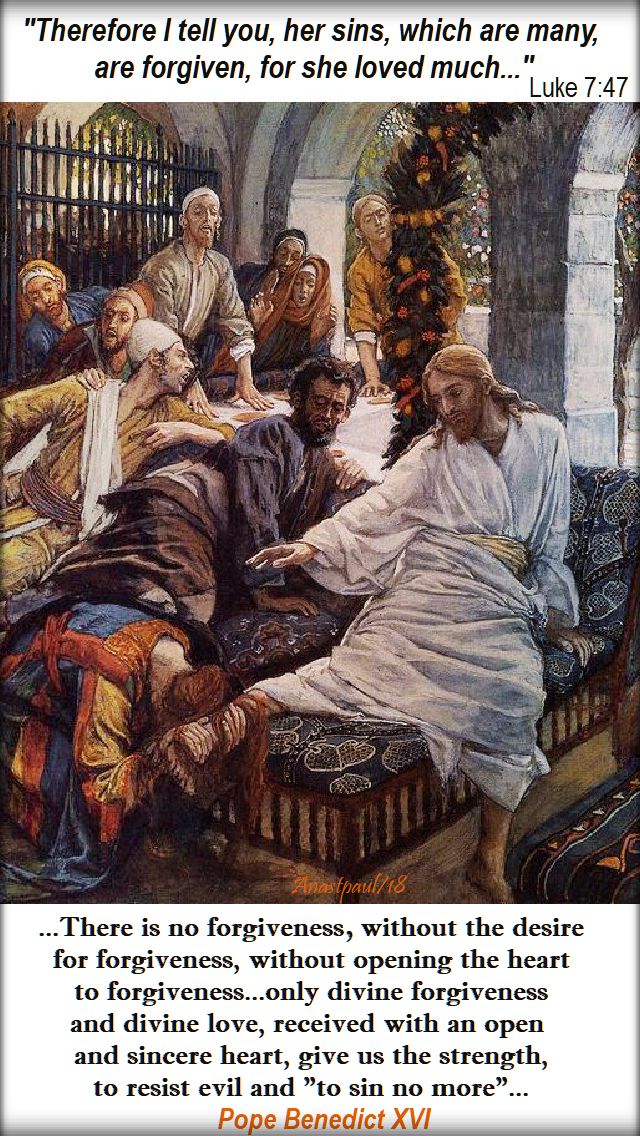
“Therefore I tell you, her sins, which are many, are forgiven, for she loved much”….Luke 7:47

REFLECTION – “Today, in particular, Jesus brings us to inner conversion:  He explains why He forgives us and teaches us to make forgiveness received from and given to, our brothers and sisters – the “daily bread” of our existence.
…Dear friends, from the Word of God we have just heard emerge practical instructions for our life.   Jesus does not enter into a theoretical discussion with His interlocutors on this section of Mosaic Law;  He is not concerned with winning an academic dispute about an interpretation of Mosaic Law but His goal is to save a soul and reveal that salvation is only found in God’s love.   This is why He came down to the earth, this is why He was to die on the Cross and why the Father was to raise Him on the third day.
Jesus came to tell us, that He wants us all in Paradise and that hell, about which little is said in our time, exists and is eternal for those who close their hearts to His love. …it is stressed that there is no forgiveness without the desire for forgiveness, without opening the heart to forgiveness – here it is highlighted, that only divine forgiveness and divine love, received with an open and sincere heart, give us the strength to resist evil and “to sin no more”, to let ourselves be struck by God’s love so that it becomes our strength.   Jesus’ attitude, thus becomes a model to follow, for every community, which is called to make love and forgiveness the vibrant heart of its life.”…Pope Benedict XVI – Sunday, 25 March 2007her sins which are many - luke 7 47 and there is no forgiveness without - pope benedict - 20 sept 2018

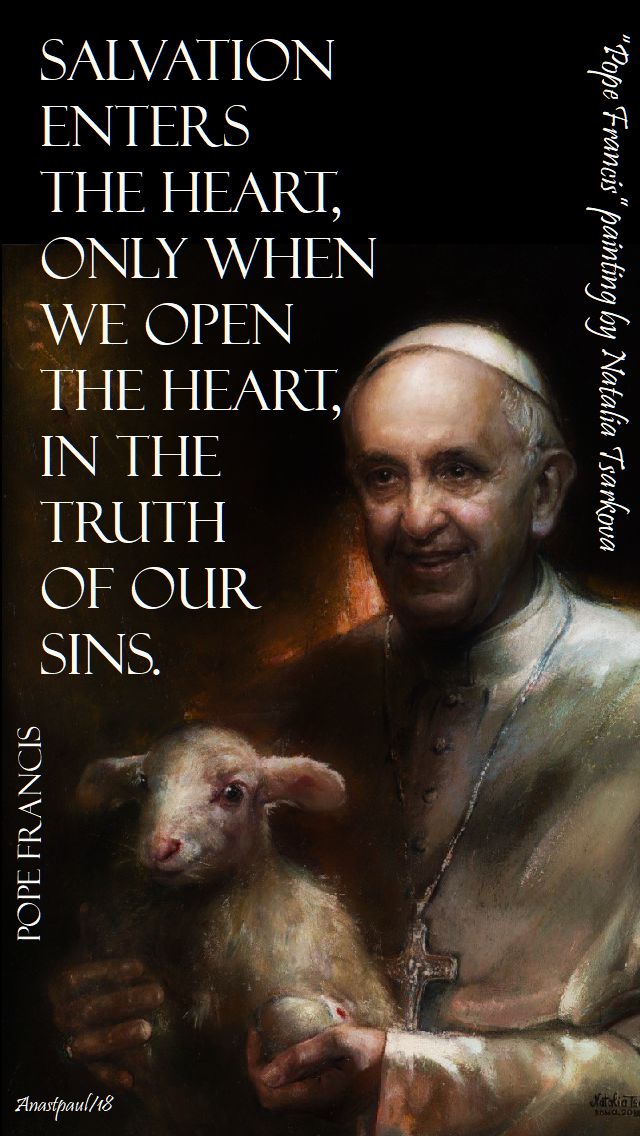
” Salvation enters the heart, only when we open the heart, in the truth of our sins.”…Pope Francis – Santa Marta, 18 Sept 2014 (“Pope Francis” painting by Natalia Tsarkova)salvation enters the heart only when we - pope francis 20 sept 2018

PRAYER – Grant us Lord, a true knowledge of salvation, so that, freed from fear and from the power of our foes, we may serve You faithfully, all the days of our life.   Give us Holy Father, a true desire for repentance and forgiveness and teach us each day, to forgive all with love.   Holy Martyrs, St Eustachius and family and those who so filled with love, died for the faith in Korea, please pray for us that we too may be filled with holy love and courage.   We make our prayer through our Lord, Jesus Christ in union with the Holy Spirit, one God, forever, amen.st eustachius and family martyrs - pray for us - 20 sept 2018holy-martyrs-of-korea-pray-for-us-20-sept-2017

Posted in SAINT of the DAY

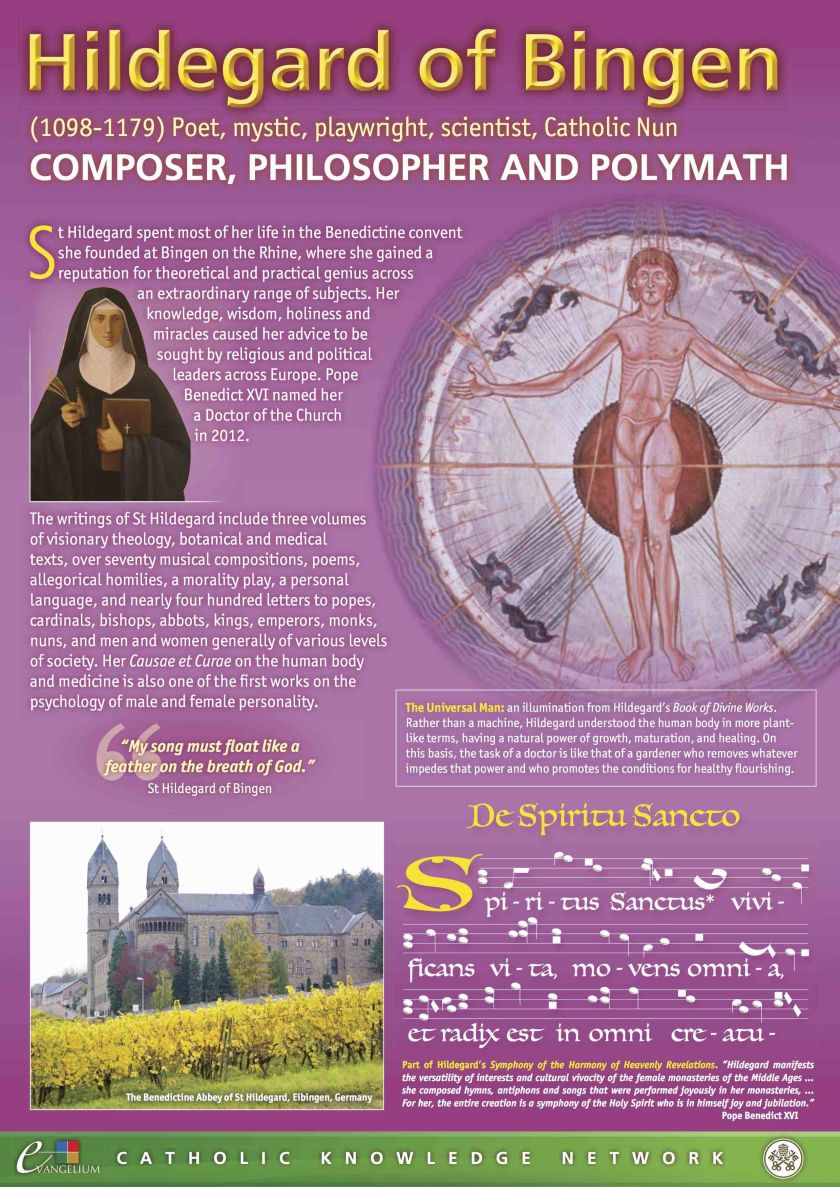
Saint of the Day – 17 September – Blessed Hildegard (1098-1179) Abbess

Saint of the Day – 17 September – Blessed Hildegard Abbess at Bingen OSB (1098-1179).   Born in 1098 at Bermersheim, Rhineland Palatinate (modern Germany) and died on 17 September 1179 at Bingen, Rhineland Palatinate (modern Germany) of natural causes.   She was Beatified on 26 August 1326 by Pope John XXII.   St Hildegard is also known as Saint Hildegard and Sibyl of the Rhine, was a German Benedictine Abbess, Theologian, Writer, Composer, Philosopher, Poet, Mystic, Visionary, Founder, Scientist, Artist and Polymath. She is considered to be the founder of scientific natural history in Germany.    Hildegard was elected magistra by her fellow nuns in 1136; she founded the Monasteries of Rupertsberg in 1150 and Eibingen in 1165.   One of her works as a composer, the Ordo Virtutum, is an early example of liturgical drama and arguably the oldest surviving morality play.   She wrote theological, botanical and medicinal texts, as well as letters, liturgical songs and poems, while supervising miniature illuminations in the Rupertsberg manuscript of her first work, Scivias.   She is also noted for the invention of a constructed language known as Lingua Ignota.st hildegard bio infoHILDEGARD VON BINGEN
1. A “light for her people and her time”:  in these words Blessed John Paul II, my Venerable Predecessor, described Saint Hildegard of Bingen in 1979, on the occasion of the eight-hundredth anniversary of the death of this German mystic.   This great woman truly stands out crystal clear against the horizon of history for her holiness of life and the originality of her teaching.   And, as with every authentic human and theological experience, her authority reaches far beyond the confines of a single epoch or society; despite the distance of time and culture, her thought has proven to be of lasting relevance.

In Saint Hildegard of Bingen there is a wonderful harmony between teaching and daily life.   In her, the search for God’s will in the imitation of Christ was expressed in the constant practice of virtue, which she exercised with supreme generosity and which she nourished from biblical, liturgical and patristic roots in the light of the Rule of Saint Benedict.   Her persevering practice of obedience, simplicity, charity and hospitality was especially visible.   In her desire to belong completely to the Lord, this Benedictine Abbess was able to bring together rare human gifts, keen intelligence and an ability to penetrate heavenly realities.514px-Engraving;_German_abbess_and_physician_Hildegard_von_Bingen_Wellcome_L0005783

2. Hildegard was born in 1098 at Bermersheim, Alzey, to parents of noble lineage who were wealthy landowners.   At the age of eight she was received as an oblate at the Benedictine Abbey of Disibodenberg, where in 1115 she made her religious profession. Upon the death of Jutta of Sponheim, around the year 1136, Hildegard was called to succeed her as magistra.   Infirm in physical health but vigorous in spirit, she committed herself totally to the renewal of religious life.   At the basis of her spirituality was the Benedictine Rule which views spiritual balance and ascetical moderation as paths to holiness.   Following the increase in vocations to the religious life, due above all to the high esteem in which Hildegard was held, around 1150 she founded a monastery on the hill of Rupertsberg, near Bingen, where she moved with twenty sisters.   In 1165, she established another monastery on the opposite bank of the Rhine.   She was the Abbess of both.

Within the walls of the cloister, she cared for the spiritual and material well-being of her sisters, fostering in a special way community life, culture and the liturgy.   In the outside world she devoted herself actively to strengthening the Christian faith and reinforcing religious practice, opposing the heretical trends of the Cathars, promoting Church reform through her writings and preaching and contributing to the improvement of the discipline and life of clerics  . At the invitation first of Hadrian IV and later of Alexander III, Hildegard practised a fruitful apostolate, something unusual for a woman at that time, making several journeys, not without hardship and difficulty, to preach even in public squares and in various cathedral churches, such as at Cologne, Trier, Liège, Mainz, Metz, Bamberg and Würzburg.   The profound spirituality of her writings had a significant influence both on the faithful and on important figures of her time and brought about an incisive renewal of theology, liturgy, natural sciences and music. Stricken by illness in the summer of 1179, Hildegard died in the odour of sanctity, surrounded by her sisters at the monastery of Rupertsberg, Bingen, on 17 September 1179.

3. In her many writings Hildegard dedicated herself exclusively to explaining divine revelation and making God known in the clarity of His love.   Hildegard’s teaching is considered eminent both for its depth, the correctness of its interpretation and the originality of its views.   The texts she produced are refreshing in their authentic “intellectual charity” and emphasise the power of penetration and comprehensiveness of her contemplation of the mystery of the Blessed Trinity, the Incarnation, the Church, humanity and nature as God’s creation, to be appreciated and respected.

These works were born from a deep mystical experience and propose a perceptive reflection on the mystery of God.   The Lord endowed her with a series of visions from childhood, whose content she dictated to the Benedictine monk Volmar, her secretary and spiritual advisor and to Richardis von Stade, one of her women religious.   But particularly illuminating are the judgements expressed by Saint Bernard of Clairvaux, who encouraged her and especially by Pope Eugene III, who in 1147 authorised her to write and to speak in public.   Theological reflection enabled Hildegard to organise and understand, at least in part, the content of her visions.   In addition to books on theology and mysticism, she also authored works on medicine and natural sciences.   Her letters are also numerous — about four hundred are extant;  these were addressed to simple people, to religious communities, popes, bishops and the civil authorities of her time.   She was also a composer of sacred music.   The corpus of her writings, for their quantity, quality and variety of interests, is unmatched by any other female author of the Middle Ages.

Her main writings are the Scivias, the Liber Vitae Meritorum and the Liber Divinorum Operum.   They relate her visions and the task she received from the Lord to transcribe them. In the author’s view her Letters were no less important, they bear witness to the attention Hildegard paid to the events of her time, which she interpreted in the light of the mystery of God.   In addition there are 58 sermons, addressed directly to her sisters. They are her Expositiones Evangeliorum, containing a literary and moral commentary on Gospel passages related to the main celebrations of the liturgical year.   Her artistic and scientific works focus mainly on music, in the Symphonia Harmoniae Caelestium Revelationum;  on medicine, in the Liber Subtilitatum Diversarum Naturarum Creaturarum and in the Causae et Curae and on natural sciences in the Physica.   Finally her linguistic writings are also noteworthy, such as the Lingua Ignota and the Litterae Ignotae, in which the words appear in an unknown language of her own invention but are composed mainly of phonemes present in German.

Hildegard’s language, characterised by an original and effective style, makes ample use of poetic expressions and is rich in symbols, dazzling intuitions, incisive comparisons and evocative metaphors.HILDEGARD ICON

4. With acute wisdom-filled and prophetic sensitivity, Hildegard focused her attention on the event of revelation.   Her investigation develops from the biblical page in which, in successive phases, it remains firmly anchored.   The range of vision of the mystic of Bingen was not limited to treating individual matters but sought to offer a global synthesis of the Christian faith.   Hence in her visions and her subsequent reflections she presents a compendium of the history of salvation from the beginning of the universe until its eschatological consummation.   God’s decision to bring about the work of creation is the first stage on this immensely long journey which, in the light of sacred Scripture, unfolds from the constitution of the heavenly hierarchy until it reaches the fall of the rebellious angels and the sin of our first parents.

This initial picture is followed by the redemptive Incarnation of the Son of God, the activity of the Church that extends in time the mystery of the Incarnation and the struggle against Satan.   The definitive Coming of the Kingdom of God and the Last Judgement crown this work.

Hildegard asks herself and us the fundamental question, whether it is possible to know God:  This is theology’s principal task.   Her answer is completely positive: through faith, as through a door, the human person is able to approach this knowledge.   God, however, always retains his veil of mystery and incomprehensibility  . He makes himself understandable in creation but, creation itself is not fully understood when detached from God.   Indeed, nature considered in itself provides only pieces of information which often become an occasion for error and abuse.   Faith, therefore, is also necessary in the natural cognitive process, for otherwise knowledge would remain limited, unsatisfactory and misleading.

Creation is an act of love by which the world can emerge from nothingness.   Hence, through the whole range of creatures, divine love flows as a river.   Of all creatures God loves man in a special way and confers upon him an extraordinary dignity, giving him that glory which the rebellious angels lost.   The human race may thus be counted as the tenth choir of the angelic hierarchy.   Indeed human beings are able to know God in Himself, that is, His one nature in the Trinity of Persons. Hildegard approached the mystery of the Blessed Trinity along the lines proposed by Saint Augustine.   By analogy with his own structure as a rational being, man is able to have an image at least of the inner life of God.   Nevertheless, it is solely in the economy of the Incarnation and human life of the Son of God that this mystery becomes accessible to human faith and knowledge.   The holy and ineffable Trinity in supreme Unity was hidden from those in the service of the ancient law.   But in the new law of grace it was revealed to all who had been freed from slavery.   The Trinity was revealed in a special way in the Cross of the Son.

A second “space” in which God becomes known is His word, contained in the Books of the Old and New Testament.   Precisely because God “speaks”, man is called to listen.   This concept affords Hildegard the opportunity to expound her doctrine on song, especially liturgical song.   The sound of the word of God creates life and is expressed in his creatures.   Thanks to the creative word, beings without rationality are also involved in the dynamism of creation.   But man of course is the creature who can answer the voice of the Creator with his own voice.   And this can happen in two ways:  in voce oris, that is, in the celebration of the liturgy, and in voce cordis, that is, through a virtuous and holy life.   The whole of human life may therefore be interpreted as harmonic and symphonic.Museum - Hildegard von Bingen

5. Hildegard’s anthropology begins from the biblical narrative of the creation of man (Gen 1:26), made in the image and likeness of God.   Man, according to Hildegard’s biblically inspired cosmology, contains all the elements of the world because the entire universe is recapitulated in him;  he is formed from the very matter of creation.   The human person can therefore consciously enter into a relationship with God.   This does not happen through a direct vision, but, in the words of Saint Paul, as “in a mirror” (1 Cor 13:12).   The divine image in man consists in his rationality, structured as intellect and will.   Thanks to his intellect, man can distinguish between good and evil;  thanks to his will, he is spurred to action.

Human beings are seen as a unity of body and soul. The German mystic shows a positive appreciation of corporeity and providential value is given even to the body’s weaknesses. The body is not a weight from which to be delivered.   Although human beings are weak and frail, this “teaches” them a sense of creatureliness and humility, protecting them from pride and arrogance.   Hildegard contemplated in a vision the souls of the blessed in paradise waiting to be rejoined to their bodies.   Our bodies, like the body of Christ, are oriented to the glorious resurrection, to the supreme transformation for eternal life.   The very vision of God, in which eternal life consists, cannot be definitively achieved without the body.

The human being exists in both the male and female form.   Hildegard recognised that a relationship of reciprocity and a substantial equality between man and woman is rooted in this ontological structure of the human condition.   Nevertheless the mystery of sin also dwells in humanity and was manifested in history for the first time precisely in the relationship between Adam and Eve.   Unlike other medieval authors who saw Eve’s weakness as the cause of the Fall, Hildegard places it above all in Adam’s immoderate passion for her.

Even in their condition as sinners, men and women continue to be the recipients of God’s love, because God’s love is unconditional and, after the Fall, acquires the face of mercy. Even the punishment that God inflicts on the man and woman brings out the merciful love of the Creator.   In this regard, the most precise description of the human creature is that of someone on a journey, homo viator.   On this pilgrimage towards the homeland, the human person is called to a struggle in order constantly to choose what is good and avoid evil.

The constant choice of good produces a virtuous life.   The Son of God made man is the subject of all virtues, therefore the imitation of Christ consists precisely in living a virtuous life in communion with Christ.   The power of virtue derives from the Holy Spirit, poured into the hearts of believers, who brings about upright beha  viour. This is the purpose of human existence.   In this way man experiences his Christ-like perfection.vonbingenhildeg

6. So as to achieve this goal, the Lord has given his Church the sacraments.   Salvation and the perfection of the human being are not achieved through the effort of the will alone but rather through the gifts of grace that God grants in the Church.

The Church herself is the first sacrament that God places in the world so that she may communicate salvation to mankind.   The Church, built up from “living souls”, may rightly be considered virgin, bride and mother and thus resembles closely the historical and mystical figure of the Mother of God.  The Church communicates salvation first of all by keeping and proclaiming the two great mysteries of the Trinity and the Incarnation, which are like the two “primary sacraments” and then through administration of the other sacraments.   The summit of the sacramental nature of the Church is the Eucharist. The sacraments produce the sanctification of believers, salvation and purification from sin, redemption and charity and all the other virtues.   However, to repeat, the Church lives because God within her has manifested his intraTrinitarian love, which was revealed in Christ.   The Lord Jesus is the mediator par excellence.   From the Trinitarian womb He comes to encounter man and from Mary’s womb He encounters God.   As the Son of God, He is love incarnate;  as the Son of Mary, He is humanity’s representative before the throne of God.

The human person can have an experience of God.   Relationship with Him, in fact, is not lived solely in the sphere of rationalit but involves the person totally.   All the external and internal senses of the human being are involved in the experience of God.   “But man was created in the image and likeness of God, so that he might act through the five bodily  senses;  he is not divided by them, rather through them he is wise, knowledgeable and intelligent in doing his work (…). For this very reason, because man is wise, knowledgeable and intelligent, he knows creation;  he knows God — whom he cannot see except by faith — through creation and his great works, even if with his five senses he barely comprehends them” (Explanatio Symboli Sancti Athanasii in PL 197, 1073).   This experiential process finds once again, its fullness in participation in the sacraments.

Hildegard also saw contradictions in the lives of individual members of the faithful and reported the most deplorable situations.   She emphasised in particular that individualism in doctrine and in practice on the part of both lay people and ordained ministers is an expression of pride and constitutes the main obstacle to the Church’s evangelising mission to non-Christians.

One of the salient points of Hildegard’s magisterium was her heartfelt exhortation to a virtuous life addressed to consecrated men and women.   Her understanding of the consecrated life is a true “theological metaphysics”, because it is firmly rooted in the theological virtue of faith, which is the source and constant impulse to full commitment in obedience, poverty and chastity.   In living out the evangelical counsels, the consecrated person shares in the experience of Christ, poor, chaste and obedient and follows in his footsteps in daily life.   This is fundamental in the consecrated life.hildegard statue

7. Hildegard’s eminent doctrine echoes the teaching of the Apostles, the Fathers and writings of her own day, while it finds a constant point of reference in the Rule of Saint Benedict.   The monastic liturgy and the interiorisation of sacred Scripture are central to her thought which, focusing on the mystery of the Incarnation, is expressed in a profound unity of style and inner content that runs through all her writings.

The teaching of the holy Benedictine nun stands as a beacon for homo viator.   Her message appears extraordinarily timely in today’s world, which is especially sensitive to the values that she proposed and lived.   For example, we think of Hildegard’s charismatic and speculative capacity, which offers a lively incentive to theological research;  her reflection on the mystery of Christ, considered in its beauty;  the dialogue of the Church and theology with culture, science and contemporary art;  the ideal of the consecrated life as a possibility for human fulfilment; her appreciation of the liturgy as a celebration of life;  her understanding of the reform of the Church, not as an empty change of structure but as conversion of heart;  her sensitivity to nature, whose laws are to be safeguarded and not violated.

For these reasons the attribution of the title of Doctor of the Universal Church to Hildegard of Bingen has great significance for today’s world and an extraordinary importance for women.   In Hildegard are expressed the most noble values of womanhood – hence the presence of women in the Church and in society is also illumined by her presence, both from the perspective of scientific research and that of pastoral activity.   Her ability to speak to those who were far from the faith and from the Church make Hildegard a credible witness of the new evangelisation.

By virtue of her reputation for holiness and her eminent teaching, on 6 March 1979 Cardinal Joseph Höffner, Archbishop of Cologne and President of the German Bishops’ Conference, together with the Cardinals, Archbishops and Bishops of the same Conference, including myself as Cardinal Archbishop of Munich and Freising, submitted to Blessed John Paul II the request that Hildegard of Bingen be declared a Doctor of the Universal Church. In that petition, the Cardinal emphasized the soundness of Hildegard’s doctrine, recognized in the twelfth century by Pope Eugene III, her holiness, widely known and celebrated by the people, and the authority of her writings. As time passed, other petitions were added to that of the German Bishops’ Conference, first and foremost the petition from the nuns of Eibingen Monastery, which bears her name. Thus, to the common wish of the People of God that Hildegard be officially canonized, was added the request that she be declared a “Doctor of the Universal Church”.

With my consent, therefore, the Congregation for the Causes of Saints diligently prepared a Positio super Canonizatione et Concessione tituli Doctoris Ecclesiae Universalis for the Mystic of Bingen.   Since this concerned a famous teacher of theology who had been the subject of many authoritative studies, I granted the dispensation from the measures prescribed by article 73 of the Apostolic Constitution Pastor Bonus.   The cause was therefore examined and approved by the Cardinals and Bishops, who met in Plenary Session on 20 March 2012.   The proponent (ponens) of the cause was His Eminence Cardinal Angelo Amato, Prefect of the Congregation for the Causes of Saints. At the audience of 10 May 2012, Cardinal Amato informed us in detail about the status quaestionis and the unanimous vote of the Fathers at the above-mentioned Plenary Session of the Congregation for the Causes of Saints.   On 27 May 2012, Pentecost Sunday, I had the joy of announcing to the crowd of pilgrims from all over the world gathered in Saint Peter’s Square the news of the conferral of the title of Doctor of the Universal Church upon Saint Hildegard of Bingen and Saint John of Avila at the beginning of the Assembly of the Synod of Bishops and on the eve of the Year of Faith.

Today, with the help of God and the approval of the whole Church, this act has taken place.   In Saint Peter’s Square, in the presence of many Cardinals and Prelates of the Roman Curia and of the Catholic Church, in confirming the acts of the process and willingly granting the desires of the petitioners, I spoke the following words in the course of the Eucharistic sacrifice:  “Fulfilling the wishes of numerous brethren in the episcopate and of many of the faithful throughout the world, after due consultation with the Congregation for the Causes of Saints, with certain knowledge and after mature deliberation, with the fullness of my apostolic authority I declare Saint John of Avila, diocesan priest and Saint Hildegard of Bingen, professed nun of the Order of Saint Benedict, to be Doctors of the Universal Church.   In the name of the Father, and of the Son, and of the Holy Spirit.”HILDEGARD VON BINGEN-LG
Posted in DOCTORS of the Church, EUCHARISTIC Adoration, FATHERS of the Church, MORNING Prayers, PAPAL MESSAGES, QUOTES of the SAINTS, QUOTES on PRAYER, SUNDAY REFLECTIONS, The HOLY EUCHARIST / The HOLY MASS

Sunday Reflection – 16 September – Twenty-fourth Sunday in Ordinary Time, Year B

Sunday Reflection – 16 September – Twenty-fourth Sunday in Ordinary Time, Year B

Excerpt from a Letter of His Holiness Pope Benedict XVI,
given on the Occasion of the 16th Centenary
of the Death of St John Chrysostom “Doctor of the Eucharist”

For Chrysostom, the ecclesial unity that is brought about in Christ is attested to in a quite special way in the Eucharist. “Called “Doctor of the Eucharist’ because of the vastness and depth of his teaching on the Most Holy Sacrament”, he taught that the sacramental unity of the Eucharist constitutes the basis of ecclesial unity in and for Christ.   “Of course, there are many things to keep us united. A table is prepared before all… all are offered the same drink, or, rather, not only the same drink but also the same cup. Our Father, desiring to lead us to tender affection, has also disposed this – that we drink from one cup, something that is befitting to an intense love”.   Reflecting on the words of St Paul’s First Letter to the Corinthians, “The bread which we break, is it not a participation in the body of Christ?”, John commented,for the Apostle, therefore, “just as that body is united to Christ, so we are united to Him through this bread”.   And even more clearly, in the light of the Apostle’s subsequent words:  “Because there is one bread, we who are many are one body”, John argued:  “What is bread?   The Body of Christ  . And what does it become when we eat it?   The Body of Christ – not many bodies but one body.   Just as bread becomes one loaf although it is made of numerous grains of wheat…, so we too are united both with one another and with Christ…. Now, if we are nourished by the same loaf and all become the same thing, why do we not also show the same love, so as to become one in this dimension, too?”.

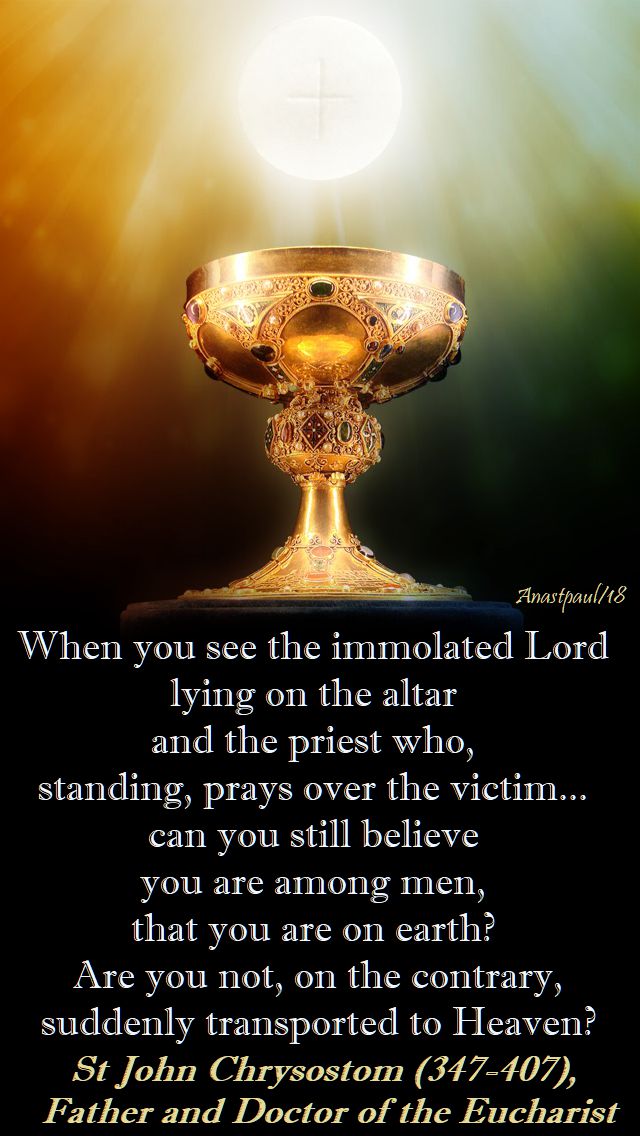
Chrysostom’s faith in the mystery of love that binds believers to Christ and to one another led him to experience profound veneration for the Eucharist, a veneration which he nourished in particular in the celebration of the Divine Liturgy.   Indeed, one of the richest forms of the Eastern Liturgy bears his name:  “The Divine Liturgy of St John Chrysostom”.   John understood that the Divine Liturgy places the believer spiritually between earthly life and the heavenly realities that have been promised by the Lord.   He told Basil the Great of the reverential awe he felt in celebrating the sacred mysteries with these words:   “When you see the immolated Lord lying on the altar and the priest who, standing, prays over the victim… can you still believe you are among men, that you are on earth? Are you not, on the contrary, suddenly transported to Heaven?”   The sacred rites, John said, “are not only marvellous to see but extraordinary because of the reverential awe they inspire. The priest who brings down the Holy Spirit stands there… he prays at length that the grace which descends on the sacrifice may illuminate the minds of all in that place and make them brighter than silver purified in the crucible. Who can spurn this venerable mystery?”.when you see the immolated lord - st john chrysostom - sunday reflection - 16 sept 2018 24th ord time year b

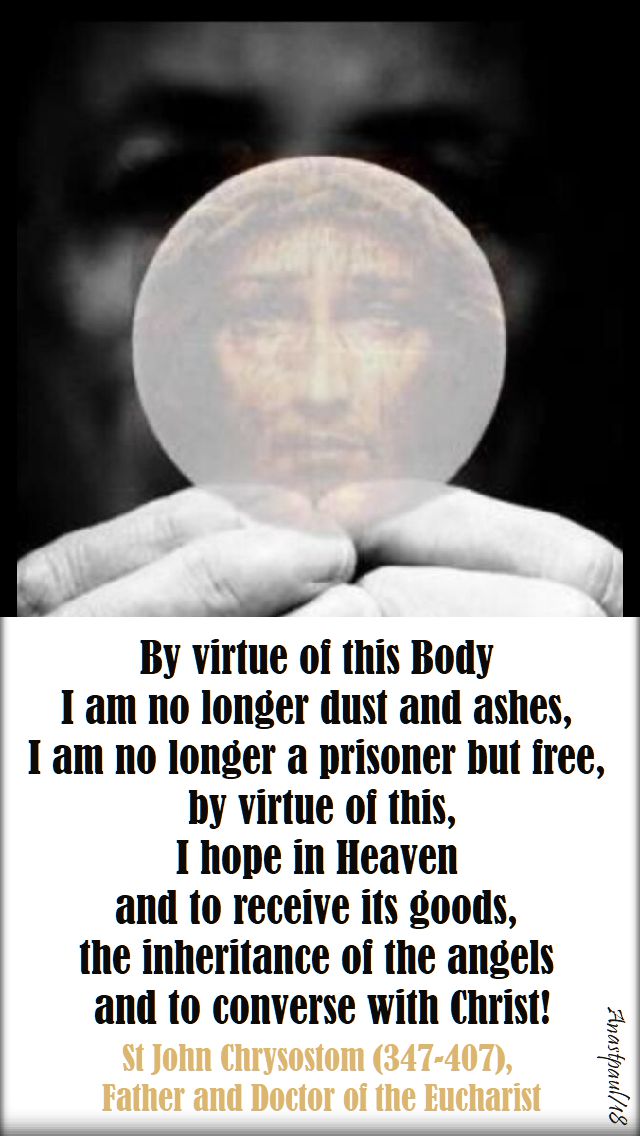
With great depth, Chrysostom developed his reflection on the effect of sacramental Communion in believers:  “The Blood of Christ renews in us the image of our King, it produces an indescribable beauty and does not allow the nobility of our souls to be destroyed but ceaselessly waters and nourishes them”.   For this reason, John often and insistently urged the faithful to approach the Lord’s altar in a dignified manner, “not with levity… not by habit or with formality”, but with “sincerity and purity of spirit”.   He tirelessly repeated that preparation for Holy Communion must include repentance for sins and gratitude for Christ’s sacrifice made for our salvation.   He therefore urged the faithful to participate fully and devoutly in the rites of the Divine Liturgy and to receive Holy Communion with these same dispositions:  “Do not permit us, we implore you, to be killed by your irreverence but approach Him with devotion and purity and, when you see Him placed before you, say to yourselves:  “By virtue of this Body I am no longer dust and ashes, I am no longer a prisoner but free, by virtue of this, I hope in Heaven and to receive its goods, the inheritance of the angels and to converse with Christ'”.by virtue of this body - st john chrysostom - 16 sept 2018

Of course, he also drew from contemplation of the Mystery the moral consequences in which he involved his listeners: he reminded them that communion with the Body and Blood of Christ obliged them to offer material help to the poor and the hungry who lived among them.   The Lord’s table is the place where believers recognise and welcome the poor and needy whom they may have previously ignored.   He urged the faithful of all times to look beyond the altar where the Eucharistic Sacrifice is offered and see Christ in the person of the poor, recalling that thanks to their assistance to the needy, they will be able to offer on Christ’s altar a sacrifice pleasing to God.”...Pope Benedict

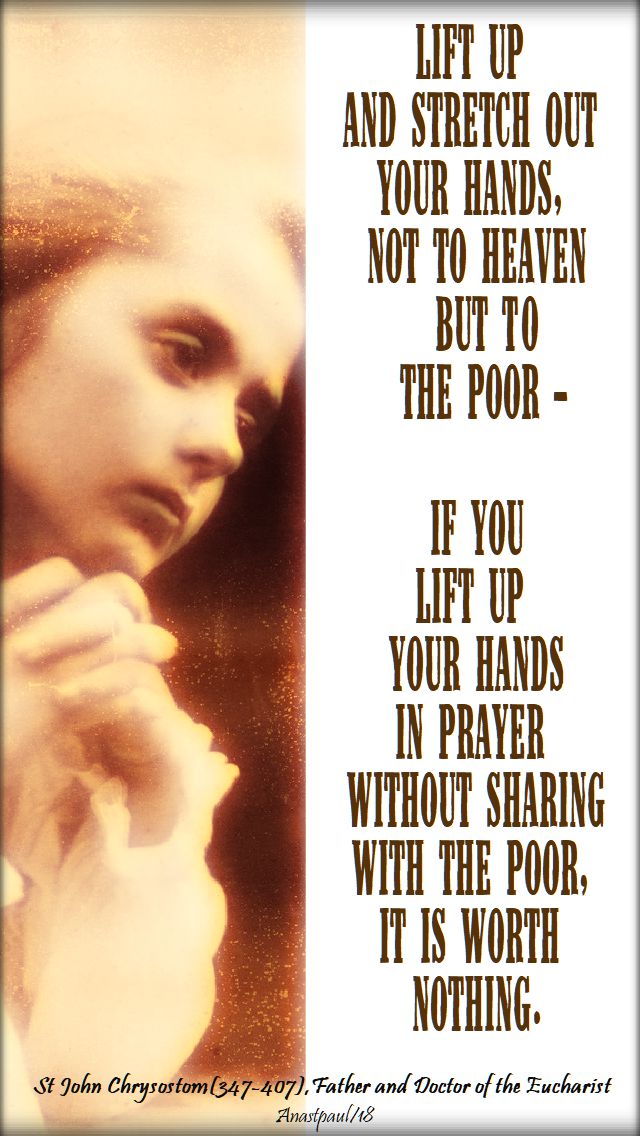
He said:
“Lift up and stretch out your hands,
not to heaven but to the poor…
if you lift up your hands in prayer
without sharing with the poor,
it is worth nothing.”lift up and stretch out your hands, not to heaven but to the poor - st john chrysostom - 16 sept 2018

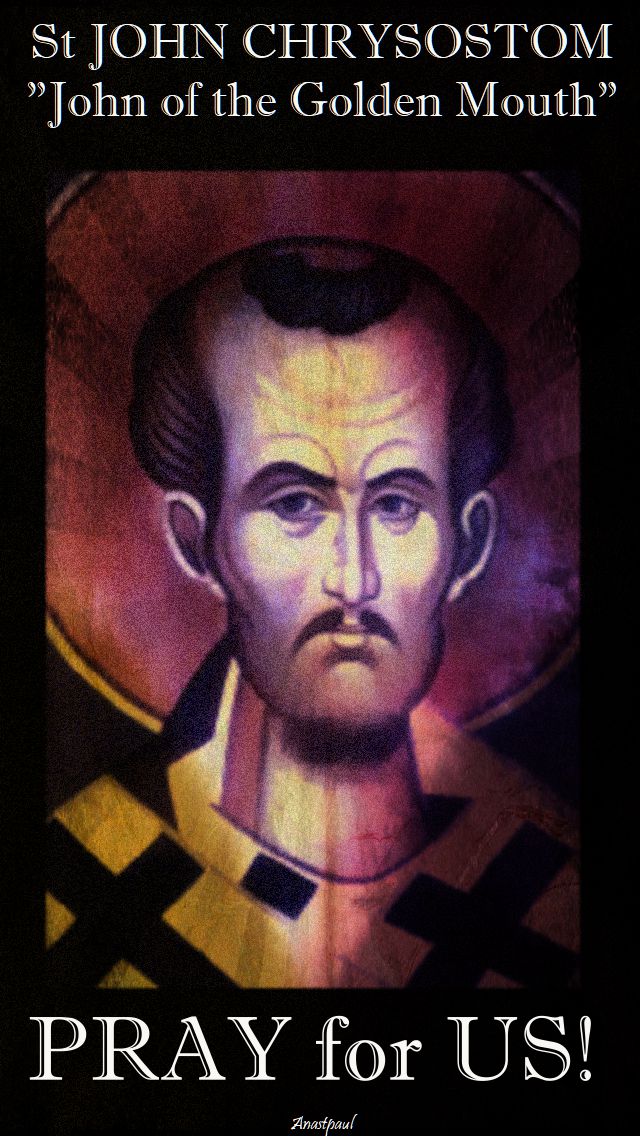
St John Chrysostom (347-407), Father and Doctor of the Eucharist, Pray for us!st john chrysostom pray for us.2

Posted in CATHOLIC DEVOTIONS of the Month, MARIAN DEVOTIONS, MARIAN QUOTES, MARIAN TITLES, PAPAL SERMONS, SAINT of the DAY, The BLESSED VIRGIN MARY

Memorial of The Seven Sorrows of the Blessed Virgin Mary – 15 September

Memorial of The Seven Sorrows of the Blessed Virgin Mary 

Excerpt from the Homily of His Holiness, Pope Benedict XVI,
at the Esplanade in front of the Basilica of Notre-Dame du Rosaire, Lourdes
Monday, 15 September 2008

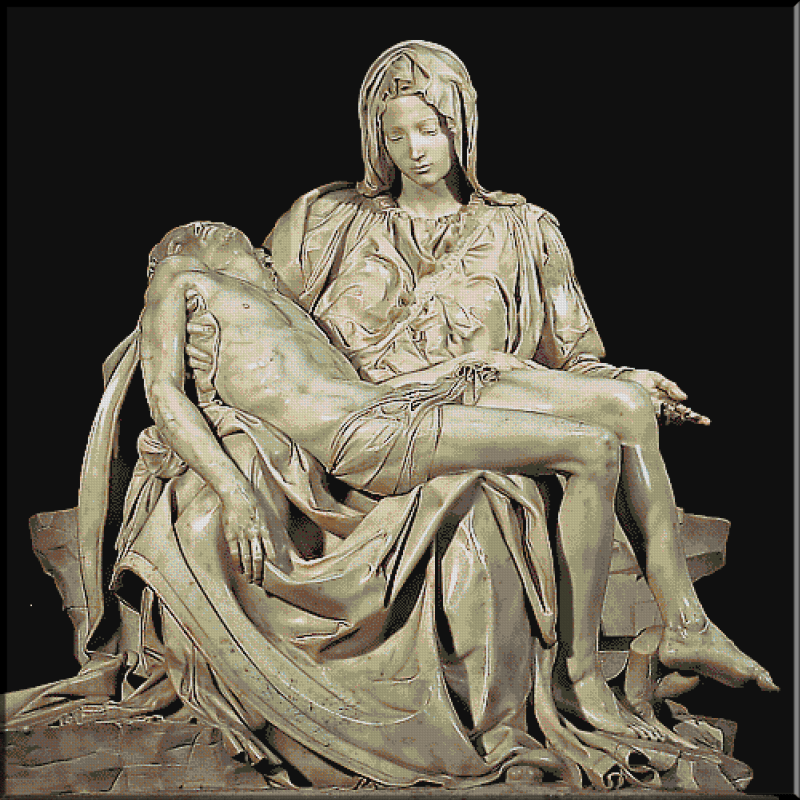
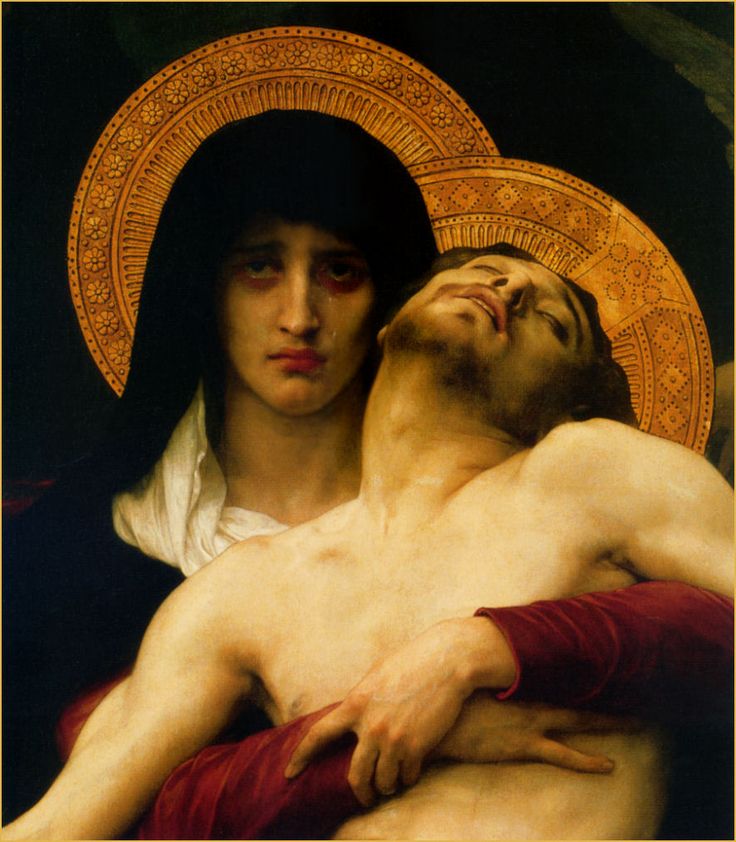
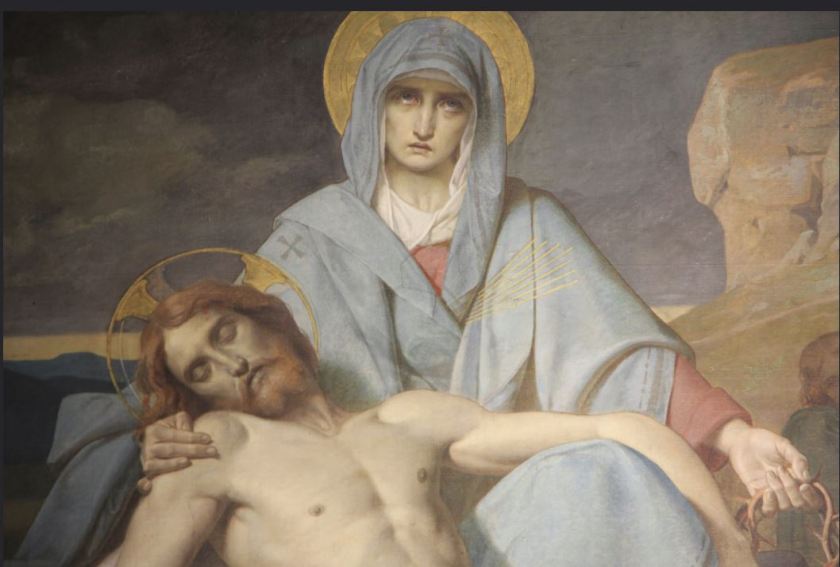
“Yesterday we celebrated the Cross of Christ, the instrument of our salvation, which reveals the mercy of our God in all its fullness.   The Cross is truly the place where God’s compassion for our world is perfectly manifested.   Today, as we celebrate the memorial of Our Lady of Sorrows, we contemplate Mary sharing her Son’s compassion for sinners.700-pietaHEADER & WP ourlady of sorrows - bougeureau

As Saint Bernard declares, the Mother of Christ entered into the Passion of her Son through her compassion (cf. Homily for Sunday in the Octave of the Assumption).   At the foot of the Cross, the prophecy of Simeon is fulfilled:  her mother’s heart is pierced through (cf. Lk 2:35) by the torment inflicted on the Innocent One born of her flesh. pieta - fr james bradley

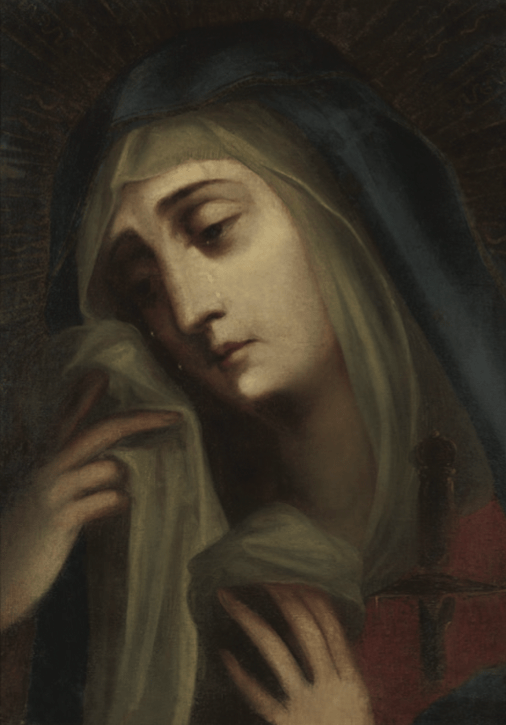
Just as Jesus cried (cf. Jn 11:35), so too Mary certainly cried over the tortured body of her Son. Her self-restraint, however, prevents us from plumbing the depths of her grief;  the full extent of her suffering is merely suggested by the traditional symbol of the seven swords. As in the case of her Son Jesus, one might say that she too was led to perfection through this suffering (cf. Heb 2:10), so as to make her capable of receiving the new spiritual mission that her Son entrusts to her immediately before “giving up his spirit” (cf. Jn 19:30) – that of becoming the mother of Christ in his members.  In that hour, through the figure of the beloved disciple, Jesus presents each of his disciples to his Mother when he says to her –  Behold your Son (cf. Jn 19:26-27).our lady of sorrows

Today Mary dwells in the joy and the glory of the Resurrection.   The tears shed at the foot of the Cross have been transformed into a smile which nothing can wipe away, even as her maternal compassion towards us remains unchanged.   The intervention of the Virgin Mary in offering succour throughout history testifies to this and does not cease to call forth, in the people of God, an unshakable confidence in her, the Memorare prayer expresses this sentiment very well.   Mary loves each of her children, giving particular attention to those who, like her Son at the hour of his Passion, are prey to suffering, she loves them quite simply because they are her children, according to the will of Christ on the Cross.

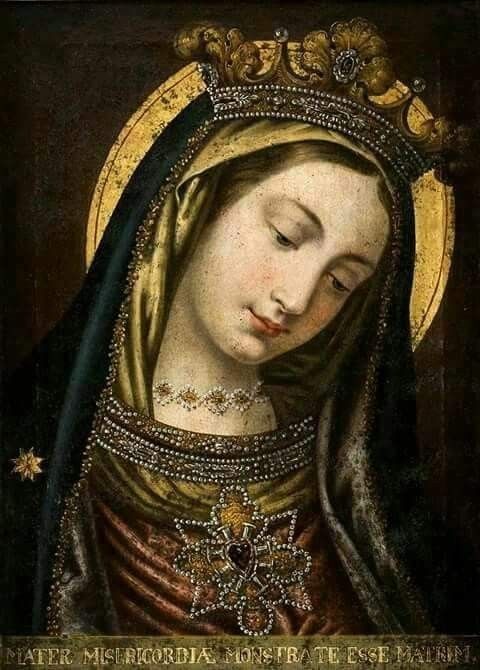
The psalmist, seeing from afar this maternal bond which unites the Mother of Christ with the people of faith, prophesies regarding the Virgin Mary that “the richest of the people … will seek your smile” (Ps 44:13).   In this way, prompted by the inspired word of Scripture, Christians have always sought the smile of Our Lady, this smile which medieval artists were able to represent with such marvellous skill and to show to advantage.   This smile of Mary is for all but it is directed quite particularly to those who suffer, so that they can find comfort and solace therein.   To seek Mary’s smile is not an act of devotional or outmoded sentimentality but rather the proper expression of the living and profoundly human relationship which binds us to her whom Christ gave us as our Mother.

mother of sorrows monstrate

To wish to contemplate this smile of the Virgin, does not mean letting oneself be led by an uncontrolled imagination.   Scripture itself discloses it to us through the lips of Mary when she sings the Magnificat:  “My soul glorifies the Lord, my spirit exults in God my Saviour” (Lk 1:46-47). When the Virgin Mary gives thanks to the Lord, she calls us to witness.   Mary shares, as if by anticipation, with us, her future children, the joy that dwells in her heart, so that it can become ours.   Every time we recite the Magnificat, we become witnesses of her smile.”

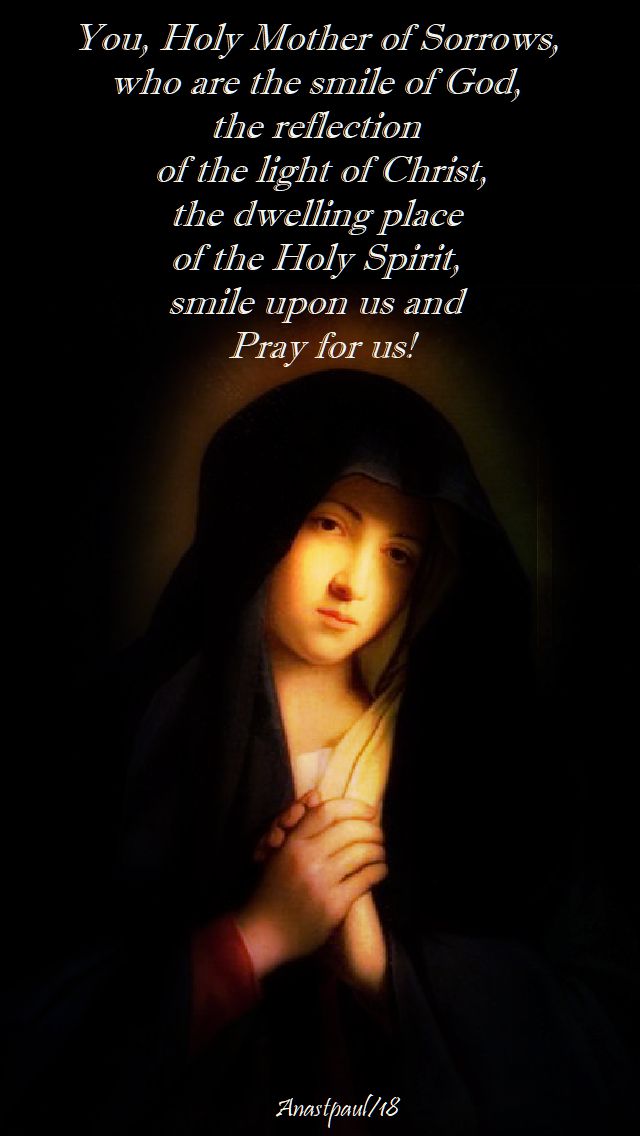
You, Holy Mother of Sorrows, who are the smile of God, the reflection of the light of Christ, the dwelling place of the Holy Spirit, smile upon us and pray for us!you holy mother of sorrows - smile upon us and pray for us - 15 sept 2018

Posted in CATHOLIC DEVOTIONS of the Month, FEASTS and SOLEMNITIES, MORNING Prayers, PAPAL SERMONS, QUOTES on the CROSS of CHRIST, SAINT of the DAY, The HOLY CROSS

Thought for the Day – 14 September – Feast of the Exaltation of the Holy Cross

Thought for the Day – 14 September – Feast of the Exaltation of the Holy Cross14-sept-exaltation-of-the-holy-cross 2017

Excerpt – Pope Benedict XVI

 Angelus, 17 September 2006

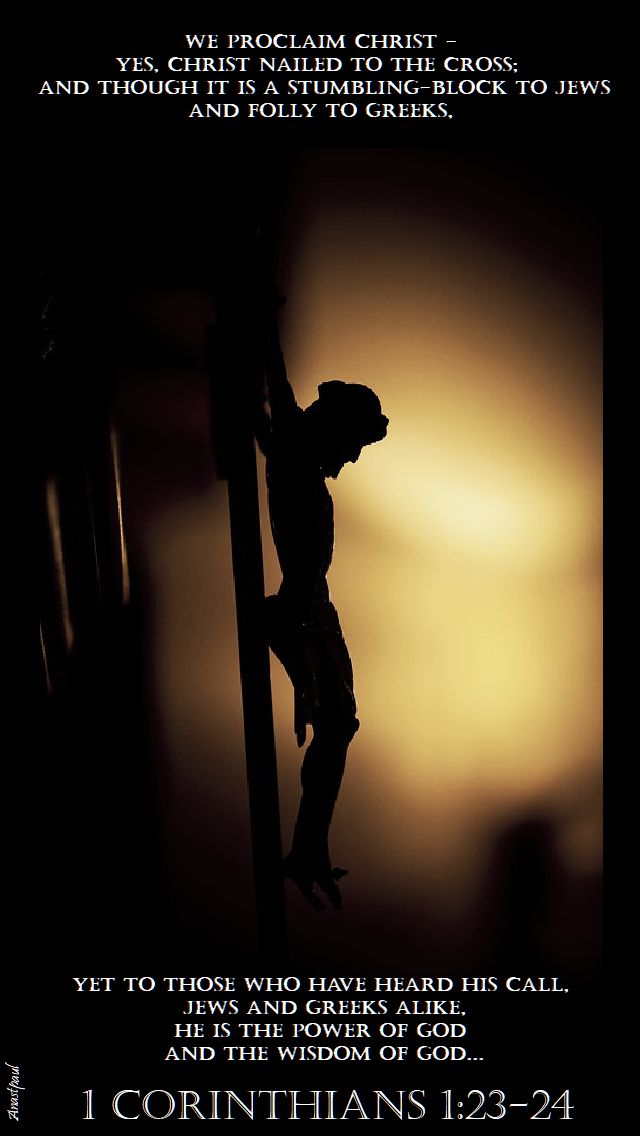
“But what does exalting the Cross mean?   Is it not maybe scandalous to venerate a shameful form of execution?   The Apostle Paul says: “We proclaim Christ crucified, a stumbling block to Jews and folly to Gentiles” (I Cor 1: 23). Christians, however, do not exalt just any cross but the Cross which Jesus sanctified with His sacrifice, the fruit and testimony of immense love.   Christ on the Cross pours out His Blood to set humanity free from the slavery of sin and death.1-corinthians-1-23-24 - we proclaim christ crucified = 14 sept 2017

Therefore, from being a sign of malediction, the Cross was transformed into a sign of blessing, from a symbol of death into a symbol par excellence of the Love that overcomes hatred and violence and generates immortal life.   “O Crux, ave spes unica! O Cross, our only hope!”.   Thus sings the liturgy.

The Evangelist recounts – Mary was standing by the Cross (cf. Jn 19: 25-27).   Her sorrow is united with that of her So  n. It is a sorrow full of faith and love.   The Virgin on Calvary participates in the saving power of the suffering of Christ, joining her “fiat”, her “yes”, to that of her Son.

Dear brothers and sisters, spiritually united to Our Lady of Sorrows, let us also renew our “yes” to God who chose the Way of the Cross in order to save us.   This is a great mystery which continues and will continue to take place until the end of the world and which also asks for our collaboration.

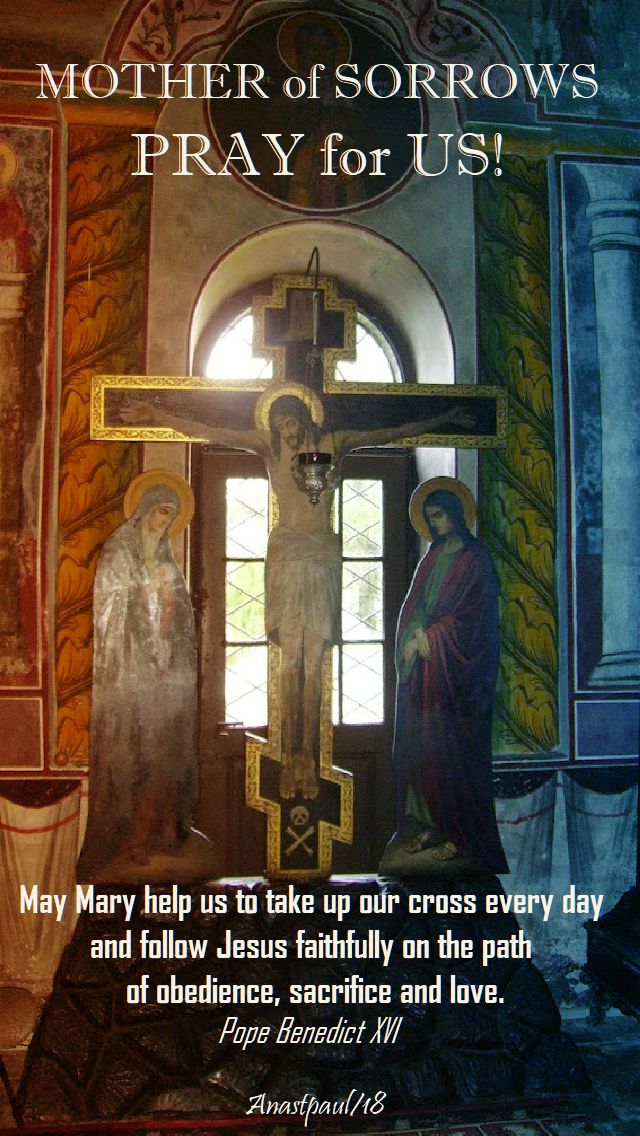
May Mary help us to take up our cross every day and follow Jesus faithfully on the path of obedience, sacrifice and love.”mother of sorrows pray for us - may mary help us - pope benedict - 14 sept 2018

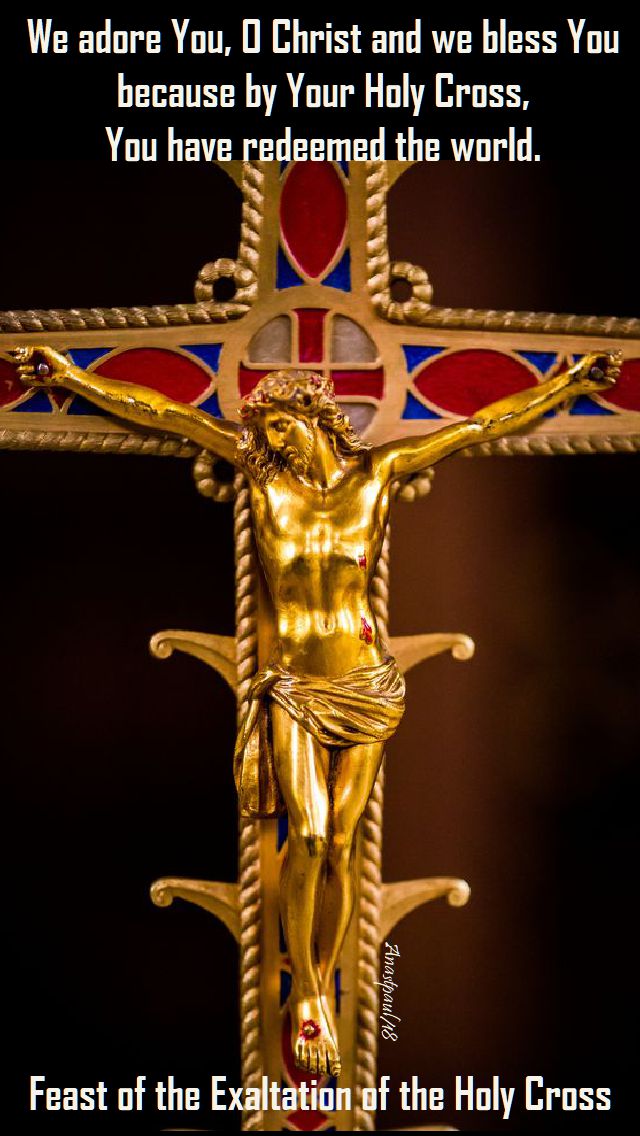
We adore You Christ and we bless You,

for by Your holy Cross You have redeemed the world.

we adore you o christ - 14 sept 2018


Posted in DOCTORS of the Church, FATHERS of the Church, FRUITS of the SPIRIT, MORNING Prayers, PAPAL SERMONS, QUOTES of the SAINTS, QUOTES on HUMILITY, SAINT of the DAY, The WORD, VATICAN Resources

Thought for the Day – 3 September – The Memorial of St Pope Gregory the Great (540-604) Father & Doctor of the Church “Father of the Fathers” “Servant of the Servants”

Thought for the Day – 3 September – The Memorial of St Pope Gregory the Great (540-604)
Father & Doctor of the Church
“Father of the Fathers”
“Servant of the Servants”

Excerpt from Pope Benedict XVI’s Homily – General Audience – 4 June 2009
St Pope Gregory the Great “Servant of the Servants” “Servus Servorum Dei”

“Probably the most systematic text of Gregory the Great is the Pastoral Rule, written in the first years of his Pontificate.   In it, Gregory proposed to treat the figure of the ideal Bishop, the teacher and guide of his flock.   To this end he illustrated the seriousness of the office of Pastor of the Church and its inherent duties.   Therefore, those who were not called to this office may not seek it with superficiality, instead those who assumed it without due reflection necessarily feel trepidation rise within their soul.   Taking up again a favourite theme, he affirmed that the Bishop is above all the “preacher” par excellence;  for this reason he must be above all an example for others, so that his behaviour may be a point of reference for all.   Efficacious pastoral action requires that he know his audience and adapt his words to the situation of each person – here Gregory paused to illustrate the various categories of the faithful with acute and precise annotations, which can justify the evaluation of those who have also seen in this work a treatise on psychology.   From this one understands that he really knew his flock and spoke of all things with the people of his time and his city.

Nevertheless, the great Pontiff insisted on the Pastor’s duty to recognise daily his own unworthiness in the eyes of the Supreme Judge, so that pride did not negate the good accomplished.   For this the final chapter of the Rule is dedicated to humility : “When one is pleased to have achieved many virtues, it is well to reflect on one’s own inadequacies and to humble oneself, instead of considering the good accomplished, it is necessary to consider what was neglected”.   All these precious indications demonstrate the lofty concept that St Gregory had for the care of souls, which he defined as the “ars artium”, the art of arts.   The Rule had such great and the rather rare, good fortune to have been quickly translated into Greek and Anglo-Saxon.

He wanted to be – and this is his expression – “Servus Servorum Dei”.   Coined by him, this phrase was not just a pious formula on his lips but a true manifestation of his way of living and acting.   He was intimately struck by the humility of God, who in Christ made Himself our servant.   He washed and washes our dirty feet.   Therefore, he was convinced that a Bishop, above all, should imitate this humility of God and follow Christ in this way.

His desire was to live truly as a monk, in permanent contact with the Word of God but for love of God he knew how to make himself the servant of all in a time full of tribulation and suffering.   He knew how to make himself the “servant of the servants”. Precisely because he was this, he is great and also shows us the measure of true greatness.”

St Pope Gregory the Great, “Servant of the Servants”, Pray for Us!st pope gregory the great servant of the servants - pray for us - 3 sept 2018

Posted in Against EPIDEMICS, DOCTORS of the Church, FATHERS of the Church, GOUT, KNEE PROBLEMS, ARTHRITIS, etc, Of Catholic Education, Students, Schools, Colleges etc, Of MUSICIANS, Choristors, Of POPES and the PAPACY, PAPAL SERMONS, SAINT of the DAY, TEACHERS, LECTURERS, INSTRUCTORS, VATICAN Resources

Saint of the Day – 3 September – St Pope Gregory the Great (540-604) – Father & Doctor of the Church – “Father of the Fathers”

Saint of the Day – 3 September – St Pope Gregory the Great (540-604) – Father & Doctor of the Church – “Father of the Fathers” – Pope, Prefect of Rome, Monk, Abbot, Writer, Theologian, Teacher, Liturgist, Administrator, Diplomat, Political Negotiator, Apostle of Charity and Social Justice, Apostle of Pastoral Ministry, PeaceMaker.  Patronages – • against gout • against plague/epidemics,• choir boys,• teachers• stone masons, stonecutters, • students, school children,• Popes, the Papacy,• musicians,• singers,• England, • West Indies,• Legazpi, Philippines, Diocese of,• Order of Knights of Saint Gregory, • Kercem, Malta,• Montone, Italy,• San Gregorio nelle Alpi, Italy.   4 original latin fathes - jerome, gregory, ambrose, augustine -- done with snips 3 sept 2018

Pier_Francesco_Sacchi_-_Dottori_della_Chiesa_-_ca._1516
Pier Francesco Sacchi – Dottori della Chiesa c 1516
Four doctors of the Church represented with attributes of the Four Evangelists: St Augustine with an eagle, St Gregory the Great with a bull, St Hieronymus with an angel, St Ambrosius with a winged lion.

gregory

Pope Benedict’s Catechesis on St Pope Gregory the Great

Today I would like to present the figure of one of the greatest Fathers in the history of the Church, one of four Doctors of the West, Pope St Gregory, who was Bishop of Rome from 590 to 604 and who earned the traditional title of Magnus/the Great.   Gregory was truly a great Pope and a great Doctor of the Church!

He was born in Rome about 540 into a rich patrician family of the gens Anicia, who were distinguished not only for their noble blood but also for their adherence to the Christian faith and for their service to the Apostolic See.   Two Popes came from this family  : Felix III (483-492), the great-great grandfather of Gregory and Agapetus (535-536).   The house in which Gregory grew up stood on the Clivus Scauri, surrounded by majestic buildings that attested to the greatness of ancient Rome and the spiritual strength of Christianity. The example of his parents Gordian and Sylvia, both venerated as Saints and those of his father’s sisters, Aemiliana and Tharsilla, who lived in their own home as consecrated virgins following a path of prayer and self-denial, inspired lofty Christian sentiments in him.

In the footsteps of his father, Gregory entered early into an administrative career which reached its climax in 572 when he became Prefect of the city.   This office, complicated by the sorry times, allowed him to apply himself on a vast range to every type of administrative problem, drawing light for future duties from them.   In particular, he retained a deep sense of order and discipline: having become Pope, he advised Bishops to take as a model for the management of ecclesial affairs the diligence and respect for the law like civil functionaries .   Yet this life could not have satisfied him since shortly after, he decided to leave every civil assignment in order to withdraw to his home to begin the monastic life, transforming his family home into the monastery of St Andrew on the Coelian Hill.  This period of monastic life, the life of permanent dialogue with the Lord in listening to His word, constituted a perennial nostalgia which he referred to ever anew and ever more in his homilies.   In the midst of the pressure of pastoral worries, he often recalled it in his writings as a happy time of recollection in God, dedication to prayer and peaceful immersion in study.   Thus, he could acquire that deep understanding of Sacred Scripture and of the Fathers of the Church that later served him in his work.

gregorius3

But the cloistered withdrawal of Gregory did not last long.   The precious experience that he gained in civil administration during a period marked by serious problems, the relationships he had had in this post with the Byzantines and the universal respect that he acquired induced Pope Pelagius to appoint him deacon and to send him to Constantinople as his “apocrisarius” – today one would say “Apostolic Nuncio” in order to help overcome the last traces of the Monophysite controversy and above all to obtain the Emperor’s support in the effort to check the Lombard invaders.   The stay at Constantinople, where he resumed monastic life with a group of monks, was very important for Gregory, since it permitted him to acquire direct experience of the Byzantine world, as well as to approach the problem of the Lombards, who would later put his ability and energy to the test during the years of his Pontificate.   After some years he was recalled to Rome by the Pope, who appointed him his secretary.   They were difficult years – the continual rain, flooding due to overflowing rivers, the famine that afflicted many regions of Italy as well as Rome.   Finally, even the plague broke out, which claimed numerous victims, among whom was also Pope Pelagius II.   The clergy, people and senate were unanimous in choosing Gregory as his successor to the See of Peter.   He tried to resist, even attempting to flee but to no avail, finally, he had to yield. The year was 590.

gregorius

Recognising the will of God in what had happened, the new Pontiff immediately and enthusiastically set to work.   From the beginning he showed a singularly enlightened vision of realty with which he had to deal, an extraordinary capacity for work confronting both ecclesial and civil affairs, a constant and even balance in making decisions, at times with courage, imposed on him by his office.
Abundant documentation has been preserved from his governance thanks to the Register of his Letters (approximately 800), reflecting the complex questions that arrived on his desk on a daily basis.   They were questions that came from Bishops, Abbots, clergy and even from civil authorities of every order and rank.   Among the problems that afflicted Italy and Rome at that time was one of special importance both in the civil and ecclesial spheres –  the Lombard question.   The Pope dedicated every possible energy to it in view of a truly peaceful solution.   Contrary to the Byzantine Emperor who assumed that the Lombards were only uncouth individuals and predators to be defeated or exterminated, St Gregory saw this people with the eyes of a good pastor and was concerned with proclaiming the word of salvation to them, establishing fraternal relationships with them in view of a future peace founded on mutual respect and peaceful coexistence between Italians, Imperials and Lombards.   He was concerned with the conversion of the young people and the new civil structure of Europe – the Visigoths of Spain, the Franks, the Saxons, the immigrants in Britain and the Lombards, were the privileged recipients of his evangelising mission.   Yesterday we celebrated the liturgical memorial of St Augustine of Canterbury, the leader of a group of monks Gregory assigned to go to Britain to evangelise England.gregorius2

The Pope – who was a true peacemaker – deeply committed himself to establish an effective peace in Rome and in Italy by undertaking intense negotiations with Agilulf, the Lombard King.   This negotiation led to a period of truce that lasted for about three years (598-601), after which, in 603, it was possible to stipulate a more stable armistice.   This positive result was obtained also thanks to the parallel contacts that, meanwhile, the Pope undertook with Queen Theodolinda, a Bavarian princess who, unlike the leaders of other Germanic peoples, was Catholic deeply Catholic.   A series of Letters of Pope Gregory to this Queen has been preserved in which he reveals his respect and friendship for her. Theodolinda, little by little was able to guide the King to Catholicism, thus preparing the way to peace.   The Pope also was careful to send her relics for the Basilica of St John the Baptist which she had had built in Monza and did not fail to send his congratulations and precious gifts for the same Cathedral of Monza on the occasion of the birth and baptism of her son, Adaloald.   The series of events concerning this Queen constitutes a beautiful testimony to the importance of women in the history of the Church.   Gregory constantly focused on three basic objectives: to limit the Lombard expansion in Italy, to preserve Queen Theodolinda from the influence of schismatics and to strengthen the Catholic faith and to mediate between the Lombards and the Byzantines in view of an accord that guaranteed peace in the peninsula and at the same time permitted the evangelisation of the Lombards themselves.   Therefore, in the complex situation his scope was constantly twofold:  to promote understanding on the diplomatic-political level and to spread the proclamation of the true faith among the peoples.

san_gregorio

Along with his purely spiritual and pastoral action, Pope Gregory also became an active protagonist in multifaceted social activities.   With the revenues from the Roman See’s substantial patrimony in Italy, especially in Sicily, he bought and distributed grain, assisted those in need, helped priests, monks and nuns who lived in poverty, paid the ransom for citizens held captive by the Lombards and purchased armistices and truces. Moreover, whether in Rome or other parts of Italy, he carefully carried out the administrative reorganisation, giving precise instructions so that the goods of the Church, useful for her sustenance and evangelising work in the world, were managed with absolute rectitude and according to the rules of justice and mercy.   He demanded that the tenants on Church territory be protected from dishonest agents and, in cases of fraud, were to be quickly compensated, so that the face of the Bride of Christ was not soiled with dishonest profits..pope gregory

Gregory carried out this intense activity notwithstanding his poor health, which often forced him to remain in bed for days on end.   The fasts practised during the years of monastic life had caused him serious digestive problems.   Furthermore, his voice was so feeble that he was often obliged to entrust the reading of his homilies to the deacon, so that the faithful present in the Roman Basilicas could hear him.   On feast days he did his best to celebrate the Missarum sollemnia, that is the solemn Mas, and then he met personally with the people of God, who were very fond of him, because they saw in him the authoritative reference from whom to draw security –  not by chance was the title Consul Dei quickly attributed to him.   Notwithstanding the very difficult conditions in which he had to work, he gained the faithful’s trust, thanks to his holiness of life and rich humanity, achieving truly magnificent results for his time and for the future.   He was a man immersed in God – his desire for God was always alive in the depths of his soul and precisely because of this he was always close to his neighbour, to the needy people of his time.   Indeed, during a desperate period of havoc, he was able to create peace and give hope.   This man of God shows us the true sources of peace, from which true hope comes. Thus, he becomes a guide also for us today.

Pope Benedict XVI, General Audience, Wednesday 28 May 2008

More about Gregory here:  https://anastpaul.wordpress.com/2017/09/03/saint-of-the-day-3-september-st-pope-gregory-the-great-540-604-father-doctor-of-the-church/gregory statue close-up

Prayer to Saint Gregory, Pope and Confessor
for the Universal Church and for Pope Francis

O invincible defender of Holy Church’s freedom,
Saint Gregory of great renown,
by that firmness you showed
in maintaining the Church’s rights
against all her enemies,
stretch forth from heaven your mighty arm,
we beseech you, to comfort her
and defend her in the fearful battle
she must ever wage with the powers of darkness.
May you, in a special manner,
give strength in this dread conflict,
to the venerable Pontiff Francis,
who has fallen heir not only to your throne
but likewise to the fearlessness of your mighty heart.
Obtain for him the joy of beholding
his holy endeavours crowned by the triumph of the Church
and the return of the lost sheep into the right path.
Grant, finally, that all may understand,
how vain it is to strive against that faith,
which has always conquered
and is destined always to conquer –
“this is the victory which overcomes the world, our faith.”
This is the prayer that we raise to you with one accord
and we are confident, that,
after you have heard our prayers on earth,
you will one day call us to stand with you in heaven,
before the eternal High Priest,
who with the Father and the Holy Spirit
lives and reigns, world without end.
AmenSan_Gregorio_I_detto_Magno_B792px-Jacopo_Vignali_-_Saint_Gregory_the_Great_-_Walters_372530

Posted in DOCTORS of the Church, FATHERS of the Church, MORNING Prayers, ON the SAINTS, PAPAL SERMONS, QUOTES - J R R Tolkien and MORE, QUOTES on CONVERSION, SAINT of the DAY

Thought for the Day – 28 August – The Memorial of St Augustine (354-430) Father and Doctor of Grace

Thought for the Day – 28 August – The Memorial of St Augustine (354-430) Father and Doctor of Grace (sorry it’s long but absolutely worth the effort)

ON CONVERSION AND ST AUGUSTINE
Papal Homily – Pastoral Visit to Vigevano and Pavia, Italy
H.H. Benedict XVI
Third Sunday of Easter
22 April 2007

The path we must take – the path that Jesus points out to us – is called “conversion”.   But what is it?   What must we do?   In every life conversion has its own form, because every human being is something new and no one is merely a copy of another.

But in the course of history, the Lord has sent us models of conversion to whom we can look to find guidance.   We could thus look at Peter himself to whom the Lord said at the Last Supper:  “[W]hen you have turned again, strengthen your brethren” (Lk 22: 32).

We could look at Paul as a great convert.   The City of Pavia speaks of one of the greatest converts in the history of the Church – St Aurelius Augustine.   He died on 28 August in 430 in the port town of Hippo, in Africa, at that time surrounded and besieged by the Vandals.   After the considerable turmoil of a turbulent history, the King of the Longobards acquired Augustine’s remains for the City of Pavia so that today they belong to this City in a special way and, in it and from it, have something special to say to all of us, to humanity but to all of us here in particular.

In his book, Confessions, Augustine touchingly described the development of his conversion which achieved its goal with Baptism, administered to him by Bishop Ambrose in the Cathedral of Milan.   Readers of his Confessions can share in the journey that Augustine had to make in a long inner struggle to receive at last, at the baptismal font on the night before Easter 387, the Sacrament which marked the great turning point in his life.   A careful examination of the course of St Augustine’s life enables one to perceive that his conversion was not an event of a single moment but, precisely, a journey.   And one can see that this journey did not end at the baptismal font.

Just as prior to his baptism Augustine’s life was a journey of conversion, after it too, although differently, his life continued to be a journey of conversion – until his last illness, when he had the penitential Psalms hung on the walls so that he might have them always before his eyes and when he excluded himself from receiving the Eucharist in order to go back once again over the path of his repentance and receive salvation from Christ’s hands as a gift of God’s mercy.

Thus, we can rightly speak of Augustine’s “conversions”, which actually consisted of one important conversion in his quest for the Face of Christ and then in the journeying on with him.   I would like to mention briefly three important landmarks in this process of conversion, three “conversions”.

The first fundamental conversion was the inner march towards Christianity, towards the “yes” of the faith and of Baptism.   What was the essential aspect of this journey?

On the one hand, Augustine was a son of his time, deeply conditioned by the customs and passions prevalent then as well as by all the questions and problems that beset any young man.   He lived like all the others, yet with a difference, he continued to be a person constantly seeking.   He was never satisfied with life as it presented itself and as so many people lived it.   The question of the truth tormented him ceaselessly.   He longed to discover truth. He wanted to succeed in knowing what man is, where we ourselves come from, where we are going and how we can find true life.

He desired to find the life that was right and not merely to live blindly, without meaning or purpose.   Passion for truth is the true key phrase of his life.   Passion for the truth truly guided him.

There is a further peculiarity: anything that did not bear Christ’s Name did not suffice for him.   Love for this Name, he tells us, he had tasted from his mother’s milk (cf. Confessions, 3, 4, 8).   And he always believed – sometimes rather vaguely, at other times, more clearly – that God exists and takes care of us (cf. Confessions, 6, 5, 8).   But to truly know this God and to become really familiar with this Jesus Christ and reach the point of saying “yes” to Him with all its consequences – this was the great interior struggle of his youthful years.

St Augustine tells us that through Platonic philosophy he learned and recognised that “in the beginning was the Word” – the Logos, creative reason.   But philosophy, which showed him that the beginning of all things was creative reason, did not show him any path on which to reach it; this Logos remained remote and intangible.   Only through faith in the Church did he later find the second essential truth – the Word, the Logos, was made flesh.

Thus, he touches us and we touch him.   The humility of God’s Incarnation – this is the important step – must be equalled by the humility of our faith, which lays down its self-important pride and bows upon entering the community of Christ’s Body; which lives with the Church and through her alone can enter into concrete and bodily communion with the living God.

I do not have to say how deeply all this concerns us:  to remain seekers; to refuse to be satisfied with what everyone else says and does;  to keep our gaze fixed on the eternal God and on Jesus Christ;  to learn the humility of faith in the corporeal Church of Jesus Christ, of the Logos Incarnate.

Augustine described his second conversion at the end of the 10th book of his Confessions with the words:  “Terrified by my sins and the pile of my misery, I had racked my heart and had meditated, taking flight to live in solitude.   But You forbade me and comforted me, saying:  “That is why Christ died for all, so that those who live should not live for themselves, but for him who died for them’ (II Cor 5: 15)”; Confessions, 10, 43, 70).

What had happened?   After his baptism, Augustine had decided to return to Africa and with some of his friends had founded a small monastery there.   His life was then to be totally dedicated to conversation with God and reflection on and contemplation of the beauty and truth of his Word.    Thus, he spent three happy years in which he believed he had achieved the goal of his life, in that period, a series of valuable philosophical and theological works came into being.

In 391, four years after his baptism, he went to the port town of Hippo to meet a friend whom he desired to win over for his monastery.   But he was recognised at the Sunday liturgy in the cathedral in which he took part.   It was not by chance that the Bishop of the city, a man of Greek origin who was not fluent in Latin and found preaching rather a struggle, said in his homily that he was hoping to find a priest to whom he could entrust the task of preaching.   People instantly grabbed hold of Augustine and forced him forward to be ordained a priest to serve the city.

Immediately after his forced ordination, Augustine wrote to Bishop Valerius:  “I was constrained… to accept second place at the helm, when as yet I knew not how to handle an oar…. And from this derived the tears which some of my brethren perceived me shedding in the city at the time of my ordination” (cf. Letter 21, 1ff.).

Augustine’s beautiful dream of a contemplative life had vanished.   As a result, his life had fundamentally changed.   He could now no longer dedicate himself solely to meditation in solitude.   He had to live with Christ for everyone.   He had to express his sublime knowledge and thoughts in the thoughts and language of the simple people in his city.   The great philosophical work of an entire lifetime, of which he had dreamed, was to remain unwritten.   Instead, however, we have been given something far more precious – the Gospel translated into the language of everyday life and of his sufferings.

These were now part of his daily life, which he described as the following: “reprimanding the undisciplined, comforting the faint-hearted, supporting the weak, refuting opponents… encouraging the negligent, soothing the quarrelsome, helping the needy, liberating the oppressed, expressing approval to the good, tolerating the wicked and loving all” (Sermon 340, 3).   “Continuously preaching, arguing, rebuking, building God’s house, having to manage for everyone – who would not shrink from such a heavy burden?” (Sermon 339, 4).

This was the second conversion which this man, struggling and suffering, was constantly obliged to make – to be available to everyone, time and again and not for his own perfection, time and again, to lay down his life with Christ so that others might find him, true Life.

Further, there was a third, decisive phase in the journey of conversion of St Augustine.   After his Ordination to the priesthood he had requested a vacation period to study the Sacred Scriptures in greater detail.

His first series of homilies, after this pause for reflection, were on the Sermon on the Mount;  he explained the way to an upright life, “the perfect life”, pointed out by Christ in a new way.   He presented it as a pilgrimage to the holy mountain of the Word of God.   In these homilies it is possible to further perceive all the enthusiasm of faith newly discovered and lived;  his firm conviction that the baptised, in living totally in accordance with Christ’s message, can precisely be “perfect” in accordance with the Sermon on the Mount.

Approximately 20 years later, Augustine wrote a book called the Retractations, in which he critically reviewed all the works he had thus far written, adding corrections wherever he had in the meantime learned something new.

With regard to the ideal of perfection in his homilies on the Sermon on the Mount, he noted:  “In the meantime, I have understood that one alone is truly perfect and that the words of the Sermon on the Mount are totally fulfilled in one alone: Jesus Christ Himself.  “The whole Church, on the other hand – all of us, including the Apostles – must pray every day:  forgive us our trespasses as we forgive those who trespass against us” (cf. Retract. I 19, 1-3).

Augustine had learned a further degree of humility – not only the humility of integrating his great thought into the humble faith of the Church, not only the humility of translating his great knowledge into the simplicity of announcement but also the humility of recognising that he himself and the entire pilgrim Church needed and continually need the merciful goodness of a God who forgives every day.

And we, he added, liken ourselves to Christ, the only Perfect One, to the greatest possible extent when we become, like Him, people of mercy.

Let us now thank God for the great light that shines out from St Augustine’s wisdom and humility and pray the Lord to give to us all, day after day, the conversion we need and thus lead us toward true life. Amen.

St Augustine, Pray for Us!st-augustine-pray-for-us

Posted in EUCHARISTIC Adoration, MORNING Prayers, PAPAL SERMONS, SUNDAY REFLECTIONS, The HOLY EUCHARIST / The HOLY MASS

Sunday Reflection – 13 August

Sunday Reflection – 13 August – 21st Sunday of the Year in Ordinary Time, Year B – Today’s Gospel: John 6:60–69

Eucharistic Meditation by Pope Benedict XVI (Excerpt)
Lourdes, 14 September 2008

Do Not Refuse His Love
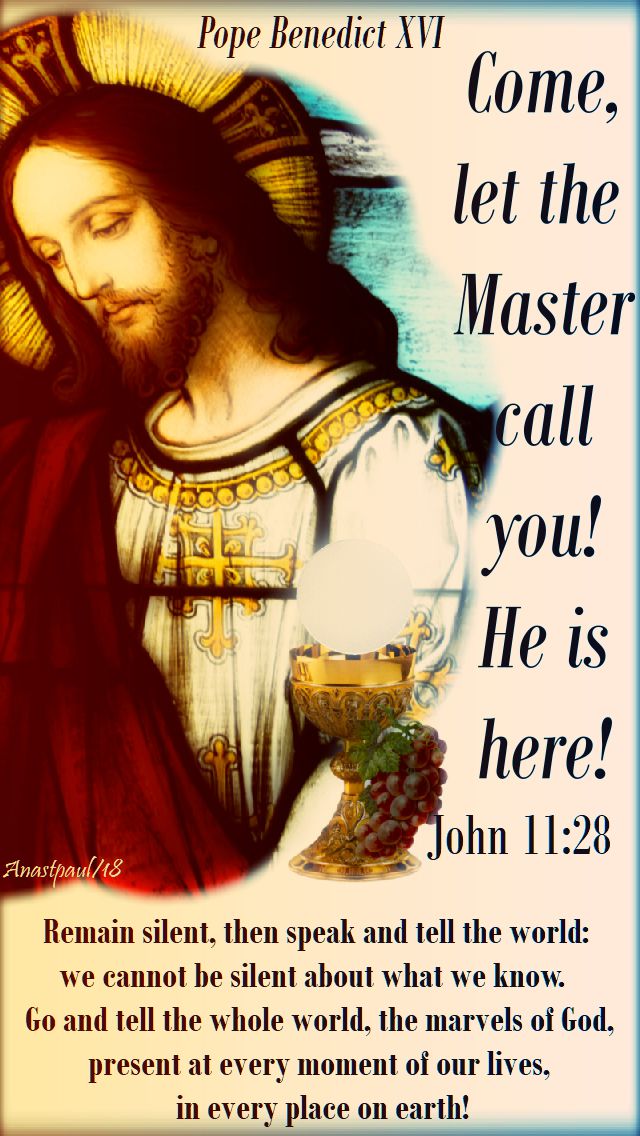
This evening, we do not see them but we hear them saying to us, to every man and to every woman among us:  “Come, let the Master call you! He is here!   He is calling you” (cf. Jn 11:28)!   He wants to take your life and join it to His.   Let yourself be embraced by Him!   Gaze no longer upon your own wounds, gaze upon His.   Do not look upon what still separates you from Him and from others;  look upon the infinite distance that He has abolished by taking your flesh, by mounting the Cross which men had prepared for Him and by letting Himself be put to death so as to show you His love.   In His wounds, He takes hold of you;   in His wounds, He hides you.   Do not refuse His Love!”

Contemplate the Wounds of Christ
The immense crowd of witnesses who have allowed themselves to be embraced by His Love, is the crowd of saints in heaven who never cease to intercede for us.   They were sinners and they knew it but they willingly ceased to gaze upon their own wounds and to gaze only upon the wounds of their Lord, so as to discover there the glory of the Cross, to discover there the victory of Life over death.   Saint Pierre-Julien Eymard (1811-1868) tells us everything when he cries out:  “The holy Eucharist is Jesus Christ, past, present and future” (Sermons and Parochial Instructions After 1856, 4-2.1, “On Meditation”).

Jesus Christ Past
Jesus Christ, past, in the historical truth of the evening in the Upper Room, to which every celebration of holy Mass leads us back.

Jesus Christ Present
Jesus Christ, present, because He said to us:  “Take and eat of this, all of you, this is my Body, this is my Blood.”   “This is”, in the present, here and now, as in every here and now throughout human history.   The Real Presence, the Presence which surpasses our poor lips, our poor hearts, our poor thoughts.   The Presence offered for us to contemplate as we do here, this evening, close to the grotto where Mary revealed herself as the Immaculate Conception.

Jesus Christ Coming
The Eucharist is also Jesus Christ, future, Jesus Christ to come.   When we contemplate the Sacred Host, His glorious transfigured and risen Body, we contemplate what we shall contemplate in eternity, where we shall discover that the whole world has been carried by its Creator during every second of its history.   Each time we consume Him but also each time we contemplate Him, we proclaim Him until he comes again, “donec veniat”. That is why we receive Him with infinite respect.

Remain Silent, Then Speak
Beloved brothers and sisters, day pilgrims and inhabitants of these valleys, brother Bishops, priests, deacons, men and women religious, all of you who see before you the infinite abasement of the Son of God and the infinite glory of the Resurrection, remain in silent adoration of your Lord, our Master and Lord Jesus Christ.   Remain silent, then speak and tell the world:  we cannot be silent about what we know.   Go and tell the whole world the marvels of God, present at every moment of our lives, in every place on earth.   May God bless us and keep us, may He lead us on the path of eternal life, He who is Life, forever and ever. Amen.come, let the master call you - remain silent - pope benedict - 26 aug 2018 sunday reflection

Posted in MORNING Prayers, ON the SAINTS, PAPAL SERMONS, SAINT of the DAY, The BLESSED VIRGIN MARY

Second Thoughts for the Day – 15 August – The Memorial of St Tarcisius (Died c 257) Martyr of the Holy Eucharist – Patron of Altar Servers

Second Thoughts for the Day – 15 August – The Memorial of St Tarcisius (Died c 257) Martyr of the Holy Eucharist – Patron of Altar Servers

Pope Benedict XVI – 4 August 2010 – General Audience to the International Pilgrimage of Altar Servers to St Peter’s, Rome

I am addressing those of you who are present here and, through you, all the altar servers of the world!

Serve Jesus present in the Eucharist generously.   It is an important task that enables you to be particularly close to the Lord and to grow in true and profound friendship with Him.    Guard this friendship in your hearts jealously, like St Tarcisius, ready to commit yourselves, to fight and to give your lives so that Jesus may reach all peoples.

May you too communicate to your peers the gift of this friendship with joy, with enthusiasm, without fear, so that they may feel that you know this Mystery, that is true and that you love it!

Every time that you approach the altar, you have the good fortune to assist in God’s great loving gesture as He continues to want to give Himself to each one of us, to be close to us, to help us, to give us strength to live in the right way.   With consecration, as you know, that little piece of bread becomes Christ’s Body, that wine becomes Christ’s Blood.   You are lucky to be able to live this indescribable Mystery from close at hand!

Do your task as altar servers with love, devotion and faithfulness, do not enter a church for the celebration with superficiality but rather, prepare yourselves inwardly for Holy Mass!   Assisting your priests in service at the altar helps to make Jesus closer, so that people can understand, can realise better – He is here.   You collaborate to make Him more present in the world, in everyday life, in the Church and everywhere.

Dear friends!   You lend Jesus your hands, your thoughts, your time.   He will not fail to reward you, giving you true joy and enabling you to feel where the fullest happiness is.   St Tarcisius has shown us that love can even bring us to give our life for an authentic good, for the true good, for the Lord.

Martyrdom will probably not be required of us but Jesus asks of us fidelity in small things, inner recollection, inner participation, our faith and our efforts to keep this treasure present in every day life.   He asks of us fidelity in daily tasks, a witness to His love, going to church through inner conviction and for the joy of His presence.   Thus we can also make known to our friends that Jesus is alive.   May St John Mary Vianney’s intercession help us in this commitment.   Today is the liturgical Memorial of this humble French Parish Priest who changed a small community and thus gave the world a new light.   May the example of St Tarcisius and St John Mary Vianney impel us every day to love Jesus and to do His will, as did the Virgin Mary, faithful to her Son to the end.   Thank you all once again! May God bless you in these days and I wish you a good journey home!

Blessed Mother Mary, Pray for us!mary immaculate - pray for us - 4 mary 2018

St Tarcisius, Pray for us!st tarcisius pray for us - 15 aug 2018

Posted in MORNING Prayers, PAPAL SERMONS, SAINT of the DAY

Second Thoughts for the Day – 8 August – The Memorial of St Mary of the Cross MacKillop (1842-1909)

Second Thoughts for the Day – 8 August – The Memorial of St Mary of the Cross MacKillop (1842-1909)

“In the vastness of the Australian continent, Blessed Mary MacKillop was not daunted by the great desert, the immense expanses of the outback, nor by the spiritual “wilderness” which affected so many of her fellow citizens.   Rather, she boldly prepared the way of the Lord, in the most trying situations.   With gentleness, courage and compassion, she was a herald of the Good News among the isolated “battlers” and the urban slum-dwellers.   Mother Mary of the Cross knew that behind the ignorance, misery and suffering which she encountered there were people, men and women, young and old, yearning for God and his righteousness.   She knew, because she was a true child of her time and place:  the daughter of immigrants who had to struggle at all times to build a life for themselves in their new surroundings.

Her story reminds us of the need to welcome people, to reach out to the lonely, the bereft, the disadvantaged.   To strive for the kingdom of God and His righteousness, means to strive to see Christ in the stranger, to meet Him in them and to help them to meet Him in each one of us!”

– Pope Benedict XVI on the Beatification of St Mary of the Cross MacKillop (Thursday 19 January 1005), whose prayers we request!st mary of the cross mackillop pray for us 8 aug 2018-no 4.

Posted in MORNING Prayers, PAPAL SERMONS, QUOTES of the SAINTS, QUOTES on PRAYER, QUOTES on SILENCE, QUOTES on WORK/LABOUR, SAINT of the DAY

Thought for the Day – 11 July – The Memorial of St Benedict of Nursia OSB (c 480-547)

Thought for the Day – 11 July – The Memorial of St Benedict of Nursia OSB (c 480-547)

Excerpt from the Homily of Pope Benedict

General Audience, 9 April 2008

“Today, I would like to speak about Benedict, the Founder of Western Monasticism and also the Patron of my Pontificate.

I begin with words that St Gregory the Great wrote about St Benedict:  “The man of God who shone on this earth among so many miracles was just as brilliant in the eloquent exposition of his teaching” (cf. Dialogues II, 36).   The great Pope wrote these words in 592 AD.   The holy monk, who had died barely 50 years earlier, lived on in people’s memories and especially in the flourishing religious Order he had founded.   St Benedict of Nursia/Norcia, with his life and his work, had a fundamental influence on the development of European civilisation and culture.   The most important source on Benedict’s life is the second book of St Gregory the Great’s Dialogues.   It is not a biography in the classical sense.   In accordance with the ideas of his time, by giving the example of a real man – St Benedict, in this case – Gregory wished to illustrate the ascent to the peak of contemplation which can be achieved by those who abandon themselves to God.   He therefore gives us a model for human life in the climb towards the summit of perfection.   St Gregory the Great also tells in this book of the Dialogues of many miracles worked by the Saint and here too he does not merely wish to recount something curious but rather to show how God, by admonishing, helping and even punishing, intervenes in the practical situations of man’s life.   Gregory’s aim was to demonstrate that God is not a distant hypothesis placed at the origin of the world but is present in the life of man, of every man.

Throughout the second book of his Dialogues, Gregory shows us how St Benedict’s life was steeped in an atmosphere of prayer, the foundation of his existence.   Without prayer there is no experience of God.   Yet Benedict’s spirituality was not an interiority removed from reality.   In the anxiety and confusion of his day, he lived under God’s gaze and in this very way never lost sight of the duties of daily life and of man with his practical needs.   Seeing God, he understood the reality of man and his mission.   In his Rule he describes monastic life as “a school for the service of the Lord” (Prol. 45) and advises his monks, “let nothing be preferred to the Work of God” [that is, the Divine Office or the Liturgy of the Hours] (43, 3).

However, Benedict states that in the first place prayer is an act of listening (Prol. 9-11), which must then be expressed in action.   “The Lord is waiting every day for us to respond to his holy admonitions by our deeds” (Prol. 35).   Thus, the monk’s life becomes a fruitful symbiosis between action and contemplation, “so that God may be glorified in all things” (57, 9).   In contrast with a facile and egocentric self-fulfilment, today often exalted, the first and indispensable commitment of a disciple of St Benedict is the sincere search for God (58, 7) on the path mapped out by the humble and obedient Christ (5, 13), whose love he must put before all else (4, 21; 72, 11) and in this way, in the service of the other, he becomes a man of service and peace  . In the exercise of obedience practised by faith inspired by love (5, 2), the monk achieves humility (5, 1), to which the Rule dedicates an entire chapter (7).   In this way, man conforms ever more to Christ and attains true self-fulfilment as a creature in the image and likeness of God.

Benedict describes the Rule he wrote as “minimal, just an initial outline” (cf. 73, 8);  in fact, however, he offers useful guidelines not only for monks but for all who seek guidance on their journey toward God.   For its moderation, humanity and sober discernment between the essential and the secondary in spiritual life, his Rule has retained its illuminating power even to today.

By proclaiming St Benedict Patron of Europe on 24 October 1964, Paul VI intended to recognise the marvellous work the Saint achieved with his Rule for the formation of the civilisation and culture of Europe.

Having recently emerged from a century that was deeply wounded by two World Wars and the collapse of the great ideologies, now revealed as tragic utopias, Europe today is in search of its own identity.   Of course, in order to create new and lasting unity, political, economic and juridical instruments are important, but it is also necessary to awaken an ethical and spiritual renewal which draws on the Christian roots of the Continent, otherwise a new Europe cannot be built.   Without this vital sap, man is exposed to the danger of succumbing to the ancient temptation of seeking to redeem himself by himself – a utopia which in different ways, in 20th-century Europe, as Pope John Paul II pointed out, has caused “a regression without precedent in the tormented history of humanity” (Address to the Pontifical Council for Culture, 12 January 1990).

Today, in seeking true progress, let us also listen to the Rule of St Benedict as a guiding light on our journey.   The great monk is still a true master at whose school we can learn to become proficient in true humanism.

Here is a PDF of the Rule for downloading:  http://www.documentacatholicaomnia.eu/03d/0480-0547,_Benedictus_Nursinus,_Regola,_EN.pdf

St Benedict, Pray for Europe, Pray for the World,

Pray for the Church, Pray for us all!st-benedict-pray-for-us-11 july 2017 - 3

Posted in FATHERS of the Church, PAPAL SERMONS, SAINT of the DAY, VATICAN Resources

Saint of the Day – 28 June – St Irenaeus of Lyons (c 135 – c 202) Father of the Church

Saint of the Day – 28 June – St Irenaeus of Lyons (c 135 – c 202) Father of the Church, Bishop, Theologian, Writer, Confessor, Defender of the Faith, Apologist.  St Irenaeus was born in c130 in Smyrna, Asia Minor (modern Izmir, Turkey) and is presumed to have been martyred in c 202 in Lyons, France.

Catechesis of Pope Benedict XVI on St Irenaeus of Lyon

General Audience, Wednesday, 28 March 2007

In the Catechesis on the prominent figures of the early Church, today we come to the eminent personality of St Irenaeus of Lyons.   The biographical information on him comes from his own testimony, handed down to us by Eusebius in his fifth book on Church History.a crash course on st irenaeus mem 28 june

Irenaeus was, in all probability, born in Smyrna (today, Izmir in Turkey) in about 135-140, where in his youth, he attended the school of Bishop Polycarp, a disciple in his turn of the Apostle John.   We do not know when he moved from Asia Minor to Gaul but his move must have coincided with the first development of the Christian community in Lyons, here, in 177, we find Irenaeus listed in the college of presbyters.   In that very year, he was sent to Rome, bearing a letter from the community in Lyons, to Pope Eleutherius.   His mission to Rome saved Irenaeus from the persecution of Marcus Aurelius which took a toll of at least 48 martyrs, including the 90-year old Bishop Pontinus of Lyons, who died from ill-treatment in prison.   Thus, on his return, Irenaeus was appointed Bishop of the city.   The new Pastor devoted himself without reserve to his episcopal ministry which ended in about 202-203, perhaps with martyrdom.snip - st irenaeus

Irenaeus was first and foremost a man of faith and a Pastor.   Like a good Pastor, he had a good sense of proportion, a wealth of doctrine and missionary enthusiasm.   As a writer, he pursued a twofold aim, to defend true doctrine from the attacks of heretics and to explain the truth of the faith clearly.   His two extant works – the five books of The Detection and Overthrow of the False Gnosis and Demonstration of the Apostolic Teaching (which can also be called the oldest “catechism of Christian doctrine”) – exactly corresponded with these aims.   In short, Irenaeus can be defined as the champion in the fight against heresies.

The second-century Church was threatened by the so-called Gnosis, a doctrine which affirmed that the faith taught in the Church was merely a symbolism for the simple who were unable to grasp difficult concepts, instead, the initiates, the intellectuals – Gnostics, they were called – claimed to understand what was behind these symbols and thus formed an elitist and intellectualist Christianity. Obviously, this intellectual Christianity became increasingly fragmented, splitting into different currents with ideas that were often bizarre and extravagant, yet attractive to many.   One element these different currents had in common was “dualism” – they denied faith in the one God and Father of all, Creator and Saviour of man and of the world.   To explain evil in the world, they affirmed the existence, besides the Good God, of a negative principle.   This negative principle was supposed to have produced material things, matter.

Firmly rooted in the biblical doctrine of creation, Irenaeus refuted the Gnostic dualism and pessimism which debased corporeal realities.   He decisively claimed the original holiness of matter, of the body, of the flesh no less than of the spirit.   But his work went far beyond the confutation of heresy, in fact, one can say, that he emerges as the first great Church theologian who created systematic theology, he himself speaks of the system of theology, that is, of the internal coherence of all faith.   At the heart of his doctrine is the question of the “rule of faith” and its transmission.   For Irenaeus, the “rule of faith” coincided in practice with the Apostles’ Creed, which gives us the key for interpreting the Gospel, for interpreting the Creed in light of the Gospel.   The Creed, which is a sort of Gospel synthesis, helps us understand what it means and how we should read the Gospel itself.st irenaeus glass detail snip face

In fact, the Gospel preached by Irenaeus is the one he was taught by Polycarp, Bishop of Smyrna, and Polycarp’s Gospel dates back to the Apostle John, whose disciple Polycarp was.
The true teaching, therefore, is not that invented by intellectuals which goes beyond the Church’s simple faith.   The true Gospel is the one imparted by the Bishops who received it in an uninterrupted line from the Apostles.   They taught nothing except this simple faith, which is also the true depth of God’s revelation.   Thus, Irenaeus tells us, there is no secret doctrine concealed in the Church’s common Creed.   There is no superior Christianity for intellectuals.   The faith publicly confessed by the Church is the common faith of all.   This faith alone is apostolic, it is handed down from the Apostles, that is, from Jesus and from God.   In adhering to this faith, publicly transmitted by the Apostles to their successors, Christians must observe what their Bishops say and must give special consideration to the teaching of the Church of Rome, pre-eminent and very ancient.   It is because of her antiquity that this Church has the greatest apostolicity; in fact, she originated in Peter and Paul, pillars of the Apostolic College.   All Churches must agree with the Church of Rome, recognising in her the measure of the true Apostolic Tradition, the Church’s one common faith.st-irenaeus-3

With these arguments, summed up very briefly here, Irenaeus refuted the claims of these Gnostics, these intellectuals, from the start.   First of all, they possessed no truth superior to that of the ordinary faith, because what they said was not of apostolic origin, it was invented by them.   Secondly, truth and salvation are not the privilege or monopoly of the few but are available to all through the preaching of the Successors of the Apostles, especially of the Bishop of Rome.   In particular – once again disputing the “secret” character of the Gnostic tradition and noting its multiple and contradictory results – Irenaeus was concerned to describe the genuine concept of the Apostolic Tradition which we can sum up here in three points.

a) Apostolic Tradition is “public”, not private or secret.   Irenaeus did not doubt that the content of the faith transmitted by the Church is that received from the Apostles and from Jesus, the Son of God.   There is no other teaching than this.   Therefore, for anyone who wishes to know true doctrine, it suffices to know “the Tradition passed down by the Apostles and the faith proclaimed to men” –  a tradition and faith that “have come down to us through the succession of Bishops” (Adversus Haereses, 3, 3, 3-4).   Hence, the succession of Bishops, the personal principle and Apostolic Tradition, the doctrinal principle, coincide.

b) Apostolic Tradition is “one”.   Indeed, whereas Gnosticism was divided into multiple sects, Church Tradition is one in its fundamental content, which – as we have seen – Irenaeus calls precisely regula fidei or veritatis –  and thus, because it is one, it creates unity through the peoples, through the different cultures, through the different peoples; it is a common content like the truth, despite the diversity of languages and cultures.   A very precious saying of St Irenaeus is found in his book Adversus Haereses:  “The Church, though dispersed throughout the world… having received [this faith from the Apostles]… as if occupying but one house, carefully preserves it.   She also believes these points [of doctrine] just as if she had but one soul and one and the same heart and she proclaims them and teaches them and hands them down with perfect harmony, as if she possessed only one mouth.   For, although the languages of the world are dissimilar, yet the import of the tradition is one and the same.   For the Churches which have been planted in Germany do not believe or hand down anything different, nor do those in Spain, nor those in Gaul, nor those in the East, nor those in Egypt, nor those in Libya, nor those which have been established in the central regions of the world” (1, 10, 1-2).   Already at that time – we are in the year 200 – it was possible to perceive the Church’s universality, her catholicity and the unifying power of the truth that unites these very different realities, from Germany, to Spain, to Italy, to Egypt, to Libya, in the common truth revealed to us by Christ.

c) Lastly, the Apostolic Tradition, as he says in the Greek language in which he wrote his book, is “pneumatic”, in other words, spiritual, guided by the Holy Spirit, in Greek, the word for “spirit” is “pneuma”.   Indeed, it is not a question of a transmission entrusted to the ability of more or less learned people but to God’s Spirit, who guarantees fidelity to the transmission of the faith.
This is the “life” of the Church, what makes the Church ever young and fresh, fruitful with multiple charisms.

For Irenaeus, Church and Spirit were inseparable:  “This faith”, we read again in the third book of Adversus Haereses, “which, having been received from the Church, we do preserve and which always, by the Spirit of God, renewing its youth as if it were some precious deposit in an excellent vessel, causes the vessel itself containing it, to renew its youth also…. For where the Church is, there is the Spirit of God and where the Spirit of God is, there is the Church and every kind of grace” (3, 24, 1).st irenaeus beautiful glass detail snip

As can be seen, Irenaeus did not stop at defining the concept of Tradition.   His tradition, uninterrupted Tradition, is not traditionalism, because this Tradition is always enlivened from within by the Holy Spirit, who makes it live anew, causes it to be interpreted and understood in the vitality of the Church.   Adhering to her teaching, the Church should transmit the faith in such a way that it must be what it appears, that is, “public”, “one”, “pneumatic”, “spiritual”.   Starting with each one of these characteristics, a fruitful discernment can be made of the authentic transmission of the faith in the today of the Church.

More generally, in Irenaeus’ teaching, the dignity of man, body and soul, is firmly anchored in divine creation, in the image of Christ and in the Spirit’s permanent work of sanctification.   This doctrine is like a “high road” in order to discern together with all people of good will, the object and boundaries of the dialogue of values and to give an ever new impetus to the Church’s missionary action, to the force of the truth, which is the source of all true values in the world.Irenæus_af_Lyon_Frederikskirken

Posted in PAPAL SERMONS, SAINT of the DAY, VATICAN Resources

Saint of the Day – 23 June – St Joseph Cafasso (1811-1860) “Priest of the Gallows”

Saint of the Day – 23 June – St Joseph Cafasso (1811-1860) “Priest of the Gallows”, Priest, Theology Lecturer, Social Reformer, Confessor, Spiritual Director (of St John Bosco and quite a few other saints), Rector of a post-Ordination Theological College, member of the Third Order of St Francis – born Giuseppe Cafasso on 15 January 1811 at Castelnuovo d’Asti, Italy and died on 23 June 1860 at Turin, Italy of pneumonia, a stomach hemorrhage and complications of his congenital medical problems (he had been born with a deformed spine which contributed to his short stature and frail constitution).   His will bequeathed everything to aid the Little House of Divine Providence which was the religious order founded by St Joseph Benedict Cottolengo (1786-1842).    St John Bosco (1815-1888) preached the funeral Mass homily.  Patronages – Italian prisons, Prison chaplains, Prisoners, those condemned to death.0627giuseppe-cafasso-header no 2

Joseph Cafasso was born in Castelnuovo d’Asti, the same village in which St John Bosco was born, on 15 January 1811.   He was the third of four children.   The last, his sister Marianna, was to be the mother of Bl Joseph Allamano, Founder of the Consolata Missionary Fathers and the Consolata Missionary Sisters.   He was born in 19th-century Piedmont, marked by serious social problems but also by many Saints who strove to find remedies for them.   These Saints were bound to each other by total love of Christ and by their profound charity for the poorest people.   The grace of the Lord can spread and multiply the seeds of holiness!   

Cafasso completed his secondary school studies and the two years of philosophy at the College of Chieri and, in 1839, went on to the theological seminary where he was ordained a priest in 1833.   Four months later he entered what for him was to be the fundamental and only “stage” in his priestly life:  the “Convitto Ecclesiastico di S. Francesco d’Assisi” in Turin.   Having entered it to perfect himself in pastoral ministry, it was here that he brought to fruition his gifts as a spiritual director and his great spirit of charity.   The “Convitto” was in fact not only a school of moral theology where young priests, who came mainly from the countryside, learned how to become confessors and how to preach but was also a true and proper school of priestly life, where priests were formed in the spirituality of St Ignatius of Loyola and in the moral and pastoral theology of the great holy Bishop St Alphonsus Mary de’ Liguori.   The type of priest that Cafasso met at the “Convitto” and that he himself helped to strengthen especially as Recto, was that of the true pastor with a rich inner life and profound zeal in pastoral care, faithful to prayer, committed to preaching and to catechesis, dedicated to the celebration of the Eucharist and to the ministry of Confession, after the model embodied by St Charles Borromeo and St Francis de Sales and promoted by the Council of Trent.   A felicitous saying of St John Bosco sums up the meaning of educational work in that community:  “at the “Convitto’ men learn to be priests”.lg - st joseph cafasso

St Joseph Cafasso sought to bring this model into being in the formation of the young priests so that, in turn, they might become the formation teachers of other priests, religious and lay people, forming a special and effective chain.   From his chair of moral theology he taught them to be good confessors and spiritual directors, concerned for the true spiritual good of people, motivated equally by a desire to make God’s mercy felt and, by an acute and lively sense of sin.   Cafasso the teacher had three main virtues, as St John Bosco recalled:  calmness, wisdom and prudence.   For him the test of the lessons taught was the ministry of Confession, to which he himself devoted many hours of the day.   Bishops, priests, religious, eminent laymen and women and simple people sought him.   He was able to give them all the time they needed.   He was also a wise spiritual counsellor to many who became Saints and founders of religious institutes.   His teaching was never abstract, nor based exclusively on the books that were used in that period. Rather, it was born from the living experience of God’s mercy and the profound knowledge of the human soul that he acquired in the long hours he spent in the confessional and in spiritual direction:  his was a real school of priestly life.

His secret was simple:  to be a man of God; to do in small daily actions “what can result in the greater glory of God and the advantage of souls”.   He loved the Lord without reserve, he was enlivened by a firmly-rooted faith, supported by profound and prolonged prayer and exercised in sincere charity to all.   He was versed in moral theology but was likewise familiar with the situation and hearts of people, of whose good he took charge as the good pastor that he was.   Those who had the grace to be close to him were transformed into as many good pastors and sound confessors.   He would point out clearly to all priests the holiness to achieve in their own pastoral ministry.   Bl. Fr Clement Marchisio, Founder of the Daughters of St Joseph, declared:  “You entered the “Convitto’ as a very mischievous, thoughtless youth, with no idea of what it meant to be a priest;  and you came out entirely different, fully aware of the dignity of the priest”.   How many priests were trained by him at the “Convitto” and then accompanied by him spiritually!   Among them as I have said emerges St John Bosco who had him as his spiritual director for a good 25 years, from 1835 to 1860:  first as a seminarian, then as a priest and lastly as a Founder.   In all the fundamental decisions of his life St John Bosco had St Joseph Cafasso to advise him but in a very specific way – Cafasso never sought to form Don Bosco as a disciple “in his own image and likeness”and Don Bosco did not copy Cafasso –  he imitated Cafasso’s human and priestly virtues, certainly and described him as “a model of priestly life” but according to his own personal disposition and his own specific vocation;   a sign of the wisdom of the spiritual teacher and of the intelligence of the disciple,the former did not impose himself on the latter but respected his personality and helped him to interpret God’s will for him.

Dear friends, this is a valuable lesson for all who are involved in the formation and education of the young generations and also a strong reminder of how important it is to have a spiritual guide in one’s life, who helps one to understand what God expects of each of us.   Our Saint declared with simplicity and depth:   “All a person’s holiness, perfection and profit lies in doing God’s will perfectly…. Happy are we if we succeed in pouring out our heart into God’s, in uniting our desires and our will to His to the point, that one heart and one will are formed, wanting what God wants, wanting in the way, in the time and in the circumstances that He desires and willing it all for no other reason, than that God wills it”.st joseph cafasso - lovely

However, another element characterises the ministry of our Saint:  attention to the least and in particular to prisoners who in 19th-century Turin lived in inhumane and dehumanising conditions.   In this sensitive service too, which he carried out for more than 20 years, he was always a good, understanding and compassionate pastor, qualities perceived by the prisoners who ended up by being won over by his sincere love, whose origin lay in God himself.

Cafasso’s simple presence did good: it reassured, it moved hearts hardened by the events of life and above all it enlightened and jolted indifferent consciences.   In his early prison ministry he often had recourse to great sermons that managed to involve almost the entire population of the prison.   As time passed, he gave priority to plain catechesis in conversation and in personal meetings.   Respectful of each individual’s affairs, he addressed the important topics of Christian life, speaking of trust in God, of adherence to His will, of the usefulness of prayer and of the sacraments whose goal is Confession, the encounter with God who makes Himself infinite mercy for us.

Those condemned to death were the object of very special human and spiritual care.   He accompanied to the scaffold 57 of the men sentenced to death, having heard their confession and having administered the Eucharist to them.   He accompanied them with deep love until the last breath of their earthly existence.joseph with prisonersSt Joseph Cafasso-thumb-275x434-6841

Joseph Cafasso died on 23 June 1860, after a life offered entirely to the Lord and spent for his neighbour.   My Predecessor, the Venerable Servant of God Pope Pius XII, proclaimed him Patron of Italian prisons on 9 April 1948 and, with his Apostolic Exhortation Menti Nostrae, on 23 September 1950 held him up as a model to priests engaged in Confession and in spiritual direction.”…Pope Benedict XVI, General Audience,  30 June 2010

St Joseph was Beatified on 3 May 1925 by Pope Pius XI and Canonised 22 June 1947, by Pope Pius XII.   His Major shrine is Santuario della Consolata, Turin, Italy.3186TorinoConsolatainside770px-Santuario_della_Consolata_Torino768px-Consolata_di_torino,_interno,_25


Posted in DOCTORS of the Church, franciscan OFM, MORNING Prayers, PAPAL SERMONS, QUOTES of the SAINTS, QUOTES on HUMAN DIGNITY, QUOTES on the CROSS of CHRIST, SAINT of the DAY, The HOLY CROSS, The PASSION

Thought for the Day – 13 June – The Memorial of St Anthony of Padua (1195-1231) Doctor of the Church

Thought for the Day – 13 June – The Memorial of St Anthony of Padua (1195-1231) Doctor of the Church

Not only the Nativity, a central point of Christ’s love for humanity but also the vision of the Crucified One inspired in Anthony thoughts of gratitude to God and esteem for the dignity of the human person, so that all believers and non-believers might find in the Crucified One and in His image a life-enriching meaning.

St Anthony writes:  “Christ, who is your life, is hanging before you, so that you may look at the Cross, as in a mirror.   There you will be able to know, how mortal were your wounds, that no medicine other, than the Blood of the Son of God, could heal.  If you look closely, you will be able to realise, how great your human dignity and your value are…. Nowhere other than looking at himself, in the mirror of the Cross, can man better understand how much he is worth”   (Sermones Dominicales et Festivi III, pp. 213-214).christ, who is your life, - st anthony of padua - 13 june 2018

In meditating on these words we are better able to understand the importance of the image of the Crucified One for our culture, for our humanity that is born from the Christian faith.   Precisely by looking at the Crucified One we see, as St Anthony says, how great are the dignity and worth of the human being.   At no other point can we understand how much the human person is worth, precisely because God makes us so important, considers us so important that, in his opinion, we are worthy of his suffering; thus all human dignity appears in the mirror of the Crucified One and our gazing upon him is ever a source of acknowledgement of human dignity…..Pope Benedict XVI (General Audience – February 10, 2010)

St Anthony of Padua, pray for us!st-anthony-pray-for-us-2.13 june 2017

Posted in EUCHARISTIC Adoration, FEASTS and SOLEMNITIES, MARIAN QUOTES, MORNING Prayers, PAPAL SERMONS, QUOTES - J R R Tolkien and MORE, SAINT of the DAY, The BLESSED VIRGIN MARY, The HOLY EUCHARIST / The HOLY MASS

Quote of the Day – 3 June 2018 – The Solemnity of Corpus Christi

Quote of the Day – 3 June 2018 – The Solemnity of Corpus Christi

“(Mary) is a young maiden but she is not afraid
because God is with her, within her,…
In a certain sense, we can say that her trip was …..
the first Eucharistic procession in history.
Is not this also the joy of the Church,
which receives Christ incessantly in the holy Eucharist
and takes Him to the world with the testimony
of active charity, full of faith and hope?

“Yes, to receive Jesus and to take Him to others
is the true joy of the Christian!

Let us follow and imitate Mary,
the profoundly Eucharistic soul
and our whole life will become a Magnificat.”

Pope Benedict XVI 2005mary is a young maiden - first eucharistic procession in history - 3 june 2018 - corpus christi

Posted in DOGMA, FEASTS and SOLEMNITIES, MORNING Prayers, PAPAL SERMONS, QUOTES - J R R Tolkien and MORE, The MOST HOLY & BLESSED TRINITY, The WORD

Second Thoughts for the Day – 27 May – The Solemnity of the Most Holy Trinity

Second Thoughts for the Day – 27 May – The Solemnity of the Most Holy Trinity

Adopted into the Family of God

“In you all the families of the earth shall be blessed” (Gen 12:3)
“For all, who are led by the Spirit of God, are children of God.” (Romans 8:14)

…”How would God be revealed to the other families of the earth?   How would the other families of the earth enter the Covenant and become heirs to the promises of God.
The language of families here is significant, for it is through the revelation of God as Trinity, the Divine Family, that all other families of the earth would be invited into the Covenant family.
For the reality of the Trinity did not emerge for the earliest Christians in the context of complex philosophical discussions but in the experience of God as Father, Son and Holy Spirit.

As Pope Benedict XVI stated in 2006.
“the intimacy of God Himself, discovering that He is not infinite solitude but communion of light and love, life given and received in an eternal dialogue between the Father and the Son in the Holy Spirit – ‘Lover, Loved and Love,’ revealed the relational nature of God, through the guidance of the Holy Spirit and by the incarnation of Jesus Christ.”    (Angelus, St Peter’s Square, 11 June 2006).

And it was by means of the revelation of God as Father, Son and Holy Spirit, that the early Christians came to know themselves as children of God, adopted into the family and Covenant of God.   The Spirit, Paul tells us, empowers us to understand, that we too are children of God, for through the Spirit, we are able to cry “Abba, Father!”   This Spirit-infused call to God as Abba, is an explicit recognition of our lineage, we belong in this family, for “it is that very Spirit bearing witness with our spirit that we are children of God.”

But the pathway to entering the family as heirs, children destined to share in the gifts and promises of the Father, in the Kingdom of God, was blazed for us, by the obedience of the Son.   As Paul says in Galatians 3:29, “If you belong to Christ, then you are Abraham’s offspring, heirs according to the promise.”   Christ through His suffering and death for us, has made us “joint heirs with Christ,” worthy of adoption into God’s family. We belong to the family of God, because we belong to the Son, who has made us “joint heirs.”   Through the true heir, we are simply joined with our Covenantal and Divine Family.

We are welcomed into God’s family as joint heirs because of the love of the Trinity for us. The Trinity models the nature of the family by allowing us to experience the source of all love.   It is because of the Trinitarian model of love for us and our experience of that love, that Jesus instructs us to go out and make the family bigger.   We belong to the family of God but so do those who have not yet come home.   We have learned something now about the nature of God and the extent of God’s family and the call is the same to all – come home and be loved!…John W Martens “The Word on the Street Year B”

John Martens is Professor of Theology at St Thomas University and Director of the MA in Theology at St Paul’s Seminary School of Divinity, Minnesota.lover, loved and love - pope benedict - holy trinity sunday - 27 may 2018

Posted in MORNING Prayers, PAPAL SERMONS, PRACTISING CATHOLIC, QUOTES - J R R Tolkien and MORE, SAINT of the DAY, The APOSTLES & EVANGELISTS, The WORD

Thought for the Day – 14 May – Monday of the Seventh Week of Eastertide – Feast of St Matthias, Apostle

Thought for the Day – 14 May – Monday of the Seventh Week of Eastertide – Feast of St Matthias, Apostle – Today’s Readings: Acts of the Apostles 1:15-17.20-26, Holy Gospel of Jesus Christ according to Saint John 15:9-17

Pope Benedict XVI, (Holy Father from 2005 to 2013)
Homily of the 14 May 2010 (Apostolic journey to Portugal – trans. © Libreria Editrice Vaticana)

Be witnesses!

“One of these men, then […] must become a witness with us to his resurrection” (Acts 1:20-22).

These were the words of Peter… My brothers and sisters, you need to become witnesses… to the resurrection of Jesus.   In effect, if you do not become His witnesses in your daily lives, who will do so in your place?   Christians are, in the Church and with the Church, missionaries of Christ sent into the world.   This is the indispensable mission of every ecclesial community, to receive from God the Father and to offer to the world the Risen Christ, so that every situation of weakness and of death may be transformed, through the Holy Spirit, into an opportunity for growth and life.

We impose nothing, yet we propose ceaselessly, as Peter recommends in one of his Letters:  “In your hearts, reverence Christ as Lord.   Always be prepared to make a defence to anyone who calls you to account for the hope that is in you” (1 Pet 3:15).   And everyone, in the end, asks this of us, even those who seem not to.   From personal and communal experience, we know well that it is Jesus whom everyone awaits.   In fact, the most profound expectations of the world and the great certainties of the Gospel meet in the ineluctable mission which is ours, for “without God man neither knows which way to go, nor even understands who he is.”   In the face of the enormous problems surrounding the development of peoples, which almost make us yield to discouragement, we find solace in the sayings of our Lord Jesus Christ, who teaches us:  ‘Apart from me you can do nothing’ (Jn 15:5) and who encourages us:  ‘I am with you always, to the close of the age’ (Mt 28:20)” (cf.Caritas in Veritate, 78)…

Yes!  We are called to serve the humanity of our own time, trusting in Jesus alone, letting ourselves be enlightened by His word:  “You did not choose me but I chose you and appointed you that you should go and bear fruit and that your fruit should abide” (Jn 15:16).   How much time we have lost, how much work has been set back, on account of our lack of attention to this point!   Everything is to be defined starting with Christ, as far as the origins and effectiveness of mission is concerned, we receive mission always from Christ, who has made known to us what He has heard from His Father and we are appointed to mission, through the Spirit, in the Church.   Like the Church herself, which is the work of Christ and His Spirit, it is a question of renewing the face of the earth, starting from God, God always and alone!you did not choose me - how much time has been lost - pope benedict - 14 may 2018

So we say, St Matthias, today we call on you for your intercession!st-matthias-pray-for-us-14 may 2018-2

Posted in CATHOLIC Quotes, DOCTORS of the Church, EASTER, FATHERS of the Church, MORNING Prayers, PRACTISING CATHOLIC, QUOTES - J R R Tolkien and MORE, QUOTES of the SAINTS, QUOTES on FAITH, QUOTES on SUFFERING, SPEAKING of .....

Quote/s of the Day – 25 April – Wednesday of the Fourth Week of Easter and the Feast of St Mark the Evangelist

Quote/s of the Day – 25 April – Wednesday of the Fourth Week of Easter and the Feast of St Mark the Evangelist

Speaking of:  Being Catholic

“I would not believe in the Gospel,
had not the authority
of the Catholic Church
already moved me.”

St Augustine (354-430) Father & Doctori would not believe - st augustine - speaking of being catholic - 25 april 2018

“In her voyage,
across the ocean of this world,
the Church is like a great ship
being pounded by the waves
of life’s different stresses.
Our duty is not to abandon ship
but to keep her on her course.”

St Boniface (672-754) Father & Martyrin her voyage across the ocean - st boniface - speaking of being catholic - 25 april 2018

“Jesus is with me.
I have nothing to fear.”

Blessed Pier Giorgio Frassati (1901-1925)jesus is with me - bl pier - 25 april 2018

“The Jesus of the Gospels
is surely not convenient for us.”the jesus of the gospels - pope benedict - 25 april 2018

“The Jesus who makes everything okay
for everyone is a phantom,
a dream,
not a real figure…”

Pope Benedict XVIthe jesus who makes - pope benedict - 25 april 2018

“Catholicism is a matter
of the body
and the senses,
as much as it is a matter
of the mind,
precisely because,
the Word became flesh.”catholicism is a matter - bishop barron - 25 april 2018

“Easter is an earthquake,
an explosion.
If you see it as less than that,
you’re not getting it.”

Bishop Robert Barroneaster is an earthquake - bishop barron - 25 april 2018

“At some point,
Jesus is going to call you out.
That’s what He does.”

Father Mike Schmitzat some point - fr mike schmitz - 25 april 2018


Posted in EASTER, MORNING Prayers, PAPAL SERMONS, The HOLY EUCHARIST / The HOLY MASS, The PASSION, The RESURRECTION, The WORD

One Minute Reflection – 15 April – The Third Sunday of Easter Year B

One Minute Reflection – 15 April – The Third Sunday of Easter Year B

Then he opened their minds to understand the scriptures and said to them, “Thus it is written, that the Christ should suffer and on the third day rise from the dead and that repentance and forgiveness of sins should be preached in his name to all nations, beginning from Jerusalem.”... Luke 24:45-48o lord let the light of your countenance shine upon us - pope benedict - third sun easter B - 15 april 2018

REFLECTION – “This very experience of repentance and forgiveness is relived in every community in the Eucharistic celebration, especially on Sundays.   The Eucharist, the privileged place in which the Church recognises “the Author of life” (Acts 3: 15) is “the breaking of the bread”, as it is called in the Acts of the Apostles.   In it, through faith, we enter into communion with Christ, who is “the priest, the altar and the lamb of sacrifice” (see Preface for Easter, 5) and is among us.   Let us gather round Him to cherish the memory of His words and of the events contained in Scripture;  let us relive His Passion, death and Resurrection.   In celebrating the Eucharist, we communicate with Christ, the victim of expiation and from Him we draw forgiveness and life.   What would our lives as Christians be without the Eucharist?   The Eucharist is the perpetual, living inheritance which the Lord has bequeathed to us in the Sacrament of His Body and His Blood and which we must constantly rethink and deepen so that, as venerable Pope Paul VI said, it may “impress its inexhaustible effectiveness on all the days of our earthly life” (Insegnamenti, V [1967], p. 779).”…Pope Benedict XVIin it, through faith, - pope benedict - 15 april 2018

PRAYER – Lord God, grant Your people constant joy in the renewed vigour of their souls. Grant them sorrow for their sins and gratitude for the suffering of Your Son.   Grant them forgiveness and life in the Holy Eucharist, through which we meet Him, who saved us. Grant, we pray, that we may grow in our love for the saving banquet to which we are called so that we may one day rejoice eternally, with You, in union with our Lord, Jesus Christ and the Holy Spirit, one God, forever amen.   “O Lord, let the light of your countenance shine upon us”!

Posted in DOCTORS of the Church, EASTER, FATHERS of the Church, FEASTS and SOLEMNITIES, MORNING Prayers, PAPAL SERMONS, QUOTES - J R R Tolkien and MORE, QUOTES of the SAINTS, SPEAKING of ....., The RESURRECTION

Quote/s of the Day – 5 April – Easter Thursday Fifth Day in the Easter Octave

Quote/s of the Day – 5 April – Easter Thursday Fifth Day in the Easter Octave

O Death, where is your sting?
O Hell, where is your victory?
Christ is Risen and you are overthrown.
Christ is Risen and the demons are fallen.
Christ is Risen and the Angels rejoice.
Christ is Risen and Life reigns.
Christ is Risen and not one dead remains in the grave.
For Christ, being Risen from the dead,
is become the First Fruits of those who have fallen asleep.
To Him be glory and dominion unto ages of ages.

St John Chrysostom (347-407)
Father & Doctor of the Church

The Lord’s triumph, on the day of the Resurrection, is final.
Where are the soldiers the rulers posted there?
Where are the seals that were fixed to the stone of the tomb?
Where are those who condemned the Master?
Where are those who crucified Jesus?
He is victorious and faced with His victory,
those poor wretches have all taken flight.
Be filled with hope:
Jesus Christ is always victorious.”

St Josemarie Escrivá (1902-1975), The Forge, 660the lord triumph on the day of the resurrection is final - st josemaria - easter thursday 5 april 2018

Posted in EASTER, NOTES to Followers, QUOTES - J R R Tolkien and MORE, The RESURRECTION

Thought for the Day – 1 April 2018 – Easter Sunday – A Blessed and Holy Easter to you all!

Thought for the Day – 1 April 2018 – Easter Sunday

A Blessed and Holy Easter to you all!

“Be Lifted Up, O Ancient Door”

It seems as the human world has no doors opening toward God.   It is locked in upon itself. It is a prison, a house of the dead.
People of the Old Testament and of other early civilizations initially applied the idea of the prison only to the world of the dead – the man who dies will not return.   They imagined the underworld as a vast dark prison in which death reigns, a ruthless tyrant. It is a place of no return.   Gradually, however, the feeling grew that, if all our paths lead to the prison which has entrances but no exit, then we are all prisoners.   In that case, even this present world is a house of the dead, the antechamber leading to a dungeon of horrors!   And it is a fact, if death has the last world – the world is a waiting room leading to the void (as manifested in many Eastern religions – my note).
Poets of our century have set down this feeling in terrifying visions.   The Jewish poet Franz Kafka has probably gone farthest into this abyss of ANGST.   His portrayal of a world of totalitarian control is intended as an interpretation of human life as such. In “The Castle”, life appears to be a futile waiting, a doomed attempt to penetrate the maze of bureaucracy and reach some competent authority and hence freedom.   In “The Trial”, life itself is present as a trial ending in execution.   The story ends with the parable of a man who waits all his life outside a door and cannot get in, in spite of the fact that it was made especially for him.
If Christ is not risen, there is nothing more to be said about man than this – all else, is merely an endeavour to deaden the pain.   The cries of despair we hear and the cruel attempts at liberation we see, are the necessary consequences of a world that will not accept Christ, its hope.
“Be lifted up, O ancient doors!” – these words of the psalm (24:7) are not liturgical symbolism, the gate liturgy of a long-past age.   They are the cry of man in a world that is far too narrow, even if he can travel in spaceships to the moon and beyond.
Christmas is only the first half of the Christian answer to this cry.   Christmas tells us that there is not only the tyrant, Death – there is God, who is Life and this God can and will reach us – He has broken a way into us.   He has found the door that was big enough for Him, or rather, He has made such a door for Himself.
But this answer is only complete if there is not only an entrance by which God can reach us but also an exit for us.   It is only satisfying, if death is no longer a prison from which no-one returns.   AND THIS IS THE CONTENT OF THE MESSAGE OF EASTER.   Not only is there a door in, there is also, a door out.   Death is no longer a house with no exits, a place of no return.
The ancient Church saw in this verse (ps 24:7) an interpretation of the article of faith “descended into hell”, referring particularly to Holy Saturday, not as a word of mourning but as a word of victory.   The Church expressed this word in poetic form – the bolts of death’s dungeon, of the world’s dungeon, are wrenched off – the ramparts are thrown down – the gates are torn from their hinges.   The one who has done this, Jesus, takes the long-imprisoned Adam and Eve, i.e. humanity, by the hand and leads them to freedom. Life is not a waiting room leading to the void but the beginning of eternity!   The world is not the universal concentration camp but the garden of hope!   Life is not the futile search for meaning, mirrored in the tangle of bureaucracy.   God is not a bureaucrat – He does not live in a distant castle, nor does He hide Himself behind impenetrable anterooms.   The door is open – it is called Jesus Christ!the door is open - pope benedict - 1 april 2018

The celebration of Easter is intended to show us the radiant light which streams from this door.   It challenges us steadfastly to follow this radiance, which is no will-o’-the-wisp but the brilliance of saving truth….Joseph Cardinal Ratzinger (Pope Benedict XVI) Seek that Which is Above 1985

A Blessed and Holy Easter to you all!

Christós anésti.
Jesus Christ is risen! He is truly risen!
Alleluia
Amena blessed and holy easter to you all - 1 april 2018

Posted in DEVOTIO, DOCTORS of the Church, FATHERS of the Church, HOLY WEEK, MORNING Prayers, QUOTES - J R R Tolkien and MORE, QUOTES on the CROSS of CHRIST, The SEVEN LAST WORDS of CHRIST

Devotion of The Seven Last Words of Christ – The Sixth Word – 30 March – Good Friday 2018

Devotion of The Seven Last Words of Christ – The Sixth Word – 30 March – Good Friday 2018

The Seven Last Words of Christ

The Seven Last Words of Christ refer, not to individual words but to the final seven phrases that Our Lord uttered as He hung on the Cross.   These phrases were not recorded in a single Gospel but are taken from the combined accounts of the four Gospels.   Greatly revered, these last words of Jesus have been the subject of many books, sermons and musical settings.

“Like a bridegroom, Christ went forth from His chamber ….
He came to the marriage-bed of the Cross
and there, in mounting it, He consummated His marriage.
And when He perceived the sighs of the creature,
He lovingly gave Himself up
to the torment, in place of His bride
and joined Himself to her forever.”

St Augustine (354-430) – Sermo Suppositus 120like a bridgegroom - it is consumated - st augustine - good friday - the sixth word - 30 march 2018

” In John’s account, Jesus’ last words are: “It is finished!” (John 19:30).
In the Greek text, this word (tetélestai) points back to the very beginning of the Passion narrative, to the episode of the washing of the feet, which the evangelist introduces by observing that Jesus loved His own “to the end (télos)” (John 13:1). This “end,” this ne plus ultra of loving, is now attained in the moment of death.
He has truly gone right to the end, to the very limit and even beyond that limit.
He has accomplished the utter fullness of love – He has given Himself.”

Pope Benedict XVI

The Sixth Word

“It is consummated.” (John 19:30)

Translation is risky because it always involves some interpretation.   So how is this sixth word of Christ on the Cross (Jn 19:30) properly rendered into English:   “It is finished” (as in “done,” “over with”); “it is completed” (with a less fatalistic ring to it); or, “it is consummated” (in the sense of “brought to fulfillment”)?   The correct choice requires a knowledge of the total Gospel of John, to which we must now turn.

The Johannine Jesus is wholly focused on His hour – the moment of glory. It cannot be hastened, as He had to remind His Mother: “My hour has not yet come” (Jn 2:4).   Nor can or should it be forestalled:  “The hour has come for the Son of Man to be glorified. . . . My soul is troubled now yet what should I say – Father, save me from this hour?   But it was for this that I came to this hour. Father, glorify your name” (Jn 12:23, 27-28).

Now, if most people were asked when Jesus’ hour of glory began, they would probably say Easter morning.   But John would disagree.   The Lord, according to this Evangelist, began His hour of glory in His Passion, when He freely consented to the Father’s plan for Him.

The Jesus we meet in John is the pre-existent Word (Jn 1:1-14) – always in control of His own destiny, never the helpless victim of either envious Jewish authorities or sadistic Roman soldiers.   Death comes when He is ready and not a minute sooner:  “The Father loves me for this: that I lay down my life to take it up again.   No one takes it from me; I lay it down freely.   I have power to lay it down, and I have power to take it up again” (Jn 10:17-18).

And so it is that Jesus announces (even proclaims) that the hour of His death has come, proving correct the ironic inscription over His head (Jn 19:19).   He is, in fact, never more a King than from the throne of His Cross.   In His death, the work of salvation is finished or, as the original Greek implies, the end or purpose is accomplished.

No morbid preoccupation with death here, for death (and especially this death) is the gateway to life.   No room for the Angst of the existentialists of another era.   Death is not the end, as common parlance understands it:  Death is The End, as Aristotle and Aquinas would have us ponder the word – the goal toward which reality struggles for fulfilment. It is in the light of this truth that Jesus’ assertion makes the most sense:  “And I – once I am lifted up from earth – will draw all things to myself” (Jn 12:32).

Dying, however, is not an end in itself.   In the very act of dying, Jesus did one thing more – He “delivered over His spirit” (Jn 19:30).   It is significant that John does not say that He “gave up” His spirit but “delivered over” (as in “gave forth”).

Thus, we inquire, What is meant by “spirit”?   Surely a play on words is intended, for spirit means “life principle” or “breath” but also spirit as in “Holy Spirit.”   Interestingly, it is only in “giving up” His own life principle that He can “give over” the Holy Spirit.

To whom is that spirit delivered?   First of all, His earthly life is given over to the Father, Who seals it all with the Resurrection. Second, in fulfilment of John 7:39, He gives His Spirit to the faithful remnant, Mary and John, at the foot of the Cross.   Which is to say that He gives His spirit to us, His Church, represented in glory’s hour by the Church’s Mother and the Church’s first son.

That deliverance of the Spirit is achieved proleptically here, by way of a sure promise, only fully actualised after the Resurrection.   However, time does not matter;  in fact, eternity has taken over in the hour of glory, so that everything coalesces into a marvellous unity:  Death, Resurrection, communication of the Spirit, birth of the Church.

Ignominy and triumph meet at the crossroads of Calvary in the hour of glory.   The Saviour knows this and that is why He can declare so majestically: “It is consummated.”… Fr Stravinskas

Prayer of Abandonment to God’s Providence

Lord, Your Cross is high and uplifted;
I cannot mount it in my own strength.
You have promised:
“I, when I am lifted up from the earth,
I will draw all to Myself.”
Draw me, then, from my sins to repentance,
from darkness to faith,
from the flesh to the spirit,
from coldness to ardent devotion,
from weak beginnings to a perfect end,
from smooth and easy paths,
if it be Your will, to a higher and holier way,
from fear to love,
from earth to heaven,
from myself to You.
And as You have said:
“No man can come to Me,
except the Father, who sent Me, draw him,”
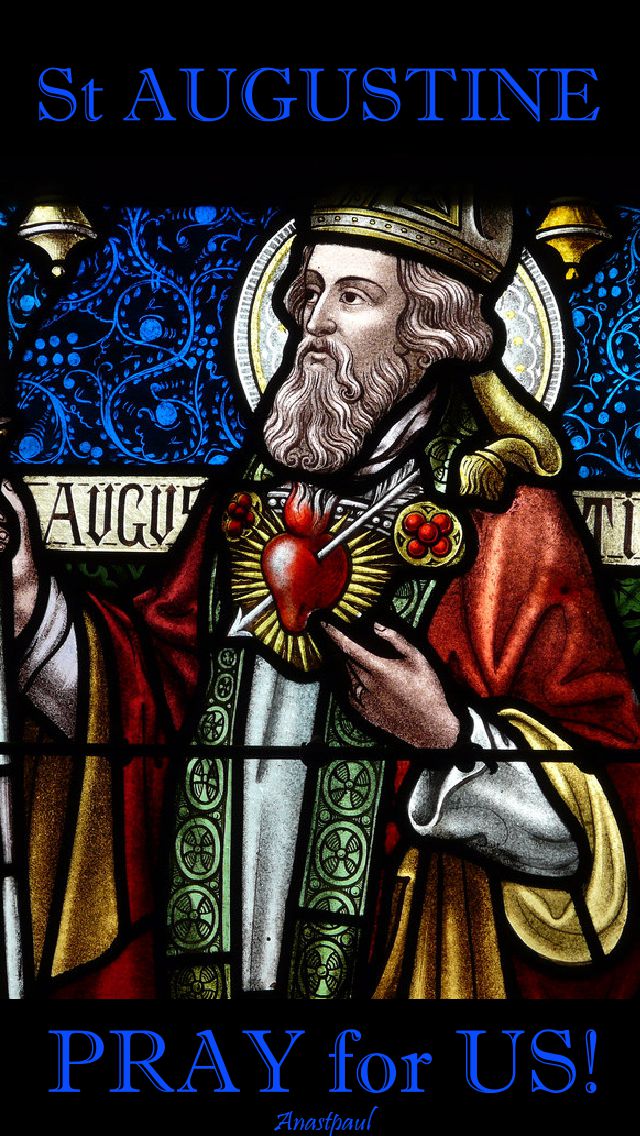
give unto me the Spirit Whom the Father hath sent in Your Name,
that in Him and through Him,
I being wholly changed,
may hasten to You
and go out no more for ever.
Amen
(From a Prayer a Day for Lent – 1923)THE SIXTH WORD -JOHN 19 230- THE SEVEN LAST WORDS OF CHRIST - THE DEVOTION - 30 MARCH 2018

Posted in CONFESSION/PENANCE, DOCTORS of the Church, FATHERS of the Church, LENT, MORNING Prayers, PAPAL SERMONS, QUOTES of the SAINTS, QUOTES on CONVERSION, QUOTES on REPENTANCE, SPEAKING of .....

Quote/s of the Day – 13 March “Speaking of Confession”

Quote/s of the Day – 13 March – “Speaking of Confession”

“In failing to confess, Lord, I would only hide You from myself, not myself from You.”

St Augustine (354-430) Doctor of the Churchin failing to confess lord - st augustine - 13 march 2018

“Confession is like a bridle that keeps the soul which reflects on it from committing sin but anything left unconfessed we continue to do without fear as if in the dark.”

St John Climacus (579-649)confession is like a bridle - st john climacus - 13 march 2018

“Confession is an act of honesty and courage – an act of entrusting ourselves, beyond sin, to the mercy of a loving and forgiving God.”

St Pope John Paul II (1920-2005)confession is an act of courage - st john paul - 13 march 2018

“Each one must confess his sin so that God’s forgiveness, already granted on the Cross, may have an effect in his heart and in his life.

St Augustine writes further: “God accuses your sins and if you also accuse them, you are united to God…. When your own deeds will begin to displease you, from that time your good works begin, as you find fault with your evil works.   The confession of evil works is the beginning of good works” (ibid., 13: PL 35, 1191).

Sometimes men and women prefer the darkness to the light because they are attached to their sins.   Nevertheless it is only by opening oneself to the light and only by sincerely confessing one’s sins to God that one finds true peace and true joy.   It is therefore important to receive the Sacrament of Penance regularly, especially during Lent, in order to receive the Lord’s forgiveness and to intensify our process of conversion.”

Pope Benedict – Angelus Address, 18 March 2012each one must confess his sin = pope benedict - 13 march 2018

Posted in CATHOLIC Quotes, DEVOTIO, MORNING Prayers, PAPAL ENCYLICALS, PAPAL MESSAGES, PAPAL SERMONS, QUOTES - J R R Tolkien and MORE, QUOTES of the SAINTS, QUOTES on PRAYER, QUOTES on the CHURCH, SUNDAY REFLECTIONS, The HOLY EUCHARIST / The HOLY MASS

Sunday Reflection – 11 February 2018 – 6th Sunday of Year B

Sunday Reflection – 11 February 2018 – 6th Sunday of Year B – Pope Benedict and St John Paul

In liturgical prayer, especially the Eucharist and – formats of the liturgy – in every prayer, we do not speak as single individuals, rather we enter into the “we” of the Church that prays.   And we need to transform our “I” entering into this “we”.   Pope Benedict XVI is one of the great liturgists of our age.   His seminal book, “The Spirit of the Liturgy”, written when he was still Joseph Cardinal Ratzinger, is required reading in most seminaries and should be read by every Catholic.

“It is not the individual – priest or layman – or the group that celebrates the liturgy but it is primarily God’s action through the Church, which has its own history, its rich tradition and creativity.   This universality and fundamental openness, which is characteristic of the entire liturgy is one of the reasons why it can not be created or amended by the individual community or by experts but must be faithful to the forms of the universal Church.

The entire Church is always present, even in the liturgy of the smallest community.   For this reason there are no “foreigners” in the liturgical community.   The entire Church participates in every liturgical celebration, heaven and earth, God and man.   The Christian liturgy, even if it is celebrated in a concrete place and space and expresses the “yes” of a particular community, it is inherently Catholic, it comes from everything and leads to everything, in union with the Pope, the Bishops , with believers of all times and all places.   The more a celebration is animated by this consciousness, the more fruitful the true sense of the liturgy is realised in it.

Dear friends, the Church is made visible in many ways:  in its charitable work, in mission projects, in the personal apostolate that every Christian must realise in his or her own environment.   But the place where it is fully experienced as a Church is in the liturgy : it is the act in which we believe that God enters into our reality and we can meet Him, we can touch Him.   It is the act in which we come into contact with God, He comes to us and we are enlightened by Him.

So when in the reflections on the liturgy we concentrate all our attention on how to make it attractive, interesting and beautiful, we risk forgetting the essential:  the liturgy is celebrated for God and not for ourselves, it is His work, He is the subject and we must open ourselves to Him and be guided by Him and His Body, which is the Church.

Let us ask the Lord to learn every day to live the sacred liturgy, especially the Eucharistic celebration, praying in the “we” of the Church, that directs its gaze not in on itself but to God and feeling part of the living Church, of all places and of all time.”…Pope Benedict XVI – Wednesday Audience 3 Oct 2012

“I have been able to celebrate Holy Mass in chapels built along mountain paths, on lakeshores and seacoasts.   I have celebrated it on altars built in stadiums and in city squares….This varied scenario of celebrations of the Eucharist, has given me, a powerful experience of its universal and, so to speak, cosmic character – YES, cosmic!   Because even when it is celebrated on the humble altar of a country church, the Eucharist is always, in some way, celebrated on the altar of the world.  It unites heaven and earth.   It embraces and permeates all creation!” St Pope John Paul “Ecclesia de Eucharista no 8”the liturgy is celebrated - pope benedict = 11 feb 2018 sunday reflection

Posted in CHRISTMASTIDE!, FEASTS and SOLEMNITIES, MORNING Prayers, SACRAMENTS, SAINT of the DAY

Thought for the Day – 8 January 2018 – Christmastide ends with the Feast of the Baptism of the Lord – Remembering and Celebrating our Baptisms – Adding a new date to our Calendars!

Thought for the Day – 8 January 2018 – Christmastide ends with the Feast of the Baptism of the Lord – Remembering and Celebrating our Baptisms – Adding a new date to our Calendars!goodbye christmastide 8 jan 2018- for this he bore our body - st basil the great

Today’s feast of the Baptism of the Lord ends the Christmas season and invites us to think of our Baptism.   Jesus willed to receive the baptism preached and administered by John the Baptist in the river Jordan.   It was a baptism of penance:  all those who approached it expressed the desire to be purified from sin and, with God’s help, committed themselves to begin a new life.

We understand then the great humility of Jesus, He who had not sinned, put himself in the queue with the penitents, mixing among them, to be baptised in the waters of the river.   What humility Jesus has!   And, by doing so, He manifested what we celebrated at Christmas:  Jesus’ willingness to immerse Himself in the river of humanity, to take upon himself the failures and weaknesses of men, to share their desire of liberation and to overcome all that distances one from God and renders brothers strangers.   As at Bethlehem, along the banks of the Jordan God keeps His promise to take charge of the human being’s fate and Jesus is the tangible and definitive sign of it.   He took charge of all of us, He takes charge of all of us, in life, in the days.

The feast of Jesus’ Baptism invites every Christian to remember his own Baptism.   I can’t ask you the question if you remember the day of your Baptism, because the majority of you were babies, like me…. However, I can ask you another question?   Do you know the date on which you were baptised? …And if you don’t know the date or have forgotten it, when you go home ask your mother, your grandmother, your uncle, your aunt, your grandfather, your godfather, your godmother – what was date?
And we must always have that date in our memory, because it’s a date of celebration, it’s the date of our initial sanctification;  it’s the date in which the Father gave us the Holy Spirit who pushes us to walk, it’s the date of the great forgiveness.
Don’t forget: what’s the date of my Baptism?

the holy spirit

We invoke the maternal protection of Mary Most Holy so that all Christians can understand increasingly the gift of Baptism and commit themselves to live it with coherence, witnessing the love of the Father and of the Son and of the Holy Spirit. – Pope Francis, Angelus Address, 7 January 2018

So let us do exactly this, this is a date in need of remembrance and celebration, this date of our new birth – I am certainly going to do this for all my family.

In the name of the Father and of the Son and of the Holy Spirit, Amen.

Jesus’ solidarity with us
“Jesus shows His solidarity with us, with our efforts to convert and to be rid of our selfishnesss, to break away from our sins in order to tell us that if we accept Him in our life He can uplift us and lead us to the heights of God the Father.   And Jesus’ solidarity is not, as it were, a mere exercise of mind and will.   Jesus truly immersed himself in our human condition, lived it to the end, in all things save sin and was able to understand our weakness and frailty.   For this reason He was moved to compassion, He chose to “suffer with” men and women, to become a penitent with us.   This is God’s work which Jesus wanted to carry out:  the divine mission to heal those who are wounded and give medicine to the sick, to take upon himself the sin of the world.” ….. From Homily of Pope Benedict XVI on feast of the Baptism of the Lord 2013remember and celebrate our baptism day - 8 jan 2018

Posted in CATHOLIC DEVOTIONS of the Month, DOCTORS of the Church, FATHERS of the Church, MORNING Prayers, PURGATORY, QUOTES of the SAINTS, The HOLY SOULS

Quote/s of the Day 2 November – The Solemnity of All Souls

Quote/s of the Day 2 November – The Solemnity of All Souls

St James the Apostle gives a method of avoiding or lessening our stay in Purgatory.
He says:  “He who saves a soul saves his own and satisfies for a multitude of sins.”  (James 1:20)james 1 20 - he who saves a soul saves his own - 2 nov 2017 

“Let us help and commemorate them.   If Job’s sons were purified by their father’s sacrifice (Job 1:5), why would we doubt that our offerings for the dead bring them some consolation?   Let us not hesitate to help those who have died and to offer our prayers for them”.

St John Chrysostom (347-407) Doctor of the Church – (Homilies on 1 Corinthians 41:5 [A.D. 392]let us help and commemorate them - st john chrysostum - 2 nov 2017

“But by the prayers of the Holy Church and by the salvific sacrifice and by the alms which are given for their spirits, there is no doubt that the dead are aided, that the Lord might deal more mercifully with them than their sins would deserve.            The whole Church observes this practice which was handed down by the Fathers: that it prays for those who have died in the communion of the Body and Blood of Christ, when they are commemorated in their own place in the sacrifice itself;   and the sacrifice is offered also in memory of them, on their behalf.    If, then, works of mercy are celebrated for the sake of those who are being remembered, who would hesitate to recommend them, on whose behalf prayers to God are not offered in vain?   It is not at all to be doubted that such prayers are of profit to the dead;   but for such of them as lived before their death in a way that makes it possible for these things to be useful to them after death”.

St Augustine (354-430) Doctor of the Church (The City of God 21:13 [A.D. 419]the whole church - st augustine - 2 nov 2017

“I would go so far as to say that if there was not purgatory, then we would have to invent it, for who would dare say of himself that he was able to stand directly before God.    And yet we don’t want to be, to use an image from scripture, ‘a pot that turned out wrong’, that has to be thrown away;   we want to be able to be put right.   Purgatory basically means that God can put the pieces back together again. That He can cleanse us in such a way that we are able to be with Him and can stand there in the fullness of life.   Purgatory strips off from one person what is unbearable and from another the inability to bear certain things, so that in each of them a pure heart is revealed and we can see that we all belong together in one enormous symphony of being.”

Pope Benedict XVIi would go so far as to say - pope benedict XVI - 2 nov 2017

“If today we are remembering
these brothers and sisters of
ours who lived before us and are
now in heaven, they are there
because they were washed in the
Blood of Christ, that is our hope
and this hope does not disappoint.
If we live our lives with the Lord,
he will never disappoint us.”

Pope Francisif today we are remembering - pope francis