
Thought for the Day – 25 August – Meditations with Saint Alphonsus Maria de Liguori (1696-1787) Bishop, Confessor, Most Zealous Doctor of the Church
“Preparation for Death”
By St Alphonsus Maria de Liguori (1696-1787)
PREFACE
Part Three (Final)
Perhaps, with its cares and pleasures, the world is occu- pying too large a portion of our time and thoughts.
The “Consideration” upon its vanity (Chapter xiii.) will teach us, in the first place, to care chiefly for those things which we can carry away with us after death, to endeavour to gain eternal possessions.
In the second place, to weigh the things of time against those of eternity and to mark their lightness.
In the third place, to contrast time with eternity and so, to become “Consideration” rich toward God.”
Each “Consideration” opens three points for meditation and to each of these, is added an “Affection” and a “Prayer.”
The “Consideration” employ the mind, the “Affection” excites the heart; they awake in us those emotions by which it seeks to unite itself with God. It is that “affectus orationis” of which St Fulgentius makes mention. The affection is kindled by consideration and the consideration is supplemented by the affection; neither can afford to be separated the one from the other.
Whilst the “Consideration” sets forth death as the end of toil, the “Affection” urges the soul to anticipate it, to ask Heaven of Jesus, not that it may enjoy itself the more but that, it may love Him the more. The former bids us look at the consummation of our victory, the latter expresses such love, that it longs quickly to die, if such be the will of Jesus. Better far to die and so to be delivered from the danger of losing grace and from the fear of love ever growing cold! …
… This brief explanation of the plan upon which this book
has been written, naturally leads to some suggestions as to
its use. And, firstly, it maybe remarked, that only one “Consideration” should be read at the same time.
In many cases one point even, with its “Affections and Prayers” will afford sufficient employment both for the head and heart.
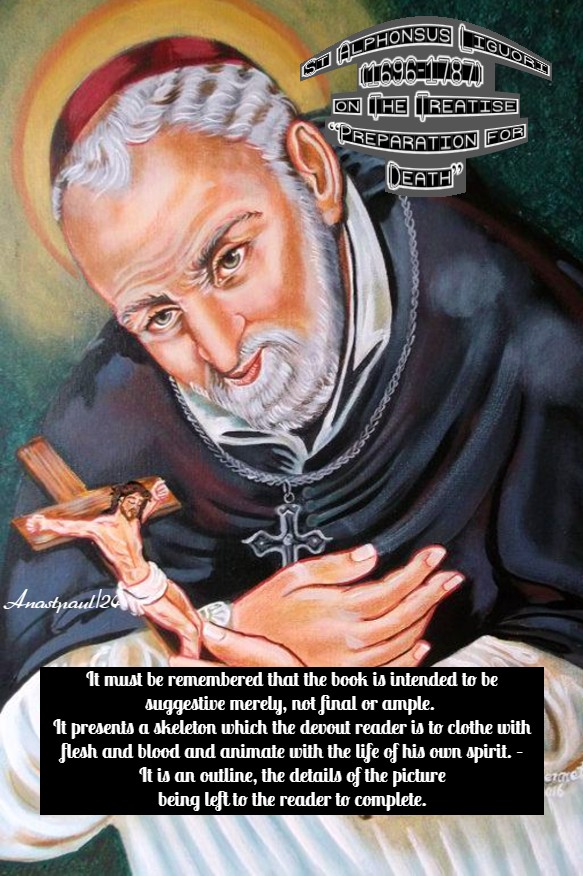
It must be remembered that the book is intended to be suggestive merely, not final or ample. It presents a skeleton which the devout reader is to clothe with flesh and blood and animate with the life of his own spirit. – It is an outline, the details of the picture being left to the reader to complete.


 AnaStpaul
You must be logged in to post a comment.