Posted in SAINT of the DAY

Saint of the Day – 31 May – Blessed Hermann of Marienstatt O.Cist. (1150-c1225) Abbot

Saint of the Day – 31 May – Blessed Hermann of Marienstatt O.Cist. (1150-c1225) Cistercian Monk and Abbot of the Himmerod Abbey; founding Abbot of Heisterbach and Marienstatt Monasteries, Hermann was a zealous and powerful administrator, blessed with the gifts of prophecy, visions and miracles, Born in 1150 in the Rhineland (in modern Germany) and died in c1225 in Himmerod, Germany of natural causes.

Hermann is mentioned as Abbot for the last time in 1225. Soon after, he seems to have lived as a simple Monk in Himmerod, where he died around that time. In the Cistercian Order’s calendar, the commemoration (memoria) of “the Blessed Abbot Hermann, who laid the foundations of Marienstatt and who was famous for his gift of prophecy and also for many other miraculous signs” is recorded on 31 May.

Hermann von Marienstatt , depiction from the Baroque period, Marienstatt Abbey

Hermann von Marienstatt was born in 1150 into a noble Rhenish family (Rhenish meaning ‘of the Rhine’). He was initially a Canon at the St Cassius and Florentius Monastery in Bonn but , in around 1175, he joined the Cistercian Abbey of Himmerod.

When, in 1177, the Archbishop of Cologne, Philipp von Heinsberg, offered the Cistercians the property of a defunct Augustinian Canonry on the Stromberg – today’s Petersberg in the Siebengebirge – as a donation, Monks from Himmerod, led by Hermann as founding Abbot, more than 10 years later, in 1189, finally complied and took over the former Monastery.

Due to the unfavourable mountain location, the Convent soon moved to the nearby valley of the Heisterbach (1192-1199), from which the new Abbey took the name Heisterbach. From 1195, Abbot Hermann worked in Himmerod again. Endowments by Cologne Burgrave Eberhard von Aremberg and his wife Adelheid von Molsberg prompted Himmerod, together with its daughter Monastery, Heisterbach, to undertake one last founding action. In 1212, under the proven leadership of our Blessed Hermann, twelve Monks settled near Neunkhausen ‘at the place of St Maria’ – since then known as Marienstatt. Disputes over inheritance law within the founding family soon forced the abandonment of this site. Thanks to a new foundation by the Counts of Sayn the Cistercians were able to gain a foothold in the Westerwald again. In this context, Hermann is now also attested in Marienstatt documents.

A Cistercian Monk in front of the Heisterbach Monastery, depicted according to a reconstructed drawing around 1930, in the new Heisterbach Monastery Church

These events were later given legend on 27 December 1324.and recorded in writing, in the “Marienstatter Tafeln” the document for the Consecration of the Church. This iconographically valuable document is now in the Rheinisches Landes Museum in Bonn. Its border is decorated with fictitious portraits of the Abbots, beginning with Hermann.
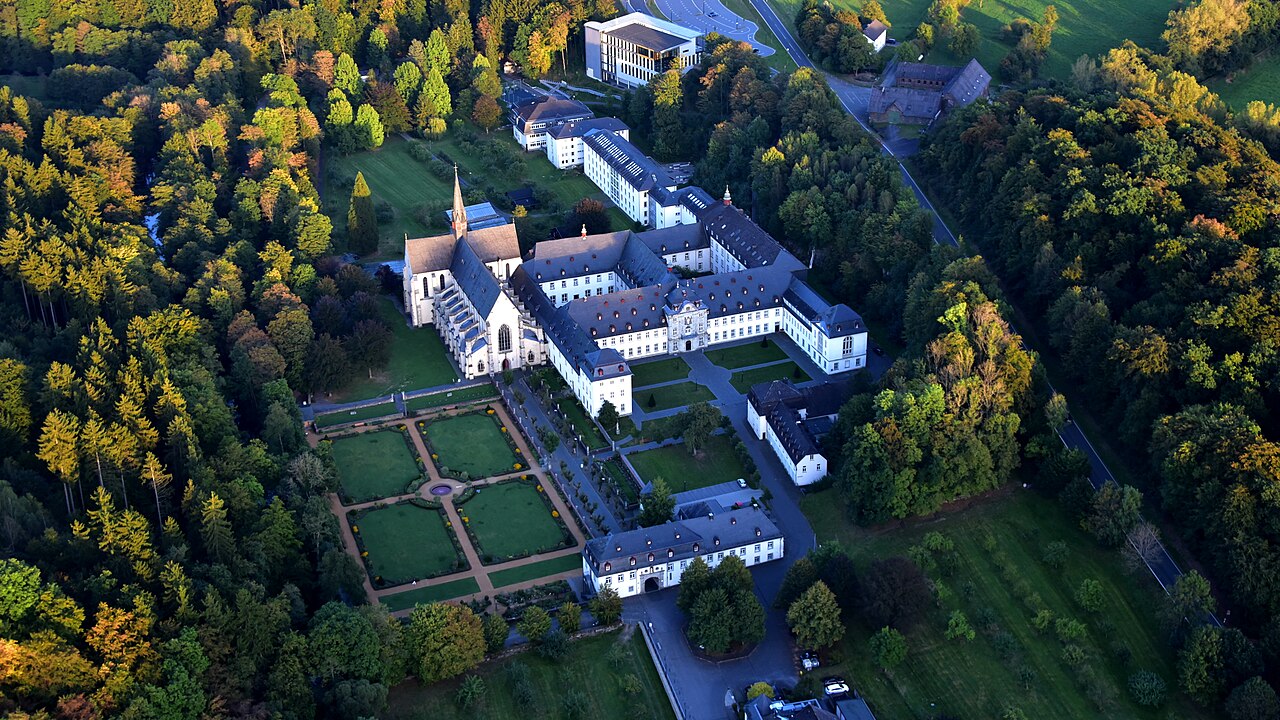
The Cistercian Marienstatt Monastery in 2016

The text tells us that the Mother of God appeared to the worried Abbot in a dream and showed him an alternative building site, where a “hawthorn bush” blooms in the middle of winter. Its branch still adorns the Abbey’s Coat of Arms today, see below.

Hermann had to manage the founding of two Monasteries which were made difficult by geographical disadvantage, inheritance disputes and, in the case of Heisterbach, resistance from the population. When this happened, the Cistercian movement had already passed its peak in the area and was facing competition from new religious movements. Perhaps this is one of the reasons for Hermann’s resignation and retirement.

Pilgrims visiting Marienstatt
Posted in GOD ALONE!, HUMILITY-Fr Richard Clarke, QUOTES on HUMILITY, QUOTES on PRIDE

Thought for the Day – 30 May – The Deeper Foundations of Humility

Thought for the Day – 30 May – Meditations with Fr Richard Frederick Clarke SJ (1839-1900)

HUMILITY
Meditations for a Month

Chapter Four
The Deeper Foundations of Humility

The consciousness of past sin will not, of itself, give us the perfection of humility. It necessarily fixes the eye of the soul upon ourselves and our own doings, whereas perfect humility means the annihilation of self. We have a deeper and more solid foundation for this virtue in our own nothingness and the absence of any sort of good, save that which God has given us. Every gift of nature is simply a free gift from Him. All that is from ourselves is the marring and injuring of what we have received; the misuse of talents, money, position, influence. What folly, then, to pride ourselves on what belongs to God!

Regarding supernatural gifts, we are still mere nothing and less than nothing. Our natural gifts are put into our hands, they remain with us and are in some sense ours but, a supernatural gift requires a fresh giving immediately from the hand of God each time it is given us! We
cannot begin any supernatural work without His preventing grace; we cannot move a step in it without fresh grace to carry on; we cannot bring it to a successful issue, without the grace necessary to complete it. Do I realise, as I ought, this nothingness of myself and my absolute
and continual dependence upon God, for each thought or act, pleasing to Him?

If this is so, how can I be anything but humble? To pride myself on that which God does in me, would be ridiculous; to pride myself on what I can do of myself, would be to pride myself on all which mars and spoils the work of God.
What hast thou that thou hast not received?” asks St Paul.
Yes, O Lord, I have only one thing that I have not received and that is my vileness, misery, sin.
Can I boast of these!?

Posted in DOCTORS of the Church, DOMINICAN OP, EUCHARISTIC, EUCHARISTIC Adoration, FEASTS and SOLEMNITIES, HOLY COMMUNION, PRAYERS of the SAINTS

Quote/s of the Day – 30 May – The Solemnity of Corpus Christi

Quote/s of the Day – 30 May – The Solemnity of Corpus Christi, The Most Holy Body and Blood of Our Lord Jesus Christ

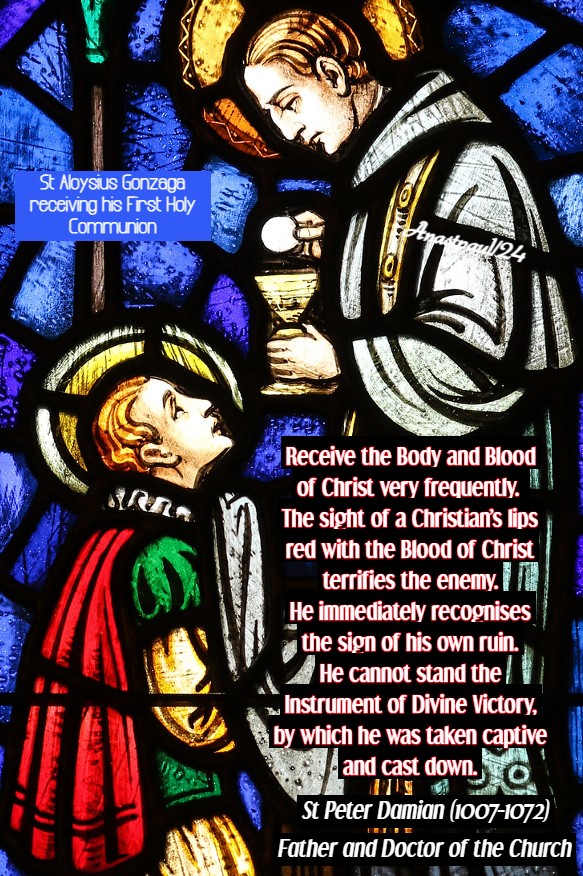
Receive the Body and Blood of Christ
very frequently. The sight of a Christian’s lips
red with the Blood of Christ terrifies the enemy.
He immediately recognises the sign of his own ruin.
He cannot stand the Instrument of Divine Victory,
by which he was taken captive and cast down.

St Peter Damian (1007-1072)
Doctor of the Church

Everything in us which is strong, steadfast,
firm, happy and joyful to carry out God’s commands,
bear with misfortune, act obediently, stand up for justice –
all these things come from this Bread’s strength,
this Wine’s gladness.
Happy are they whose deeds are strong and joyful!
And since no-one can do it of themselves,
happy are they who have an eager desire
to cleave to what is just and right
and to be strengthened in everything
and rejoice through Him
… ”

Baldwin of Canterbury (c1125-1190)
Cistercian Abbot of Forde Monastery and
Archbishop of Canterbury

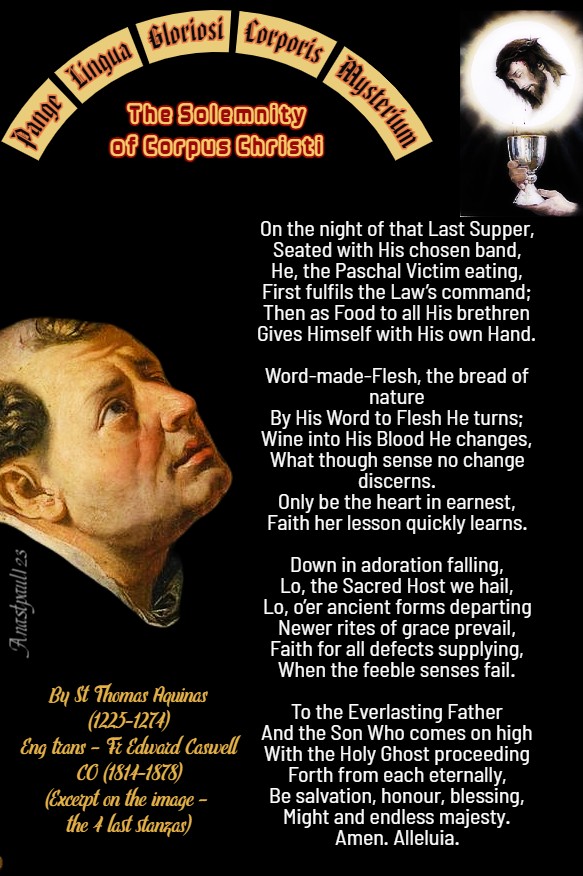
Pange Lingua Gloriosi Corporis Mysterium
Sing, My Tongue
By St Thomas Aquinas (1225-1274)

Eng trans – Fr Edward Caswell CO (1814-1878)
(Excerpt on the image – the 4 last stanzas)

Sing, my tongue, the Saviour’s glory,
Of His Flesh, the Mystery sing;
Of the Blood, all price exceeding,
Shed by our Immortal King,
Destined, for the world’s redemption,
From a noble Womb to spring.

Of a pure and spotless Virgin
Born for us on earth below,
He, as Man, with man conversing,
Stayed, the seeds of truth to sow;
Then He closed in solemn order
Wondrously His Life of woe.

On the night of that Last Supper,
Seated with His chosen band,
He, the Paschal Victim eating,
First fulfils the Law’s command;
Then as Food to all His brethren
Gives Himself with His own Hand.

Word-made-Flesh, the bread of nature
By His Word to Flesh He turns;
Wine into His Blood He changes,
What though sense no change discerns.
Only be the heart in earnest,
Faith her lesson quickly learns.

Down in adoration falling,
Lo, the Sacred Host we hail,
Lo, o’er ancient forms departing
Newer rites of grace prevail,
Faith for all defects supplying,
When the feeble senses fail.

To the Everlasting Father
And the Son Who comes on high
With the Holy Ghost proceeding
Forth from each eternally,
Be salvation, honour, blessing,
Might and endless majesty.
Amen. Alleluia.

Written by St Thomas Aquinas (1225-1274) the Angelic and Common Doctor of the Church, for the very first Solemnity of Corpus Christi, this Hymn is considered the most beautiful of Aquinas’ Hymns and one of the seven great Hymns of the Church.

The last two stanzas make up the Tantum Ergo (Down in Adoration Falling) which is used at Benediction of the Blessed Sacrament. The Hymn is also used on Maundy Thursday during the procession from the Sanctuary to the Altar of Repose, where the Blessed Sacrament is kept until Good Friday.

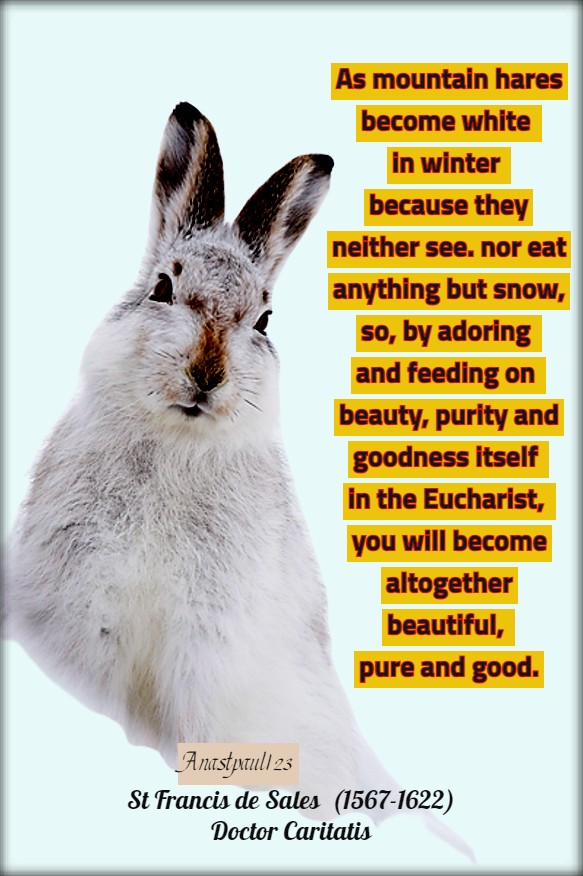
“As mountain hares become white in winter
because they neither see. nor eat
anything but snow,
so, by adoring and feeding on
beauty, purity and goodness itself
in the Eucharist,
you will become altogether
beautiful, pure and good.”

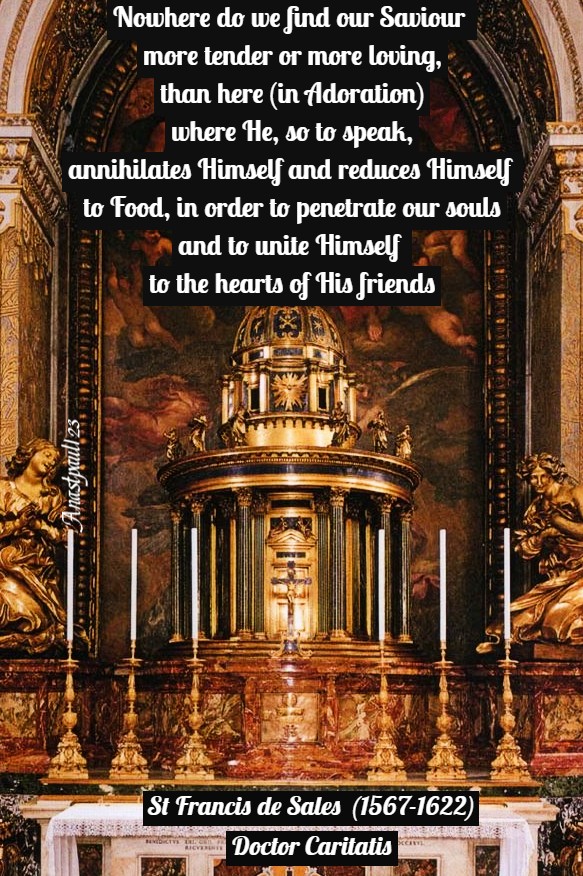
Nowhere do we find our Saviour
more tender or more loving,
than here [in Adoration]
where He, so to speak,
annihilates Himself and reduces Himself
to Food, in order to penetrate our souls
and to unite Himself
to the hearts of His friends.”

St Francis de Sales (1567-1622)
Doctor Caritatis

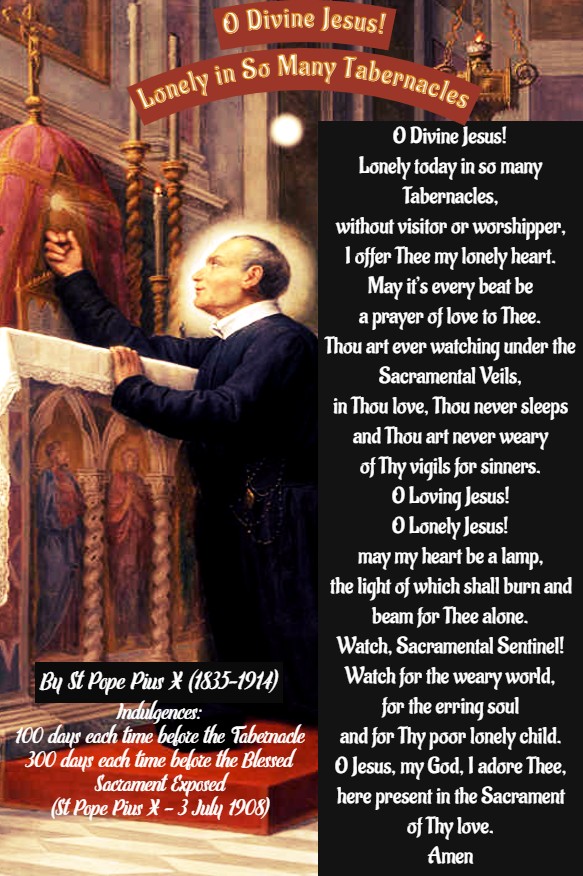
O Divine Jesus!
Lonely in So Many Tabernacles

By St Pope Pius X (1835-1914)
Pope of the Blessed Sacrament

O Divine Jesus!
Lonely today in so many Tabernacles,
without visitor or worshipper,
I offer Thee my lonely heart.
May it’s every beat be a prayer of love to Thee.
Thou are ever watching under the Sacramental Veils,
in Thou love, Thou never sleeps
and Thou are never weary of Thy vigils for sinners.
O Loving Jesus!
O Lonely Jesus!
may my heart be a lamp,
the light of which shall burn and beam
for Thee alone.
Watch, Sacramental Sentinel!
Watch for the weary world,
for the erring soul
and for Thy poor lonely child.

O Jesus, my God, I adore Thee,
here present in the Sacrament of Thy love.
Amen

Indulgences:
100 days each time before the Tabernacle
300 days each time before the Blessed Sacrament Exposed
(St Pope Pius X – 3 July 1908)
Prayers to the Sacred Heart

15th Ed 1936

MORE:
https://anastpaul.com/2023/06/11/quote-s-of-the-day-11-june-he-left-his-body-and-his-blood/

Posted in EUCHARISTIC Adoration, FEASTS and SOLEMNITIES, HOLY COMMUNION, ONE Minute REFLECTION, The HOLY EUCHARIST / The HOLY MASS

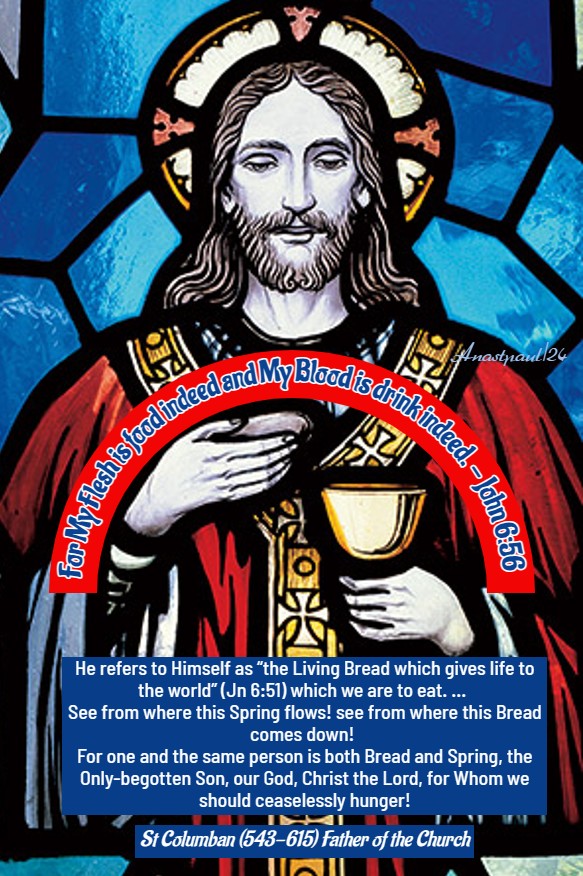
One Minute Reflection – 30 May – ‘ …Christ the Lord, for Whom we should ceaselessly hunger! …’St Columban

One Minute Reflection – 30 May – The Solemnity of Corpus Christi, The Most Holy Body and Blood of Our Lord Jesus Christ – 1 Corinthians 23-29; John 6:56-59– Scripture search here: https://www.drbo.org/

For My Flesh is food indeed and My Blood is drink indeed.” – John 6:56

REFLECTION – “Beloved brethren, quench your thirst at the waters of that Divine Spring we want to tell you about – quench it but do not extinguish it; drink but do not become satisfied. The Living Spring, the Source of Life, calls us and says: “Let anyone who thirsts come to Me and drink” (Jn 7:37). Understand what it is you are drinking. Let the Prophet tell you and let the Source Itself tell you: “Listen to the word of the Lord, they have forsaken Me the Source of Living Water” (Jer 2:13). So the Lord our God Himself, Jesus Christ, is He Who is that Source of Life and that is why He invites us to come to Him so that we might drink Him. Whoever loves Him, drinks Him; whoever feeds on the Word of God, drinks Him. … Drink, therefore, from this Source that others have forsaken!

That we might eat of this Bread and drink from this Spring … He refers to Himself as “the Living Bread which gives life to the world” (cf. Jn 6:51) which we are to eat. … See from where this Spring flows! see from where this Bread comes down! For one and the same person is both Bread and Spring, the Only-begotten Son, our God, Christ the Lord, for Whom we should ceaselessly hunger!

It is our love which gives Him as food to us, our desire which makes us eat Him and when we have been satisfied, we desire Him still. Let us go to Him as to a fountain and drink of Him in our overflowing love, let us drink Him always with ever-new desire, finding our joy in the sweetness of His Love. The Lord is gentle and good. We eat and drink Him without ceasing to hunger and thirst for Him, for we cannot exhaust this Food and Drink. We eat of this Bread yet do not run out of it; we drink at this Spring, yet it does not run dry. This Bread is eternal; this Stream flows without end!” – St Columban (543-615) Father of the Church, Monk, Irish Missionary, Abbot, Writer, Reformer, Teacher, Miracle-worker, Founder of numerous Nonateries. (Spiritual instructions 12, 2, 3).

PRAYER – O God, Thou Who in this wondrous Sacrament has left us a memorial of Thy Passion, grant us, we beseech Thee, so to venerate the Sacred Mysteries of Thine Body and Blood that we may ever experience within ourselves, the effect of Thy redemption. Who lives and reignest with God the Father, in the unity of the Holy Ghost, God, world without end. Amen (Collect).

Posted in CONSECRATION Prayers, EUCHARISTIC, HOLY COMMUNION, MARIAN PRAYERS, Our MORNING Offering

Our Morning Offering – 30 May – On the Feast of Corpus Christi – Consecration to Our Lady of the Eucharist After Holy Communion

Our Morning Offering – 30 May – “The Month of the Blessed Virgin Mother” – Corpus Christi!

Consecration to Our Lady of the Eucharist
After Holy Communion

By the Claretian Fathers Teaching Ministry
Order founded by St Anthony Mary Claret (1807-1870)

Mary is called Our Lady of the Eucharist, because
without her, there would be no physical Body of Jesus
to be present in the Eucharist.
 (See John 6:51)

Most kind Mother,
we consecrate to thee, our bodies,
which have just been
honoured and sanctified,
by the presence of thy Divine Son,
our souls which have
conversed with Him
and our hearts which have loved Him.
O dearest Mother,
may the words which we have spoken, be made
acceptable to Him. through thy intercession.
Tell Him the things which we should have said
but were unable to express.
Love Him and beseech Him for us,
thy poor children.
Receive and keep us in thine heart.
Warn us, protect us
and guide us during this day
that we may faithfully serve thy Divine Son
and please Him
in all our thoughts, desires and actions.
Amen

Posted in CHRIST the WORD and WISDOM, FATHERS of the Church, GOD ALONE!, ONE Minute REFLECTION, PRACTISING CATHOLIC, QUOTES on SACRED SCRIPTURE, QUOTES on THE VOICE OF GOD, The WORD

One Minute Reflection – 29 May – ‘… Those who want to be favourably listened to by God, must begin by listening to God. …’

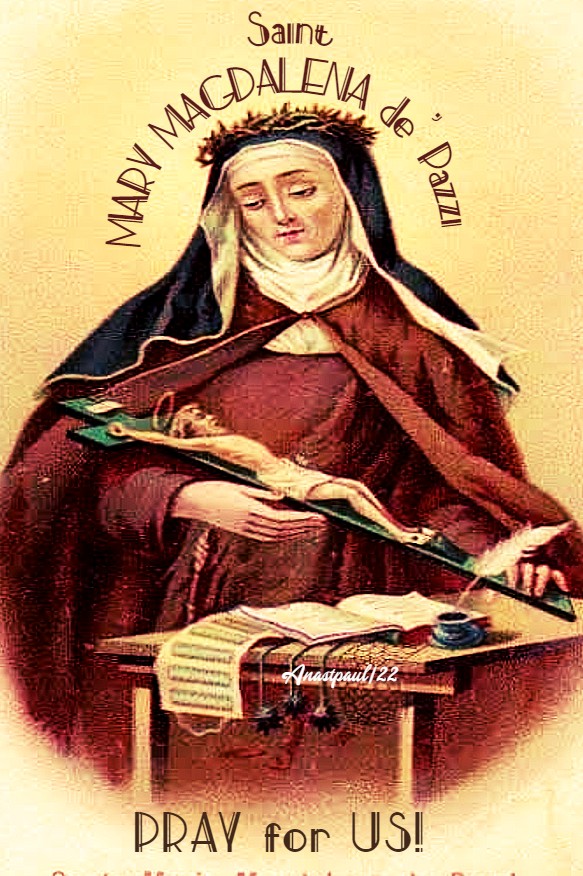
One Minute Reflection – 29 May – “The Month of the Blessed Virgin Mother of God” – St Maria Magdalena de’ Pazzi O.Carm (1566-1607) Virgin – 2 Corinthians 10:17-18; 11:1-2; Matthew 25:1-13 – Scripture search here: https://www.drbo.org/

Amen I say to you, I know you not.” – Matthew 25:12

REFLECTION – “Pay attention, dear brothers – the holy Scriptures were passed onto us, so to speak, like letters come from our homeland. Our homeland, indeed, is paradise; our forebears are the Patriarchs, the Prophets, the Apostles and the Martyrs; our fellow countrymen, the Angels; our King, Christ. When Adam sinned, we were thrown into the exile, as it were, of this world. But because our King is faithful and merciful, more than we can imagine or express, He deigned to send us the holy Scriptures through the Patriarchs and the Prophets, as the letters of invitation, with which He invites us to our eternal and original homeland. … Because of His unspeakable Kindness, He has invited us to reign with Him.

In these conditions, what idea do they have of themselves, these servants who do not deign to read the letters which invite us to the happiness of the Kingdom? … “If anyone does not acknowledge this, he is not acknowledged” (1 Cor 14:38). Certainly, the one who neglects to look for God in this world, by reading the Sacred texts, God, in His turn, will refuse to admit him to eternal happiness. He should fear that he may find the doors locked, leaving him outside with the foolish virgins (Mt 25:10) and that he might hear: “ I do not know who you are, I do not know you, depart from me, all you evildoers. ” … Those who want to be favourably listened to by God, must begin by listening to God. How could we have the effrontery to want God to listen to us favourably, if we attach so little importance to Him that we neglect to read His precepts!?” – St Caesarius of Arles (470-543) Bishop, Father of the Church (Sermons – 7).

PRAYER – O God, lover of chastity, Who endowed with heavenly gifts, blessed Mary Magdalena, a virgin on fire with love for You, grant that we, who keep this feast-day in her honour, may imitate her by purity and love. Through Jesus Christ, Thy Son our Lord, Who lives and reigns with Thee, in the unity of the Holy Ghost, God, world without end. Amen (Collect).