Saint of the Day – 2 May – St Athanasius (c295-373) – Father and Doctor of the Church Bishop, Confessor, known as “Father of Orthodoxy” and Athanasius of Alexandria, Athanasius of Egypt, Athanasius the Great, Champion of Christ’s Divinity, Champion of Orthodoxy, Greek Doctor of the Church, Holy Hierarch, Pillar of the Church – Attributes: Bishop arguing with a pagan; bishop holding an open book; bishop standing over a defeated heretic.
Athanasius was born of Christian parents in Alexandria, Egypt, about 295. As a young man, he spent four years in prayer and solitude in the desert. There he met Anthony the hermit, who influenced him. After he left the desert, Athanasius became a priest and was appointed secretary to Alexander, bishop of Alexandria.
Meanwhile, Arius had begun preaching that Jesus was not truly God. At a church council at Nicaea in 325, Arius and his ideas were condemned and the bishops composed the Nicene Creed.
Conflict with Arius and Arianism as well as successive Roman emperors shaped Athanasius’ career. In 325, at the age of 27, Athanasius began his leading role against the Arians as a deacon and assistant to Bishop Alexander of Alexandria during the First Council of Nicaea. Roman emperor Constantine the Great had convened the council in May–August 325 to address the Arian position that the Son of God, Jesus of Nazareth, is of a distinct substance from the Father. Three years after that council, Athanasius succeeded his mentor as archbishop of Alexandria. In addition to the conflict with the Arians (including powerful and influential Arian churchmen led by Eusebius of Nicomedia), he struggled against the Emperors Constantine, Constantius II, Julian the Apostate and Valens. He was known as “Athanasius Contra Mundum” (Latin for Athanasius Against the World).
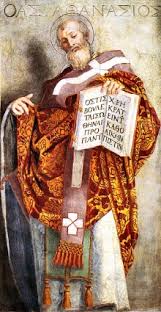
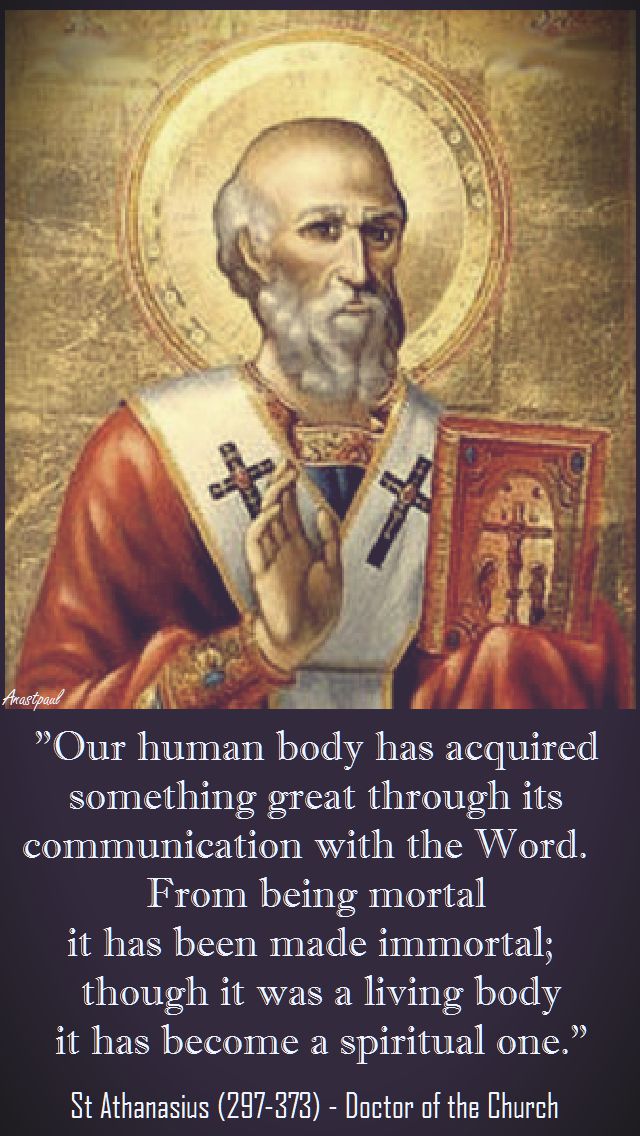
Nonetheless, within a few years after his death, Gregory of Nazianzus called him the “Pillar of the Church”. His writings were well regarded by all Church fathers who followed, in both the West and the East, who noted their rich devotion to the Word-become-man, great pastoral concern and profound interest in monasticism. Athanasius is counted as one of the four great Eastern Doctors of the Church in the Roman Catholic Church – he is labeled as the “Father of Orthodoxy”.
Bl. John Henry Newman described him as a “principal instrument, after the Apostles, by which the sacred truths of Christianity have been conveyed and secured to the world”. [Letters..]
Historian Cornelius Clifford says: “His career almost personifies a crisis in the history of Christianity; and he may be said rather to have shaped the events in which he took part than to have been shaped by them.”
The greater majority of Church leaders and the emperors fell into support for Arianism, so much so that Jerome, 340–420, wrote of the period: “The whole world groaned and was amazed to find itself Arian”. He, Athanasius, even suffered an unjust excommunication from Pope Liberius (325–366) who was exiled and leant towards the Arians, until he was allowed back to the See of Rome. Athanasius stood virtually alone against the world.




 AnaStpaul
You must be logged in to post a comment.