
Saint of the Day – 18 June – Saint Calogerus (c466-c561) Hermit in Sicily, Missionary evangeliser graced with visions and the charism of casting out demons as an Exorcist, Born in c466 in Chalcedon, Thrace in Egypt and died in c561 at Monte Cronios, Sciacca, Sicily. Patronage – of Petralia Sottana a Town in Sicily. Also known as – Calogero, Calogerus of Sicily, … the Hermit, Calogerus of Sicily. The name Calogerus, is of Greek origin and means “elderly beauty.” In the Greek ideal of beauty, that which is beautiful is also fair and good, suffice it to remember in the Gospel according to St John, the original Greek version calls Jesus the “beautiful Shepherd” which later became the “good Shepherd.”

This term was used in the East and in southern Italy for the Hermit Monks, who were thus called Caloyers or Calogeri, Therefore, some experts believe that this was not the name of our Hermit Haint but rather the appellation he was recognised by. However, other scholars are convinced that this was, in fact, his name.
The Roman Martyrology reads today: “At Sacca, in Sicily,, St Calogerus, Hermit, whose holiness is principally manifested by the deliverance of possessed persons.”
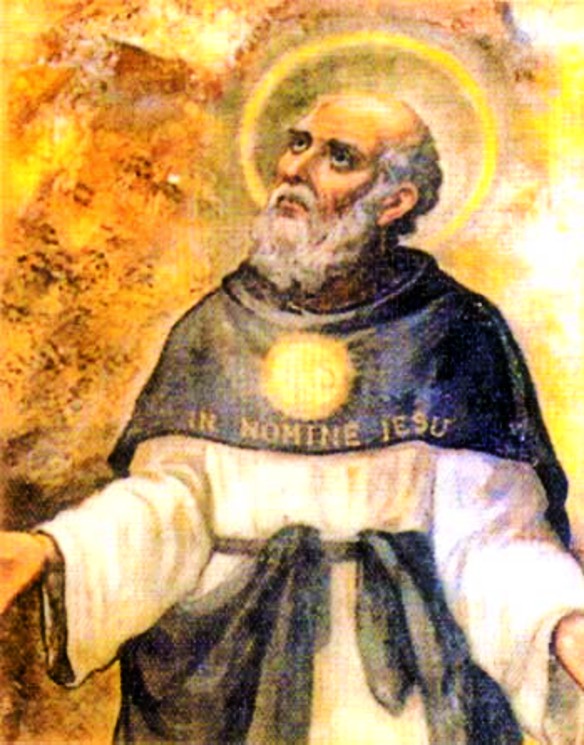
According to tradition, since there is no certain documentation, Calogerus was born around 466 in Chalcedon on the Bosphorus, a Town in ancient Thrace which, in 46 became a Roman Province and then followed the fate of the Byzantine Empire.
Since Calogerus’ childhood he fasted, prayed and studied the Holy Scripture and according to the ‘Acts’ taken from the ancient Siculo-Gallican Breviary, in use in Sicily from the 9th Century to the 16th, he came to Rome on a pilgrimage, receiving from Pope Felix III (483-492), permission to live in solitude in an unspecified place.
Here, he had an angelic vision or a celestial inspiration which instructed him to evangelise Sicily. When he returned from the Pope, he obtained authorisation to go to the island, with his companions Philip, Onofrius and Archileone, to free that people from demons and from the worship of pagan gods.
He and his companions spread out to different places to more effectively spread the Gospel.
During stay on the island of Lipari, Calogerus had a vision of the death of King Theodoric († 526) who, in recent years had begun to persecute those Latins he considered a danger to his kingdom, among whom were the philosopher Boethius (480-524). This is reported in the ‘Dialogues’ of Pope St Gregory I the Great, the vision had come true on the exact day and hour of the King’s death and Calogerus saw his soul hurled into the crater of the nearby Volcano.
Calogerus is also held to have worked as a missionary on Lipari in the Aeolian Islands, before retiring to live as a solitary Hermit on Monte Giummariaro which is now sometimes called in Sicilian: Monte San Caluòru in his honour, as is another mountain near Palermo. Calogerus settled in a cave adjacent to the vaporous ones, which, as in Lipari, also exist here in abundance.
In said cave, there is a majolica image (see below) of St Calogerus walled into the rock, placed above a rustic Altar which is said to have been built by himself, The image is from 1545 and represents the bearded hermit holding a book and a stick-branch in his right hand, at his feet there is a kneeling believer and a doe collapsed and wounded by an arrow.
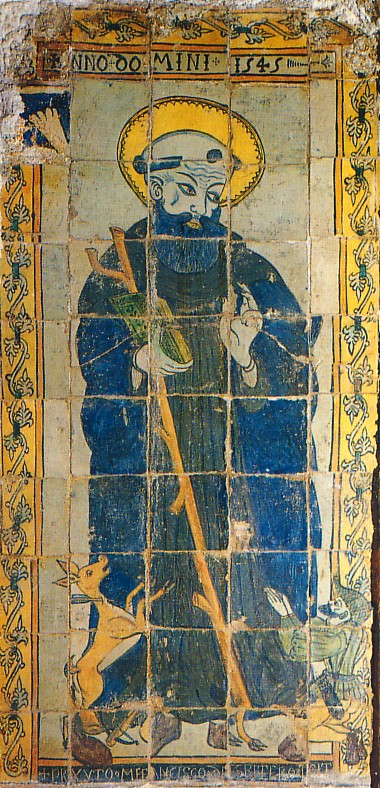
The image refers to an episode of his last days, being now over ninety years old, he could no longer feed himself, so God sent him a doe which fed him with her delicate milk. One day, a hunter named Sierus, seeing the animal, took his bow and pierced the doe with an arrow which managed to drag itself inside Calogerus’ cave, dying in his arms.
The repentant and crying hunter, recognised, in the old man, the one who had Baptised him years before, asked for forgiveness and Calogerus took him to the nearby steamy cave, giving him instructions for the healing properties of that steam and the waters which flowed from that mountain.
The hunter Sierus, who had become his disciple, often climbed the mountain to visit him but 40 days after killing the doe, he found the old hermit dead, still kneeling before the Altar. According to tradition, he had died in the cave between 17 and 18 June 561 and had lived in that place for 35 years.
When the news spread, the inhabitants of the nearby Towns flocked to him and buried him in the cave itself which was then transferred to another cave, whose memory has been lost over the centuries.
It should be added that the Relics of the Saint, according to another tradition, were later transferred to a Monastery three km from the cave. And, in 1490 they were moved to Fragalà (Messina) by the Basilian Monk Urbano da Naso and then to Frazzanò (Messina), to the Parish Church. Some of his Relics are kept in the Sanctuary of San Calogerus built near his cave in the 17 Century. This Church is now a destination for pilgrimages.
In any case, St Calogerus is venerated throughout Sicily and in all the Cities he is honoured with Processions and celebrations, typical of the intense pirty and devotion of the Sicilians, almost all of which take place on his Feastday on 18 June.



 AnaStpaul
You must be logged in to post a comment.