
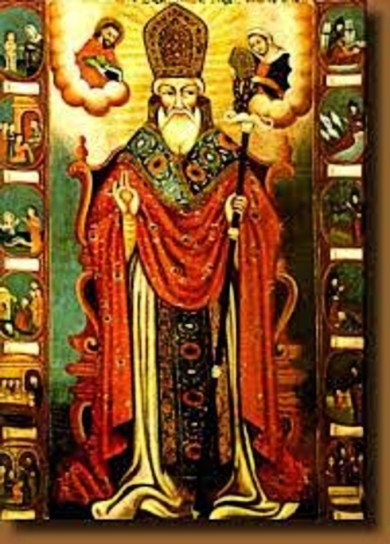
Saint of the Day – 11 February – Saint Castrensis (5th Century) Bishop of Carthage and then in Italy, of Castel Volturno or Sessa Aurunca. Patronages – All in Italy: Castel Volturno, Marano di Napoli, the City and Archdiocese of Monreale, San Castrese di Sessa Aurunca. Also known as – Castrensis of Sessa, Castrensis of Campania, Castrensis of Africa, Castrense… Castrese… Castrenze… Additional Memorial – 1 September as one of the Exiles of Campania; in Castel Volturno he is celebrated in August; in Capua on 29 December and on the 2nd Sunday in May, as the date of the translation of his Relics.
The Roman Martyrology reads today: “At Capua, St Castrensis, Bishop.”

Castrensis who lived around the 5th Century, is remembered in the “Marble Calendar” of Naples even though very little is known about him.
During the persecution of the Vandals led by Genseric (390-477), together with other Priests and faithful, he was sent off embarked on an old ship without a rudder, an anchor and cables, with the aim of drowning all on board. But they landed miraculously in Campania, Italy on 10 May, where he began to carry out his Apostolate.

It is uncertain whether he was the Bishop of Castel Volturno or Sessa Aurunca but he led the faithful of his City with love and zeal.
Biographers report two miraculous prodigies performed by him during his life and the liberation of a man possessed by the devil and the saving of a ship full of people (both episodes are depicted in two Mosaic panels in the Cathedral of Monreale, see below). The inscription above the Mosaics says:
“He saves the sailors and rescues them from the anger of the demon which he had forced to go out from the body of the posessed man.”

Castrensis died at the end of the 5th Century “among his people, after having celebrated the Mysteries and having descended, by himself, into the tomb” and was immediately venerated by the people throughout Campania and in many other regions.

He was considered a martyr because he was depicted in some paintings, discovered around 1881 in a cave in Calvi (Caserta) and dating to the 7th Century, together with the Martyr Priscus.
The Archbishop of Capua, Alfano, who had to accompany Princess Giovanna, daughter of King Henry II of England and sister of Richard the Lionheart, to Palermo, brought as a wedding gift to King William II, the body of St Castrensis without the head which remained in Capua (see Vita di Guglielmo II , Palermo 1770).
The Relics are today preserved in the Cathedral of Monreale, in the Chapel of the same name , inside a silver urn made by Cardinal Cosimo Torres, in 1637. On the plaque of the urn one can read:
“ St Castrensis, eternal Bastion of the City of Monreale. ”

Castrensis is highly venerated in Castel Volturno (Caserta), where, in August, a procession along the river, is held in his honour. In Capua, which celebrates St Castrensis on 29 December and the second Sunday of May, the date of the translation).



 AnaStpaul
You must be logged in to post a comment.