Quote/s of the Day – 14 January -Speaking of the Holy Eucharist from the Fathers of the Church
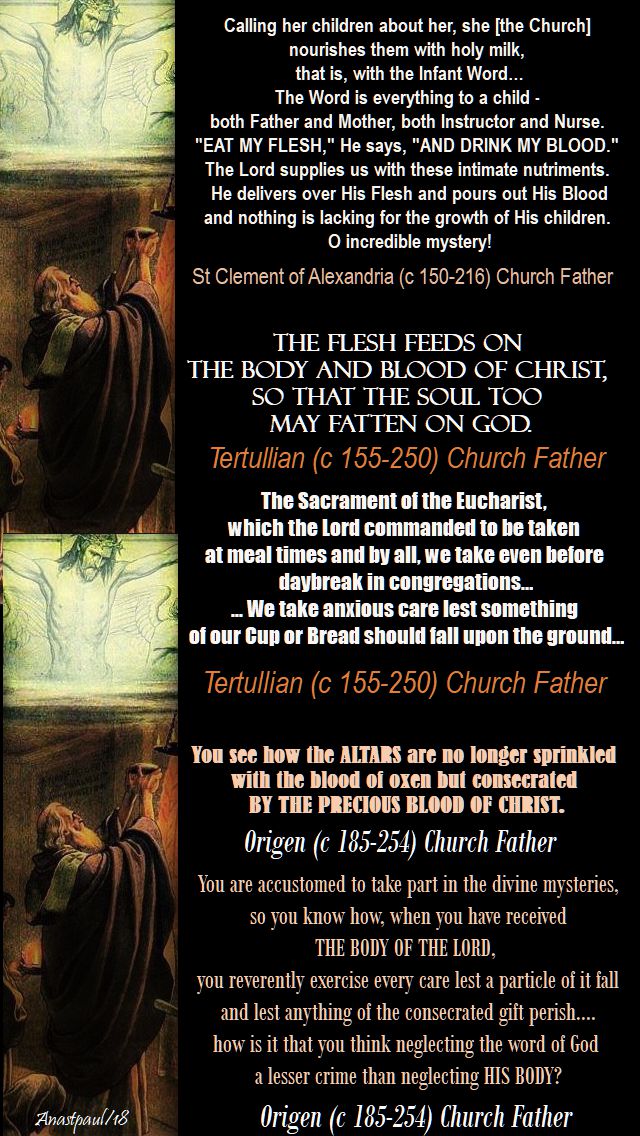
“Calling her children about her, she [the Church] nourishes them with holy milk, that is, with the Infant Word… The Word is everything to a child – both Father and Mother, both Instructor and Nurse. “EAT MY FLESH,” He says, “AND DRINK MY BLOOD.” The Lord supplies us with these intimate nutriments. He delivers over His Flesh and pours out His Blood and nothing is lacking for the growth of His children. O incredible mystery!” (Instructor of Children 1:6:42,1,3)
St Clement of Alexandria (c 150-216) Church Father
“The flesh feeds on THE BODY AND BLOOD OF CHRIST, so that the SOUL TOO may fatten on God.” (Resurrection of the Dead 8:3)
“The Sacrament of the Eucharist, which the Lord commanded to be taken at meal times and by all, we take even before daybreak in congregations… … We take anxious care lest something of our Cup or Bread should fall upon the ground…” (The Crown 3:3-4)
Tertullian (c 155-250) Church Father
“You see how the ALTARS are no longer sprinkled with the blood of oxen but consecrated BY THE PRECIOUS BLOOD OF CHRIST.” (Homilies on Joshua 2:1)
“You are accustomed to take part in the divine mysteries, so you know how, when you have received THE BODY OF THE LORD, you reverently exercise every care lest a particle of it fall and lest anything of the consecrated gift perish…. how is it that you think neglecting the word of God a lesser crime than neglecting HIS BODY?” (Homilies on Exodus 13:3)
Origen (c 185-254) Church Father
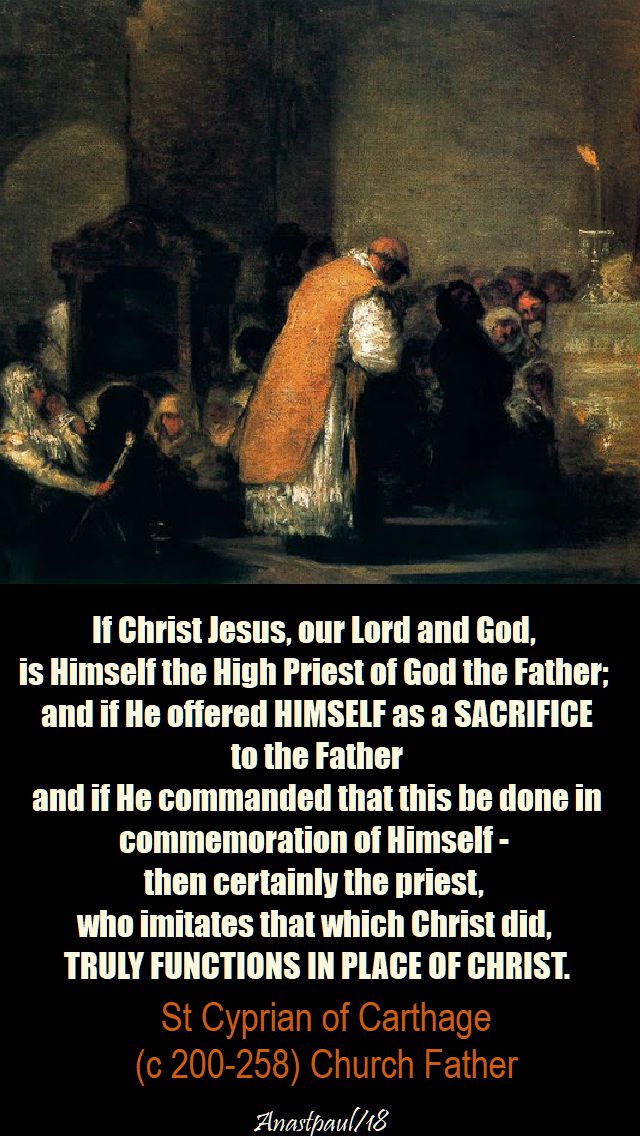
“If Christ Jesus, our Lord and God, is Himself the High Priest of God the Father; and if He offered HIMSELF as a SACRIFICE to the Father and if He commanded that this be done in commemoration of Himself – then certainly the priest, who imitates that which Christ did, TRULY FUNCTIONS IN PLACE OF CHRIST.” (Letters 63:14)
One Minute Reflection – 16 September – The Memorial of Sts Cornelius and Cyprian
Your will be done on earth as it is in heaven…Matthew 6:10
REFLECTION – “We must carry out the will of God rather than our own. This is what we pledge to do in the “Our Father”, which we recite every day.
What a travesty it would be if, after praying that God’s will be done, we should carry out that will halfheartedly and only because we are obliged to do so!…St Cyprian of Carthage
PRAYER – Lord God, heavenly Father, You gave Sts Cornelius and Cyprian to Your Church as faithful shepherds and steadfast martyrs. Strengthen our faith and our courage by their prayers, so that we may strive with all our power, to do Your will at all times, wholeheartedly! Amen
Saints of the Day – 16 September – St Pope Cornelius and St Cyprian of Carthage – Martyrs. St Pope Cornelius – Papal Ascension: 251. He was Martyred in 253 and his remains were buried at the Cemetery of Saint Callistus Rome. “Cornelius” means ‘battle horn.‘ Patronages – • against earache; earache sufferers• epileptics; against epilepsy• against fever• against myoclonus• cattle• domestic animals• Kornelimünster, Germany. St Cornelius was a Bishop becoming ar reluctant 21st Pope, elected after a 1 1/2 year period, during which the persecutions were so severe that Papal ascension was an immediate death sentence. He worked to maintain unity in a time of schism and apostasy and fought Novatianism. He also called a Synod of Bishops to confirm him as rightful Pontiff, as opposed to the anti-pope Novatian. He had the support of Saint Cyprian of Carthage and Saint Dionysius. He welcomed back those who had apostacised during the persecutions of Decius – the documents which settled this matter prove the final authority of the Pope. Exiled to Centumcellae in 252 by Roman authorities to punish Christians in general, who were said to have provoked the gods to send plague against Rome. Martyr. A document from Cornelius shows the size of the Roman Clergy during his Papacy – 46 Priests, 7 Deacons, 7 Sub-deacons, approximately 50,000 Christians. His name is in the Communicantes in the Canon of the Mass.
St Cyprian of Carthage – (Died in 190 in Carthage, North Africa – Bishop and Martyr, learned Rhetorician, Teacher, Writer, Theologian – beheaded 14 September 258 in Carthage, North Africa). Patronages – • Algeria (proclaimed on 6 July 1914 by Pope Pius X)• North Africa (proclaimed on 6 July 1914 by Pope Pius X, on 10 January 1958 by Pope Pius XII and on 27 July 1962 by Pope John XXIII NOTE – no, I don’t know why it was done so many times).
St Cyprian was born to wealthy pagan parents. He taught rhetoric and literature. He was adult convert in 246, taught the faith by Saint Caecilius of Carthage. He was ordained in 247 and became the Bishop of Carthage in 249. During the persecution of Decius, beginning in 250, Cyprian lived in hiding, covertly ministering to his flock; his enemies condemned him for being a coward and not standing up for his faith. As a writer he was second only in importance to Tertullian as a Latin Father of the Church. Friend of Saint Pontius. St Cyprian was involved in the great argument over whether apostates should be readmitted to the Church; Cyprian believed they should but under stringent conditions. He was supported St Pope Cornelius against the anti-pope Novatian. During the persecutions of Valerian he was exiled to Curubis in 257, brought back Carthage and then martyred in 258. His name is in the Communicantes in the Canon of the Mass.
An excerpt written to Cornelius, Bishop of Rome condemned to martyrdom for his faith, from his brother Bishop Cyprian of Carthage, himself to give his witness as a Martyr a few years later. Read on the feasts of Sts Cornelius and Cyprian, Martyrs, on 16 September.
Cyprian to his brother Cornelius.
My very dear brother, we have heard of the glorious witness given by your courageous faith. On learning of the honour you had won by your witness, we were filled with such joy that we felt ourselves sharers and companions in your praiseworthy achievements. After all, we have the same Church, the same mind, the same unbroken harmony. Why then should a priest not take pride in the praise given to a fellow priest as though it were given to him? What brotherhood fails to rejoice in the happiness of its brothers wherever they are?
Words cannot express how great was the exultation and delight here when we heard of your good fortune and brave deeds: how you stood out as leader of your brothers in their declaration of faith, while the leader’s confession was enhanced as they declared their faith. You led the way to glory, but you gained many companions in that glory; being foremost in your readiness to bear witness on behalf of all, you prevailed on your people to become a single witness.
We cannot decide which we ought to praise, your own ready and unshaken faith or the love of your brothers who would not leave you. While the courage of the bishop who thus led the way has been demonstrated, at the same time the unity of the brotherhood who followed has been manifested. Since you have one heart and one voice, it is the Roman Church as a whole that has thus born witness.
Dearest brother bright and shining is the faith which the blessed Apostle praised in your community. He foresaw in the spirit the praise your courage deserves and the strength that could not be broken; he was heralding the future when he testified to your achievements; his praise of the fathers was a challenge to the sons. Your unity, your strength have become shining examples of these virtues to the rest of the brethren.
Divine providence has now prepared us. God’s merciful design has warned us that the day of our own struggle, our own contest, is at hand. By that shared love which binds us close together, we are doing all we can to exhort our congregation, to give ourselves unceasingly to fastings, vigils and prayers in common. These are the heavenly weapons which give us the strength to stand firm and endure; they are the spiritual defenses, the God-given armaments that protect us.
Let us then remember one another, united in mind and heart. Let us pray without ceasing, you for us, we for you; by the love we share we shall thus relieve the strain of these great trials.
“Let us remember one another in concord and unanimity. Let us on both sides of death always pray for one another. Let us relieve burdens and afflictions by mutual love, that if one of us, by the swiftness of divine condescension, shall go hence the first, our love may continue in the presence of the Lord and our prayers for our brethren and sisters not cease in the presence of the Father’s mercy.”
St Cyprian of Carthage (c 190 – 258) from Letters, 253
You must be logged in to post a comment.