
Saint of the Day – 26 June – St Deodatus (Died 473) Bishop of Nola succeeding St Paulinus the Younger after having been his Archpriest. He had previously been the Deacon of St Paulinus Nola (c354-431) (St Paulinus image below).

The life of Saint Deodatus, although rich in virtues and meritorious works, has come down to us in fragments.
From various sources we learn that Deodato was first Archpriest of the City of Nola during the Episcopate of Saint Paulinus the Younger, who died in 442. His wisdom and prudence were such that “with the consent of all the Presbyters and Clerics of the entire Nolan Church,, he was entrusted with the administration of the revenues to be collected and distributed and, in a certain sense, he was a bishop.”
However, his moral integrity was put to the test by slanderous accusations. Malicious individuals denounced him to the Emperor Valentinian III, accusing him of disposing of Ecclesiastical goods “at his pleasure and for his own use.”
Following these accusations, Deodato was imprisoned, exiled and only thanks to divine intervention was he able to regain his freedom.
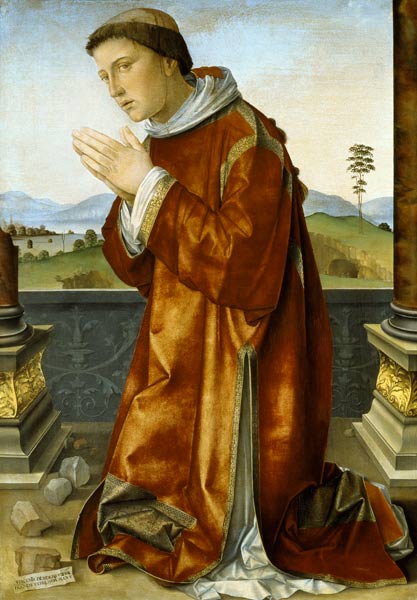
Two years after the death of St Paulinus the Younger, in 444, Deodatus was elected as the Bishop of Nola, assuming the leadership of the Diocese with dedication and wisdom.
His Episcopate was characterised by intense pastoral activity and deep attention to the needs of the faithful. Deodatus distinguished himself by his humility and charity, earning the affection and esteem of all. He died on 26 June 473 and was buried in his hometown of Nola.
Already in life, Deodatus was venerated for his sanctity. While still the Archpriest, he had prepared a cenotaph with an inscription which emphasised his humility:
“Deodatus, unworthy Archpriest of the Holy Church of Nola, rests here.”
After his death, another epigraph was dedicated to him, extolling his virtues:
“Beloved by God and men in the Priesthood.”
Several historical sources, including the author of the Vita himself, confirm that Deodatus was both Archpriest and Bishop of Nola.
Around 840, his Relics were transported to Benevento, where they are still venerated today.



 AnaStpaul
You must be logged in to post a comment.