Quote/s of the Day – 24 March – Tuesday of Passion Week – Daniel 14:27-42 – John 7:1-13 – Scripture search here: https://www.drbo.org/
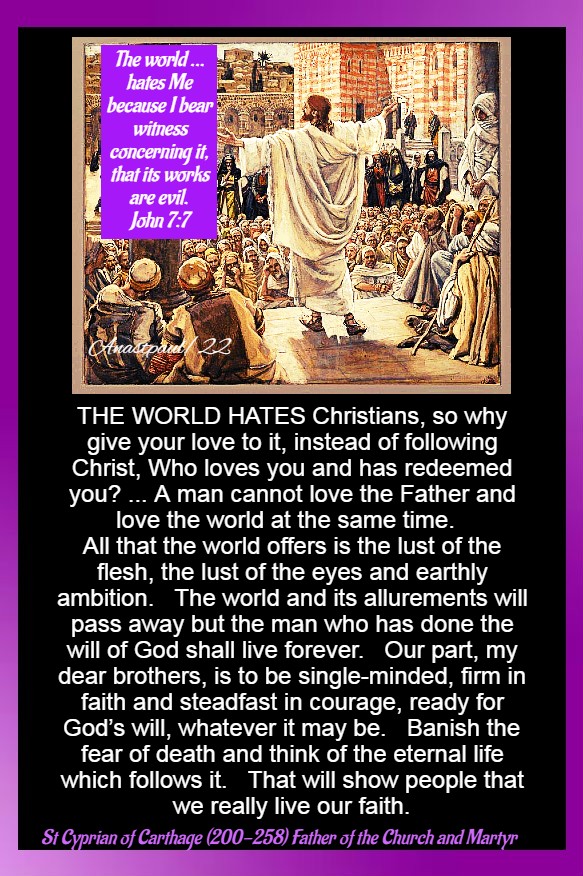
“The world … hates Me because I bear witness concerning it, that its works are evil.”
John 7:7
“… THE WORLD HATES Christians, so why give your love to it, instead of following Christ, Who Loves you and has Redeemed you? A man cannot love the Father and love the world at the same time. All that the world offers is the lust of the flesh, the lust of the eyes and earthly ambition. The world and its allurements will pass away but the man who has done the will of God shall live forever. Our part, my dear brothers, is to be single-minded, firm in faith and steadfast in courage, ready for God’s will, whatever it may be. Banish the fear of death and think of the eternal life which follows it. That will show people that we really live our faith.”
St Cyprian of Carthage (200-258) Bishop of Carthage, Martyr Father of the Church
(An excerpt from On Man’s Mortality).
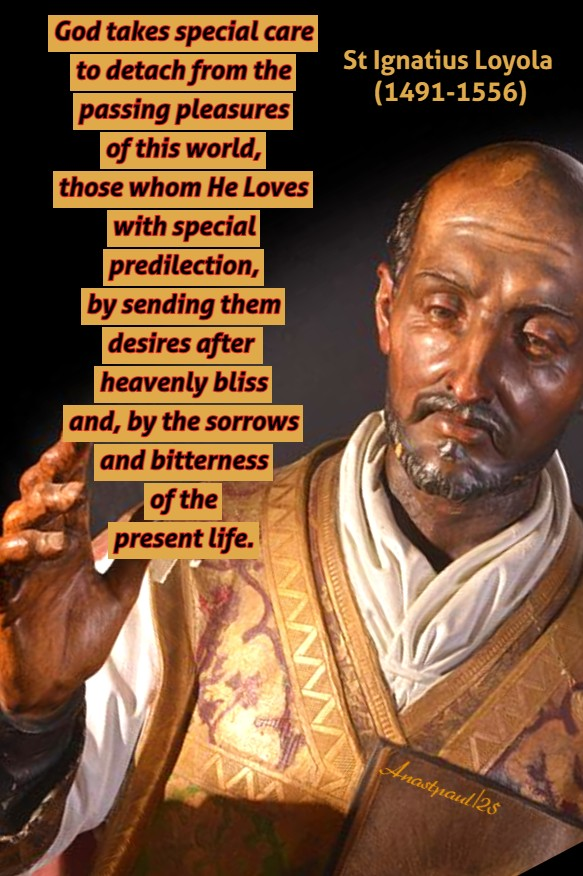
“God takes special care to detach from the passing pleasures of this world, those whom He Loves with special predilection, by sending them desires after heavenly bliss and, by the sorrows and bitterness of the present life.”
St Ignatius Loyola (1491-1556)
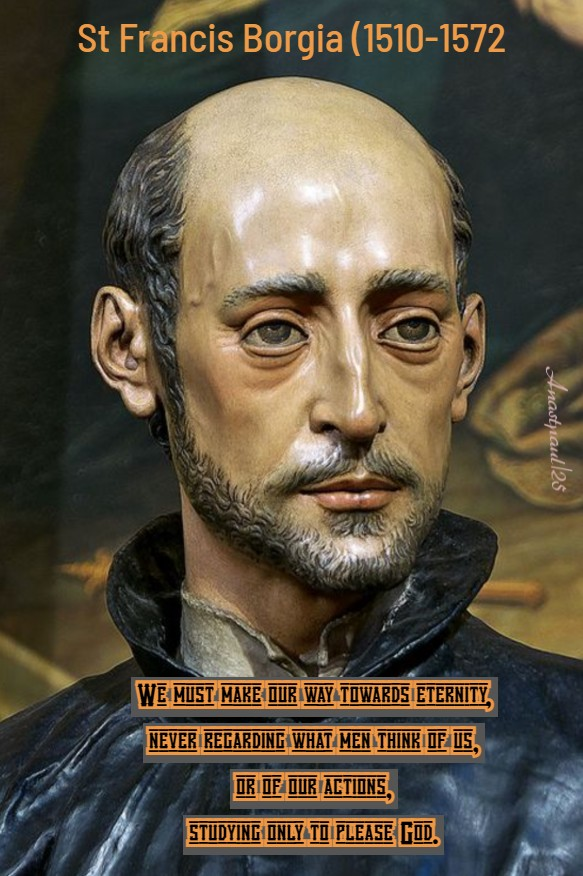
“We must make our way towards eternity, never regarding what men think of us, or of our actions, studying only to please God.”
Quote/s of the Day – 5 November – All Saints and Blesseds of the Society of Jesus (SJ)
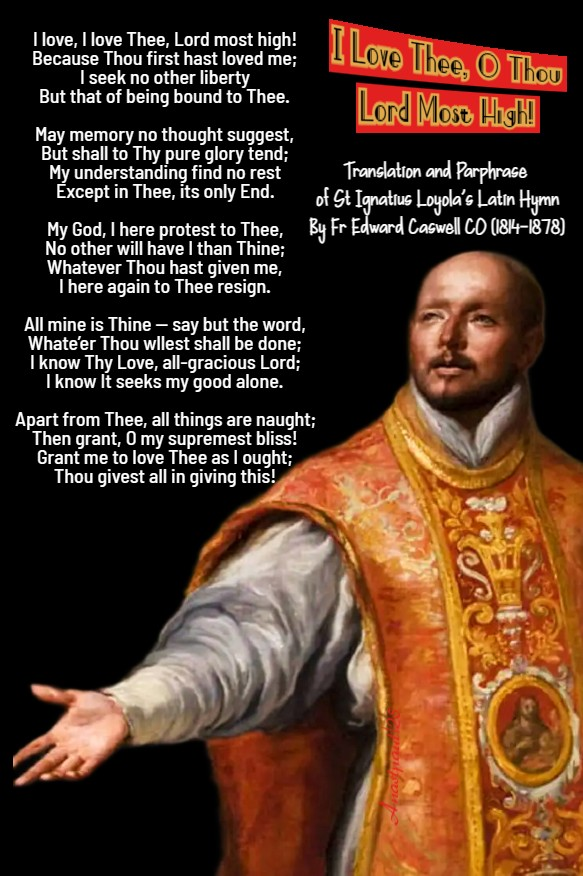
I Love Thee, O Thou Lord Most High! Translation and Parphrase of St Ignatius Loyola’s Latin Hymn By Fr Edward Caswell CO (1814-1878)
I love, I love Thee, Lord most high! Because Thou first hast loved me; I seek no other liberty But that of being bound to Thee.
May memory no thought suggest, But shall to Thy pure glory tend; My understanding find no rest Except in Thee, its only End.
My God, I here protest to Thee, No other will have I than Thine; Whatever Thou hast given me, I here again to Thee resign.
All mine is Thine — say but the word, Whate’er Thou wllest shall be done; I know Thy Love, all-gracious Lord; I know It seeks my good alone.
Apart from Thee, all things are naught; Then grant, O my supremest bliss! Grant me to love Thee as I ought; Thou givest all in giving this!
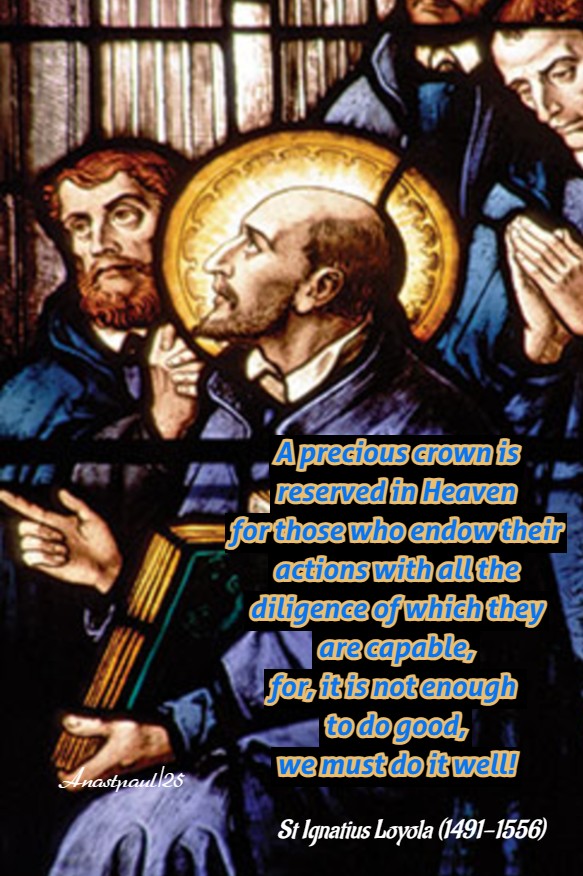
“A precious crown is reserved in Heaven for those who endow their actions with all the diligence of which they are capable, for, it is not enough to do good, we must do it well!”
“God takes special care to detach from the passing pleasures of this world, those whom He Loves with special predilection, by sending them desires after heavenly bliss and, by the sorrows and bitterness of the present life.”
St Ignatius Loyola (1491-1556)
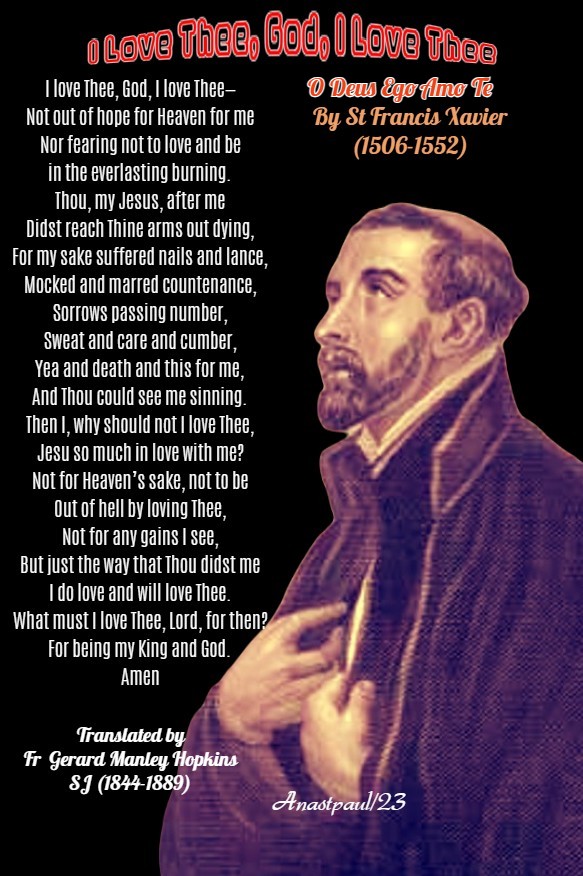
I Love Thee, God, I Love Thee O Deus Ego Amo Te By St Francis Xavier (1506-1552) Translated by Gerard Manley Hopkins SJ (1844-1889)
I love Thee, God, I love Thee— Not out of hope for Heaven for me Nor fearing not to love and be in the everlasting burning. Thou, my Jesus, after me Didst reach Thine arms out dying, For my sake suffered nails and lance, Mocked and marred countenance, Sorrows passing number, Sweat and care and cumber, Yea and death and this for me, And Thou could see me sinning. Then I, why should not I love Thee, Jesu so much in love with me? Not for Heaven’s sake, not to be Out of hell by loving Thee, Not for any gains I see, But just the way that Thou didst me I do love and will love Thee. What must I love Thee, Lord, for then? For being my King and God. Amen
“We must make our way towards eternity, never regarding what men think of us, or of our actions, studying only to please God.”
St Francis Borgia (1510-1572)
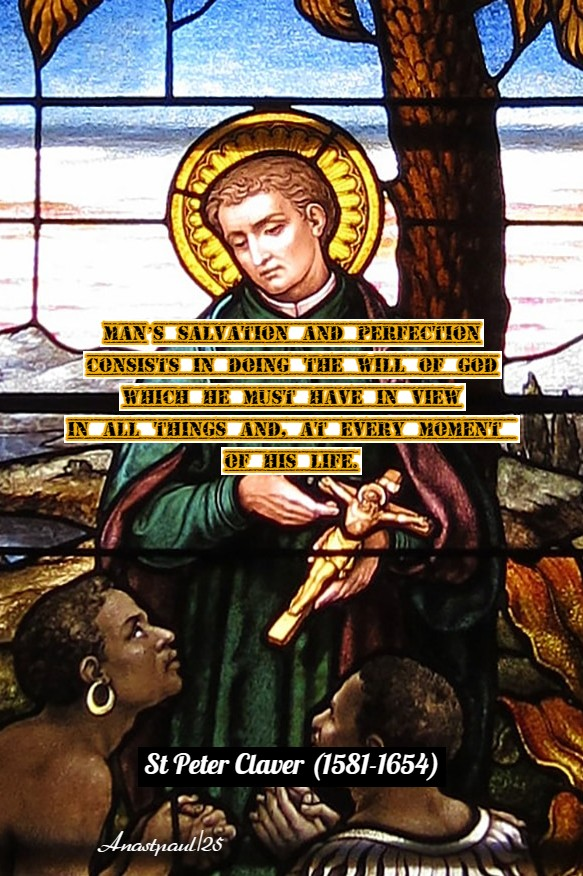
““Man’s salvation and perfection consists in doing the Will of God which he must have in view in all things and, at every moment of his life.”
St Peter Claver (1581-1654)
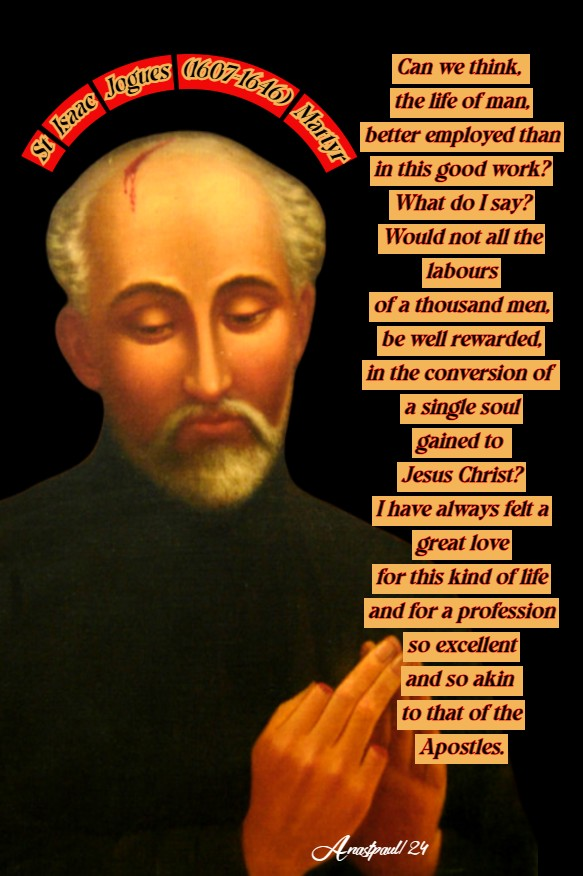
“Can we think, the life of man, better employed than in this good work? What do I say? Would not all the labours of a thousand men, be well rewarded, in the conversion of a single soul gained to Jesus Christ? I have always felt a great love for this kind of life and for a profession so excellent and so akin to that of the Apostles.”
St Isaac Jogues (1607-1646) Martyr
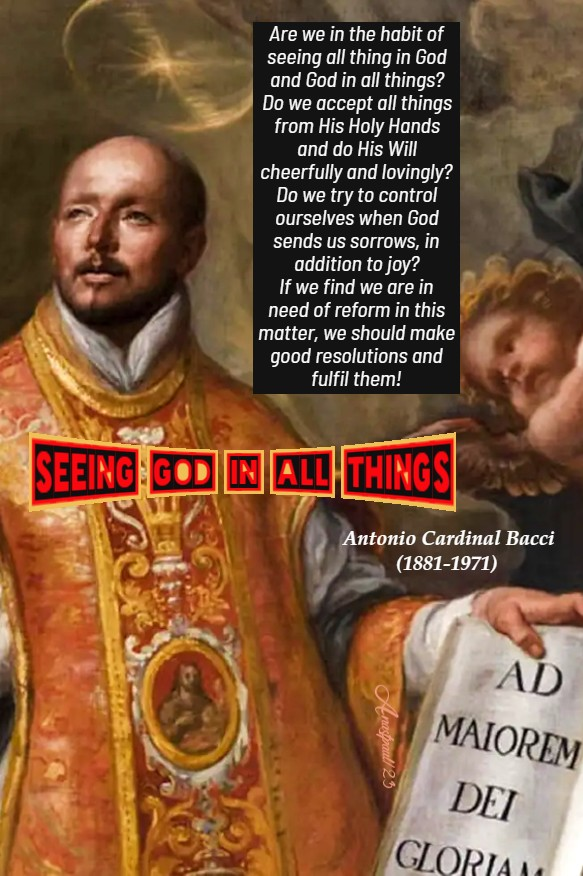
“Are we in the habit of seeing all thing in God and God in all things? Do we accept all things from His Holy Hands and do His Will cheerfully and lovingly? Do we try to control ourselves when God sends us sorrows, in addition to joy? If we find we are in need of reform in this matter, we should make good resolutions and fulfil them!”
St Aldericus St Cassius St Cerbonius (c493-575) Bishop and Confessor of Populonia in Tuscany, Italy St Cerbonius of Verona St Clarus of Nantes Bl Demestrius of Albania Bl Edward Detkens St Eulampia St Eulampius St Florentius the Martyr St Fulk of Fontenelle St Gereon St Gundisalvus Bl Hugh of Macon
Bl Pedro de Alcantara de Forton de Cascajares St Pinytus of Crete Bl Pontius de Barellis St Tanca St Teodechilde St Victor of Xanten
Martyrs of Ceuta – 7 Beati: A group of seven Franciscan Friars Minor missionaries to Muslims in the Ceuta area of modern Morocco. Initially treated as madmen, within three weeks they were ordered to convert to Islam and when they would not they were first abused in the streets, then arrested, tortured and executed. Angelo, Daniele di Calabria, Donnolo, Hugolinus, Leone, Nicola, Samuele. They were beheaded in 1227 in Mauritania Tingitana (Ceuta, Morocco). Local Christians secreted the bodies away and gave them proper burial in Ceuta. They were Beatified in 1516 by Pope Leo X.
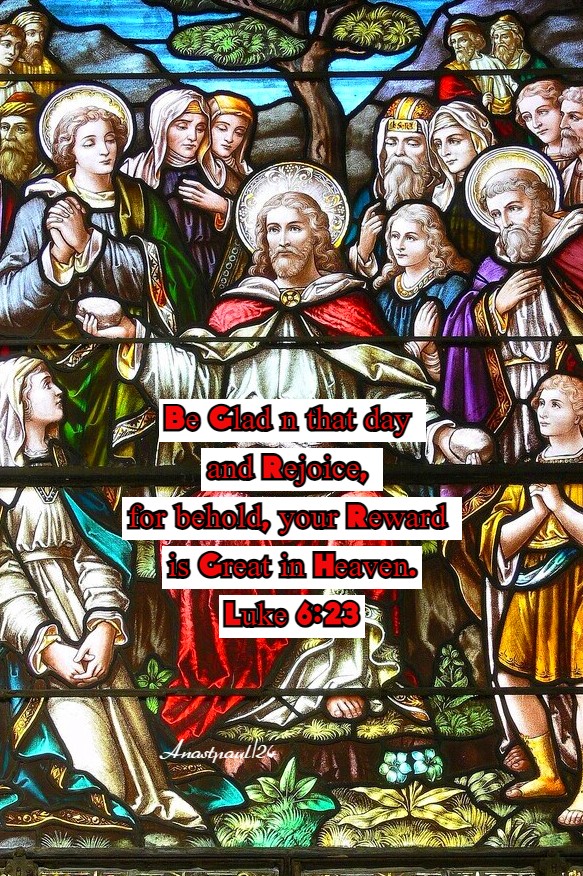
Quote/s of the Day – 27 September – Saints Cosmas and Damian (Died c 286 ) Martyrs – Wisdom 5:16-20; Luke 6:17-23 – Scripture search here: https://www.drbo.org/
“Be glad in that day and rejoice, for behold, your reward is great in Heaven,”
Luke 6:23
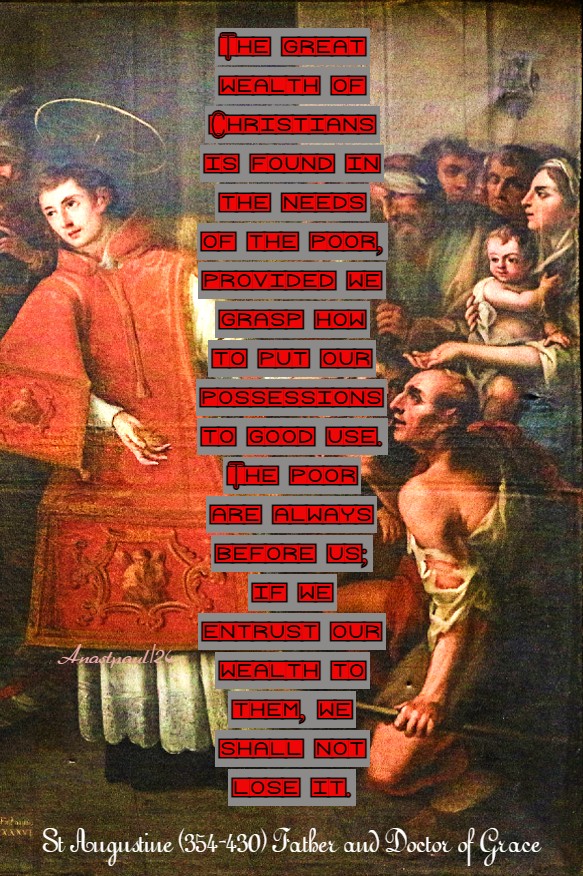
“The great wealth of Christians is found in the needs of the poor, provided we grasp how to put our possessions to good use. The poor are always before us; if we entrust our wealth to them, we shall not lose it.”
St Augustine (354-430) Father and Doctor of Grace
“The one who walks in the love of God seeks neither gain nor reward but seeks only, with the will, to lose self and all things, for God and this loss, the lover judges to be a gain! ”
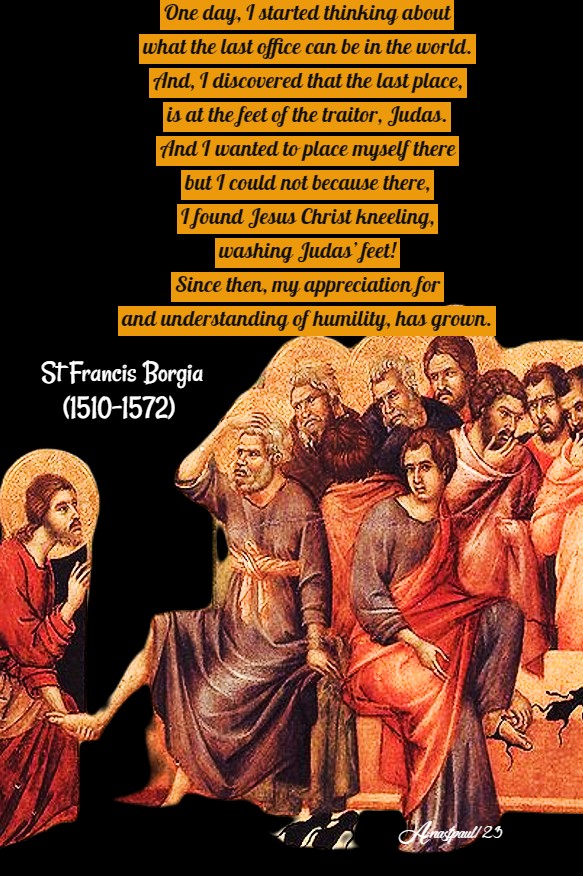
“One day, I started thinking about what the last office can be in the world. And, I discovered that the last place, is at the feet of the traitor, Judas. And I wanted to place myself there but I could not because there, I found Jesus Christ kneeling, washing Judas’ feet! Since then, my appreciation for and understanding of humility, has grown.”
Thought for the Day – 2 September – Meditations with Saint Alphonsus Maria de Liguori (1696-1787) Bishop, Confessor, Most Zealous Doctor of the Church
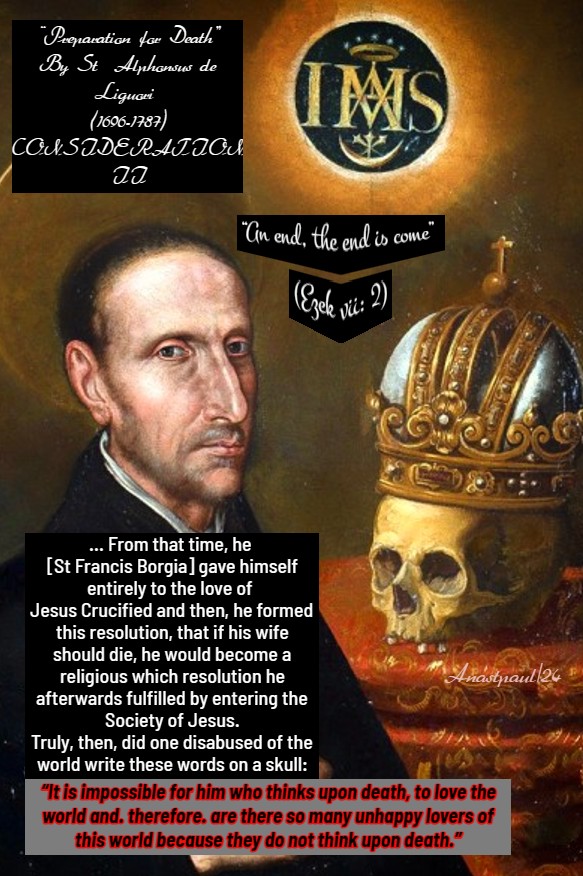
“Preparation for Death” By St Alphonsus Maria de Liguori (1696-1787)
CONSIDERATION II
“An end, the end is come.” (Ezek vii: 2)
THIRD POINT: David likened the happiness of this present life to a dream, -when one awakens: “Yea, even like as a dream, when one awaketh.” (Ps Ixxiii: 19) . A certain author observes: “In a dream, the senses being at rest, great things appear and are not and quickly vanish away. ” The goods of this world appear great but in truth, they are nothing, like sleep, they last but a short time and then they all vanish away.
This thought, namely, that all things end with death, made St Francis Borgia give himself up entirely to God. This Saint was obliged to accompany the body of the Empress Isabella to Granada. When the coffin was opened, all those present fled because of the dreadful sight and smell but St Francis, led by Divine Light, remained to contemplate, in that body, the vanity of the world and looking upon it, he said: “Art thou then my empress? Art thou that great one to whom so many great ones bowed the knee? O my mistress, Isabella, where is now thy majesty and thy beauty? Even thus,” he concluded within himself, “do the grandeurs and the crowns of this world end. From this day forward, I will, therefore, serve a Master Who can never die!” Therefore, from that time, he gave himself entirely to the love of Jesus Crucified and then, he formed this resolution, that if his wife should die, he would become a religious which resolution he afterwards fulfilled by entering the Society of Jesus. Truly, then, did one disabused of the world write these words on a skull: “It is impossible for him who thinks upon death, to love the world and. therefore. are there so many unhappy lovers of this world because they do not think upon death.”
“O ye sons of men, how long will ye blaspheme mine honour and have such pleasure in vanity and seek after pleasing?” (Ps iv: 2) O miserable children of Adam, the Holy Ghost warns us. why, therefore, do you not drive away from your hearts, that affection for the world which causes you to love vanity and deceit? That which happened to your forefathers will one day happen to you, they, at one time were living in the same houses and many slept upon the same beds which you do now but now they are no more – the same will happen to you.
Therefore, my brother, give thyself now to God, before death shall come to Thee. “Whatsoever thy hand findeth to do, do it with thy might”(Eccles ix: 10) . Whatsoever thou canst do to-day, do it and wait not until to-morrow because this day will pass away and will never return and to-morrow death might overtake you, so that you would then be able to do nothing at all. Quickly remove yourself from all that separates, or that may separate you from God. Let us now give up all our love for this world’s goods, before death takes them away from us by force! “Blessed are the dead, who die in the Lord.” (Rev xiv:13). Blessed are those, who, when dying, are found dead to the affection o fthis world. By such as these, death is not feared, it is desired, it is joyfully embraced, for instead of separating them from all that they love, it then unites them to their Sovereign Good, Who is alone loved by them and Who, will make them blessed for evermore.
Affections andPrayers
My dear Redeemer, I indeed thank Thee for having waited for me. What would have become of me if I had died when I was far from Thee? Forever blessed be Thy mercy and Thy patience which Thou hast exercised towards me, during the many years past. I thank Thee for the light and grace with which Thou dost now assist me. At one time I did not love Thee and then, I cared little for being loved by Thee.
Now, I love Thee, with all my heart and now, I have no greater grief, than what I feel, for having once displeased a God so gracious. This grief torments me but the torment is sweet because, this grief gives me confidence that Thou hast indeed pardoned me. My sweet Saviour, would that I had died over and over again, rather than once even, to have given Thee offence. I tremble and fear, lest at any time, I should ever again displease Thee. Ah, rather let me die a most painful death, than that I should ever again lose Thy grace. Once I was the slave of hell but now, I am Thy servant, O God of my soul.
Thou hast said that Thou wilt love those who love Thee. I love them who love me. I do love Thee, therefore, Thou art mine and I am Thine. I might lose Thee at some time but this is the grace which I seek, namely, it would be better for me to die, than to lose Thee again. Thou hast given me so many graces that I have not asked Thee. for, therefore, I cannot fear that Thou wilt fail to grant me this grace, for which I am now asking Thee.
Never again let me lose Thee; give me Thy holy Love and nothing more can I desire!
Thought for the Day – 29 July – Meditations with Fr Richard Frederick Clarke SJ (1839-1900)
HUMILITY Meditations for a Month
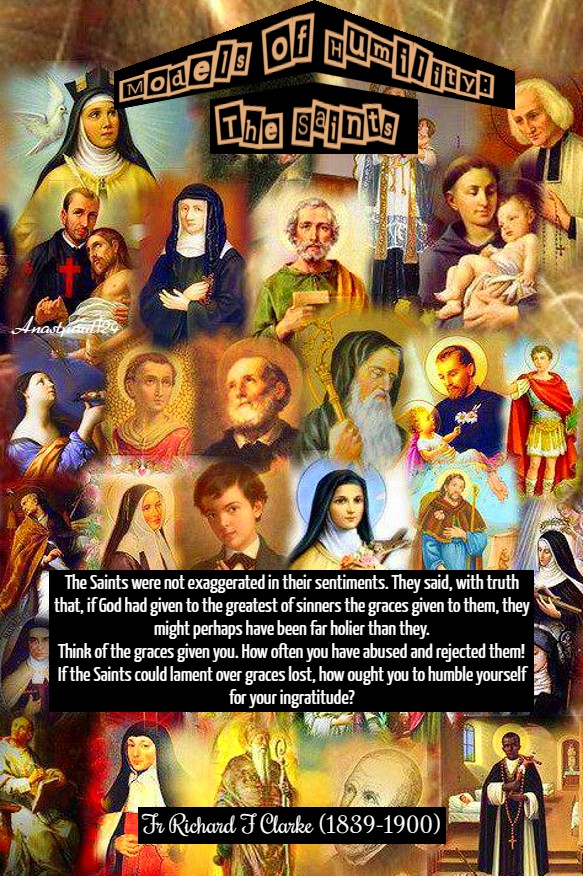
Models of Humility: The Saints
Some Saints excelled in one virtue, some in another but all were pre-eminent in humility. The heroes of the Church of God, whether under the Old or the New Dispensation, were marked off from the heroes of paganism by their humility. Thus, Abraham described himself as dust and ashes. Job, in the presence of God, expressed his abhorrence of himself. David, when visited by the Hand of God, thanks Him for having humbled him. Daniel declares that to him belongs shame and confusion of face. If, even without the example of Jesus and Mary before them, these Saints were so humble, what ought you to be? !
The Saints of the New Testament are still more conspicuous for their humility. Saint Paul believed and declared himself to be the chief of sinners. Saint Bernard expressed his astonishment that God should work miracles by the hands of one so vile as he. Saint Dominic, before entering a City, used to pray that he might not bring down judgements upon it for his sins. Saint Philip Neri used to invent ingenious methods of drawing down ridicule upon himself! Saint Francis Borgia, when someone by accident, spat in his face, merely remarked that he could not have found a more suitable place to spit upon. Compare the humility of these saints with your pride and humble yourself before God.
The Saints were not exaggerated in their sentiments. They said, with truth that, if God had given to the greatest of sinners the graces given to them, they might perhaps have been far holier than they. Think of the graces given you. How often you have abused and rejected them! If the Saints could lament over graces lost, how ought you to humble yourself for your ingratitude?
Quote/s of the Day – 2 April – “The Month of the Resurrection and the Blessed Sacrament” – Easter Tuesday
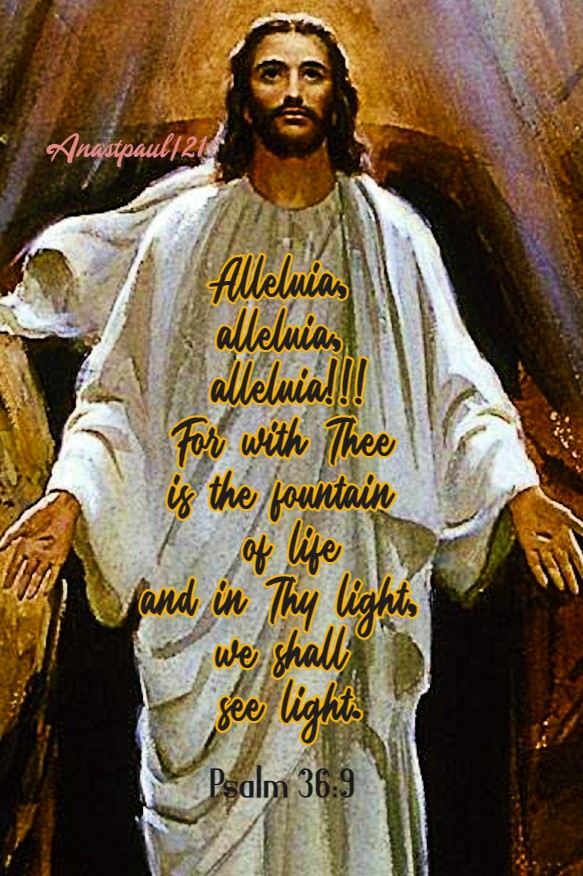
“Alleluia, alleluia, alleluia!!! For with thee is the fountain of life and in Thy Light, we shall see light.”
Psalm 36:9
“Do we, then, regard it as a great and marvellous thing, for the Creator of all things, to bring about the resurrection of those, who have served Him with holiness, in the assurance of a good faith?… With this hope, then, let our souls be bound to Him Who is faithful, to His promises and upright in His judgements. He, Who has commanded us not to lie will much more not lie Himself. For nothing is impossible to God except lying (Jn 32:17; Lk 1:37; 6:18).” (Letter to the Corinthians, #24-28)
St Pope Clement I (c35-c99) Pope from about 90 to 99 Apostolic Father
“Let us listen to the holy Voice of God which summons us from on high, from the holy mountain top. There, we must hasten – I make bold to say – like Jesus, Who is our leader and has gone before us into Heaven. There, with Him, may the eyes of our mind shine with His light and the features of our soul be made new; may we be transfigured with Him and moulded to His image, ever becoming divine, being transformed in an ever greater degree of glory.”
St Anastasius Sinaita (Died 6th Century) Priest and Abbot
“We must make our way towards eternity, never regarding what men think of us, or of our actions, studying only to please God.”
We know that there is only ONE thing necessary and so, for this New Year, 2024, I wish you only that ONE THING – that HE may fill your heart, your mind, your soul, your whole being, everyday and every moment and then, nothing will be wanting to you, ALL will be yours and even sadness and pain will serve only to unite you more and more closely to our Divine Saviour. And so, abiding in His Sacred Heart, 2024 will be PERFECT!
“We must make our way towards eternity, never regarding what men think of us, or of our actions, studying only to please God.”
St Francis Borgia (1510-1572)
The One Thing Necessary By St Alphonsus Maria de Liguori (1696-1787) Most Zealous Doctor
O my God, help me to remember, that time is short, eternity long. What good is all the greatness of this world at the hour of death? To love Thee, my God and save my soul is the one thing necessary. Without Thee, there is no peace of mind or soul. My God, I need fear only sin and nothing else in this life, for to lose Thee, my God, is to lose all. O my God, help me to remember, that I came into this world with nothing and shall take nothing from it, when I die. To gain Thee, I must leave all. But in loving Thee, I already have all good things – the infinite riches of Christ and His Church in life, Mary’s motherly protection and perpetual help and the eternal dwelling place Jesus has prepared for me. Eternal Father, Jesus has promised that whatever we ask in His Name will be granted us. In His Name, I pray, give me a burning faith, a joyful hope, a holy love for Thee. Grant me perseverance in doing Thine will and never let me be separated from Thee. My God and my All, make me a Saint! Amen
Quote/s of the Day – 25 November – Sirach 51:1-8; 5:12, Matthew 25:1-13 – Scripture search here: https://www.drbo.org/
“Behold, the Bridegroom is coming, go forth to meet Him!” Matthew 25:6
“He worked and struggled as our Champion against our enemies, broke open the bars of our prison, won the struggle, vanquished our death through His Own, redeemed us through His Blood, freed us through His water in Baptism and made us rich, through His Sacraments and His gifts, so that, as He says in the Gospel (Mt 25:6), we might “go out” with all virtues to, “meet Him” in the palace of His glory and enjoy Him forever in eternity.”
Bl Jan van Ruysbroeck (1293-1381)
“So, my brothers, let us pray as God our master has taught us. To ask the Father in words His Son has given us, to let Him hear the prayer of Christ ringing in His ears, is to make our prayer one of friendship, a family prayer. Let the Father recognise the words of His Son. Let the Son who lives in our hearts, be also on our lips. We have Him as an Advocate for sinners, before the Father, when we ask for forgiveness for ours sins, let us use the words given by our Advocate. He tells us – Whatever you ask the Father in my name, He will give you. What more effective prayer could we then make, in the name of Christ, than in the words of His own prayer?”
An excerpt from St Cyprian’s Treatise On the Lord’s Prayer
St Cyprian of Carthage (c 200-258) Martyr, Bishop of Carthage, Father of the Church
“Carry me, O Christ, on Thy Cross which is salvation to the wanderer, rest for the wearied and, in which alone, is Life for those who die.”
St Ambrose (340-397) Father and Doctor of the Church
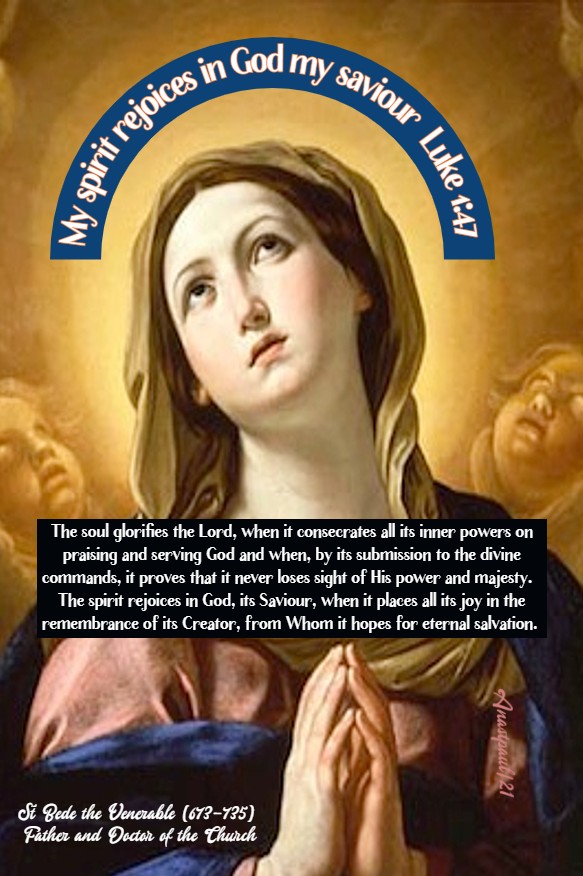
“The soul glorifies the Lord, when it consecrates all its inner powers on praising and serving God and when, by its submission to the Divine commands, it proves that it never loses sight of His Power and Majesty. The spirit rejoices in God, its Saviour, when it places all its joy in the remembrance of its Creator, from Whom it hopes for eternal salvation.”
St Bede the Venerable (673-735) Father and Doctor of the Church
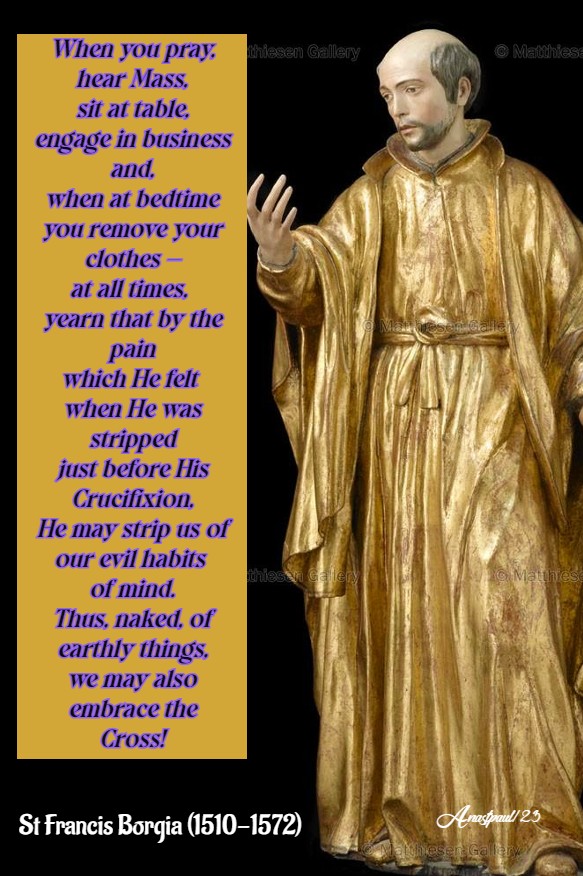
“When you pray, hear Mass, sit at table, engage in business and, when at bedtime you remove your clothes— at all times, yearn that by the pain which He felt when He was stripped just before His Crucifixion, He may strip us of our evil habits of mind. Thus, naked, of earthly things, we may also embrace the Cross!”
St Francis Borgia SJ (1510-1572)
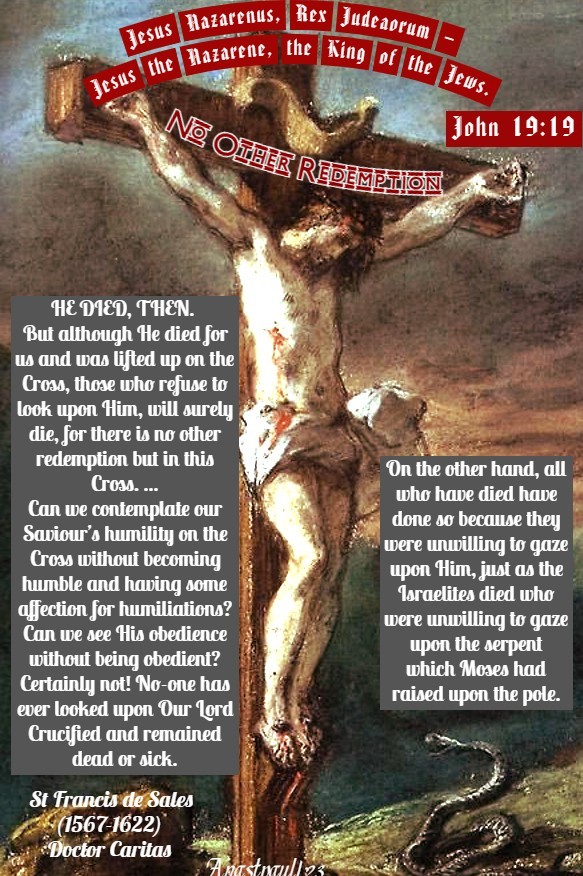
“Jesus Nazarenus, Rex Judeaorum – Jesus the Nazarene, the King of the Jews.” John 19:19
“HE DIED, THEN But although He died for us and was lifted up on the Cross, those who refuse to look upon Him, will surely die, for there is no other redemption but in this Cross.
O God, how spiritually beneficial and profitable is a consideration of Thy Cross and Passion! Can we contemplate our Saviour’s humility on the Cross, without becoming humble and, having some affection for humiliations? Can we see His obedience, without being obedient? Certainly not! No-one has ever looked upon Our Lord Crucified and remained dead or sick. On the other hand, all who have died, have done so because. they were unwilling to gaze upon Him, just as the Israelites died. who were unwilling to gaze upon the serpent which Moses had raised upon the pole.”
Quote/s of the Day – 5 November – All Saints and Blesseds of the Society of Jesus (SJ)
“True humility consists in persuading and convincing oneself that without God, we are insignificant and despicable and, in accepting to be treated as such!”
St Ignatius Loyola SJ (1491-1556)
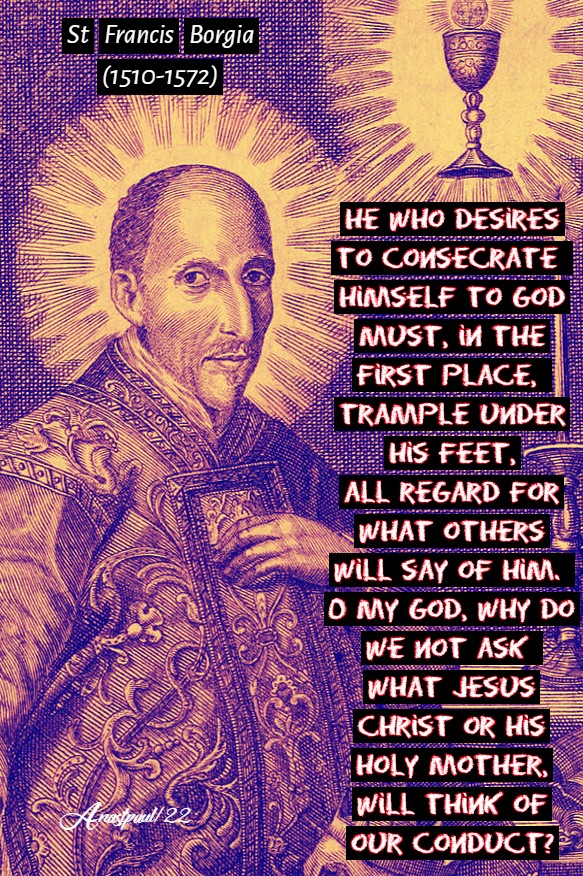
“He who desires to consecrate himself to God must, in the first place, trample under his feet, all regard for what others will say of him. O my God, why do we not ask what Jesus Christ or His holy Mother, will think of our conduct?”
St Francis Borgia SJ (1510-1572)
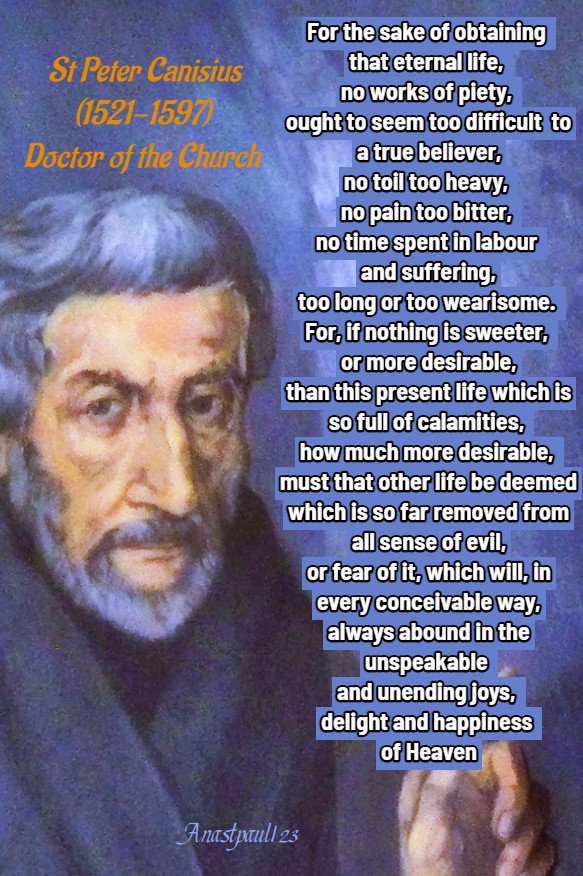
“For the sake of obtaining that eternal life, no works of piety, ought to seem too difficult to a true believer, no toil too heavy, no pain too bitter, no time spent in labour and suffering, too long or too wearisome. For, if nothing is sweeter, or more desirable, than this present life which is so full of calamities, how much more desirable, must that other life be deemed which is so far removed from all sense of evil, or fear of it, which will, in every conceivable way, always abound in the unspeakable and unending joys, delight and happiness of Heaven.”
St Peter Canisius SJ (1521-1597) Confessor, Doctor of the Church
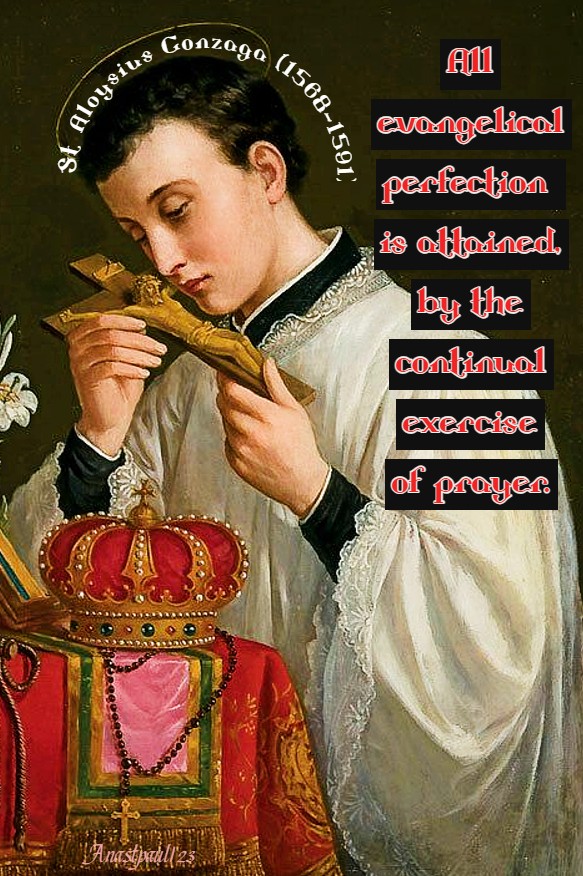
“All evangelical perfection is attained, by the continual exercise of prayer.”
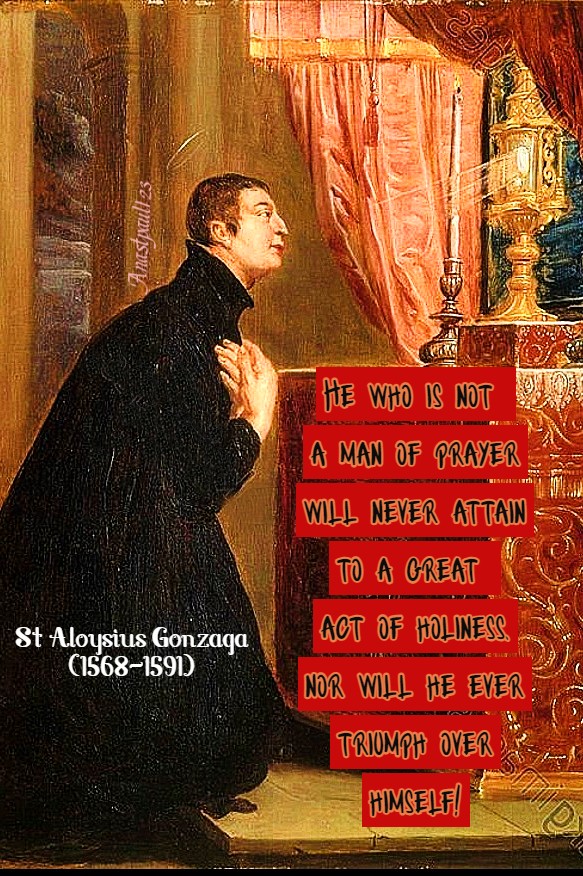
“He who is not a man of prayer will never attain to a great act of holiness, nor will he ever triumph over himself!”
St Aloysius Gonzaga SJ (1568-1591)
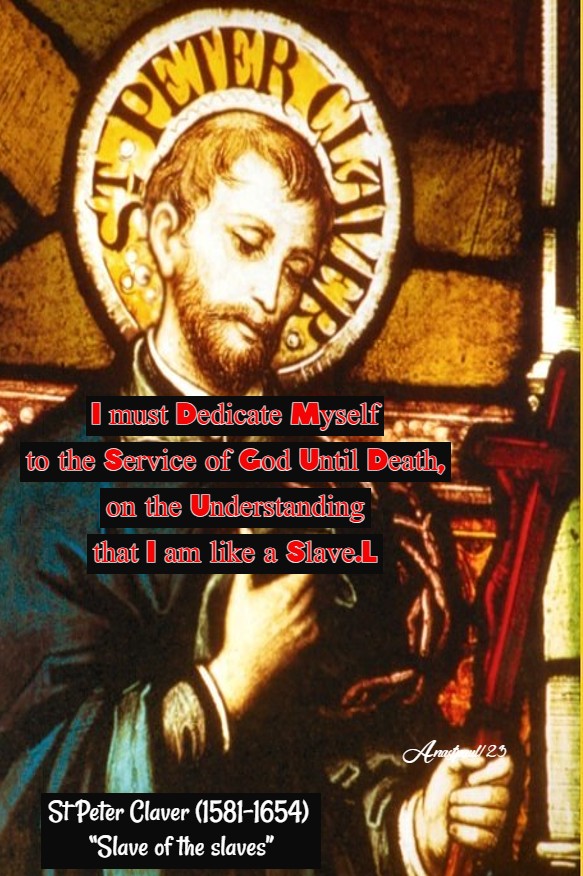
“I must dedicate myself to the service of God until death, on the understanding that I am like a slave.”
St Peter Claver SJ (1581-1654)
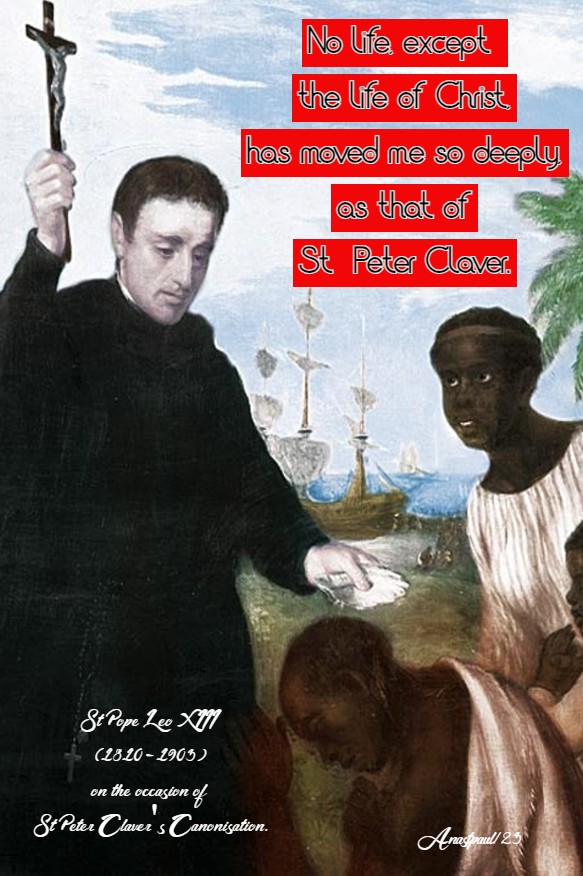
“No life, except the life of Christ, has moved me so deeply, as that of Peter Claver.”
St Pope Leo XIII (1810-1903) on the occasion of St Peter Claver’s Canonisation.
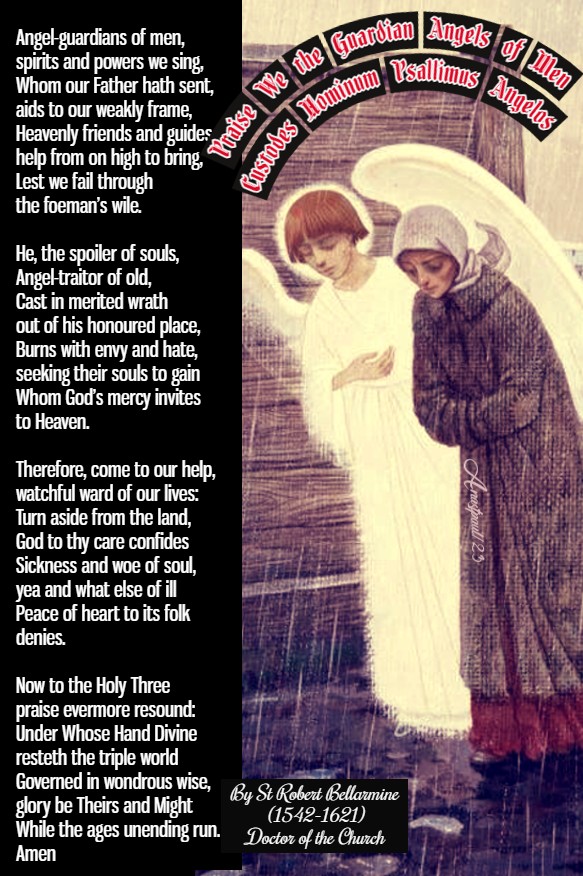
Custodes Hominum Psallimus Angelos Praise We the Guardian Angels of Men By St Robert Bellarmine SJ (1542-1621) Archbishop of Capua, Theologian Doctor of the Church
Angel-guardians of men, spirits and powers we sing, Whom our Father hath sent, aids to our weakly frame, Heavenly friends and guides, help from on high to bring, Lest we fail through the foeman’s wile.
He, the spoiler of souls, Angel-traitor of old, Cast in merited wrath out of his honoured place, Burns with envy and hate, seeking their souls to gain Whom God’s mercy invites to Heaven.
Therefore, come to our help, watchful ward of our lives: Turn aside from the land, God to thy care confides Sickness and woe of soul, yea and what else of ill Peace of heart to its folk denies.
Now to the Holy Three praise evermore resound: Under Whose Hand Divine resteth the triple world Governed in wondrous wise, glory be Theirs and Might While the ages unending run. Amen
This Hymn by St Robert Bellarmine,was added to the Roman Breviary in 1608, by command of Pope Paul V. It is for Vespers in the Office for “the Holy Guardian Angels. Double of the second class, 2 October.
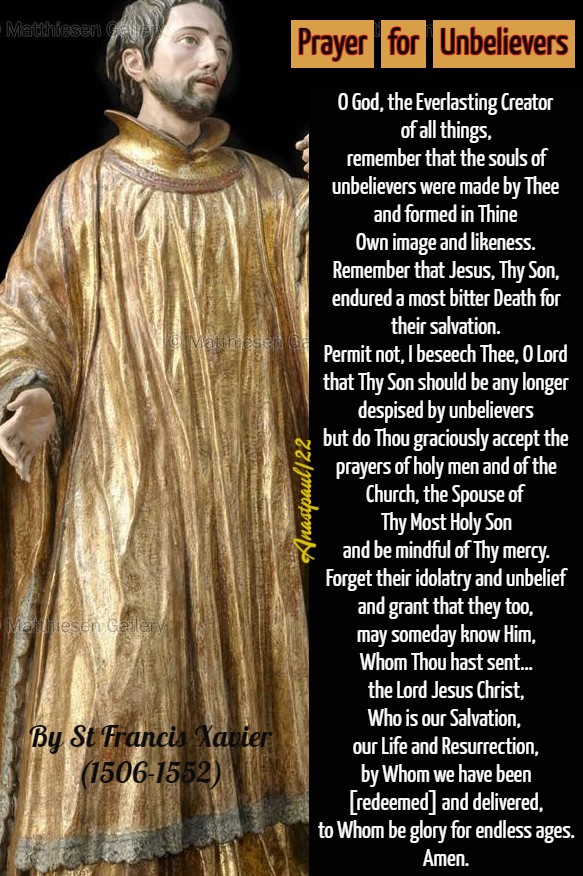
Prayer for Unbelievers By St Francis Xavier (1506-1552)
O God, the Everlasting Creator of all things, remember that the souls of unbelievers were made by Thee and formed in Thine own image and likeness. Remember that Jesus, Thy Son, endured a most bitter Death for their salvation. Permit not, I beseech Thee, O Lord that Thy Son should be any longer despised by unbelievers but do Thou graciously accept the prayers of holy men and of the Church, the Spouse of Thy Most Holy Son and be mindful of Thy mercy. Forget their idolatry and unbelief and grant that they too, may someday know Him, Whom Thou hast sent…the Lord Jesus Christ, Who is our Salvation, our Life and Resurrection, by Whom we have been [redeemed] and delivered, to Whom be glory for endless ages. Amen.
Quote/s of the Day – 10 October – St Francis Borgia SJ (1510-1572) Confessor
“When you pray, hear Mass, sit at table, engage in business and, when at bedtime you remove your clothes— at all times, yearn that by the pain which He felt when He was stripped just before His Crucifixion, He may strip us of our evil habits of mind. Thus, naked, of earthly things, we may also embrace the Cross!”
“What is it, my soul, that I seek in the world? How long shall I pursue and grasp at shadows? What is she already become, who was lately so beautiful, so great, so much revered? This death which has thus treated the imperial diadem, has already levelled his bow to strike me. Is it not prudent, to prevent its stroke, by dying now to the world that, at my death. I may live to God?”
One Minute Reflection – 10 October – “The Month of the Most Holy Rosary and of the Angels” – St Francis Borgia SJ (1510-1572) Confessor, Priest of the Society of Jesus, – Ecclesiasticus 45:1-6, Matthew 19:27-29 – Scripture search here: https://www.drbo.org/
“And everyone who has left house, or brethren, or sisters, or father, or mother, or wife, or children, or lands, for My Name’s sake, shall receive a hundredfold and shall possess life everlasting.” – Matthew 19:29
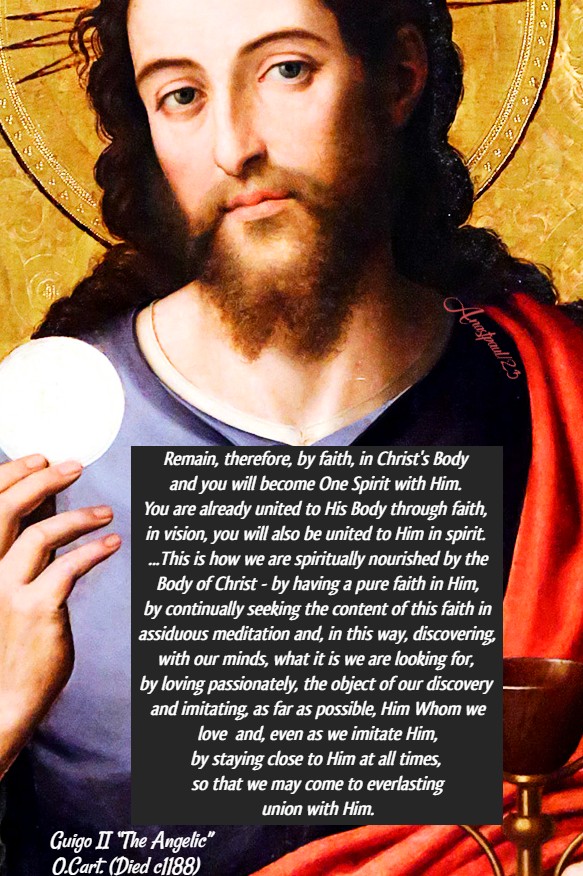
REFLECTION – “We must follow Christ, cleaving to Him, nor should we forsake Him until we die. As Elisha said to his master: “ As the Lord lives and as you yourself live, I will not leave you ” (2 Kgs 2:2) … So, let us follow Christ and stay close to Him! “To be near God is my good” says the Psalmist (72:28). “ My soul clings fast to Thee; Thy right hand upholds me ” (Ps 62:9). And Saint Paul adds : “ Whoever is joined to the Lord becomes One Spirit with Him ” (1 Cor 6:17). Not just One Body but One Spirit. His whole body lives from the Spirit of Christ through the Body of Christ, we attain to the Spirit of Christ. Remain, therefore, by faith, in Christ’s Body and you will become One Spirit with Him. You are already united to His Body through faith, in vision, you will also be united to Him in spirit. Not that we shall see without a body when we are above but our bodies will be spiritual (1 Cor 15:44).
“Father,” Christ said : “I pray that they may all be one, as Thou, art in Me and I in Thee, that the world may believe” this is what union through faith is. And later He asks: “” this is union through vision.
This is how we are spiritually nourished by the Body of Christ – by having a pure faith in Him, by continually seeking the content of this faith in assiduous meditation and, in this way, discovering, with our minds, what it is we are looking for, by loving passionately, the object of our discovery and imitating, as far as possible, Him Whom we love and, even as we imitate Him, by staying close to Him at all times, so that we may come to everlasting union with Him.” – Guigo II “The Angelic” O.Cart. (Died c1188) The 9th Prior of Grande Chartreuse, from 1174 to 1180 (Meditation 10).
PRAYER – O Lord Jesus Christ, model of true humility and its reward, we beseech Thee, that as Thou made blessed Francis one of Thy glorious imitators, by his contempt for earthly honours, grant us to follow his example and to share in his glory.Through the same Jesus Christ, Thy Son our Lord, Who lives and reigns with Thee, in the unity of the Holy Ghost, God, world without end. Amen (Collect).
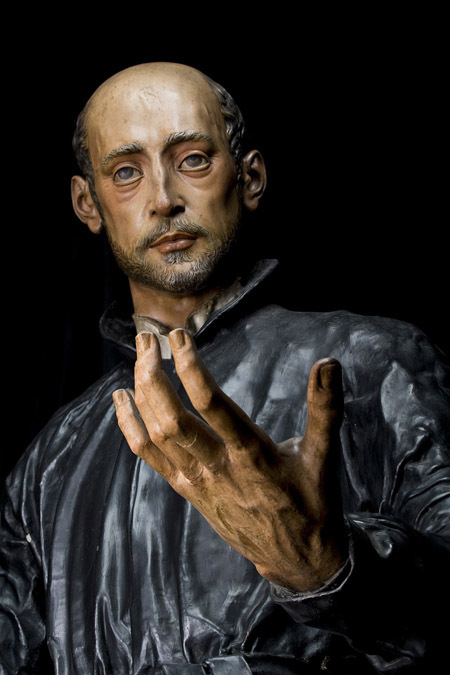
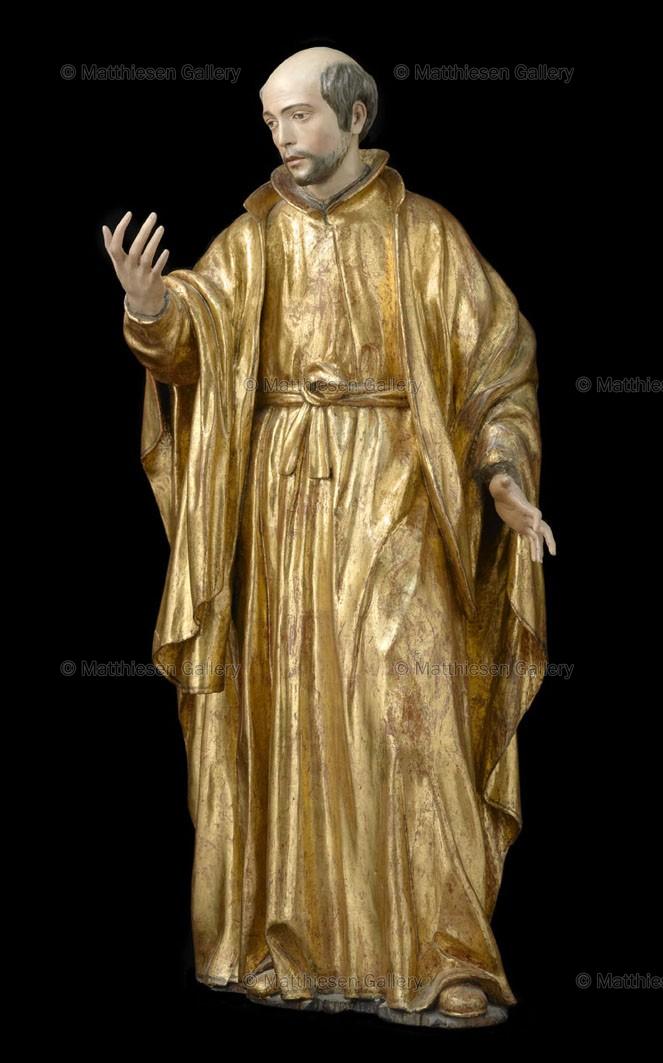
Saint of the Day – 10 October – St Francis Borgia SJ (1510-1572) Confessor, Priest of the Society of Jesus, Advisor, Missionary, Evangelist, Administrator par excelleance. Francisco de Borja y Aragon was the 4th Duke of Gandía, was a Grandee of Spain, a Spanish Jesuit and third Superior General of the Society of Jesus
A continuation of the life of St Francis Borgia – an entire year has slipped by, for which I should apologise, however, each day brings its own duties to the Saints being venerated on that particular day. Time runs away … Let us continue with a little more from Fr Alban Butler (1711-1773) who wrote his portrayal of our Saint from:
“The life, compiled by Fr Ribadeneira, who was for nine years, his Confessor, is the master-piece of that pious author, who, by his acquaintance with the holy man and his own experience in an interior life, was excellently qualified to animate, in his expression, the narrative of the actions of the Saint with that spirit with which they were performed.”
We continue – ST FRANCIS at COURT and his MARRIAGE until the DEATH of the EMPRESS – his “DAMASCUS MOMENT”:
Francis, although he delighted chiefly in the company of the most virtuous, was courteous and obliging to all, never spoke ill of anyone, nor ever suffered others to do it in his presence.
He was a stranger to envy, ambition, gallantry, luxury and gaming – vices which are often too fashionable in Courts and against which he armed himself with the utmost precaution. He not only never played but would never see others playing, saying that a man commonly loses by it four things – his money, his time, the devotion of his heart to God and his conscience.
One of his servants discovered, that on the days on which he was obliged to visit company in which ladies made a part, he wore a hair-shirt. In him it appeared, that there is no readier way to gain the esteem of men, though without seeking it, than by the heroic practice of Christian virtue. Nothing is so contemptible even amongst men of the world, as insolence, pride, injustice, or anger; nothing so hateful as one who loves nobody but himself, refers everything to himself and makes himself the centre of all his desires and actions.
Nor is there anything more amiable than a man who seeks not himself but refers himself to God and seeks and does all things for God, and the service of others; in which Christian piety consists. The wicked themselves, find no more solid comfort or protection in affliction, than the friendship of such a person; even those who persecute him,because his virtue is a censure of their irregularities, nevertheless admire in their breasts that sincere piety which condemns them. This is more conspicuous when such a virtue shines forth in an exalted station. It is not, therefore, to be wondered that Francis was honoured and beloved by all the Court, particularly by the Emperor, who called him the miracle of Princes!
… The Empress had so great an esteem for him and so high an idea of his merit, that she fixed her eye on him to marry Eleanor de Castro, a Portuguese lady of the first rank, a person of great piety and accomplishments, her principal favourite, who had been educated with her and whom, she had brought with her out of Portugal. The marriage was solemnised in the most Christian manner, to which state the Saint brought the best preparation – innocence of life with unsullied purity and an ardent spirit of religion and devotion. The Emperor on that occasion created him Marquis of Lombay and Master of the Horse to the Empress and having had experience of his wisdom, secrecy and fidelity, not only admitted him into his Privy-Council but took great delight in conferring, often privately, with him upon his most difficult undertakings and communicated to him his most important designs. …
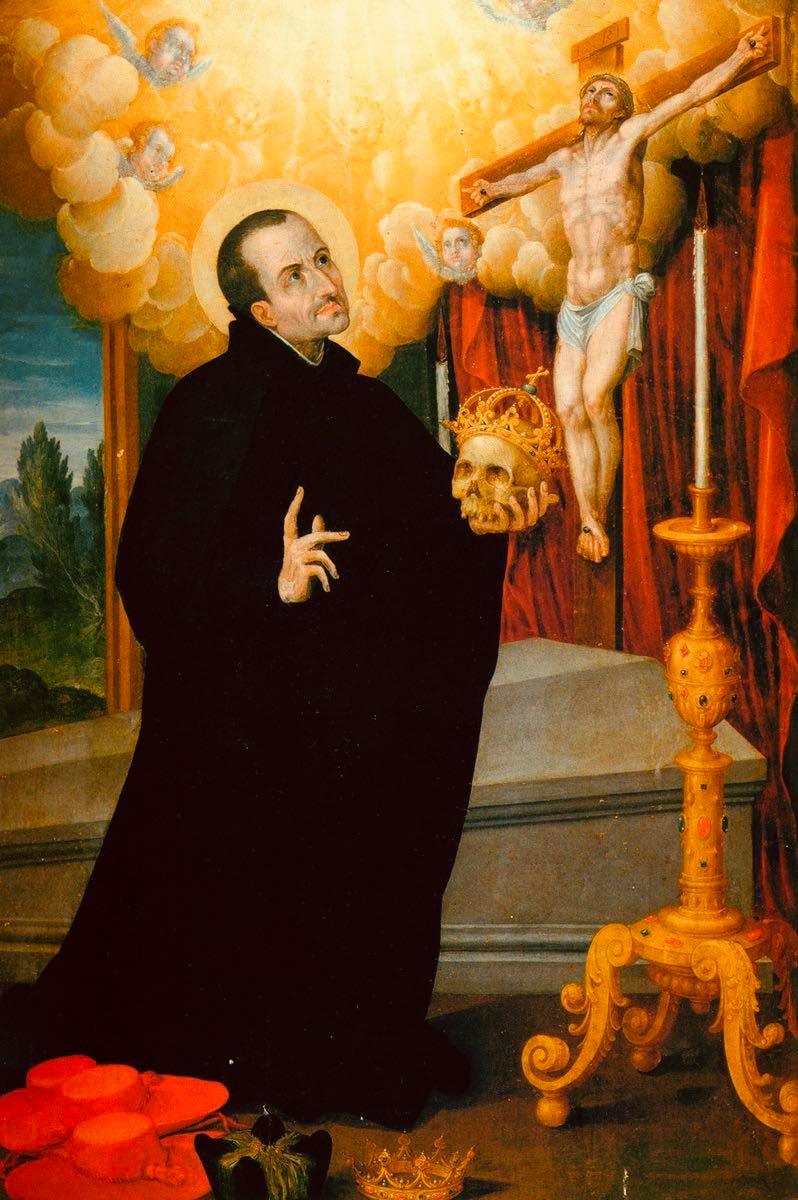
Cristobal de Villalpando, Portrait of St. Francis Borgia , c1690
In 1537, being at the Court, which was then at Segovia, he fell ill of a dangerous quinsy, in which he never ceased praying in his heart, though he was not able to pronounce the words. These accidents were Divine graces which weaned Francis, daily more and more, from the world; although, whilst it smiled upon him, he saw the treachery, the shortness and the dangers of its flattering enjoyments, through that gaudy flash, in which it danced before his eyes.
… God blessed his marriage with a numerous and happy offspring – five boys and three girls: Charles, the eldest, who was Duke of Gandia, when Ribadeneira wrote the life of ourSaint; Isabel, John, Alvarez, Johanna, Fernandez, Dorothy and Alphonsus. Dorothy died young as a Poor Clare at Gandia; the rest all married, enjoyed different titles and posts of honour,and left families behind them.
St Francis was much affected, in 1537, by the death of his intimate friend, the famous poet, Garcilas de Vega, who was killed at the siege of a castle in Provence. The death of the pious Empress Isabel, happened two years after, on the 1st of May, 1539, whilst the Emperor was holding the states of Castile at Toledo, with the utmost pomp and magnificence. His majesty was much afflicted by the loss of so virtuous a consort. The Marquis and Marchioness of Lombay, were commissioned, by him, to attend her corpse to Granada, where she was to be buried. When the funeral convoy arrived at Granada and the Marquis delivered the corpse into the hands of the Magistrates of that City, they were on both sides, to make oath that it was the body of the late Empress. The coffin of lead was, therefore, opened and her face was uncovered but appeared so hideous and so much disfigured that no-one knew it and the stench was so noisome that everyone made, what haste he could away. Francis not knowing the face, would only swear it was the body of the Empress because, from the care he had taken, he was sure no-one could have changed it upon the road.
Being exceedingly struck at this spectacle, he repeated to himself:
“What is now become of those eyes, once so sparkling? Where is now the beauty and graceful air of that countenance which we so lately beheld? Are you her sacred majesty, Donna Isabel? Are you my Empress and my lady, my mistress?”
The impression which this spectacle made on his soul remained strong and lively during the thirty-three years by which he survived it, to his last breath!
Returning that evening from the Royal Chapel to his lodgings, Francis locked himself in his chamber and passed the whole night without a wink of sleep. Prostrate on the floor, shedding a torrent of tears, he said to himself,
“What is it, my soul, that I seek in the world? How long shall I pursue and grasp at shadows? What is she already become, who was lately so beautiful, so great, so much revered? This death which has thus treated the imperial diadem, has already levelled his bow to strike me. Is it not prudent, to prevent its stroke, by dying now to the world that at my death. I may live to God?”
St Aldericus St Cassius St Cerbonius of Populonia St Cerbonius of Verona St Clarus of Nantes Bl Demestrius of Albania Bl Edward Detkens St Eulampia St Eulampius St Florentius the Martyr St Fulk of Fontenelle St Gereon St Gundisalvus Bl Hugh of Macon
Bl Pedro de Alcantara de Forton de Cascajares St Pinytus of Crete Bl Pontius de Barellis St Tanca St Teodechilde St Victor of Xanten
Martyrs of Ceuta – 7 Beati: A group of seven Franciscan Friars Minor missionaries to Muslims in the Ceuta area of modern Morocco. Initially treated as madmen, within three weeks they were ordered to convert to Islam and when they would not they were first abused in the streets, then arrested, tortured and executed. Angelo, Daniele di Calabria, Donnolo, Hugolinus, Leone, Nicola, Samuele. They were beheaded in 1227 in Mauritania Tingitana (Ceuta, Morocco). Local Christians secreted the bodies away and gave them proper burial in Ceuta. They were Beatified in 1516 by Pope Leo X.
Quote/s of the Day – 20 September – Wisdom 5:16-20, Luke 6:17-23 – Scripture search here: https://www.drbo.org/
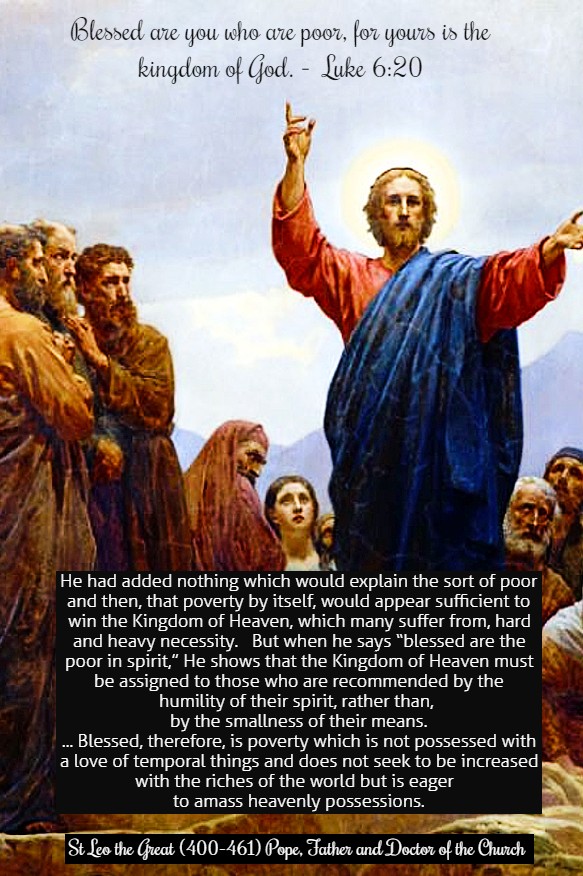
“Blessed are you who are poor, for yours is the Kingdom of God.”
Luke 6:20
“He had added nothing which would explain the sort of poor and then, that poverty by itself, would appear sufficient to win the Kingdom of Heaven, which many suffer from, hard and heavy necessity. But when He says “blessed are the poor in spirit,” He shows that the Kingdom of Heaven must be assigned to those who are recommended by the humility of their spirit, rather than, by the smallness of their means. Blessed, therefore, is poverty which is not possessed with a love of temporal things and does not seek to be increased with the riches of the world but is eager to amass heavenly possessions.”
St Leo the Great (400-461) Pope, Father and Doctor of the Church
“True humility consists in persuading and convincing oneself that without God, we are insignificant and despicable and, in accepting to be treated as such!”
St Ignatius Loyola SJ (1491-1556)
“One day, I started thinking about what the last office can be in the world. And, I discovered that the last place, is at the feet of the traitor, Judas. And I wanted to place myself there but I could not because there, I found Jesus Christ kneeling, washing Judas’ feet! Since then, my appreciation for and understanding of humility, has grown.”
“He who desires to consecrate himself to God must, in the first place, trample under his feet, all regard for what others will say of him. O my God, why do we not ask what Jesus Christ or His holy Mother, will think of our conduct?”
“You shall love the Lord your God with all your heart and with all your soul and with all your mind. And the second is like it: You shall love your neighbour as yourself.”
Matthew 22:36,39
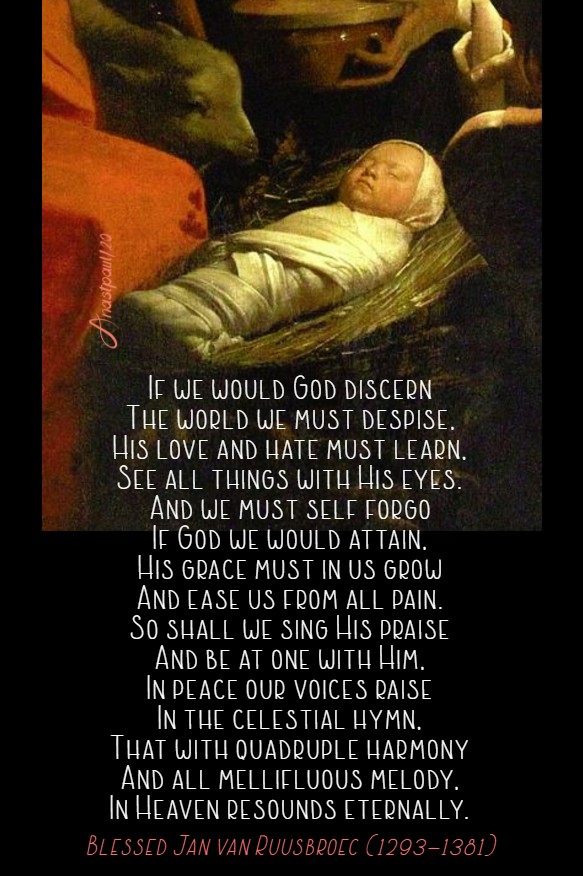
“If we would God discern The world we must despise, His love and hate must learn, See all things with His eyes. And we must self forgo If God we would attain, His grace must in us grow And ease us from all pain. So shall we sing His praise And be at one with Him, In peace our voices raise In the celestial hymn, That with quadruple harmony And all mellifluous melody, In Heaven resounds eternally.”
Bl Jan van Ruusbroec (1293-1381)
“We must make our way towards eternity, never regarding what men think of us, or of our actions, studying only to please God.”
St Francis Borgia (1510-1572)
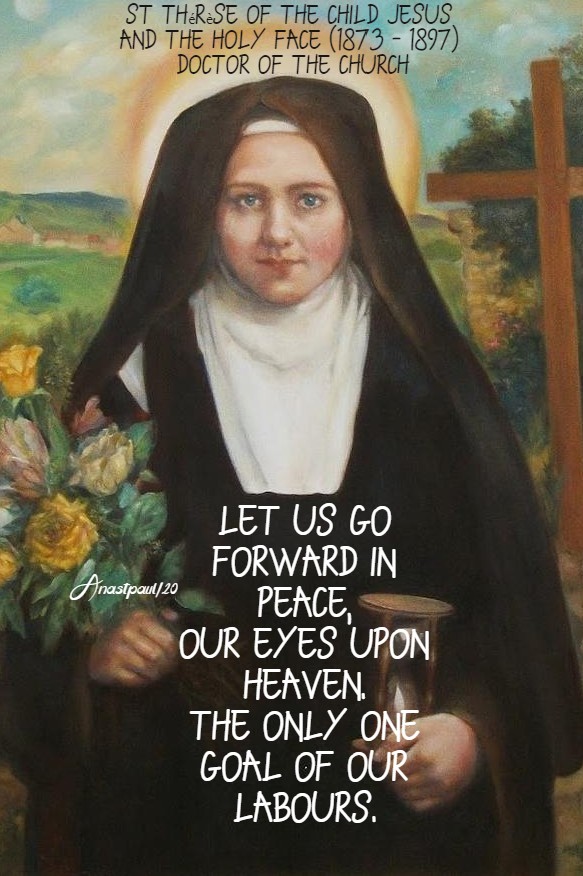
“Let us go forward in peace, our eyes upon Heaven, the only one goal of our labours.”
Quote/s of the Day – 21 December – Feast of St Thomas, Apostle of Christ, Martyr – “The Month of the Divine Infant and the Immaculate Conception” – Ephesians 2:19-22, John 20:24-29 – Scripture search here: https://www.drbo.org/
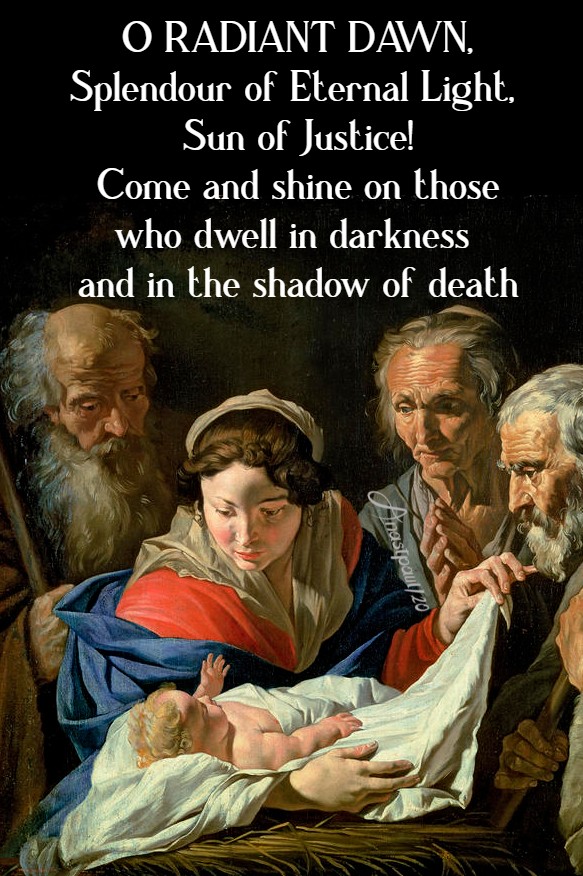
“O Radiant Dawn, Splendour of Eternal Light, Sun of Justice! Come and shine on those who dwell in darkness and in the shadow of death.”
“My Lord and my God”
John 20:28
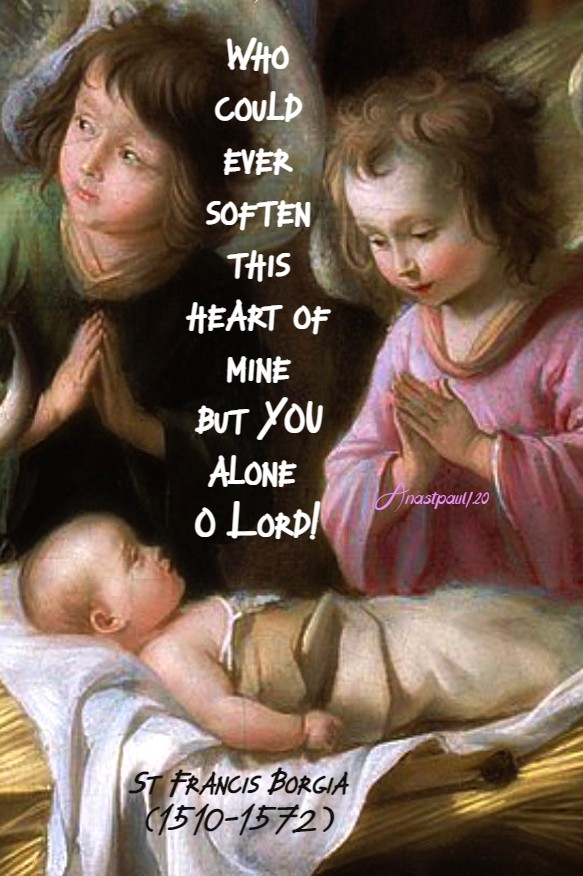
“Who could ever soften this heart of mine but YOU alone O Lord!”
St Francis Borgia (1510-1572)
“Christ first of all, Christ in the centre of the heart, in the centre of history and of the cosmos. Humanity needs Christ intensely because, He is our “measure.” There is no realm, that cannot be touched by His strength; there is no evil, that cannot find remedy in Him, there is no problem, that cannot be solved in Him. Either Christ or nothing!”
Quote/s of the Day – 5 November – All Saints and Blesseds of the Society of Jesus (SJ)
“God’s love calls us to move beyond fear. We ask God for the courage to abandon ourselves unreservedly, so that we might be moulded by God’s grace, even as we cannot see where that path may lead us.”
“Hate what the world seeks and seek, what it avoids.”
“He who carries God in his heart bears heaven with him, wherever he goes.”
St Ignatius Loyola SJ (1491-1556)
“We must make our way towards eternity, never regarding what men think of us, or of our actions, studying only to please God.”
St Francis Borgia SJ (1510-1572)
“Better that only a few Catholics should be left, staunch and sincere in their religion, than that they should, remaining many, desire as it were, to be in collusion with the Church’s enemies and in conformity with the open foes of our faith.”
St Peter Canisius SJ (1521-1597) Doctor of the Church
“The path to Heaven is narrow, rough and full of wearisome and trying ascents, nor can it be trodden without great toil and, therefore, wrong is their way, gross their error and assured their ruin, who, after the testimony of so many thousands of Saints, will not learn where to settle their footing!”
St Robert Southwell SJ (1561-1595) Priest and Martyr
“Recommend yourself to your Angel Guardian three times a day – in the morning. by the prayer “Angele Dei” in the evening, by the same prayer and during the day, when you visit the Altars in Churches. Remember that you are to be guided by your Angel, like a blind man who cannot see the dangers of the streets and trusts entirely. to the person who leads him.”
St Aloysius de Gonzaga (SJ 1568-1591)
“My child, it is indeed the Voice of God you have heard. He has given you a great grace in thus calling you into His one true Church. While you live, never cease to thank Him and bless Him for it.”
St John Francis Régis SJ (1597-1640)
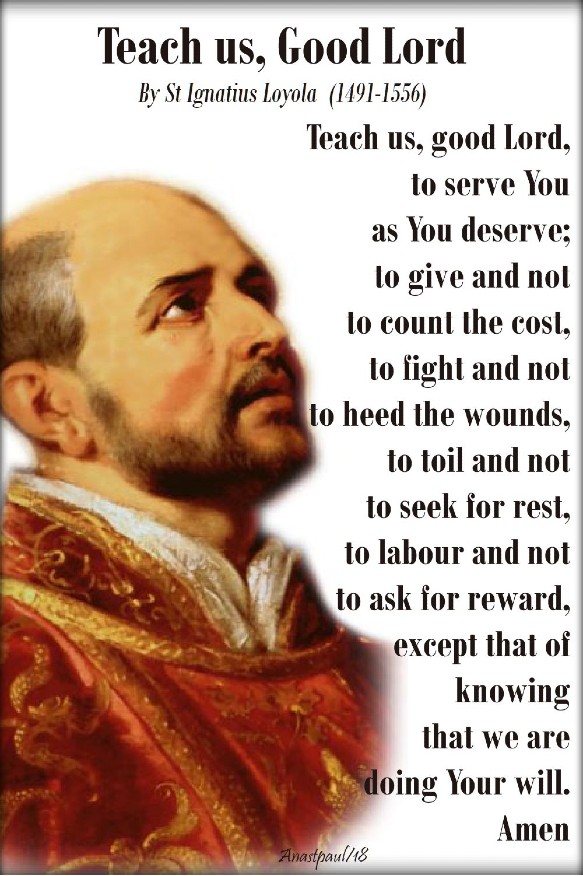
“Teach Us Good Lord” By St Ignatius Loyola SJ (1491-1556) Teach us, good Lord, to serve You as You deserve; to give and not to count the cost, to fight and not to heed the wounds, to toil and not to seek for rest, to labour and not to ask for reward, except that of knowing that we are doing Your will. Amen
My God, I Love Thee By St Francis Xavier (1506-1552) (Attri) Transr: Fr Edward Caswall CO (1814-1878)
My God, I love Thee, not because I hope for heav’n thereby, nor yet for fear, that loving not, I might forever die but for that Thou didst all mankind upon the Cross embrace; for us didst bear the nails and spear and manifold disgrace.
And griefs and torments numberless and sweat of agony; e’en death itself and all for man, who was Thine enemy. Then why, most loving Jesus Christ, should I not love Thee well? Not for the sake of winning heav’n, nor any fear of hell.
Not with the hope of gaining aught, nor seeking a reward but as Thyself hast loved me, O ever loving Lord! E’en so I love Thee and will love and in Thy praise will sing, solely because Thou art my God and my eternal King! Amen
Quote/s of the Day – 2 November – All Souls Day – “The Month of the Holy Souls in Purgatory”
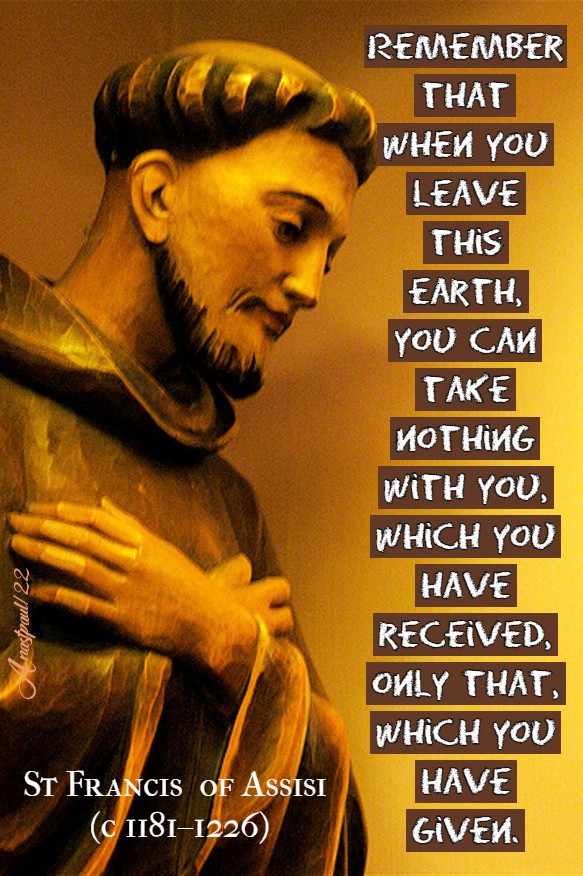
“Remember, when you leave this earth, you can take nothing with you, which you have received, only that, which you have given.”
St Francis of Assisi (c 1181–1226)
“This death … has already levelled his bow to strike me. Is it not prudent to prevent its stroke, by dying now to the world, that at my death, I may live to God?”
St Francis Borgia (1510-1572)
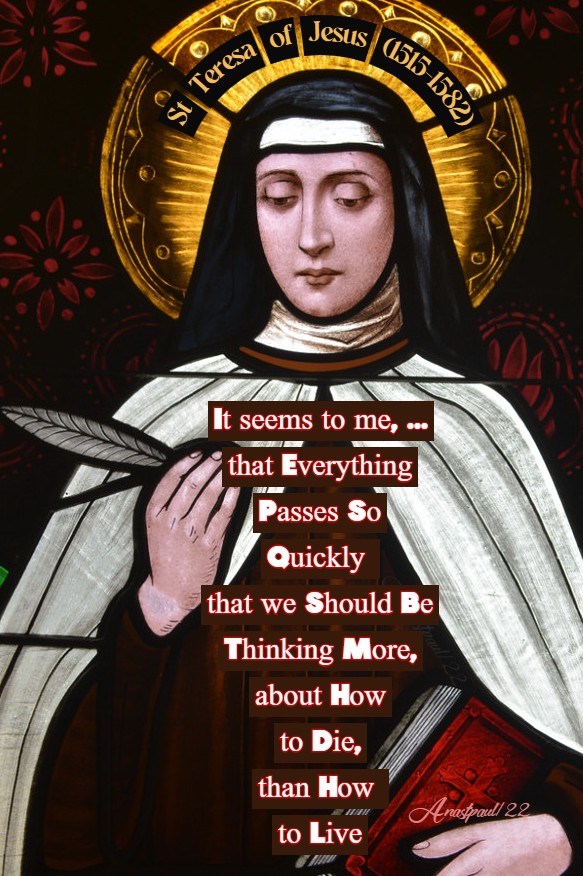
“It seems to me, my daughters, that everything passes so quickly that we should be thinking more, about how to die, than how to live!”
St Teresa of Jesus of Avila (1515-1582) Doctor of the Church
“The powers of hell will assail the dying Christian but his Angel Guardian will come to console him. His Patrons and St Michael, who has been appointed by God to defend his faithful servants, in their last combat with the devils, will come to his aid.”
St Alphonsus Liguori (1696-1787) Most Zealous Doctor
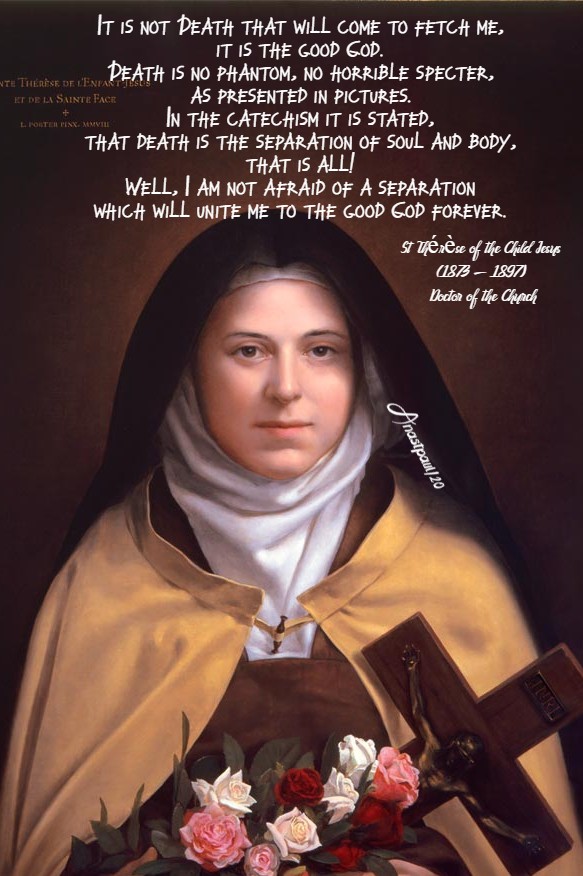
“It is not Death that will come to fetch me, it is the good God. Death is no phantom, no horrible specter, as presented in pictures. In the catechism it is stated, that death is the separation of soul and body, that is all! Well, I am not afraid of a separation which will unite me to the good God forever.”
St Thérèse of the Child Jesus and the Holy Face (1873 – 1897)
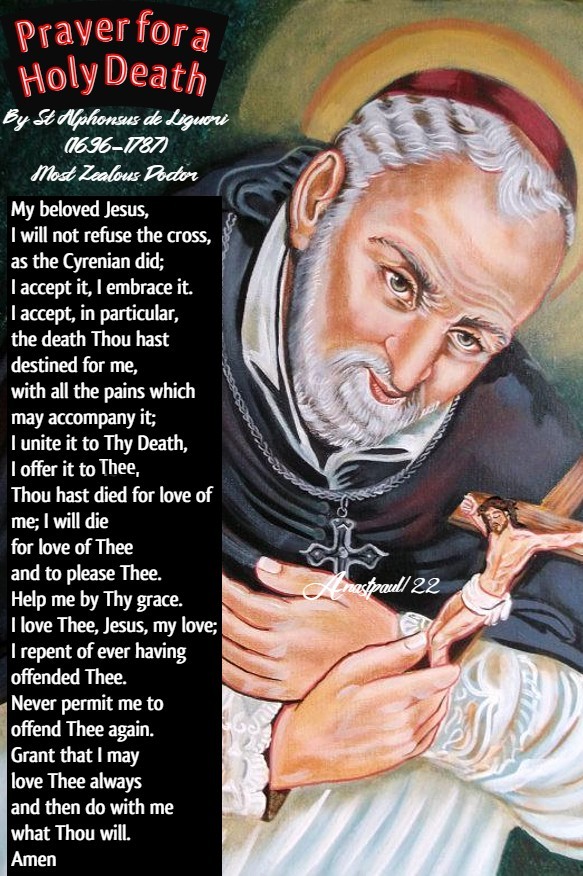
Prayer for a Holy Death By St Alphonsus de Liguori (1696-1787) Most Zealous Doctor
My beloved Jesus, I will not refuse the cross, as the Cyrenian did; I accept it, I embrace it. I accept, in particular, the death Thou hast destined for me, with all the pains which may accompany it; I unite it to Thy Death, I offer it to Thee Thou hast died for love of me; I will die for love of Thee and to please Thee. Help me by Thy grace. I love Thee, Jesus, my love; I repent of ever having offended Thee. Never permit me to offend Thee again. Grant that I may love Thee always and then do with me what Thou will. Amen
Quote/s of the Day – 10 October – St Francis Borgia SJ (1510-1572) Confessor
“He who desires to consecrate himself to God must, in the first place, trample under his feet, all regard for what others will say of him. O my God, why do we not ask what Jesus Christ or His holy Mother, will think of our conduct?”
“Wherever our brethren may be, let their first care be, for those already converted. Their first aim must be, to strengthen these in the faith and to help them save their souls. After this, they may convert others not yet Baptised.”
(Excerpt from his correspondence, as Master General of the Order, to the Jesuit Missionaries he had sent to the Spanish colonies in Florida, Mexico and Peru.)
“This beast, (so he often called his body) “must suffer ,to expiate the delight it formerly took, in immoderately flattering its palate and can I forget, that Christ drank gall for me on His Cross!”
One Minute Reflection – 10 October – St Francis Borgia SJ (1510-1572) Confessor, Priest of the Society of Jesus, – Ecclesiasticus 45:1-6, Matthew 19:27-29 – Scripture search here: https://www.drbo.org/
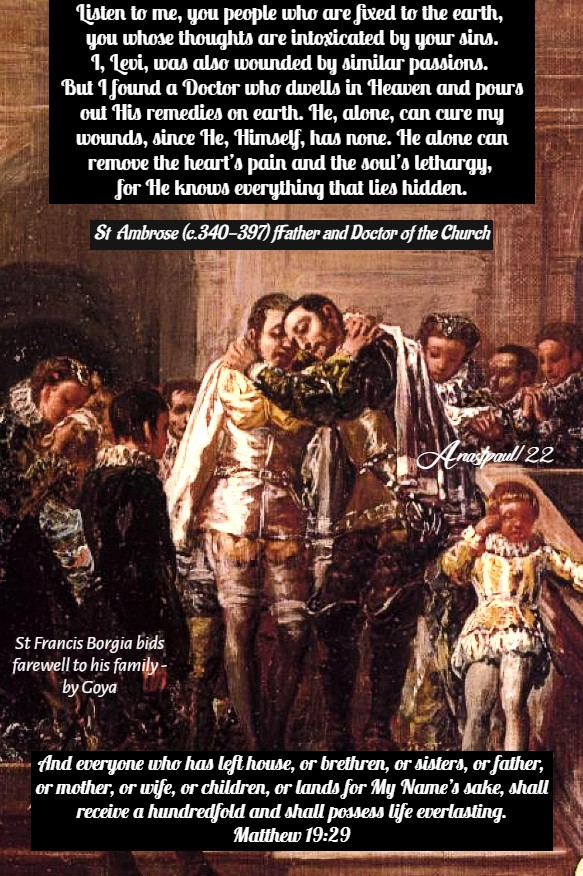
“And everyone who has left house, or brethren, or sisters, or father, or mother, or wife, or children, or lands for My Name’s sake, shall receive a hundredfold and shall possess life everlasting.” – Matthew 19:29
REFLECTION – “The Apostle Paul said: “Take off the old self with its practices and put on the new self” (Col 3,9-10)… This was the work Christ accomplished when He called Levi; He refashioned him into a new man. Similarly, it is as a new person that the former publican prepares a banquet for Christ, since Christ takes pleasure in him and he ,himself merits, to have a share in happiness, with Christ… He followed Him now, happy, lighthearted and overflowing with joy.
“I have the aspect of a publican no more,” he said, “I do not carry around the old Levi, any longer, I put off Levi when I put on Christ. I flee from my earlier life, my Lord Jesus, Thou alone, Who heals my wounds, I desire to follow. Who shall separate me from the love of God within Thee? tribulation? anguish? hunger? (Rom 8,35). I am bound to Thee by faith as by nails, I am held fast by the worthy bonds of love. All Thy commandments will be like a cautery which I will apply firmly to my wound – the remedy stings but it takes away the ulcerous infection. Lord Jesus, with Thy powerful sword, cut away the corruption of my sins, come quickly, lance my hidden and varied passions. Purge away all infection in the new bath.
Listen to me, you people who are fixed to the earth, you whose thoughts are intoxicated by your sins. I, Levi, was also wounded by similar passions. But I found a Doctor Who dwells in Heaven and pours out His remedies on earth. He, alone, can cure my wounds, since He, Himself, has none. He alone can remove the heart’s pain and the soul’s lethargy, for He knows everything that lies hidden.” – St Ambrose (c.340-397) Bishop of Milan and Father and Doctor of the Church (Commentary on Saint Luke’s Gospel, 5, 23.27).
PRAYER – O Lord Jesus Christ, model of true humility and its reward, we beseech Thee, that as Thou made blessed Francis one of Thy glorious imitators, by his contempt for earthly honours, grant us to follow his example and to share in his glory. Through the same Jesus Christ, Thy Son our Lord, Who lives and reigns with Thee, in the unity of the Holy Ghost, God, world without end. Amen (Collect).
Saint of the Day – 10 October – St Francis Borgia SJ (1510-1572) Confessor, Priest of the Society of Jesus, Advisor, Missionary, Evangelist, Administrator par excelleance. Francisco de Borja y Aragon was the 4th Duke of Gandía, was a Grandee of Spain, a Spanish Jesuit and third Superior General of the Society of Jesus
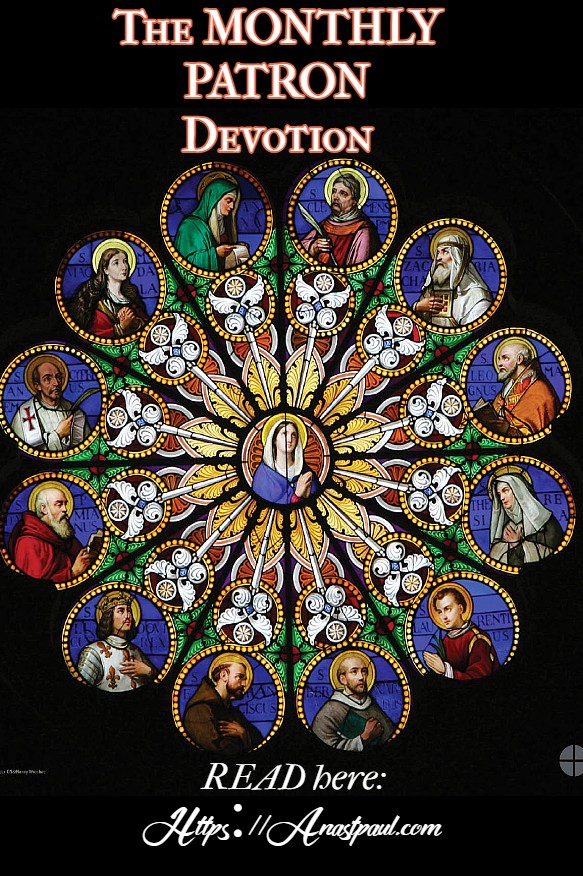
“St Francis instituted at his Court, before he entered the religious life, the veneration of the Saints of the Month. Every Catholic, besides worshipping the Almighty, ought to honour the Saints. We should especially honour the Divine Mother, as the Queen of all the Saints, then, the foster-father of Christ, St Joseph and further,, our Guardian Angel and Patron Saint. Besides this, we ought to select some special Patrons, for whom we feel particular esteem and love. It is also very beneficial, to adopt the practice of the “Monthly Patrons.” This consists in selecting, on the last day of every month, a Saint whose festival will be celebrated during the following month. Daily should he be invoked and honoured. If possible his life should be read and something from it, be selected for imitation. We may also approach the Sacraments on his festival, or on the Sunday after it and employ a little more time than usual, in good works. It is known, that several great servants of God, at the end of their days, called upon the Saints whom they had honoured as their Monthly Patrons during life and it cannot be doubted, that they received benefit and comfort. “Everyone,” says St Bonaventure, “ought to venerate an especial Saint with great devotion. To him, he ought daily, to commend himself and practise some good work, in his honoru.” By Fr Francis Xavier Weninger SJ (1805-1888)
Because the life of St Francis Borgia is rather long for one post, I post below, a part of it on his childhood and youth. Hopefully, we do not have to wait a year before I add to it. It is excerpted from the Lives of the Saints by Fr Alban Butler (1711-1773.)
St Francis Borgia, Fourth Duke of Gandia and Third General of the Jesuits, was son to John Borgia, Duke of Gandia and Grandee of Spain and of Joanna of Arragon, daughter of Alphonso, natural son to Ferdinand V King of Arragon … who was the great-grandfather to our Saint. The family of Borgia or Borja, had long flourished in Spain but in 1455, received a new lustre, by the exaltation of Cardinal Alphonso Borgia to the Pontificate, under the name of Calixtus III.
St Francis was born in 1510, at Gandia, a town which was the chief seat of the family, in the Kingdom of Valencia. His pious mother had a great devotion to St Francis of Assisi and, in the pangs of a dangerous labour, made a vow that if she brought forth a son, he should be called Francis.
As soon as he began to speak, his parents taught him to pronounce the Holy Names of Jesus and Mary, which he used often to repeat with wonderful seriousness. At five years of age he recited, everyday on his knees, the chief parts of the Catechism. All his diversion was to set up pious pictures, make little altars, imitate the ceremonies of the Church and teach them to the little boys, who were his pages. From the cradle he was mild, modest, patient and affable to all. The noble sentiments of gratitude and generosity, which he then began to discover, were certain presages of an innate greatness of soul – the former being inseparable from a goodness of heart and the latter, when regulated by prudence and charity, being the greatest virtue of a Prince, who is raised above others, only that he may govern and do good to mankind.
Francis, at seven years of age, could read his mother tongue and the Latin Office of the Blessed Virgin very distinctly. His father, therefore, thought it time for him to learn writing and grammar, for which purpose he appointed him a preceptor of known prudence, learning and piety, who was called Dr.Ferdinand. At the same time, he was furnished with a governor, whose business it was, at different hours, to fashion the young Prince to the exercises that were suitable to his birth, in proportion as his age was capable of them. It was the first care of the parents, in the choice of the masters whom they placed about their son, that they were persons of uncommon piety, whose example might be a continual lesson of virtue and whose instructions, should all ultimately tend to the grafting, in his mind, true sentiments of morality and religion, without which all other accomplishments, lose their value.
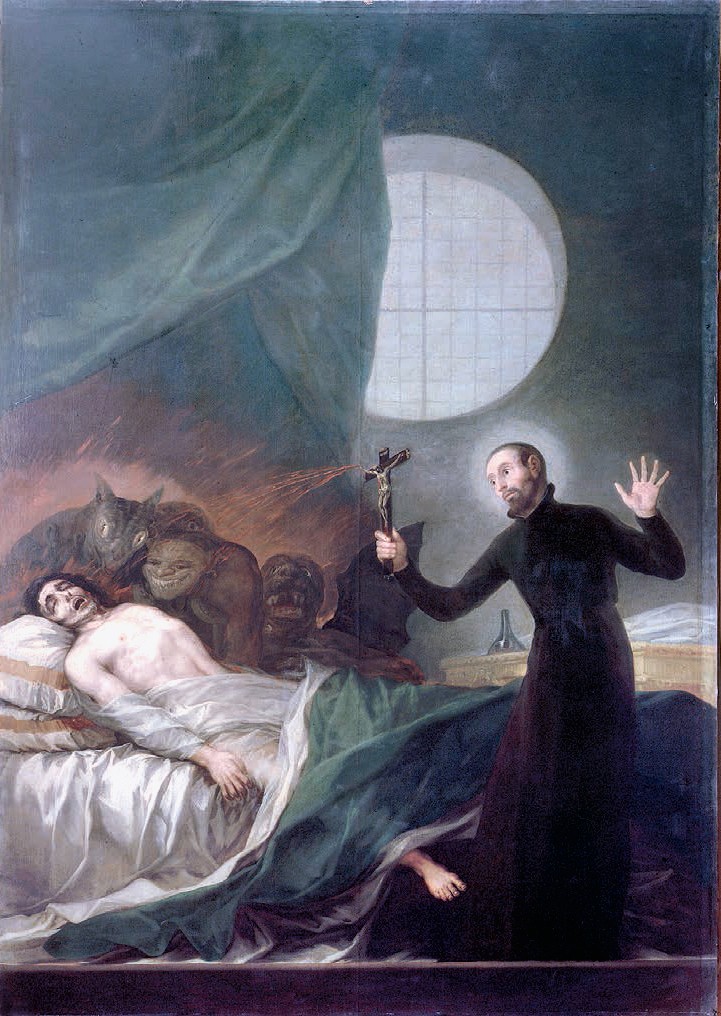
St Francis Borgia assists at the death of a impenitent by Goya
Before he was ten years old , Francis began to take wonderful delight in hearing sermons and spent much time in practising devotions, being tenderly affected to the Passion of our Divine Redeemer, which he honoured with certain daily exercises. In his tenth year, his pious mother fell dangerously ill; on which occasion, Francis, shutting himself up in his chamber, prayed for her with abundance of tears. This was the first time he used that practice of mortification, which he afterwards frequently made a part of his penance. It pleased God that the Duchess died of that distemper in 1520. This loss cost Francis many tears, though he moderated his grief by his entire resignation to the Divine will. Her pious counsels had always been to him a great spur to virtue and he took care never to forget them.
At that time, Spain was filled with tumults and insurrections of the common people, against the regency. The rebels, taking advantage of the absence of the young King, Charles V.(who was then in Germany, where he had been chosen Emperor,) plundered the houses of the nobility in the Kingdom of Valencia and made themselves masters of the town of Gandia. The Duke fled with his whole family. Going to Saragossa, he left his son Francis, then twelve years old, under the care of the Archbishop, John of Arragon, who was his uncle, being brother to his deceased mother. The Archbishop made up a household for his nephew and provided him with masters in grammar, music,and fencing, which he had begun to learn. The young nobleman laboured at the same time, to improve daily in grace and in every virtue.
At the age of fifteen, Francis was sent to Tordesillas, to be taken into the family and service of the Infanta Catharine, sister to Charles V. who was soon after to be married to John III. King of Portugal. The marriage was accomplished in 1525 but when the Infanta went into Portugal, the Duke of Gandia, who had greater plans for his son in Spain, recalled him, and engaged the Archbishop of Saragossa to re-assume the care of his education. When he had finished rhetoric, Francis studied philosophy for two years under an excellent master, with extraordinary diligence and applause. …
By the eighteenth year of his age, Francis had strong inclinations to entera religious state. … But in 1528, his father and uncle, to divert his thoughts from a religious life, removed him from Saragossa to the Court of Charles V. , where they hoped his thoughts would take a different turn. He considered his duty to his Prince, as his duty to God and although he willingly accepted, every mark of his Prince’s regard for him, he was very solicitous in all things to refer himself, his actions,and whatever he received from God, purely to the Divine honour. … (TO BE CONTINUED …)
St Aldericus St Cassius St Cerbonius of Populonia St Cerbonius of Verona St Clarus of Nantes Bl Demestrius of Albania Bl Edward Detkens St Eulampia St Eulampius St Florentius the Martyr St Fulk of Fontenelle St Gereon St Gundisalvus Bl Hugh of Macon
Bl Pedro de Alcantara de Forton de Cascajares St Pinytus of Crete Bl Pontius de Barellis St Tanca St Teodechilde St Victor of Xanten
Martyrs of Ceuta – 7 Beati: A group of seven Franciscan Friars Minor missionaries to Muslims in the Ceuta area of modern Morocco. Initially treated as madmen, within three weeks they were ordered to convert to Islam and when they would not they were first abused in the streets, then arrested, tortured and executed. • Angelo • Daniele di Calabria • Donnolo • Hugolinus • Leone • Nicola • Samuele They were beheaded in 1227 in Mauritania Tingitana (Ceuta, Morocco). Local Christians secreted the bodies away and gave them proper burial in Ceuta. They were Beatified in 1516 by Pope Leo X.
Quote/s of the Day – 27 September – Wisdpm 5:16-20, Luke 6:17-23
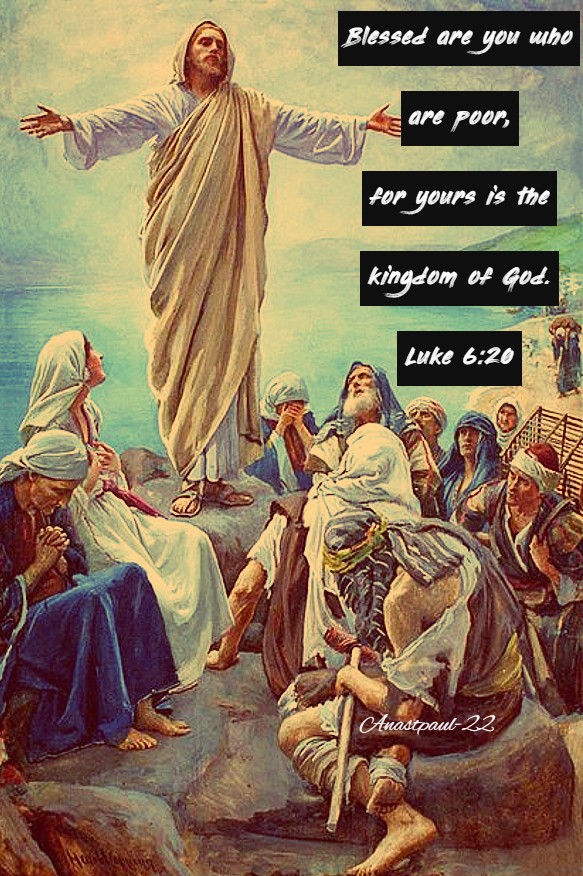
“Blessed are you who are poor, for yours is the Kingdom of God.”
Luke 6:20
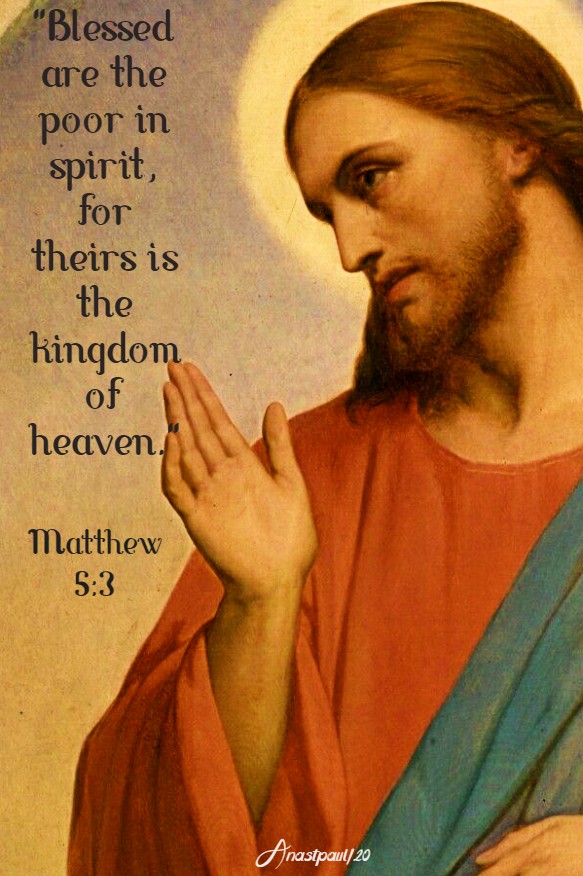
“Blessed are the poor in spirit, for theirs is the Kingdom of Heaven.”
Matthew 5:3
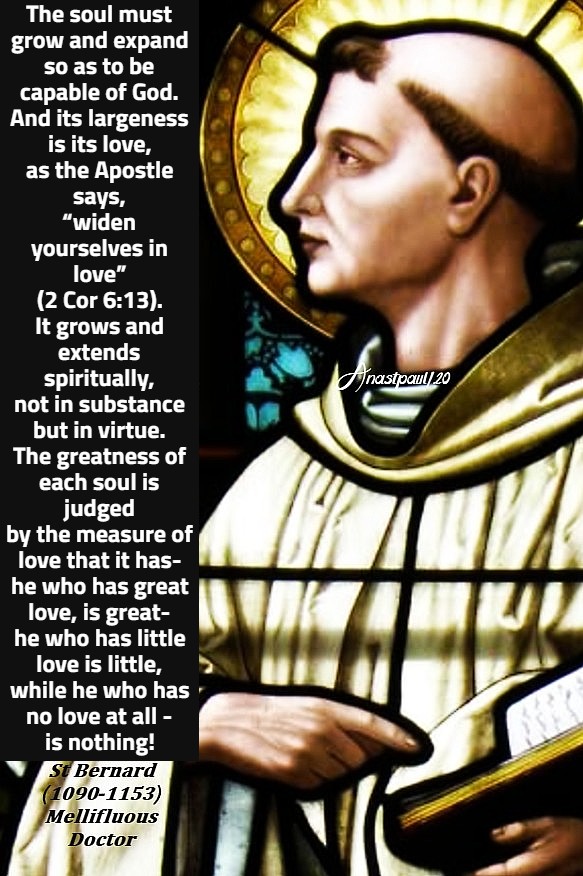
“The soul must grow and expand so as to be capable of God. And its largeness is its love, as the Apostle says, “widen yourselves in love” (2 Cor 6:13). It grows and extends spiritually, not in substance but in virtue. The greatness of each soul is judged by the measure of love that it has- he who has great love, is great- he who has little love is little, while he who has no love at all – is nothing!”
St Bernard (1090-1153) Mellifluous Doctor of the Church
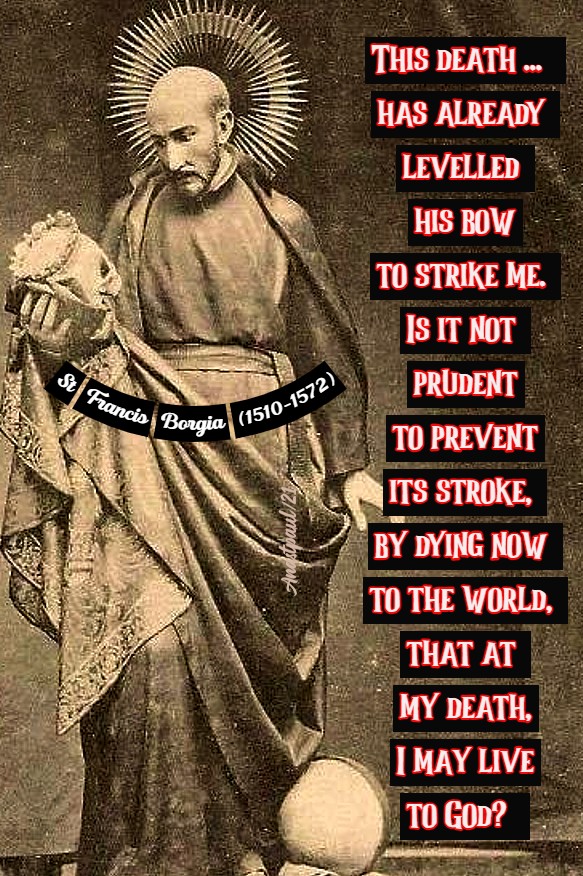
“This death … has already levelled his bow to strike me. Is it not prudent to prevent its stroke, by dying now to the world, that at my death, I may live to God?”
St Francis Borgia (1510-1572)
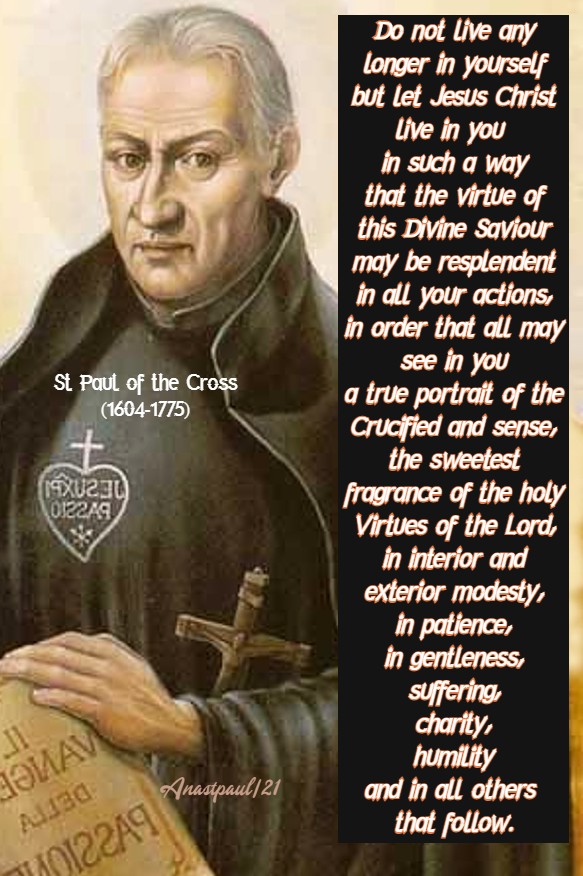
“Do not live any longer in yourself but let Jesus Christ live in you in such a way that the virtue of this Divine Saviour may be resplendent in all your actions, in order that all may see in you a true portrait of the Crucified and sense, the sweetest fragrance of the holy virtues of the Lord, in interior and exterior modesty, in patience, in gentleness, suffering, charity, humility and in all others that follow.”
St Paul of the Cross (1604-1775)
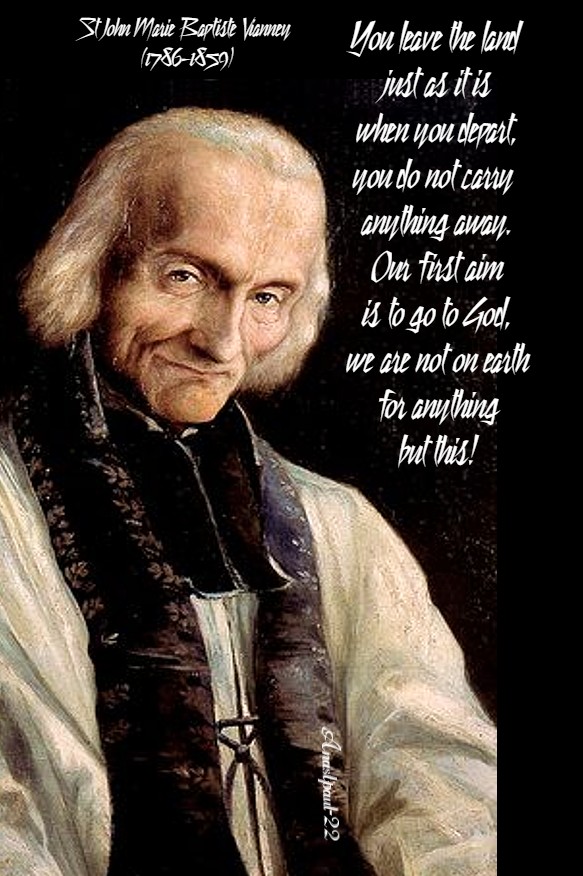
“You leave the land just as it is when you depart, you do not carry anything away. Our first aim is to go to God, we are not on earth for anything but this!”
Quote/s of the Day – 1 April – Friday of the Fourth Week of Lent – 3 Kings 17:17-24, John 11:1-45
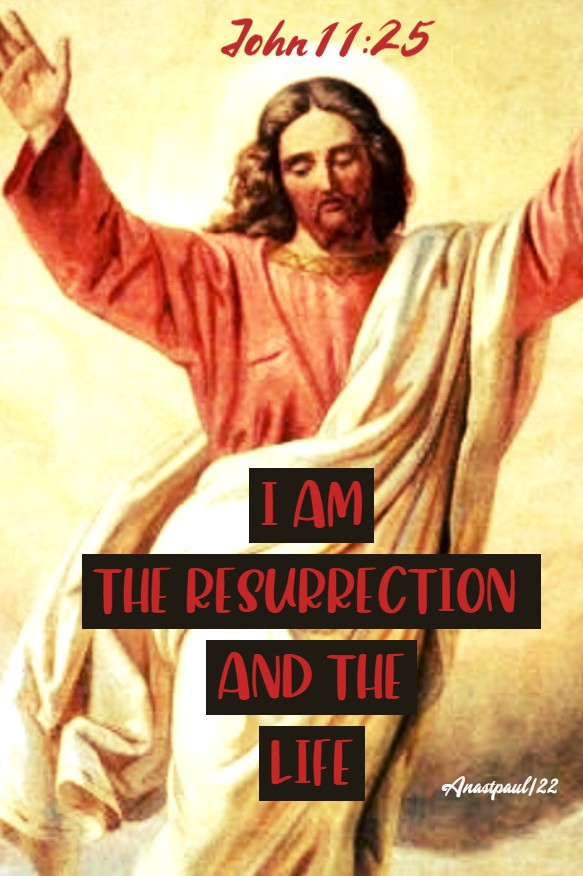
“I Am the Resurrection and the Life”
John 11:25
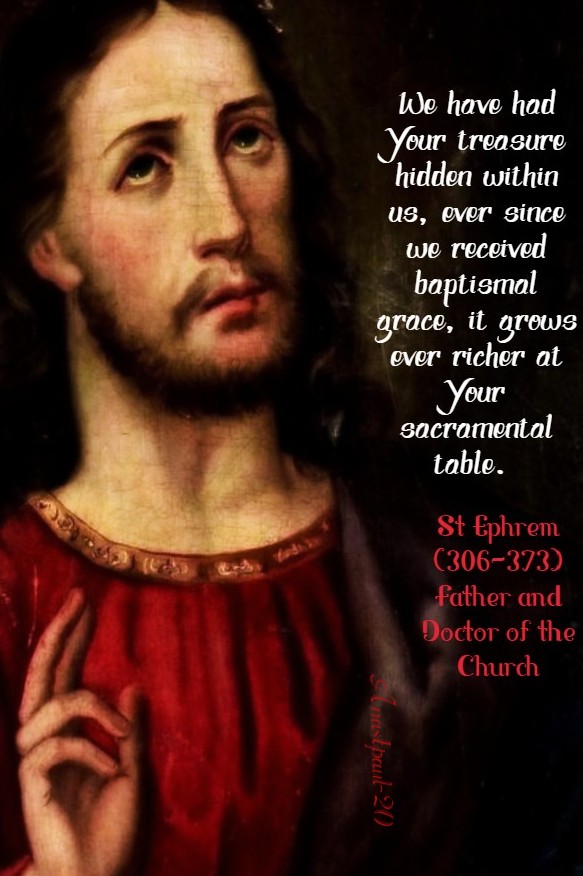
“We have had Your treasure hidden within us, ever since we received baptismal grace, it grows ever richer at Your sacramental table.”
St Ephrem (306-373) Father and Doctor of the Church
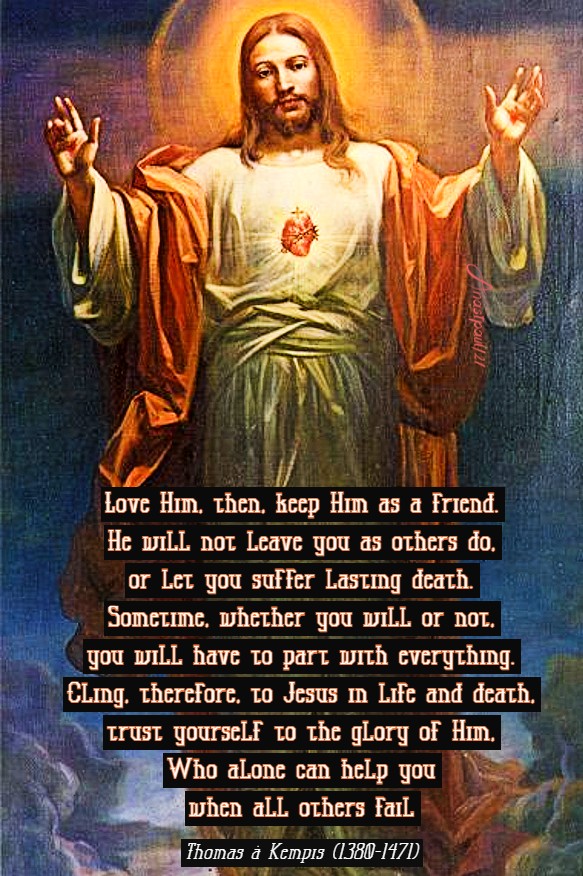
“Love Him, then, keep Him as a friend. He will not leave you as others do, or let you suffer lasting death. Sometime, whether you will or not, you will have to part with everything. Cling, therefore, to Jesus in life and death, trust yourself to the glory of Him, Who alone can help you when all others fail.“
Thomas à Kempis (1380-1471)
“This death … has already levelled his bow to strike me. Is it not prudent to prevent its stroke, by dying now to the world, that at my death, I may live to God?”
Quote/s of the Day – 18 February – “Month of the Most Blessed Trinity” – Septuagesima Weekday
ETERNAL LIFE
“And everyone who has left house, or brethren, or sisters, or father, or mother, or wife, or children, or lands for my name’s sake, shall receive a hundredfold and shall possess life everlasting.”
Matthew 19:29
“He seemed to me, a very foolish man and very wretched, who will not increase his understanding while he is in the world and ever with and long to reach that endless life, where all shall be made clear.”
St Alfred the Great (849-899) King
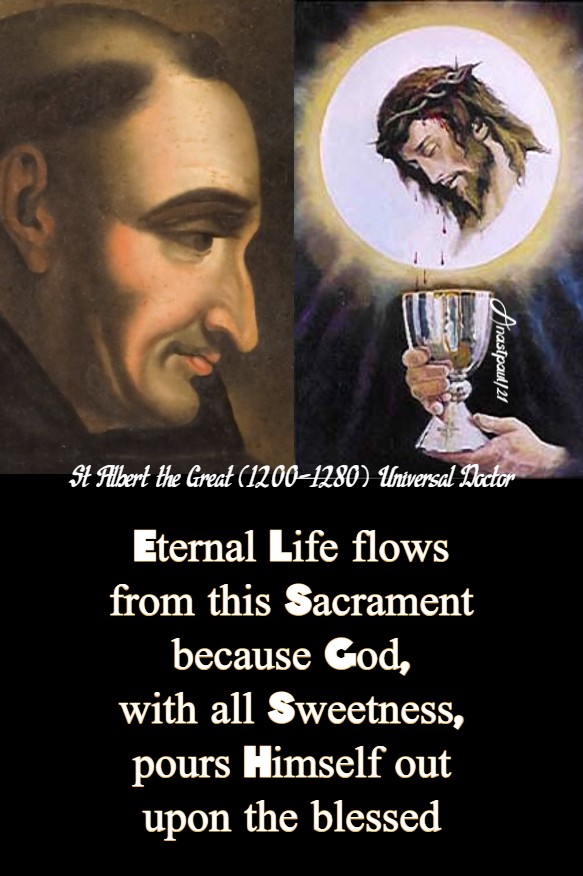
“Eternal life flows from this Sacrament because God, with all sweetness, pours Himself out upon the blessed.”
St Albert the Great OP (1200-1280) Bishop of Regensburg Universal Doctor of the Church
“We must make our way towards eternity, never regarding what men think of us, or of our actions, studying only to please God.”
St Francis Borgia SJ (1510-1572)
“By giving yourself to God, you not only receive Himself in exchange but, eternal life as well!”
St Francis de Sales (1567-1622) Doctor Caritatis
“On the journey of this life to eternity, let me carry You in my heart, following Mary’s example, who bore You in her arms, during the flight to Egypt.”
St Alphonsus Maria de Liguori (1696-1787) Most Zealous Doctor
Quote/s of the Day – 20 January – Hebrews 11:33-39; Luke 6:17-23
“Blessed are you who are poor, for yours is the kingdom of God.”
Luke 6:20
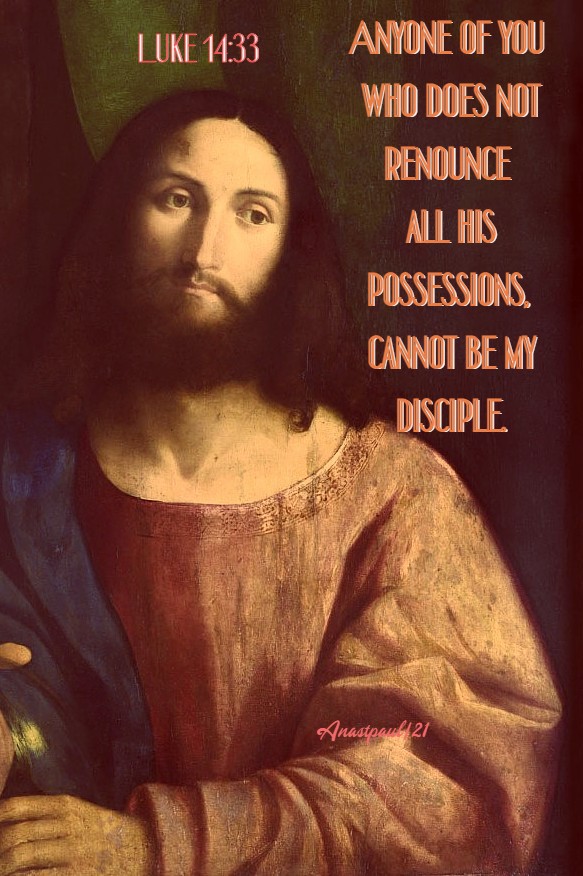
“… Anyone of you who does not renounce all his possessions, cannot be my disciple.”
Luke 14:33
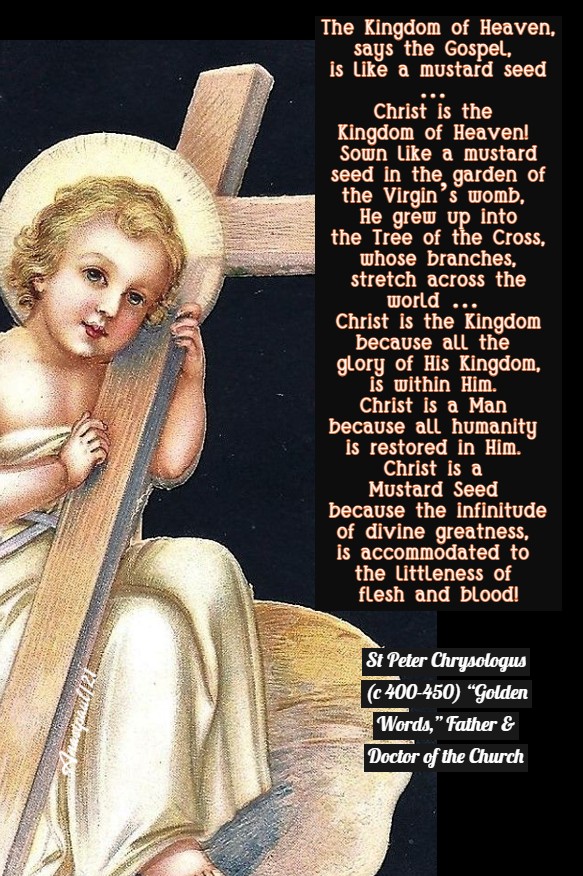
“The Kingdom of Heaven, says the gospel, is like a mustard seed … Christ is the Kingdom of Heaven! Sown like a mustard seed in the garden of the Virgin’s womb, He grew up into the Tree of the Cross, whose branches, stretch across the world … Christ is the Kingdom because all the glory of His Kingdom, is within Him. Christ is a Man because all humanity is restored in Him. Christ is a Mustard Seed because the infinitude of divine greatness, is accommodated to the littleness of flesh and blood!”
St Peter Chrysologus (c 400-450) “Golden Words” Father & Doctor of the Church
“Keep a clear eye toward life’s end. Do not forget your purpose and destiny as God’s creature. What you are in His sight, is what you are and nothing more. Remember that when you leave this earth, you can take nothing that you have received… but only what you have given – a full heart enriched by honest service, love, sacrifice and courage.”
St Francis of Assisi (c 1181-1226)
“Blessed are the poor in spirit, for theirs is the kingdom of heaven.”
Matthew 5:3
“This death … has already levelled his bow to strike me. Is it not prudent to prevent its stroke, by dying now to the world, that at my death, I may live to God?”
St Francis Borgia (1510-1572)
“Do not live any longer in yourself but let Jesus Christ live in you in such a way that the virtue of this Divine Saviour may be resplendent in all your actions, in order that all may see in you a true portrait of the Crucified and sense, the sweetest fragrance of the holy virtues of the Lord, in interior and exterior modesty, in patience, in gentleness, suffering, charity, humility and in all others that follow.”
St Paul of the Cross (1604-1775)
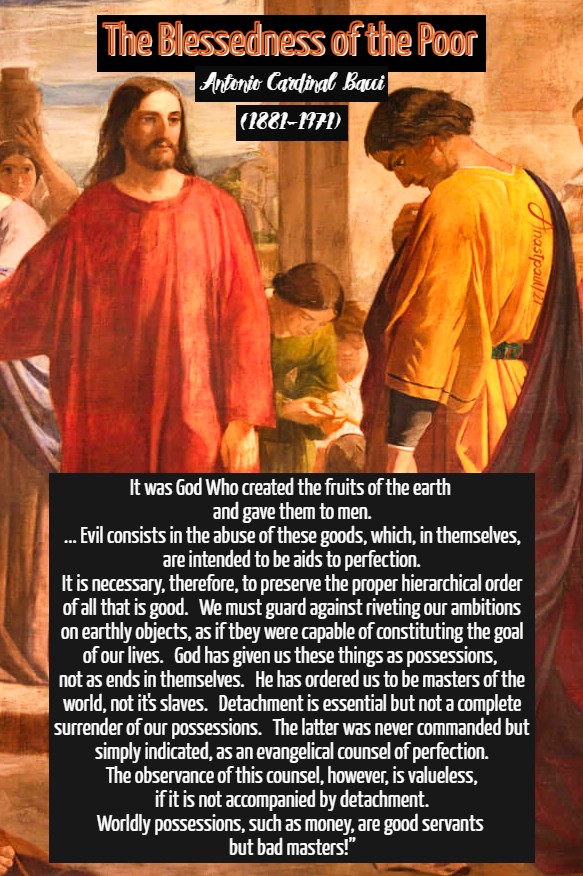
“It was God Who created the fruits of the earth and gave them to men. … Evil consists in the abuse of these goods, which, in themselves, are intended to be aids to perfection. It is necessary, therefore, to preserve the proper hierarchical order of all that is good. We must guard against riveting our ambitions on earthly objects, as if tbey were capable of constituting the goal of our lives. God has given us these things as possessions, not as ends in themselves. He has ordered us to be masters of the world, not it’s slaves. Detachment is essential but not a complete surrender of our possessions. The latter was never commanded but simply indicated, as an evangelical counsel of perfection. The observance of this counsel, however, is valueless, if it is not accompanied by detachment. Worldly possessions, such as money, are good servants but bad masters!”
Quote/s of the Day – 11 December – Saturday of the Second week of Advent
“Let us become like Christ, since Christ became like us. He assumed the worse, that He might give us the better; He became poor, that we through His poverty, might be rich.”
St Gregory of Nazianzen (330-390) Father and Doctor of the Church
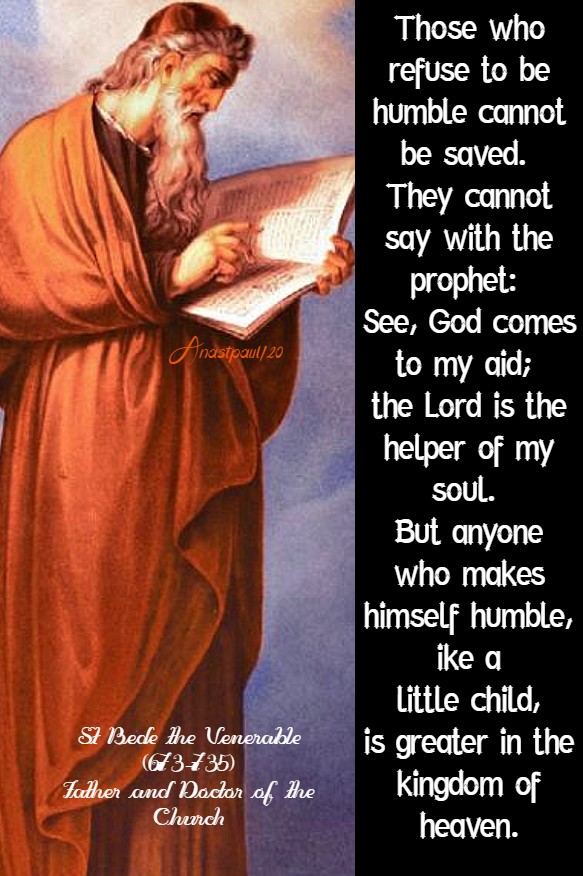
“Those who refuse to be humble cannot be saved. They cannot say with the prophet: See, God comes to my aid; the Lord is the helper of my soul. But anyone who makes himself humble, like a little child, is greater in the kingdom of heaven.”
St Bede the Venerable (673-735)
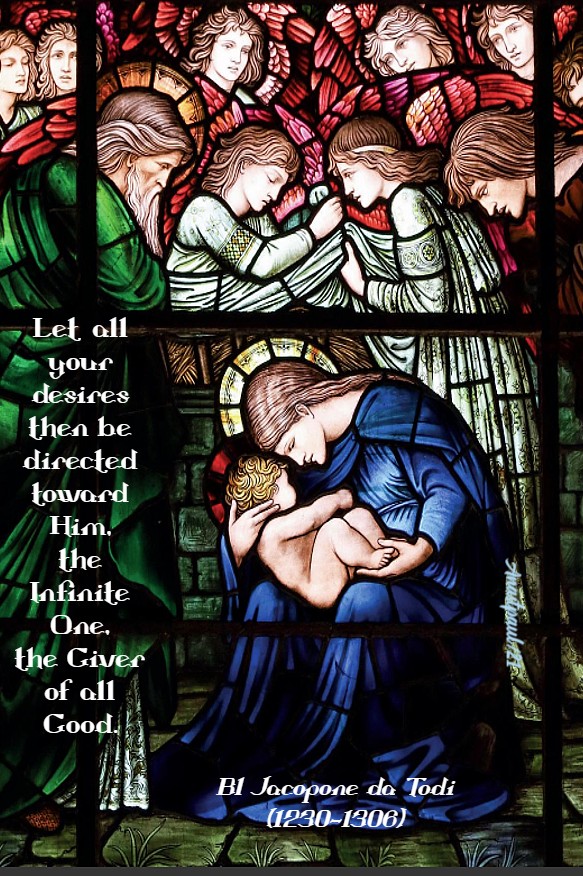
“Let all your desires then be, directed toward Him, the Infinite One, the Giver of all Good.”
Bl Jacopone da Todi (1230-1306)
“Who could ever soften this heart of mine but YOU alone O Lord!”
St Francis Borgia (1510-1572)
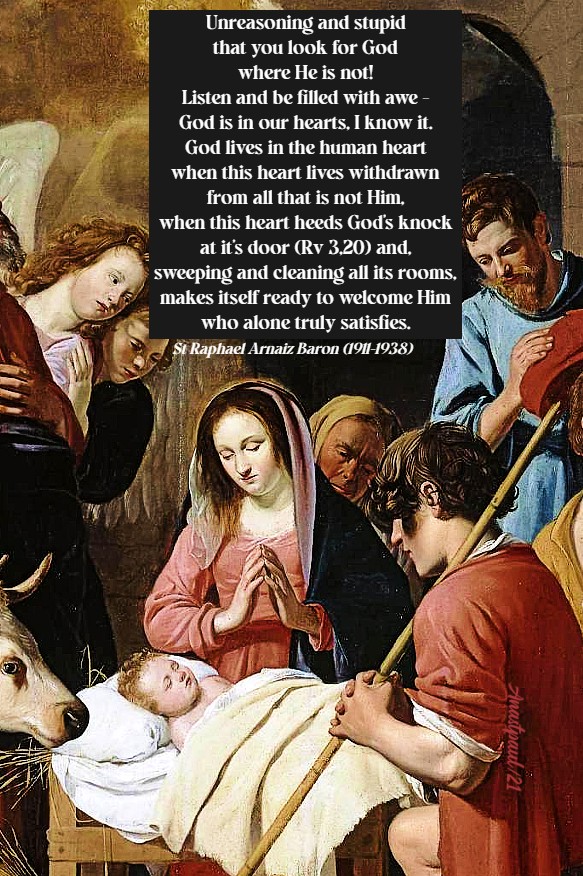
“Unreasoning and stupid that you look for God where He is not! Listen and be filled with awe – God is in our hearts, I know it. God lives in the human heart when this heart lives withdrawn from all that is not Him, when this heart heeds God’s knock at it’s door (Rv 3,20) and, sweeping and cleaning all its rooms, makes itself ready to welcome Him who alone truly satisfies.”
Quote/s of the Day – 5 November – The Memorial of All Jesuit Saints and Blesseds
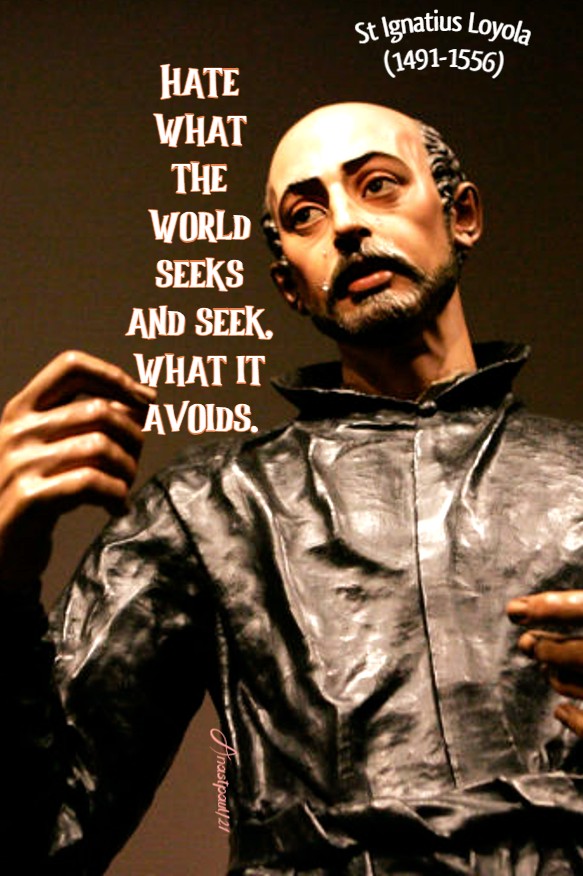
“Hate what the world seeks and seek, what it avoids.”
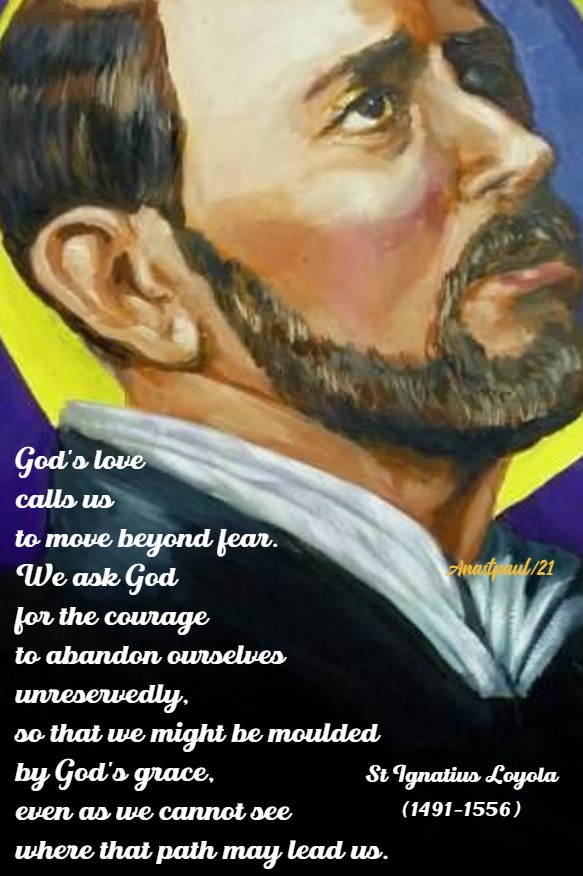
“God’s love calls us to move beyond fear. We ask God for the courage to abandon ourselves unreservedly, so that we might be moulded by God’s grace, even as we cannot see where that path may lead us.”
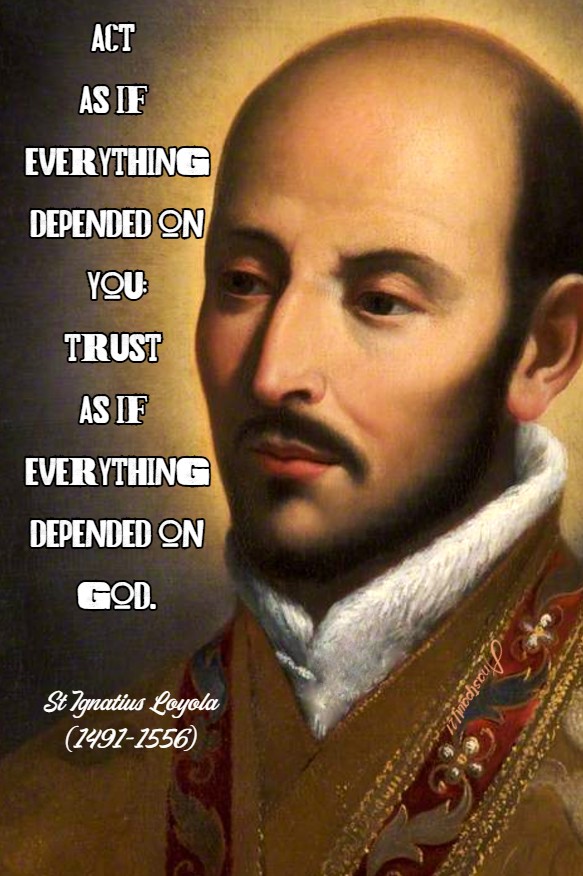
“Act as if everything depended on you; trust as if everything depended on God.”
St Ignatius Loyola SJ (1491-1556)
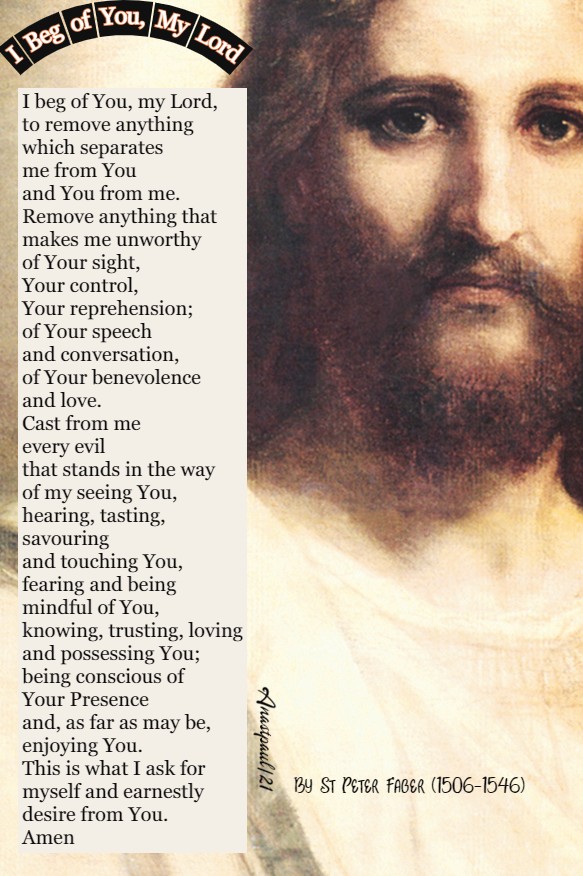
I Beg of You, My Lord By St Peter Faber (1506-1546)
I beg of You, my Lord, to remove anything which separates me from You and You from me. Remove anything that makes me unworthy of Your sight, Your control, Your reprehension; of Your speech and conversation, of Your benevolence and love. Cast from me every evil that stands in the way of my seeing You, hearing, tasting, savouring and touching You, fearing and being mindful of You, knowing, trusting, loving and possessing You; being conscious of Your Presence and, as far as may be, enjoying You. This is what I ask for myself and earnestly desire from You. Amen
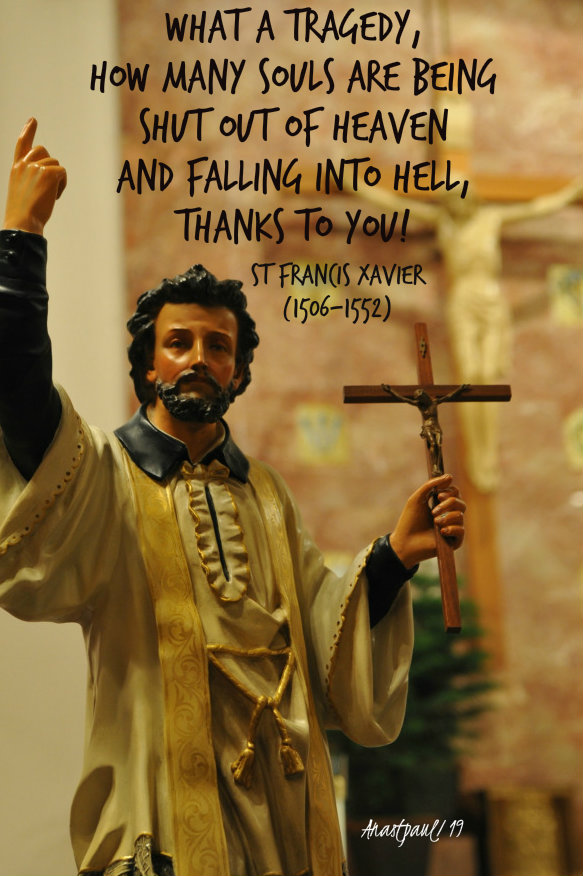
“What a tragedy, how many souls are being shut out of heaven and falling into hell, thanks to you!”
St Francis Xavier SJ (1506-1552)
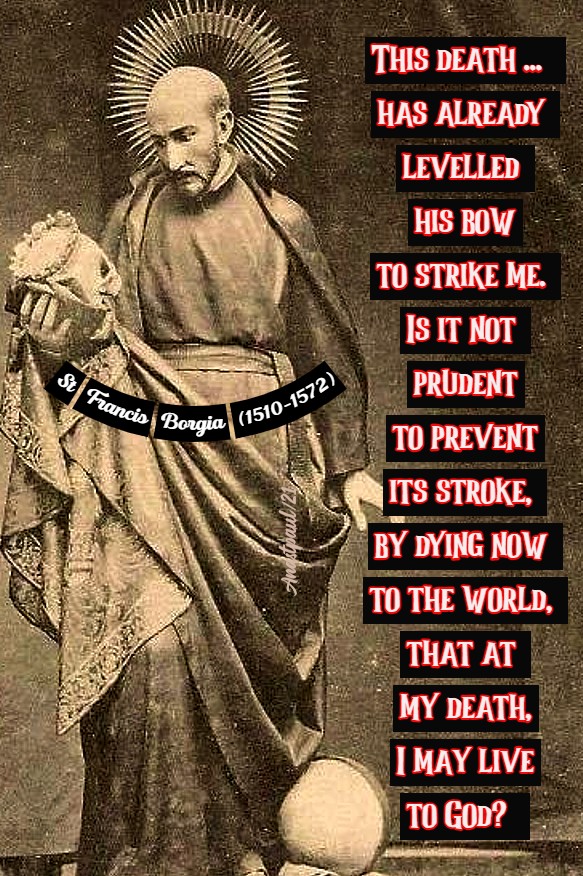
“This death … has already levelled his bow to strike me. Is it not prudent to prevent its stroke, by dying now to the world, that at my death, I may live to God?”
St Francis Borgia (1510-1572)
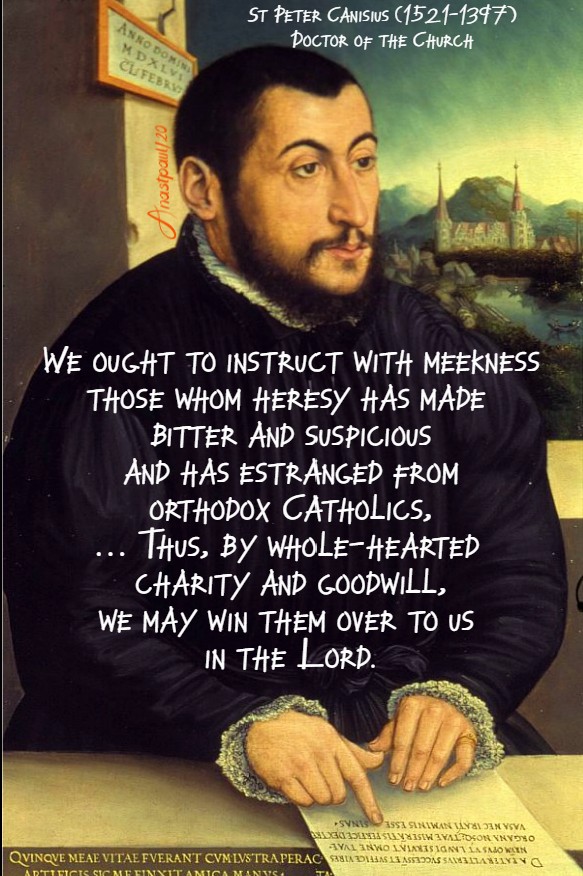
“We ought to instruct with meekness those whom heresy has made bitter and suspicious and has estranged from orthodox Catholics, … Thus, by whole-hearted charity and goodwill, we may win them over to us in the Lord.”
St Peter Canisius SJ (1521-1397) Doctor of the Church
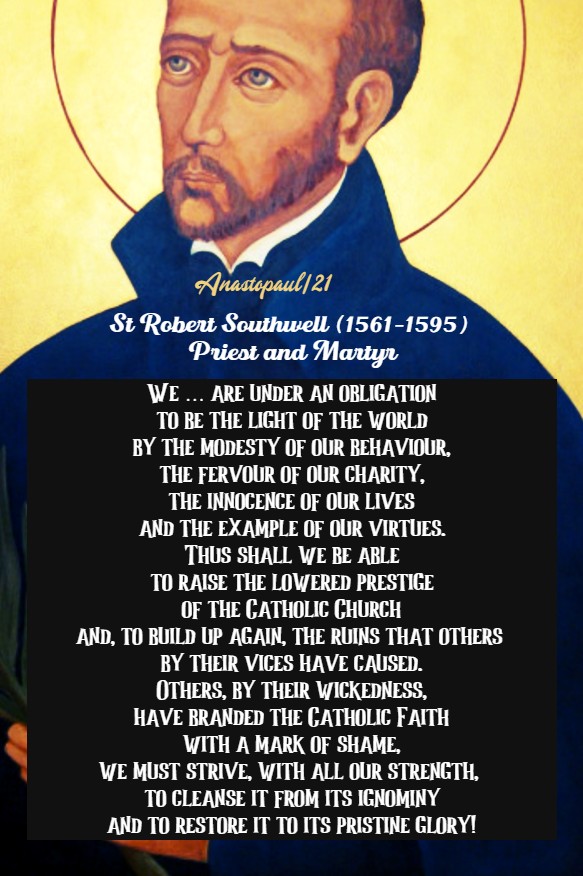
“We … are under an obligation to be the light of the world by the modesty of our behaviour, the fervour of our charity, the innocence of our lives and the example of our virtues. Thus shall we be able to raise the lowered prestige of the Catholic Church and, to build up again, the ruins that others by their vices have caused. Others, by their wickedness, have branded the Catholic Faith with a mark of shame, we must strive, with all our strength, to cleanse it from its ignominy and to restore it to its pristine glory!”
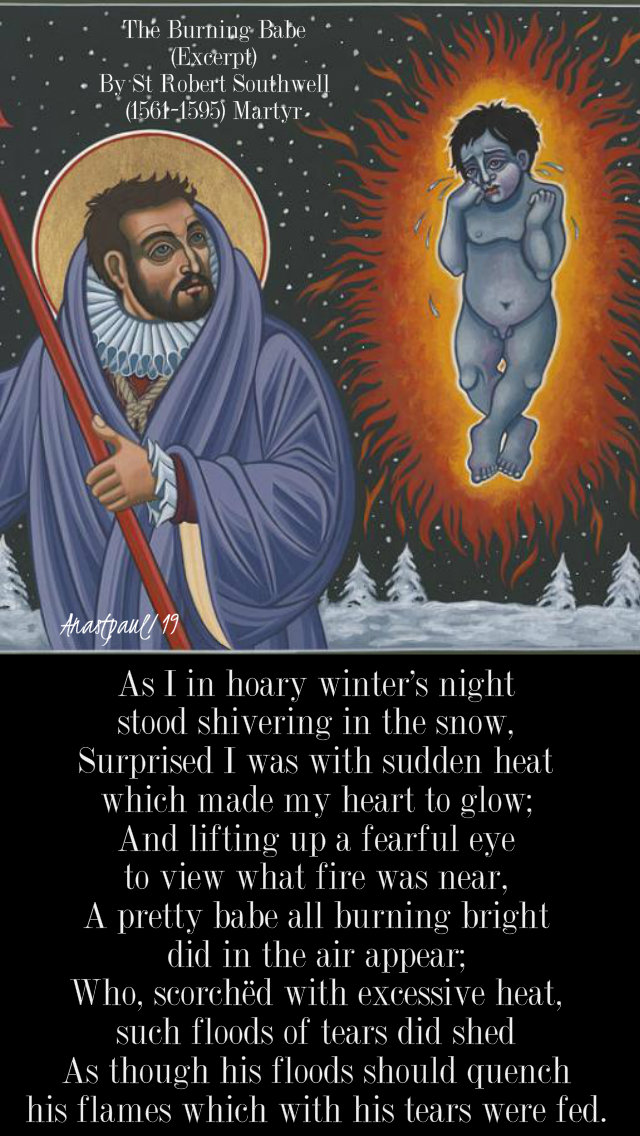
The Burning Babe,
As I in hoary winter’s night stood shivering in the snow, Surprised I was with sudden heat which made my heart to glow; And lifting up a fearful eye to view what fire was near, A pretty babe all burning bright did in the air appear; Who, scorchëd with excessive heat, such floods of tears did shed As though His floods should quench His flames which with His tears were fed. Alas, quoth He but newly born in fiery heats I fry, Yet none approach to warm their hearts or feel my fire but I! My faultless breast the furnace is, the fuel wounding thorns, Love is the fire and sighs the smoke, the ashes shame and scorns; The fuel justice layeth on and mercy blows the coals, The metal in this furnace wrought are men’s defiled souls, For which, as now on fire I am to work them to their good, So will I melt into a bath to wash them in my blood. With this He vanished out of sight and swiftly shrunk away, And straight I called unto mind that it was Christmas day.
St Robert Southwell SJ (1561-1595) Priest and Martyr
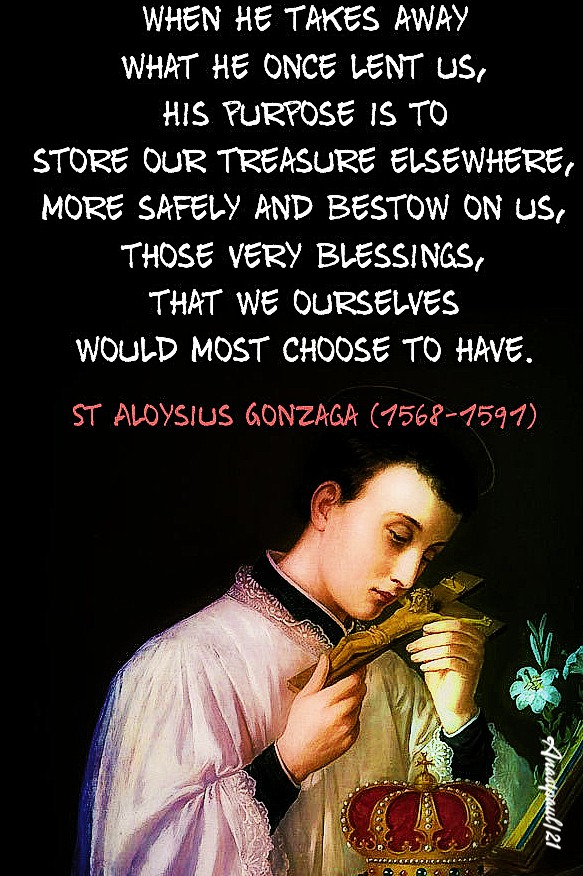
“When He takes away what He once lent us, His purpose is to store our treasure elsewhere, more safely and bestow on us, those very blessings, that we ourselves would most choose to have.” (From A Letter to His Mother)
St Aloysius Gonzaga SJ (1568-1591)
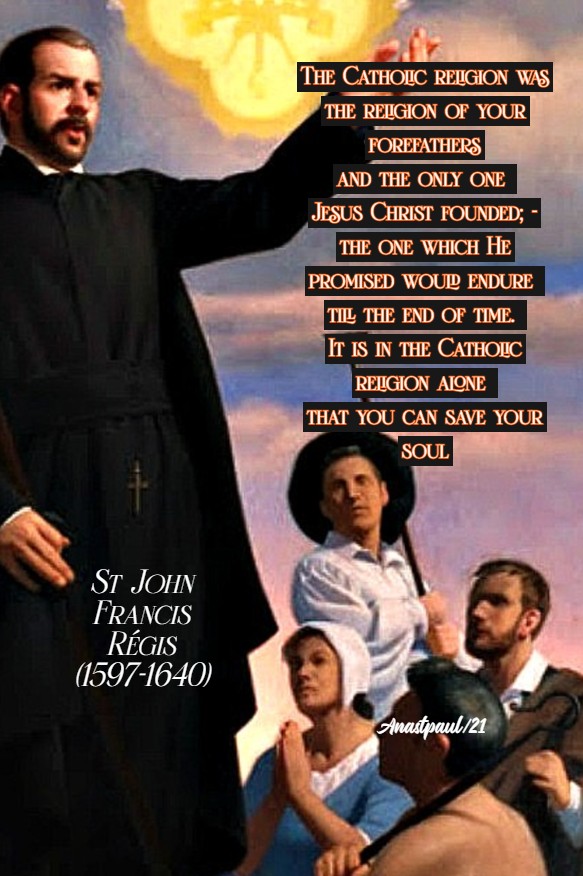
“The Catholic religion was the religion of your forefathers and the only one Jesus Christ founded; – the one which He promised would endure till the end of time. It is in the Catholic religion alone that you can save your soul.”
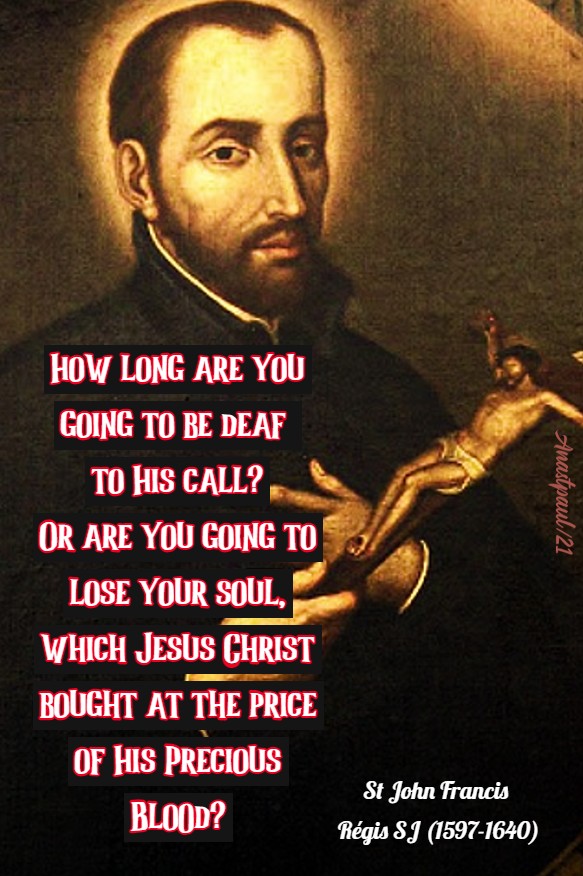
“How long are you going to be deaf to His call? Or are you going to lose your soul, which Jesus Christ bought at the price of His Precious Blood?”
St John Francis Régis SJ (1597-1640)
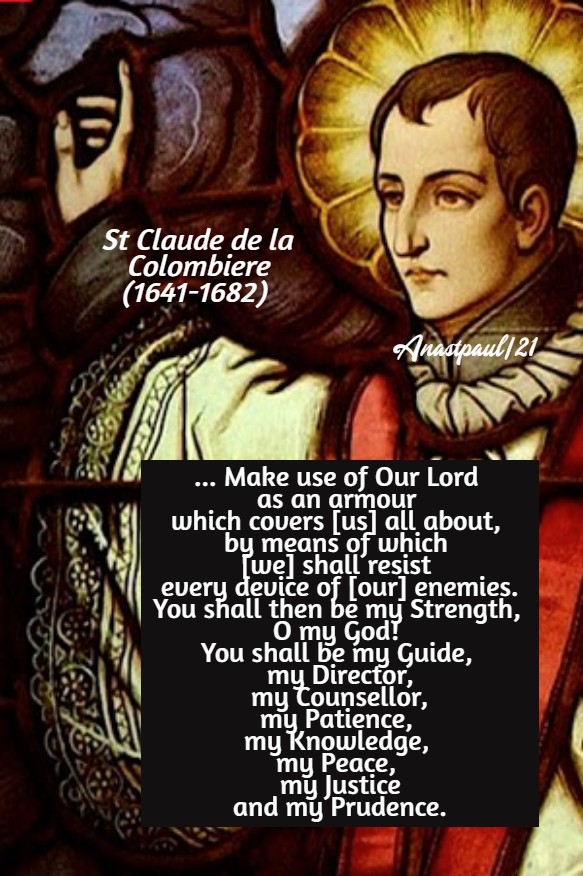
“… Make use of Our Lord as an armour which covers [us] all about, by means of which [we] shall resist every device of [our] enemies. You shall then be my Strength, O my God! You shall be my Guide, my Director, my Counsellor, my Patience, my Knowledge, my Peace, my Justice and my Prudence.”
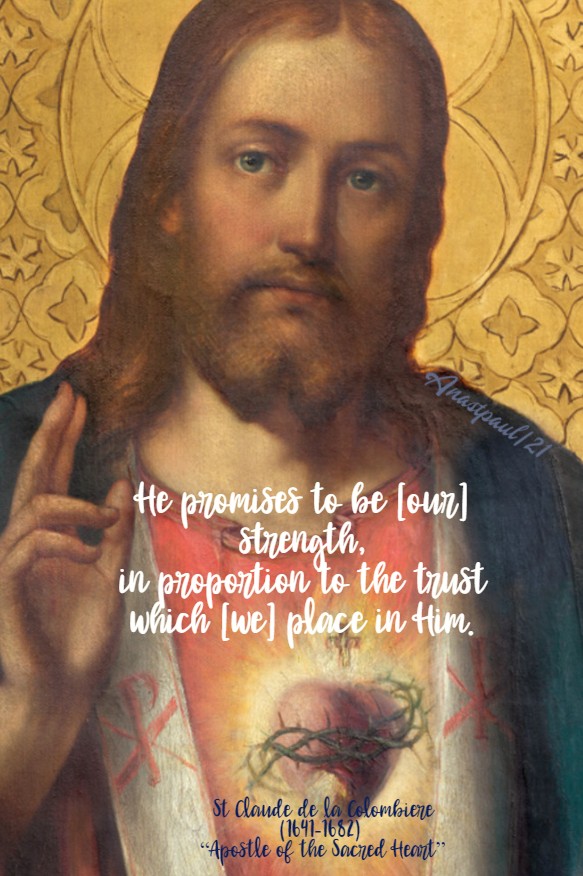
“He promises to be [our] strength, in proportion to the trust which [we] place in Him.”
St Claude de la Colombiere SJ (1641-1682) “Apostle of the Sacred Heart”
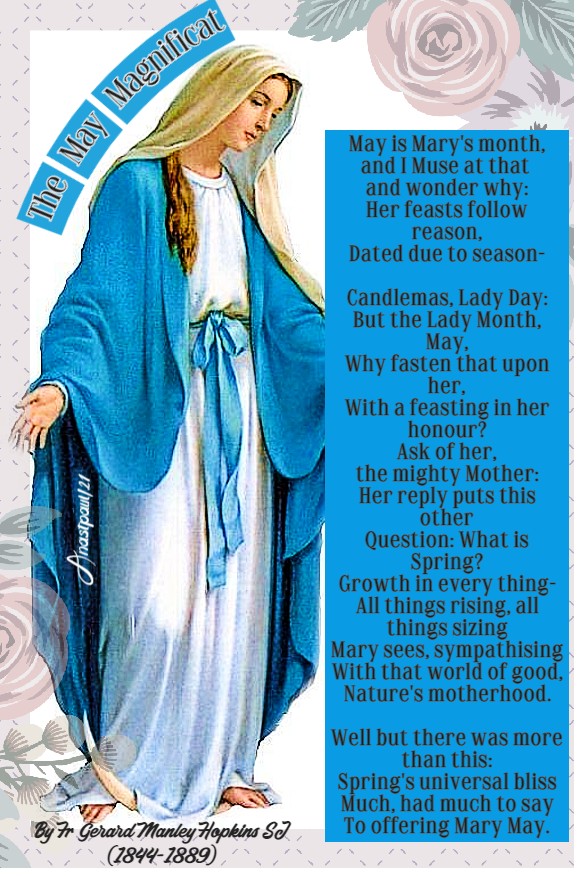
The May Magnificat By Gerard Manley Hopkins SJ (1844-1889)
May is Mary’s month and I Muse at that and wonder why: Her feasts follow reason, Dated due to season-
Candlemas, Lady Day: But the Lady Month, May, Why fasten that upon her, With a feasting in her honour? Ask of her, the mighty Mother: Her reply puts this other Question: What is Spring? Growth in everything- All things rising, all things sizing Mary sees, sympathising With that world of good, Nature’s motherhood.
Well but there was more than this: Spring’s universal bliss Much, had much to say To offering Mary May.
Quote/s of the Day – 20 October – “Month of the Most Holy Rosary” – Readings: Romans 6: 12-18; Psalm 124: 1-8; Luke 12: 39-48
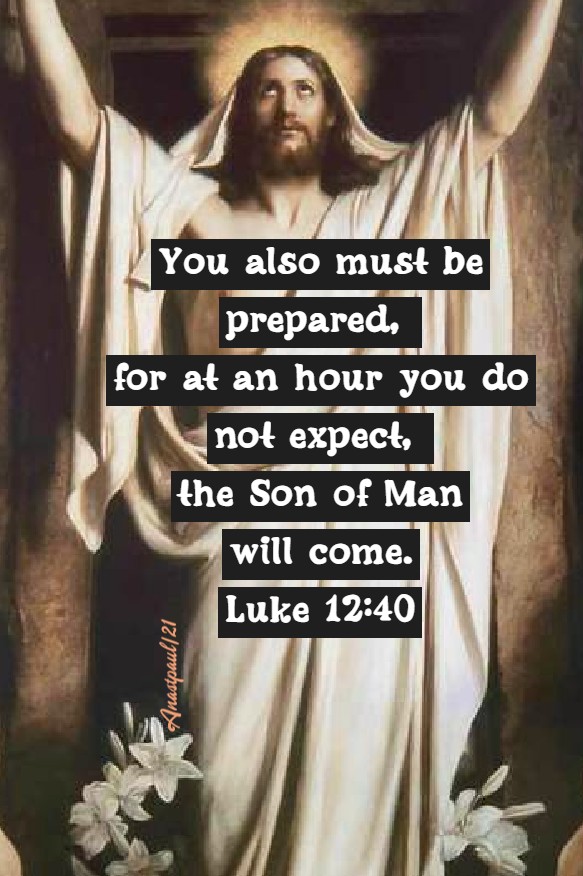
“You also must be prepared, for at an hour you do not expect, the Son of Man will come.”
Luke 12:40
“Therefore, stay awake, for you know neither the day nor the hour.”
Matthew 24:13
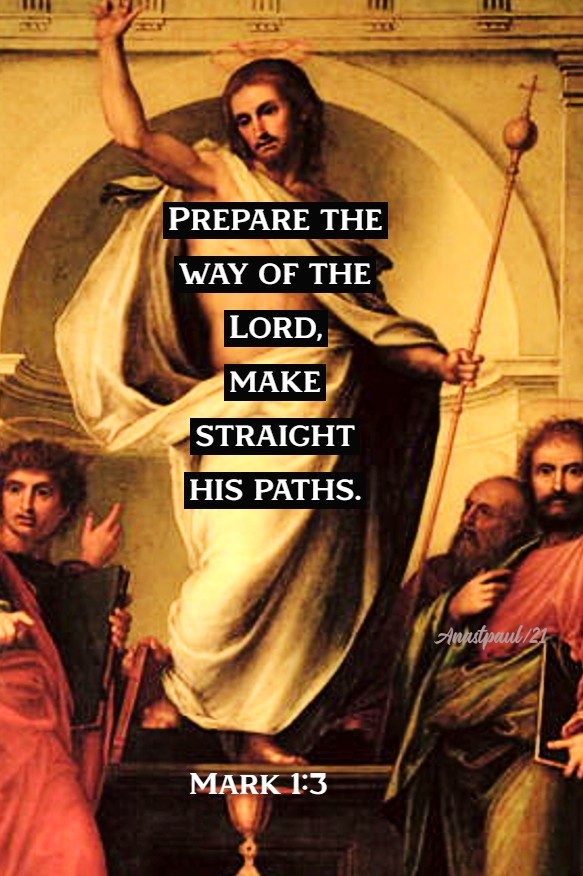
“Prepare the way of the Lord, make straight his paths.”
Mark 1:3
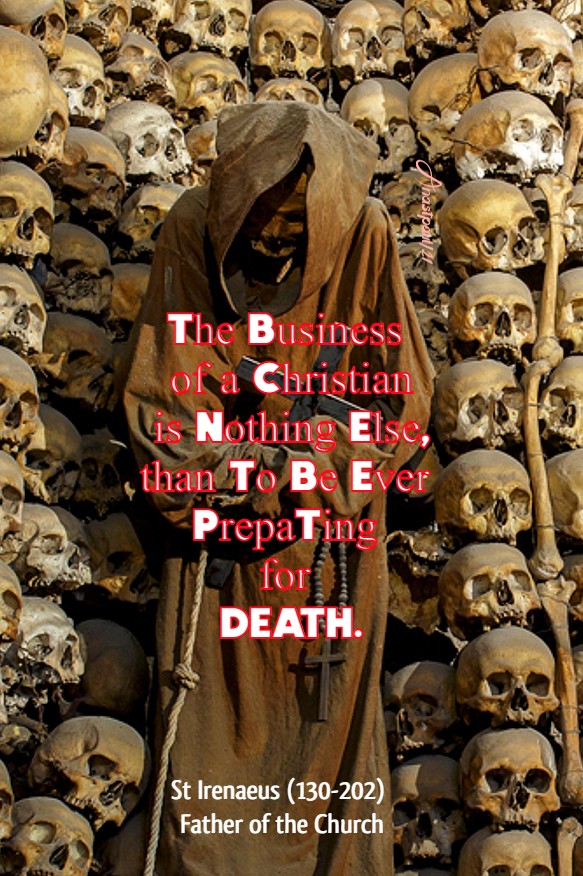
“The business of a Christian is nothing else, than to be ever preparing for death.”
St Irenaeus (130-202) Father of the Church
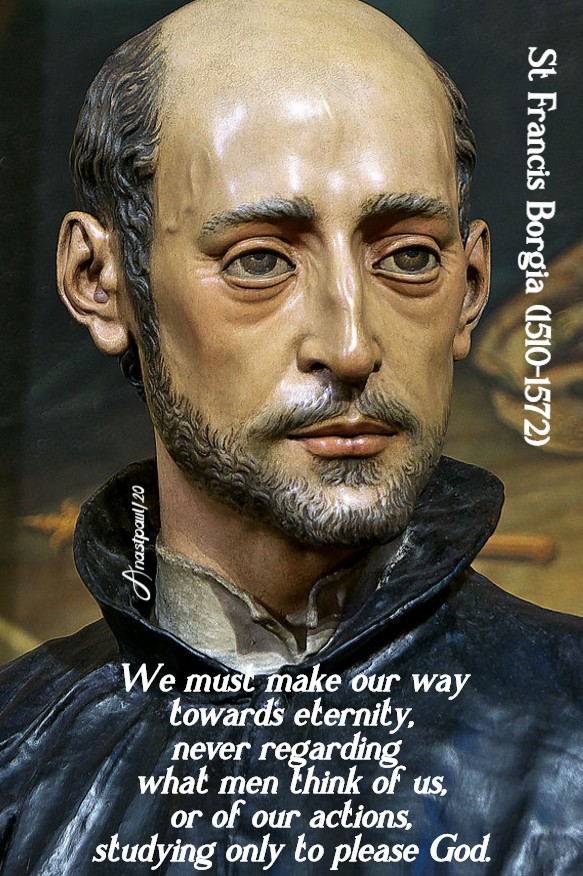
“We must make our way towards eternity, never regarding what men think of us, or of our actions, studying only to please God.”
St Francis Borgia (1510-1572)
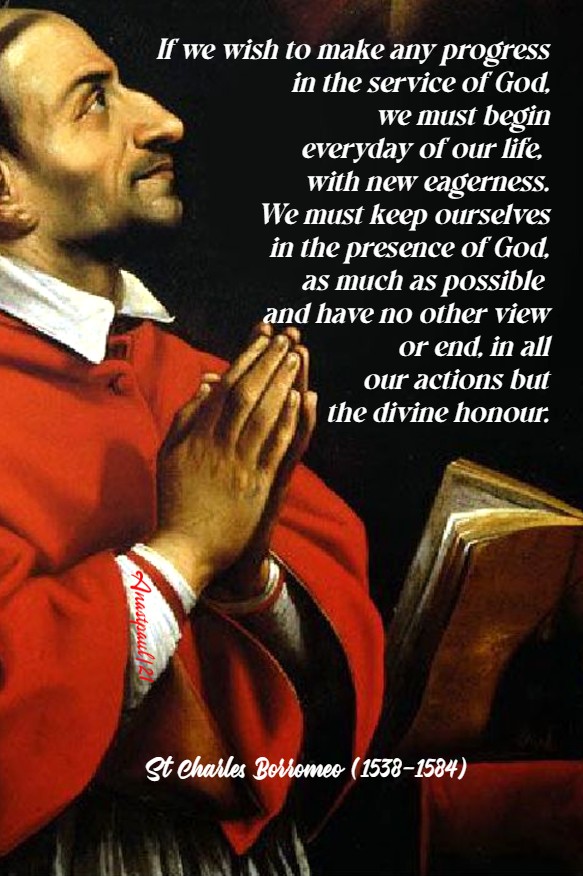
“If we wish to make any progress in the service of God, we must begin everyday of our life, with new eagerness. We must keep ourselves, in the presence of God, as much as possible and have no other view or end, in all our actions but the divine honour.”
St Charles Borromeo (1538-1584)
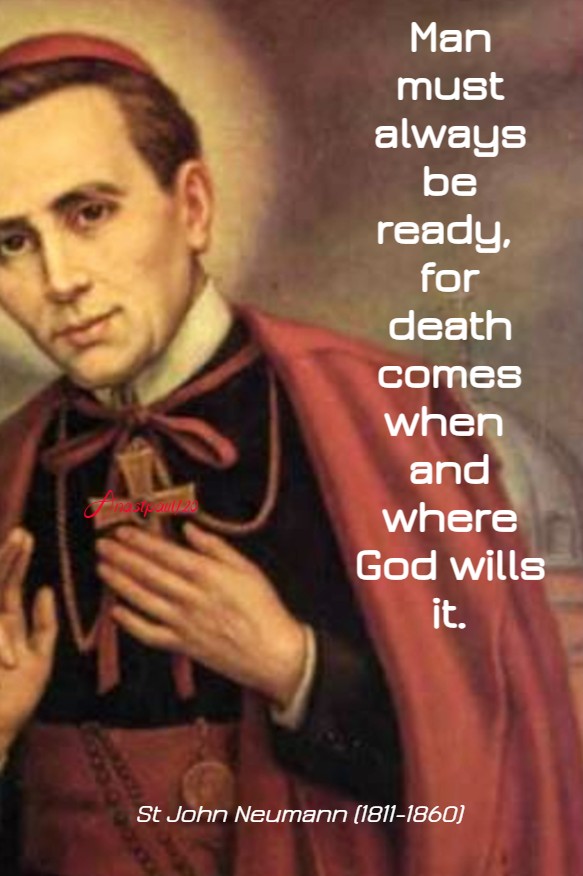
“Man must always be ready, for death comes when and where God wills it.”










































 AnaStpaul
You must be logged in to post a comment.