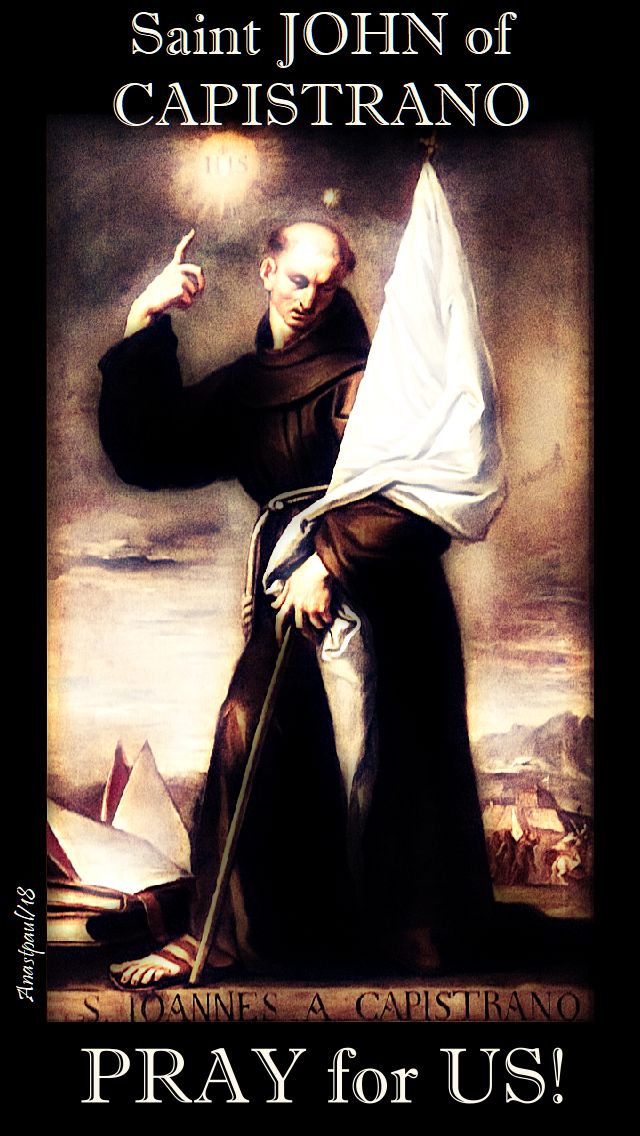
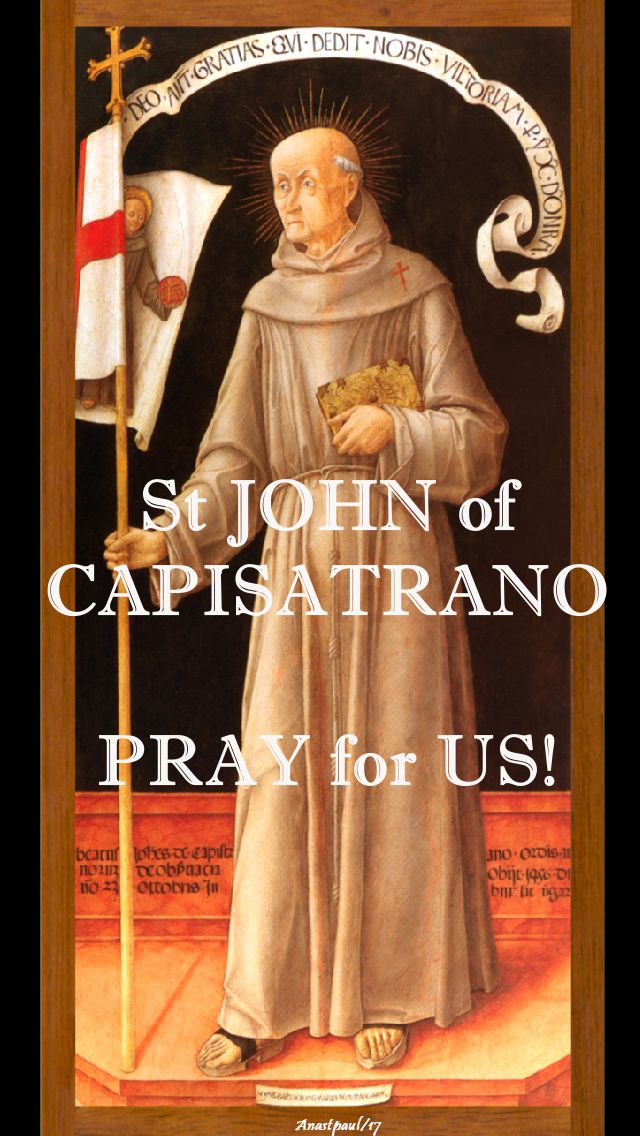
One Minute Reflection – 28 March – “The Month of Saint Joseph” – Friday in the 3rd Week in Lent – St John of Capistrano OFM (1386-1456) Confessor – Wisdom 10:10-14 – Luke 9:1-6 – Scripture search here: https://www.drbo.org/
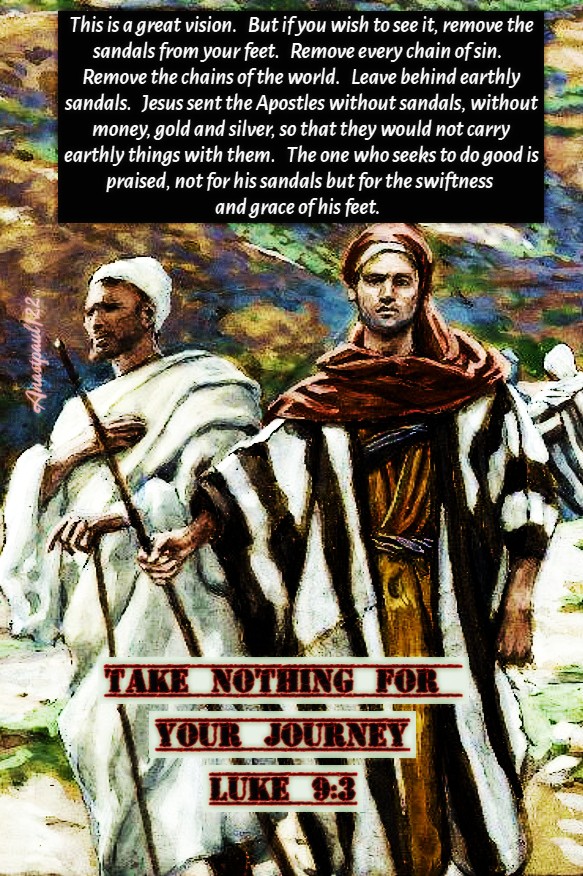
“Take nothing for your journey, neither staff, nor sack, nor bread, nor money; neither have two tunics.” – Luke 9:3
REFLECTION – “This is a great vision. But if you wish to see it, remove the sandals from your feet. Remove every chain of sin. Remove the chains of the world. Leave behind earthly sandals. Jesus sent the Apostles without sandals, without money, gold and silver, so that they would not carry earthly things with them. The one who seeks to do good is praised, not for his sandals but for the swiftness and grace of his feet. The Scripture says, “How beautiful are the feet of those who preach the gospel of peace, of those who bring glad tidings of good things!” Therefore, remove the sandals from your feet, that they may be beautiful for preaching the Gospel!” – St Ambrose (340-397) Bishop of Milan, Father and Doctor of the Church (Flight From the World 5).
PRAYER – O God, Who, through blessed John, made Thy faithful people conquer the enemies of the Cross by the power of the Most Holy Name of Jesus, grant, we beseech Thee, that by his intercession we may avoid the snares of our spiritual enemies and may be found worthy to receive from Thee, the crown of justice. Through esus Christ, Thy Son our Lord, Who lives and reigns with Thee, in the unity of the Holy Ghost, God, world without end. Amen (Collect).
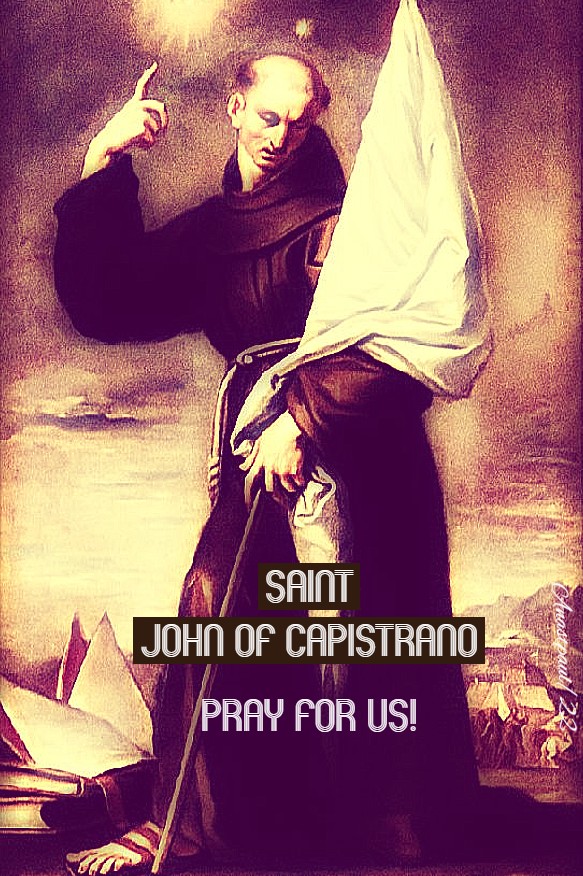
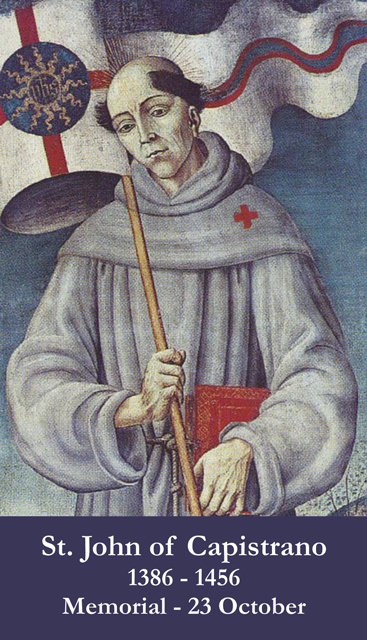
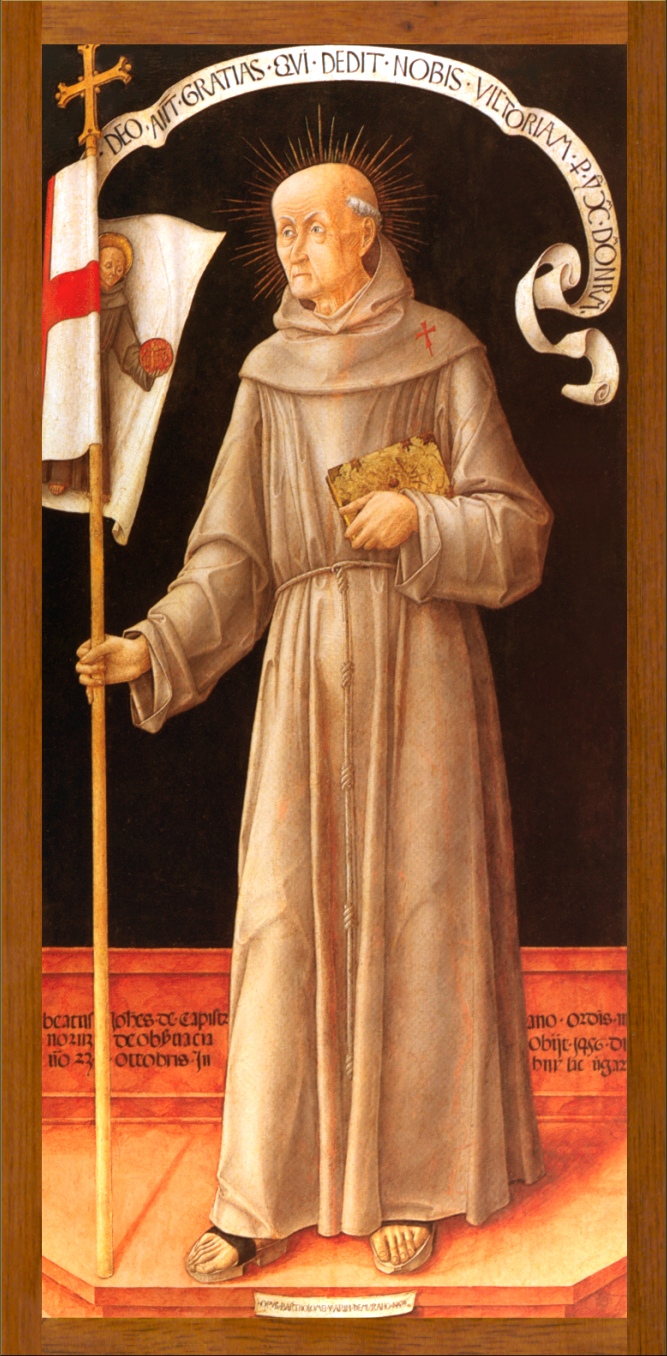
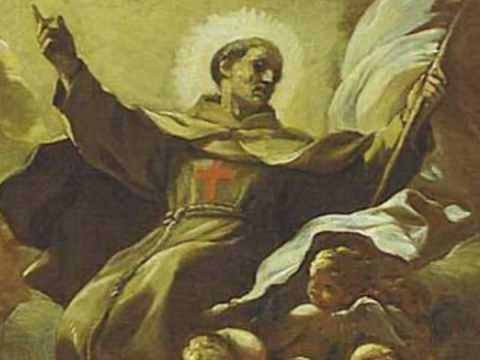
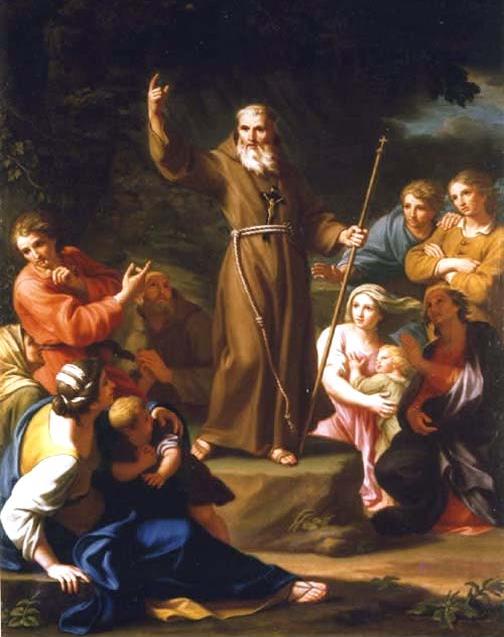
St John of Capistrano OFM (1386-1456) Priest and Friar of the Friars Minor, Confessor and Preacher. Famous as a Preacher, Theologian and Inquisitor, trained Lawyer, he earned himself the nickname ‘the Soldier Saint’ when in 1456 at age 70 he led a Crusade against the invading Ottoman Empire at the Siege of Belgrade. He was Beatified on 19 December 1650 by Pope Innocent X and Canonised on 16 October 1690 by Pope Alexander VIII. Feast Day moved from 28 March in 1969. A Wonderful Saint: https://anastpaul.com/2017/10/23/saint-of-the-day-23-october-st-john-capistrano-ofm-1386-1456-the-soldier-saint/
St Cyril the Deacon St Dorotheus of Tarsus St Gundelindis of Niedermünster
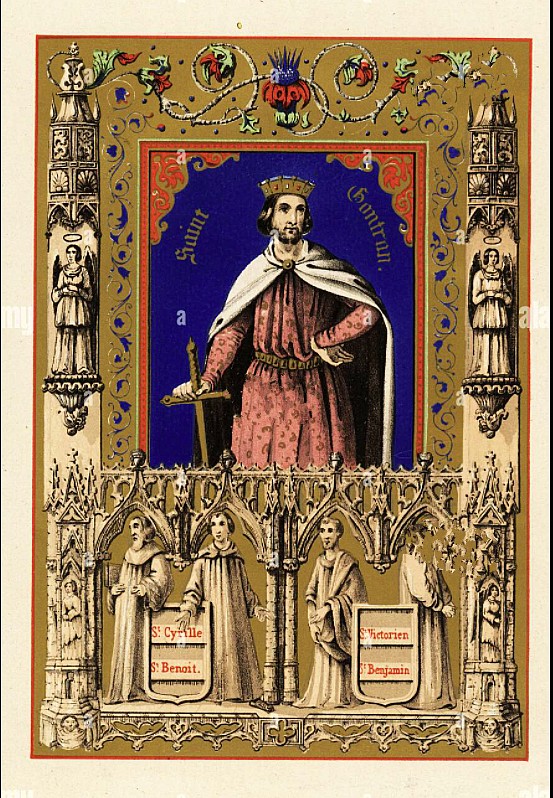
St Guntramnus (c532-592) King of the Kingdom of Orléans and Burgundy from 561 until his death in 592, Confessor, Apostle of the needs of the Church and of the poor and sick, Penitent. The Roman Martyrology reads: “At Chalons in France, the demise of St Gontran King, who devoted himself to exercises of piety, renounced the pomps of the world and bestowed his treasures on the Church and the poor,” A Pious and Generous Ruler: https://anastpaul.com/2022/03/28/saint-of-the-day-28-march-saint-guntramnus-died-597/
Quote/s of the Day – 25 November – Sirach 51:1-8; 5:12, Matthew 25:1-13 – Scripture search here: https://www.drbo.org/
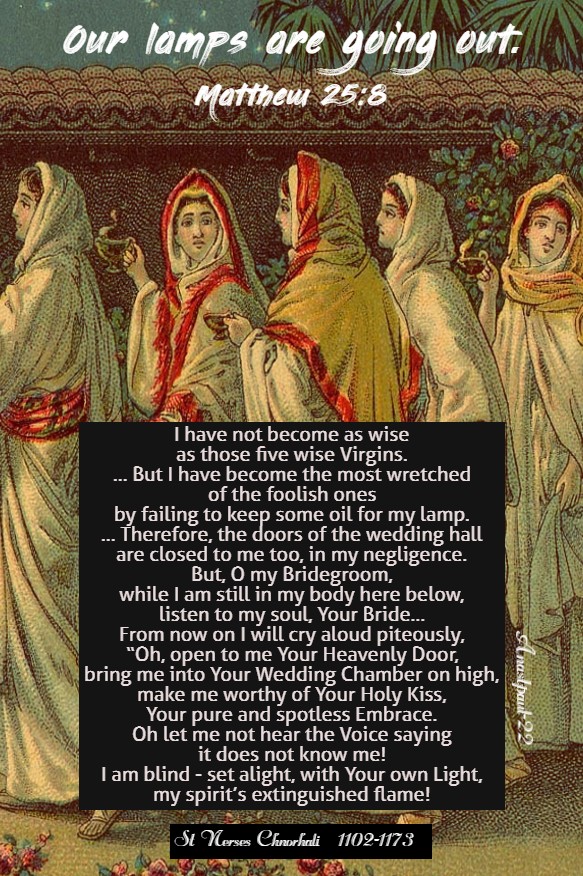
“Our lamps are going out.”
Matthew 25:8
“I have not become as wise as those five wise Virgins. … But I have become the most wretched of the foolish ones by failing to keep some oil for my lamp, namely, mercy together with virginity or, still more, the anointing from Baptism’s Sacred fount…
Therefore, the doors of the wedding hall are closed to me too, in my negligence. But, O my Bridegroom, while I am still in my body here below, listen to my soul, Your Bride… From now on, I will cry aloud piteously, “Oh, open to me Your Heavenly Door, bring me into Your Wedding Chamber on high, make me worthy of Your Holy Kiss, Your pure and spotless Embrace. Oh let me not hear the Voice saying it does not know me! I am blind; set alight with Your own Light my spirit’s extinguished flame!”
St Nerses Chnorhali (1102-1173) Armenian Bishop
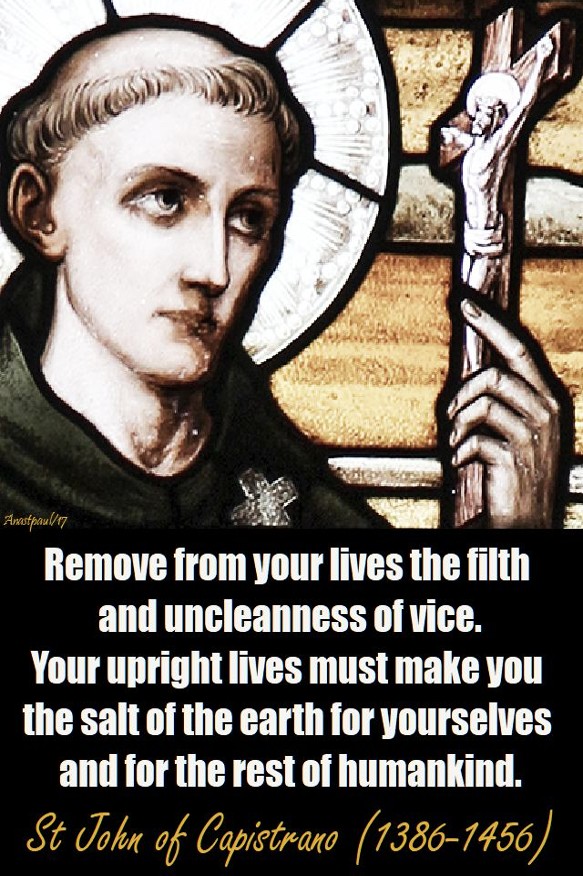
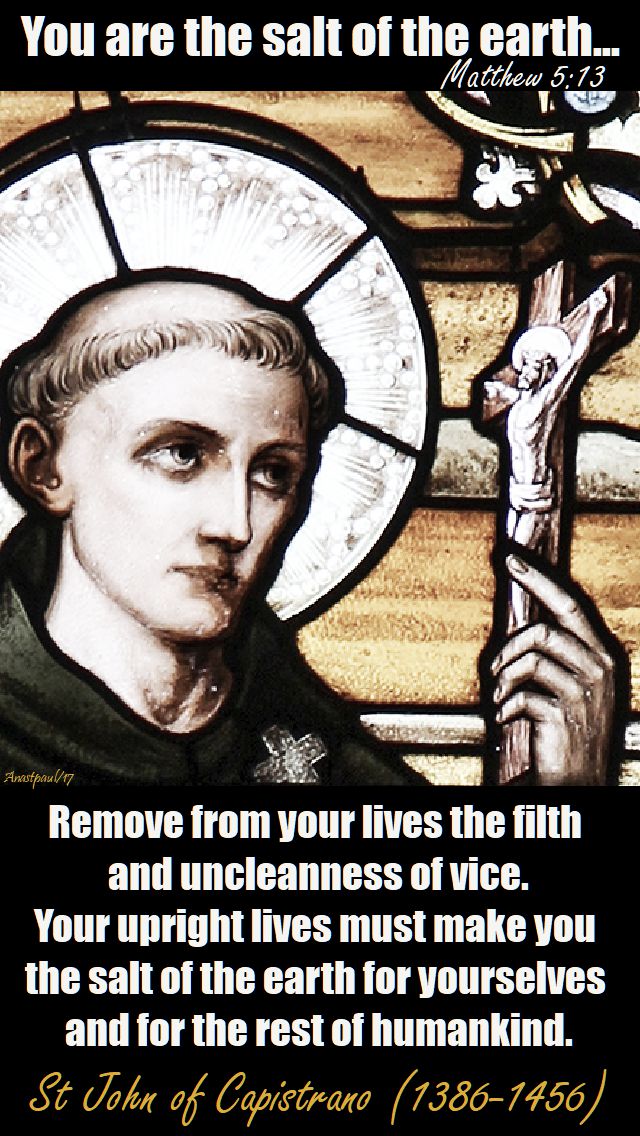
“Remove from your lives the filth and uncleanness of vice. Your upright lives must make you the salt of the earth for yourselves and for the rest of humankind…”
St John of Capistrano OFM (1386-1456)
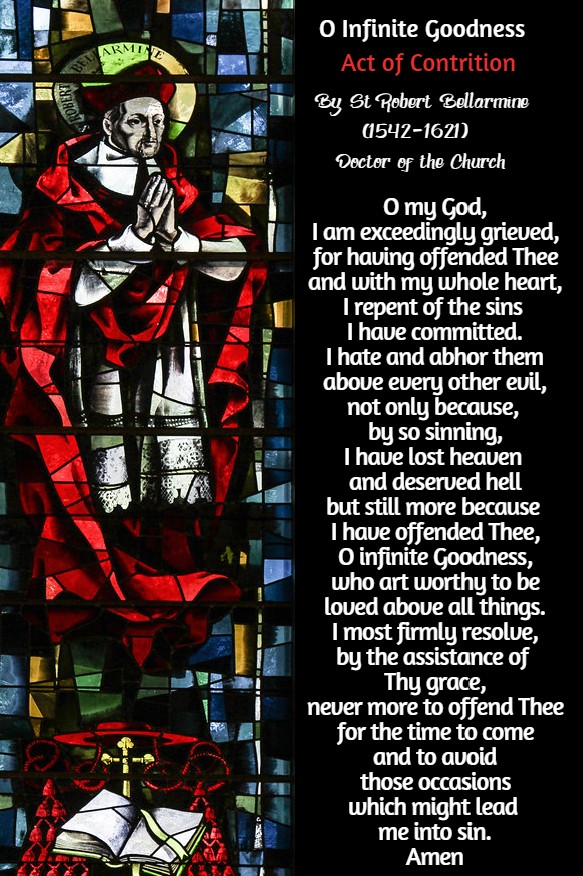
O Infinite Goodness – Act of Contrition By St Robert Bellarmine (1542-1621) – Doctor of the Church
O my God, I am exceedingly grieved, for having offended Thee and with my whole heart, I repent of the sins I have committed. I hate and abhor them above every other evil, not only because, by so sinning, I have lost heaven and deserved hell but still more because I have offended Thee, O infinite Goodness, who art worthy to be loved above all things. I most firmly resolve, by the assistance of Thy grace, never more to offend Thee for the time to come and to avoid those occasions which might lead me into sin. Amen
St John of Capistrano OFM (1386-1456) Priest and Friar of the Friars Minor, Confessor and Preacher. Famous as a Preacher, Theologian and Inquisitor, trained Lawyer, he earned himself the nickname ‘the Soldier Saint’ when in 1456 at age 70 he led a Crusade against the invading Ottoman Empire at the Siege of Belgrade. He was Beatified on 19 December 1650 by Pope Innocent X and Canonised on 16 October 1690 by Pope Alexander VIII. Feast Day moved from 28 March in 1969. Biography: https://anastpaul.com/2017/10/23/saint-of-the-day-23-october-st-john-capistrano-ofm-1386-1456-the-soldier-saint/
St Cyril the Deacon St Dorotheus of Tarsus St Gundelindis of Niedermünster
St Guntramnus (c 532-592) King of the Kingdom of Orléans and Burgundy from 561 until his death in 592, Confessor, Apostle of the needs of the Church and of the poor and sick, Penitent. The Roman Martyrology reads: “At Chalons in France, the demise of St Gontran King, who devoted himself to exercises of piety, renounced the pomps of the world and bestowed his trasures on the Church and the poor,” https://anastpaul.com/2022/03/28/saint-of-the-day-28-march-saint-guntramnus-died-597/
St Hesychius of Jerusalem St Hilarion of Pelecete Blessed Jeanne Marie de Maille (1331-1414) Widow, Recluse St Proterius of Alexandria St Rogatus the Martyr St Successus the Martyr St Tutilo of Saint-Gall
Quote/s of the Day – 28 March – The Memorial of St John of Capistrano OFM (1386-1456)
“Remove from your lives the filth and uncleanness of vice. Your upright lives must make you the salt of the earth for yourselves and for the rest of humankind…”
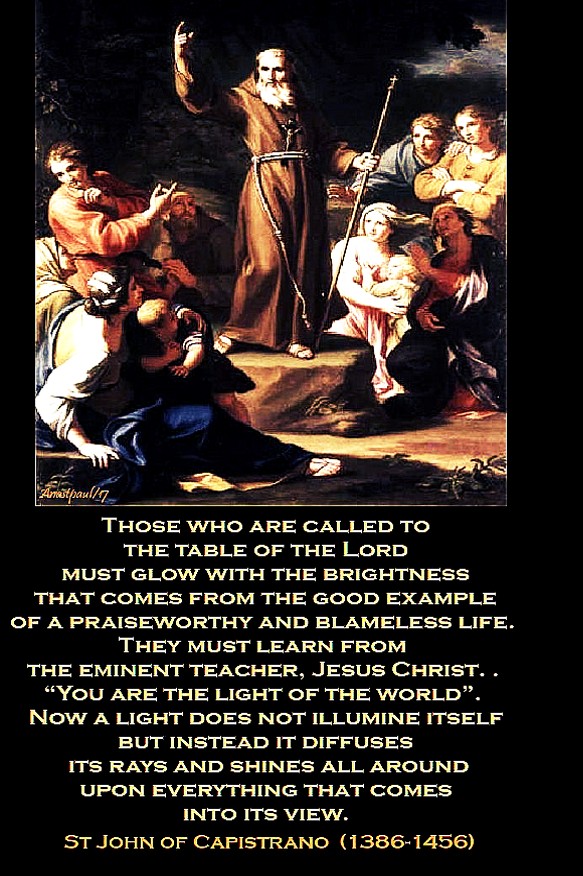
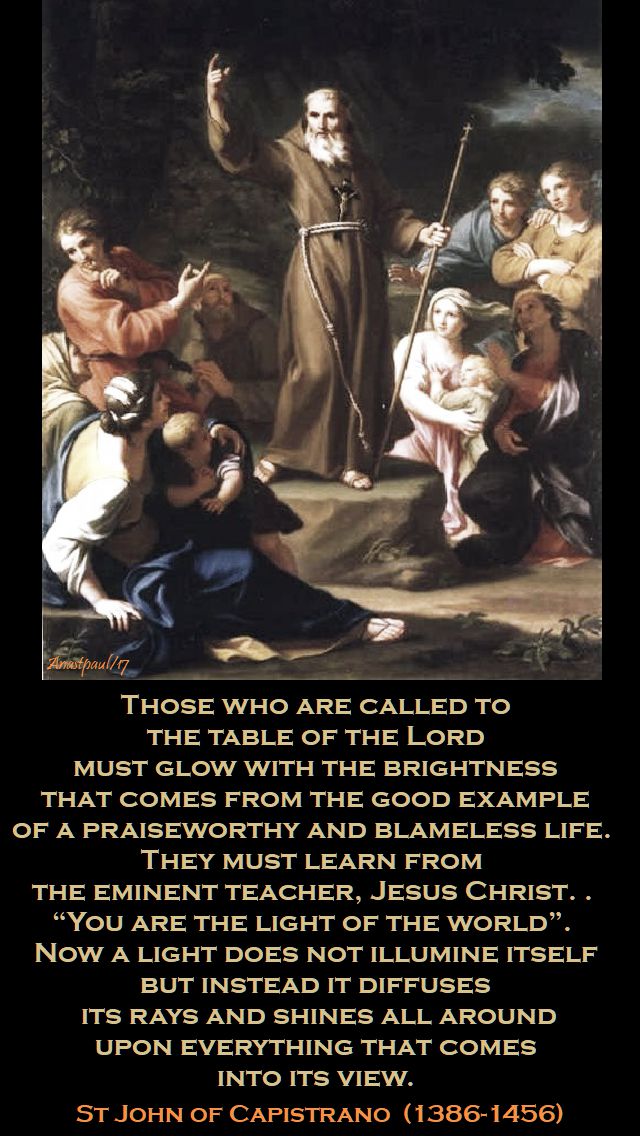
“Those who are called to the table of the Lord must glow with the brightness that comes from the good example of a praiseworthy and blameless life. They must learn from the eminent Teacher, Jesus Christ. . “You are the light of the world” (see Matthew 5:14). Now a light does not illumine itself but instead, it diffuses its rays and shines all around upon everything that comes into its view..“
St John of Capistrano OFM (1386-1456) Friar of the Friars Minor, Priest, Confessor and Preacher. Famous as a preacher, theologian and inquisitor, trained lawyer, he earned himself the nickname ‘the Soldier Saint’ when in 1456 at age 70 he led a crusade against the invading Ottoman Empire at the siege of Belgrade. Feast Day moved from 28 March in 1969. Biography: https://anastpaul.com/2017/10/23/saint-of-the-day-23-october-st-john-capistrano-ofm-1386-1456-the-soldier-saint/
St Cyril the Deacon Bl Dedë Maçaj St Donal O’NeylaC St Dorotheus of Tarsus St Gundelindis of Niedermünster St Guntramnus (c 532-592) King, Confessor St Hesychius of Jerusalem St Hilarion of Pelecete Bl Jean-Baptiste Malo Bl Jeanne Marie de Maille St Proterius of Alexandria Bl Renée-Marie Feillatreau épouse Dumont St Rogatus the Martyr St Successus the Martyr St Tutilo of Saint-Gall
Feast of the Most Holy Redeemer – The Feast of the Most Holy Redeemer was a Catholic liturgical feast. It is celebrated in Venice as the Festa del Redentore. It is also celebrated by the Redemptorists and was celebrated in the City of Rome. The feast is found only in the special calendar of some Diocese and religious Orders and is celebrated with proper Mass and Office either on the third Sunday of July or on 23 October. https://anastpaul.com/2019/10/23/the-feast-of-the-most-holy-redeemer-23-october/
St John of Capistrano OFM (1386-1456) “The Soldier Saint.” Franciscan Friar and Priest, Confessor and Preacher. Famous as a preacher, theologian and inquisitor, trained lawyer, he earned himself the nickname ‘the Soldier Saint’ when in 1456 at age 70 he led a crusade against the invading Ottoman Empire at the siege of Belgrade with the Hungarian military commander John Hunyadi, called the Athleta Christi (“Christ’s Champion”) by Pope Pius II. (Optional Memorial) St John’s Story here: https://anastpaul.wordpress.com/2017/10/23/saint-of-the-day-23-october-st-john-capistrano-ofm-1386-1456-the-soldier-saint/
Bl John Buoni St John of Syracuse St Oda of Aquitaine St Phaolô Tong Viet Buong St Romanus of Rouen St Severinus of Cologne St Syra of Faremoutiers St Theodoret of Antioch Bl Thomas Thwing St Verus of Salerno — Martyrs of Cadiz – 2 saints Germanus Servandus Martyrs of Hadrianopolis – 2 saints Dorotheus Severus Martyrs of Nicaea – 3 saints Euerotas Socrates Theodota
Martyrs of Valenciennes – 6 beati: A group of Urusuline and Briggittine nuns murdered together in the anti-Christian excesses of the French Revolution. They were guillotined on 23 October 1794 in Valenciennes, Nord, France and Beatified on 13 June 1920 by Pope Benedict XV. • Anne-Joseph Leroux • Clotilde-Joseph Paillot • Jeanne-Louise Barré • Marie-Augustine Erraux • Marie-Liévine Lacroix • Marie-Marguerite-Joseph Leroux
Martyred in the Spanish Civil War including Martyrs of Manzanares (7 beati): • Agapit Gorgues Manresa • Agustín Nogal Tobar • Andrés Navarro Sierra • César Elexgaray Otazua • Cristóbal González Carcedo • Dorinda Sotelo Rodríguez • Eduardo Valverde Rodríguez • Felipe Basauri Altube • José María Fernández Sánchez • Juan Nuñez Orcajo • Leonardo Olivera Buera • Manuel Navarro Martínez • Roque Guillén Garcés • Toribia Marticorena Sola
St Benedict of Sebaste St Clether St Domitius St Elfleda St Ethelfleda St Gratien of Amiens St Henry of Cologne St Ignatius of Constantinople Blessed John Angelo Porro OSM (1451-1505) Bl John Buoni St John of Syracuse St Oda of Aquitaine St Phaolô Tong Viet Buong St Romanus of Rouen Bl Severinus Boethius St Severinus of Cologne Syra of Faremoutiers St Theodoret of Antioch Bl Thomas Thwing St Verus of Salerno — Martyrs of Cadiz – 2 saints Germanus Servandus Martyrs of Hadrianopolis – 2 saints Dorotheus Severus Martyrs of Nicaea – 3 saints Euerotas Socrates Theodota
Martyrs of Valenciennes – 6 beati: A group of Urusuline and Briggittine nuns murdered together in the anti-Christian excesses of the French Revolution. They were guillotined on 23 October 1794 in Valenciennes, Nord, France and Beatified on 13 June 1920 by Pope Benedict XV. • Anne-Joseph Leroux • Clotilde-Joseph Paillot • Jeanne-Louise Barré • Marie-Augustine Erraux • Marie-Liévine Lacroix • Marie-Marguerite-Joseph Leroux
Martyred in the Spanish Civil War including Martyrs of Manzanares (7 beati): • Agapit Gorgues Manresa • Agustín Nogal Tobar • Andrés Navarro Sierra • César Elexgaray Otazua • Cristóbal González Carcedo • Dorinda Sotelo Rodríguez • Eduardo Valverde Rodríguez • Felipe Basauri Altube • José María Fernández Sánchez • Juan Nuñez Orcajo • Leonardo Olivera Buera • Manuel Navarro Martínez • Roque Guillén Garcés • Toribia Marticorena Sola
St Benedict of Sebaste
St Clether
St Domitius
St Elfleda
St Ethelfleda
St Gratien of Amiens
St Henry of Cologne
St Ignatius of Constantinople
Bl John Angelo Porro
Bl John Buoni
St John of Syracuse
Oda of Aquitaine
St Phaolô Tong Viet Buong
St Romanus of Rouen
Bl Severinus Boethius
St Severinus of Cologne
Syra of Faremoutiers
St Theodoret of Antioch
Bl Thomas Thwing
St Verus of Salerno
—
Martyrs of Cadiz – 2 saints
Germanus
Servandus
Martyrs of Hadrianopolis – 2 saints
Dorotheus
Severus
Martyrs of Nicaea – 3 saints
Euerotas
Socrates
Theodota
Martyrs of Valenciennes – 6 beati: A group of Urusuline and Briggittine nuns murdered together in the anti-Christian excesses of the French Revolution. They were guillotined on 23 October 1794 in Valenciennes, Nord, France and Beatified on 13 June 1920 by Pope Benedict XV.
• Anne-Joseph Leroux
• Clotilde-Joseph Paillot
• Jeanne-Louise Barré
• Marie-Augustine Erraux
• Marie-Liévine Lacroix
• Marie-Marguerite-Joseph Leroux
Martyred in the Spanish Civil War including Martyrs of Manzanares (7 beati):
• Agapit Gorgues Manresa
• Agustín Nogal Tobar
• Andrés Navarro Sierra
• César Elexgaray Otazua
• Cristóbal González Carcedo
• Dorinda Sotelo Rodríguez
• Eduardo Valverde Rodríguez
• Felipe Basauri Altube
• José María Fernández Sánchez
• Juan Nuñez Orcajo
• Leonardo Olivera Buera
• Manuel Navarro Martínez
• Roque Guillén Garcés
• Toribia Marticorena Sola
Thought for the Day – 23 October – The Memorial of St John of Capistrano OFM (1386-1456)
It has been said the Christian saints are the world’s greatest optimists. Not blind to the existence and consequences of evil, they base their confidence on the power of Christ’s redemption. The power of conversion through Christ extends not only to sinful people but also to calamitous events.
Imagine being born in the 14th century. One-third of the population and nearly 40 percent of the clergy were wiped out by the bubonic plague. The Western Schism split the Church with two or three claimants to the Holy See at one time. England and France were at war. The city-states of Italy were constantly in conflict. No wonder that gloom dominated the spirit of the culture and the times.
John Capistrano was born in 1386. His education was thorough. His talents and success were great. When he was 26 he was made governor of Perugia. Imprisoned after a battle against the Malatestas, he resolved to change his way of life completely. At the age of 30 he entered the Franciscan novitiate and was ordained a priest four years later.
John’s preaching attracted great throngs at a time of religious apathy and confusion. He and 12 Franciscan brethren were received in the countries of central Europe as angels of God. They were instrumental in reviving a dying faith and devotion.
The Franciscan Order itself was in turmoil over the interpretation and observance of the Rule of St Francis. Through John’s tireless efforts and his expertise in law, the heretical Fraticelli were suppressed and the “Spirituals” were freed from interference in their stricter observance.
John of Capistrano helped bring about a brief reunion with the Greek and Armenian Churches.
When the Turks captured Constantinople in 1453, John was commissioned to preach a crusade for the defence of Europe. Gaining little response in Bavaria and Austria, he decided to concentrate his efforts in Hungary. He led the army to Belgrade. Under the great General John Hunyadi, they gained an overwhelming victory and the siege of Belgrade was lifted. Worn out by his superhuman efforts, Capistrano was an easy prey to an infection after the battle. He died on October 23, 1456.
John Hofer, a biographer of John Capistrano, recalls a Brussels organisation named after the saint. Seeking to solve life problems in a fully Christian spirit, its motto was: “Initiative, Organisation, Activity.” These three words characterised John’s life. He was not one to sit around. His deep Christian optimism drove him to battle problems at all levels with the confidence engendered by a deep faith in Christ. (Lives of the Saints – Franciscan Media)
Thought for the Day – 23 October – The Memorial of St John of Capistrano (1386-1456)
John was a Franciscan friar and priest, but not of the good-natured variety of Franciscans that holds the popular imagination. To describe John as zealous would be an understatement. He walked the fine line between zeal and fanaticism, allowing God to write straight with the crooked lines he drew throughout his life. Some might wonder why such a man is even a saint but he is, and the lesson in that might be that being a saint is about more than just being nice and friendly. Sanctity is an uncanny quality that can be as off-putting as it is attractive.
We might be “put off” by a saint like John Capistrano. Perhaps the lesson there is that if he made it, there is hope for us all.
John Hofer, a biographer of John Capistrano, recalls a Brussels organization named after the saint. Seeking to solve life problems in a fully Christian spirit, its motto was: “Initiative, Organisation, Activity.” These three words characterised John’s life. He was not one to sit around. His deep Christian optimism drove him to battle problems at all levels with the confidence engendered by a deep faith in Christ.
We are not Christians because we build and maintain institutions. We are Christians because people experience in us an invitation to know Jesus Christ and find in His Church the reality of His divine life and presence.
Quote of the Day – 23 October – The Memorial of St John of Capistrano (1386-1456)
“Those who are called to the table of the Lord must glow with the brightness that comes from the good example of a praiseworthy and blameless life. They must learn from the eminent teacher, Jesus Christ. . “You are the light of the world” (see Matthew 5:14). Now a light does not illumine itself but instead it diffuses its rays and shines all around upon everything that comes into its view..“
One Minute Reflection – 23 October – The Memorial of St John of Capistrano (1386-1456)
You are the salt of the earth.……Matthew 5:13
REFLECTION – Remove from your lives the filth and uncleanness of vice.
Your upright lives must make you the salt of the earth for yourselves
and for the rest of humankind…….St John of Capistrano
PRAYER – Heavenly Father, enable me both to practice and to preach Your Message to all those I meet. Grant that – in accord with Your Son’s mandate – I may be the salt of the earth. St John of Capistrano, you lived a zealous life endlessly becoming “salt” to all.
Please pray for us that we may grow in zeal to glorify the Kingdom by our lives! Amen
Saint of the Day – 23 October – St John Capistrano OFM (1386-1456) Priest and Friar of the Friars Minor, Confessor and Preacher. Famous as a Preacher, Theologian and Inquisitor, trained Lawyer, he earned himself the nickname ‘the Soldier Saint’ when, in 1456 at age 70 he led a Crusade against the invading Ottoman Empire at the Siege of Belgrade with the Hungarian Military Commander, John Hunyadi, called theAthleta Christi (“Christ’s Champion”) by Pope Pius II. Born in 1386 at Capistrano, Italy – 23 October 1456 at Villach, Hungary of natural causes. He was Beatified on 19 December 1650 by Pope Innocent X and Canonised on 16 October 1690 by Pope Alexander VIII. Patronages – judges, jurists • lawyers • military chaplains • military ordinariate of the Philippines • Hungary and Belgrade, Serbia. He was buried in Ilok, Croatia.
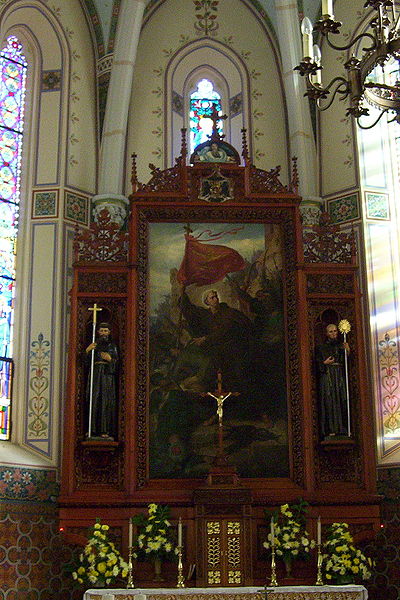
St John of Capistrano Church in Ilok, Croatia
As was the custom of this time, John is denoted by the village of Capestrano, in the Diocese of Sulmona, in the Abruzzi region, Kingdom of Naples. He studied law at the University of Perugia. In 1412, King Ladislaus of Naples appointed him Governor of Perugia. When war broke out between Perugia and the Malatestas in 1416, John was sent as ambassador to broker a peace but Malatesta threw him in prison. It was during this imprisonment that he began to think more seriously about his soul. He decided eventually to give up the world and become a Franciscan Friar, owing to a dream he had in which he saw St Francis and was warned by the saint to enter the Franciscan Order. Having never consummated the marriage, he asked and received permission from his wife to annul the marriage and started studying theology with St Bernardine of Siena.
Together with St James of the Marches, John entered the Order of Friars Minor at Perugia on 4 October 1416. At once he gave himself up to the most rigorous asceticism, violently defending the ideal of strict observance and orthodoxy, following the example set by Bernardine. From 1420 onwards, he preached with great effect in numerous cities and eventually became well known.
Unlike most Italian preachers of repentance in the 15th century, John was effective in northern and central Europe – in German states of Holy Roman Empire, Bohemia, Moravia, Austria, Hungary, Croatia and Kingdom of Poland. The largest churches could not hold the crowds, so he preached in the public squares—at Brescia in Italy, he preached to a crowd of 126,000.
When he was not preaching, John was writing tracts against heresy of every kind. This facet of his life is covered in great detail by his early biographers, Nicholas of Fara, Christopher of Varese and Girlamo of Udine. While he was thus evangelising, he was actively engaged in assisting Bernardine of Siena in the reform of the Franciscan Order, largely in the interests of a more rigorous discipline in the Franciscan communities. Like Bernardine, he strongly emphasised devotion to the Holy Name of Jesus and, together with that saint, was accused of heresy on this account. In 1429, these Observant friars were called to Rome to answer charges of heresy and John was chosen by his companions to speak for them. They were both acquitted by the Commission of Cardinals appointed to judge the accusations.
John, in spite of this restless life, found time to work—both during the lifetime of his mentor, Bernardine and afterwards—on the reform of the Order of Friars Minor. He also upheld, in his writings, speeches and sermons, theories of papal supremacy rather than the theological wranglings of councils (see Conciliar Movement). John, together with his teacher, Bernardine, his colleague, James of the Marche, and Blessed Albert Berdini of Sarteano, are considered the four great pillars of the Observant reform among the Friars Minor.
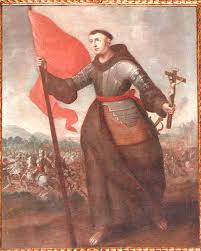
After the Fall of Constantinople in 1453, the Ottoman Empire, under Sultan Mehmed II, threatened Christian Europe. That following year Pope Callixtus III sent John, who was already aged seventy, to preach a Crusade against the invading Turks at the Imperial Diet of Frankfurt. Gaining little response in Bavaria and Austria, he decided to concentrate his efforts in Hungary. John succeeded in gathering together enough troops to march onto Belgrade, which at that time was under siege by Turkish forces. In the summer of 1456, these troops, together with John Hunyadi, managed to raise the siege of Belgrade; the old and frail friar actually led his own contingent into battle. This feat earned him the moniker of ‘the Soldier Priest’.
Although he survived the battle, John fell victim to the bubonic plague, which flourished in the unsanitary conditions prevailing among armies of the day. He died on 23 October 1456 at the nearby town of Ilok, Kingdom of Croatia in personal union with Hungary (now a Croatian border town on the Danube).
You must be logged in to post a comment.