One Minute Reflection – 18 October – The Feast of St Luke the Evangelist, Gospel: Luke 10:1-9
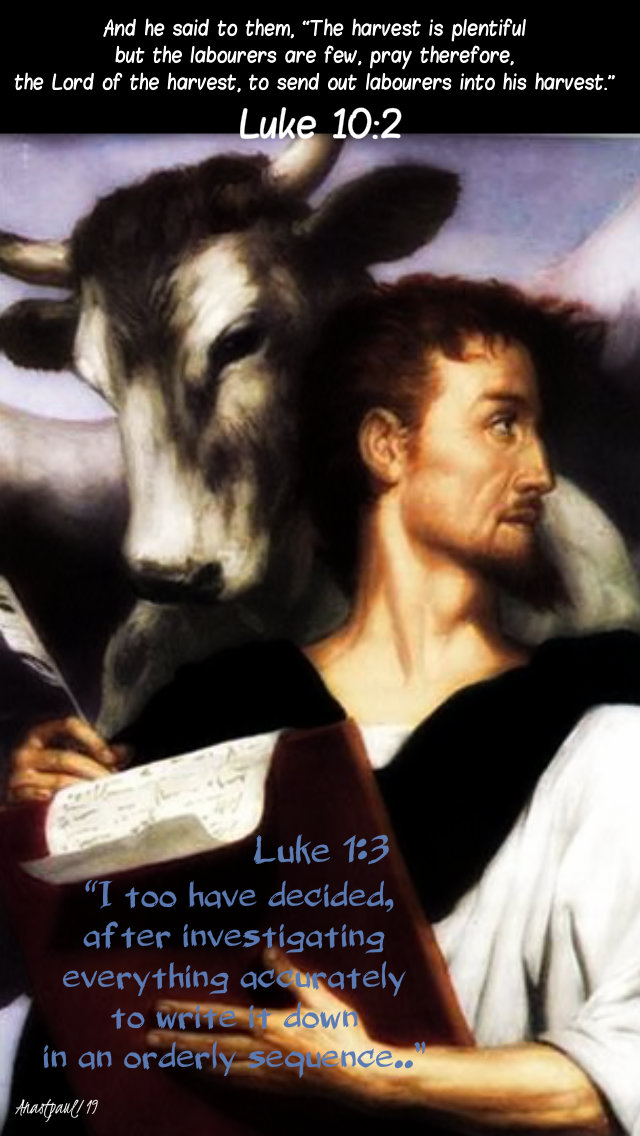
And he said to them, “The harvest is plentiful but the labourers are few, pray therefore, the Lord of the harvest, to send out labourers into his harvest.” … Luke 10:2
Saint Luke’s testimony – “I too have decided, after investigating everything accurately to write it down in an orderly sequence” (Luke 1:3)
REFLECTION – “Among all the Scriptures, even those of the New Testament, the Gospels have a special pre-eminence and rightly so, for they are the principal witness for the life and teaching of the incarnate Word, our Saviour. The Church has always and everywhere, held and continues to hold, that the four Gospels are of apostolic origin. For what the Apostles preached in fulfilment of the commission of Christ, afterwards, they themselves and apostolic men, under the inspiration of the divine Spirit, handed on to us in writing – the foundation of faith, namely, the fourfold Gospel, according to Matthew, Mark, Luke and John.
Holy Mother Church has firmly and with absolute constancy, held and continues to hold, that the four Gospels just named, whose historical character the Church unhesitatingly asserts, faithfully hand on what Jesus Christ, while living among men, really did and taught for their eternal salvation until the day He was taken up into heaven (Acts 1:1-2). Indeed, after the Ascension of the Lord the Apostles handed on to their hearers what He had said and done. This they did with that clearer understanding which they enjoyed after they had been instructed by the glorious events of Christ’s life and taught by the light of the Spirit of truth (Jn 14:26).
The sacred authors wrote the four Gospels, selecting some things from the many which had been handed on by word of mouth or in writing, reducing some of them to a synthesis, explaining some things in view of the situation of their churches and preserving the form of proclamation but always, in such fashion, that they told us the honest truth about Jesus. For their intention in writing, was that either from their own memory and recollections, or from the witness of those who “themselves from the beginning were eyewitnesses and ministers of the Word” we might know “the truth concerning those matters about which we have been instructed” (Lk 1, 1-4). … Vatican Council II – Dogmatic Constitution on Revelation “ Dei Verbum ” # 18-19
PRAYER – Lord God, You chose St Luke to reveal the mystery of Your love in his preaching and his writings. Grant, we pray, that we may grow in love for the Holy Face of Christ, His words and His directions, revealed to us in the Gospels, in the example of your saints. Today, on his feast, we especially look to St Luke, to guide, teach and pray for us. We make our prayer through our Lord Jesus Christ, with the Holy Spirit, one God with You, forever and ever, amen.
Our Morning Offering – 18 October – The Feast of St Luke,
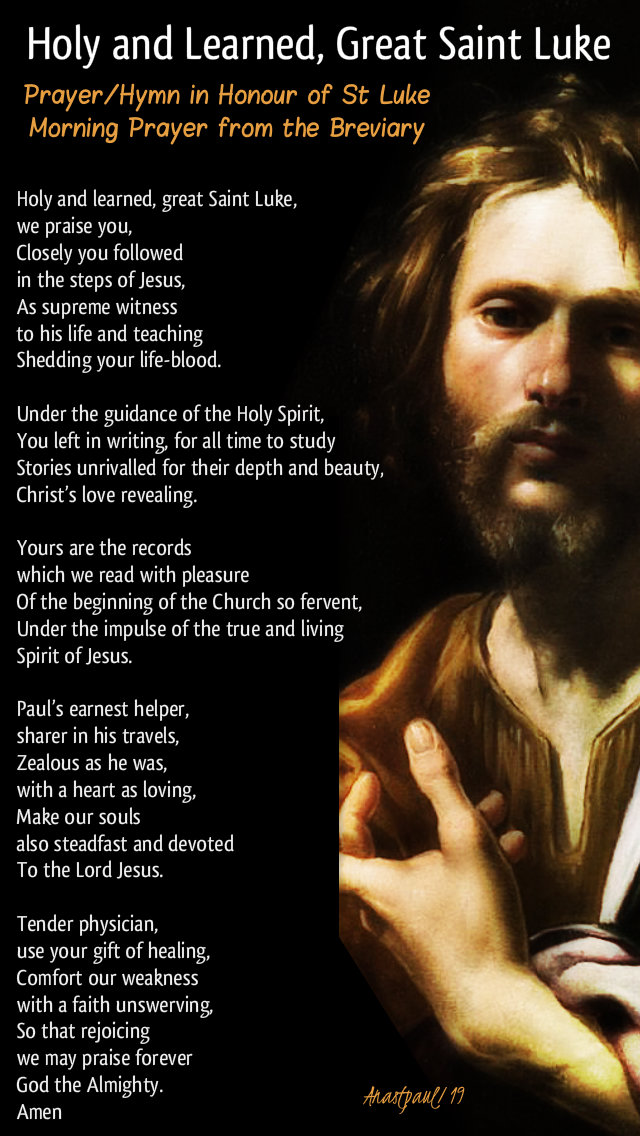
Holy and Learned, Great Saint Luke Prayer/Hymn in Honour of St Luke Morning Prayer from the Breviary
Holy and learned, great Saint Luke, we praise you,
Closely you followed in the steps of Jesus,
As supreme witness to his life and teaching
Shedding your life-blood.
Under the guidance of the Holy Spirit,
You left in writing, for all time to study
Stories unrivalled for their depth and beauty,
Christ’s love revealing.
Yours are the records which we read with pleasure
Of the beginning of the Church so fervent,
Under the impulse of the true and living
Spirit of Jesus.
Paul’s earnest helper, sharer in his travels,
Zealous as he was, with a heart as loving,
Make our souls also steadfast and devoted
To the Lord Jesus.
Tender physician, use your gift of healing,
Comfort our weakness with a faith unswerving,
So that rejoicing we may praise forever
God the Almighty.
Amen
St Acutius of Pozzuoli
St Asclepiades of Antioch
St Brothen
Bl Burchard I
St Cadwaladr of Brittany
Bl Domenico of Perpignano
St Eutychius of Pozzuoli
St Gwen
St Gwen of Tagarth
St Gwendoline
St Isaac Jogues
St Julian the Hermit St Justus of Beauvais (c 278—c 287) Child of nine
Bl Margherita Tornielli
St Monon of Nassogne
St Proculus of Pozzuoli
Bl Theobald of Narbonna
St Tryphonia of Rome
—
Martyrs of Africa – 9 saints: A group of Christians martryed together in Africa. The only details that have survived are the names – Beresus, Dasius, Faustinus, Leucius, Lucius, Martialis, Victoricus, Victrix and Viktor. They were martyred in c.300 in Africa.
Martyred in the Spanish Civil War:
• Blessed Alfredo Almunia López-Teruel
• Blessed Francisco Roselló Hernández
• Blessed Isidro Juan Martínez
Thought for the Day – 18 October – The Feast of St Luke the Evangelist – St Luke the Painter and the Painter in Words.
“According to a pious tradition, Luke is thought to have painted the image of Mary, the Virgin Mother. But the real portrait that Luke draws of Jesus’ Mother is the one that emerges from the pages of his work – in scenes that have become familiar to the People of God, he draws an eloquent image of the Virgin. The Annunciation, the Visitation, the Nativity, the Presentation in the Temple, life in the home of Nazareth, Jesus’ discussion with the doctors and His being lost and Pentecost have provided abundant material down the centuries for the ever new creations of painters, sculptors, poets and musicians.
What is most important however is to discover that, through pictures of Marian life, Luke introduces us to Mary’s interior life, helping us at the same time to understand her unique role in salvation history.
Mary is the one who says fiat, a personal and total “yes” to God’s invitation, calling herself the “handmaid of the Lord” (Lk 1: 38). This attitude of total assent to God and unconditional acceptance of His Word represents the highest model of faith, the anticipation of the Church as the community of believers.
The life of faith grows and develops in Mary through sapiential meditation on the words and events of Christ’s life (cf. Lk 2: 19, 51). She “ponders in her heart” to understand the deep meaning of His words, in order to assimilate it and share it with others.
The Magnificat hymn (cf. Lk 1: 46-55) shows another important aspect of Mary’s “spirituality”: she embodies the figure of the poor person, capable of putting all her trust in God, who casts down the mighty from their thrones and raises up the lowly.
Luke also describes the figure of Mary in the early Church, showing that she is present in the Upper Room as they await the Holy Spirit – “All these [the 11 Apostles] with one accord devoted themselves to prayer, together with the women and Mary the mother of Jesus, and with his brethren” (Acts 1: 14).
The group gathered in the Upper Room forms the original nucleus of the Church. Within it Mary carries out a double role: on the one hand, she intercedes for the birth of the Church through the Holy Spirit; on the other, she shares her experience of Jesus with the newborn Church.
Luke’s work thus offers the Church … a powerful stimulus to make the most of the “Marian dimension” of Christian life as she follows the way of Christ.” …St Pope John Paul 15 October 2000
Quote of the Day – – 18 October – The Feast of St Luke the Evangelist
“My soul proclaims the greatness of the Lord, my spirit rejoices in God my saviour. For he has looked upon his handmaid’s lowliness, henceforth, all generations will call me blessed.”
One Minute Reflection – 18 October – Today’s Gospel: Luke 10:1–9 – The Feast of St Luke the Evangelist
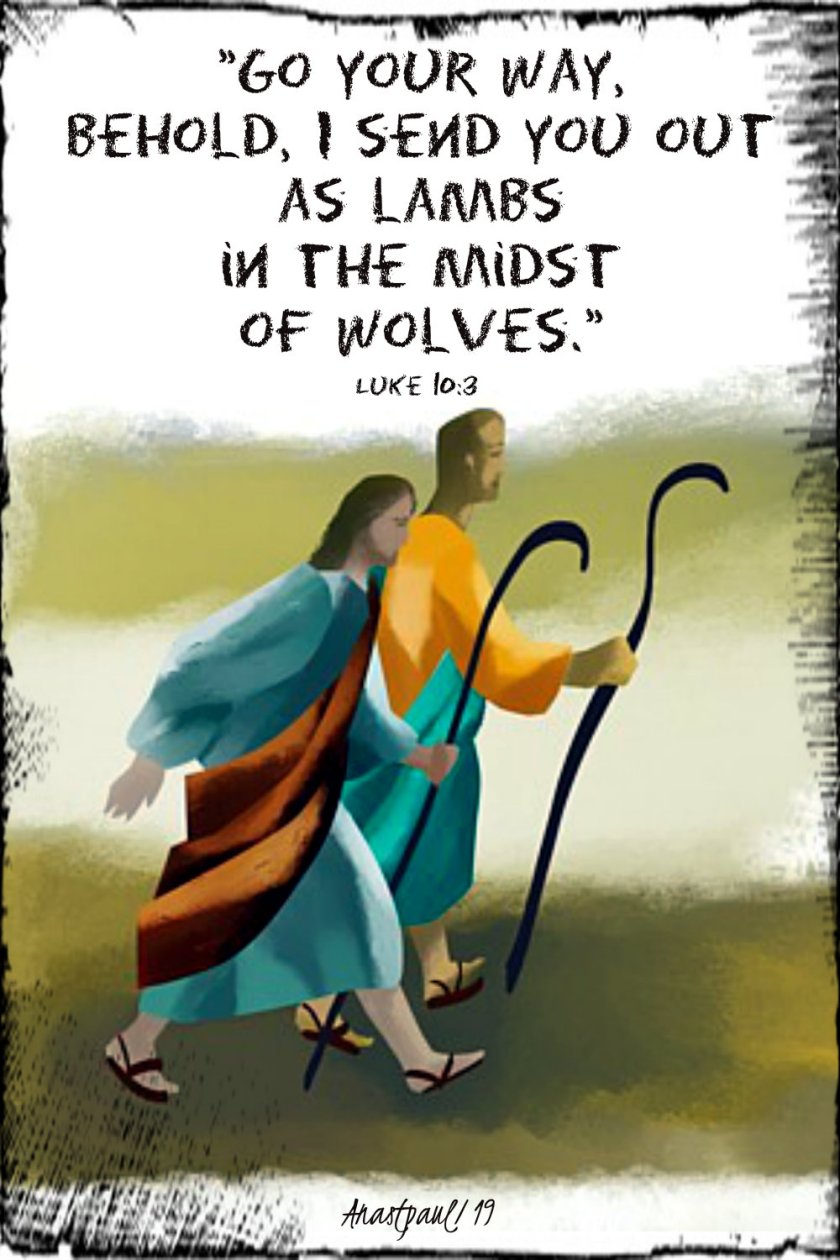
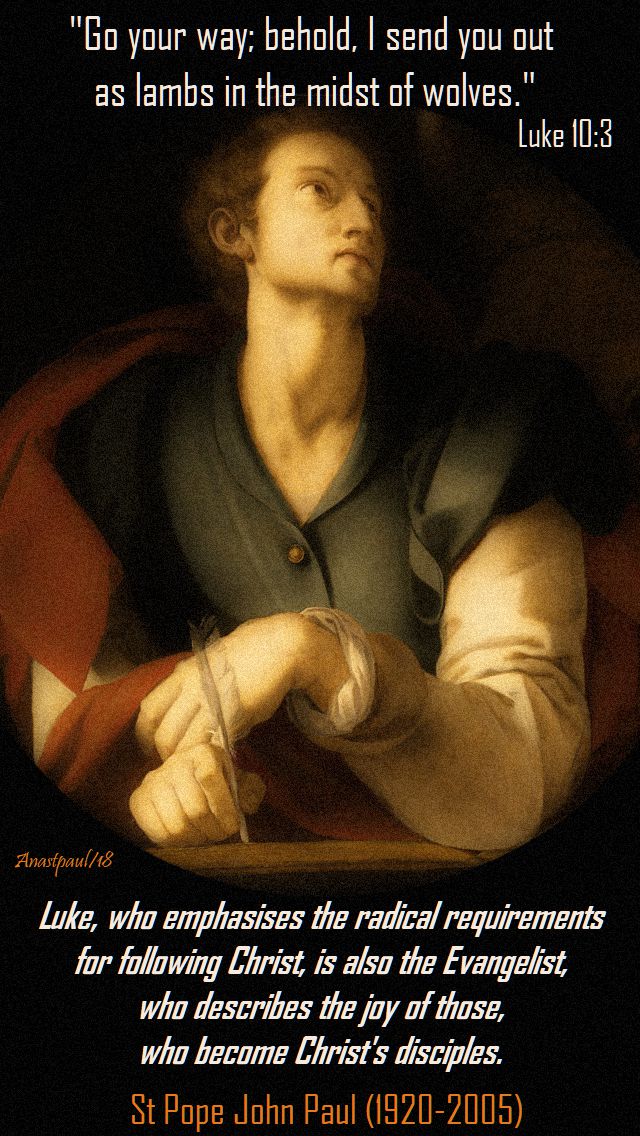
“Go your way; behold, I send you out as lambs in the midst of wolves.”…Luke 10:3
REFLECTION – “We must abandon ourselves to the power of the Spirit, who is able to infuse light and especially love for Christ; we must open ourselves to the inner fascination that Jesus works in the hearts of those who aspire to authenticity, while fleeing from half measures. This is certainly difficult for human beings but it becomes possible with the grace of God (cf. Lk 18: 27). On the other hand, if following Christ means carrying the Cross each day, the latter in turn is the tree of life leading to the resurrection. Luke, who emphasises the radical requirements for following Christ, is also the Evangelist who describes the joy of those who become Christ’s disciples.”…St Pope John Paul (1920-2005) 15 October 2000
PRAYER – Lord God, You chose St Luke to reveal the mystery of Your love in his preaching and his writings. Grant, we pray, that we may grow in love for the Holy Face of Christ, His words and His directions, revealed to us in the Gospels, in the example of your saints. Today, on his feast, we especially look to St Luke, to guide, teach and pray for us. We make our prayer through our Lord Jesus Christ, with the Holy Spirit, one God with You, forever and ever, amen.
Saint of the Day – 18 October – St Luke the Evangelist
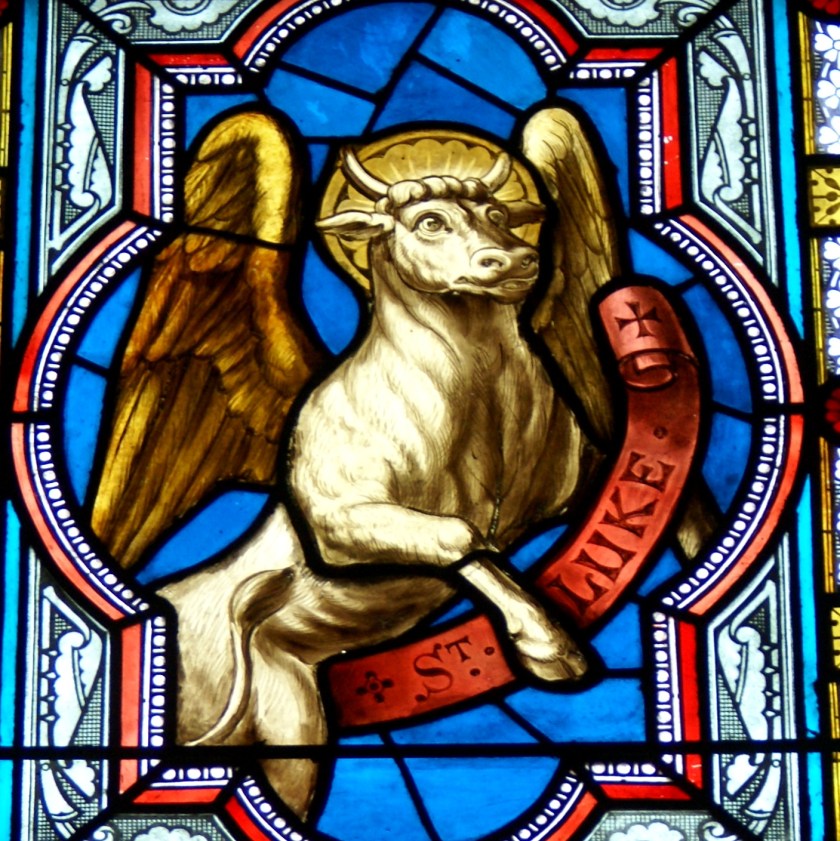
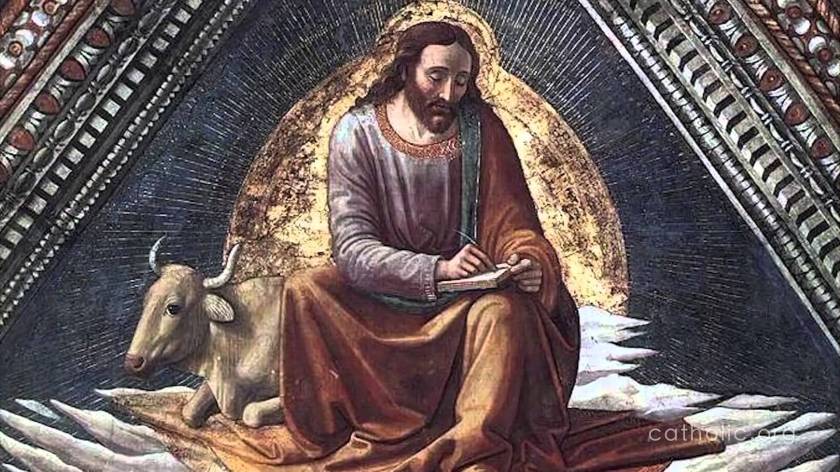
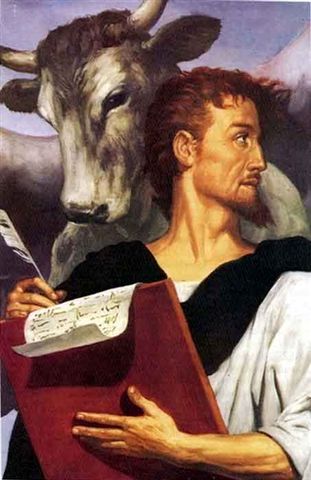
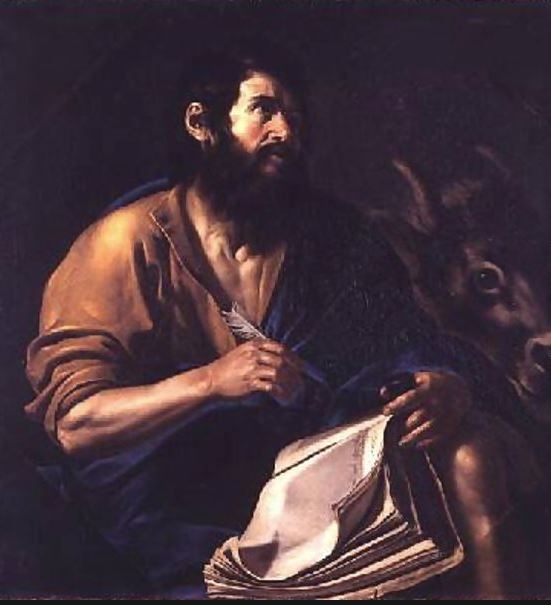
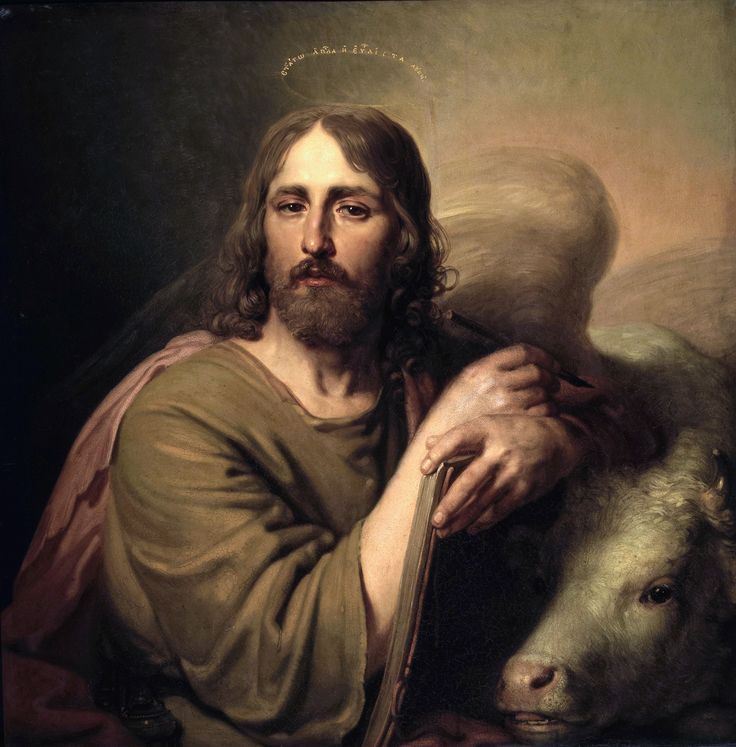
St Luke, the inspired author of the third Gospel and of the Acts of the Apostles, was a native of Antioch in Syria and a physician and one of the early converts from paganism. He accompanied St Paul on a considerable part of his missionary journey. He was also his companion while in prison at Rome on two different occasions. His account of these events, contained in the Acts, is first hand history. His symbol is a Winged Ox anticipated by Ezekiel. The ox, recognised as the animal of sacrifice, was applied to St Luke because his Gospel emphasises the atonement made by Christ’s sacrifice of Himself on the Cross. His name means “bringer of light” (= luke).
Luke’s Gospel is, above all, the Gospel of the Merciful Heart of Jesus. It emphasises the fact that Christ is the salvation of all men, especially of the repentant sinner and of the lowly. Legend says that Luke painted the Blessed Virgin’s portrait. It is certainly true that he painted the most beautiful word-picture of Mary ever written.
St Luke came from Antioch, was a practising physician and was one of the first converts to Christianity. He accompanied St Paul, who converted him, on his missionary journeys and was still with him in Rome when St Paul was in prison awaiting death. We hear no more of him afterwards and nothing is known of his last years. The Church venerates him as a Martyr.
St Luke’s Gospel is principally concerned with salvation and mercy – in it are preserved some of our Lord’s most moving parables, like those of the lost sheep and the prodigal son. Dante calls St Luke the “historian of the meekness of Christ.” It is also St Luke who tells us the greater part of what we know about our Lord’s childhood.
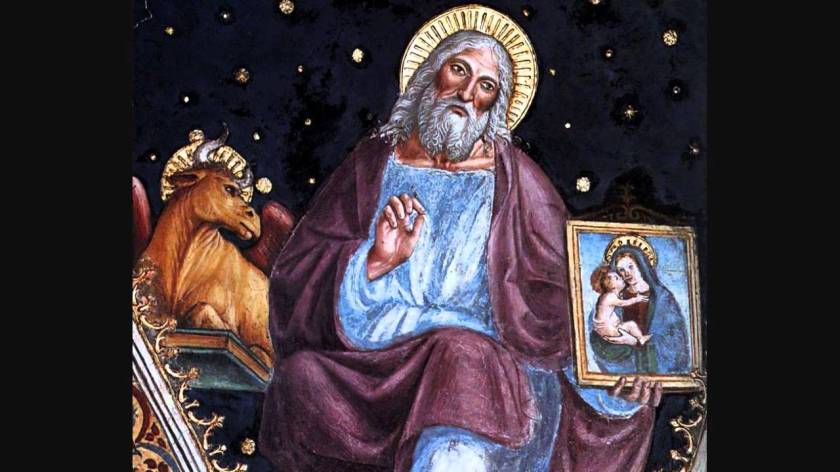
“According to tradition he was an artist, as well as a man of letters and with a soul alive to all the most delicate inspirations, he consecrated his pencil to the holiest use and handed down to us the features of the Mother of God. It was an illustration worthy of the Gospel which relates to the divine Infancy and it won for the artist a new title to the gratitude of those who never saw Jesus and Mary in the flesh. Hence St Luke is the patron of Christian art.” …-Excerpted from The Liturgical Year, Abbot Gueranger O.S.B.
St Luke did not personally know our Lord and like St Mark, the author of the second Gospel, he is not included among the apostles. For this reason the Gospel chosen for their feast is the account of the sending forth of the seventy-two disciples. According to St Jerome, St Luke died in Achaia (Greece) at the age of 84 and it is unknown whether or not he died a martyr’s death.
His symbol is a Winged Ox anticipated by Ezekiel. The ox, recognised as the animal of sacrifice, was applied to St Luke because his Gospel emphasises the atonement made by Christ’s sacrifice of Himself on the Cross. His name means “bringer of light” (= luke).
Thought for the Day – 18 October – The Feast of St Luke the Evangelist
According to a pious tradition, Luke is thought to have painted the image of Mary, the Virgin Mother. But the real portrait that Luke draws of Jesus’ Mother is the one that emerges from the pages of his work: in scenes that have become familiar to the People of God, he draws an eloquent image of the Virgin. The Annunciation, the Visitation, the Nativity, the Presentation in the Temple, life in the home of Nazareth, Jesus’ discussion with the doctors and his being lost and Pentecost have provided abundant material down the centuries for the ever new creations of painters, sculptors, poets and musicians.
What is most important however is to discover that, through pictures of Marian life, Luke introduces us to Mary’s interior life, helping us at the same time to understand her unique role in salvation history.
Mary is the one who says fiat, a personal and total “yes” to God’s invitation, calling herself the “handmaid of the Lord” (Lk 1: 38). This attitude of total assent to God and unconditional acceptance of his Word represents the highest model of faith, the anticipation of the Church as the community of believers.
The life of faith grows and develops in Mary through sapiential meditation on the words and events of Christ’s life (cf. Lk 2: 19, 51). She “ponders in her heart” to understand the deep meaning of his words, in order to assimilate it and share it with others.
The Magnificat hymn (cf. Lk 1: 46-55) shows another important aspect of Mary’s “spirituality”: she embodies the figure of the poor person, capable of putting all her trust in God, who casts down the mighty from their thrones and raises up the lowly.
Luke also describes the figure of Mary in the early Church, showing that she is present in the Upper Room as they await the Holy Spirit: “All these [the 11 Apostles] with one accord devoted themselves to prayer, together with the women and Mary the mother of Jesus, and with his brethren” (Acts 1: 14).
The group gathered in the Upper Room forms the original nucleus of the Church. Within it Mary carries out a double role: on the one hand, she intercedes for the birth of the Church through the Holy Spirit; on the other, she shares her experience of Jesus with the newborn Church. (St John Paul on the Feast of St Luke, Padua 2000 at the Shrine of St Luke)
Luke wrote as a Gentile for Gentile Christians. His Gospel and Acts of the Apostles reveal his expertise in classic Greek style as well as his knowledge of Jewish sources. There is a warmth to Luke’s writing that sets it apart from that of the other synoptic Gospels and yet it beautifully complements those works. The treasure of the Scriptures is a true gift of the Holy Spirit to the Church and the Marian writings of St Luke are a great treasure to us all!
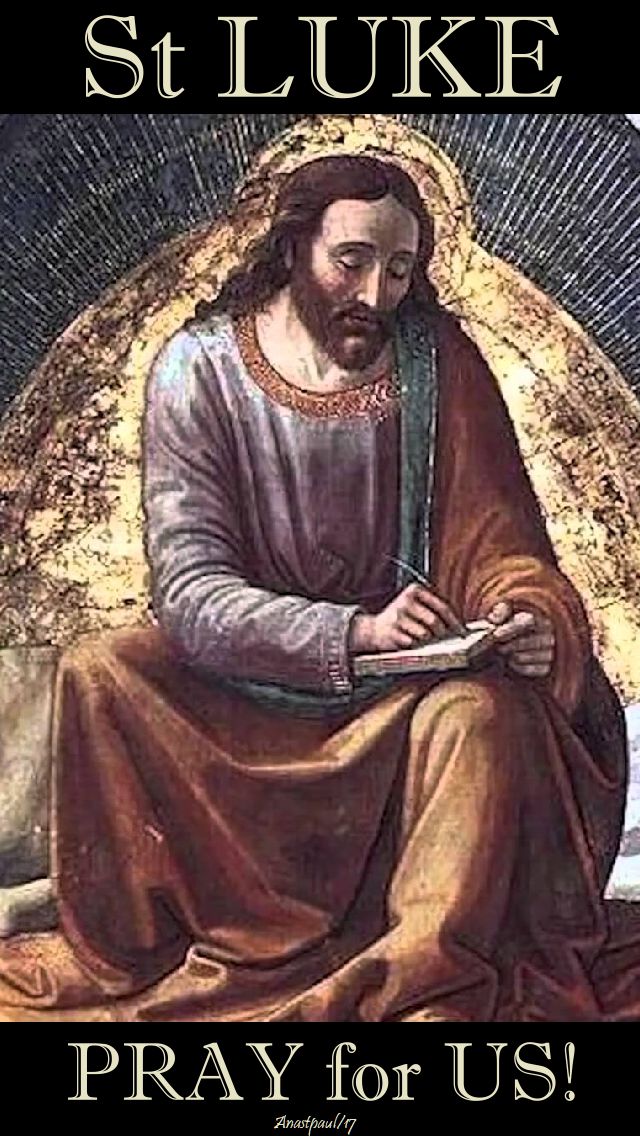
St Luke, pray for us.
Holy Mother of God, pray for us.
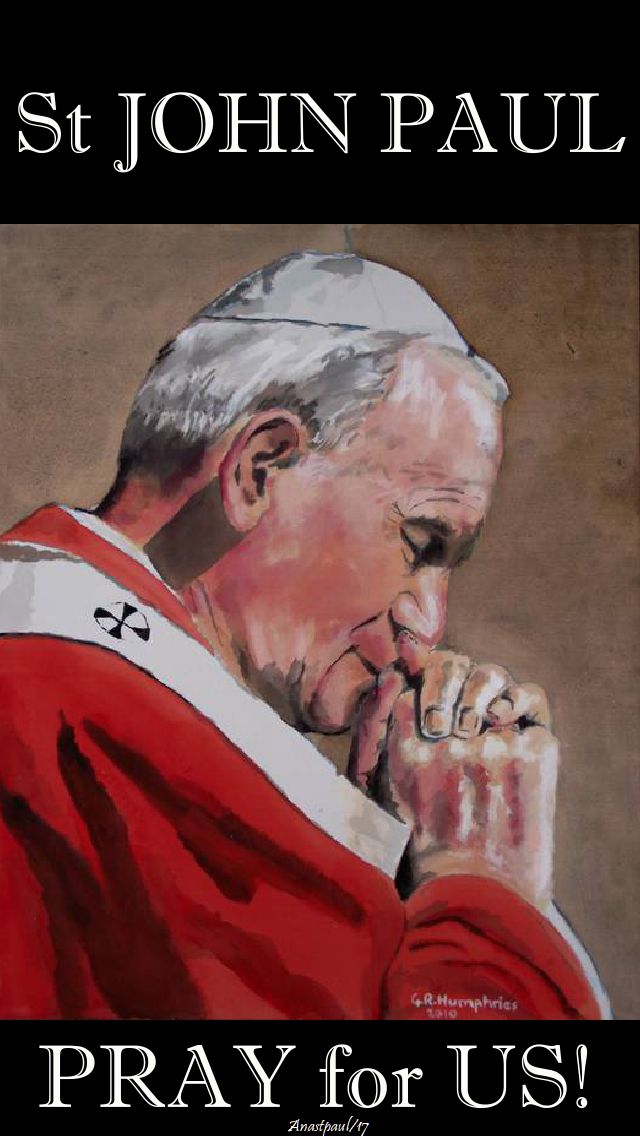
St John Paul, pray for us.
Quote/s of the Day – 18 October – The Feast of St Luke the Evangelist
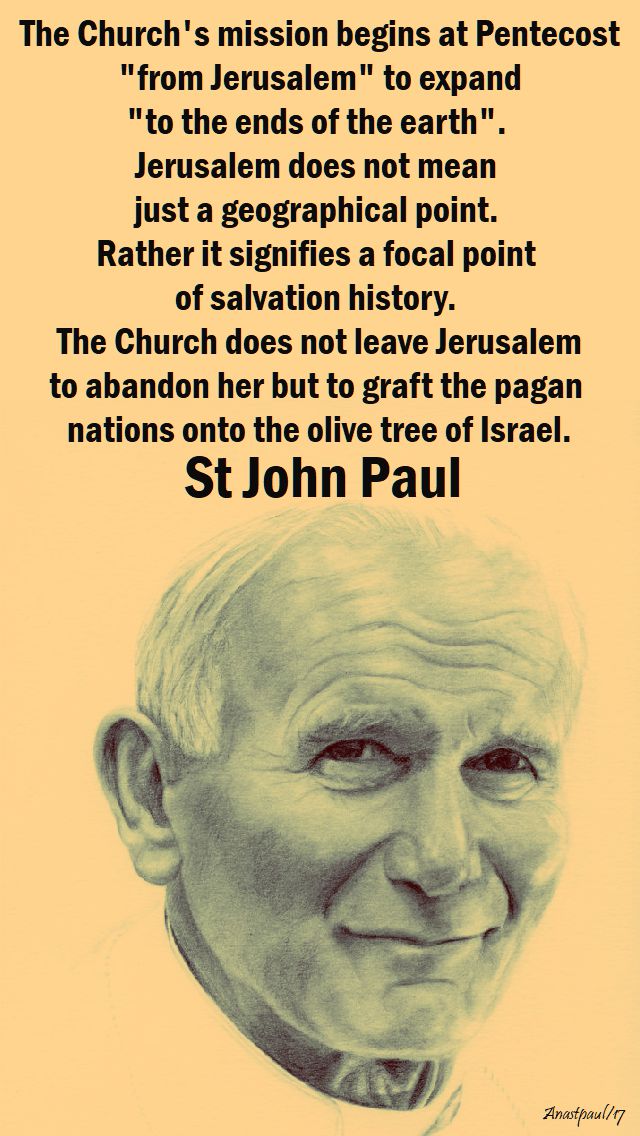
“The Church’s mission begins at Pentecost “from Jerusalem” to expand “to the ends of the earth”. Jerusalem does not mean just a geographical point. Rather it signifies a focal point of salvation history. The Church does not leave Jerusalem to abandon her but to graft the pagan nations onto the olive tree of Israel.”
“We must abandon ourselves to the power of the Spirit, who is able to infuse light and especially love for Christ; we must open ourselves to the inner fascination that Jesus works in the hearts of those who aspire to authenticity, while fleeing from half measures.”
St John Paul on the Feast of St Luke, Padua 2000 at the Shrine of St Luke
One Minute Reflection – 18 October – The Feast of St Luke the Evangelist
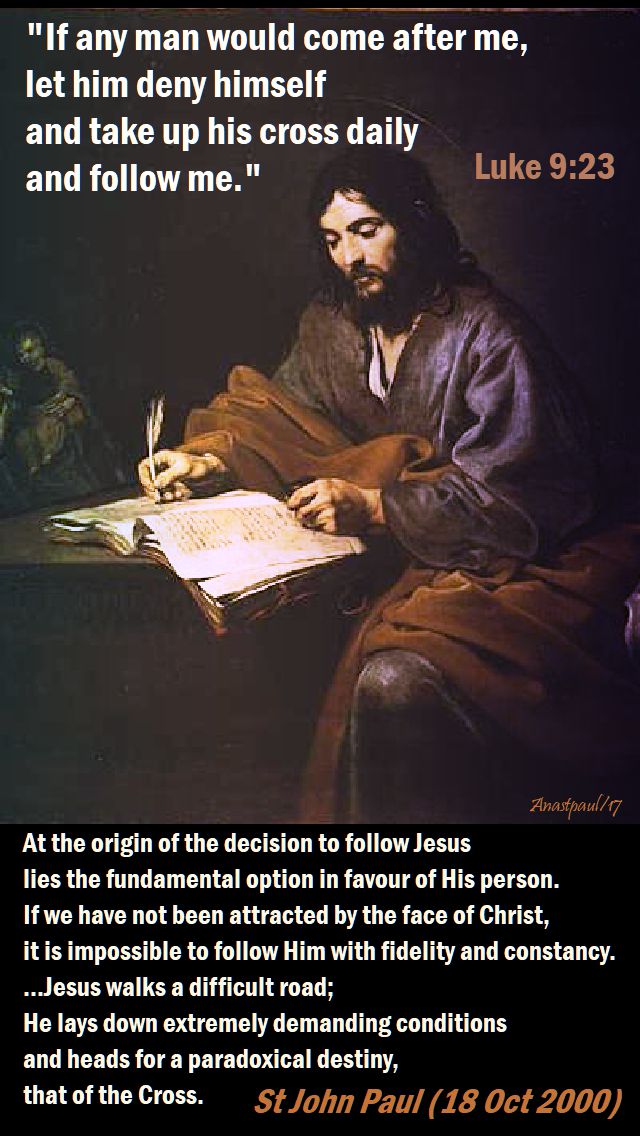
“If any man would come after me, let him deny himself and take up his cross daily and follow me.”…Luke 9: 23.
REFLECTION – “To be a Christian for Luke means to follow Jesus on the path that he takes. It is Jesus Himself who takes the initiative and calls us to follow Him and He does it decisively, unmistakably, thus showing His extraordinary identity, His mystery of being the Son who knows the Father and reveals Him. At the origin of the decision to follow Jesus lies the fundamental option in favour of His person. If we have not been attracted by the face of Christ, it is impossible to follow Him with fidelity and constancy. This is also because Jesus walks a difficult road; He lays down extremely demanding conditions and heads for a paradoxical destiny, that of the Cross. Luke emphasises that Jesus does not like compromises and requires a commitment of the whole person, a decisive detachment from any nostalgia for the past, from family demands, from material possessions (cf. Lk 9: 57-62; 14: 26-33).”….St John Paul 18 Oct 2000
PRAYER – Lord God, You chose St Luke to reveal the mystery of Your love in his preaching and his writings. Grant, we pray, that we may grow in love for the Holy Face of Christ, His words and His directions, revealed to us in the Gospels, in the example of your saints. Today, on his feast, we especially look to St Luke, to guide, teach and pray for us. We make our prayer through our Lord Jesus Christ, with the Holy Spirit, one God with You, forever and ever, amen.
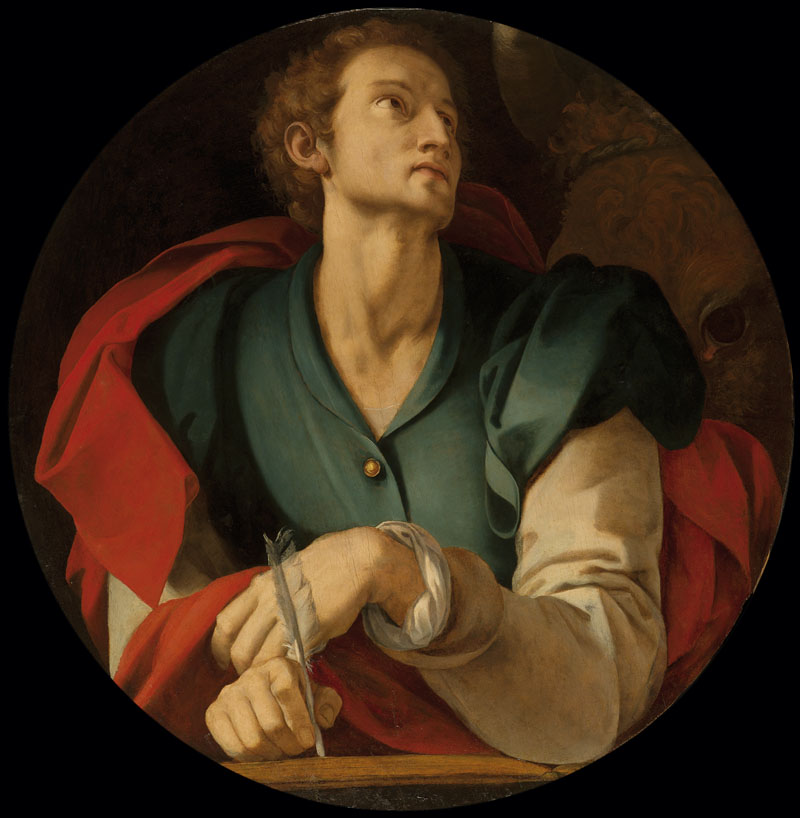
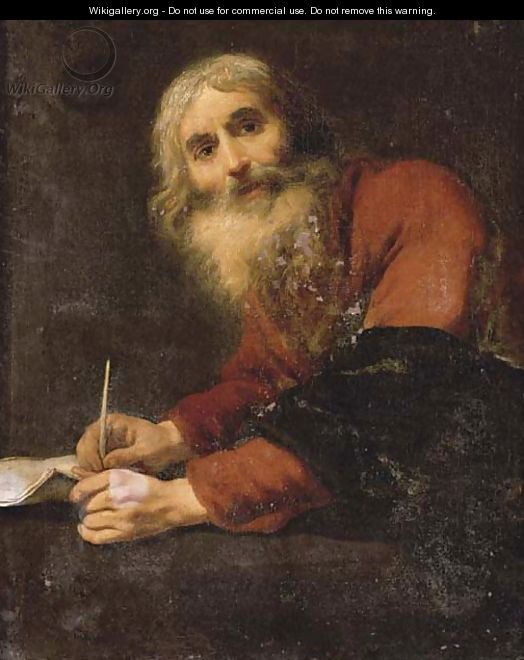
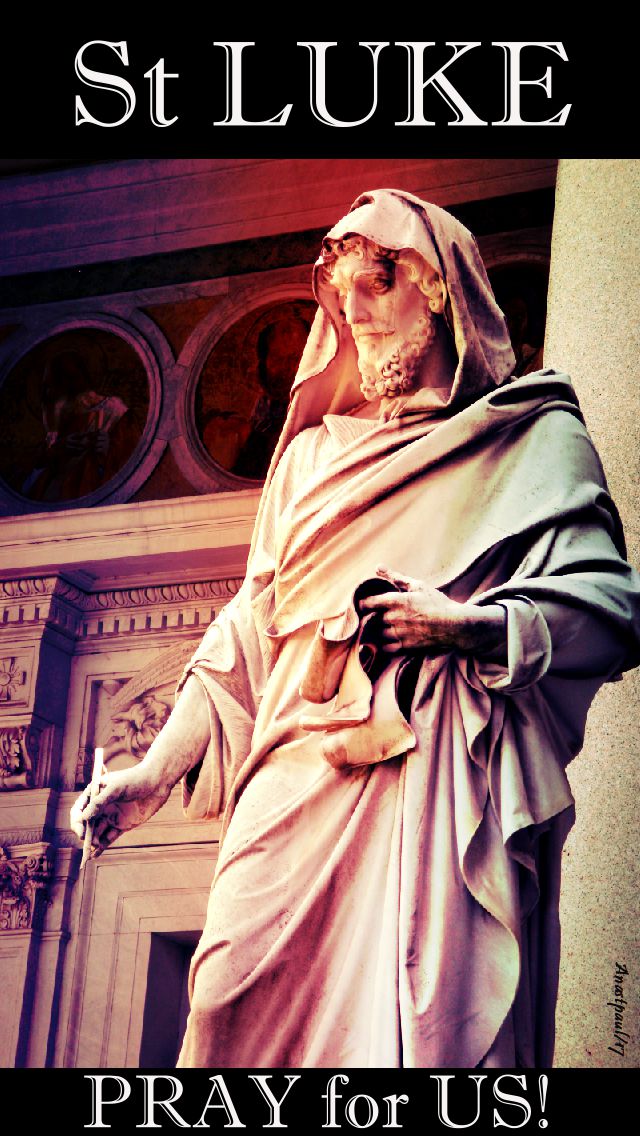
Saint of the Day – St Luke the Evangelist – 18 October – Physician,Ddisciple of St Paul, Evangelist, Author of the Gospel according to Luke and the Acts of the Apostles. Tradition says he was an Artist too. He was born at Antioch and Died in c 74 in Greece. Some say he was Martyred, others that he died of natural causes. His relics reside at Padua, Italy. Patronages – artists, bachelors, bookbinders, brewers, butchers, doctors, glass makers, glassworkers, glaziers, gold workers, goldsmiths, lacemakers, lace workers, notaries, painters, physicians, sculptors, stained glass workers, surgeons, 2 cities. Attributes – Evangelist, Physician, a Bishop, a book or a pen, a man accompanied by a winged ox/winged calf/ox, a man painting an icon of the Blessed Virgin Mary, a brush or a palette (referring to the tradition that he was a painter). St Luke is one of the Four Evangelists—the four traditionally ascribed authors of the canonical Gospels. The early Church Fathers ascribed to him authorship of both the Gospel according to Luke and the book of Acts of the Apostles, which would mean Luke contributed over a quarter of the text of the New Testament, more than any other author. Prominent figures in early Christianity such as Jerome and Eusebius later reaffirmed his authorship. The New Testament mentions Luke briefly a few times and the Pauline epistle to the Colossians refers to him as a physician (from Greek for ‘one who heals’); thus he is thought to have been both a physician and a disciple of Paul. Christians since the faith’s early years have regarded him as a saint. He is believed to have been a martyr, reportedly as having been hanged from an olive tree, though some believe otherwise.
Luke came from the large metropolitan city of Antioch, a part of modern-day Turkey. In Luke’s lifetime, his native city emerged as an important center of early Christianity. During the future saint’s early years, the city’s port had already become a cultural center, renowned for arts and sciences. Historians do not know whether Luke came to Christianity from Judaism or paganism, although there are strong suggestions that Luke was a gentile convert.
Educated as a physician in the Greek-speaking city, Luke was among the most cultured and cosmopolitan members of the early Church. Scholars of archeology and ancient literature have ranked him among the top historians of his time period, besides noting the outstanding Greek prose style and technical accuracy of his accounts of Christ’s life and the apostles’ missionary journeys.
Other students of biblical history adduce from Luke’s writings that he was the only evangelist to incorporate the personal testimony of the Blessed Virgin Mary, whose role in Christ’s life emerges most clearly in his gospel. Tradition credits him with painting several icons of Christ’s mother and one of the sacred portraits ascribed to him – known by the title “Salus Populi Romano – Salvation of the Roman People”– survives to this day in the Basilica of St Mary Major.
Some traditions hold that Luke became a direct disciple of Jesus before His ascension, while others hold that he became a believer only afterward. After St Paul’s conversion, Luke accompanied him as his personal physician– and, in effect, as a kind of biographer, since the journeys of Paul on which Luke accompanied him occupy a large portion of the Acts of the Apostles. Luke probably wrote this text, the final narrative portion of the New Testament, in the city of Rome where the account ends.
Luke appears in Acts during Paul’s second journey, remains at Philippi for several years until Paul returns from his third journey, accompanies Paul to Jerusalem and remains near him when he is imprisoned in Caesarea. During these two years, Luke had time to seek information and interview persons who had known Jesus. He accompanied Paul on the dangerous journey to Rome where he was a faithful companion After the martyrdom of St Paul in the year 67, St Luke is said to have preached elsewhere throughout the Mediterranean and possibly died as a martyr. However, even tradition is unclear on this point. Fittingly, the evangelist whose travels and erudition could have filled volumes, wrote just enough to proclaim the gospel and apostolic preaching to the world.
Luke’s unique character may best be seen by the emphases of his Gospel, which has been given a number of subtitles:
1) The Gospel of Mercy
2) The Gospel of Universal Salvation
3) The Gospel of the Poor
4) The Gospel of Absolute Renunciation
5) The Gospel of Prayer and the Holy Spirit
6) The Gospel of Joy
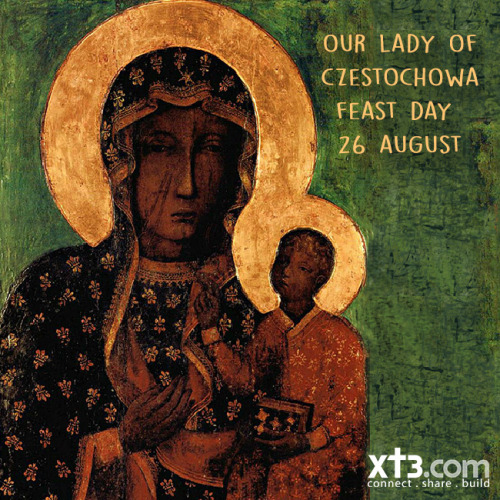
Blessed Feast of Our Lady of Czestochowa, Queen of Poland – 26 August – Also known as – The Black Madonna of Czestochowa, Czarna Madonna, Hodegetria, Imago thaumaturga Beatae Virginis Mariae Immaculatae Conceptae, Matka Boska Czestochowska, One Who Shows the Way. Our Lady of Czestochowa is a revered icon of the Virgin Mary housed at the Jasna Góra Monastery in Częstochowa, Poland. Several Pontiffs have recognised the venerated icon, beginning with Pope Clement XI who issued a Canonical Coronation to the image on 8 September 1717 via the Vatican Chapter. Patron of Poland.
According to tradition, the icon of Jasna Góra (Bright Mountain) was painted by Luke the Evangelist on a tabletop built by Jesus Himself and the icon was discovered by St Helen, mother of Emperor Constantine and collector of Christian relics in the Holy Land. The icon was then enshrined in the imperial city of Constantinople, where it remained for the next 500 years.
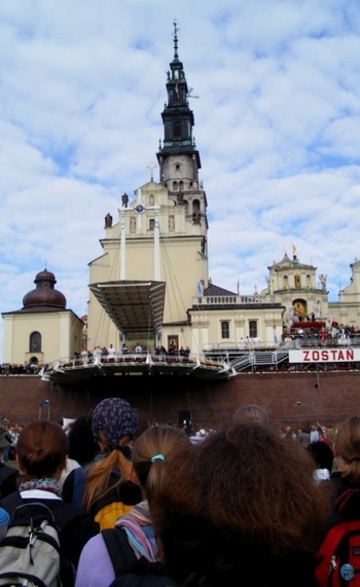
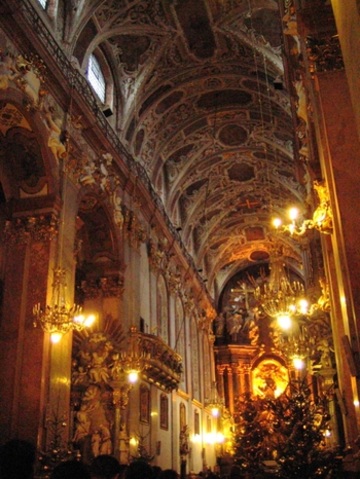
JASNA GORA MONASTERYBASILICA OF OUR LADY OF CZESTOCHOWA AT JASNA GORA
In 803, the painting is said to have been given as a wedding gift from the Byzantine emperor to a Greek princess, who married a Ruthenian nobleman. The image was then placed in the royal palace at Belz, where it remained for nearly 600 years.
History first combines with tradition upon the icon’s arrival in Poland in 1382 with a Polish army fleeing the Tartars, who had struck it with an arrow.
Legend has it that during the looting of Belz, a mysterious cloud enveloped the chapel containing the image. A monastery was founded in Częstochowa to enshrine the icon in 1386 and soon King Jagiello built a cathedral around the chapel containing the icon.
However, the image soon came under attack once again. In 1430, Hussites (pre-Reformation reformers) attacked the monastery, slashed the Virgin’s face with a sword, and left it desecrated in a puddle of blood and mud.
It is said that when the monks pulled the icon from the mud, a miraculous fountain appeared, which they used to clean the painting. The icon was repainted in Krakow, but both the arrow mark and the gashes from the sword were left and remain clearly visible today.
The miracle for which the Black Madonna of Częstochowa is most famous occurred in 1655, when Swedish troops were about to invade Częstochowa. A group of Polish soldiers prayed fervently before the icon for deliverance and the enemy retreated. In 1656, King John Casimir declared Our Lady of Częstochowa “Queen of Poland” and made the city the spiritual capital of the nation.
The Virgin again came to the aid of her people in 1920, when the Soviet Russian Red Army gathered on the banks of the Vistula River, preparing to attack Warsaw. The citizens and soldiers fervently prayed to Our Lady of Częstochowa and on September 15, the Feast of Our Lady of Sorrows, she appeared in the clouds above Warsaw. The Russians were defeated in a series of battles later dubbed the “Miracle at the Vistula.”
During Nazi occupation, Hitler prohibited pilgrimages to Jasna Góra but many still secretly made the journey. In 1945, after Poland was liberated, half a million pilgrims journeyed to Czestochowa to express their gratitude. On September 8, 1946, 1.5 million people gathered at the shrine to rededicate the entire nation to the Immaculate Heart of Mary. During the Cold War, Jasna Góra was a centre of anti-Communist resistance. Czestochowa is regarded as the most popular shrine in Poland, with many Polish Catholics making a pilgrimage there every year. A pilgrimage has left Warsaw every August 6 since 1711 for the nine-day, 140-mile trek. Elderly pilgrims recall stealing through the dark countryside at great personal risk during the German Nazi occupation. Pope John Paul II secretly visited as a student pilgrim during World War II. He was a fervent devotee of the Virgin Mary and of her icon at Czestochowa. As pope, he made pilgrimages to pray before the Black Madonna in 1979, 1983, 1991 and 1997. In 1991, he held his Sixth World Youth Day at Czestochowa, which was attended by 350,000 young people from across Europe.
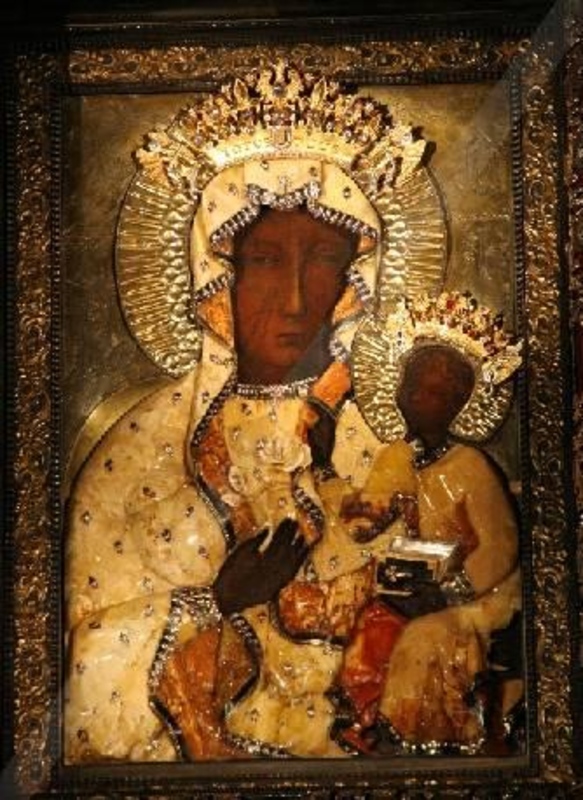
The four-foot-high painting displays a traditional composition well known in the icons of Eastern Christians. The Virgin Mary is shown as the “Hodegetria” (“One Who Shows the Way”). In it the Virgin directs attention away from herself, gesturing with her right hand toward Jesus as the source of salvation. In turn, the child extends his right hand toward the viewer in blessing while holding a book of gospels in his left hand. The icon shows the Madonna in fleur-de-lis robes.
This image shows Our Lady dressed in special robes at Jasna Gora














 AnaStpaul
You must be logged in to post a comment.