
Saint of the Day – 12 June – St Onuphrius (Died c400) Hermi, living a miraculous life assisted by his Angel alone in the Egyptian desert for 60 years. Speaking to God and His Angel only, who weekly brought him Holy Communion and daily brought him bodily sustenance. The dates and details of his birth and death are unknown except that he died in June c400. Patronages – of weavers (apparently due to his leaf-woven garment and his long hair which also acted as clothing, Towns in Italy – Centrache, Catanzaro Paterno, Avezzano, Siena and Sutera. Also known as – Onuphrius of Egypt, Humphrey… Onofre… Onofrio…
Onophry… Onouphrius… The name Onophrius is of Egyptian origin and means ‘who is always happy.’
The Roman Martyrology reads today: “In Egypt, St Onuphrius, an Anchorite, who led a religioys life in the desert for 60 years and renowned for great virtues and merits, departed for Heaven. His admirable deeds were recorded by the Abbot, Paphmutius.”

The Vita of our Saint today, Onuphrius, was written by another Saint, Paphmutius, an Egyptian Monk. His writing bears an unmistakable resemblance to two other great classics of the genre, St Jerome’s life of St Paul the First Hermit and the tale of St Mary of Egypt.
Paphmutius, eager to meet the desert Hermit, to learn about their lives and their eremeiic experience which was so much discussed at that time, went into the desert in search of them. After two stops in 21 days, exhausted, he collapsed onto the ground. Looking up, he saw a human figure of terrible appearance appear, covered from head to toe only by long hair and a few leaves.
This was usual for Hermits, who were accustomed to being always alone and seen only by Angels, in the end did without a garment difficult to obtain or replace in the desert.
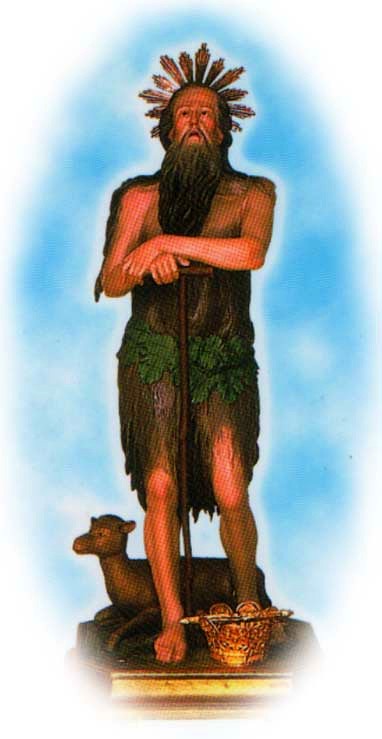
Initially frightened, Paphmutius tried to escape but the human figure called him telling him to stay, then he understood that he had found who he was looking for, it was an Hermit. Once mutual trust had been established, the confidences began, the Hermit said his name was Onuphrius and he had been in the desert for around 60 years and had never seen another living soul! He ate herbs and rested in caves but initially it was not like this, he had lived in a Monastery in the Thebaid area, together with a hundred Monks.
But desirous of a more solitary life following the example of St. John the Baptist and the Prophet Elijah, he left the Monastery to dedicate himself to the eremitical life; having advanced into the desert area with little food, after a few days he met another Hermit in a cave, whom he asked to assit him and initiate him into that very particular life.
The Hermit obliged and then accompanied him to a place which was an oasis with palm trees, stayed with him for thirty days and then left, returning to his cave. Once a year the Hermit would come to visit him and comfort him but on one of these visits, as soon as he arrived he bowed to greet him and collapsed and died. Filled with sadness Onuphrius buried him in a place near his Hermitage. Onuphrius then told Paphmutius how he adapted to the changing seasons; how he resisted the elements and how he supported his physical needs, an Angel provided for his daily nourishment, the same Angel brought him Holy Communion on Sundays. The miracle of the Angel was also seen by Paphmutius whom Onuphrius led to his Hermitage of ‘Calidiomea,’ the place of palm trees.
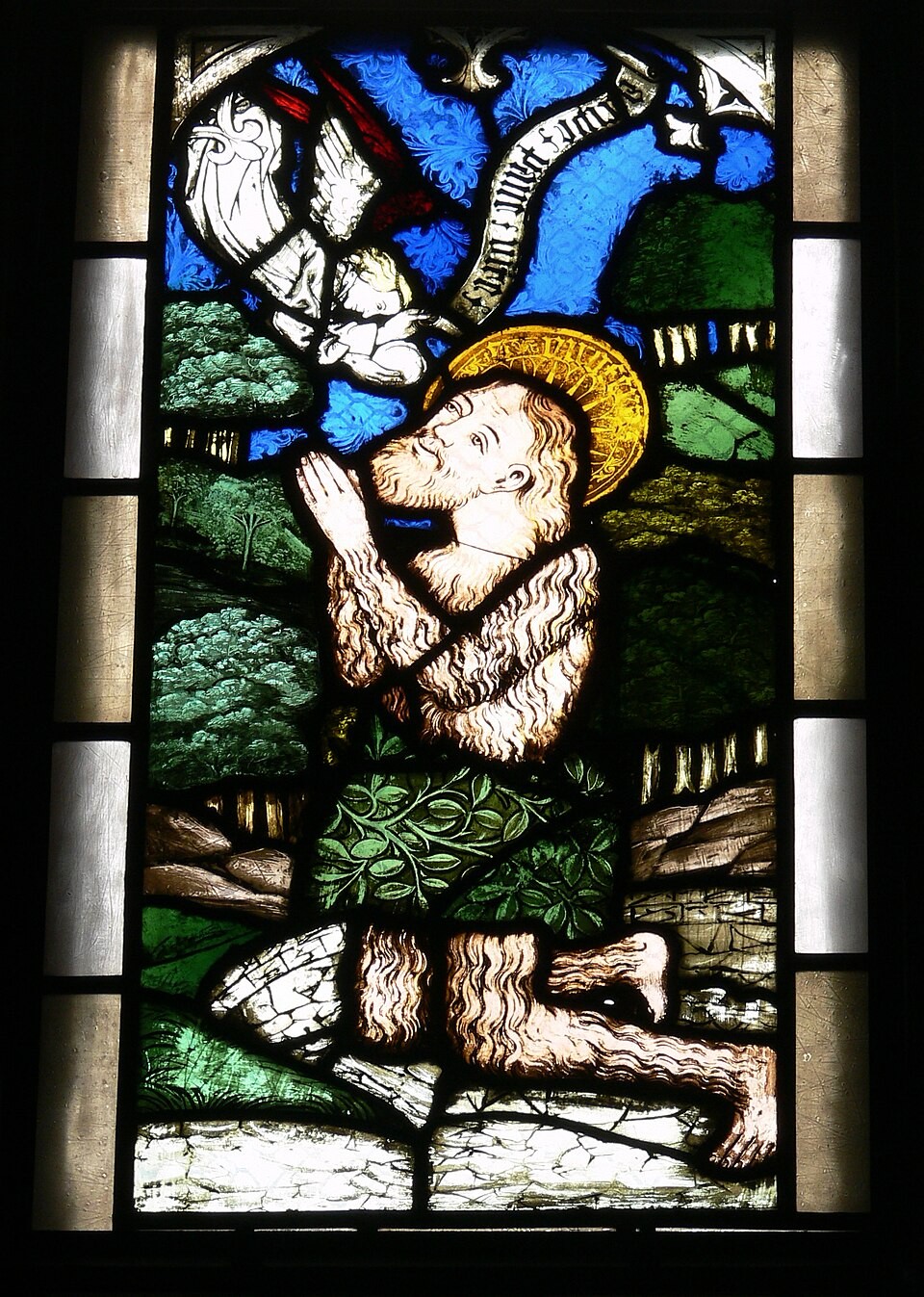
They continued their spiritual conversations until the holy Hermit said: “God has sent you here so that you may give my body a suitable burial, since I have reached the end of my earthly life.” Paphnutius proposed that Onuphrius take his place, but the Hermit replied that this was not God’s Will, he had to return to Egypt and tell what he had witnessed.
After blessing him, he knelt in prayer and Died. Paphnutius covered him with part of his own tunic and buried him in a crevice in the rock. Before he left, a landslide reduced Onuphrius’ cave to ruins, also knocking down the palm trees, a sign of God’s Will that no one else would live as a Hermit in that place.
Regardless of the historical existence of St Onuphrius, the Greek ‘Life’ of Paphnutius concludes by saying that the holy Hermit died on 11 June 11, however St Onuphrius is celebrated on 12 June. Anthony, Archbishop of Novgorod, reports that in his time (1200) the head of St Onuphrius was preserved in the Church of St Acindino.
St Onuphrius’ cult and his memory spread to all the countries of Asia Minor and to Egypt, all the calendars of these regions report him on the 10th, 11th, 12th of June; in Arabic he is Abü Nufar, (the herbivore).
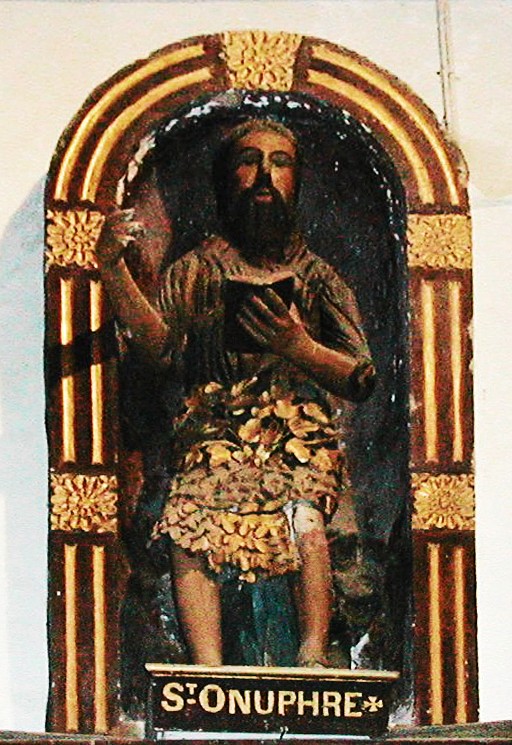
The image of St Onuphrius, a naked Hermit, covered only with his hair, was the object of figurative representation in art, in all the centuries, enriched by the many narrated details, the loincloth made of leaves, the camel, the skull, the Cross, the host with the chalice, the Angel.


 AnaStpaul
You must be logged in to post a comment.