One Minute Reflection – 31 August – “The Month of the Immaculate Heart of Mary” – Pentecost XII – St Raymond Nonnatus 1204-1240) Priest, Confessor, Cardinal, Friar of the Mercedarian Order – Ecclesiasticus Sir 31:8-1 – Luke 12:35-40 – Scripture search here: https://www.drbo.org/
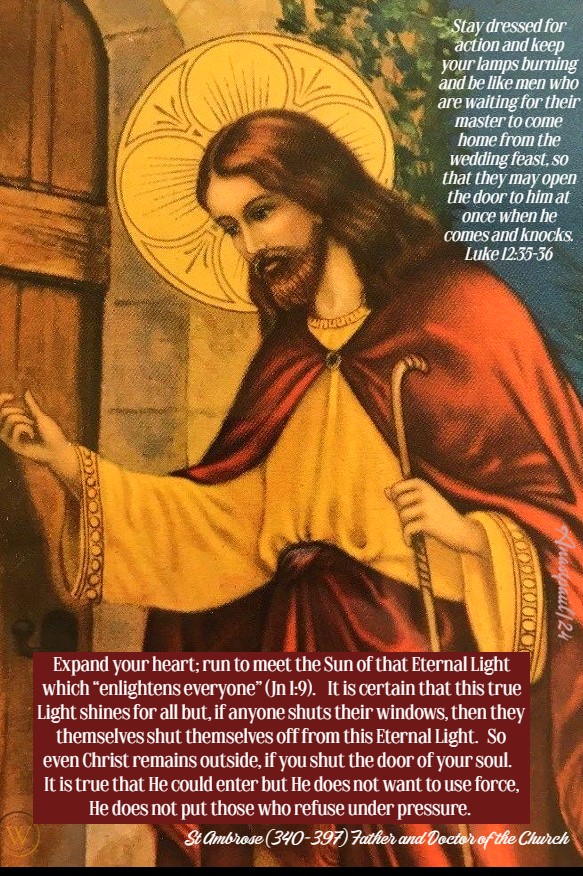
“Stay dressed for action and keep your lamps burning and be like men who are waiting for their master to come home from the wedding feast, so that they may open the door to him at once when he comes and knocks.” – Luke 12:35-36
REFLECTION – “God, the Word, stirs up the lazy and arouses the sleeper. For indeed, someone who comes knocking at the door is always wanting to come in. But it depends on us, if He does not always enter or always remain. … May your door be open to Him who comes; open your soul, enlarge your spiritual capacities, that you may discover the riches of simplicity, the treasures of peace and sweetness of grace. Expand your heart; run to meet the Sun of that Eternal Light which “enlightens everyone” (Jn 1:9). It is certain, that this true Light shines for all but, if anyone shuts their windows, then they themselves, shut themselves off from this Eternal Light.
So even Christ remains outside, if you shut the door of your soul. It is true, He could enter but He does not wish to use force, He does not put those who refuse under pressure. Descended from the Virgin, born from her womb, He shines throughout the universe to give Light to all. Those who long to receive the Light, that shines with an everlasting brightness, open up to Him. No night comes to intervene. Indeed, the sun we see each day, gives way to night’s darkness but the Sun of Justice (Mal 3:20) knows no setting, for Wisdom is not overcome by evil.” – St Ambrose (340-397) Bishop of Milan and Father and Doctor of the Church (12th Sermon on Psalm 118).
PRAYER – O God, Who made blessed Raymund, Thy Confessor, famous for delivering Thy faithful from the captivity of the infidels, grant us, by his intercession that, having been released from the bonds of our sins, we may with free minds, do what is pleasing to Thee. Through Jesus Christ, Thy Son our Lord, Who lives and reigns with Thee, in the unity of the Holy Ghost, God, world without end. Amen (Collect).
St Ammi of Caesarea St Aristides the Philosopher St Barbolenus of Bobbio St Bonajuncia OSM Confessor St Caesidius St Cuthburga of Wimborne (Died c725) Abbess St Cwenburgh of Wimborne
Quote/s of the Day – 31 August – St Raymond Nonnatus (1204-1240) Priest, Confessor
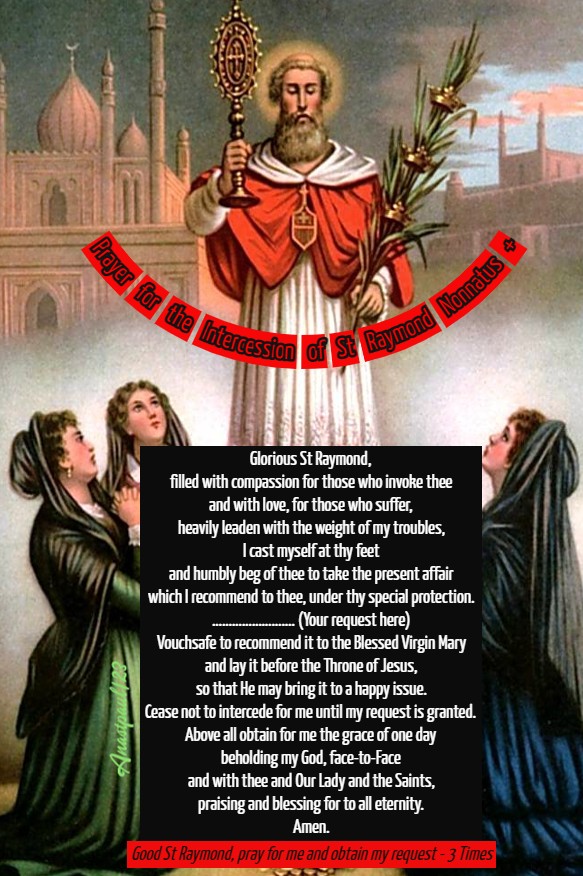
Prayer for the Intercession of St Raymond Nonnatus (Can also be used as a Novena Prayer).
Glorious St Raymond, filled with compassion for those who invoke thee and with love, for those who suffer, heavily leaden with the weight of my troubles, I cast myself at thy feet and humbly beg of thee to take the present affair which I recommend to thee, under thy special protection. ……………………. (Your request here) Vouchsafe to recommend it to the Blessed Virgin Mary and lay it before the Throne of Jesus, so that He may bring it to a happy issue. Cease not to intercede for me until my request is granted. Above all obtain for me the grace of one day beholding my God, face-to-Face and with thee and Our Lady and the Saints, praising and blessing for to all eternity. Amen.
Good St Raymond, pray for me and obtain my request – 3 Times
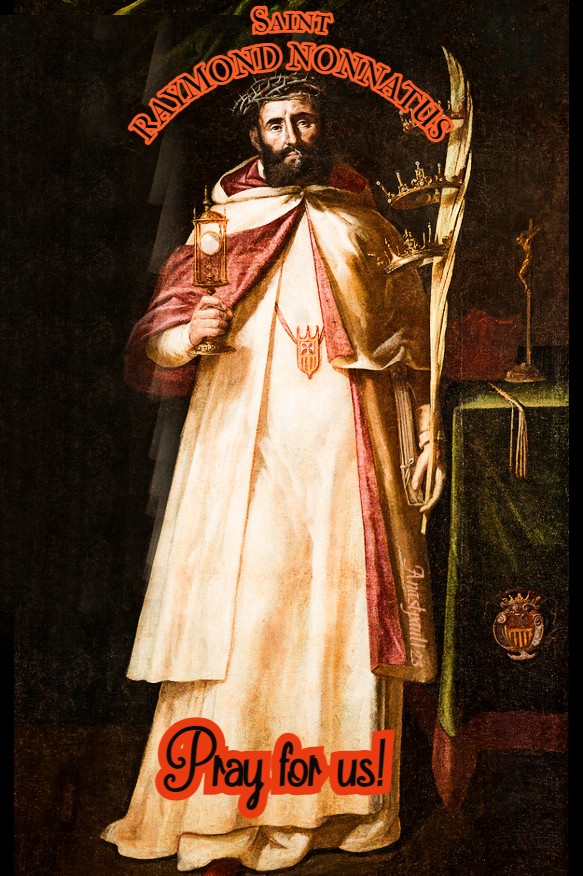
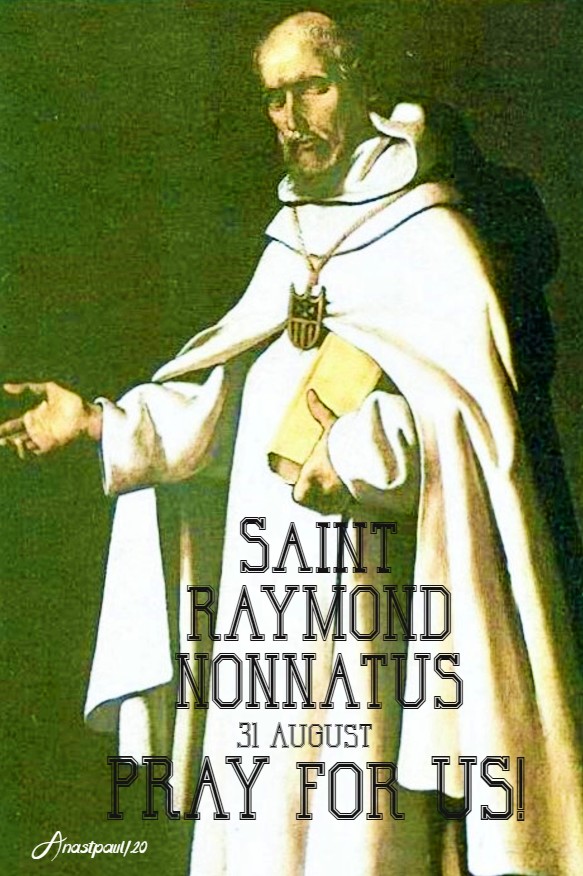
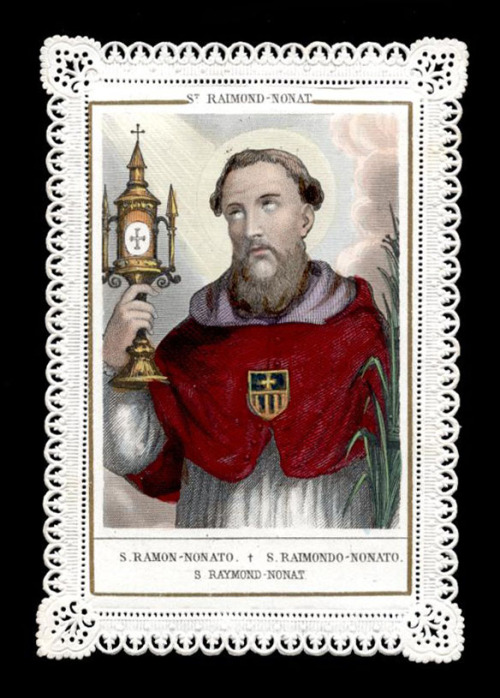
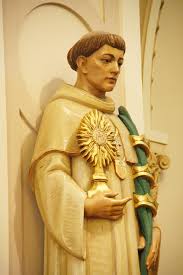
Saint of the Day – 31 August – St Raymond Nonnatus (1204-1240) Priest, Confessor, Cardinal, Friar of the Mercedarian Order. Patronages – against gossip, of silence, against fever, of babies, infants, childbirth, children, pregnant women, falsely accused people, midwives, obstetricians, Baltoa, Dominican Republic, San Ramon, Costa Rica. Raymond was delivered by Caesarean operation when his mother died during childbirth – hence the name: non natus = not born.
Saint Raymond Nonnatus, Confessor By Fr Francis Xavier Weninger SJ (1805-1888)
Catalonia, Spain, was the native country of St Raymund who, to the astonishment of the Physicians, was born after his mother’s death! As soon as he was old enough to comprehend how early he had become an orphan, he chose the Queen of Heaven as his mother and, to his last day, called her by no other name. When he had studied for some time with great success, his father, fearing the youth would enter a Religious Order, sent him into the too, opportunities to serve God. He became very fond of solitude and, therefore, chose for his occupation, the care of the sheep, in order to gain more time for prayer and meditation.
At the foot of the mountain to which he generally led his flock, was a small deserted hermitage, with a Chapel, in which an extremely lovely picture of the Blessed Virgin was kept, which was a source of great joy to him. There, he spent several hours daily, in devout exercises. Other shepherds, who observed this and to whom the piety of Raymund was a reproach of their own negligence, reported to his father that he was doing nothing but praying and, thereby neglected his flock. The father came to convince himself of the fact but, although he found his son praying in the Chapel, he saw that the flock was, meanwhile attended to by a youth of uncommon beauty of form and features. Asking his son who this young shepherd was and why he had engaged him, Raymund, to whom it was unknown that Providence had worked a miracle on his behalf, fell on his knees before his father and begging forgiveness, earnestly promised not to commit the fault again.
The Divine Mother, of Whom he begged the grace of knowing his vocation, appeared to him, saying that she desired him to take the habit of the newly established Order for the Redemption of Captives. He did so,and was sent to Algiers where he found a great many Christians in slavery and, as the money he had brought for their ransom was not sufficient, he offered himself as a hostage to redeem the others. He was induced to this by the danger in which the prisoners were of losing their faith and with it eternal life. This great and heroic charity gave him occasion to suffer much for the sake of Christ. At first, he was treated very harshly by his masters but when they began to fear that he would die before the ransom was paid, they allowed him more liberty which the holy man used, only for the salvation of the captive Christians. He strengthened them in their faith and, at the same time, endeavoured to convert the infidels.
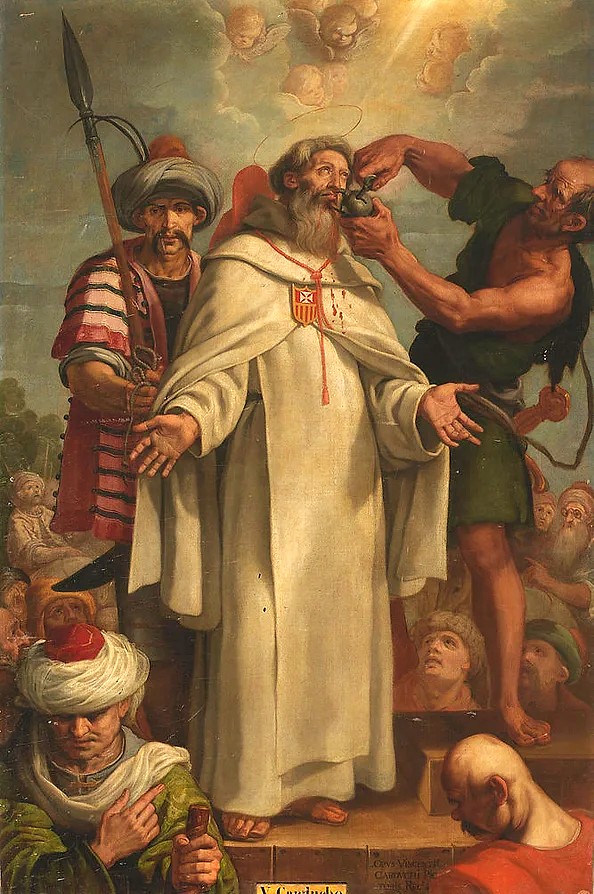
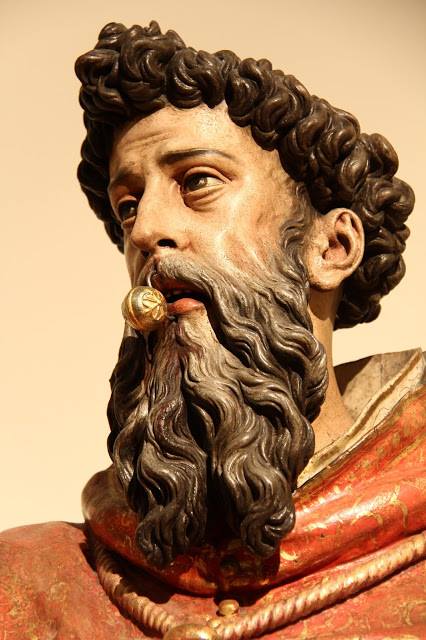
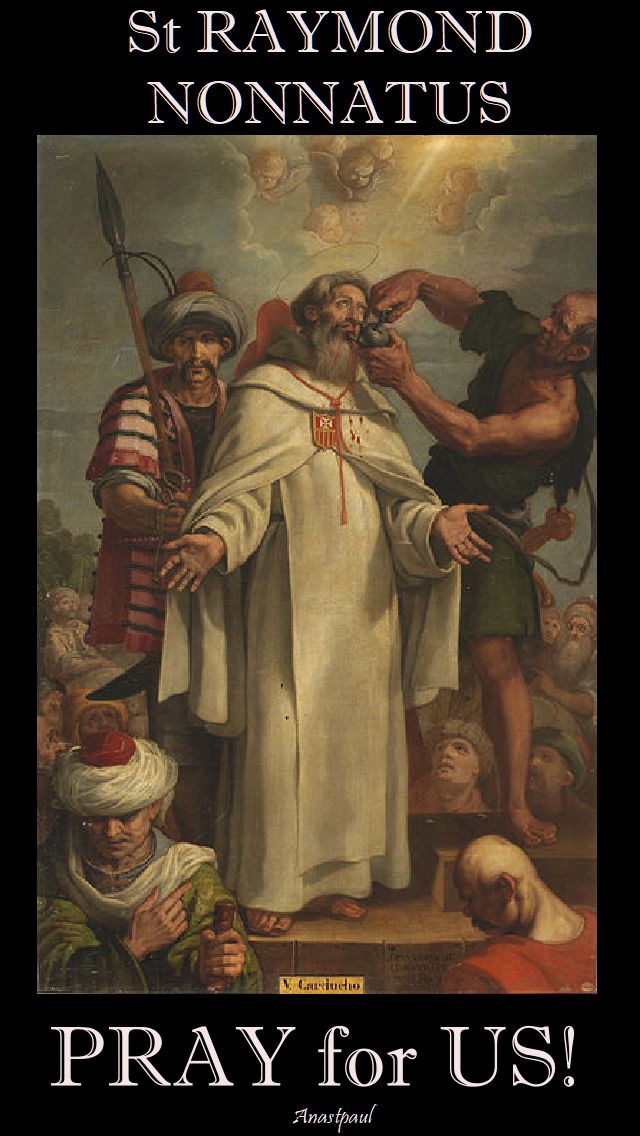
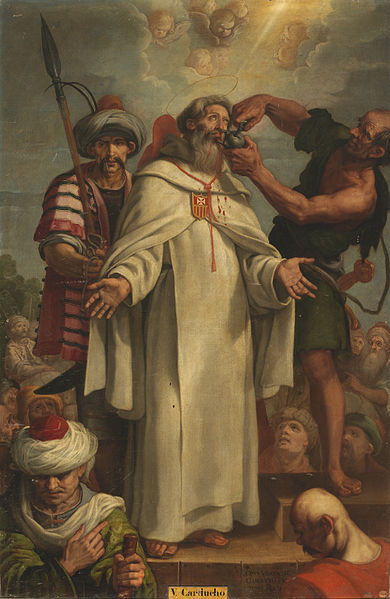
Accused of this before the Judge, he was condemned to be impaled alive and nothing but the hope of a large ransom prevented the execution of this barbarous sentence and caused it to be changed into a cruel bastinado (a form of torture which involves the caning of the soles of the feet). Raymund, who desired nothing more fervently than to die for Christ’s sake, was not intimidated by what he had undergone but wherever an opportunity offered itself, he explained to the infidels, the word of God. The Judge, informed of it, ordered him to be whipped through all the streets of the city and then to be brought to the marketplace, where the executioner, with a red hot iron, pierced his lips, through which a small chain was drawn and closed with a padlock, in order that the holy man might no more use his tongue to instruct others. Every three days the lock was opened and he received just enough food to keep him from starvation. Besides this, he was loaded with chains and cast into a dungeon, where he lay for eight months, until his ransom arrived. Although it was the desire of the Saint to remain among the infidels, as he would there have an opportunity to gain the Crown of Martyrdom, obedience recalled him to his Monastery.
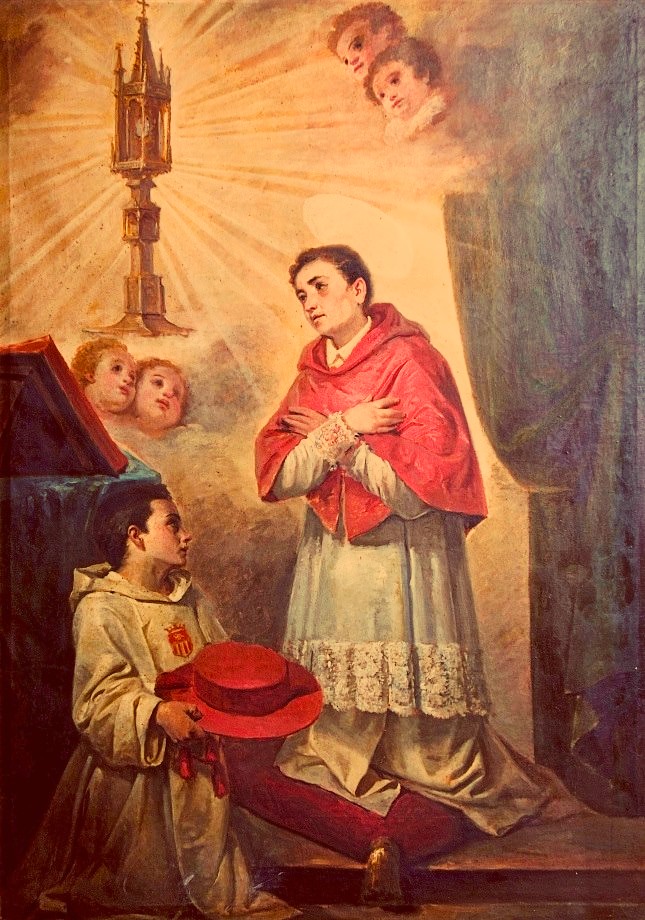
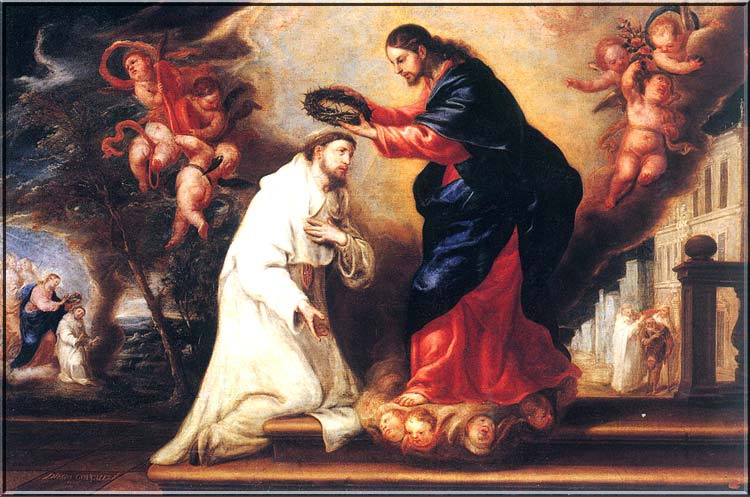
When the Pope was informed of all that Raymund had suffered during his captivity, he appointed him as a Cardinal but the humble Saint returned to his Convent and lived like all the other brothers of the Order, without making the least change in his dress, food, or dwelling, nor accepting any honour due to him as so high a dignitary of the Church.
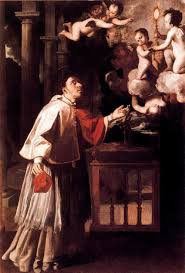
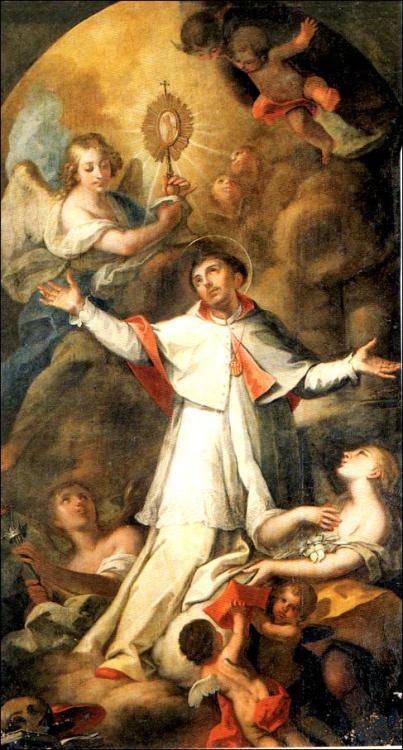
Pope Gregory IX, desired to have so holy a man near him and called him to Rome. The Saint obeyed and set out on his journey. He had,, however, scarcely reached Cardona, six miles from Barcelona, when he was seized with a malignant fever which soon became fatal. He desired most fervently to receive the holy Sacraments but, as the Priest called to administer them to him, delayed to come, God sent an Angel, who brought him the Divine food. After receiving it, he returned thanks to God for all the graces he had received from Him during his life and peacefully gave up his soul, in the 37th year of his age.
After his death, the inhabitants of Cardona, the Clergy of Barcelona and the religious of his Order, contended as to where the holy body should be buried. Each party thought they had the greatest claim to possess his tomb. At last they resolved to leave the decision to Providence. They placed the coffin, in which the holy body reposed, upon a blind mule, determined that the treasure should be deposited in the place to which this animal should carry it. The mule, accompanied by a large concourse of people, went on until it had reached the hermitage and Chapel where the holy Cardinal, as a shepherd boy, had spent so many hours in prayer and had received so many graces from God. There the Saint was buried and St Peter Nolasco, Founder of the Order in the course of time, founded there a Convent, with a Church in which the holy remains are still preserved and greatly honoUred by the people of Catalonia.
St Raymond Nonnatus O.deM. (1204-1240) Religious Priest, Confessor, Cardinal, Friar of the Mercedarian Order. Beatified on 5 November 1625 by Pope Urban VIII and Canonised in 1657 by Pope Alexander VII. Raymond was delivered by Caesarean operation when his mother died during childbirth – hence the name: non natus = not born. Biography here: https://anastpaul.wordpress.com/2017/08/31/saint-of-the-day-31-august-st-raymond-nonnatus-o-dem/
St Ammi of Caesarea St Aristides the Philosopher St Barbolenus of Bobbio St Bonajuncia OSM Confessor St Caesidius St Cuthburga of Wimborne St Cwenburgh of Wimborne
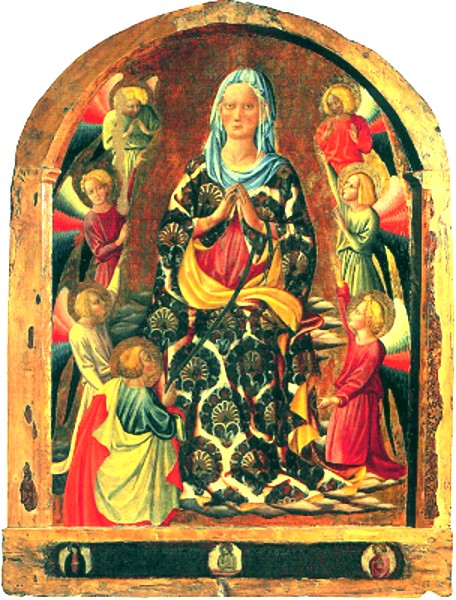
Our Lady of the Founders – The Relic of the Girdle of Our Lady, Constantinople (5th Century) – 31 August:
The Abbot Giovanni Battista Orsini tells us the Empress Saint Pulcheria had this Church built, and gave to it the Girdle of Our Lady. A feast of this relic is kept at Constantinople, under the title of the Deposition of Our Lady’s Girdle. The French having taken this City, this precious treasure was carried off by Nivellon, Bishop of Soissons and placed in the celebrated Abbey of Our Lady, with a portion of the veil of that Queen of Heaven.
The Empress Saint Pulcheria lived in Constantinople in the 5th century, and she built many Churches, hospitals and public houses for the destitute. She is responsible for at least three Churches in Constantinople that were dedicated to the Blessed Virgin – the Blachemae, the Chalkoprateia and the Hodegetria. The Church of the Virgin of Blachernae, now known as the Church of Panagia of Blachernae, is located in Istanbul. It was once the most celebrated Shrine in Constantinople and lies inside the high walls of the City, only a short distance from the Golden Horn. The Church was begun by the Empress Pulcheria, and completed by her husband, the Emperor Marcian. It was built upon the site of what was thought to be a sacred spring, the waters of which are still thought to have therapeutic value. The Emperor Leo I made several additions, including the Hagai Soros, which was actually a small Chapel next to the Church where the Holy Robe and Girdle of the Blessed Virgin Mary were kept in a silver and gold reliquary. The relics had been brought from Palestine in 458.
In the year 911 it was reported that there was a Marian apparition at this Church. The City was under siege by a large Muslim army, so the citizens of Constantinople had recourse to Mary, praying for relief at the Blachernae Church. Very early one morning the Blessed Virgin, preceded by a host of Angels, was seen to enter through the Church doors, escorted by Saint John the Baptist and Saint John the Apostle. She advanced to the centre of the Church and knelt there to pray fervently with tears in her eyes. After a time she moved to the Altar and continued praying before she removed her veil and held it out over the faithful as she ascended back into Heaven. This was seen as a sign that she was taking the City under her protection and so it happened that the Christian’s won a striking victory over their enemies, who were driven off. The City of Constantinople came under siege during the Fourth Crusade in the year 1203 and was captured in April of 1204. The Bishop Nivelon de Cherisy was one of the first men to scale the walls of mighty Constantinople when it was finally opened to the Crusaders. Despite the fact that there was a stern prohibition against plundering relics from Churches and monasteries, many holy relics were obtained and brought back to the West. Bishop Conrad of Halberstadt, Abbot Martin of Pairis, and Nivelon of Soiccons were known to have taken relics. Nivelon of Soiccons enriched his Cathedral at Soissons with several important relics. Robert of Clari later includes in a list of relics he viewed at the Church of the Blessed Virgin of the Pharos (Lighthouse) the Crown of Thorns, the Virgin’s Robe, the Head of St John the Baptist and two large pieces of the True Cross. The robe was a large portion of the sleeveless shirt worn by the Virgin Mary, as well as her Girdle.
St Ammi of Caesarea St Aristides the Philosopher St Barbolenus of Bobbio St Caesidius St Cuthburgh of Wimborne St Cwenburgh of Wimborne St Joseph of Arimathea (Died 1st Century) “The Secret Disciple of Jesus” St Mark of Milan St Optatus of Auxerre
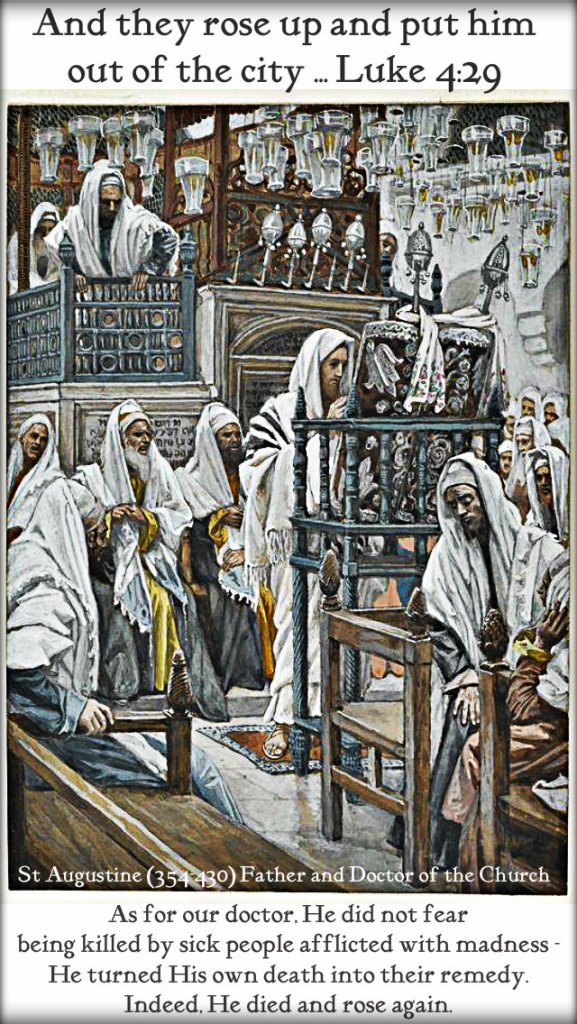
And they rose up and put him out of the city and led him to the brow of the hill on which their city was built, that they might throw him down headlong. But passing through the midst of them he went away….Luke 4:29-30
REFLECTION – “A doctor came amongst us to restore us to health – our Lord Jesus Christ. He discovered blindness in our hearts and promised the light that “eye has not seen and ear has not heard and has not entered the heart of man” (1Cor 2:9). The humility of Jesus Christ is the cure for your pride. Do not scorn what will bring you healing, be humble, you for whom God humbled Himself. Indeed, He knew that the medicine of humility would cure you, He, who well understood your sickness and knew how to cure it. While you were unable to run to the doctor’s house, the doctor in person came to your house… He is coming, He wants to help you, He knows what you need. God has come with humility precisely in order that man might imitate Him. If He had remained above you, how would you have been able to imitate Him? And, without imitating Him, how could you be healed? He came with humility because He knew the nature of the remedy He had to administer – a little bitter, it is true but healing. And do you continue to scorn Him? He who holds out the cup to you and you say: “But what sort of God is this God of mine? He was born, suffered, was covered with spittle, crowned with thorns, nailed on the cross!” O miserable soul! You see the doctor’s humility and not the cancer of your pride. That is why humility displeases you… It often happens that mentally ill people end up by beating their doctor. When that happens, the unfortunate doctor is not only not distressed by the one who beat him but attempts to treat him… As for our doctor, He did not fear being killed by sick people afflicted with madness, He turned His own death into their remedy. Indeed, He died and rose again.”…St Augustine (354-430) Father and Doctor of the Church
PRAYER – My Lord and my God, help me eternal Father, to overcome my weakness! Teach me to be constantly on guard against my pride, to constantly keep watch for temptation and to live constantly in prayer, that Your Son will lead me to safety. St Raymond Nonnatus, you suffered torture but always remain prayerful and awake, imitating the Lord, please pray for me, amen.
Thought for the Day – 31 August – The Memorial of St Raymond Nonnatus
The life of St. Raymond Nonnatus is a life filled with extraordinary facts – from his birth after his mother had already died. Then, consider the torment he suffered of having a padlock perforating his lips. Imagine the enormous pain and discomfort of having a padlock cutting through one’s lips even in sleep. Think how this would bother a man and disturb his nervous system! Then, each time that he had to eat, a Moor would come and open the padlock, breaking the wounds anew and causing new sufferings. Closing it would produce additional torments. Was he allowed to drink water during the day? Can you imagine the discomfort of drinking anything in this situation? He endured this life for the period of eight months.
What did he do when he was freed? Did he have a psychological breakdown? Become discouraged? Feel sorry for himself? No. He took an extraordinarily manly attitude and returned to a life of intense activity. You see how he resisted the temptations to feel sorry for himself and stop fighting for the Catholic cause. His attitude demanded a highly supernatural spirit and a strong virile personality. You see the astonishing fortitude of soul such a man had. He returned and continued an active life for another ten years or so.
He traveled throughout Europe as an ambassador of the Pope and a preacher of the Crusade. What a powerful impression the word of his sermons delivered by his wounded lips must have made on the people!
Imagine such a scene: St. Raymond Nonnatus arriving in a city; the bells ringing and the word spreading that Fr. Raymond – the one with the wounded lips – is in town to preach a Crusade on behalf of the Pope. All the nobles and people of the area gather around with their families and he begins to speak. He speaks about the meaning of the Sepulchre of Our Lord Jesus Christ and what its profanation represents. How it is necessary to re-conquer it for the glory of God and Catholic honour. He speaks with the voice and prestige of a saint, with the supernatural power of communication that only the saints have.
The hearts of men opened to saints like St Raymond Nonnatus and St. Bernard who preached the Crusade
The hearts of the knights begin to be touched, the ladies weep and give their consent for their husbands to go and fight for the Holy Land. Everyone goes to Confession and the date of the Crusade is announced. The practical preparations start. All this happens because a saint passes through that area.
This imaginary scene may help you to understand what the Middle Ages was. The influence of the saints and the good reception the people gave them is what really explains why the Middle Ages had so many wonderful things and our epoch does not. The key is the presence of the saints and the openness people had for them. How few saints there are today! Knowing this, we understand the tragedy of the contemporary situation of the Church and the world.
Let us ask St. Raymond Nonnatus to give us more saints to regenerate the Church and the world and make the modern man recognise them and be receptive to their message.
One Minute Reflection – 31 August – Gospel Mathew 24:42-51
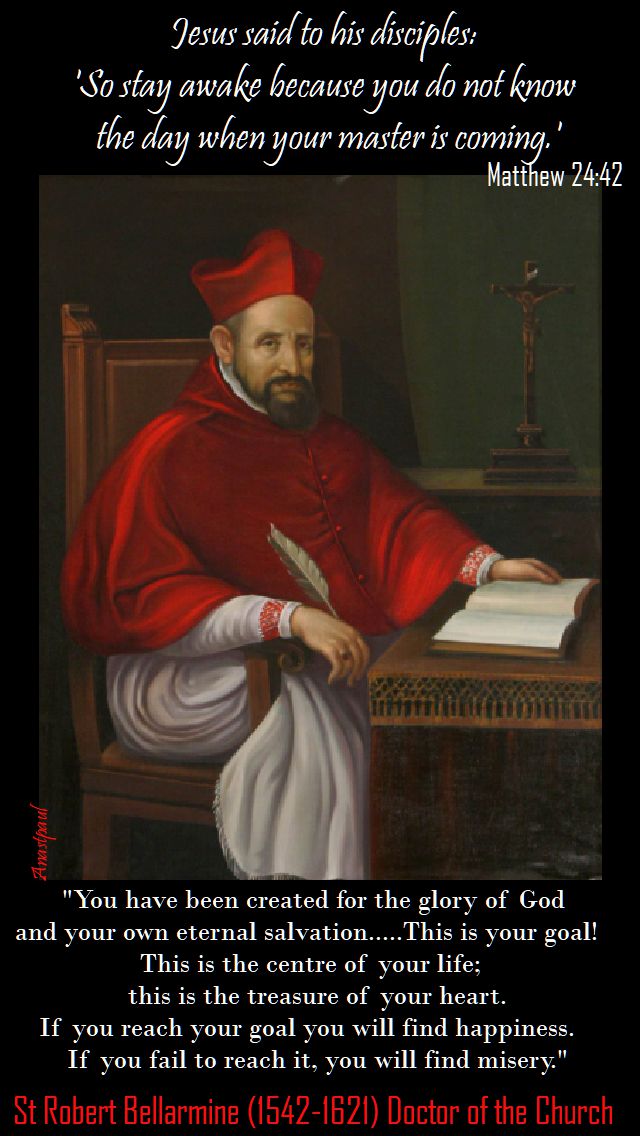
Jesus said to his disciples: ‘So stay awake, because you do not know the day when your master is coming.’...Matthew 24:42
REFLECTION – “You have been created for the glory of God and your own eternal salvation…..This is your goal! This is the centre of your life; this is the treasure of your heart. If you reach your goal you will find happiness. If you fail to reach it, you will find misery.”……St Robert Bellarmine (1542-1621) Doctor of the Church
PRAYER – My Lord and my God, help me eternal Father, to stay awake! Teach me to be constantly on guard against my own weakness, to constantly keep watch for temptation and to live constantly in prayer, that Your Son will lead me to safety. St Raymond Nonnatus, you suffered torture but always remain prayerful and awake, waiting for the Lord, please pray for me, amen.
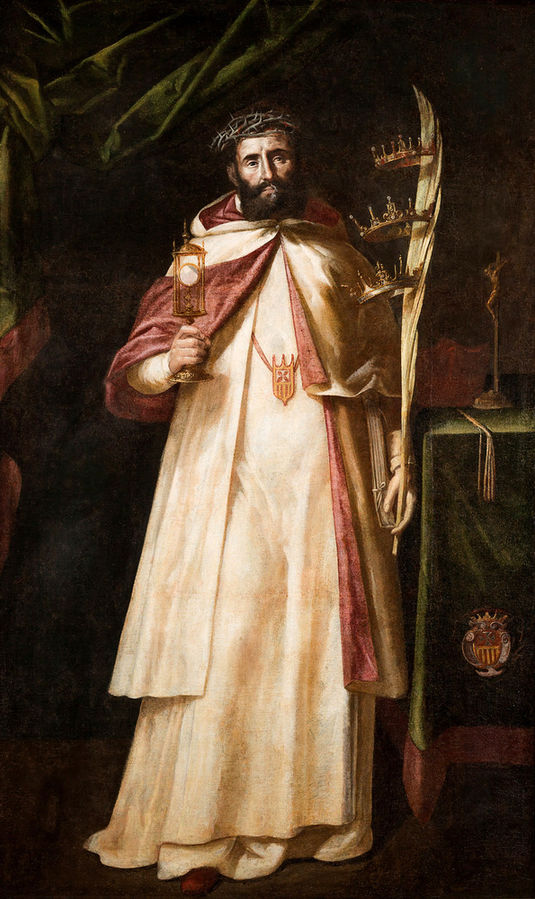
Saint of the Day – 31 August – St Raymond Nonnatus O.deM (1204-1240). Priest, Confessor, Cardinal, Friar of the Mercedarian Order. He was delivered by Caesarean operation when his mother died in childbirth; hence the name non natus = not born. Born in 1204 at Portella, diocese of Urgel, Catalonia, Spain and died on31 August 1240 at Cardona, Spain of a fever. He was buried at the Chapel of Saint Nicholas near his family farm he was supposed to have managed. He was Beatified on 5 November 1625 by Pope Urban VIII (cultus confirmed) and Canonised on 1657 by Pope Alexander VII. Patronages – against gossip, of silence, against fever, of babies, infants, childbirth, children, pregnant women, falsely accused people, midwives, obstetricians, Baltoa, Dominican Republic, San Ramon, Costa Rica.
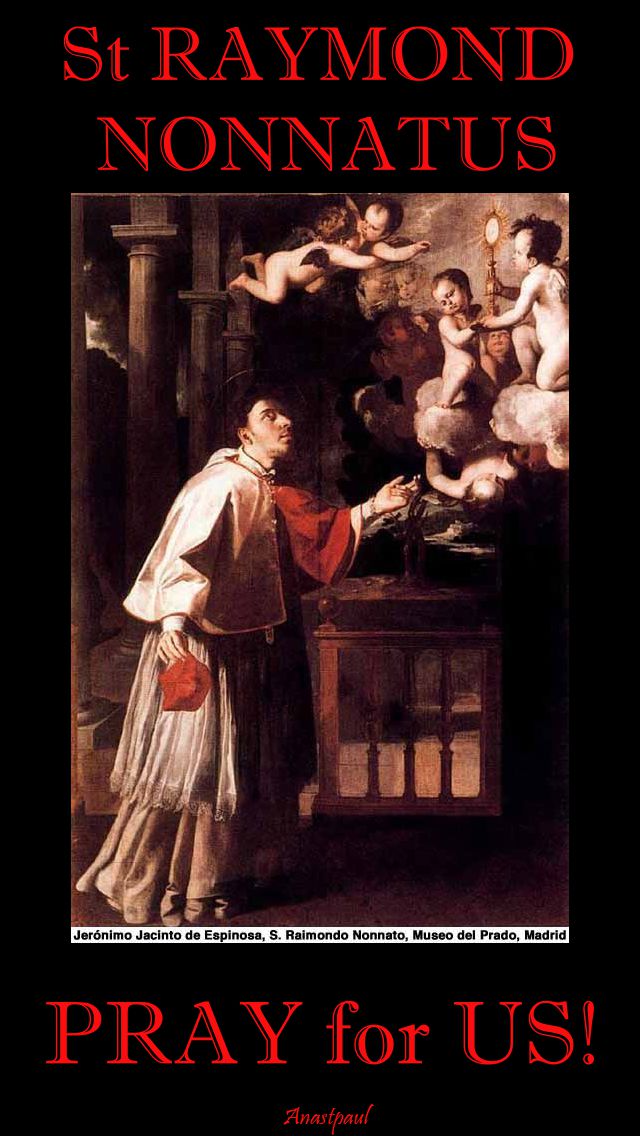
From the time he was very young, he manifested a great devotion to the Most Holy Virgin. He prayed the Rosary every day in the hermitage of St. Nicholas of Mira . Once Our Lady appeared to him and promised him her protection. Afterward he was strongly tempted to sin against chastity but did not fall. He went to thank his Patroness and consecrated his virginity to her. Mary appeared to him again, showing her satisfaction and advising him to enter the Order of the Mercedarians (Order of Mercy), whose foundation she had inspired St. Peter Nolasco to make only shortly before, in 1218.
He was ordained a Priest and dedicated himself to the redemption of captives until 1231. He liberated 140 captives in Valencia, 250 in Argel and 28 in Tunis. It was in this last city that he had the occasion to fulfill the special fourth vow of the Mercedarians to offer themselves to remain in captivity in the place of Catholic prisoners. Since he was unable to pay the ransom demanded by the slave dealers in Tunis, Raymond offered himself to take the place of some prisoners.
The trade was made and he began a hard captivity. To prevent him from speaking about Our Lord, for his engaging words were converting numerous Muslims, the Arabian slave masters pierced his lips with a red-hot iron and closed them with a padlock. This padlock was only opened for him to eat. After eight months of this torment, other Mercedarians arrived from Spain bringing the demanded ransom.
The last ten years of his life were spent in Rome, where he became the representative of his Order and in traveling throughout different countries to preach the Crusade. As a cardinal representative of Pope Gregory IX he was sent to meet with St Louis of France and encourage him to go on the Crusade, which actually took place 10 years later.
St. Raymond Nonnatus died in Cardona, a Spanish village close to Barcelona, on August 31, 1240. He was only 37-years-old.
One particular devotion is centered around the padlock that is part of his martyrdom. Locks are placed at his altar representing a prayer request to end gossip, rumours, false testimonies and other sins of the tongue. The locks are used as a visible sign of such prayer request, which first and foremost must take place interiorly, a prayer to God through St. Raymond’s intercession.
The Mercedarians – Order of the Blessed Virgin Mary of Mercy:
The Order of the Blessed Virgin Mary of Mercy is an international community of priests and brothers who live a life of prayer and communal fraternity. In addition to the vows of poverty, chastity and obedience, their members take a special fourth vow to give up their own selves for others whose faith is in danger.
The Order, also called the Mercedarians, or Order of Mercy, was founded in 1218 in Spain by St Peter Nolasco to redeem Christian captives from their Muslim captors. The Order exists today in 17 countries, including Spain, Italy, Brazil, India and the United States.
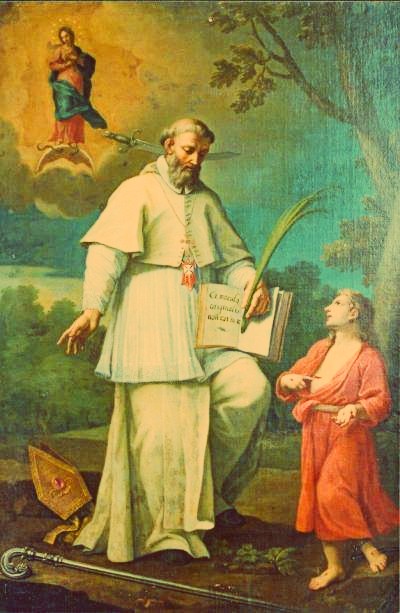
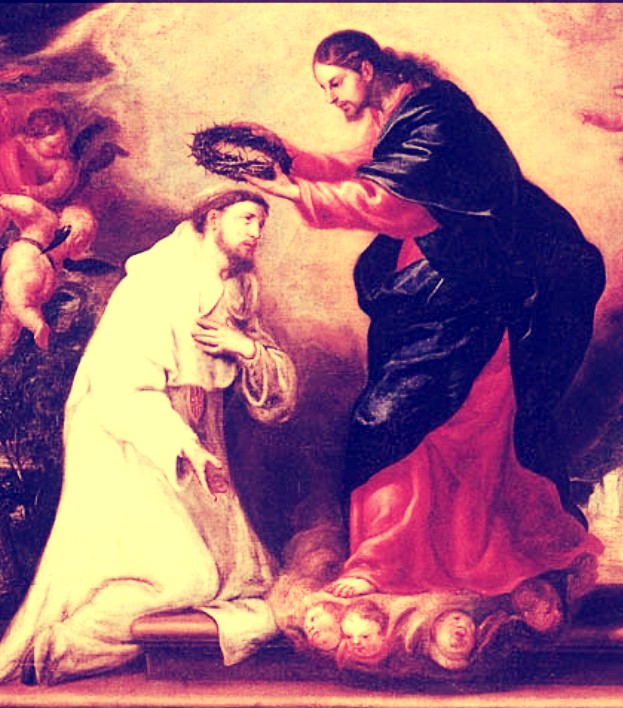
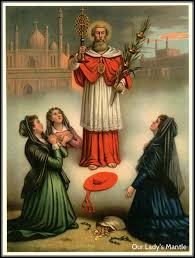
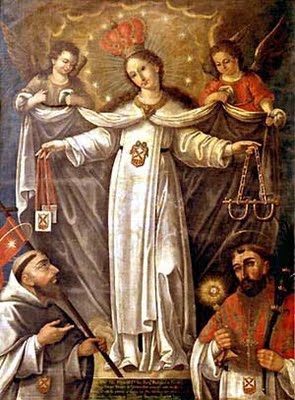
St Peter Nolasco & St Raymond Nonnatus and the Blessed Virgin Mary
Today, friars of the Order of Mercy continue to rescue others from modern types of captivity, such as social, political, and psychological forms. They work in jails, marginal neighborhoods, among addicts and in hospitals.
The spiritual and communal life of the friars include prayer, meditation, Holy Mass, recreation and apostolate. Their life is based on the Rule of St. Augustine and the Constitutions of the Order.
Overall, the Order of Mercy commits itself to give testimony to the same Good News of love and redemption that it has shown since the beginning of its history.





 AnaStpaul
You must be logged in to post a comment.