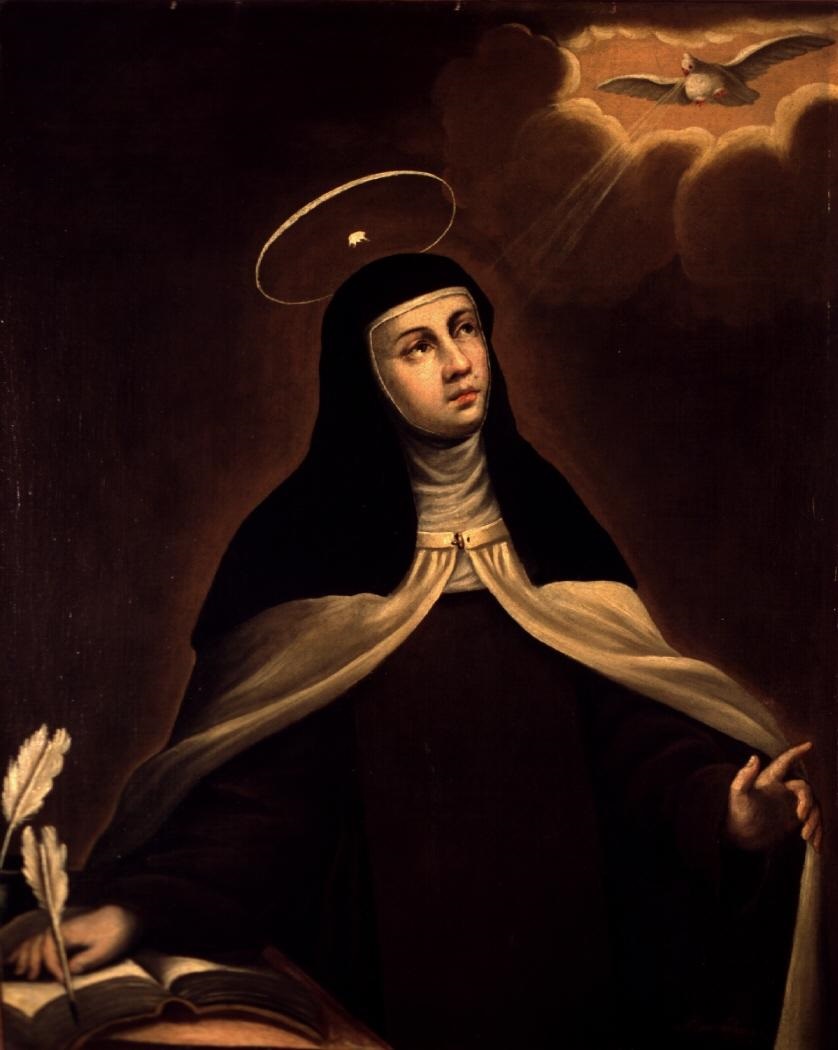
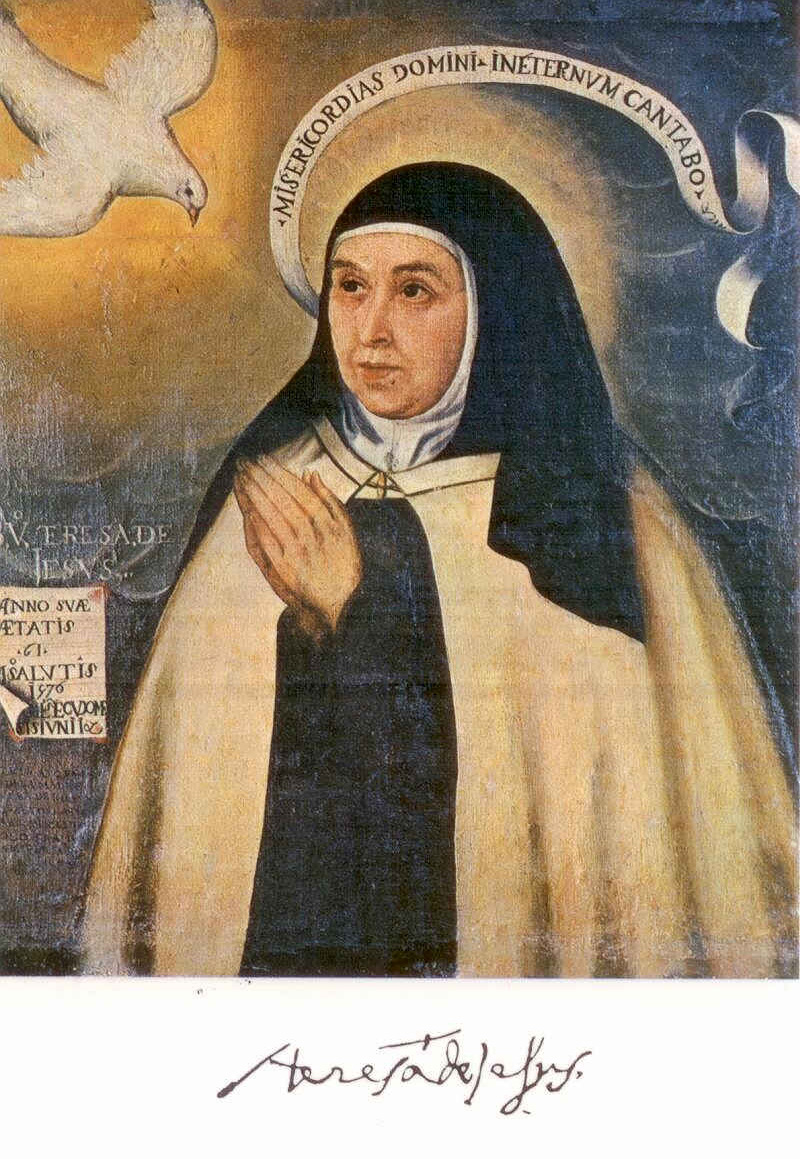
One Minute Reflection – 15 October – Today’s Gospel: Luke 11:29–32 – Monday of the Twenty-eighth week in Ordinary Time, Year B and the Memorial of St Teresa of Jesus/Avila (1515-1582) Doctor of the Church “Doctor of Prayer”
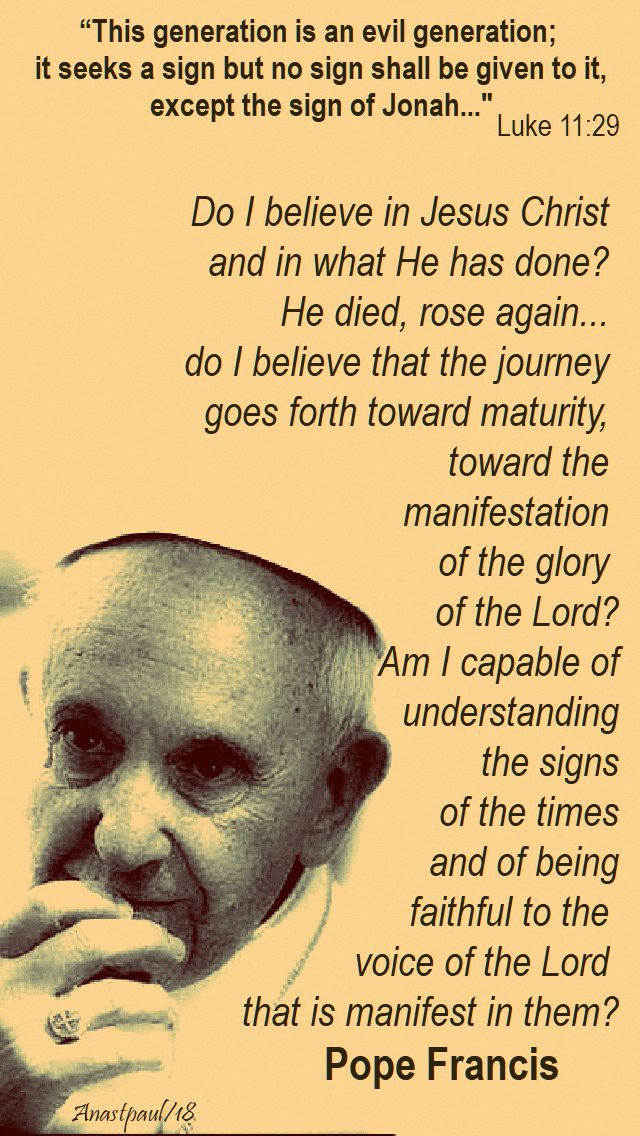
“This generation is an evil generation; it seeks a sign but no sign shall be given to it except the sign of Jonah…”…Luke 11:29
REFLECTION – “Am I attached to my things, to my ideas, closed? Or am I open to the God of surprises? Am I a stationary person or a person on a journey?….Do I believe in Jesus Christ and in what He has done? He died, rose again… do I believe that the journey goes forth toward maturity, toward the manifestation of the glory of the Lord? Am I capable of understanding the signs of the times and of being faithful to the voice of the Lord that is manifest in them?”…Pope Francis 13 October 2014
Better Your faithful love than life itself;
my lips will praise You.
Thus I will bless You all my life,
in Your name lift up my hands. (Ps 63:3-4)
PRAYER – Almighty God, our Father, You sent St Teresa of Jesus to be a witness in the Church to the way of perfection. Sustain us by her spiritual doctrine and kindle in us, the longing for true holiness. Through Christ, our Lord, in union with the Holy Spirit, God forever. May the intercession of St Teresa be a source of strength, amen
Our Morning Offering – 15 October – The Memorial of St Teresa of Jesus/Avila (1515-1582) Doctor of the Church “Doctor of Prayer”
Morning Offering Of St Teresa of Avila (1515-1582)
Lord,
grant that I may always
allow myself
to be guided by You,
always follow Your plans,
and perfectly accomplish
Your Holy Will.
Grant that in all things,
great and small,
today and all the days of my life,
I may do
whatever You require of me.
Help me respond
to the slightest prompting
of Your Grace,
so that I may be
Your trustworthy instrument
for Your honour.
May Your Will be done
in time
and in eternity
by me,
in me
and through me.
Amen
Excerpt of Pope Benedict’s Catechesis
on the Doctors of the Church
Wednesday, 2 February 2011
St Teresa, whose name was Teresa de Cepeda y Ahumada, was born in Avila, Spain, in 1515. In her autobiography she mentions some details of her childhood – she was born into a large family, her “father and mother, who were devout and feared God”. She had three sisters and nine brothers.
While she was still a child and not yet nine years old she had the opportunity to read the lives of several Martyrs which inspired in her such a longing for martyrdom that she briefly ran away from home in order to die a Martyr’s death and to go to Heaven (cf. Vida, [Life], 1, 4) – “I want to see God”, the little girl told her parents.
A few years later Teresa was to speak of her childhood reading and to state that she had discovered in it the way of truth which she sums up in two fundamental principles. On the one hand was the fact that “all things of this world will pass away” while on the other God alone is “forever, ever, ever”, a topic that recurs in her best known poem: “Let nothing disturb you, Let nothing frighten you, all things are passing away: God never changes. Patience obtains all things. Whoever has God lacks nothing, God alone suffices”. She was about 12 years old when her mother died and she implored the Virgin Most Holy to be her mother (cf. Vida, I, 7).
When she was 20 she entered the Carmelite Monastery of the Incarnation, also in Avila. In her religious life she took the name “Teresa of Jesus”. Three years later she fell seriously ill, so ill that she remained in a coma for four days, looking as if she were dead (cf. Vida, 5, 9). In the fight against her own illnesses too, the Saint saw the combat against weaknesses and the resistance to God’s call: “I wished to live”, she wrote, “but I saw clearly that I was not living but rather wrestling with the shadow of death, there was no one to give me life and I was not able to take it. He who could have given it to me had good reasons for not coming to my aid, seeing that He had brought me back to Himself so many times and I as often had left Him” (Vida, 7, 8).
In 1543 she lost the closeness of her relatives, her father died and all her siblings, one after another, emigrated to America. In Lent 1554, when she was 39 years old, Teresa reached the climax of her struggle against her own weaknesses. The fortuitous discovery of the statue of “a Christ most grievously wounded”, left a deep mark on her life (cf. Vida, 9). The Saint, who in that period felt deeply in tune with the St Augustine of the Confessions, thus describes the decisive day of her mystical experience: “and… a feeling of the presence of God would come over me unexpectedly, so that I could in no wise doubt either that He was within me, or that I was wholly absorbed in Him”(Vida, 10, 1).
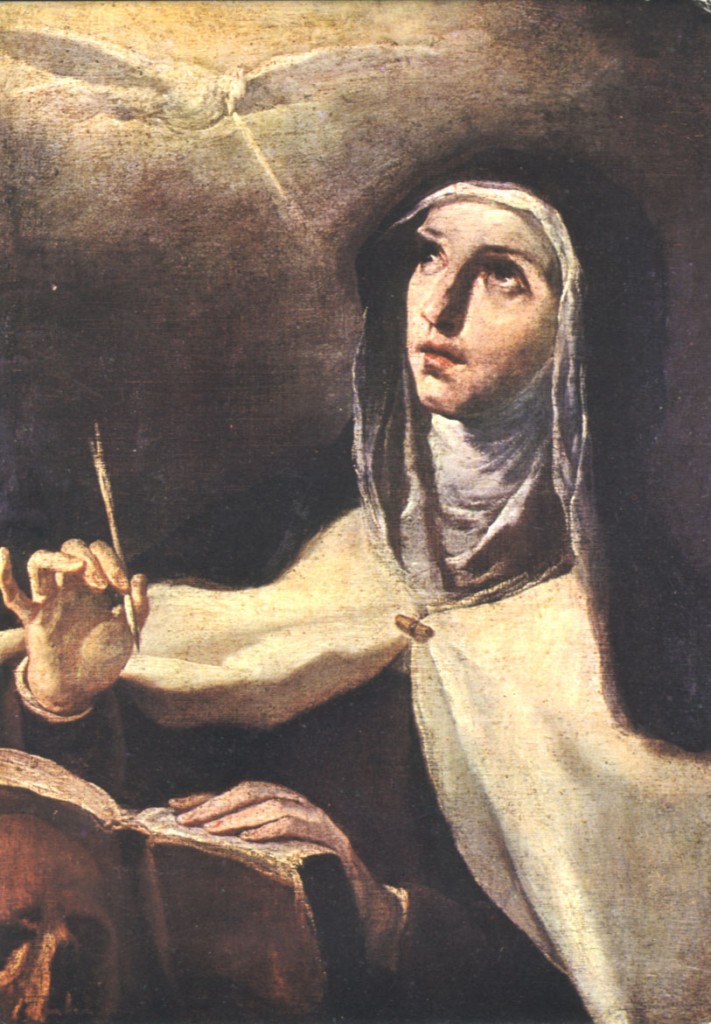
Artist – Yaquinto de Corrado
Parallel to her inner development, the Saint began in practice to realise her ideal of the reform of the Carmelite Order – in 1562 she founded the first reformed Carmel in Avila, with the support of the city’s Bishop, Don Alvaro de Mendoza and shortly afterwards also received the approval of John Baptist Rossi, the Order’s Superior General. In the years that followed, she continued her foundations of new Carmelite convents, 17 in all. Her meeting with St John of the Cross was fundamental. With him, in 1568, she set up the first convent of Discalced Carmelites in Duruelo, not far from Avila. In 1580 she obtained from Rome the authorisation for her reformed Carmels as a separate, autonomous Province. This was the starting point for the Discalced Carmelite Order.
Indeed, Teresa’s earthly life ended while she was in the middle of her founding activities. She died on the night of 15 October 1582 in Alba de Tormes, after setting up the Carmelite Convent in Burgos, while on her way back to Avila. Her last humble words were: “After all I die as a child of the Church” and “O my Lord and my Spouse, the hour that I have longed for has come. It is time to meet one another”.
Teresa spent her entire life for the whole Church although she spent it in Spain. She was beatified by Pope Paul V in 1614 and Canonised by Pope Gregory XV in 1622 . The Servant of God (now Canonised yesterday, 14 October 2018) Paul VI proclaimed her a “Doctor of the Church” in 1970.
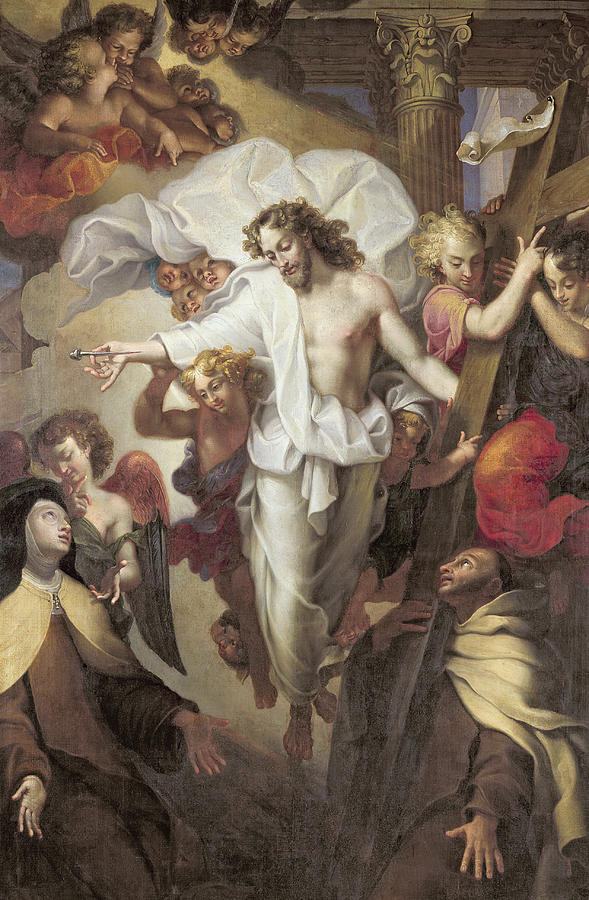
Christ Resurrected Between St Teresa Of Avila & St John of the Cross by Michel des Gobelins Corneille
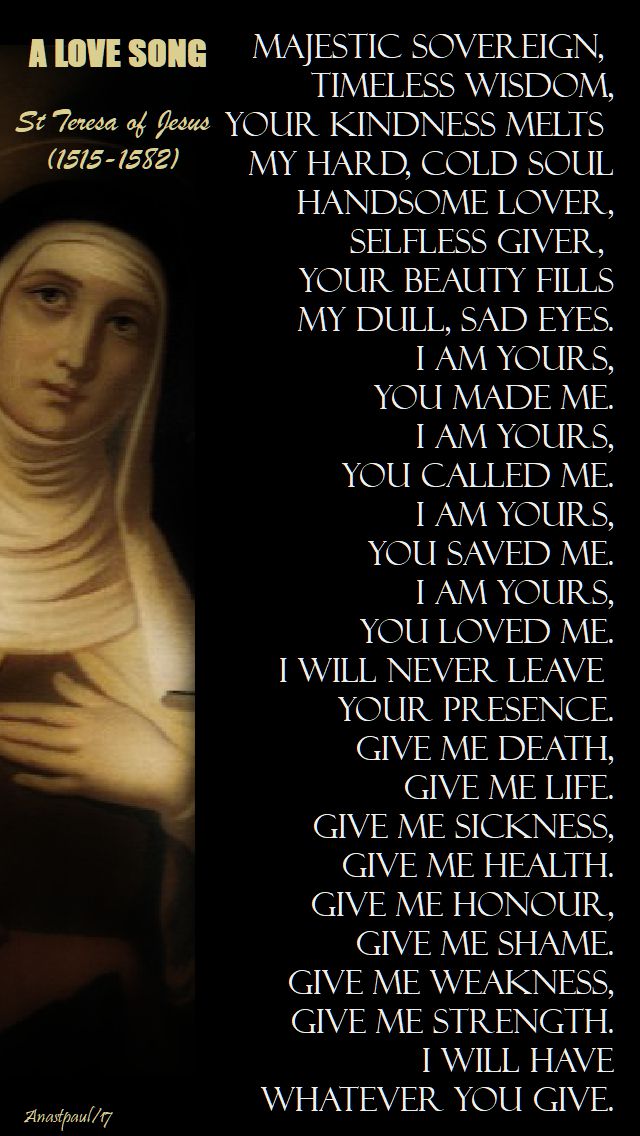
Majestic Sovereign, timeless Wisdom,
Your kindness melts my hard, cold soul.
Handsome Lover, selfless Giver,
Your beauty fills my dull, sad eyes.
I am Yours, You made me.
I am Yours, You called me.
I am Yours, You saved me.
I am Yours, You loved me.
I will never leave Your presence.
Give me death, give me life.
Give me sickness, give me health.
Give me honour, give me shame.
Give me weakness, give me strength.
I will have whatever You give.
Amen
Thought for the Day – – 15 October – The Memorial of St Teresa of Jesus/Avila (1515-1582) Doctor of the Church
Since her encounter with Jesus, St Teresa lived “another life”; she become a tireless communicator of the Gospel (cf. Life, 23, 1). Eager to serve the Church and in the face of serious problems of her time, she did not limit herself to being a spectator of the reality around her. In her position as a woman and with her health difficulties, she decided, she said, “to do what little depended on me … that is to follow the evangelical counsels as perfectly as possible and to ensure that these few nuns who are here do the same” (The Way, 1, 2). Thus began the Teresian reform, in which she asked her sisters not to lose time negotiating with God “interests of little importance,” while “the world is in flames” (ibid., 1, 5). This missionary and ecclesial dimension has always marked the Carmelites and Discalced Carmelites.
As she did then, even today the saint opens new horizons for us, she calls us to a great undertaking, to see the world with the eyes of Christ, to seek what He seeks and to love what He loves. (Pope Francis in a letter to to Carmelite Father Xavier Cannistrà)
Ours is a time of turmoil, a time of reform, and a time of liberation. Modern women have in Teresa a challenging example. Promoters of renewal, promoters of prayer, all have in Teresa a woman to reckon with, one whom they can admire and imitate.
Quotes of the Day – 15 October – The Memorial of St Teresa of Jesus/Avila (1515-1582) Doctor of the Church
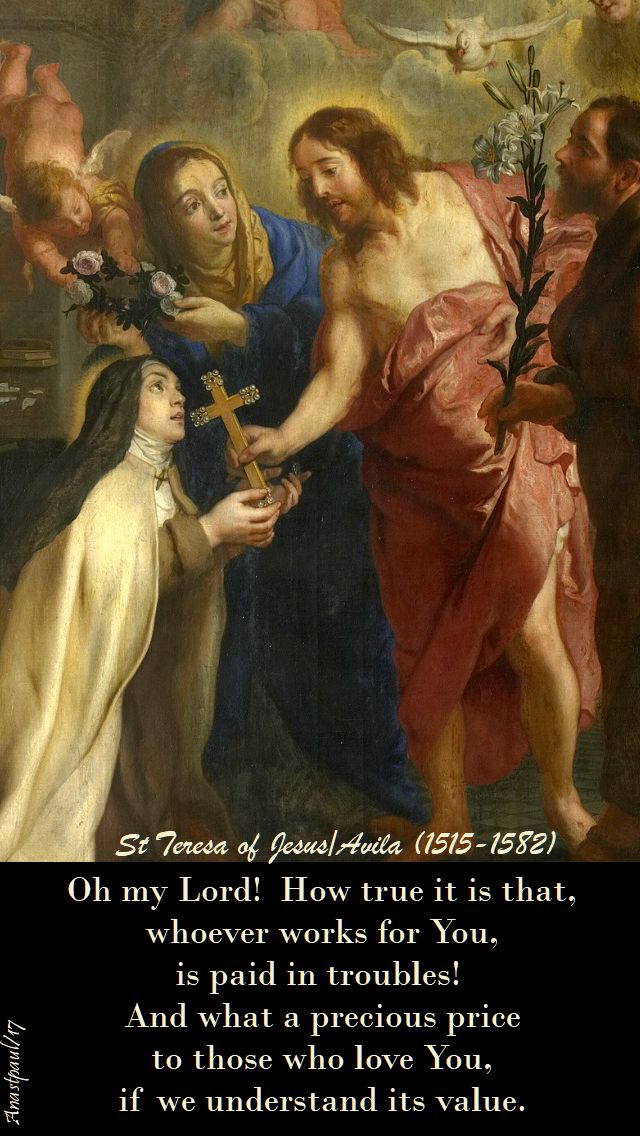
“Oh my Lord! How true it is that, whoever works for You, is paid in troubles! And what a precious price to those who love You, if we understand its value.”
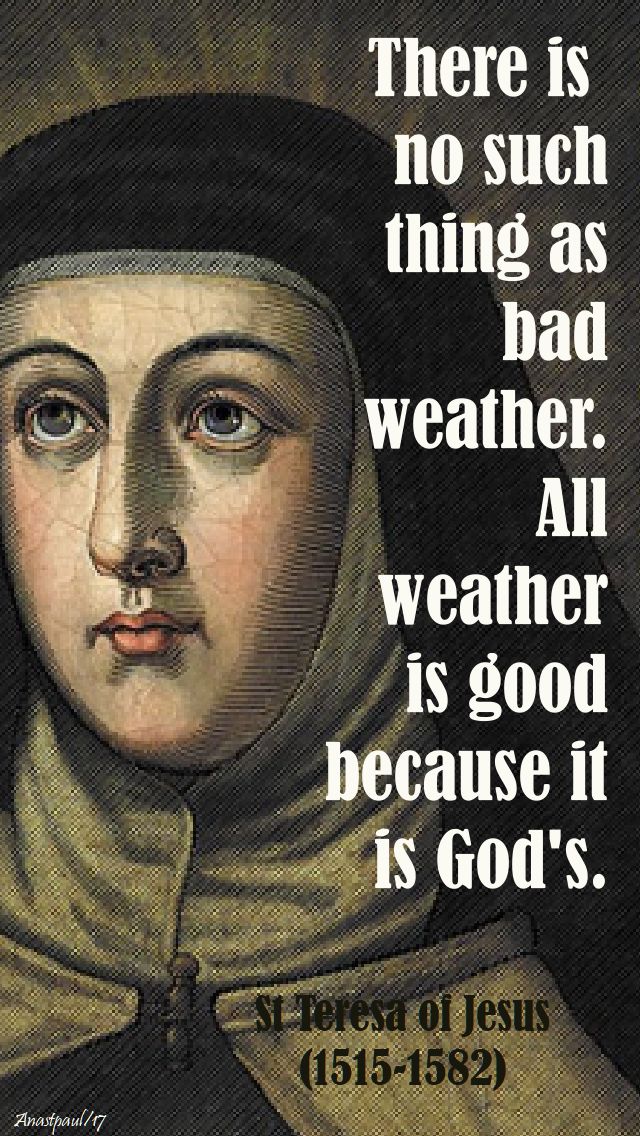
“There is no such thing as bad weather. All weather is good because it is God’s.”
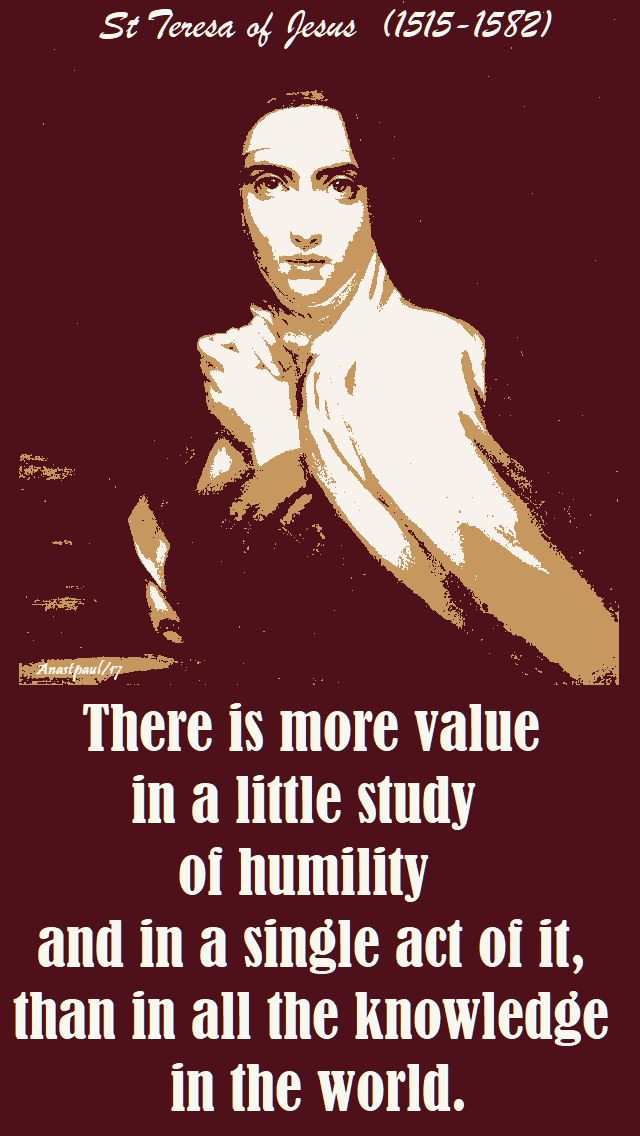
“There is more value in a little study of humility and in a single act of it, than in all the knowledge in the world.”
“We need no wings to go in search of Him but have only to look upon Him, present within us.”
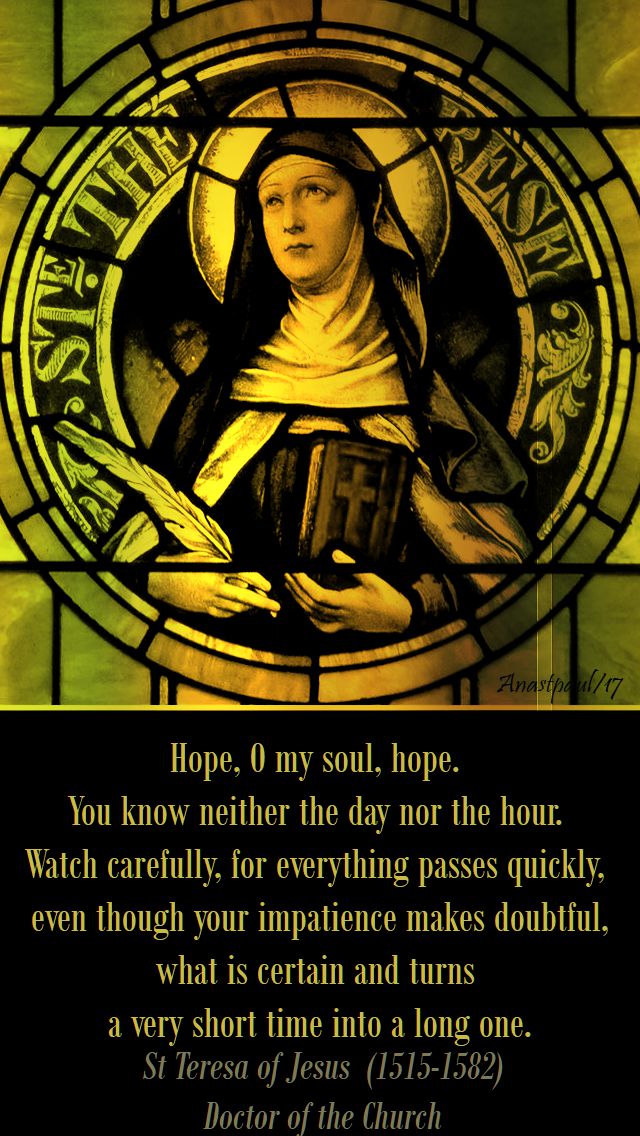
“Hope, O my soul, hope. You know neither the day nor the hour. Watch carefully, for everything passes quickly, even though your impatience makes doubtful, what is certain and turns a very short time into a long one.”
Our Morning Offering – 15 October – The Memorial of St Teresa of Jesus (1515-1582)
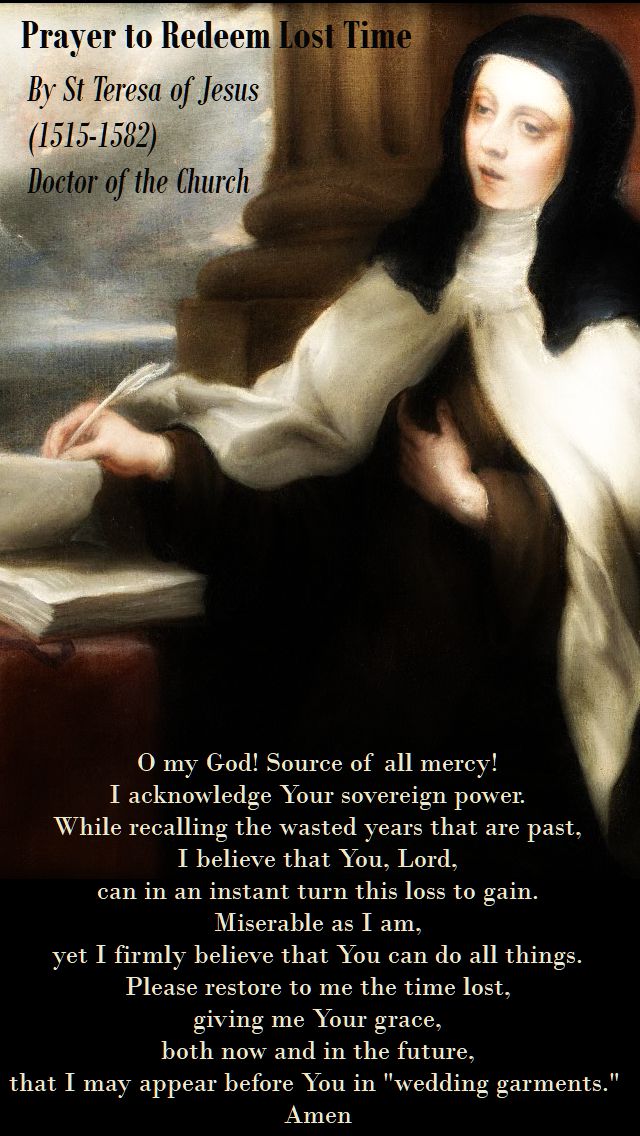
To Redeem Lost Time By St Teresa of Jesus (1515-1582) Doctor of the Church
O my God! Source of all mercy!
I acknowledge Your sovereign power.
While recalling the wasted years that are past,
I believe that You, Lord,
can in an instant turn this loss to gain.
Miserable as I am,
yet I firmly believe that You can do all things.
Please restore to me the time lost,
giving me Your grace,
both now and in the future,
that I may appear before You in “wedding garments.”
Amen





 AnaStpaul
You must be logged in to post a comment.