
Posted in CONFESSION/PENANCE, DOCTORS of the Church, FATHERS of the Church, QUOTES on ANGER, QUOTES on ENEMIES, QUOTES on FORGIVENESS, QUOTES on HEAVEN, QUOTES on HUMILITY, QUOTES on SANCTITY, The WORD

Quote/s of the Day – 17 September – ‘… … Never place yourself above anyone …’

Quote/s of the Day – 17 September – Ephesians 3:13-21, Luke 14:1-11 – Scripture search here: https://www.drbo.org/

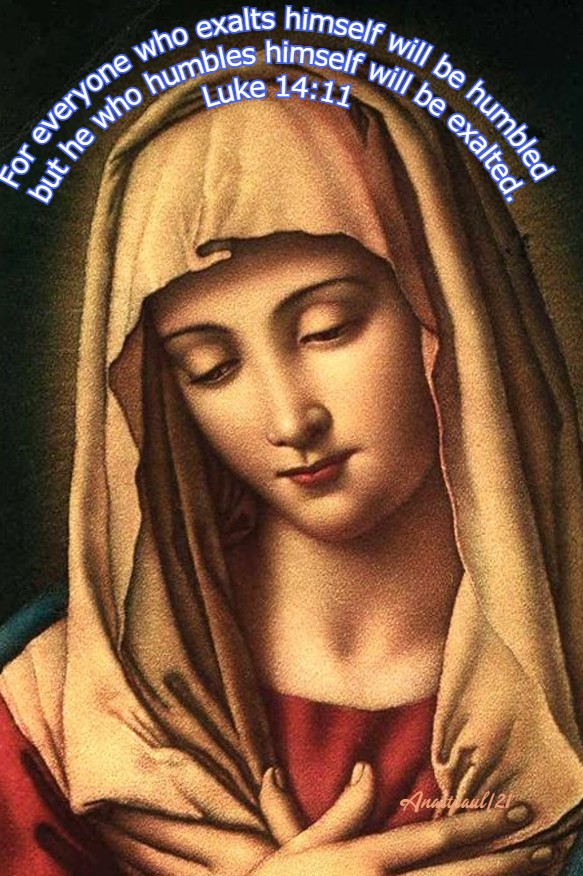
For everyone who exalts himself,
will be humbled and he
who humbles himself,
will be exalted.”

Luke 14:11
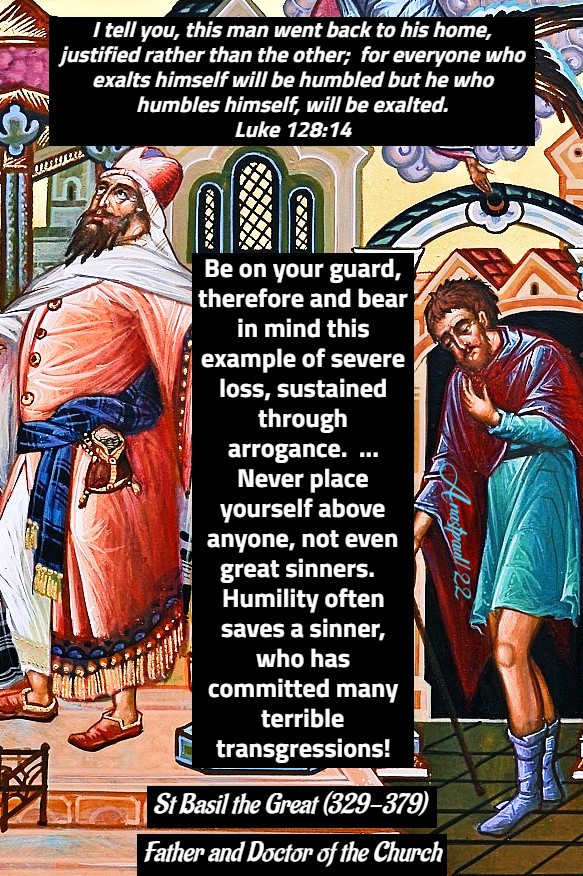
“I tell you, this man went back to his home justified,
rather than the other;
for everyone who exalts himself will be humbled
but he who humbles himself,
will be exalted

Luke 18:14

Be on your guard, therefore
and bear in mind, this example
of severe loss, sustained through arrogance.
… Never place yourself above anyone,
not even great sinners.
Humility often saves a sinner,
who has committed many terrible transgressions!”
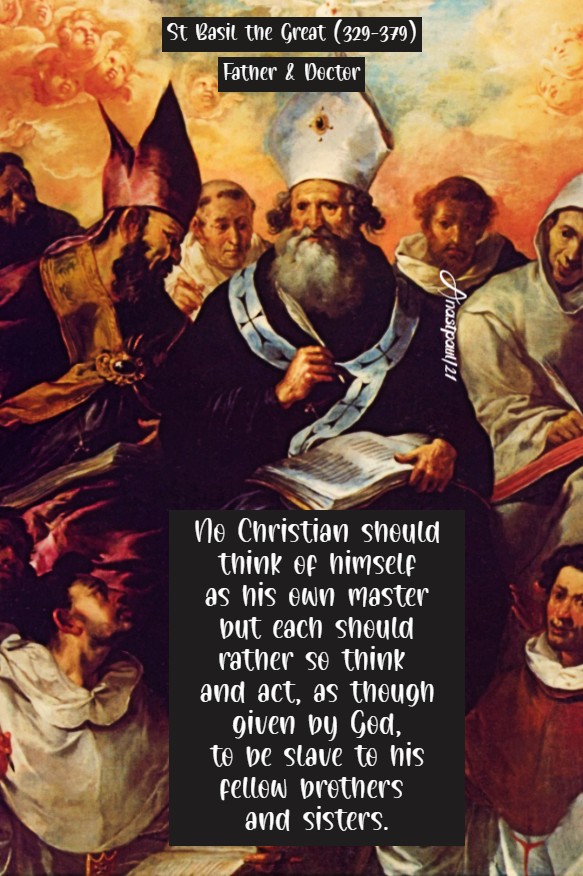
No Christian should think of himself
as his own master
but each should rather so think and act,
as though given by God,
to be slave to his fellow brothers and sisters.

St Basil the Great (329-379)
Father and Doctor of the Church
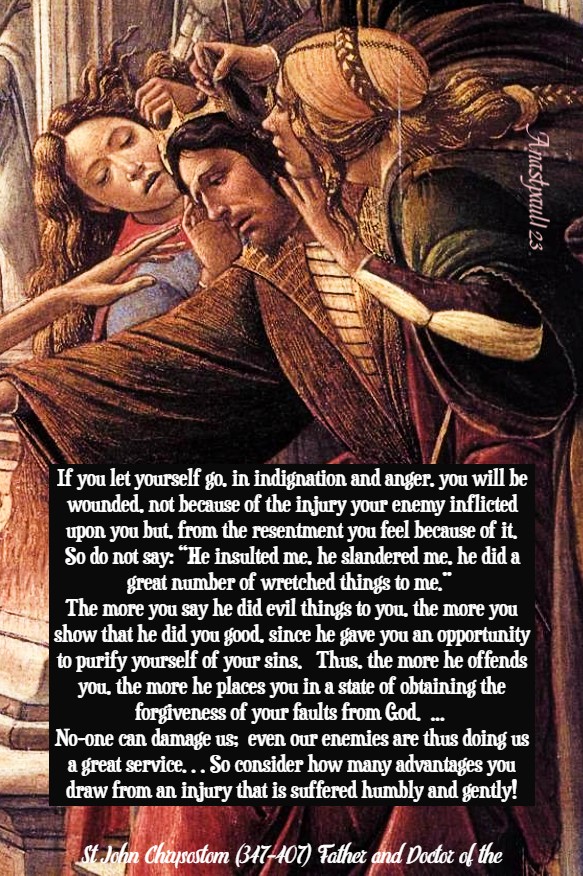
What evil can your enemy do to you
which would be comparable to that,
which you do to yourself? …
If you let yourself go, in indignation and anger,
you will be wounded, not because of the injury
your enemy inflicted upon you
but, from the resentment you feel because of it.
So do not say: “He insulted me, he slandered me,
he did a great number of wretched things to me.”
The more you say he did evil things to you,
the more you show that he did you good,
since he gave you an opportunity
to purify yourself of your sins.
Thus, the more he offends you,
the more he places you in a state
of obtaining the forgiveness of your faults from God.
For if we want, no-one can damage us;
even our enemies are thus doing us a great service…
So consider how many advantages
you draw from an injury that is suffered humbly

and gently!

St John Chrysostom (347-407)
Father and Doctor of the Church
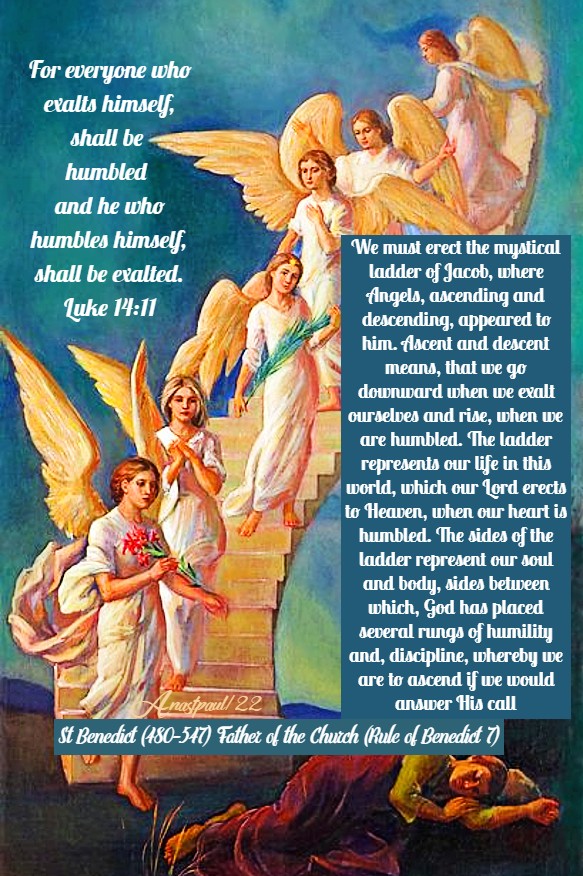
We must erect the mystical ladder of Jacob,
where Angels, ascending and descending,
appeared to him.
Ascent and descent means,
that we go downward when we exalt ourselves
and rise, when we are humbled.
The ladder represents our life in this world,
which our Lord erects to Heaven,
when our heart is humbled.
The sides of the ladder represent our soul and body,
sides between which,
God has placed several rungs of humility and, discipline,
whereby we are to ascend
if we would answer His call.

(Rule of Benedict #7)

St Benedict (480-547)
Father of the Church
Posted in SAINT of the DAY

2 January – Memorials of the Saints

St Basil the Great (Memorial)  (329-379) Doctor of the Church
St Gregory of Nazianzen (330-390) Doctor of the Church (Memorial) – https://www.youtube.com/watch?v=lwe8voh3H_4

St Adelard of Corbie
Bl Airaldus of Maurienne
St Asclepius of Limoges
St Aspasius of Auch
St Blidulf of Bobbio
St Gaspare Bufalo
Bl Guillaume Répin
St Hortulana of Assisi
St Isidore of Antioch
St Isidore of Nitria
St Laurent Bâtard
St Macarius the Younger
St Maximus of Vienne
Bl Odino of Rot
St Paracodius of Vienne
St Seraphim of Sarov
St Seiriol
Bl Stephana de Quinzanis
St Telesphorus, Pope
St Theodota
St Theopistus
St Vincentian of Tulle

Many Martyrs Who Suffered in Rome: There were many martyrs who suffered in the persecutions of Diocletian for refusing to surrender the holy books. Though we know these atrocities occured, we do not know the names of the saints and we honour them as a group. c 303 in Rome, Italy.

Martyrs of Antioch – 5 saints: A group of Christian soldiers martyred together for their faith. We know the names of five – Albanus, Macarius, Possessor, Starus and Stratonicus. They were born in Greece and were martyred in Antioch (modern Antakya, Turkey).

Many Martyrs of Britain: The Christians of Britain appear to have escaped unharmed in the earlier persecutions which afflicted the Church but the cruel edicts of Diocletian were enforced in every corner of the empire and the faithful inhabitants of this land, whether native Britons or Roman colonists, were called upon to furnish their full number of holy Martyrs and Confessors. The names of few are on record but the British historian, Saint Gildas, after relating the martyrdom of Saint Alban, tells us that many others were seized, some put to the most unheard-of tortures and others immediately executed, while not a few hid themselves in forests and deserts and the caves of the earth, where they endured a prolonged death until God called them to their reward. The same writer attributes it to the subsequent invasion of the English, then a pagan people, that the recollection of the places, sanctified by these martyrdoms, has been lost and so little honour paid to their memory . It may be added that, according to one tradition, a thousand of these Christians were overtaken in their flight near Lichfield and cruelly massacred and that the name of Lichfield, or Field of the Dead, is derived from them.

Martyrs of Ethiopia – 3 saints: A group of Christians martyred together for their faith. We know the names of three – Auriga, Claudia and Rutile.

Martyrs of Jerusalem – 2 saints: A group of Christians martyred together for their faith. We know the names of two – Stephen and Vitalis.

Martyrs of Lichfield: Many Christians suffered at Lichfield (aka Lyke-field, meaning field of dead bodies), England in the persecutions of Diocletian. Though we know these atrocities occured, we do not know the names of the saints, and we honour them as a group. Their martyrdom occurred in 304 at Lichfield, England.

Martyrs of Piacenza: A group of Christians who died together for their faith in the persecutions of Diocletian. No details about them have survived. They were martyred on the site of church of Madonna di Campagna, Piacenza, Italy.

Martyrs of Puy – 4 saints: Missionaries, sent by Saint Fronto of Périgueux to the area of Puy, France. Tortured and martyred by local pagans. We know the names – Frontasius, Severinus, Severian and Silanus. They were beheaded in Puy (modern Puy-en-Velay), France and buried together in the church of Notre Dame, Puy-en-Velay by Saint Fronto, their bodies laid out to form a cross.

Martyrs of Syrmium – 7 saints: Group of Christians martyred together, date unknown. We know the names of seven – Acutus, Artaxus, Eugenda, Maximianus, Timothy, Tobias and Vitus – but very little else. This occurred in the 3rd or 4th century at Syrmium, Pannonia (modern Sremska Mitrovica, Serbia).

Martyrs of Tomi – 3 saints: Three brothers, all Christians, all soldiers in the imperial Roman army, and all three martyred in the persecutions of emperor Licinius Licinianus. We know their names – Argeus, Marcellinus and Narcissus – but little else.
They were martyred in 320 at Tomi, Exinius Pontus, Moesia (modern Constanta, Romania).