Quote/s of the Day – 20 August – “The Month of the Immaculate Heart of Mary” – The Feast of St Bernard (1090-1153) Confessor, Father and Mellifluous Doctor
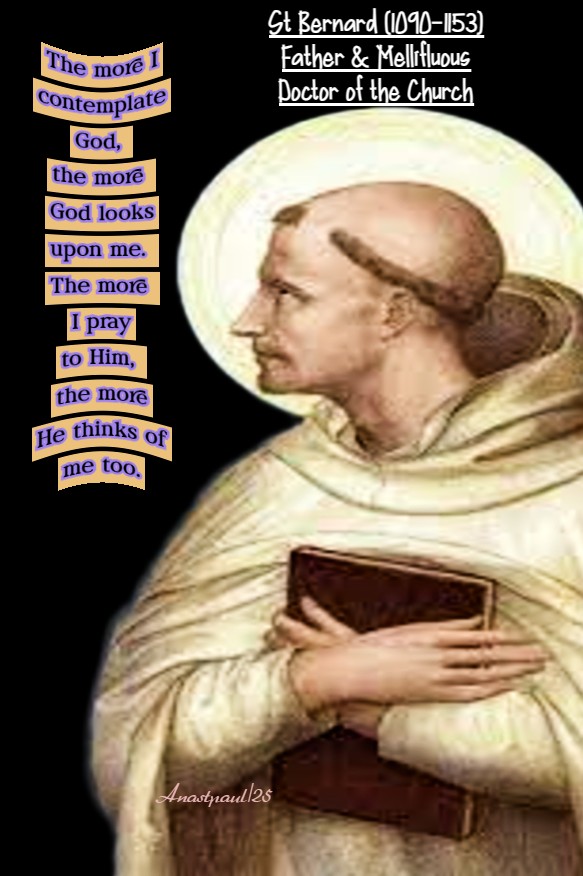
“The more I contemplate God, the more God looks upon me. The more I pray to Him, the more He thinks of me too.”
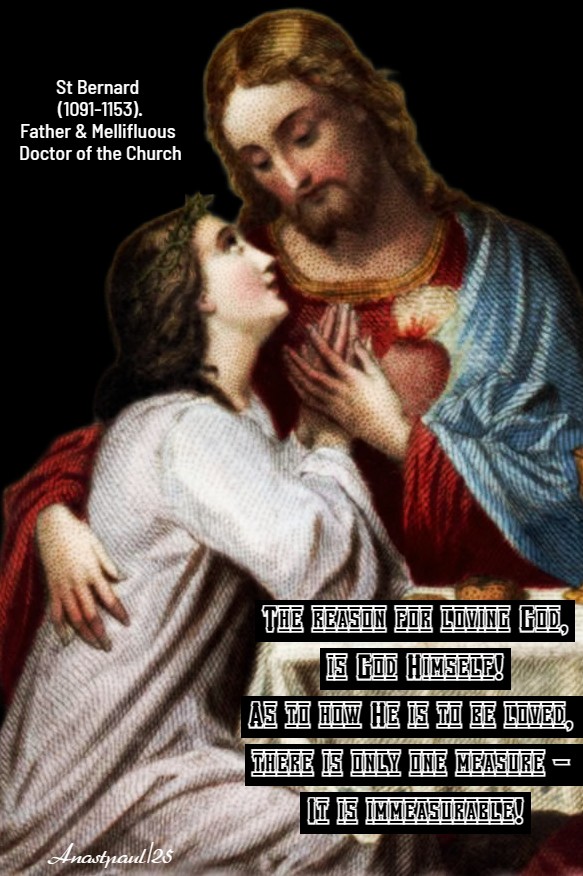
“The reason for loving God, is God Himself! As to how He is to be loved, there is only one measure – It is immeasurable!”
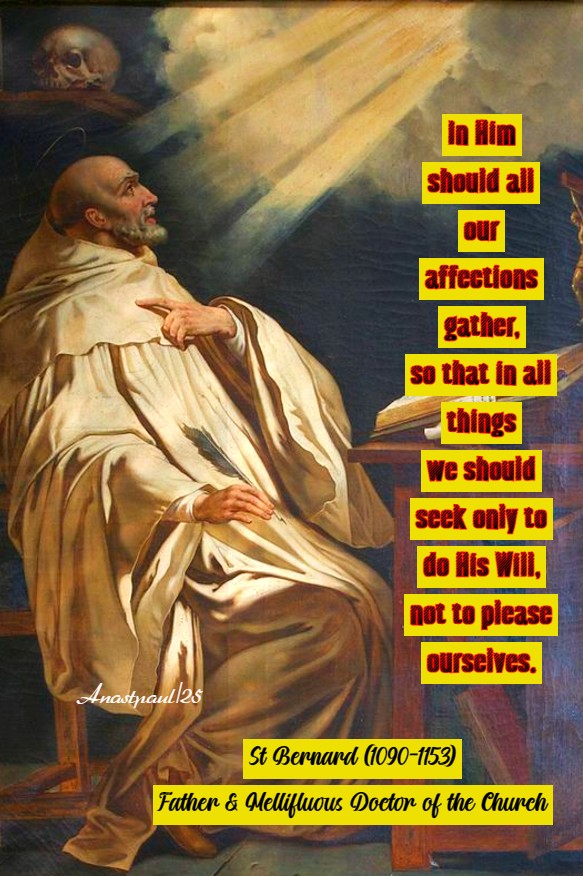
“In Him should all our affections gather, so that in all things we should seek only to do His Will, not to please ourselves.”
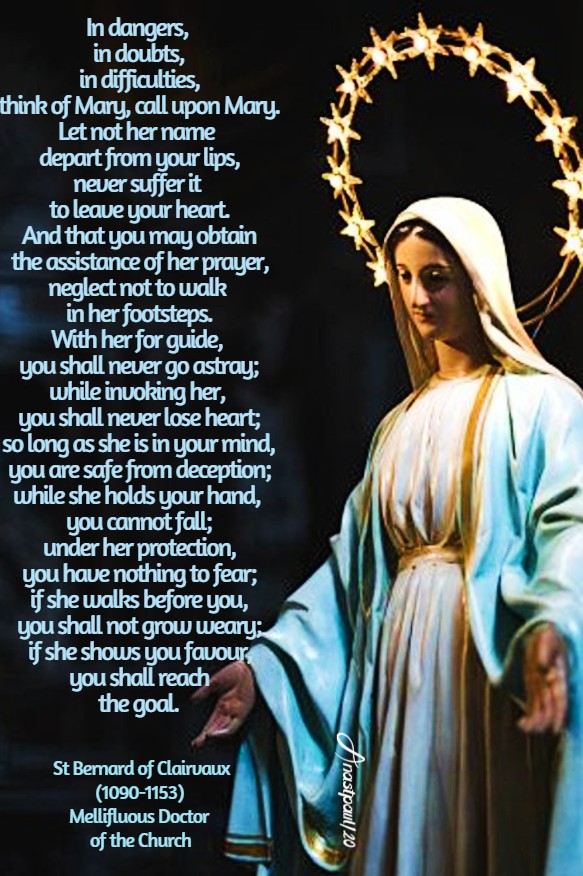
“In dangers, in doubts, in difficulties, think of Mary, call upon Mary. Let not her name depart from your lips, never suffer it to leave your heart. And that you may obtain the assistance of her prayer, neglect not to walk in her footsteps. With her for guide, you shall never go astray; while invoking her, you shall never lose heart; so long as she is in your mind, you are safe from deception; while she holds your hand, you cannot fall; under her protection you have nothing to fear; if she walks before you, you shall not grow weary; if she shows you favour, you shall reach the goal.”
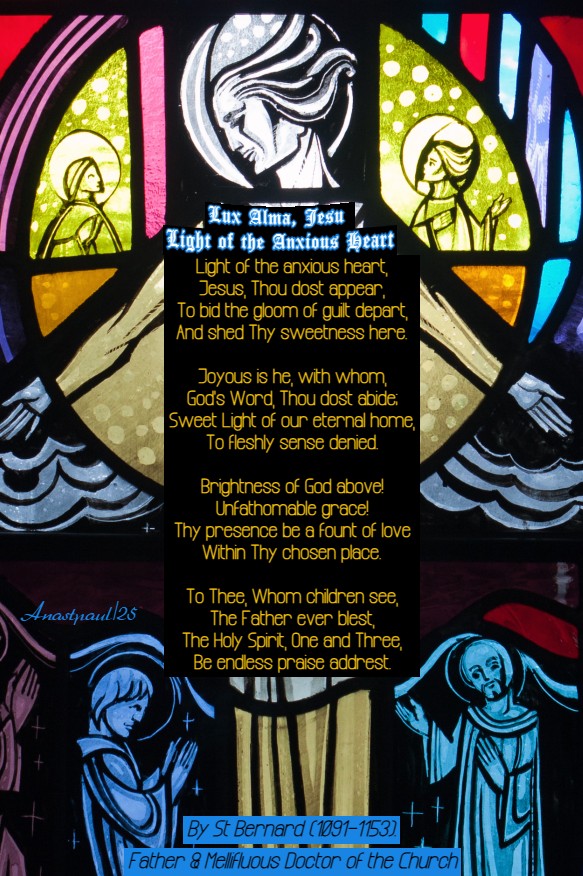
Lux Alma, Jesu Light of the Anxious Heart By St Bernard (1091-1153). Father & Mellifluous Doctor of the Church
Light of the anxious heart, Jesus, Thou dost appear, To bid the gloom of guilt depart, And shed Thy sweetness here.
Joyous is he, with whom, God’s Word, Thou dost abide; Sweet Light of our eternal home, To fleshly sense denied.
Brightness of God above! Unfathomable grace! Thy presence be a fount of love Within Thy chosen place.
To Thee, Whom children see, The Father ever blest, The Holy Spirit, One and Three, Be endless praise addrest.
Translation by Cardinal Newman (1800-1890). There are eight translations. Liturgical Use: Hymn for Lauds on the Feast of the Transfiguration of Our Lord. This Hymn is a cento from St Bernard’s Jesu Dulcis Memoria.
Our Morning Offering – 20 August – “The Month of the Immaculate Heart of Mary” – The Feast of St Bernard (1090-1153) Confessor, Father and Mellifluous Doctor
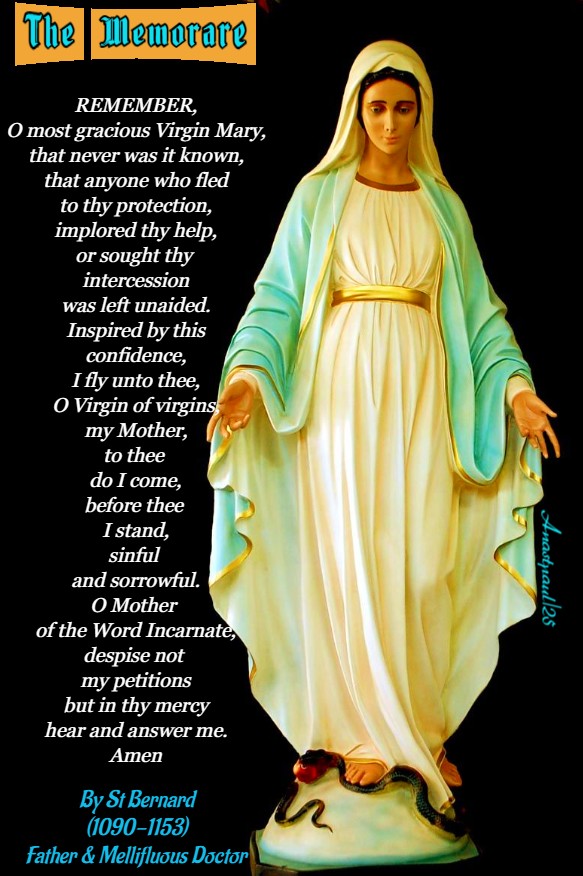
The Memorare By St Bernard (1090-1153) Father and Mellifluous Doctor
REMEMBER, O most gracious Virgin Mary, that never was it known, that anyone who fled to thy protection, implored thy help, or sought thy intercession was left unaided. Inspired by this confidence, I fly unto thee, O Virgin of virgins, my Mother, to thee do I come, before thee I stand, sinful and sorrowful. O Mother of the Word Incarnate, despise not my petitions but in thy mercy hear and answer me. Amen
St Brogan St Burchard of Worms St Christopher of Cordoba St Cristòfol Baqués Almirall St Gobert of Apremont St Haduin of Le Mans St Heliodorus of Persia St Herbert Hoscam (Died 1188) Bishop St Leovigild of Cordoba St Lucius of Cyprus St Manetius/Benedict dell’ Antella OSM Confessor
Our Morning Offering – 30 May – “The Month of the Blessed Virgin Mary”
Run, Hasten O Lady! By St Bernard of Clairvaux (1090-1153) Mellifluous Doctor
Run, hasten, O Lady, and in your mercy help your sinful servant, who calls upon you, and deliver him from the hands of the enemy. Who will not sigh to you? We sigh with love and grief, for we are oppressed on every side. How can we do otherwise than sigh to you, O solace of the miserable, refuge of outcasts, ransom of captives? We are certain that when you see our miseries, your compassion will hasten to relieve us. O our Sovereign Lady and our Advocate, commend us to your Son. Grant, O blessed one, by the grace which you have merited, that He Who through you was graciously pleased, to become a Partaker of our infirmity and misery, may also, through your intercession, make us partakers of His happiness and glory. Amen.
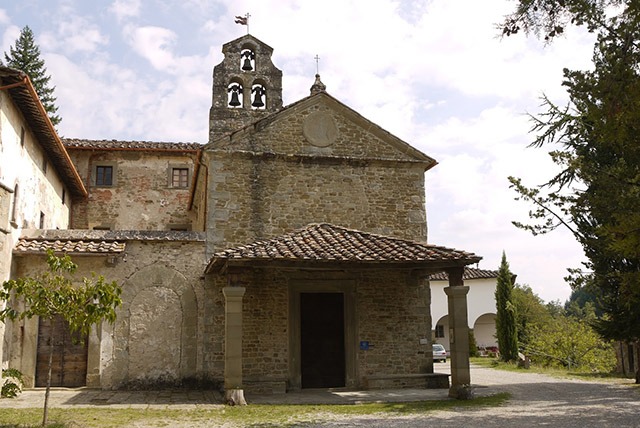
Santa Maria delle Grazie / Holy Mary of the Graces in Stia, Arezzo, Italy (1428) – 20 May:
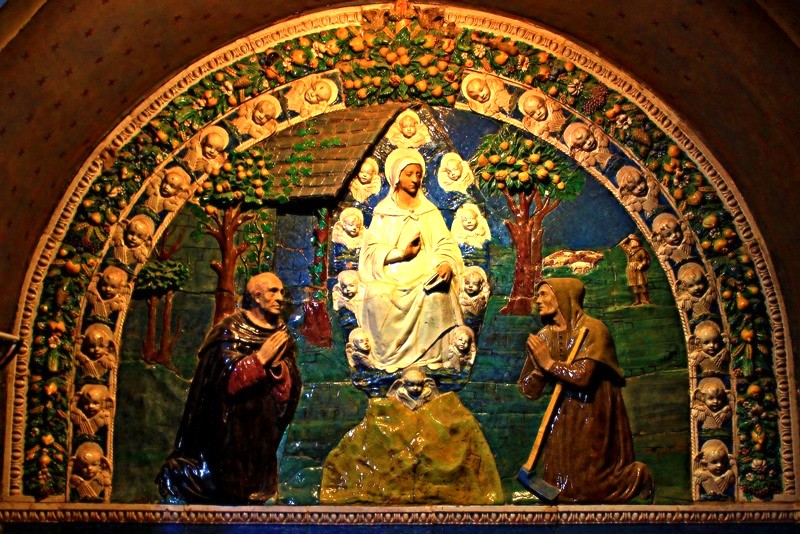
It was the year 1428 and Mona Giovanna one day, taking advantage of a moment of clear weather, left her cottage to dedicate herself to the work in the fields. Suddenly, she was surprised by a strong storm and, unable to return to her home, she found a refuge in a cavern covered with tree trunks, located above a white boulder. Having reached the shelter, Giovanna began to pray. Suddenly she was enveloped in a light of exceptional splendour and a celestial figure of a woman of extraordinary majesty and beauty appeared to her, placing her foot on the white boulder. Giovanna felt and understood that the Lady was the Mother of God. The Virgin spoke to her maternally saying:
“If the people want to remove many great punishments and misfortunes, they will, in my honour, build here, a Church in the place chosen by myrself and once it is built, that they pay homage and veneration to my Son and I, with constant prayers.
The place where Giovanna had taken refuge continued to shine with a very bright light, when a shepherd, Pietro Campodonico, approaching saw the miracle in person. Shortly after Giovanna repeated the narration to Messer Luca, Parish Priest of Stia, who was quick to believe her, knowing Giovanna’s goodness and simplicity. Immediately he went in procession with the Parishioners to the place where the miracle had happened. Feelings of religious piety awoke in all the people of the countryside, spreading not only in the nearby parishes but in the entire Casentino valley, up to the Cities of Arezzo, Florence and Siena. The construction of the Church, begun by the unanimous will of authority (including “Messer Luca lo Pievano” from Stia and Conte Neri from Porciano) and by the people, with the offerings and gifts left by the devotees. It was completed on 8 September 1432. In September 1474 a sudden fire totally destroyed the building with all the furnishings and images. The Church was immediately rebuilt, assisted by the offerings of the faithful. In 1490 the building was already rebuilt as we now see it – the Sanctuary was called from the beginning Santa Maria delle Grazie:.
On 20 May of each year the faithful of the neighbouring areas come in procession to celebrate the feast of the apparition. The Church is an elegant edifice of Florentine architecture, preceded by a portico on the left of the facade, a three-light sailed bell tower in sandstone. The interior consists of a single nave with a large presbytery. Two carved stone Altars lean against the side walls, of which the one on the left of the XV century is remarkable, finely carved. On the left wall there is an octagonal stone pulpit, supported by two shelves. The presbytery, a work of artistic value of the XVI century, square in shape, is framed in the façade by two pillars and a stone archivolt, decorated with raised foliage, finely worked and is enclosed inside by a stone cornice, decorated with a series of 30 enamelled terracotta cherub heads, interspersed with 5 coats of arms of the Santa Maria Nuova Hospital. In the pendentives are the cylindrical reliefs of the 4 Evangelists, also in glazed terracotta.
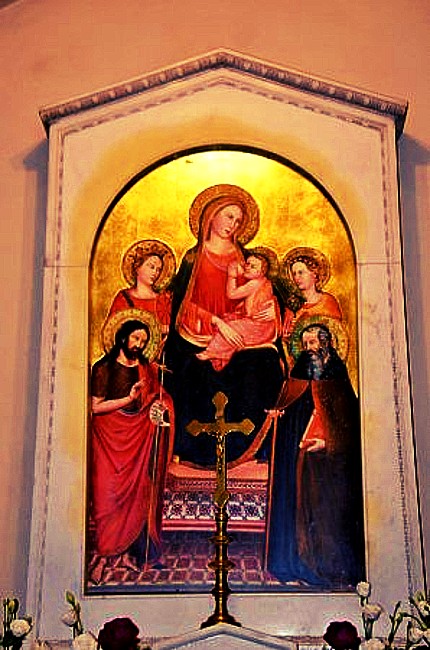
Image above the high Altar
Both the reliefs and the glazed frieze are works of Robbian art, from Andrea’s workshop (1435-1528), to refer to the beginning of the XVII century. In the underlying rooms, in the shape of a rib, there are two large Robbians depicting the apparition of the Madonna to Blessed Giovanna and to the crib, on the right and left. Under the Robbiane school there is an inlaid wooden seat from the 15th century. In the centre of the presbytery, the high Altar, in worked marble, rises above the boulder where the Virgin appeared.
St Bernadine of Siena OFM (1380-1444) (Optional Memorial) “Apostle of the Most Holy Name of Jesus,” Priest of the Order of St Francis, Missionary, Preacher, known as the “Apostle of Italy,” the “Star of Tuscany,” and the “Second Paul.” Biography: https://anastpaul.com/2017/05/20/saint-of-the-day-20-may-st-bernardine-of-siena/
St Abercius Bl Albert of Bologna St Alexander of Edessa St Althryda St Anastasius of Brescia St Aquila of Egypt Bl Arnaldo Serra and Companions St Asterius of Edessa St Austregisilus of Bourges St Basilla of Rome St Baudelius of Nîmes St Codrato Blessed Columba of Rieti OP (1467- 1501) Mystic
St Plautilla of Rome St Protasius Chong Kuk-bo St Rafaél García Torres St Talaleo of Egea St Thalalaeus of Edessa St Theodore of Pavia St Tomás Valera González
Quote/s of the Day – 4 September – The Feast of Our Lady of Consolation
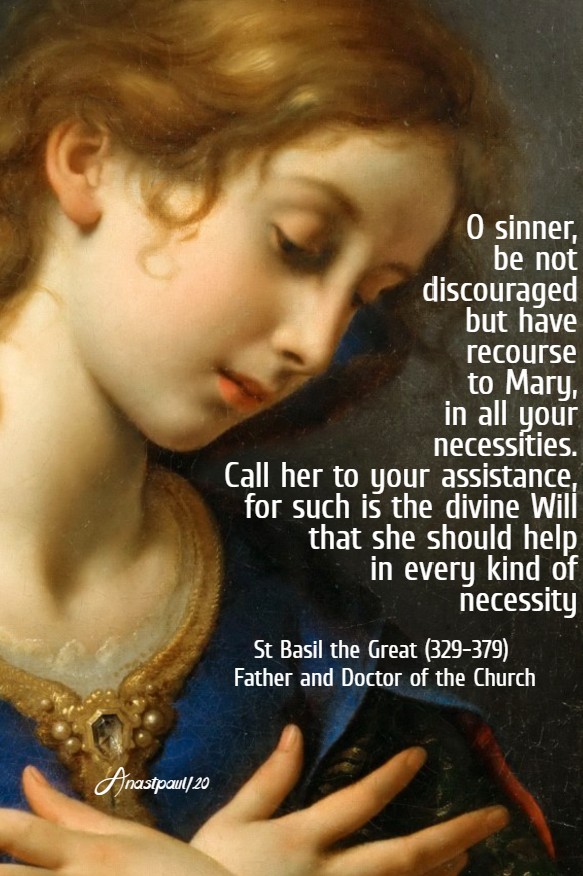
“O sinner, be not discouraged but have recourse to Mary, in all your necessities. Call her to your assistance, for such is the divine Will that she should help in every kind of necessity.”
St Basil the Great (329-379) Father and Doctor of the Church
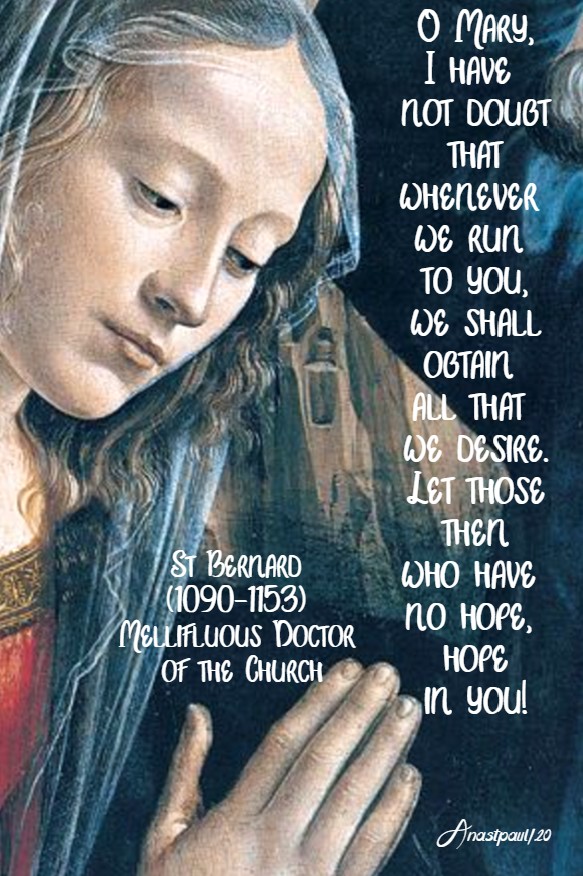
“O Mary, I have not doubt that whenever we run to you, we shall obtain all that we desire. Let those then who have no hope, hope in you!”
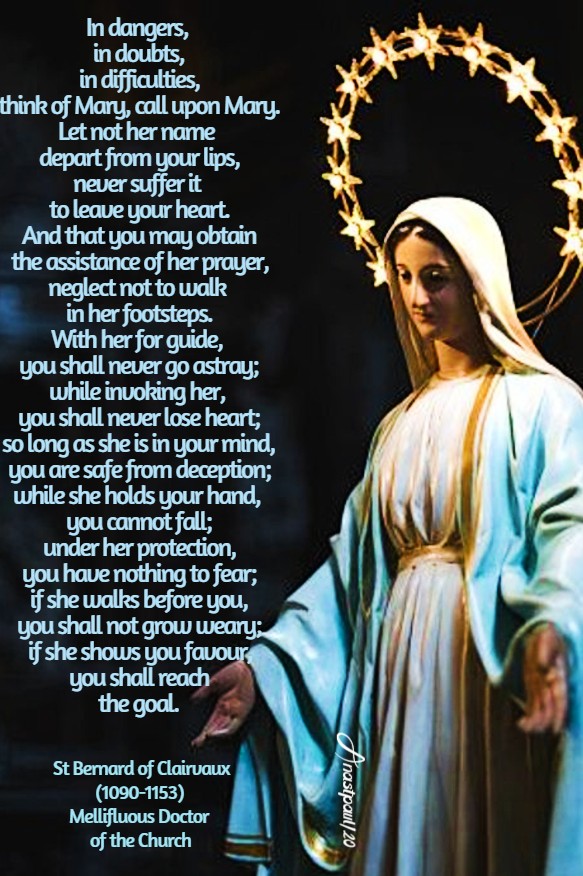
“In dangers, in doubts, in difficulties, think of Mary, call upon Mary. Let not her name depart from your lips, never suffer it to leave your heart. And that you may obtain the assistance of her prayer, neglect not to walk in her footsteps. With her for guide, you shall never go astray; while invoking her, you shall never lose heart; so long as she is in your mind, you are safe from deception; while she holds your hand, you cannot fall; under her protection you have nothing to fear; if she walks before you, you shall not grow weary; if she shows you favour, you shall reach the goal.”
St Bernard of Clairvaux (1090-1153) Mellifluous Doctor of the Church
“Has anyone ever come away from Mary, troubled or saddened or ignorant of the heavenly Mysteries? Who has not returned to everyday life gladdened and joyful because a request has been granted by the Mother of God?”
St Amadeus of Lausanne (1110-1159)
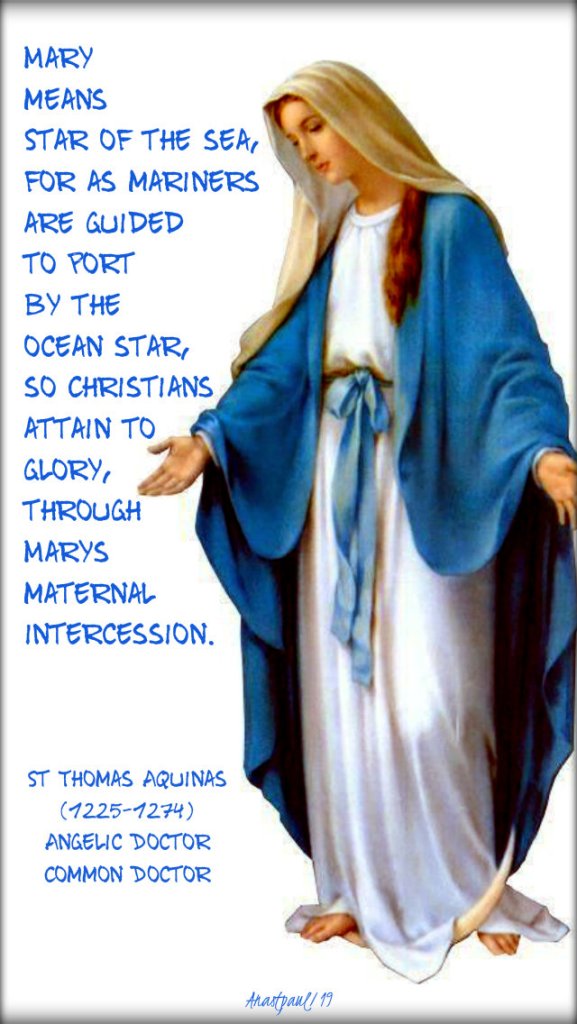
“Mary means Star of the sea, for as mariners are guided to port by the ocean star, so Christians attain to glory, through Mary’s maternal intercession.”
St Thomas Aquinas (1225-1274) Doctor Angelicus Doctor Communis
“Let us run to Mary and, as her little children, cast ourselves into her arms with a perfect confidence.”
St Francis de Sales (1567-1622) Doctor Caritatis
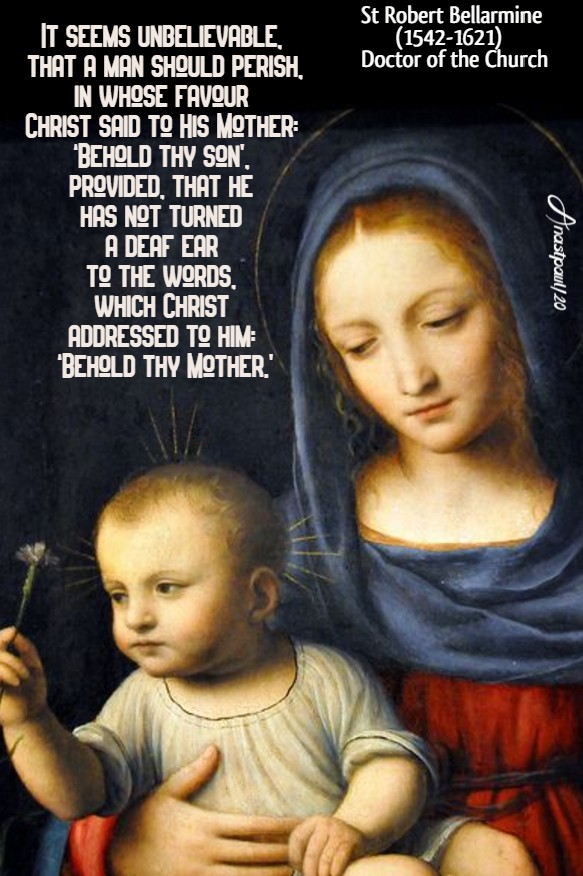
”It seems unbelievable, that a man should perish, in whose favour Christ said to His Mother: ‘Behold thy son’, provided, that he has not turned a deaf ear to the words, which Christ addressed to him: ‘Behold thy Mother.’”
St Robert Bellarmine (1542-1621) Doctor of the Church
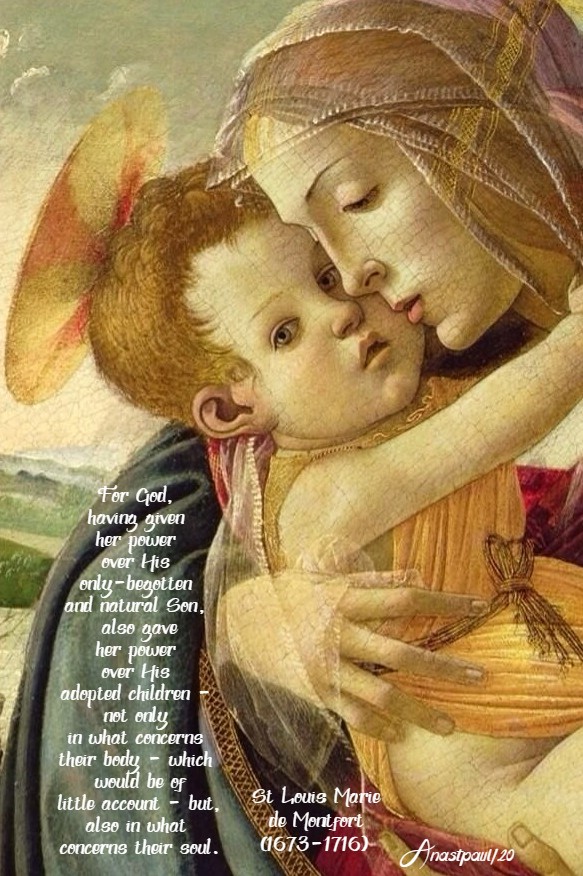
“For God, having given her power over His only-begotten and natural Son, also gave her power over His adopted children – not only in what concerns their body – which would be of little account – but also in what concerns their soul.”
St Louis Marie de Montfort (1673-1716)
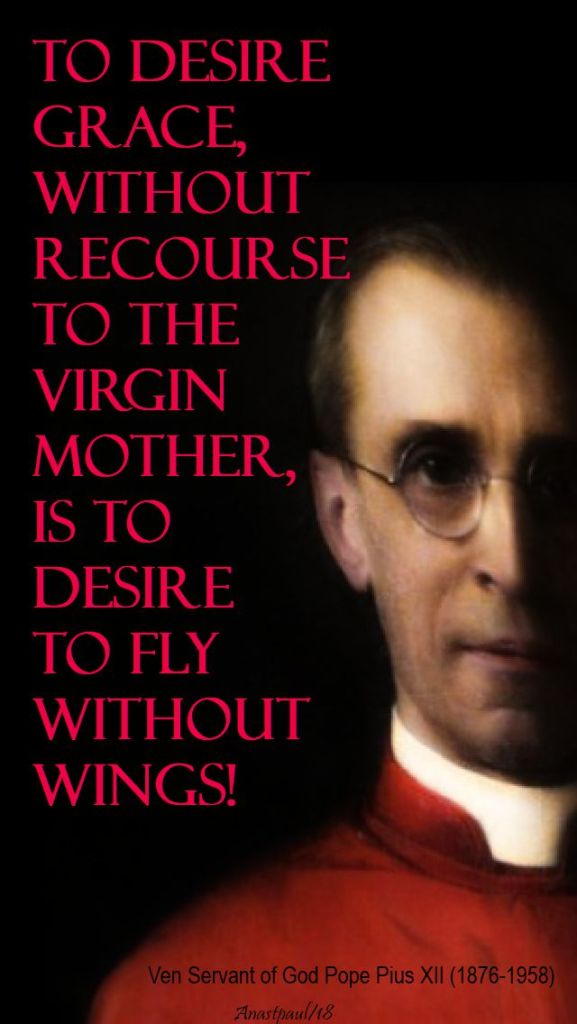
”To desire grace without recourse to the Virgin Mother is to desire to fly without wings.”
Quote/s of the Day – 20 August – The Memorial of St Bernard of Clairvaux (1090-1153) Mellifluous Docotr, “Doctor of Light”
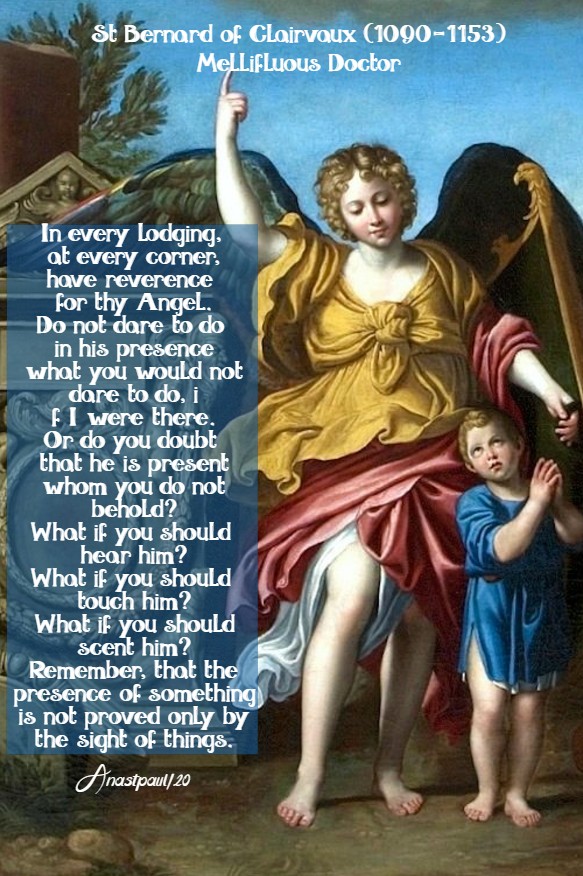
“In every lodging, at every corner, have reverence for thy Angel. Do not dare to do in his presence what you would not dare to do, if I were there. Or do you doubt that he is present whom you do not behold? What if you should hear him? What if you should touch him? What if you should scent him? Remember, that the presence of something is not proved only by the sight of things.”
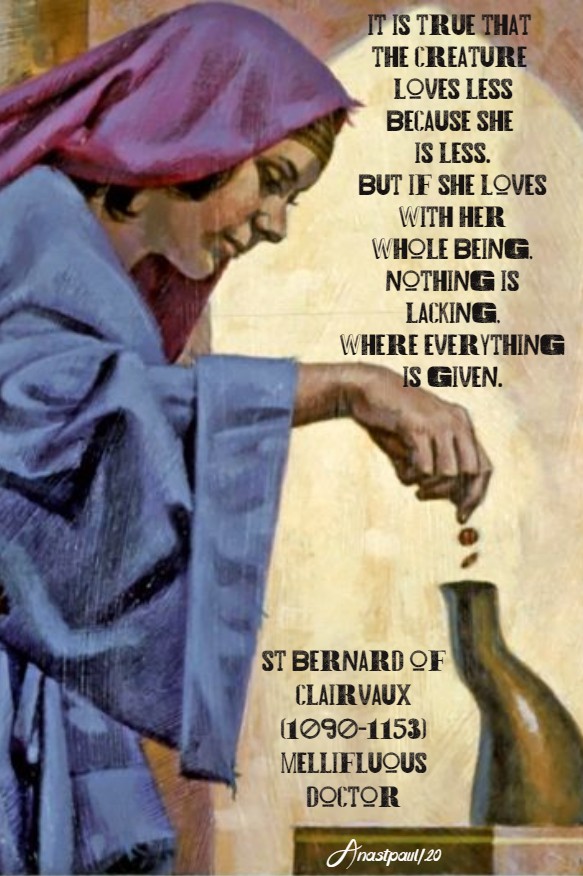
” It is true that the creature loves less because she is less. But if she loves with her whole being, nothing is lacking, where everything is given.”
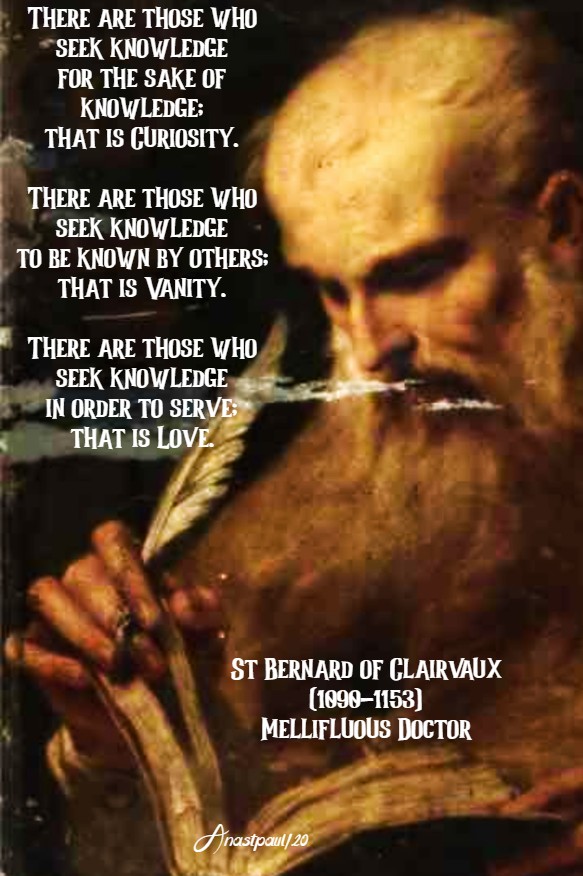
“There are those who seek knowledge for the sake of knowledge; that is Curiosity. There are those who seek knowledge to be known by others; that is Vanity. There are those who seek knowledge in order to serve; that is Love.”
“The road to hell is paved with good intentions.”
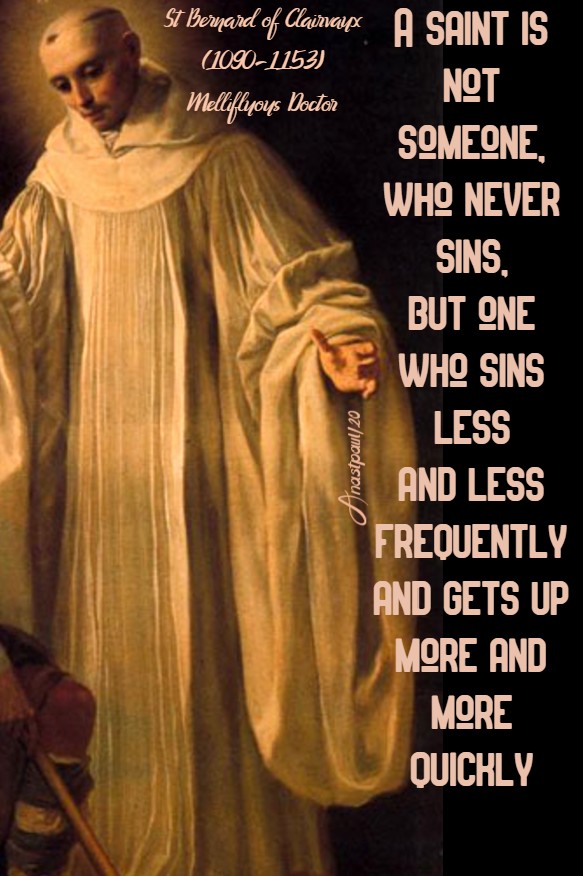
“A saint is not someone, who never sins, but one who sins less and less frequently and gets up more and more quickly.”
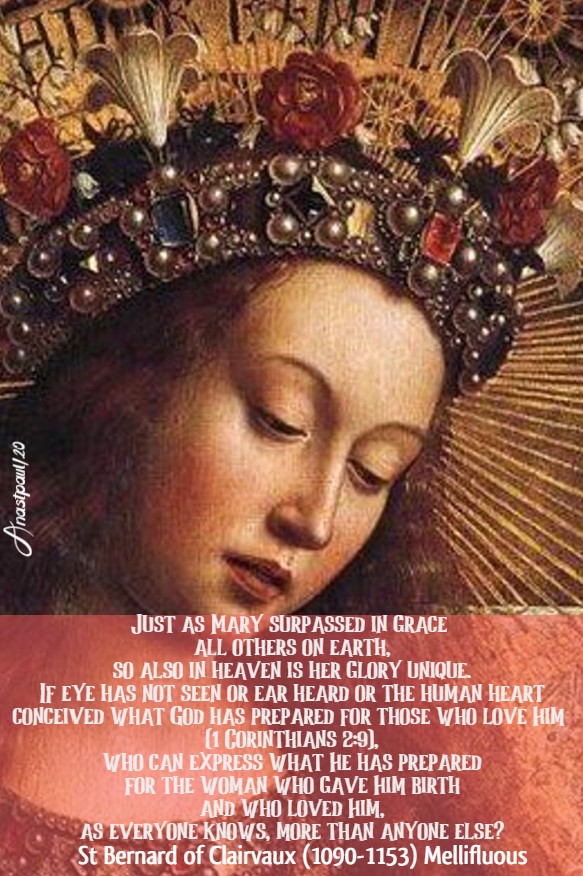
“Just as Mary surpassed in grace all others on earth, so also in heaven is her glory unique. If eye has not seen or ear heard or the human heart conceived what God has prepared for those who love Him (1 Corinthians 2:9), who can express what He has prepared for the woman who gave Him birth and who loved Him, as everyone knows, more than anyone else?”
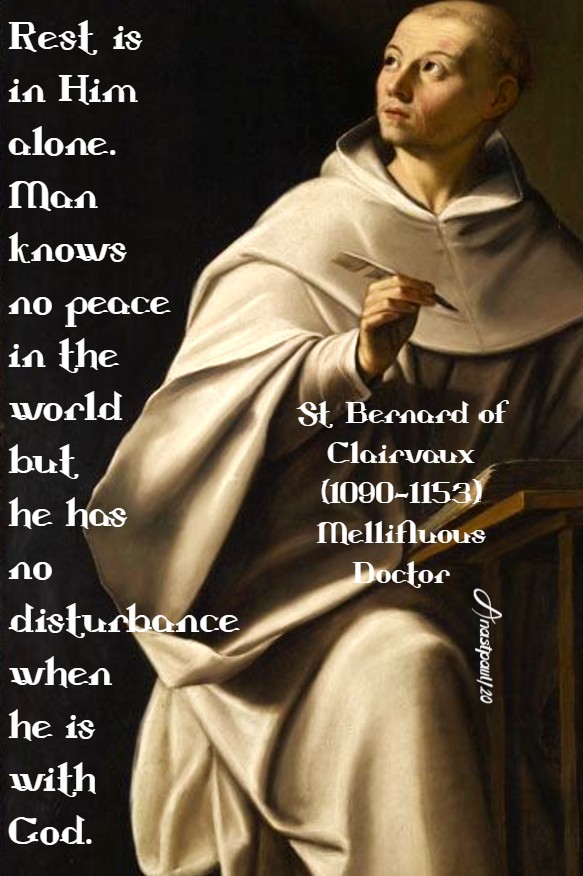
“Rest is in Him alone. Man knows no peace in the world but he has no disturbance when he is with God.”
Jesu Dulcis Memori
Jesus, the very thought of Thee with sweetness fills my breast, But sweeter far Thy face to see and in Thy presence rest.
Nor voice can sing nor heart can frame, Nor can the memory find a sweeter sound than Jesus’ name, O Saviour of mankind.
O hope of every contrite heart, O joy of all the meek to those who fall, how kind Thou art, how good to those who seek!
But what to those who find? Ah this nor tongue nor pen can show, the love of Jesus, what it is none but His loved ones know.
Jesus our only joy be Thou as Thou our prize wilt be. Jesus, be Thou our glory now and through eternity. Amen
Our Morning Offering – 1 February – Saturday of the Third week in Ordinary Time, Year A
I Will Love You Lord By St Bernard of Clairvaux (1090-1153) Mellifluous Doctor
I will love You, O Lord,
my Strength,
my Stony Rock
and my Defense,
my Saviour,
my one desire and love.
I will love You
with all the power
You have given me –
not as much as You deserve to be loved,
for that can never be
but as much as I am able to.
The more power to love You give me,
the more I will love You.
Amen
Thought for the Day – 7 October – The Memorial of – Our Lady of the Rosary
We should Meditate on the Mysteries of Salvation
Saint Bernard of Clairvaux (1090-1153) Abbot and Doctor of the Church
An excerpt from one of his Sermons
The child to be born of you will be called holy, the Son of God, the fountain of wisdom, the Word of the Father on high. Through you, blessed Virgin, this Word will become flesh, so that even though, as He says: I am in the Father and the Father is in me, it is still true for him to say: “I came forth from God and am here.”
In the beginning was the Word. The spring was gushing forth, yet still within Himself. Indeed, the Word was with God, truly dwelling in inaccessible light. And the Lord said from the beginning – I think thoughts of peace and not of affliction. Yet your thought was locked within you and whatever you thought, we did not know, for who knew the mind of the Lord, or who was His counsellor?
And so the idea of peace came down to do the work of peace – The Word was made flesh and even now dwells among us. It is by faith that He dwells in our hearts, in our memory, our intellect and penetrates even into our imagination. What concept could man have of God if he did not first fashion an image of Him in his heart? By nature incomprehensible and inaccessible, He was invisible and unthinkable but now He wished to be understood, to be seen and thought of.
But how, you ask, was this done? He lay in a manger and rested on a virgin’s breast, preached on a mountain and spent the night in prayer. He hung on a cross, grew pale in death and roamed free among the dead and ruled over those in hell. He rose again on the third day and showed the apostles the wounds of the nails, the signs of victory and finally, in their presence, He ascended to the sanctuary of heaven.
How can we not contemplate this story in truth, piety and holiness? Whatever of all this I consider, it is God I am considering, in all this, He is my God. I have said it is wise to meditate on these truths and I have thought it right to recall, the abundant sweetness, given by the fruits of this priestly root and Mary, drawing abundantly from heaven, has caused this sweetness to overflow for us.
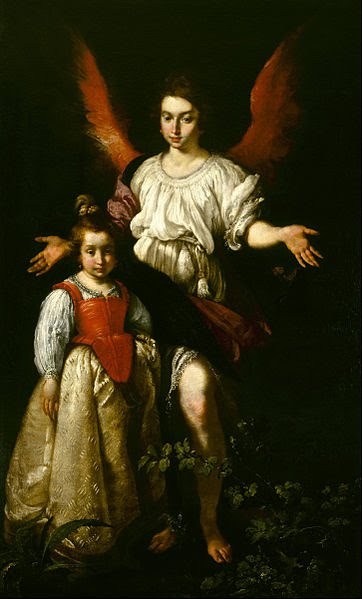
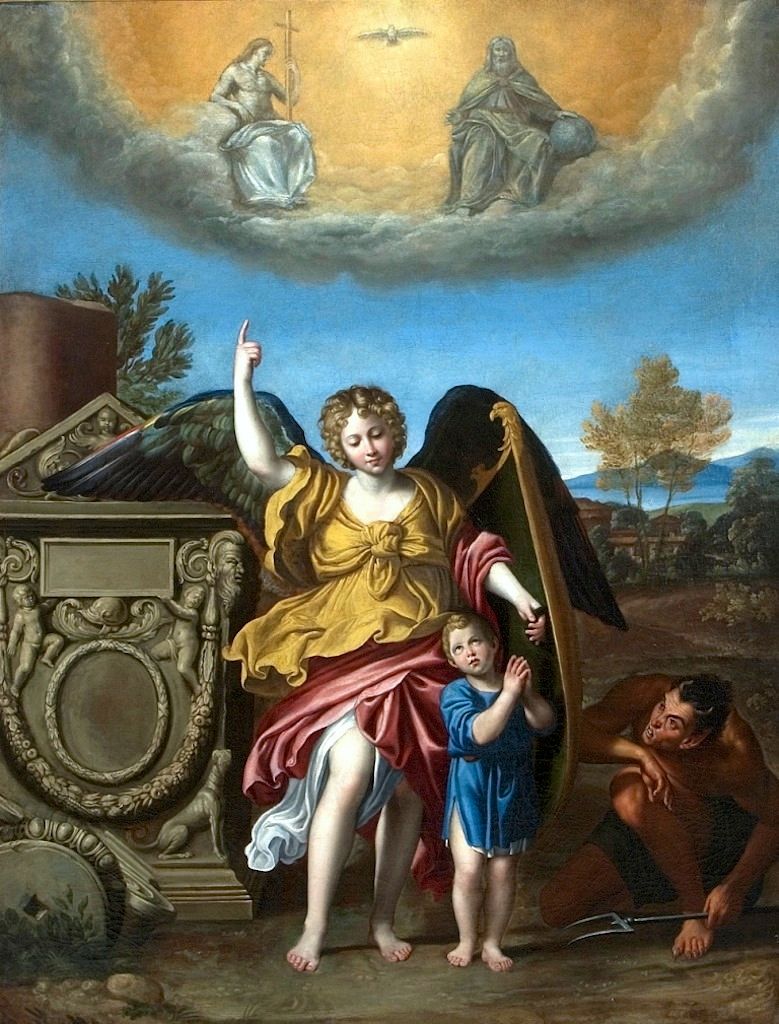
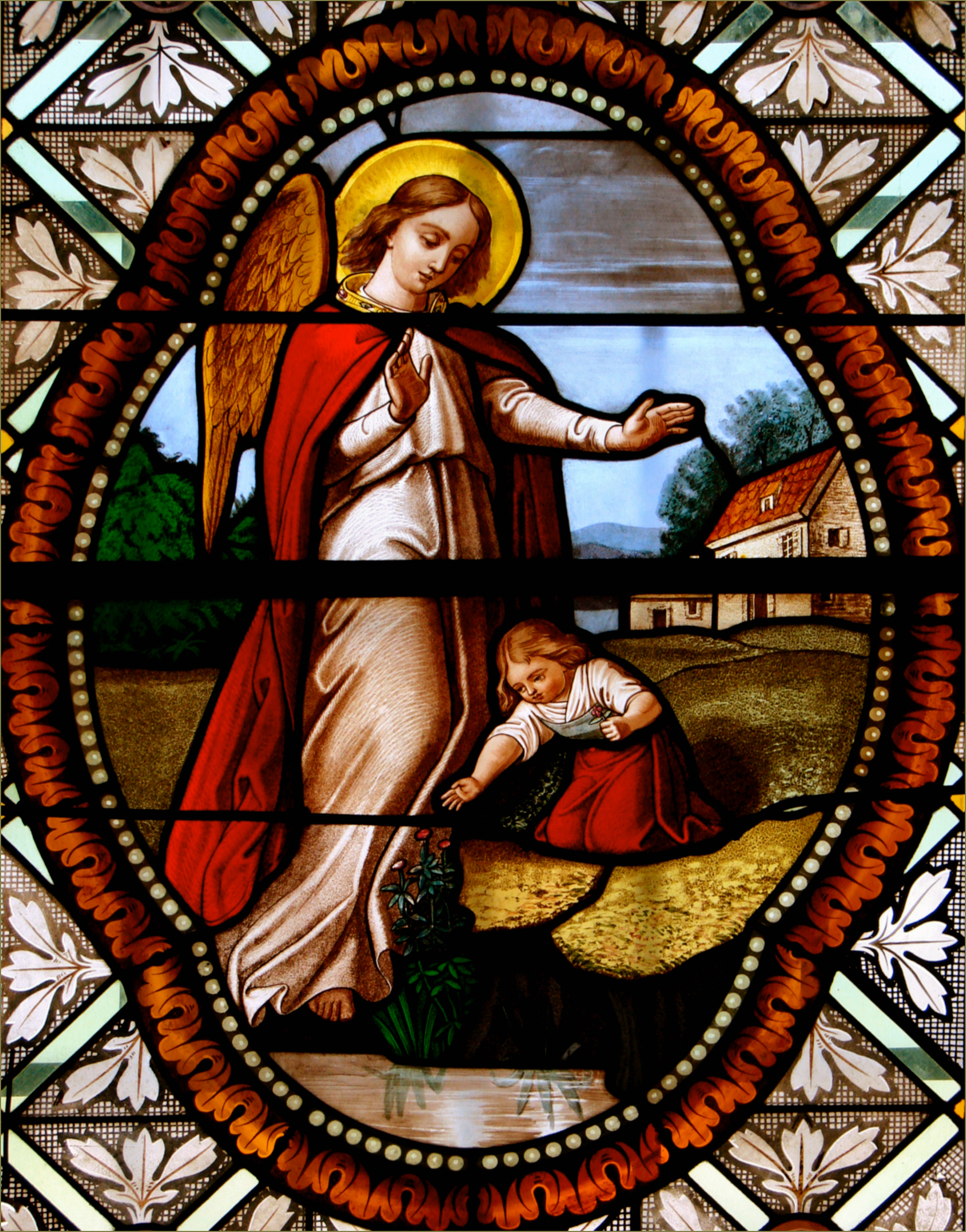
“He hath given his angels charge over thee.” O wonderful bounty and truly great love of charity! Who? For whom? Wherefore? What has He commanded? Let us study closely, brethren and let us diligently commit to our memory, this great mandate. Who is it that commands? Whose angels are they? Whose mandates do they fulfil? Whose will do they obey? In answer, “He hath given his angels charge over thee, to keep thee in all thy ways.” And they do not hesitate even to lift thee up in their hands.
So the Supreme Majesty has given charge to the angels. Yes, He has given charge to His own angels. Think of it! To those sublime beings, who cling to Him so joyfully and intimately, to His very own He has given charge over you! Who are you? “What is man that thou art mindful of him? or the son of man that thou visit him?” As if man were not rottenness and the son of man a worm! Now why, do you think, he Has given them charge over thee? — To guard thee!
With what great reverence should you treat this word! What devotion should you proffer it, what great confidence should you place in it. Reverence because of their presence, devotion because of their benevolence, confidence because of their solicitude. Walk carefully, in all thy ways, as one with whom the angels are presen,t as He has given them charge. In every lodging, at every corner, have reverence for thy Angel. Do not dare to do in his presence what you would not dare to do if I were there. Or do you doubt that he is present whom you do not behold? What if you should hear him? What if you should touch him? What if you should scent him? Remember that the presence of something is not proved only by the sight of things.
In this, therefore, brethren, let us affectionately love His angels as one day our future coheirs, meanwhile, however, as counsellors and defenders appointed by the Father and placed over us. Why should we fear under such guardians? Those who keep us in all our ways, can neither be overcome, nor be deceived, much less deceive. They are faithful, they are pruden, they are powerful, why do we tremble? Let us only follow them, let us remain close to them and in the protection of the God of heaven, let us abide. As often, therefore, as a most serious temptation is perceived to weigh upon you and an excessive trial is threatening, call to your guard, your leader, your helper in your needs, in your tribulation, cry to him and say: “Lord, save us; we perish!”
This excerpt from a sermon by St Bernard of Clairvaux (Sermo 12 in psalmum Qui habitat, 3. 6-8: Opera omnia, Edit. Cisterc. 4 [1966], 458-462) is used in the Roman Office of Readings for the memorial of the Guardian Angels on 2 October.
Our Morning Offering – 18 May – ‘Mary’s Month” – Saturday Fourth Week of Easter, C
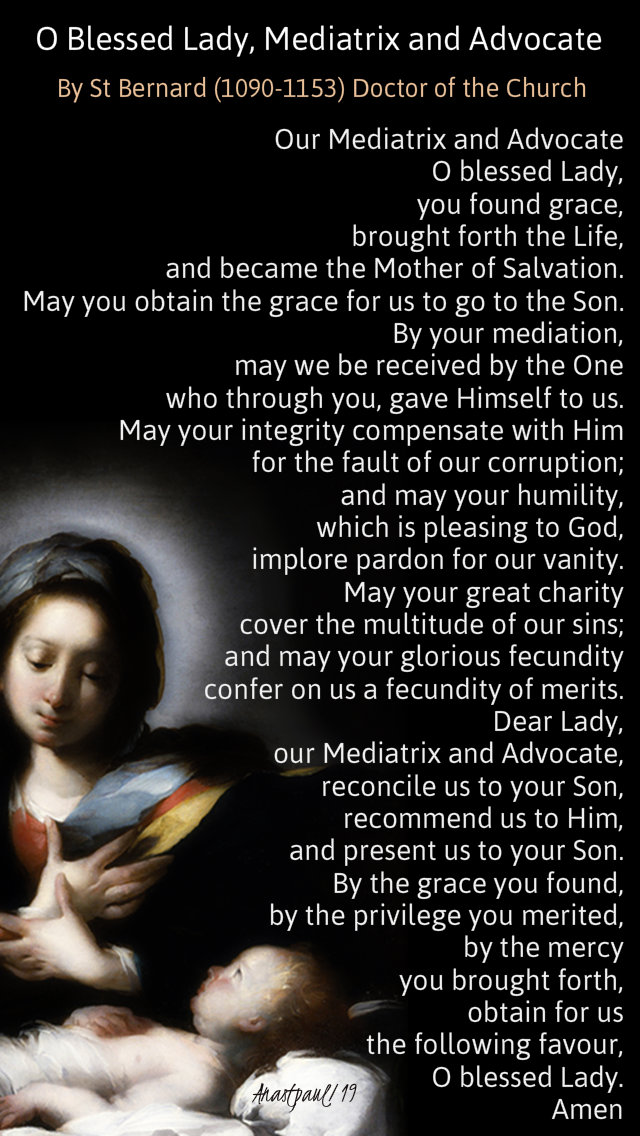
O Blessed Lady, Mediatrix and Advocate By St Bernard (1090-1153)
Our Mediatrix and Advocate
O blessed Lady,
you found grace,
brought forth the Life,
and became the Mother of Salvation.
May you obtain the grace for us to go to the Son.
By your mediation,
may we be received by the One
who through you, gave Himself to us.
May your integrity compensate with Him
for the fault of our corruption;
and may your humility,
which is pleasing to God,
implore pardon for our vanity.
May your great charity
cover the multitude of our sins;
and may your glorious fecundity
confer on us a fecundity of merits.
Dear Lady,
our Mediatrix and Advocate,
reconcile us to your Son,
recommend us to Him,
and present us to your Son.
By the grace you found,
by the privilege you merited,
by the mercy you brought forth,
obtain for us the following favour,
O blessed Lady.
Amen
One Minute Reflection – 26 March 2018 – Monday of Holy Week, Gospel: John 12:1–11
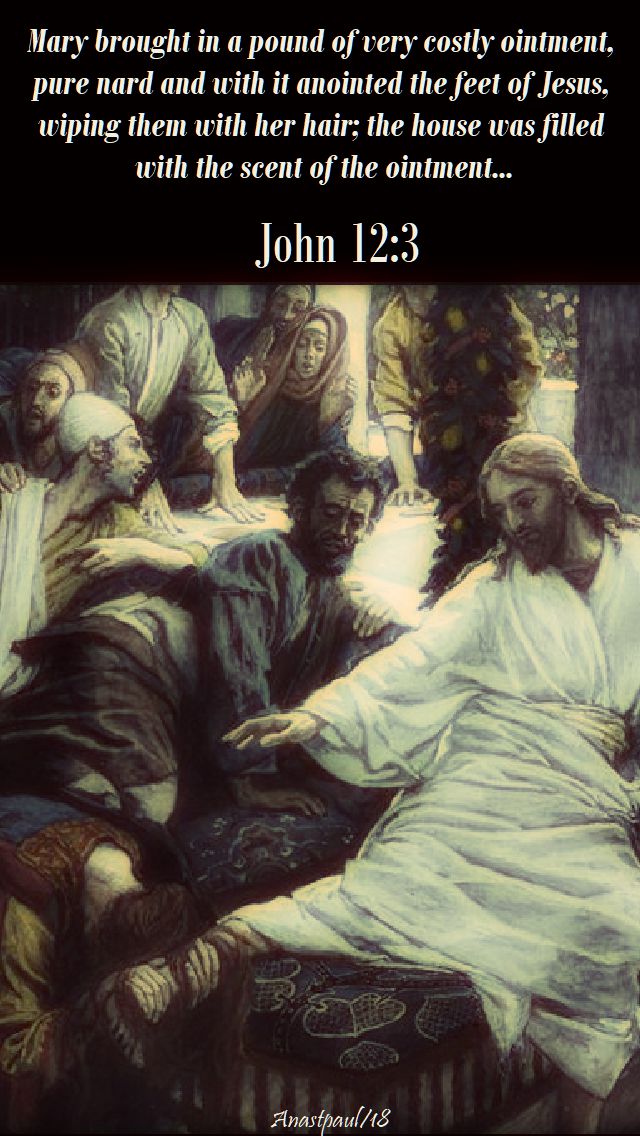
Mary brought in a pound of very costly ointment, pure nard and with it, anointed the feet of Jesus, wiping them with her hair; the house was filled with the scent of the ointment…John 12:3
REFLECTION – “Anointing the feet of Christ with perfumed oil of compassion
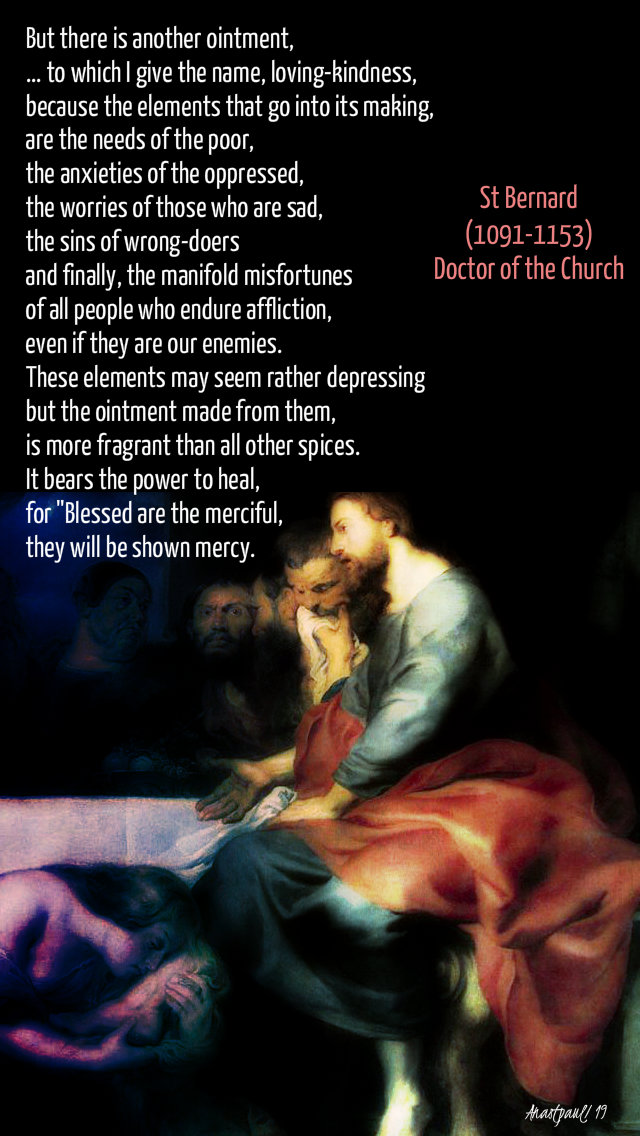
I have already discussed two ointments with you – one of contrition, that takes account of numerous sins — it is symbolised by the perfumed oil with which the sinful woman anointed the feet of Lord: “the house was filled with the fragrance of the oil”, the other of devotion, that embodies numerous blessings… But there is another ointment, far excelling these two, to which I give the name, loving-kindness, because the elements that go into its making, are the needs of the poor, the anxieties of the oppressed, the worries of those who are sad, the sins of wrong-doers and finally, the manifold misfortunes of all people who endure affliction, even if they are our enemies. These elements may seem rather depressing but the ointment made from them, is more fragrant, than all other spices. It bears the power to heal, for “Blessed are the merciful, they will be shown mercy” (Mt 5:7)
A collection therefore of many miseries, on which the eye rests with loving-kindness, represents the ingredients from which the best ointments are made… Happy the soul that has been wise enough to enrich itself with an assortment of spices such as these, pouring upon them the oil of mercy and warming them with the fire of charity! Who, in your opinion, is “the good man who takes pity and lends” (Ps 112:5), who is compassionate, quick to render assistance, who believes that there is “more happiness in giving than in receiving” (Acts 20:35), who forgives easily but is not easily angered, who never seeks to be avenged and in all things takes thought for his neighbour’s needs as if they were his own?
Whoever you may be, if your soul is thus disposed, if you are saturated with the dew of mercy, overflowing with affectionate kindness, making yourself “all things to all people” (1 Co 9:22) yet considering your deeds, like a discarded flask, in order to be always ready to supply to others what they need, in a word, so dead to yourself, that you live only for others — if this be you, then you possess the third and best of all ointments. Your hands have dripped with liquid myrrh that is utterly enchanting (cf Sg 5:5). It will not run dry in times of stress nor evaporate in the heat of persecution but God will perpetually “remember all your oblations and find your holocaust acceptable.” (Ps 20:4)”...Saint Bernard (1091-1153) Doctor of the Church
PRAYER – Almighty God, grant that we who are constantly betrayed by our own weakness, may draw the breath of new life from the passion and death of Your only-begotten Son. May our hands to drip with the liquid myrrh of mercy to all our neighbours and may our hearts be ever open to forgiveness. Listen, we pray, to the prayers of Your Holy angels and Saints and grant that the Blessed Virgin may guide our steps in this vale of tears. Through our Lord and Saviour, who suffered and died for us, in unity with the Holy Spirit, one God forever, amen.
Our Morning Offering – 10 April – Wednesday of the Fifth week of Lent, Year C
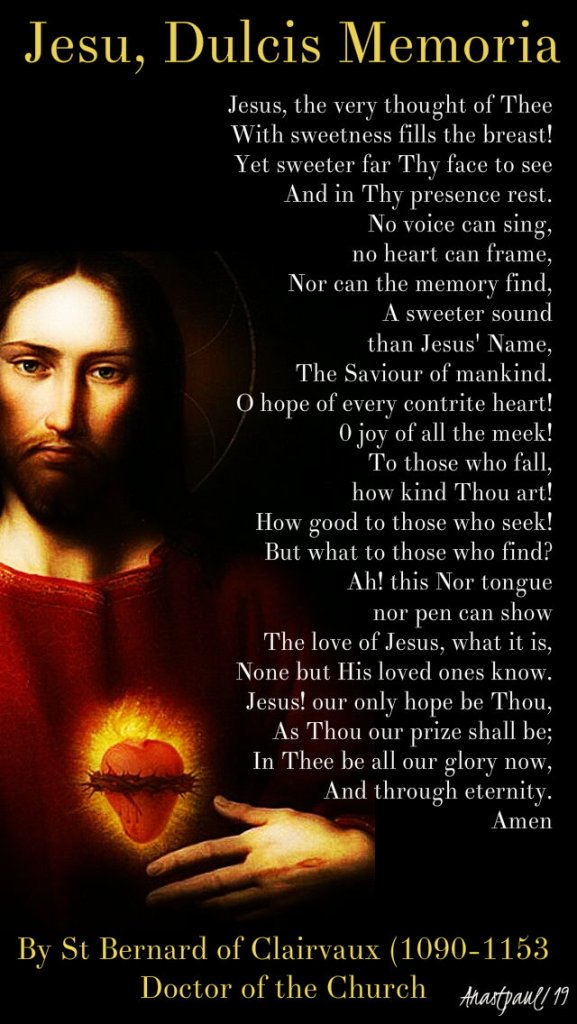
Jesus, the very thought of Thee! By St Bernard of Clairvaux (1090-1153) Mellifluous Doctor
Jesus, the very thought of Thee
With sweetness fills the breast!
Yet sweeter far Thy face to see
And in Thy presence rest.
No voice can sing, no heart can frame,
Nor can the memory find,
A sweeter sound than Jesus’ name,
The Saviour of mankind.
O hope of every contrite heart!
0 joy of all the meek!
To those who fall, how kind Thou art!
How good to those who seek!
But what to those who find? Ah! this
Nor tongue nor pen can show
The love of Jesus, what it is,
None but His loved ones know.
Jesus! our only hope be Thou,
As Thou our prize shall be;
In Thee be all our glory now,
And through eternity.
Amen
Quote/s of the Day – 18 February – Monday of the Sixth week in Ordinary Time, Year C, Gospel: Mark 8:11–13
And he sighed deeply in his spirit and said, “Why does this generation seek a sign?…Mark 8:12-13
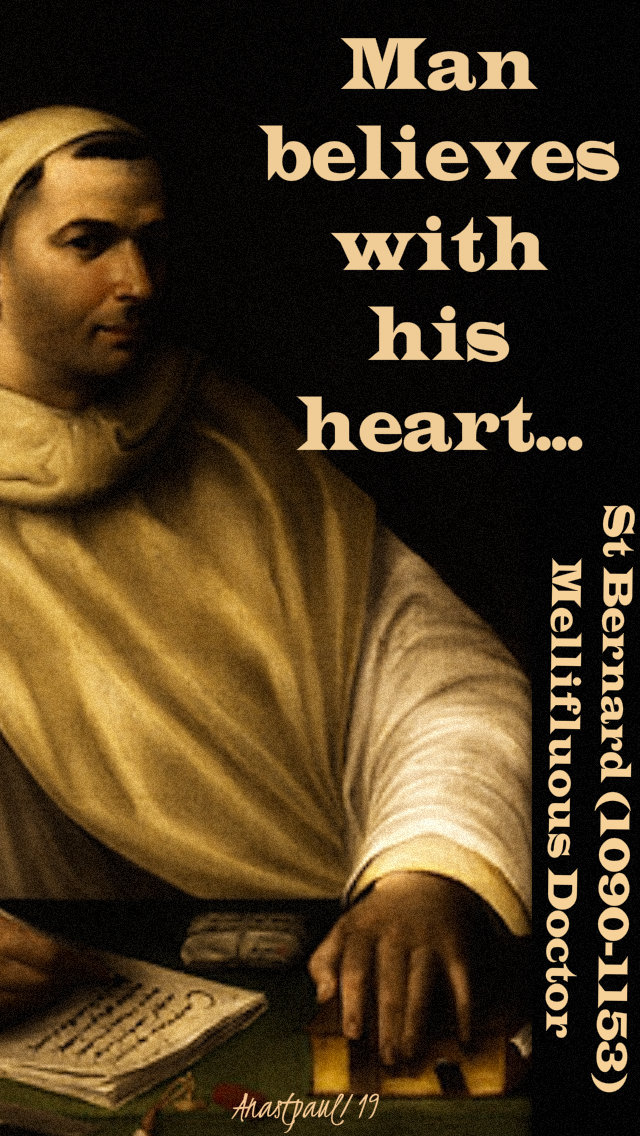
Happy is the man who has found wisdom. Even more happy is the man who lives in wisdom, for he perceives its abundance. There are three ways for wisdom or prudence to abound in you – if you confess your sins, if you give thanks and praise and if your speech is edifying. Man believes with his heart and so he is justified. He confesses with his lips and so he is saved. In the beginning of his speech, the just man is his own accuser, next he gives glory to God and thirdly, if his wisdom extends that far, he edifies his neighbour.
St Bernard (1090-1153)
Mellifluous Doctor
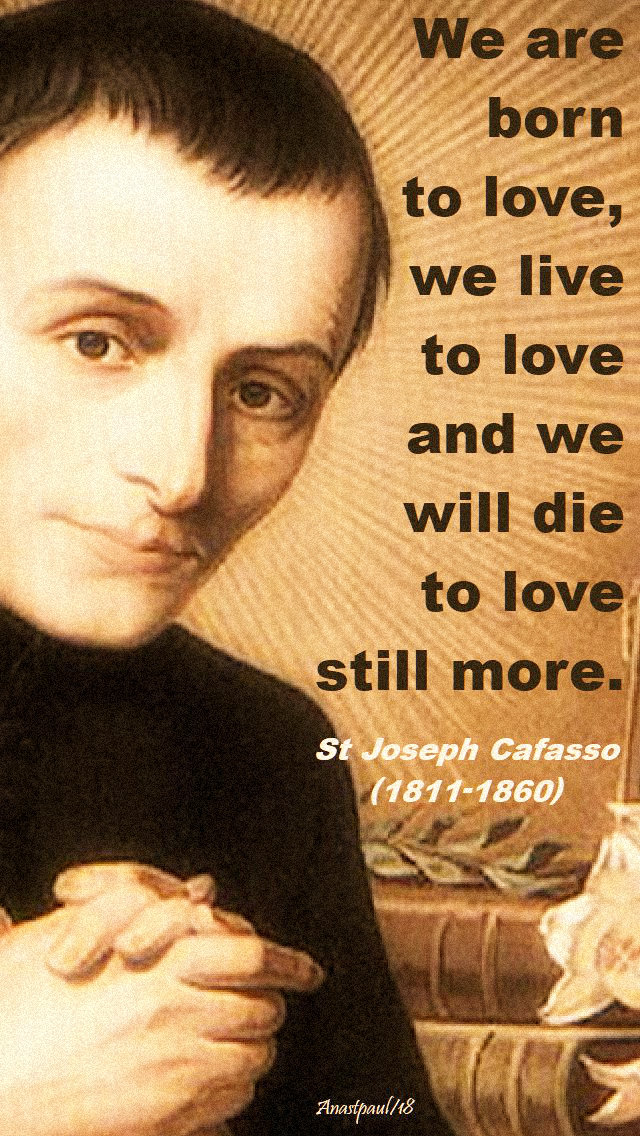
“We are born to love, we live to love and we will die to love still more.”
Quote/s of the Day – 6 January – The Solemnity of the Epiphany of the Lord
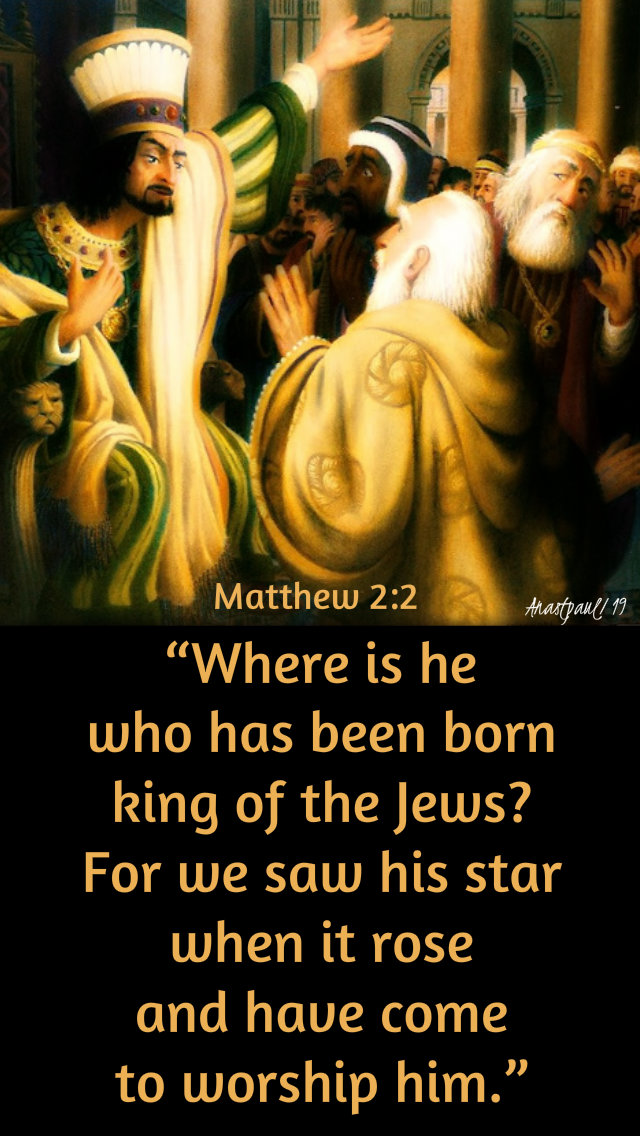
“Where is he who has been born king of the Jews? For we saw his star when it rose and have come to worship him.”
Matthew 2:2
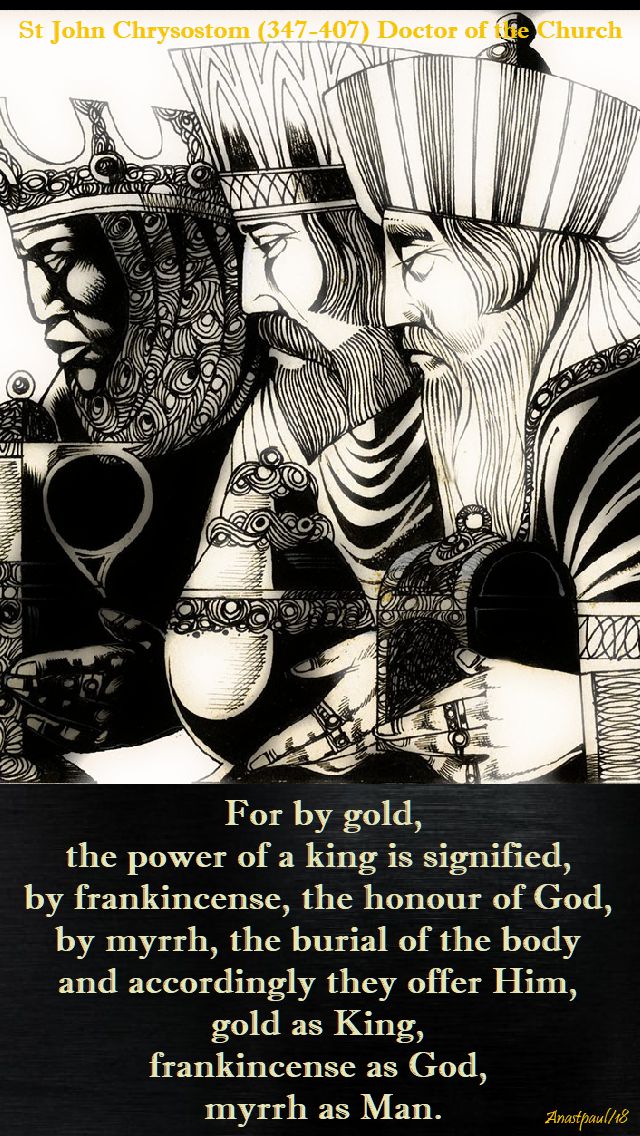
“For by gold, the power of a king is signified, by frankincense the honour of God, by myrrh the burial of the body and accordingly they offer Him, gold as King, frankincense as God, myrrh as Man.”
St John Chrysostom (347-407) Father & Doctor of the Church
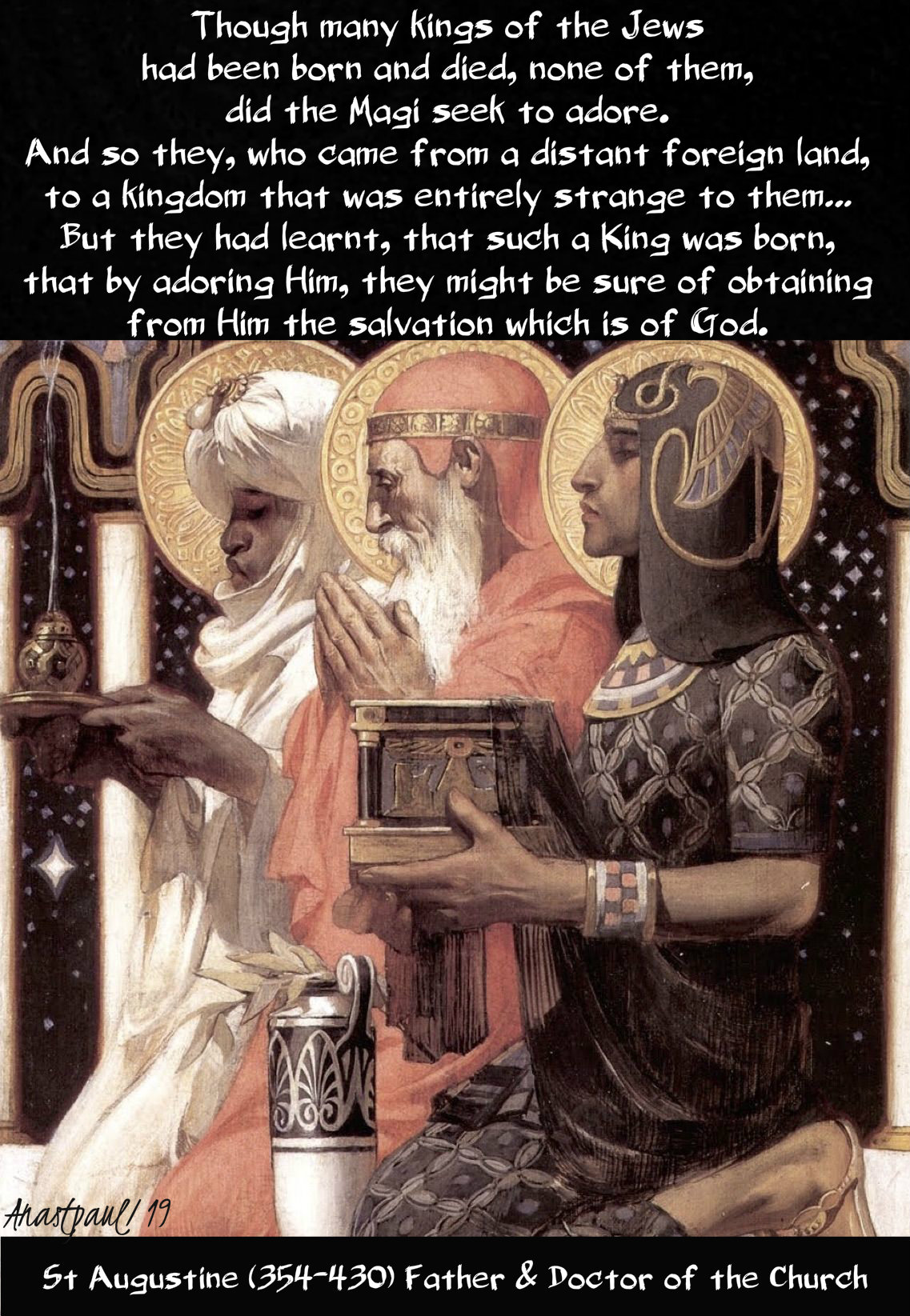
“Though many kings of the Jews had been born and died, none of them, did the Magi seek to adore. And so they, who came from a distant foreign land, to a kingdom that was entirely strange to them… But they had learnt, that such a King was born, that by adoring Him, they might be sure of obtaining from Him the salvation which is of God.”
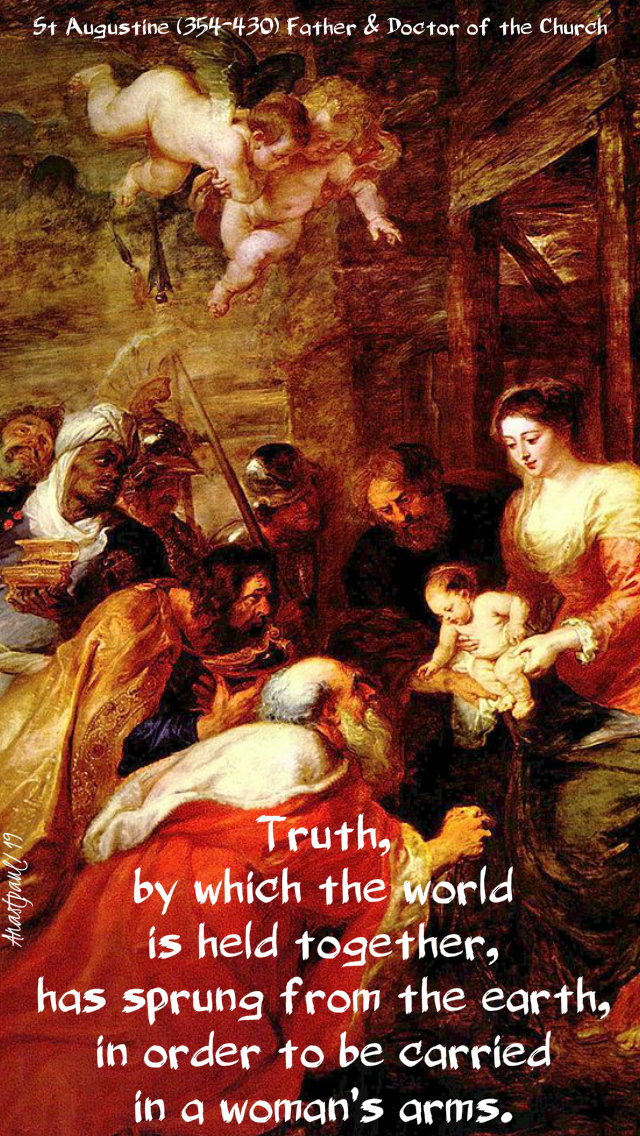
“Truth, by which the world is held together, has sprung from the earth, in order to be carried in a woman’s arms.”
St Augustine (354-430) Father & Doctor of the Church
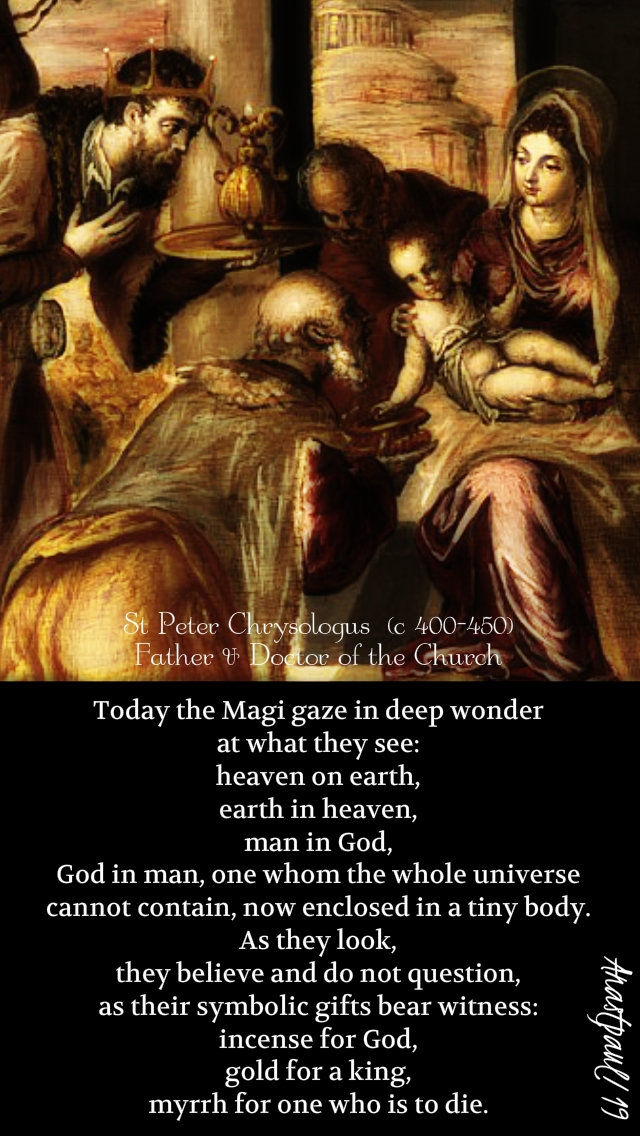
“Today the Magi gaze in deep wonder at what they see: heaven on earth, earth in heaven, man in God, God in man, one whom the whole universe cannot contain, now enclosed in a tiny body. As they look, they believe and do not question, as their symbolic gifts bear witness: incense for God, gold for a king, myrrh for one who is to die.”
St Peter Chrysologus (c 400-450) Father & Doctor of the Church
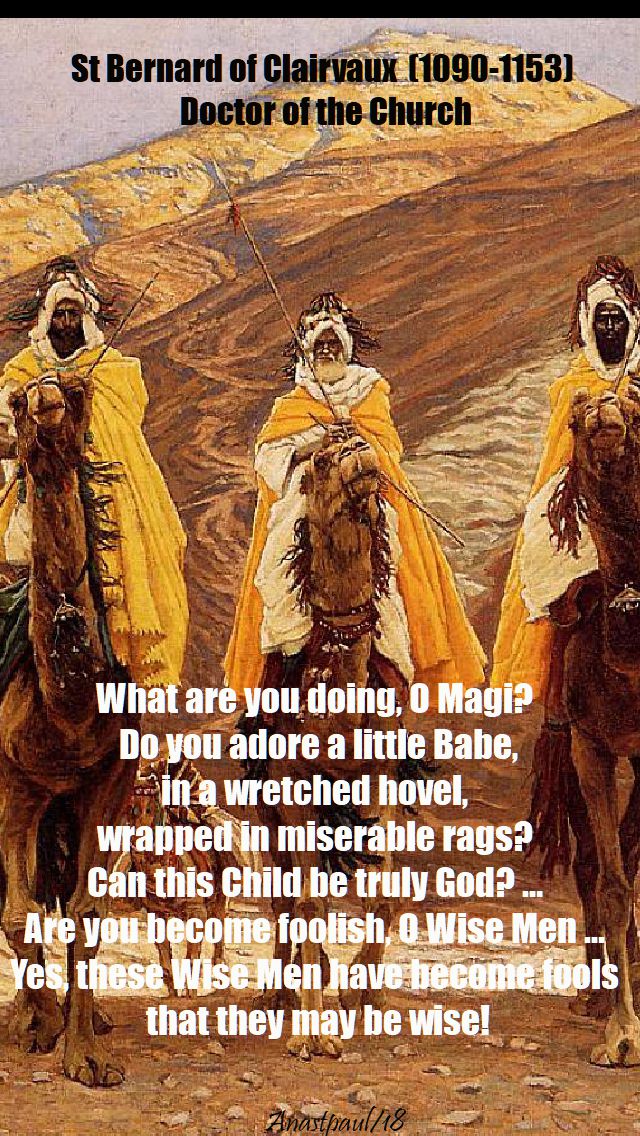
“What are you doing, O Magi? Do you adore a little Babe, in a wretched hovel, wrapped in miserable rags? Can this Child be truly God? … Are you become foolish, O Wise Men … Yes, these Wise Men have become fools that they may be wise!”
St Bernard of Clairvaux (1090-1153) Doctor of the Church
Quote/s of the Day – 3 January – The Feast of the Most Holy Name of Jesus
“The sweet Name of Jesus produces in us holy thoughts, fills the soul with noble sentiments, strengthens virtue, begets good works and nourishes pure affection. All spiritual food leaves the soul dry, if it contain not, that penetrating oil, the Name Jesus.”
St Bernard of Clairvaux (1090 – 1153) Doctor of the Church
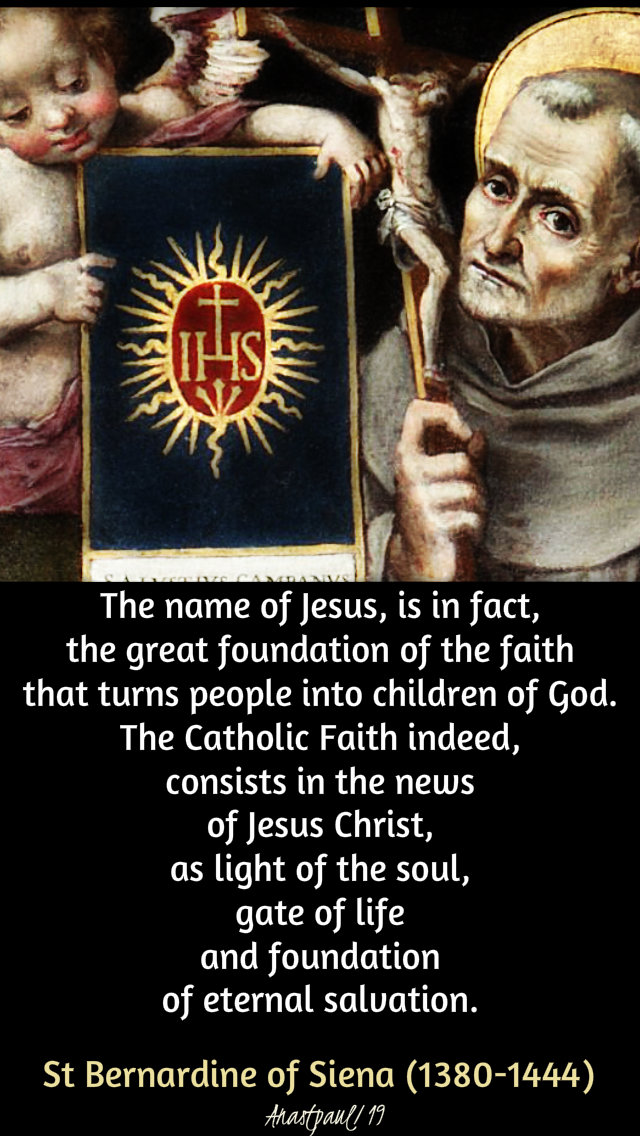
“The name of Jesus, is in fact, the great foundation of the faith that turns people into children of God. The Catholic Faith indeed, consists in the news of Jesus Christ, as light of the soul, gate of life and foundation of eternal salvation.”
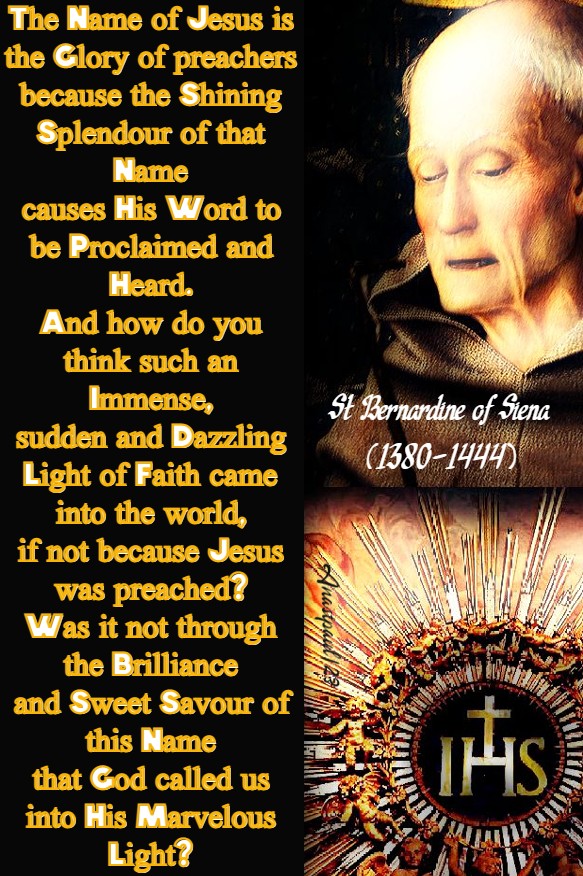
“The Name of Jesus is the glory of preachers because the shining splendour of that Name causes His word to be proclaimed and heard. And how do you think such an immense, sudden and dazzling light of faith came into the world, if not because Jesus was preached? Was it not through the brilliance and sweet savour of this Name that God called us into His marvelous light?”
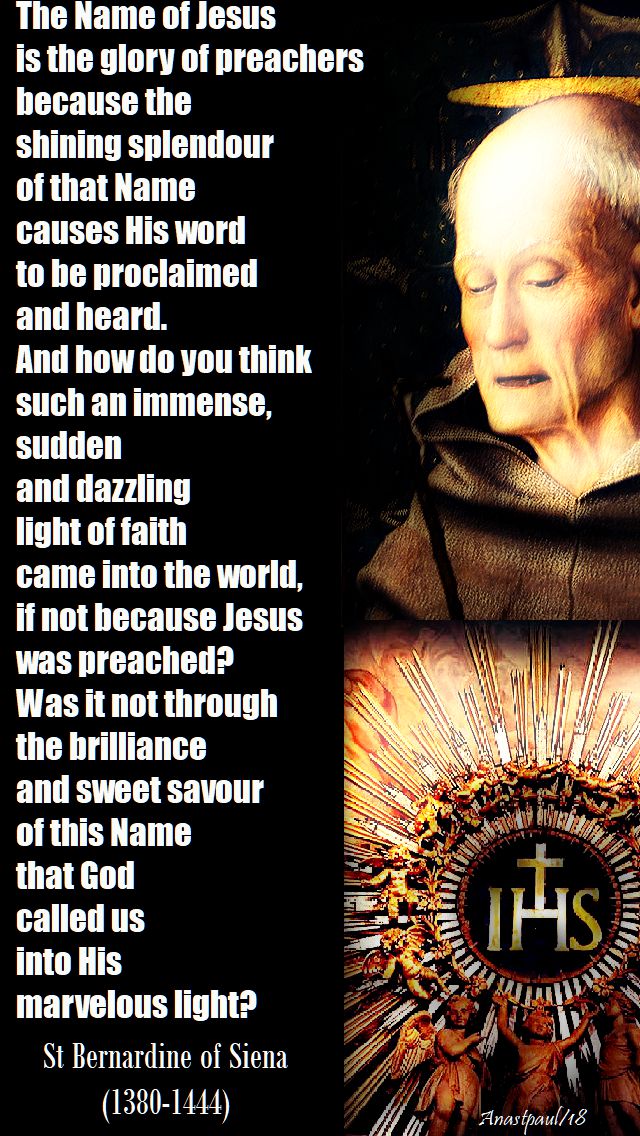
St Bernardine of Siena (1380-1444)
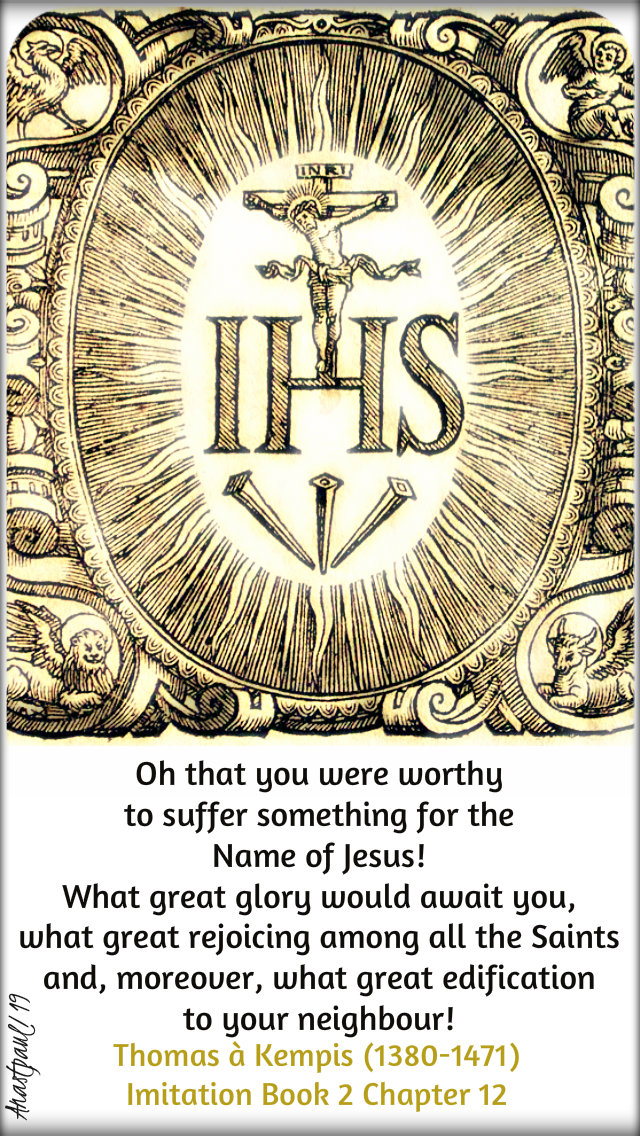
“Oh that you were worthy to suffer something for the Name of Jesus! What great glory would await you, what great rejoicing among all the Saints and, moreover, what great edification to your neighbour!”
Thomas à Kempis (1380-1471)
(Imitation Book 2- Chapter 12)
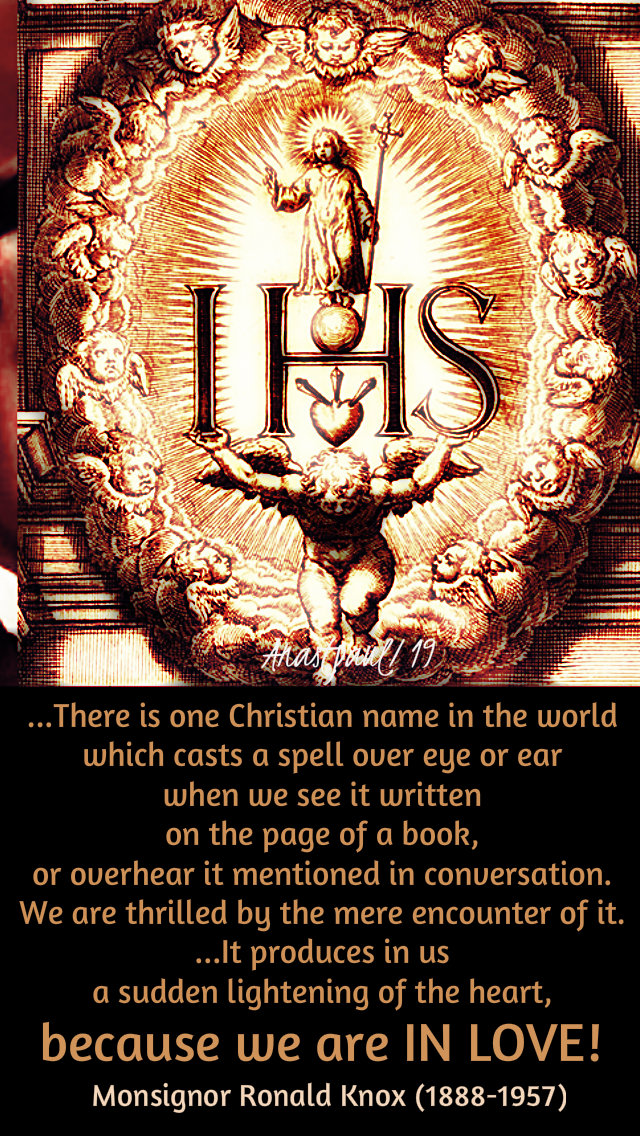
…There is one Christian name in the world which casts a spell over eye or ear when we see it written on the page of a book, or overhear it mentioned in conversation. We are thrilled by the mere encounter of it. …It produces in us a sudden lightening of the heart, because we are in love!”
Our Morning Offering – 3 January – The Feast of the Most Holy Name of Jesus
Jesu, Dulcis Memoria is a celebrated 12th century hymn by St Bernard of Clairvaux (1090-1153), Doctor Mellifluous. The entire hymn has some 42 to 53 stanzas depending upon the manuscript. Parts of this hymn are used for the Feast of the Holy Name of Jesus.
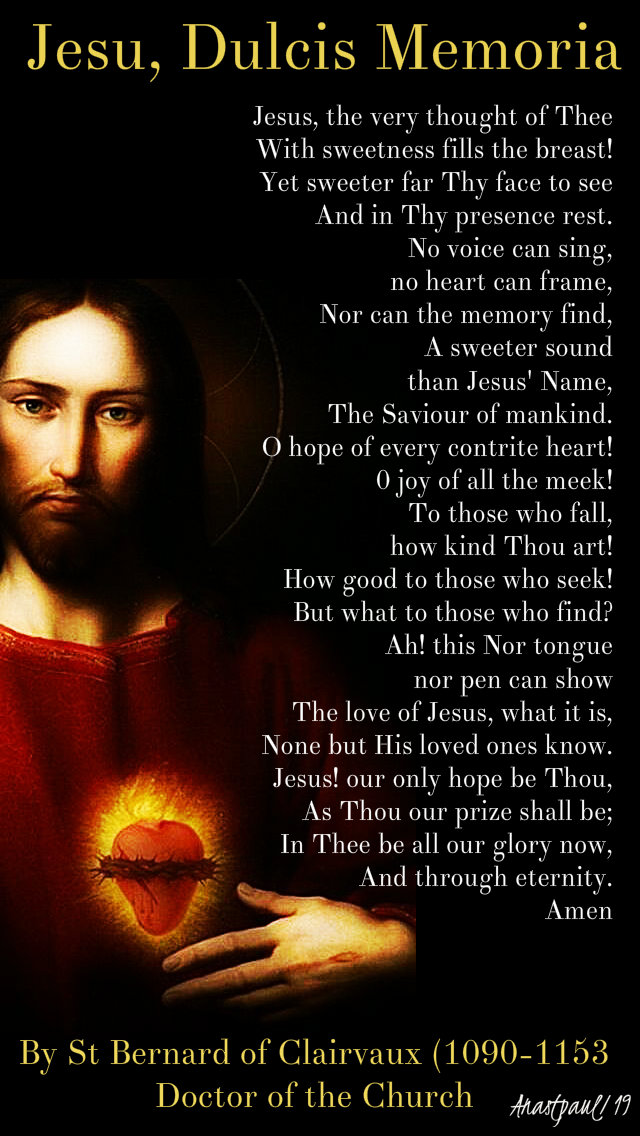
Hymn or Prayer Jesu, Dulcis Memoria By St Bernard of Clairvaux (1090-1153)
Jesus, the very thought of Thee
With sweetness fills the breast!
Yet sweeter far Thy face to see
And in Thy presence rest.
No voice can sing,
no heart can frame,
Nor can the memory find,
A sweeter sound than Jesus’ Name,
The Saviour of mankind.
O hope of every contrite heart!
0 joy of all the meek!
To those who fall, how kind Thou art!
How good to those who seek!
But what to those who find?
Ah! this Nor tongue nor pen can show
The love of Jesus, what it is,
None but His loved ones know.
Jesus! our only hope be Thou,
As Thou our prize shall be;
In Thee be all our glory now,
And through eternity.
Amen
Thought for the Day – 20 December – “And behold, you will conceive in your womb and bear a son and you shall call his name Jesus.” – Today’s Gospel Luke 1:26-38
Saint Bernard of Clairvaux (1090-1153) Abbot and Doctor of the Church
An excerpt from Homily 4
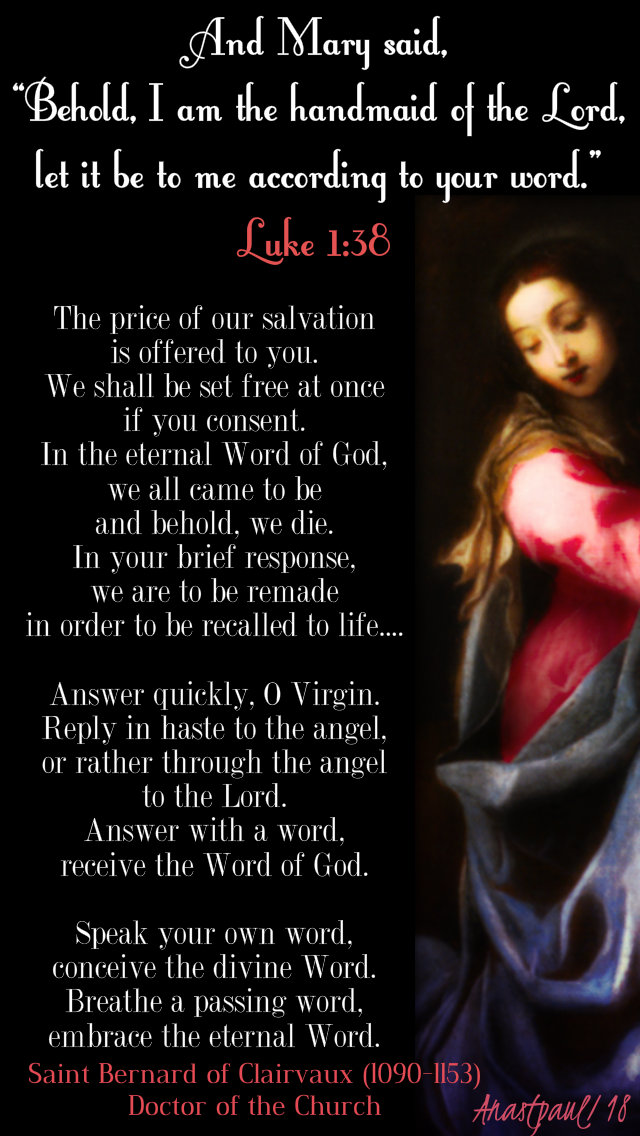
” In the sixth month, the angel Gabriel was sent from God to a city of Galilee named Nazareth, to a virgin betrothed to a man whose name was Joseph, of the house of David; and the virgin’s name was Mary. And he came to her and said, “Hail, full of grace, the Lord is with you!” But she was greatly troubled at the saying and considered in her mind what sort of greeting this might be. And the angel said to her, “Do not be afraid, Mary, for you have found favour with God. And behold, you will conceive in your womb and bear a son, and you shall call his name Jesus.”…Luke1:26-31
You have heard, O Virgin, that you will conceive and bear a son – you have heard that it will not be by man but by the Holy Spirit. The angel awaits an answer – it is time for him to return to God who sent him. We too are waiting, O Lady, for your word of compassion, the sentence of condemnation weighs heavily upon us.
The price of our salvation is offered to you. We shall be set free at once if you consent. In the eternal Word of God we all came to be and behold, we die. In your brief response we are to be remade in order to be recalled to life.
Tearful Adam with his sorrowing family begs this of you, O loving Virgin, in their exile from Paradise. Abraham begs it, David begs it. All the other holy patriarchs, your ancestors, ask it of you, as they dwell in the country of the shadow of death. This is what the whole earth waits for, prostrate at your feet. It is right in doing so, for on your word depends comfort for the wretched, ransom for the captive, freedom for the condemned, indeed, salvation for all the sons of Adam, the whole of your race.
Answer quickly, O Virgin. Reply in haste to the angel, or rather through the angel to the Lord. Answer with a word, receive the Word of God. Speak your own word, conceive the divine Word. Breathe a passing word, embrace the eternal Word.
Why do you delay, why are you afraid? Believe, give praise and receive. Let humility be bold, let modesty be confident. This is no time for virginal simplicity to forget prudence. In this matter alone, O prudent Virgin, do not fear to be presumptuous. Though modest silence is pleasing, dutiful speech is now more necessary. Open your heart to faith, O blessed Virgin, your lips to praise, your womb to the Creator. See, the desired of all nations is at your door, knocking to enter. If He should pass by because of your delay, in sorrow, you would begin to seek Him afresh, the One whom your soul loves. Arise, hasten, open. Arise in faith, hasten in devotion, open in praise and thanksgiving.
Behold the handmaid of the Lord, she says, be it done to me according to your word.
Thought for the Day – 15 December – Saturday of the Second week of Advent
The Word of the Lord will come to us – The Threefold Coming of the Lord
St Bernard Clairvaux (1090-1153) Doctor of the Church
We know that the coming of the Lord is threefold – the third coming is between the other two and it is not visible in the way they are. At His first coming the Lord was seen on earth and lived among men, who saw Him and hated Him. At His last coming All flesh shall see the salvation of our God and They shall look on Him whom they have pierced. In the middle, the hidden coming, only the chosen see Him and they see Him within themselves and so their souls are saved. The first coming was in flesh and weakness, the middle coming is in spirit and power and the final coming will be in glory and majesty.
This middle coming is like a road that leads from the first coming to the last. At the first, Christ was our redemption, at the last, He will become manifest as our life but in this middle way He is our rest and our consolation.
If you think that I am inventing what I am saying about the middle coming, listen to the Lord Himself: “If anyone loves me, he will keep my words and the Father will love him and we shall come to him.” Elsewhere I have read: Whoever fears the Lord does good things – but I think that what was said about whoever loves Him was more important, that whoever loves Him will keep His words. Where are these words to be kept? In the heart certainly, as the Prophet says I have hidden your sayings in my heart so that I do not sin against you. Keep the word of God in that way – Blessed are those who keep it. Let it penetrate deep into the core of your soul and then flow out again in your feelings and the way you behave, because if you feed your soul well it will grow and rejoice. Do not forget to eat your bread, or your heart will dry up. Remember and your soul will grow fat and sleek.
If you keep God’s word like this, there is no doubt that it will keep you, for the Son will come to you with the Father, the great Prophet will come, who will renew Jerusalem and He is the one who makes all things new. For this is what this coming will do, just as we have been shaped in the earthly image, so will we be shaped in the heavenly image. Just as the old Adam was poured into the whole man and took possession of him, so in turn will our whole humanity be taken over by Christ, who created all things, has redeemed all things and will glorify all things.
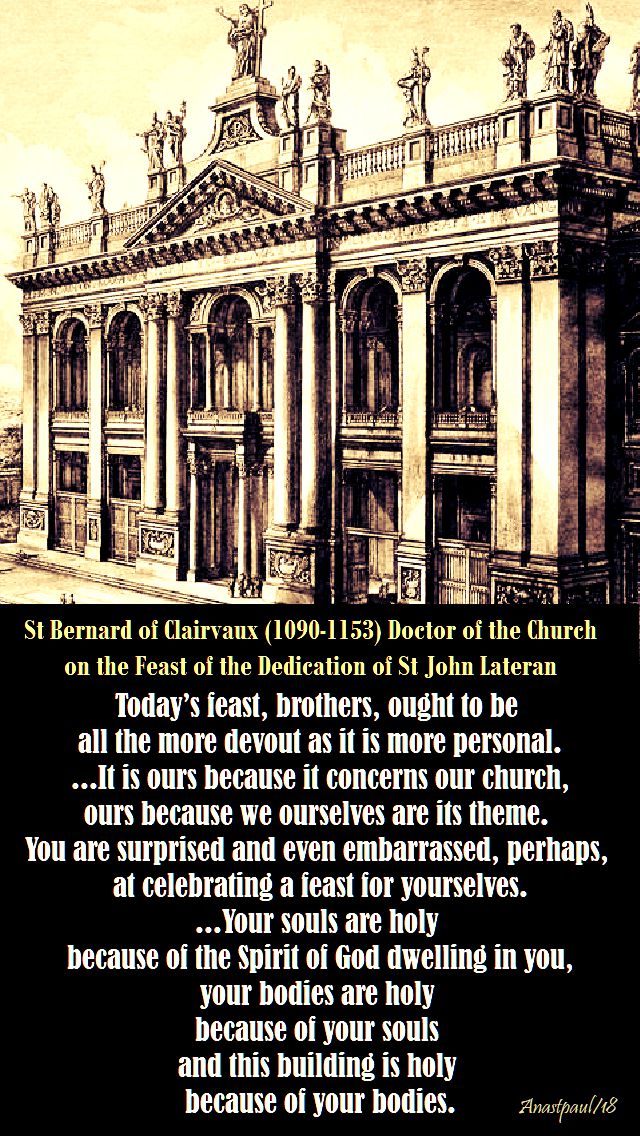
Quote/s of the Day – 9 November – The Feast of the Dedication of St John Lateran
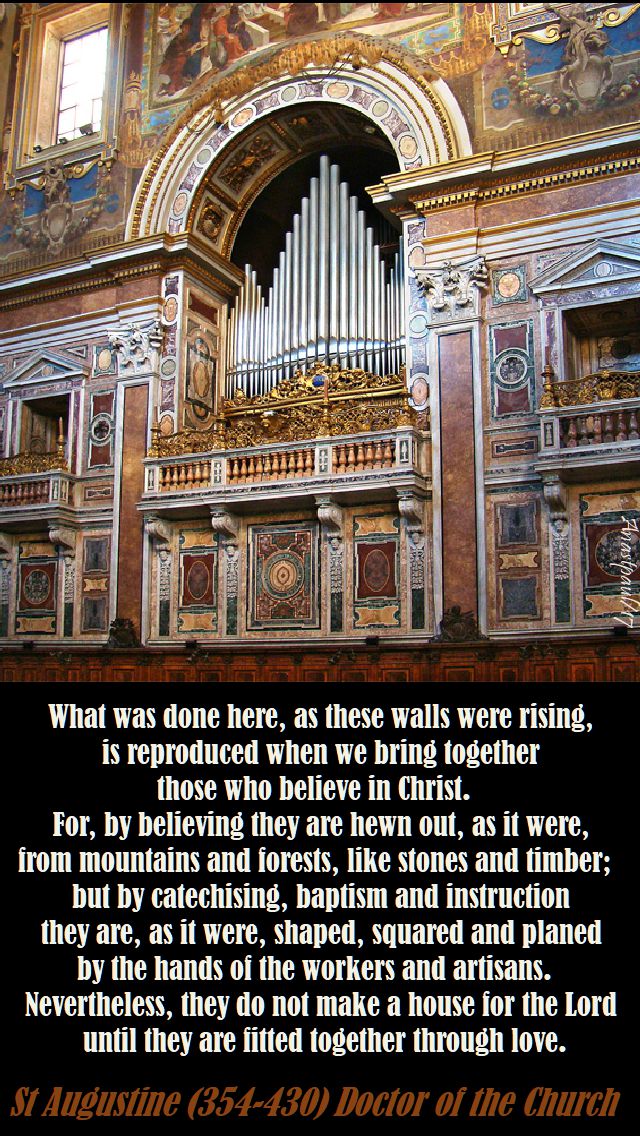
“What was done here, as these walls were rising, is reproduced when we bring together those who believe in Christ. For, by believing they are hewn out, as it were, from mountains and forests, like stones and timber but by catechising, baptism and instruction they are, as it were, shaped, squared and planed by the hands of the workers and artisans. Nevertheless, they do not make a house for the Lord, until they are fitted together through love”.
St Augustine (354-430) Doctor of the Church – Sermon 36
“Today’s feast, brothers, ought to be all the more devout as it is more personal. For other celebrations we have in common with other ecclesiastical communities but this one is proper to us, so that if we do not celebrate it, nobody will. It is ours because it concerns our church, ours because we ourselves are its theme. You are surprised and even embarrassed, perhaps, at celebrating a feast for yourselves. But do not be like horses and mules that have no understanding. Your souls are holy because of the Spirit of God dwelling in you, your bodies are holy because of your souls and this building is holy because of your bodies.”
St Bernard of Clairvaux (1090-1153) Doctor of the Church
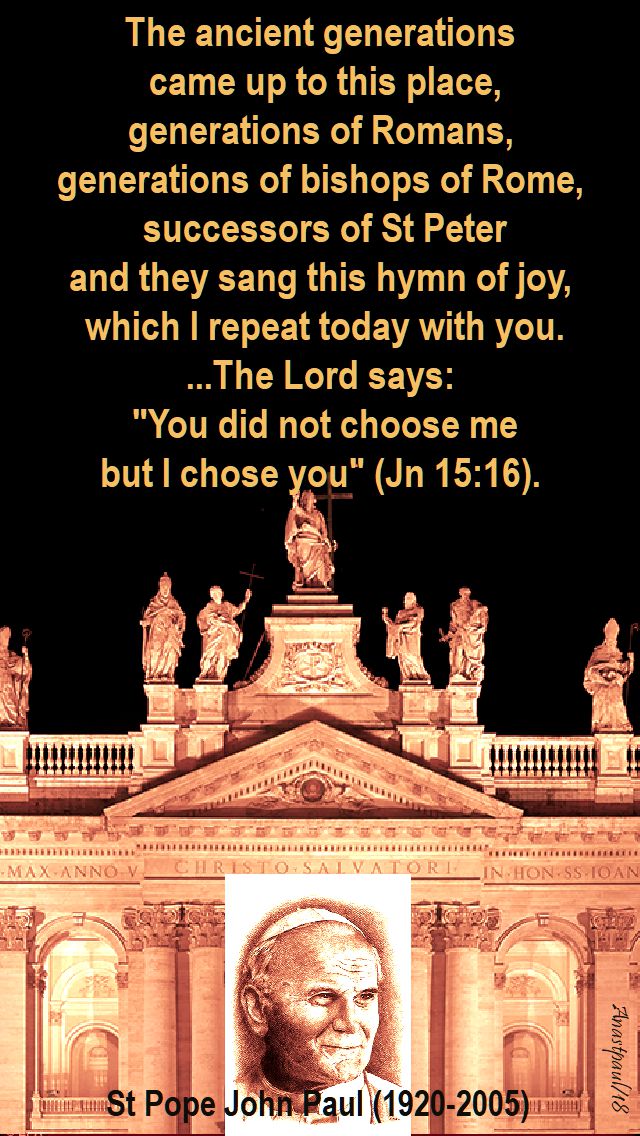
“Is not this an image of today’s event? The ancient generations came up to this place, generations of Romans, generations of bishops of Rome, successors of St Peter and they sang this hymn of joy, which I repeat today with you. I join these generations, I, the new Bishop of Rome, John Paul II, Polish by origin. I stop on the threshold of this temple and I ask you to welcome me in the Lord’s name. I beg you to welcome me, as you welcomed my Predecessors throughout the centuries, as you welcomed, only a few weeks ago, John Paul I, so beloved by the whole world! I beg you to welcome me too. The Lord says: “You did not choose me, but I chose you” (Jn 15:16). This is the only appeal I can make – I am not here by my own will. The Lord has elected me. In the Lord’s name I beg you therefore – welcome me!”
St Pope John Paul (1920-2005) RITE OF POSSESSION OF THE CHAIR OF THE BISHOP OF ROME HOMILY OF HIS HOLINESS JOHN PAUL II Basilica of St John Lateran Sunday, 12 November 1978
Our Morning Offering – 7 November – Wednesday of the Thirty First week in Ordinary Time, Year B
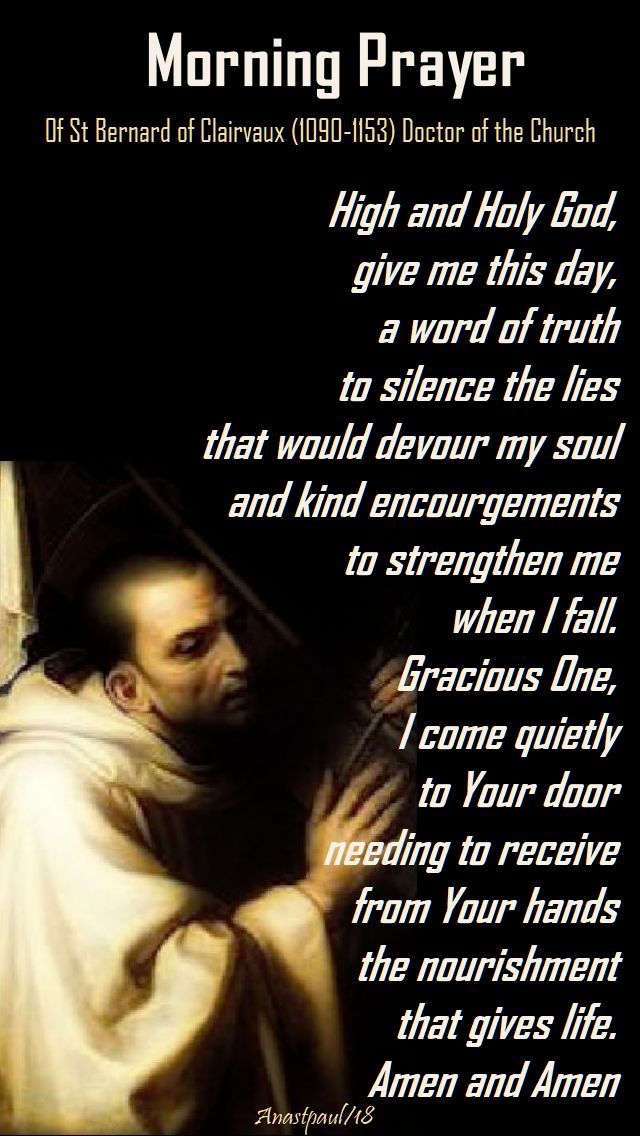
Morning Prayer By St Bernard of Clairvaux (1090-1153) Doctor of the Church
High and Holy God,
give me this day a word of truth
to silence the lies, that would devour my soul
and kind encourgements
to strengthen me when I fall.
Gracious One,
I come quietly to Your door
needing to receive from Your hands
the nourishment that gives life.
Amen and Amen
Sunday Reflection – 4 November – Thirty First Sunday in Ordinary Time, Year B
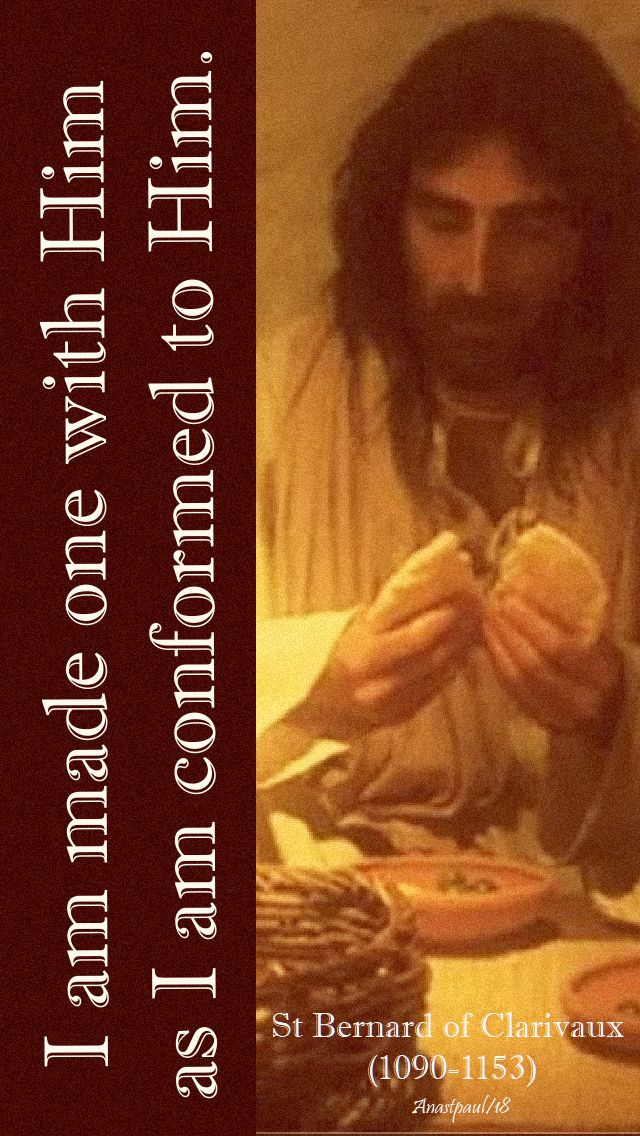
“I am made one with Him, as I am conformed to Him.” St Bernard of Clairvaux (1090-1153) Doctor of the Church
Saint Bernard teaches, that it is not enough for us to take and eat the Bread from Heaven. We must also offer ourselves to be eaten. Holy Communion is a wondrous exchange in which we become the bread of Christ. Listen to Saint Bernard:
“My penitence, my salvation are His food.
I myself am His food.
I am chewed as I am reproved by Him;
I am swallowed by Him as I am taught;
I am digested by Him as I am changed;
I am assimilated as I am transformed;
I am made one with Him, as I am conformed to Him.
He feeds upon us and is fed by us
that we may be the more loosely bound to Him.”
Saint Bernard, ever the poet, uses images of eating and assimilation to describe how Christ unites us to Himself. Our Lord becomes our food that we might become His. We need the language of poets and preachers in our approach to the Eucharist.
Quote/s of the Day- 2 October – The Memorial of the Holy Guardian Angels
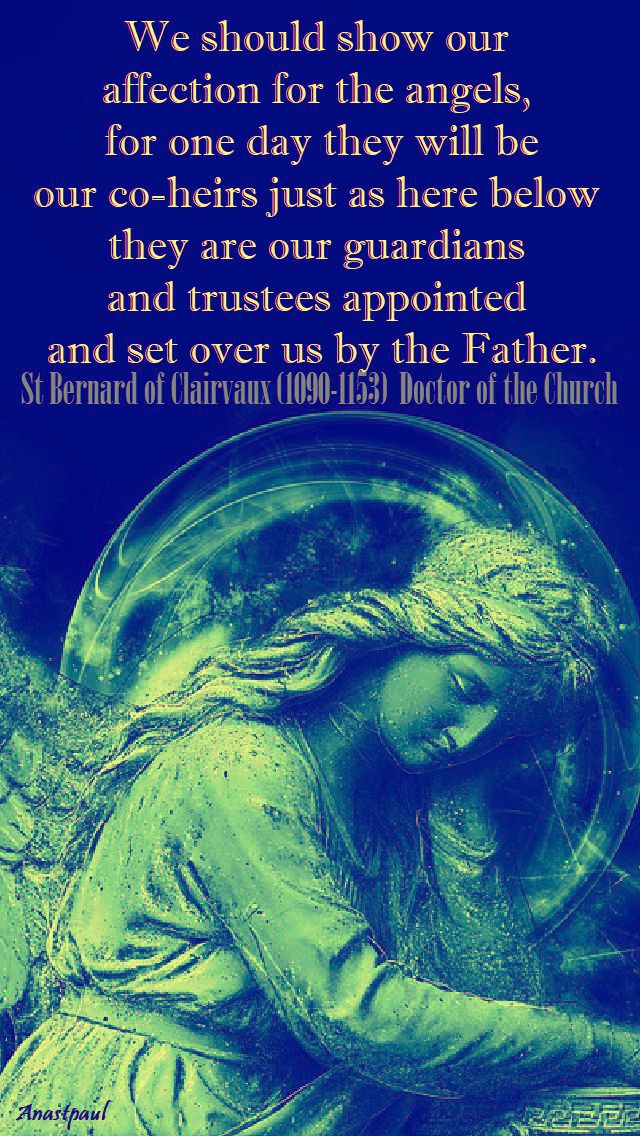
“We should show our affection for the angels, for one day they will be our co-heirs just as here below they are our guardians and trustees appointed and set over us by the Father.”
St Bernard of Clairvaux (1090-1153) Doctor of the Church
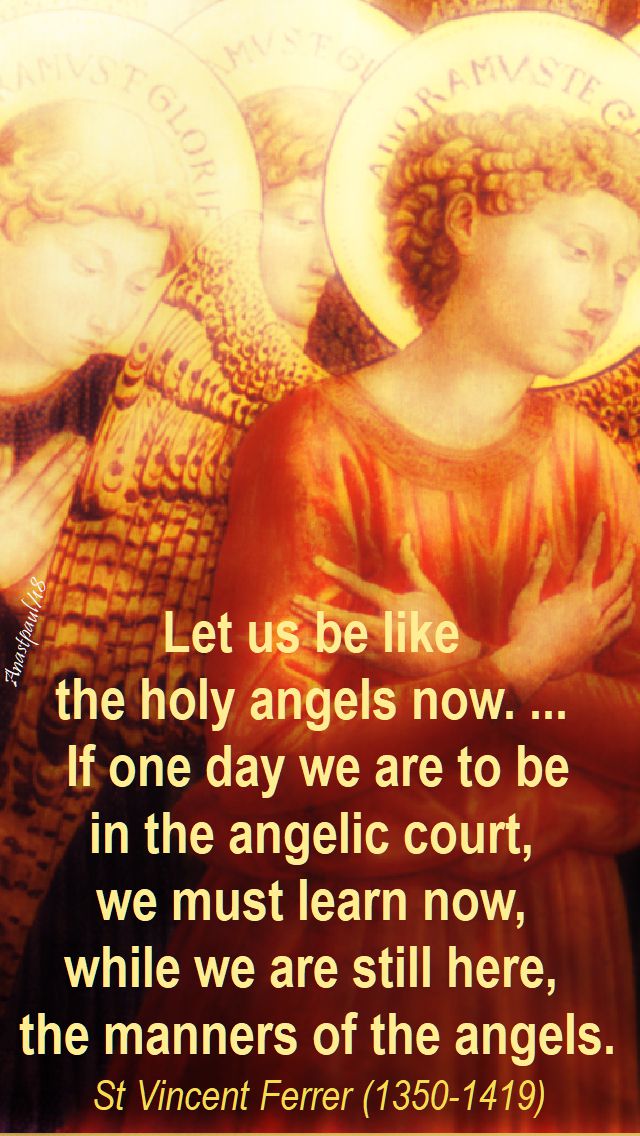
“Let us be like the holy angels now. … If one day we are to be in the angelic court, we must learn now, while we are still here, the manners of the angels.”
St Vincent Ferrer (1350-1419)
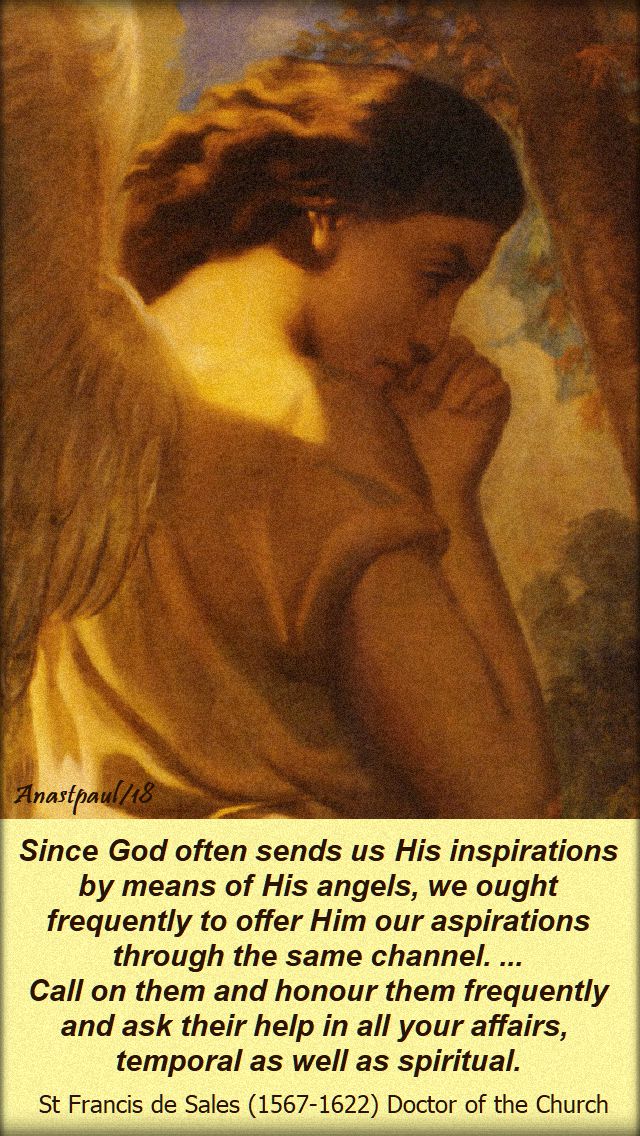
“Since God often sends us His inspirations by means of his angels, we ought frequently to offer Him our aspirations through the same channel…. Call on them and honour them frequently and ask their help in all your affairs, temporal as well as spiritual.”
St Francis de Sales (1567-1622) Doctor of the Church
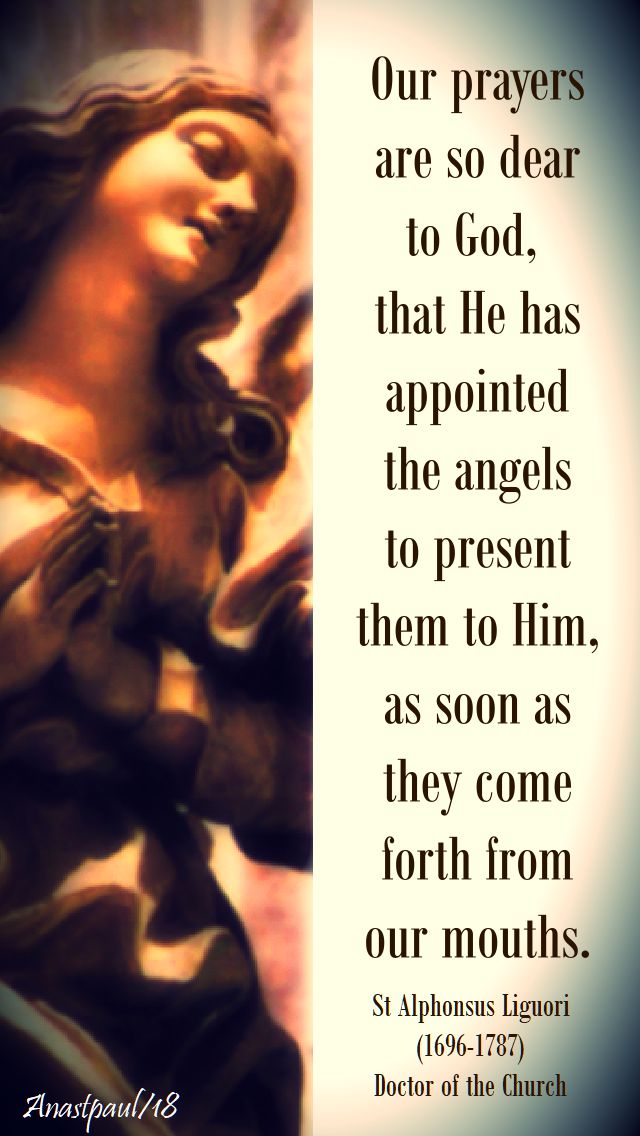
“Our prayers are so dear to God, that He has appointed the angels to present them to Him, as soon as they come forth from our mouths. ‘The angels,’ says St Hilary, ‘preside over the prayers of the faithful and offer them daily to God.’ This is that smoke of the incense, which are the prayers of saints, which St John saw ascending to God from the hands of the angels (Apoc. 8,3) and which he saw in another place, represented by golden phials full of sweet odours, very acceptable to God.”
St Alphonsus Liguori (1696-1787) Doctor of the Church
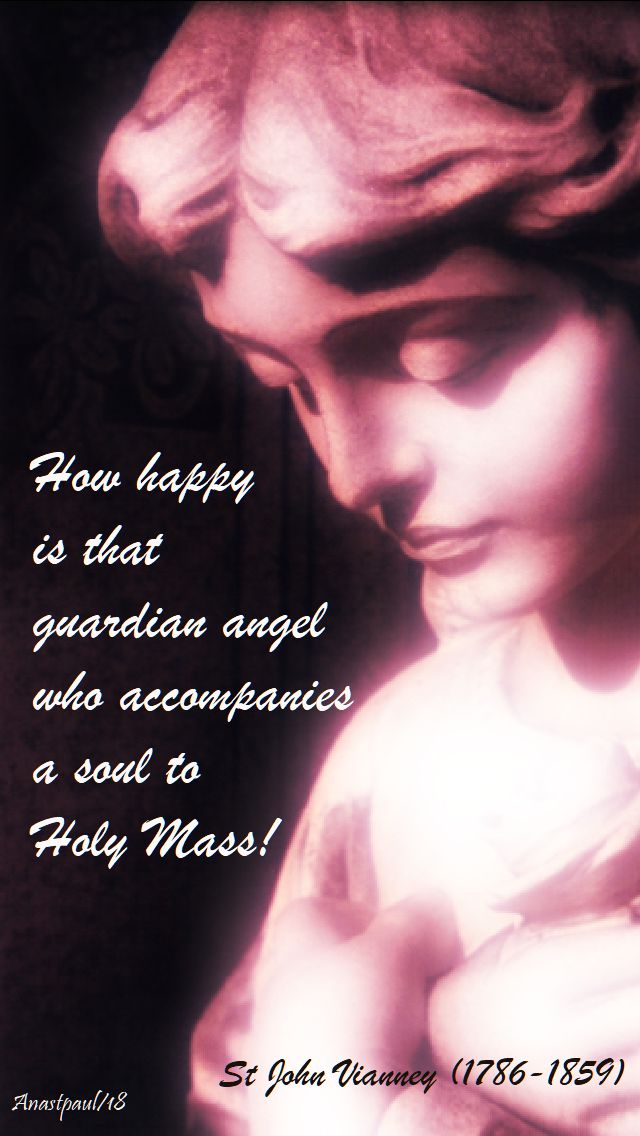
“How happy is that guardian angel who accompanies a soul to Holy Mass!”
Our Morning Offering – 16 September – Twenty-fourth Sunday in Ordinary Time, Year B
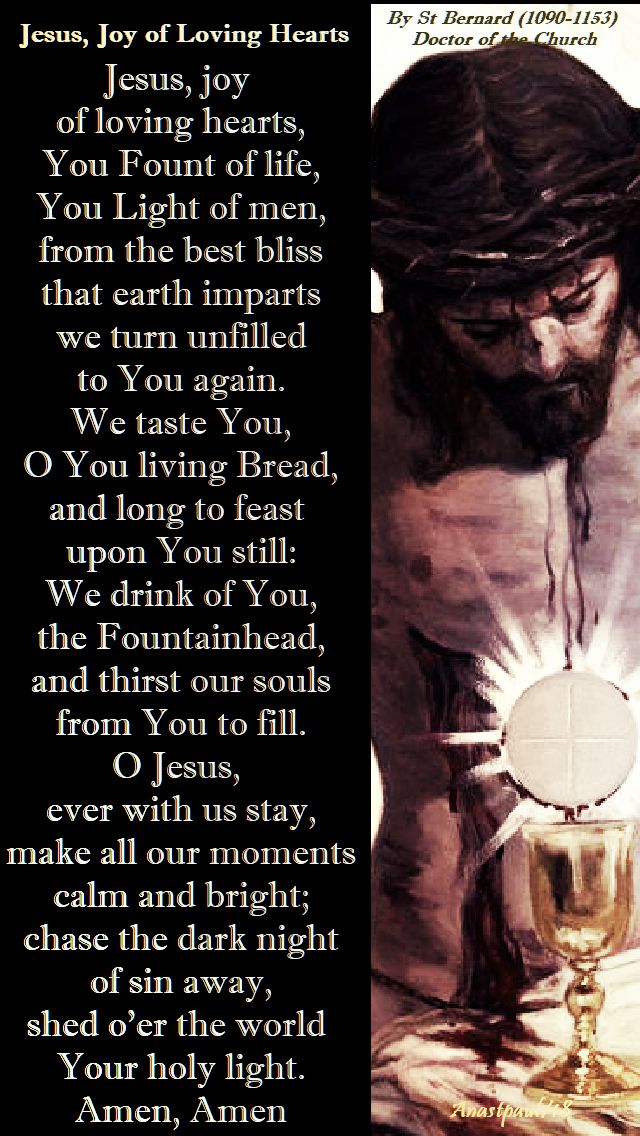
Jesus, Joy of Loving Hearts By St Bernard of Clairvaux (1090-1153) Doctor of the Church
Jesus, joy of loving hearts,
You Fount of life,
You Light of men,
from the best bliss that earth imparts
we turn unfilled to You again.
We taste You,
O You living Bread,
and long to feast upon You still:
We drink of You, the Fountainhead,
and thirst our souls from You to fill.
O Jesus, ever with us stay,
make all our moments calm and bright;
chase the dark night of sin away,
shed o’er the world Your holy light.
Amen, Amen
Saint Bernard teaches that it is not enough for us to take and eat the Bread from Heaven.
We must also offer ourselves to be eaten.
Holy Communion is a wondrous exchange in which we become the bread of Christ.
Listen to Saint Bernard:
“My penitence, my salvation are His food. I myself am His food. I am chewed. as I am reproved by Him; I am swallowed by Him. as I am taught; I am digested by Him. as I am changed; I am assimilated. as I am transformed; I am made one with Him, as I am conformed to Him. He feeds upon us and is fed by us that we may be the more loosely bound to Him.”
Saint Bernard, ever the poet, uses images of eating and assimilation to describe how Christ unites us to Himself.
Our Lord becomes our food that we might become His.
We need the language of poets and preachers in our approach to the Eucharist.
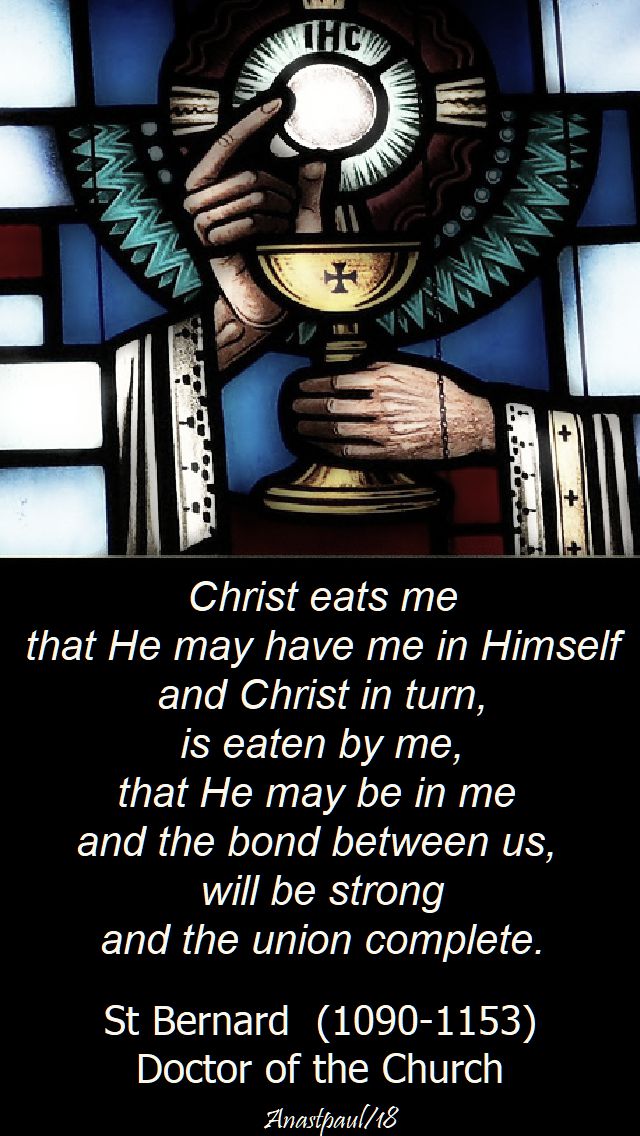
Saint Bernard says, “Christ eats me that He may have me in Himself and Christ in turn is eaten by me that He may be in me and the bond between us, will be strong and the union complete.”
What awaits you in Holy Communion exceeds all that you can desire. Eat, then and offer yourself to be eaten. Receive the Bread of God and become the bread of God.
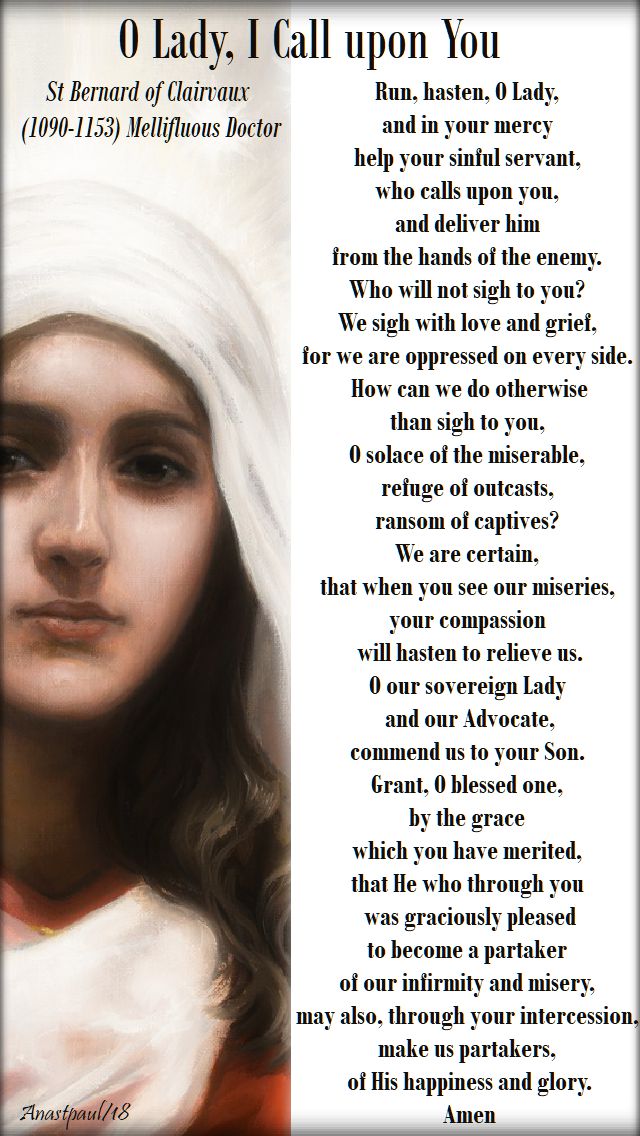
O Lady, I Call upon You St Bernard of Clairvaux (1090-1153) Mellifluous Doctor
Run, hasten, O Lady,
and in your mercy help your sinful servant,
who calls upon you,
and deliver him from the hands of the enemy.
Who will not sigh to you?
We sigh with love and grief,
for we are oppressed on every side.
How can we do otherwise than sigh to you,
O solace of the miserable,
refuge of outcasts,
ransom of captives?
We are certain that when you see our miseries,
your compassion will hasten to relieve us.
O our sovereign Lady and our Advocate,
commend us to your Son.
Grant, O blessed one,
by the grace which you have merited,
that He who through you
was graciously pleased to become a partaker
of our infirmity and misery,
may also, through your intercession,
make us partakers, of His happiness and glory.
Amen
Thought for the Day – 8 May – Tuesday of the Sixth Week of Eastertide – Today’s Gospel: John 16:5–11
” 5 But now I am going to him who sent me; yet none of you asks me, ‘Where are you going?’ 6 But because I have said these things to you, sorrow has filled your hearts. 7 Nevertheless I tell you the truth: it is to your advantage that I go away, for if I do not go away, the Counsellor will not come to you; but if I go, I will send him to you. 8 And when he comes, he will convince the world concerning sin and righteousness and judgment: 9 concerning sin, because they do not believe in me; 10 concerning righteousness, because I go to the Father, and you will see me no more; 11 concerning judgment, because the ruler of this world is judged.” (RSV-Catholic ed)
“It is better for you that I go”
St Bernard (1091-1153) Mellifluous Doctor 3rd sermon for Pentecost
The Holy Spirit overshadowed the Virgin Mary (Lk 1:35) and strengthened the apostles on the day of Pentecost. In her case it was to soften the impact on her virginal body of the coming of the divinity and, in theirs, to “clothe them with power from on high” (Lk 24:49), that is with burning charity… In their weakness how could they have fulfilled their mission of conquering death without that “love as strong as death” or not allowed the “gates of hell to prevail against them” without that “passion fierce as Sheol” ? (Mt 16:18; Sg 8:6). However, when they saw such enthusiasm, some thought they were drunk (Acts 2:13).
They were indeed drunk but with new wine…, that which the “true Vine” poured down from the heights of heaven, that which “gladdens the human heart” (Jn 15:1; Ps 104[103]:15)… This was a new wine for the dwellers on earth but it is found in abundance in heaven…, it runs in streams in the streets and squares of the holy city where it spreads gladness of heart…
And so in heaven, there was a special wine of which earth was ignorant. Yet earth, too, had something of its own that was its glory – Christ’s flesh – and heaven thirsted for the presence of that flesh. Could anyone stand in the way of so reliable and grace-filled an exchange, between heaven and earth, angels and apostles, as that by which earth possesses the Holy Spirit and heaven the flesh of Christ?…
“If I do not go away,” Jesus says, “the Advocate will not come to you.” That is to say, if you do not allow what you love to leave you, you will not obtain what you desire. “It is to your advantage that I go” and that I should carry you over from earth to heaven, from flesh to spirit, for the Father is spirit, the Son is spirit and the Holy Spirit is also spirit… And the Father “who is spirit seeks worshippers who will worship him in spirit and in truth” (Jn 4:23-24).
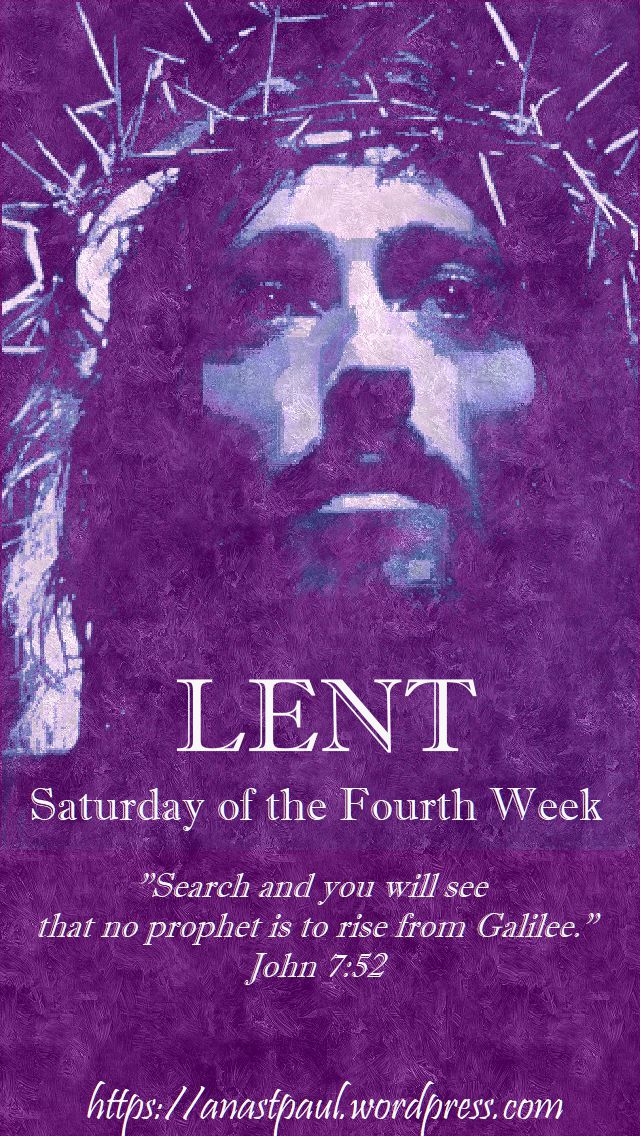
Lenten Reflection – 17 March 2018 – Saturday of the 4th Week of Lent
Jeremiah 11:18-20, Psalms 7:2-3, 9-12, John 7:40-53
Jeremiah 11:18 – “The Lord made it known to me and I knew; then thou didst show me their evil deeds.”
John 7:50-53 – Nicodemus, who had gone to him before and who was one of them, said to them, “Does our law judge a man without first giving him a hearing and learning what he does?” They replied, “Are you from Galilee too? Search and you will see that no prophet is to rise from Galilee.” They went each to his own house…”
Tomorrow we shall enter Passiontide and the long shadow of the Cross is now cast over our Lenten journey. In today’s first reading, the first of Jeremiah’s ‘confessions’, he is coping with the shocking fact that people are trying to murder him. And how does he cope? In the way that we all must, by turning back to God.
In the Gospel, we hear the sinister note of the forces who are moving towards the destruction of Jesus. It starts (as so often in the fourth Gospel) with divisions among “the crowd”. There are three positions that they variously adopt – i) that Jesus is the prophet; ii) that He is the Messiah; iii) that Jesus is none of the above, because Messiah’s don’t come from Galilee.
The next division is between the servants who had been sent to arrest Jesus and the authorities who had sent them. The servants fail to bring him back because ‘no human being ever spoke like this’ – the Pharisees respond with a bullying argument argument ‘The crowd don’t know the law and they’re accursed.’
The final division is between Nicodemus, battling bravely against the tide and his peers. He wants due process of law whilst they simply re-assert their slogan ‘prophets don’t come from Galilee’.
Significantly, the division remains and no unity is produced amongst the dissidents but ‘they each went to their own home’. And yet, Jesus’ death is now visible on the horizon, less than two weeks away!…(Fr Nicholas King S.J. – The Lenten Journey to Easter)
Have I ever been the cause of division and arguments, perhaps unfairly? What ideologies might I cling to that blind me from seeing the true and bigger picture? Have I the strength to battle against the tide of evil?
“Great thing is the knowledge of the crucified Christ. How many things are enclosed inside this treasure! Christ crucified! Such is the hidden treasure of wisdom and science. Do not be deceived, then, under the pretext of wisdom. Gather before the covering and pray that it may be uncovered. Foolish philosopher of this world, what you are looking for is worthless… What is the advantage of being thirsty, if you despise the source? … And what is His precept but that we believe in Him and love each other? In whom? In Christ crucified. This is His commandment: that we believe in Christ crucified … But where humility is, there is also majesty, where weakness is, there shall one find power, where death is, there shall be life as well. If you wish to arrive at the second part, do not despise the first “(Sermon 160, 3-4) St Augustine
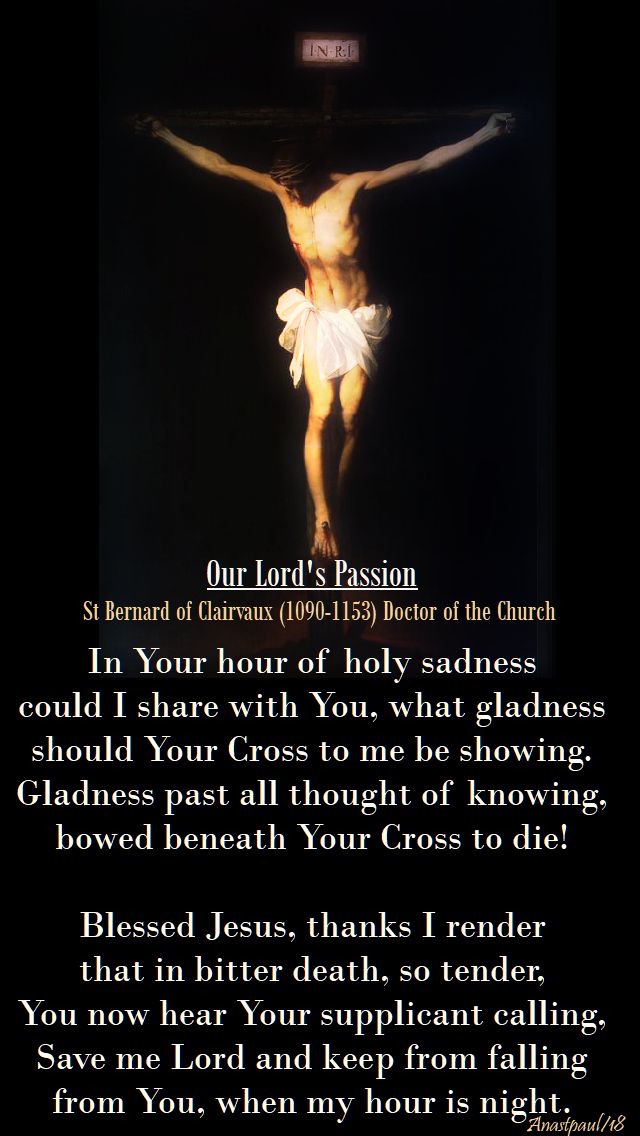
Our Lord’s Passion St Bernard of Clairvaux (1090-1153) Doctor of the Church
In Your hour of holy sadness could I share with You, what gladness should Your Cross to me be showing. Gladness past all thought of knowing, bowed beneath Your Cross to die!
Blessed Jesus, thanks I render that in bitter death, so tender, You now hear Your supplicant calling, Save me Lord and keep from falling from You, when my hour is night.
Quote/s of the Day – 26 January – Memorial of Sts Timothy and Titus, Disciples and Companions of the Apostle Paul and Bishops of the Catholic Church
“Speaking of Obedience”
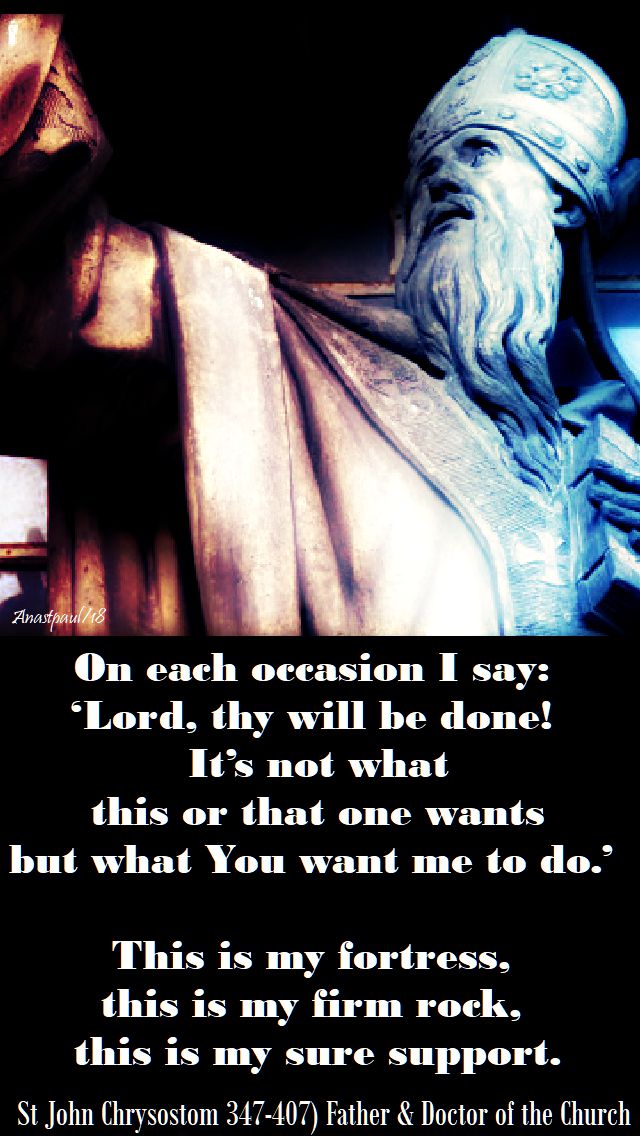
“On each occasion I say: ‘Lord, thy will be done! It’s not what this or that one wants but what You want me to do.’ This is my fortress, this is my firm rock, this is my sure support.”
St John Chrysostom 347-407) Father & Doctor of the Church
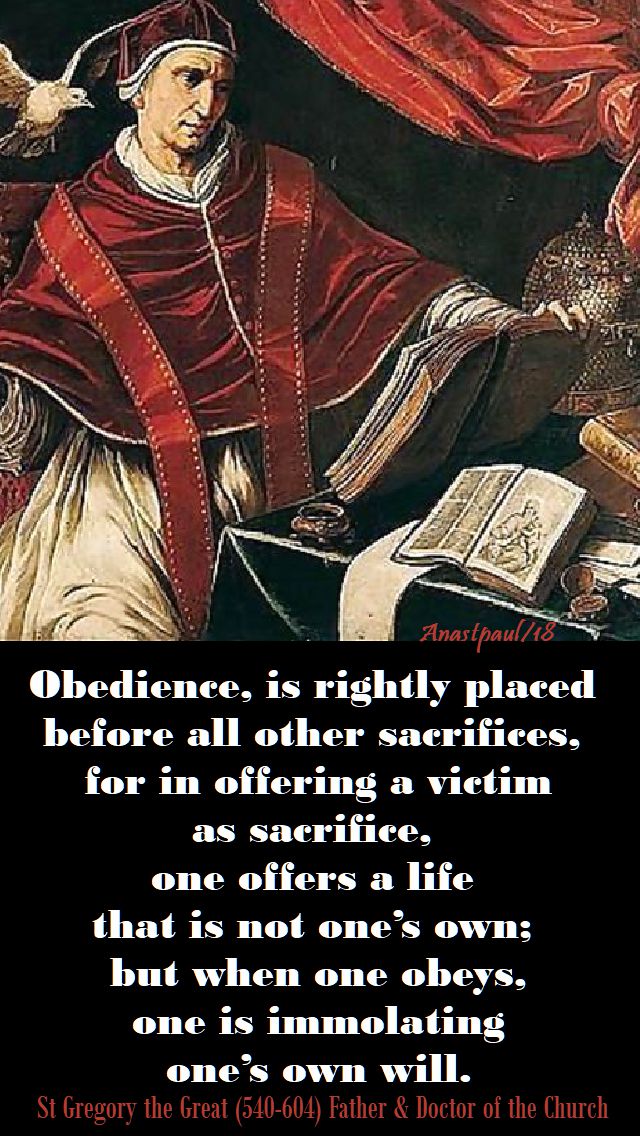
“Obedience, is rightly placed before all other sacrifices, for in offering a victim as sacrifice, one offers a life that is not one’s own; but when one obeys, one is immolating one’s own will.”
St Gregory the Great (540-604) Father & Doctor of the Church
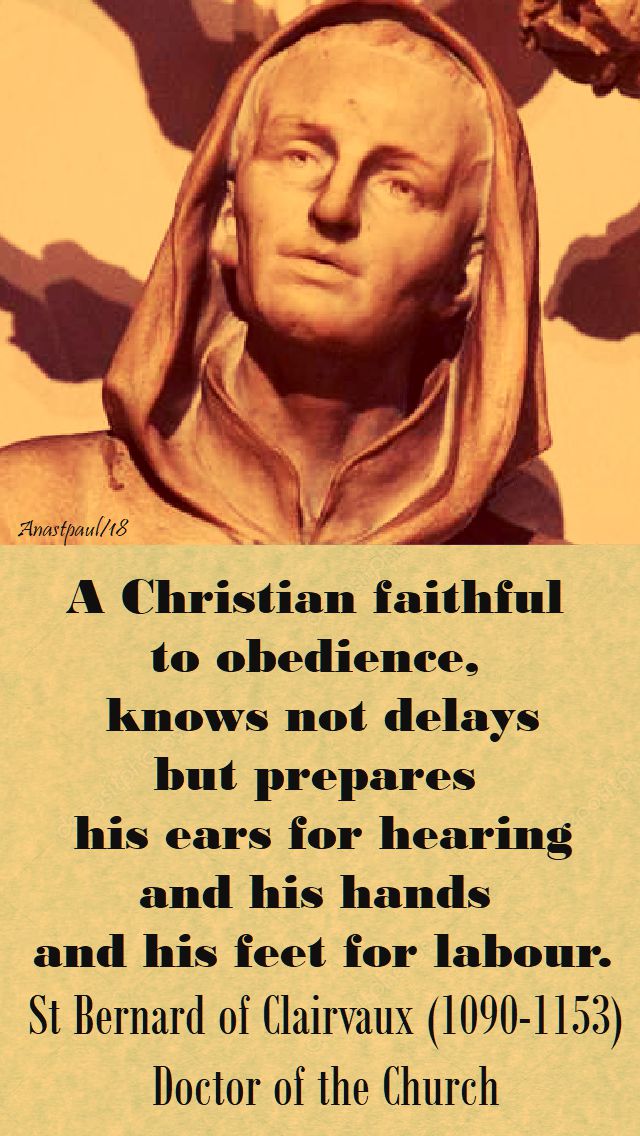
“A Christian faithful to obedience, knows not delays but prepares his ears for hearing and his hands and his feet for labour.”
St Bernard of Clairvaux (1090-1153) Doctor of the Church
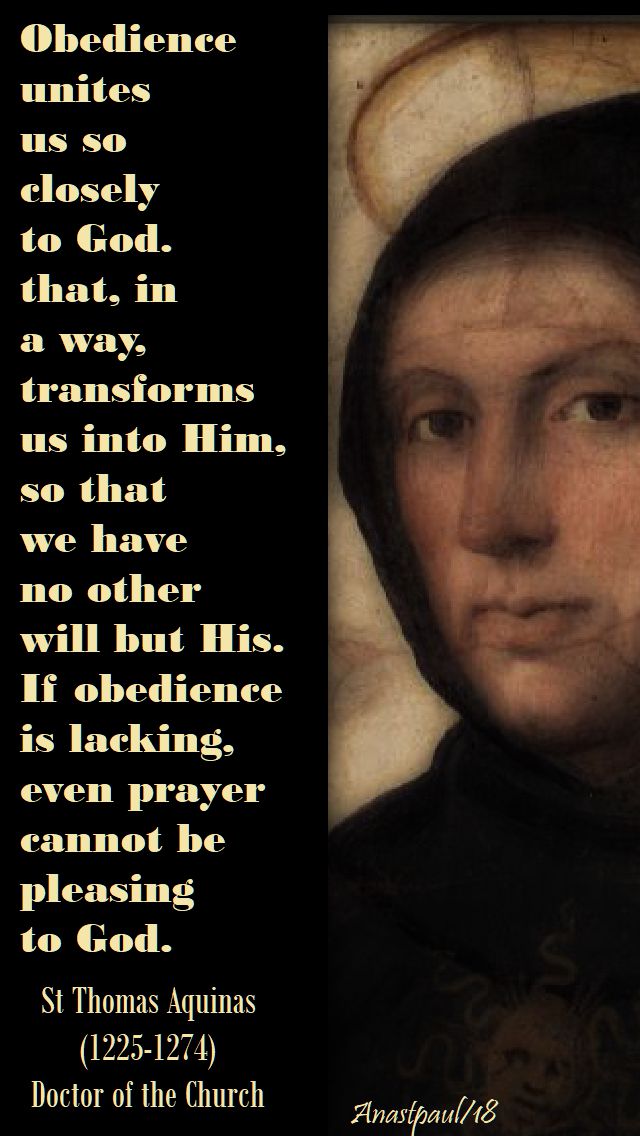
“Obedience unites us so closely to God. that in a way transforms us into Him, so that we have no other will but His. If obedience is lacking, even prayer cannot be pleasing to God.”
St Thomas Aquinas (1225-1274) Doctor of the Church
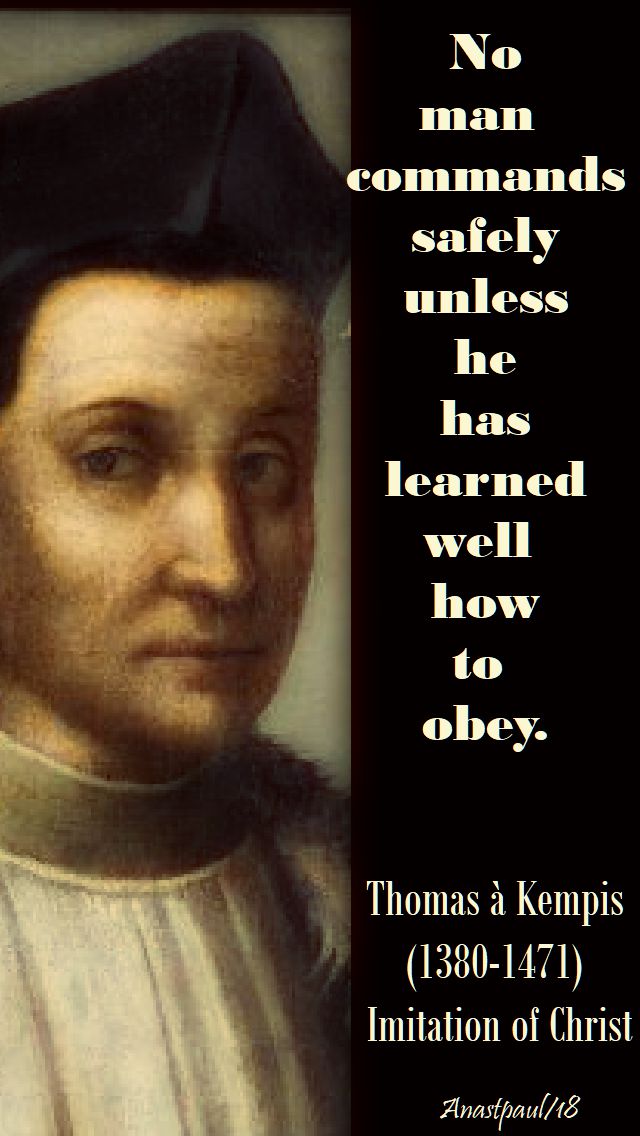
“No man commands safely unless he has learned well how to obey.”
Thomas à Kempis (1380-1471) – Imitation of Christ
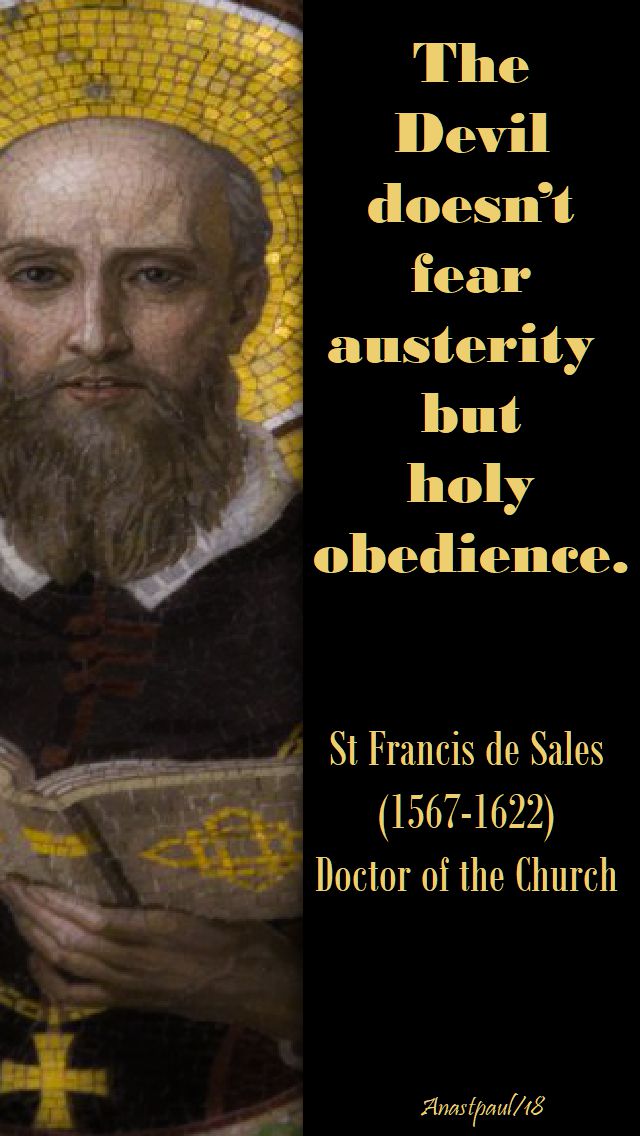
“The Devil doesn’t fear austerity but holy obedience.”
St Francis de Sales (1567-1622) Doctor of the Church
Quote/s of the Day – 3 January – The Most Holy Name of Jesus
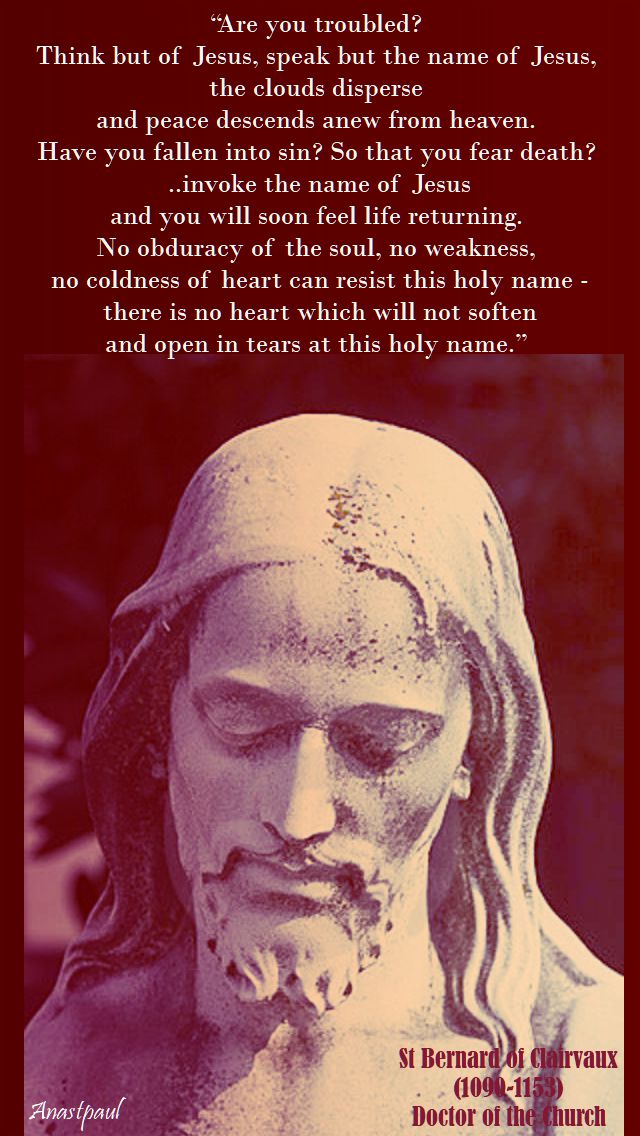
“Are you troubled? Think but of Jesus – speak but the name of Jesus, the clouds disperse and peace descends anew from heaven. Have you fallen into sin? So that you fear death? ..invoke the name of Jesus and you will soon feel life returning. No obduracy of the soul, no weakness, no coldness of heart can resist this holy name – there is no heart which will not soften and open in tears at this holy name.”
St Bernard of Clairvaux – (1090-1153) – Doctor of the Church
“The Name of Jesus is the glory of preachers because the shining splendour of that Name causes His word to be proclaimed and heard. And how do you think such an immense, sudden and dazzling light of faith came into the world, if not because Jesus was preached? Was it not through the brilliance and sweet savour of this Name that God called us into His marvelous light?”












 AnaStpaul
You must be logged in to post a comment.