Posted in JESUIT SJ, MARIAN TITLES, SAINT of the DAY

The 23rd Sunday after Pentecost, Within the Octave of All Saints, Feast of the Holy Relics, Nossa Senhora da Medalha Milagrosa / Our Lady of the Miraculous Medal, Brazil (1939), All Saints and Blesseds of the Society of Jesus and all the Saints for 5 November

The 23rd Sunday after Pentecost
Within the Octave of All Saints

Feast of the Holy Relics:
https://anastpaul.com/2022/11/05/feast-of-the-holy-relics-5-november-2/
AND:
About: https://anastpaul.wordpress.com/2017/11/05/feast-of-the-holy-relics-5-november/
Protestantism pretends to regard the veneration which the Church pays to the Relics of the Saints, as a sin and contends that this pious practice is a remnant of paganism.
The Council of Trent, on the contrary, has decided that the bodies of the Martyrs and other Saints, who were living members of Jesus Christ and temples of the Holy Ghost, are to be honoured by the faithful.
This decision was based upon the established usage of the earliest days of the Church and upon the teaching of the Fathers and of the Councils.
The Council orders, however, that all abuse of this devotion is to be careffully avoided and forbids any Relics to be exposed which have not been approved by the Bishops and, these Prelates are recommended, to instruct the people faithfully, in the teaching of the Church on this subject.
While we regret, then, the errors of the impious and of heretics, let us profit by the advantages which we gain, by hearkening to the voice of the Church!

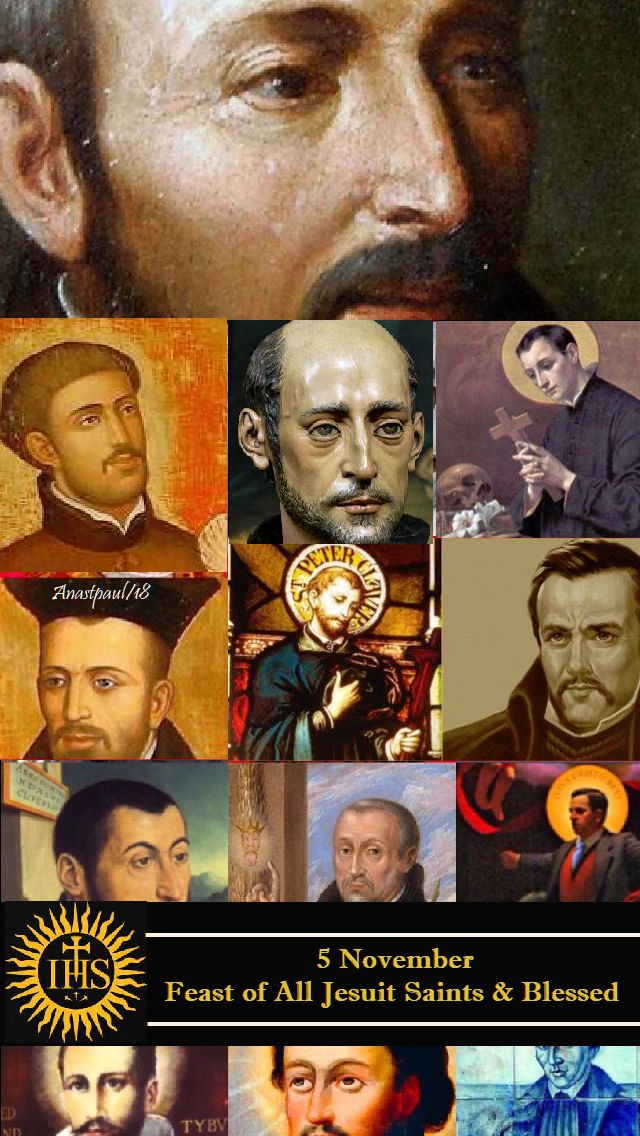
All Saints and Blesseds of the Society of Jesus:
The Society of Jesus, commonly known as the Jesuits, was Founded in 1534 by Saint Ignatius Loyola (1491-1556) at Montmartre, Paris, France. A body of clerics regular organised for Apostolic work, following a religious rule and relying on alms for their support. It was the chief instrument of the Catholic Reformation. Pope Paul III approved the new rule in 1540 and Ignatius was elected the first general of the order in 1541. The constitutions, drafted by him and based on his Spiritual Exercises were adopted in 1558. It was the first order which enjoined by its constitutions devotion to the cause of education. The ministry of the Society consists chiefly in preaching. teaching catechism. administering the sacraments. conducting missions in parishes, taking care of parishes. organising pious confraternities, teaching in schools of every grade, writing books, pamphlets, periodical articles, going on foreign missions and special missions when ordered by the current Holy Father, to whom they take a vow of total obedience. Our current Holy Father, Pope Francis is a Jesuit and has jokingly wondered aloud who is boss of whom in his Order. The general resides at Rome, Italy and has a council of assistants. The motto of the Society is Ad Majorem Dei Gloriam (For the greater glory of God).
All Jesuit Saints and Blesseds:
https://anastpaul.com/2018/11/05/feast-of-all-the-saints-and-blesseds-of-the-society-of-jesus/
St Augustine of Terracina
Bl Bernhard Lichtenberg

St Canonica
St Comasia
St Dominator of Brescia
St Elizabeth
St Domninus the Physician
St Epistemis
St Eusebius of Terracina
St Felix of Terracina
St Fibitius
St Galation
St Gerald of Béziers OSA (1070–1123) Bishop
Bl Gomidas Keumurjian
Bl Gregory Lakota
St Guetnoco
St Hermenegild
St Idda
St Juan Antoni Burró Mas
St Juan Duarte Martín
St Kanten
St Kea
St Laetus of Orleans
St Magnus of Milan
St Mamete
St Marco of Troia
St Spinulus of Moyen-Moûtier
St Sylvanus of Syria
St Zachary

Posted in SAINT of the DAY

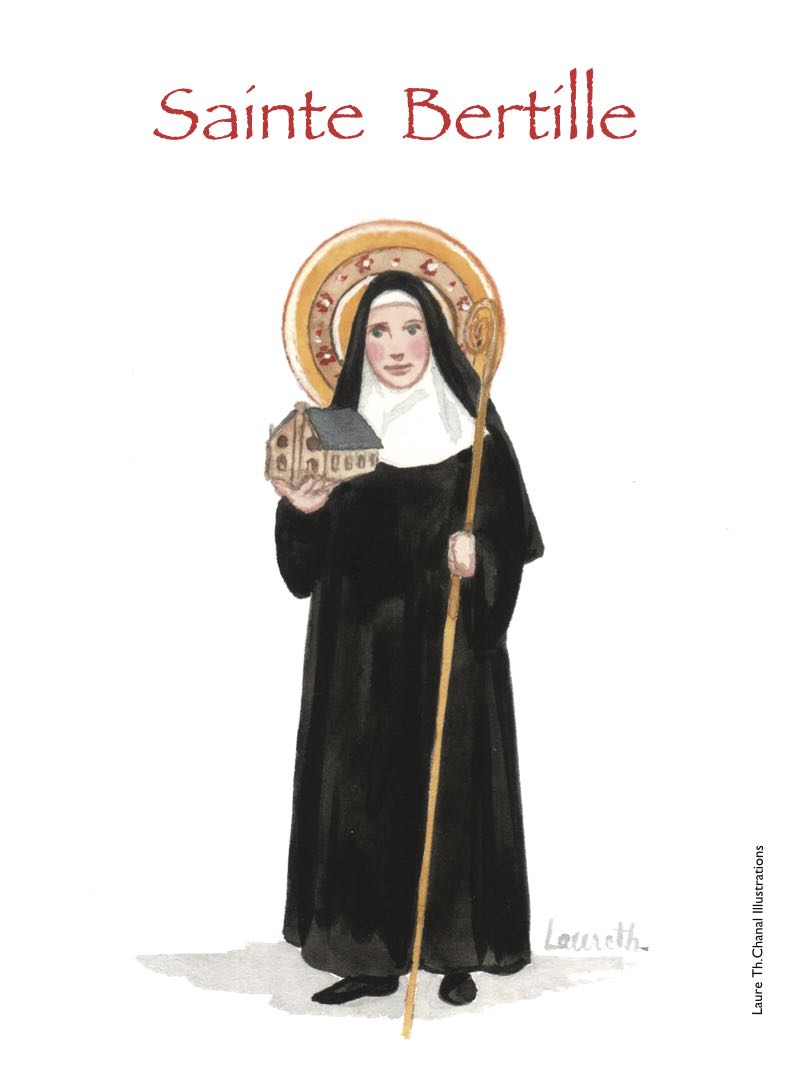
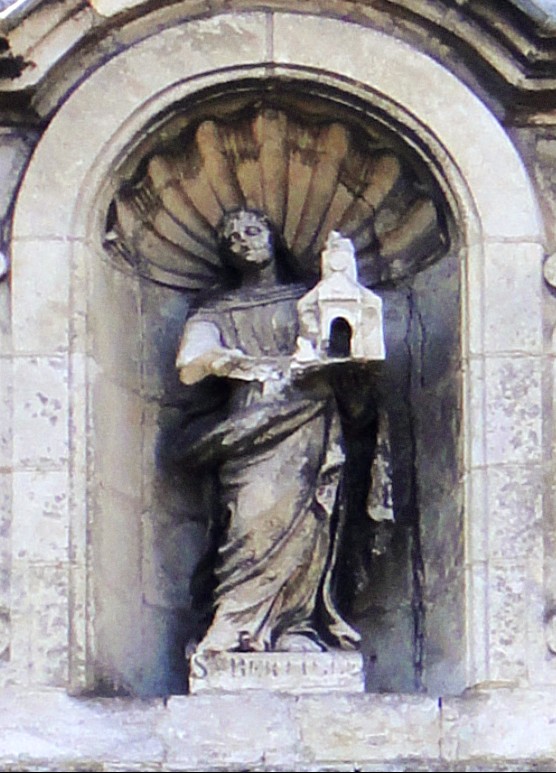
Saint of the Day – 5 November – Saint Bertille (c 629-c 703)

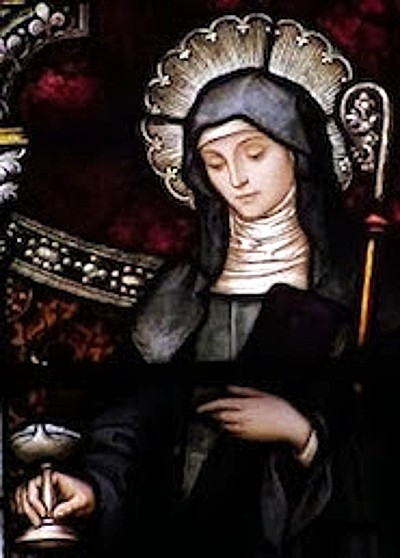
Saint of the Day – 5 November – Saint Bertille (c 629-c 703) Virgin, Abbess, spiritual student of St Ouen (also known as St Audoin). Born at Soissons, France and died in c 703 of natural causes. Also known as – Bertilla.

St Bertille was born of one of the most illustrious families in the territory of Soissons, in the reign of Dagobert I and by her piety, acquired the true nobility of the children of God. From her infancy she preferred the love of God to that of creatures, shunned as much as possible, the company and amusements of the world and employed her time in serious duties and chiefly in holy prayer.

As she grew up, by relishing daily more and more. the sweetness of conversing with God, she learned perfectly, to despise the world and earnestly desired to renounce it. Not daring to discover this inclination to her parents, she first opened herself to St Ouen, by whom she was encouraged in her resolution. Self-love early disguises itself in every shape and the devil often transforms himself into an angel of light. Not to be deceived through precipitation and rashness in so important a choice as that of a state of life, impartial advice, prayer, careful self-examination and mature deliberation are necessary. These means having been employed, the saint’s parents were made acquainted with her desire, which God inclined them not to oppose. They conducted her to Jouarre, great Monastery in Brie, four leagues from Meaux, founded not long before, about the year 630, by Ado, the elder brother of St. Ouen, who took the monastic habit there with many other young noblemen and established a nunnery in the neighbourhood, which became the principal house.

St Thelchildes, a Virgin of noble descent, who seems to have been educated or first professed in the Monastery of Faremoutier, was the first Abbess of Jouarre and governed that house until about the year 660. By her and her religious community, St Bertille was received with great joy and trained in the strictest practice of monastic perfection. Our saint, looking upon this solitude as a secure harbour, never ceased to return thanks to God for His infinite mercy in having drawn her out of the tempestuous ocean of the world but was persuaded she could never deserve to become the spouse of Jesus Christ ,unless she endeavoured to follow Him in the path of humiliation and self-denial. By her perfect submission to all her sisters she seemed everyone’s servant and in her whole conduct, was a model of humility, obedience, regularity and devotion. Though she was yet young, her prudence and virtue appeared consummate and the care of entertaining strangers, of the sick and of the children that were educated in the Monastery was successfully committed to her. In all these employments she had acquitted herself with great charity and edification when she was chosen Prioress to assist the Abbess in her administration. In this office, her tender devotion, her habitual sense of the divine presence and her other virtues, shone forth with new lustre and had a wonderful influence on the direction of the whole community.

When St Bathildes, wife of Clovis II, munificently refounded the Abbey of Chelles, which St Clotildis had instituted near the Marne, four leagues from Paris, she desired St Thelchildes to furnish this new community with a small colony of the most experienced and virtuous Nuns of Jouarre, who might direct the novices in the rule of monastic perfection. Bertille was sent at the head of this holy company and was appointed the first Abbess of Chelles, in 646, or thereabouts. The reputation of the sanctity and prudence of our saint and the excellent discipline which she established in this house, drew several foreign princesses to desire admittance. Among others Bede mentions Hereswith, Queen of the East-Angles. She was daughter of Hereic, brother or brother-in-law to St Edwin, King of Northumberland and married the religious King Annas, with whose consent she renounced the world and, passing into France, in 646, became a Nun at Chelles. Queen Bathildes, after the death of her husband in 655, was left Regent of the Kingdom during the minority of her son Clotaire III but as soon as he was of age to govern, in 665, she retired to Chelies, took the religious habit from the hands of St Bertille, obeyed her as if she had been the last sister in the house and passed to the glory of the Angels in 680. In this numerous family of holy Queens, Princesses and Virgins, no contests arose but those of humility and charity. The holy Abbess, who saw two great Queens everyday at her feet, seemed the most humble and the most fervent among her sisters and showed, by her conduct, that no-one commands well or with safety, who has not first learned and is not always ready,, to obey well.

St Bertille governed this great Monastery for the space of forty six years with equal vigour and discretion. In her old age, far from abating her fervour, she strove daily to redouble it both in her penances and in her devotions. In these holy dispositions of fervour the saint closed her penitential life in around 703. (Rev Alban Butler).

Posted in JESUIT SJ, MARIAN TITLES, SAINT of the DAY

Feast of the Holy Relics, Nossa Senhora da Medalha Milagrosa / Our Lady of the Miraculous Medal, Monte Sião, Brazil (1939) and Memorials of the Saints

Feast of the Holy Relics:
About: https://anastpaul.wordpress.com/2017/11/05/feast-of-the-holy-relics-5-november/

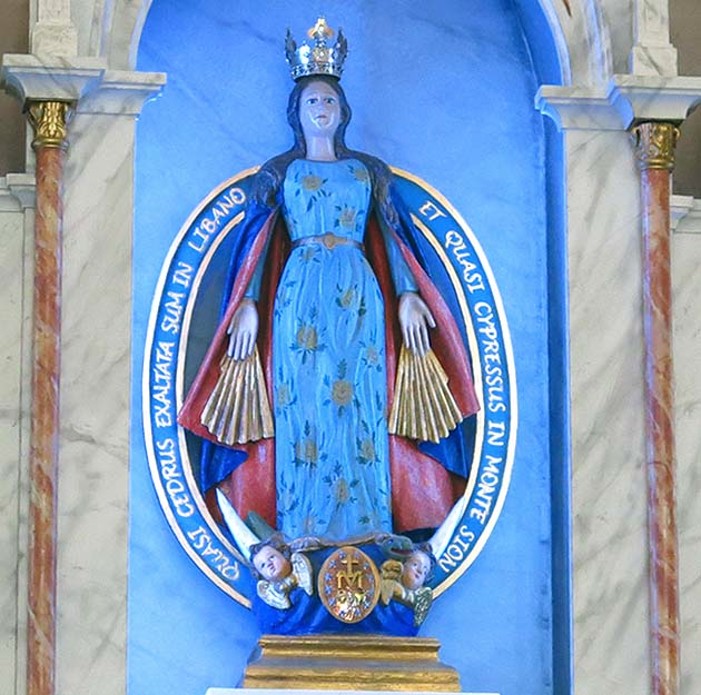
Nossa Senhora da Medalha Milagrosa / Our Lady of the Miraculous Medal, Monte Sião, Brazil (1939)5 November now moved to 27 November:

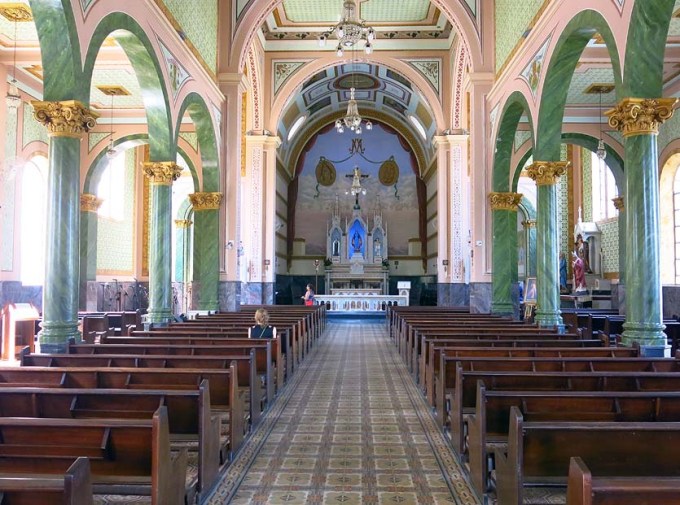
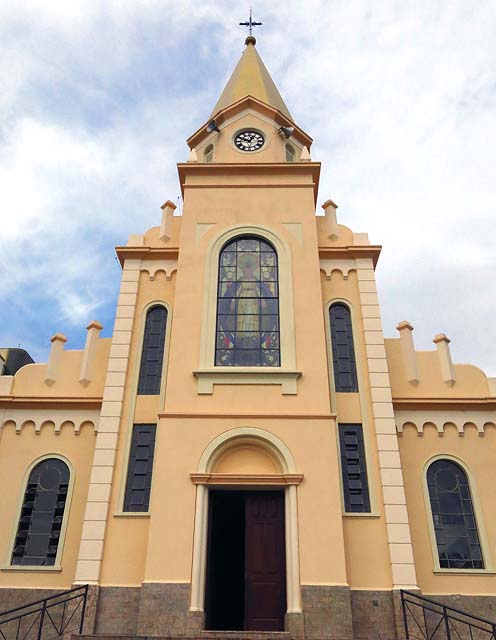
The first Church in Monte Sião appeared in 1849, dedicated to Our Lady of the Miraculous Medal, built by the founder of the place, Antonio Bernardes de Souza. The official Consecration of the Church took place on 13 April 1850. In the Parish of Father Luigi Cocoresi, from 1883 to 1890, more precisely in 1881, the Chapel was replaced by the Parish Church, built on top of in in the same square. The new Church was also built of clay based on strips of sawn wood.
In the parish administration of Fr. José Eugênio de Faria – Fr Zequinha – in 1934, the construction of the current Mother Church began, which is located in the same place as the previous otwo
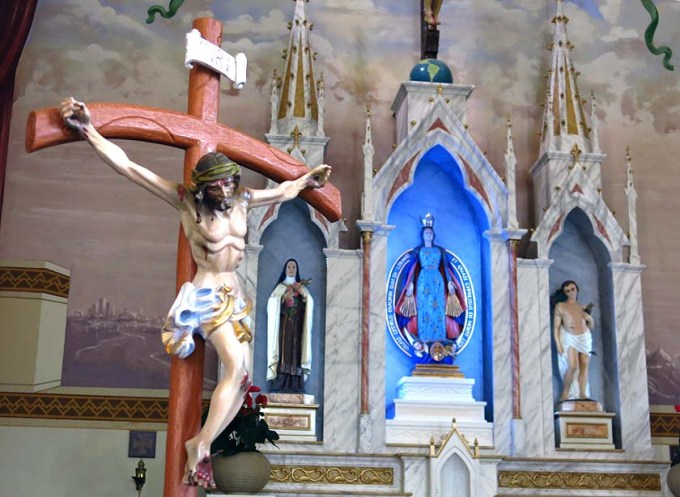
The Church’s architecture resembles the style of Roman art from the 12th century and the main Altar is entirely carved in wood, where the centenary image of the Patron Saint, the Blessed Mother, can be seen. The image of Our Lady of the Miraculous Medal, which adorns the main Altar, was brought to Monte Sião around 1860 and came from Portugal, through a Portuguese farmer, Mr João Pereira Batista Machado, who would have funded both its acquisition and the transportation. The image arrived at the Port of Rio de Janeiro and was brought to the City on the back of animals, inside a cargo jack and wrapped in dry corn husk.

In 1937, at the request of the Bishop, the image was removed from the Altar and sent to a Chapel in the countryside, claiming that the Statue looked too modern.
The faithful greatly missed the Statue in the Igreja Matriz. It was then, that between 1937 and 1939, the City of Monte Sião was inflicted by a period of great drought. There was rain in every other City but not there. The people then associated the lack of rain with the absence of the Statue of their Patron and went to intercede with the Parish Priest, to bring the Statue back. On 5 November 1939, the Statue was allowed to return. The day was sunny and a procession was held to honour the Patroness.
When the Statue reached the City, the first drops began to fall and then a heavy rain, soaking everyone. This was called the rain miracle and after that, everything went smoothly. The Statue underwent a restoration in the year 2015, which returned all the original features to the image, which had been lost with previous restorations.
Although the Feast was 5 November it was moved to co-incide with the official Feast of the Miraculous Medal, 27 November, which is a local public holiday, when it is celebrated after a Novena between 18 and 26 November, with a Mass in honour of the Patron , the Blessed Maria of the Miraculous Medal.

All Saints and Blesseds of the Society of Jesus:

The Society of Jesus, commonly known as the Jesuits, was Founded in 1534 by Saint Ignatius Loyola (1491-1556) at Montmartre, Paris, France. A body of clerics regular organised for Apostolic work, following a religious rule and relying on alms for their support. It was the chief instrument of the Catholic Reformation. Pope Paul III approved the new rule in 1540 and Ignatius was elected the first general of the order in 1541. The constitutions, drafted by him and based on his Spiritual Exercises were adopted in 1558. It was the first order which enjoined by its constitutions devotion to the cause of education. The ministry of the Society consists chiefly in preaching. teaching catechism. administering the sacraments. conducting missions in parishes, taking care of parishes. organising pious confraternities, teaching in schools of every grade, writing books, pamphlets, periodical articles, going on foreign missions and special missions when ordered by the current Holy Father, to whom they take a vow of total obedience. Our current Holy Father, Pope Francis is a Jesuit and has jokingly wondered aloud who is boss of whom in his Order. The general resides at Rome, Italy and has a council of assistants. The motto of the Society is Ad Majorem Dei Gloriam (For the greater glory of God).
All Jesuit Saints and Blesseds:
https://anastpaul.com/2018/11/05/feast-of-all-the-saints-and-blesseds-of-the-society-of-jesus/

St Augustine of Terracina
Bl Bernhard Lichtenberg
St Bertille (c 629-c 703) Abbess
St Canonica
St Comasia
St Ðaminh Mau
St Dominator of Brescia
St Elizabeth
St Domninus the Physician
St Epistemis
St Eusebius of Terracina
St Felix of Terracina
St Fibitius
St Galation
St Gerald of Beziers
Bl Gomidas Keumurjian
Bl Gregory Lakota
St Guetnoco
St Guido Maria Conforti
St St Hermenegild
St Idda
St Juan Antoni Burró Mas
St Juan Duarte Martín
St Kanten
St Kea
St Laetus of Orleans
St Magnus of Milan
St Mamete
St Marco of Troia
Bl María del Carmen Viel Ferrando
Bl Simon Ballachi
St Spinulus of Moyen-Moûtier
St Sylvanus of Syria
St Zachary

Martyrs of Caesarea Maritima – 4 saints: Four young Christian men who were martyred together in the persecutions of Maximian – Aussenzius, Philotheus, Timothy and Theotimus. They were martyred in the arena at Caesarea Maritima, Palestine.

Martyred in the Spanish Civil War:
• Blessed Juan Antoni Burró Mas
• Blessed Juan Duarte Martín
• Blessed María del Carmen Viel Ferrando