Quote/s of the Day – 22 November – St Cecilia (Died 3rd Century) Virgin Martyr – Ecclesiasticus 51:13-17, Matthew 25:1-13 – Scripture search here: https://www.drbo.org/
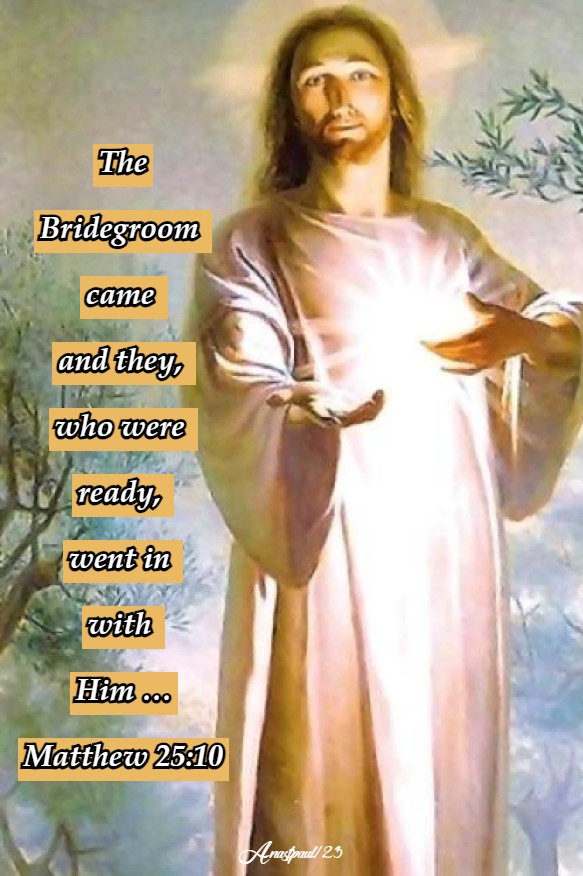
“ … The Bridegroom came and they, who were ready, went in with Him … ”
Matthew 25:10
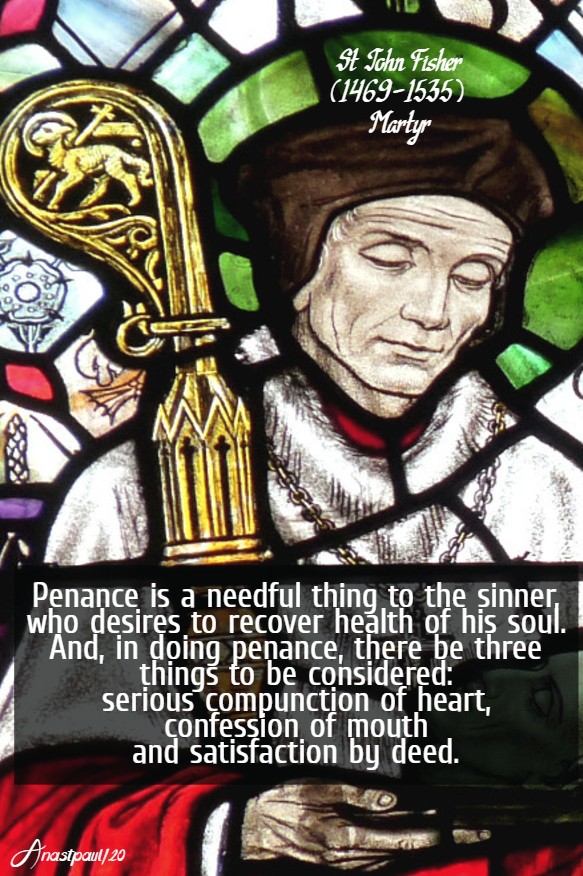
“Penance is a needful thing to the sinner, who desires to recover health of his soul. And, in doing penance, there be three things to be considered: serious compunction of heart, confession of mouth and satisfaction by deed.”
St John Fisher (1469-1535) Martyr
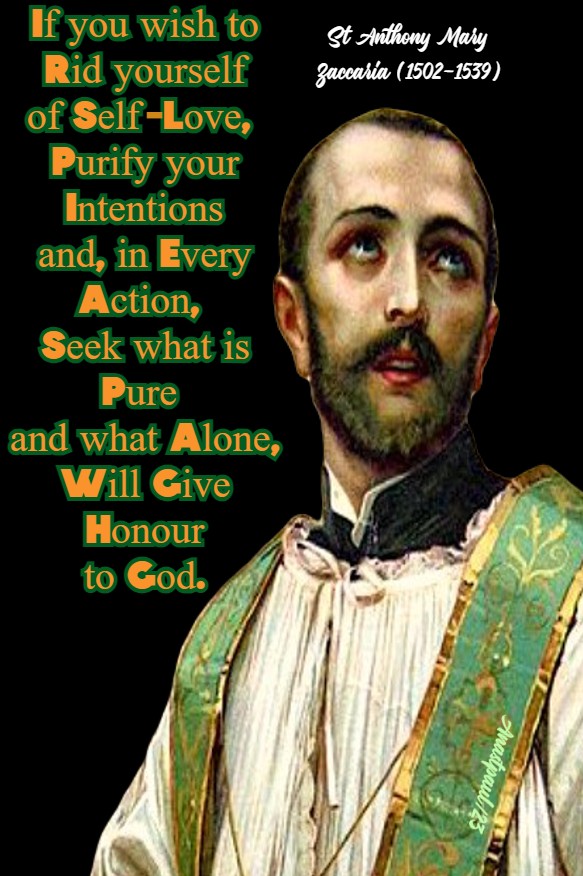
“If you wish to rid yourself of self-love, purify your intentions and, in every action, seek what is pure and what alone, will give honour to God.”
St Anthony Mary Zaccaria (1502-1539)
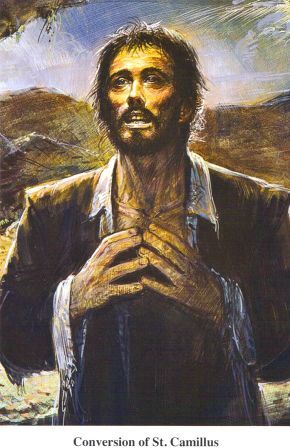
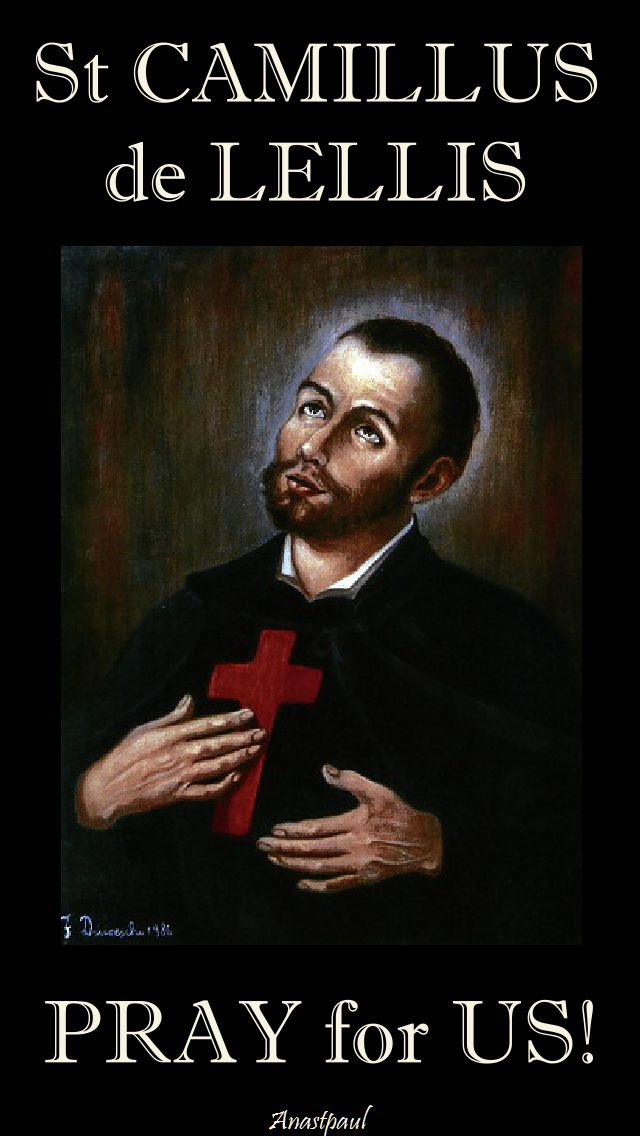
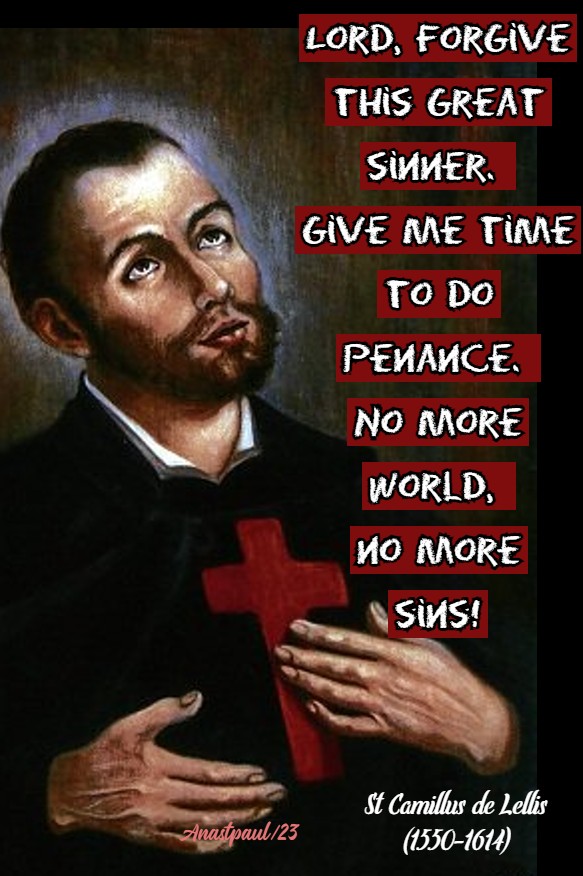
“Lord, forgive this great sinner. Give me time to do penance. No more world, no more sins!”
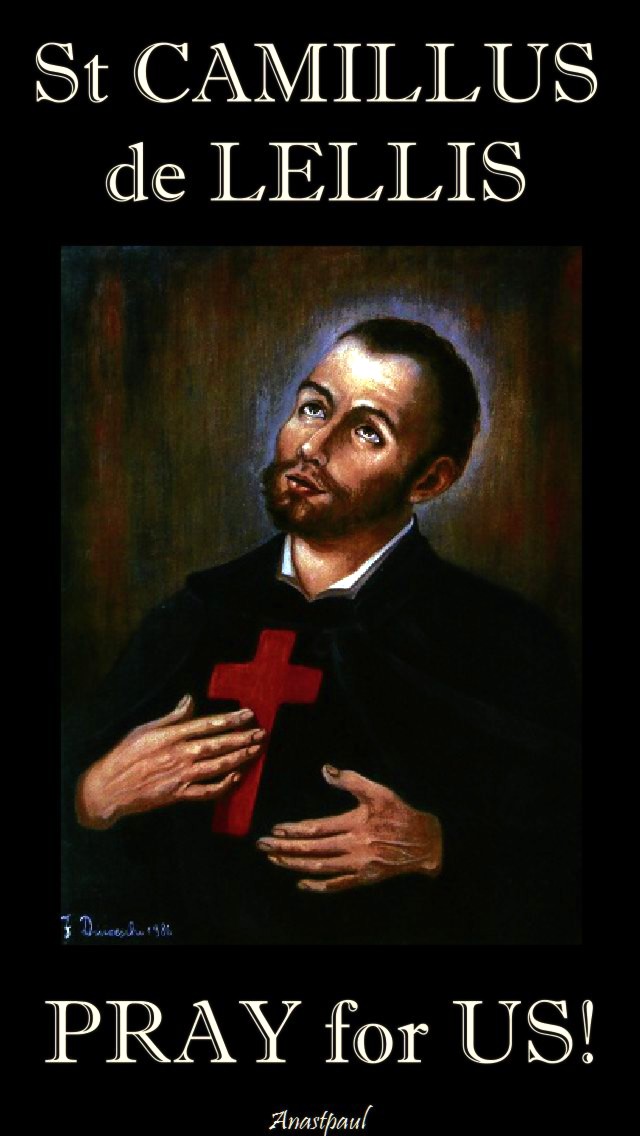
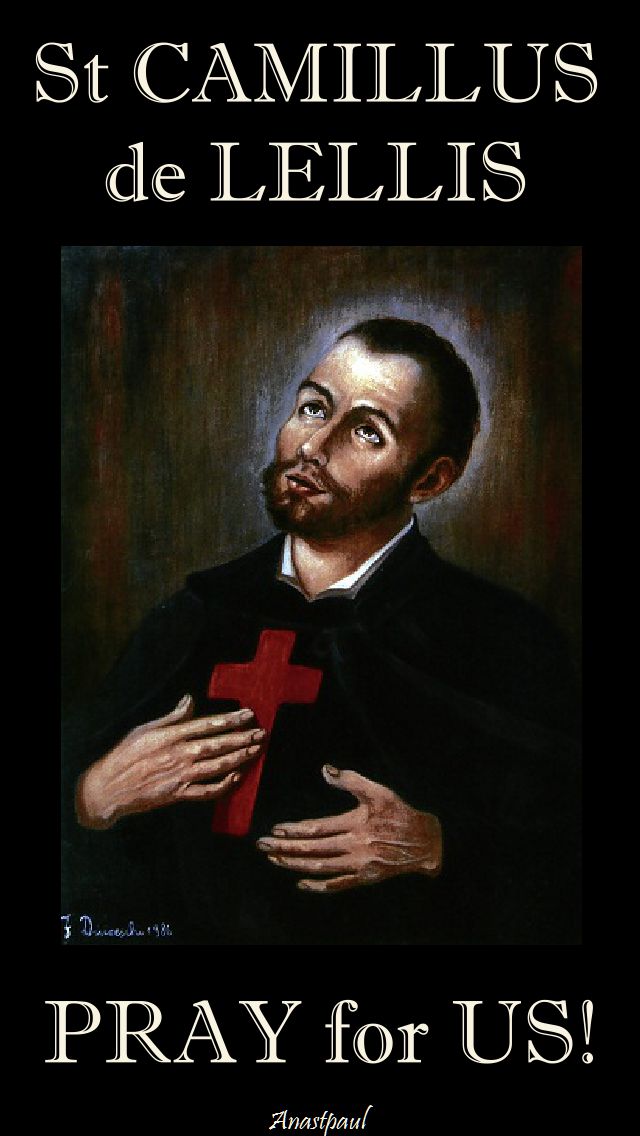
St Camillus de Lellis MI (1550-1614)
“Our Lord, Who saved the world, through the Cross, will only Work for the good of souls, through the Cross.”
St Madeleine Sophie Barat (1779-1865)
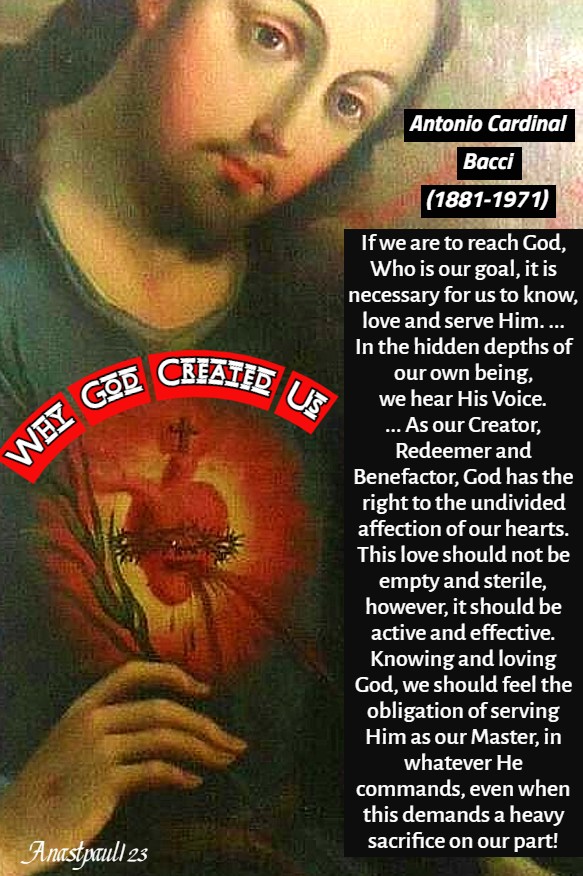
“If we are to reach God, Who is our goal, it is necessary for us to know, love and serve Him. In the hidden depths of our own being, we hear His Voice. As our Creator, Redeemer and Benefactor, God has the right to the undivided affection of our hearts. This love should not be empty and sterile, however, it should be active and effective. Knowing and loving God, we should feel the obligation of serving Him as our Master, in whatever He commands, even when this demands a heavy sacrifice on our part!”
Quote/s of the Day – 4 September – Feria – Galatians 5:16-24, Matthew 6:24-33 – Scripture search here: https://www.drbo.org/
“No man can serve two masters.”
Matthew 6:24
“Penance is a needful thing to the sinner, who desires to recover health of his soul. And, in doing penance, there be three things to be considered: serious compunction of heart, confession of mouth and satisfaction by deed.”
St John Fisher (1469-1535)
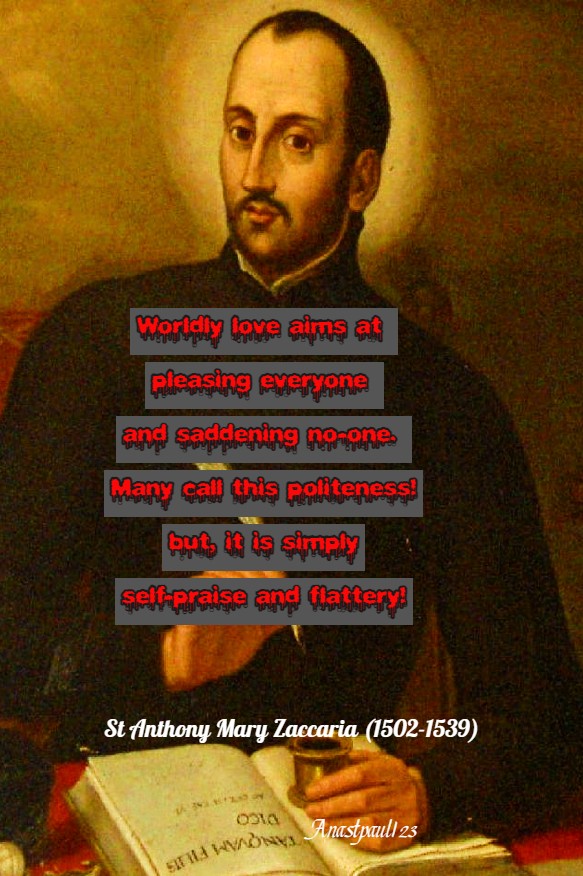
“Worldly love aims at pleasing everyone and saddening no-one. Many call this politeness! but, it is simply self-praise and flattery!”
“If you wish to rid yourself of self-love, purify your intentions and, in every action, seek what is pure and what alone, will give honour to God.”
St Anthony Mary Zaccaria (1502-1539)
“Lord, forgive this great sinner. Give me time to do penance. No more world, no more sins!”
St Camillus de Lellis MI (1550-1614)
“To advance well, we must apply ourselves to make good way on the road nearest to us and do, the first day’s journey.”
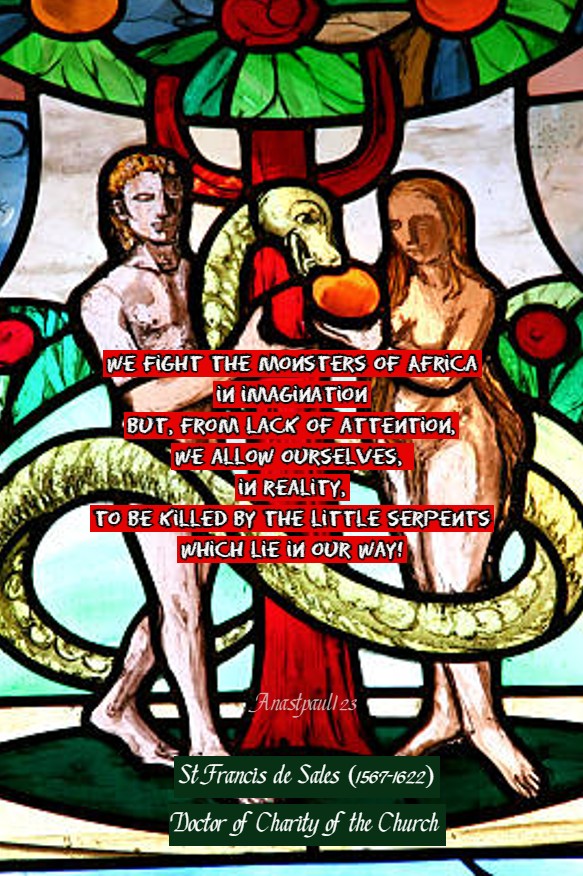
“We fight the monsters of Africa in imagination but, from lack of attention, we allow ourselves, in reality, to be killed by the little serpents which lie in our way!”
(Intro to the Devout Life III:37)
St Francis de Sales (1567-1622) Doctor of Charity of the Church
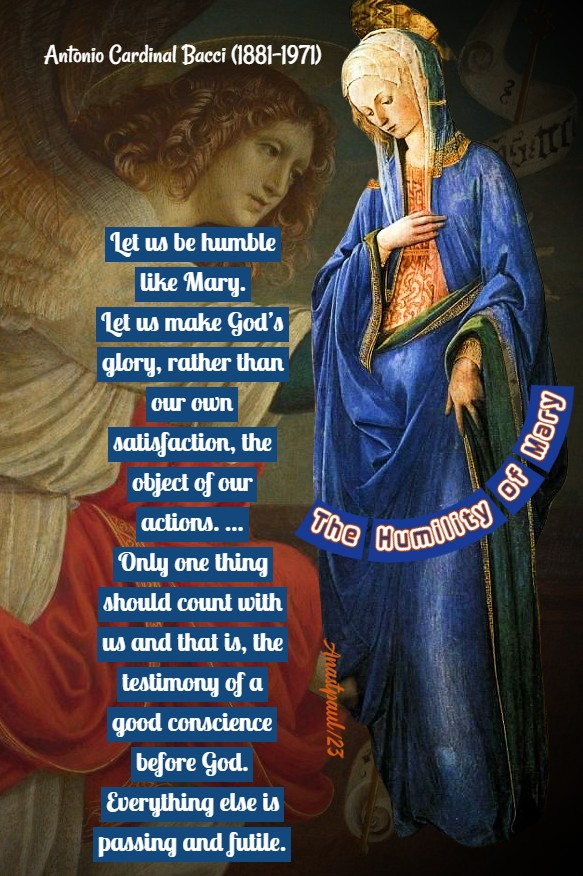
“Let us be humble like Mary. Let us make God’s glory, rather than our own satisfaction, the object of our actions. Only one thing should count with us and that is, the testimony of a good conscience before God. Everything else is passing and futile.”
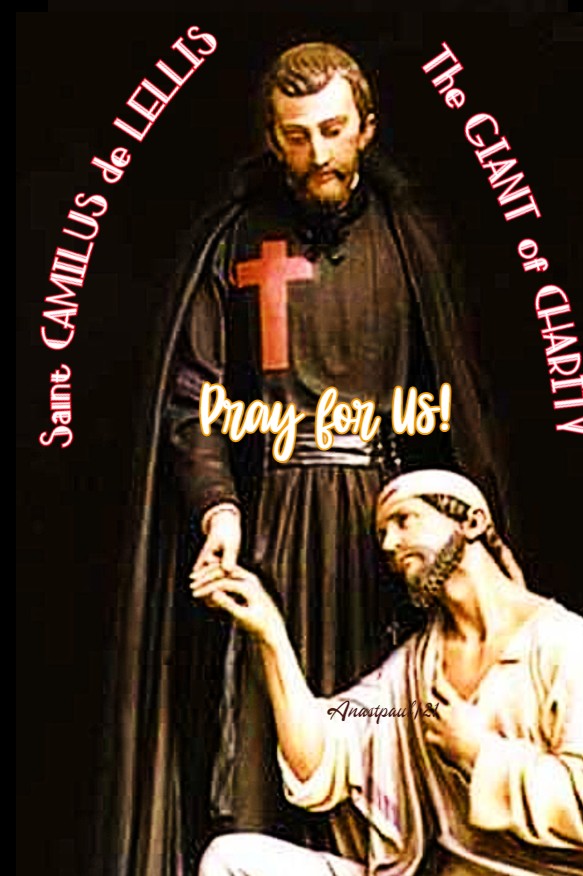
Quote/s of the Day – 18 July – “The Month of the Most Precious Blood of Jesus” – St Camillus de Lellis MI (1550-1614) “The Giant of Charity,” Confessor, Priest and Founder the Order of the Ministers of the Sick, or simply as the “Camillians”
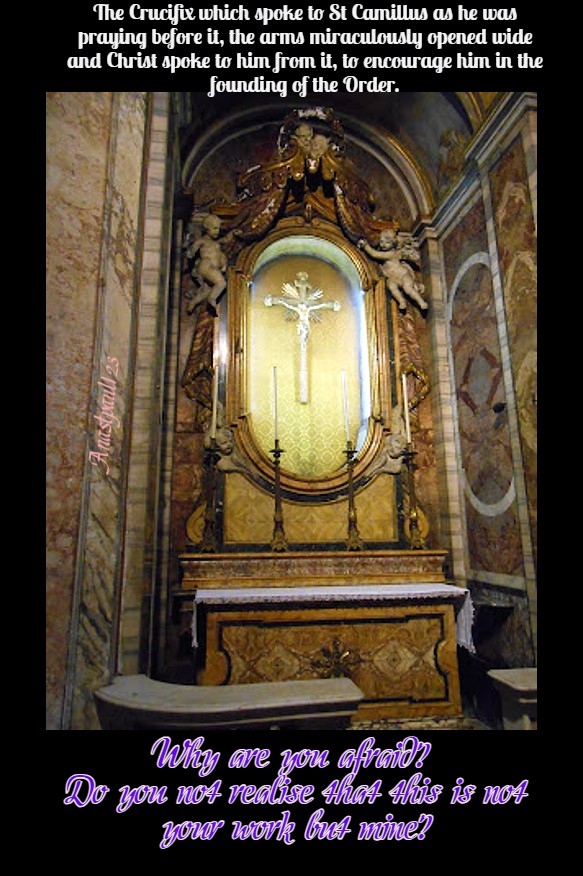
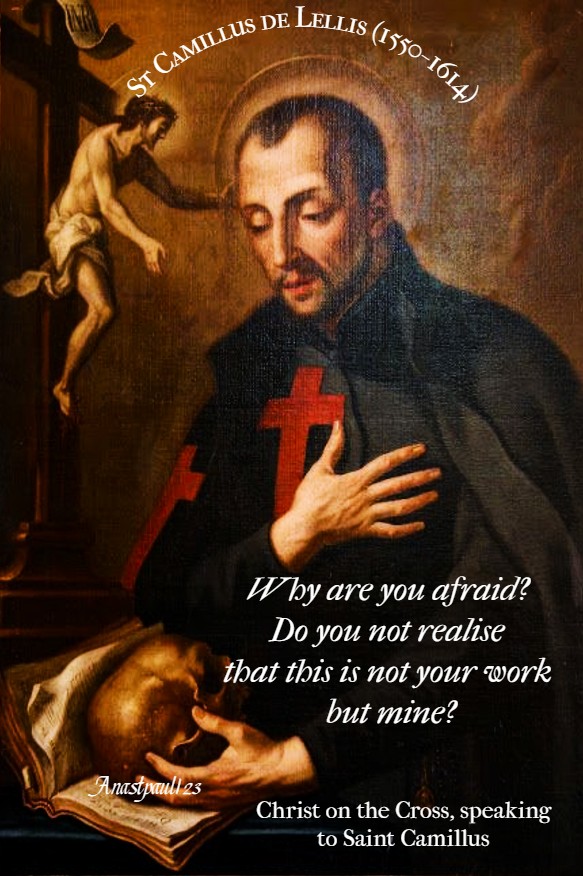
“Why are you afraid? Do you not realise that this is not your work but mine?”
Christ on the Cross speaking to Saint Camillus
“Lord, forgive this great sinner. Give me time to do penance. No more world, no more sins!”
One Minute Reflection – 18 July – “The Month of the Most Precious Blood of Jesus” – St Camillus de Lellis MI (1550-1614) Confessor, Priest and Founder, “The Giant of Charity.” – 1 John 3:13-18, John 15:12-16 – Scripture search here: https://www.drbo.org/
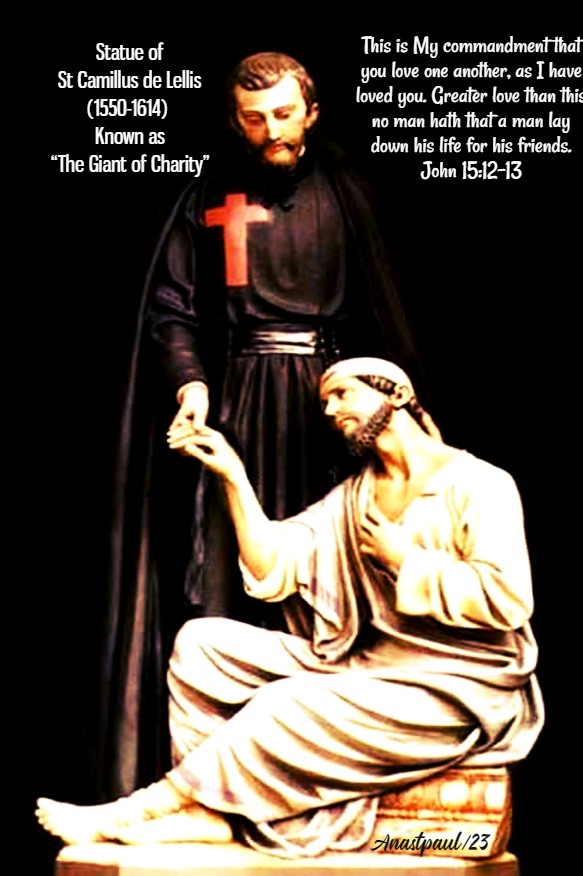
“This is My commandment that you love one another, as I have loved you. Greater love than this no man hath that a man lay down his life for his friends.” – John 15:12-13
REFLECTION – “We cannot truly love God without loving our neighbour, nor can we truly love our neighbour without loving God. This is why… the Holy Spirit was given a second time to the disciples. First it was given by the Lord while He was still dwelling on earth and later while he was watching over us in Heaven (Jn 20:22; Acts 2). He was given to us on earth that we may love our neighbours, from Heaven that we may love God. Why first on earth and later from Heaven – except for the reason given us openly by John: “How can anyone, who does not love his brother, whom he sees love God Whom he does not see?”
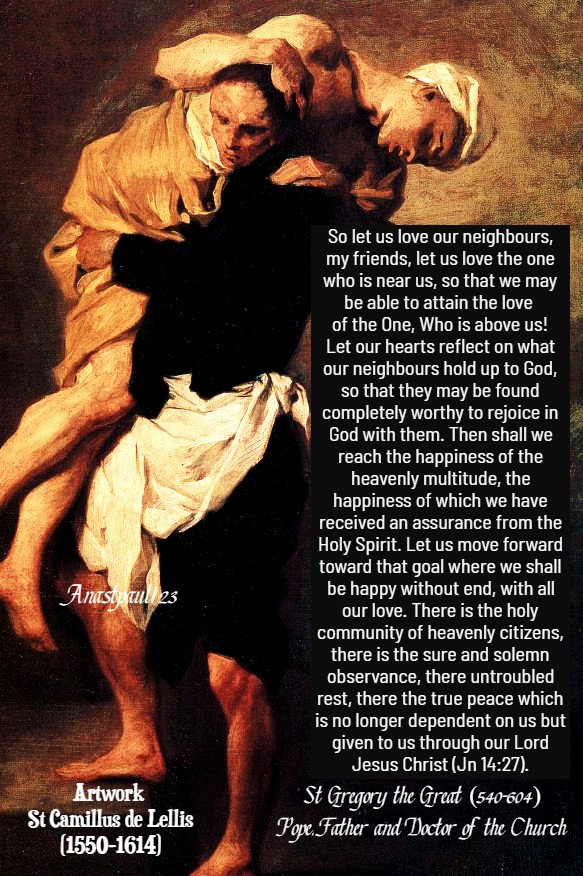
So let us love our neighbours, my friends, let us love the one who is near us, so that we may be able to attain the love of the One, Who is above us! Let our hearts reflect on what our neighbours hold up to God, so that they may be found completely worthy to rejoice in God with them. Then shall we reach the happiness of the heavenly multitude, the happiness of which we have received an assurance from the Holy Spirit. Let us move forward toward that goal where we shall be happy without end, with all our love. There is the holy community of heavenly citizens, there is the sure and solemn observance, there untroubled rest, there the true peace which is no longer dependent on us but given to us through our Lord Jesus Christ (Jn 14:27).” – St Gregory the Great (540-604) Pope, Father and Doctor of the Church (Excerpt Sermons on the Gospel No 30).
PRAYER – O God, Who endowed St Camillus with a special gift of charity for the help of souls struggling in their final agony, pour upon us, we beseech Thee, by his merits, the spirit of Thy love, so that at the hour of our death, we may be found worthy to overcome the enemy and attain the heavenly crown. Through Jesus Christ, Thy Son our Lord, Who lives and reigns with Thee, in the unity of the Holy Ghost, God, world without end. Amen (Collect).
St Symphorosa and her seven sons / Also known as – The Martyrs of Tivoli – 8 Saints: A widow, St Symphorosa and her seven sons ( Crescens, Eugene, Julian, Justin, Nemesius, Primitivus and Stracteus) Martyred in Tivoli, Italy in the 2nd-century persecutions of Hadrian.
St Aemilian of Dorostorium St Alanus of Sassovivo St Alfons Tracki Blessed Angeline of Marsciano Bl Arnold of Amiens St Arnold of Arnoldsweiler St Arnoul the Martyr
St Goneri of Treguier St Gundenis of Carthage Bl Herveus St Marina of Ourense St Maternus of Milan St Minnborinus St Pambo of the Nitrian Desert St Philastrius of Brescia (c330-c387) Bishop St Rufillus of Forlimpopoli
Martyrs of Silistria – 7 Saints: Seven Christians who were Martyred together. No details about them have survived but the names – Bassus, Donata, Justus, Marinus, Maximus, Paulus and Secunda. They were martyred in Silistria (Durostorum), Moesia (in modern Bulgaria), date unknown.
Quote/s of the Day – 16 March – Thursday of the Third Week in Lent
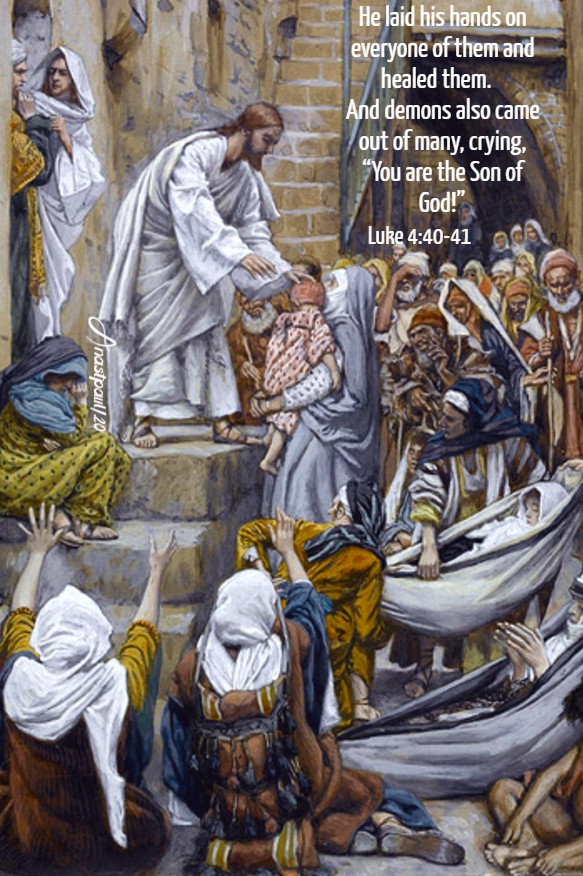
“Now when the sun was setting, all those who had any who were sick with various diseases brought them to him and he laid his hands on everyone of them and healed them. And demons also came out of many, crying, “You are the Son of God!” But he rebuked them and would not allow them to speak because they knew that he was the Christ.”
Luke 4:40-41
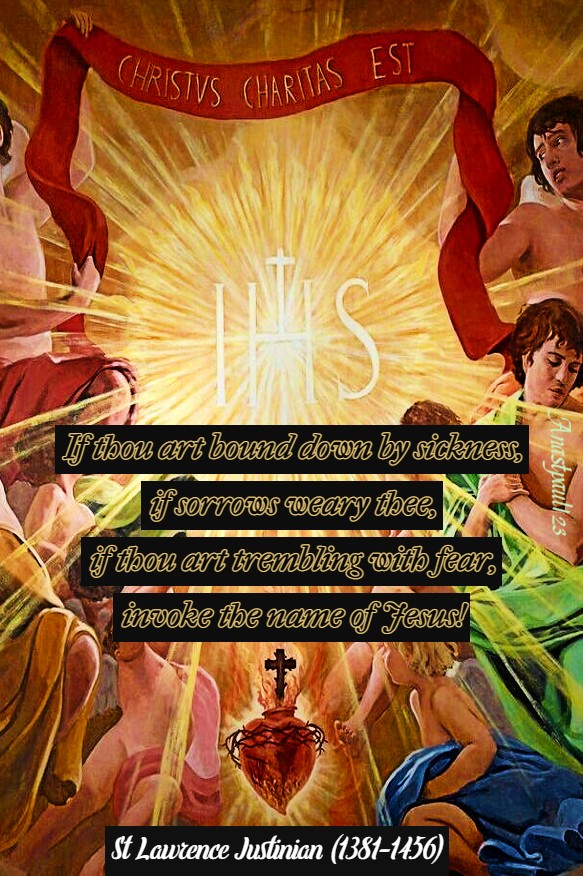
“If thou art bound down by sickness, if sorrows weary thee, if thou art trembling with fear, invoke the name of Jesus!”
St Lawrence Justinian (1381-1456)
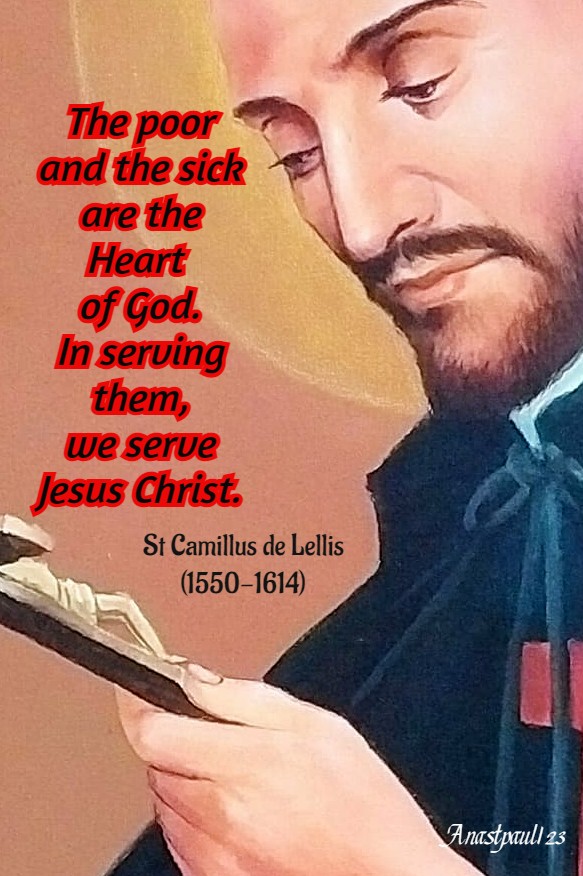
“The poor and the sick are the Heart of God. In serving them, we serve Jesus Christ.”
St Camillus de Lellis MI (1550-1614)
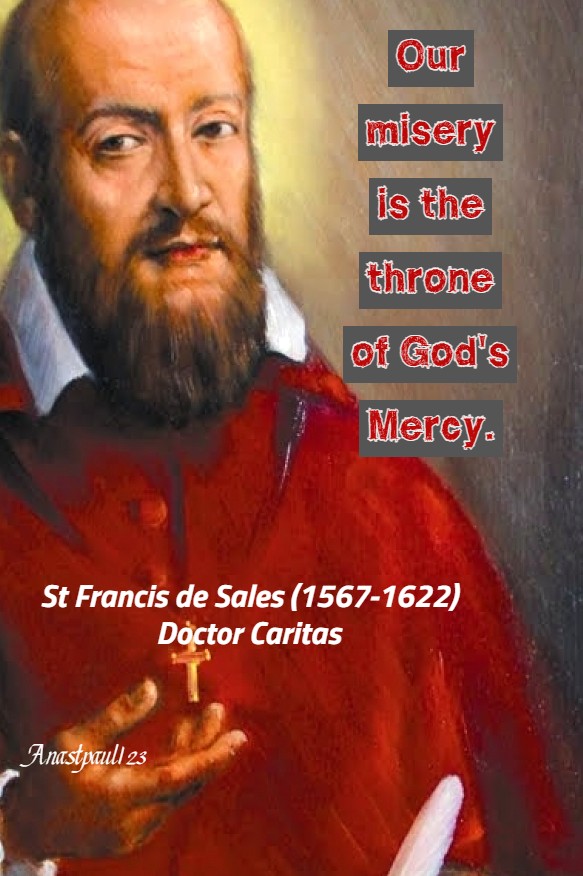
“Our misery is the throne of God’s Mercy.”
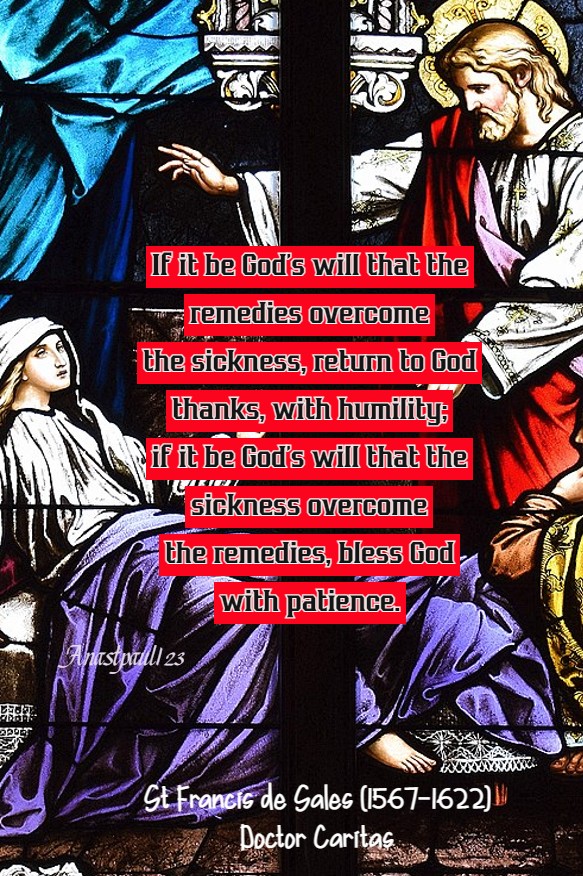
“If it be God’s will that the remedies overcome the sickness, return to God thanks, with humility; if it be God’s will that the sickness overcome the remedies, bless God with patience.”
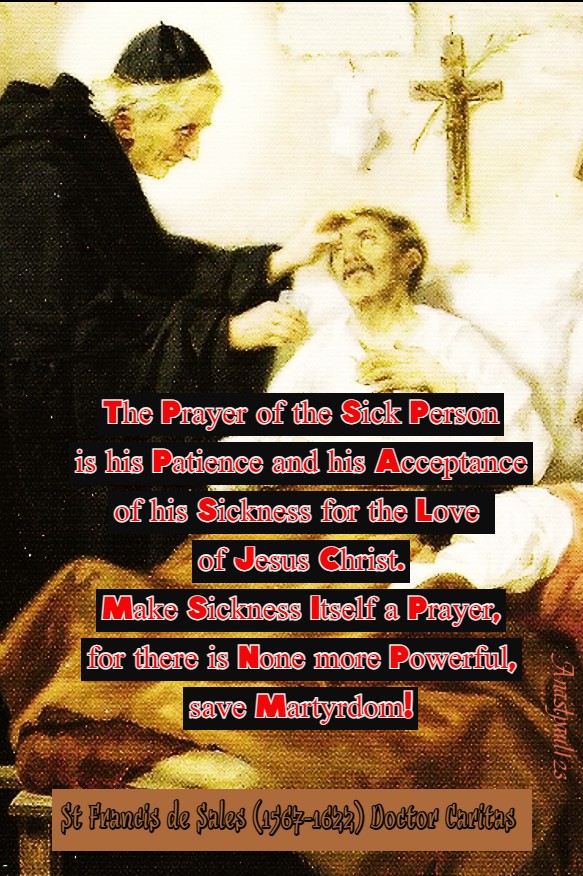
“The prayer of the sick person is his patience and his acceptance of his sickness for the love of Jesus Christ. Make sickness itself a prayer, for there is none more powerful, save Martyrdom!”
Quote/s of the Day – 18 July – “The Month of the Precious Blood” – St Camillus de Lellis MI (1550-1614) Confessor, Priest and Founder the Order of the Ministers of the Sick, or simply as the “Camillians,” known as “The Giant of Charity.”
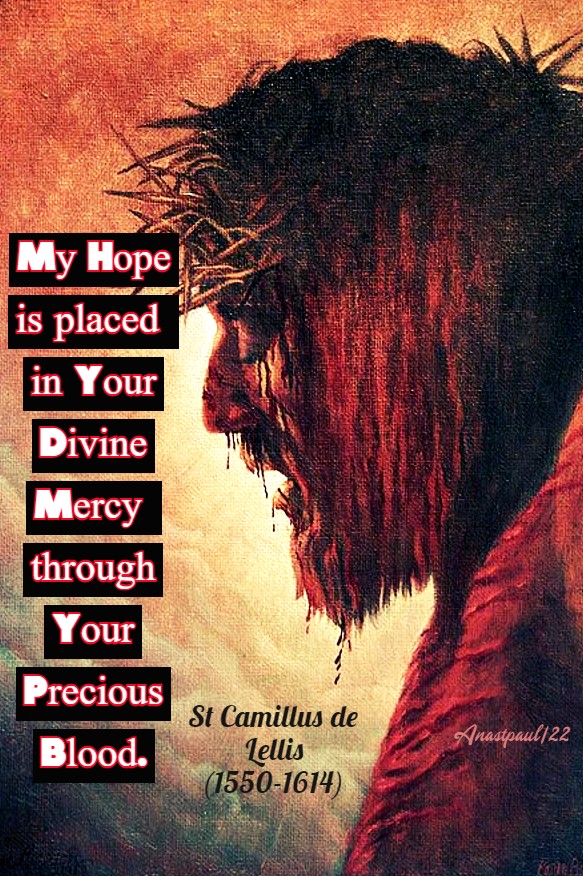
“My hope is placed in Your Divine Mercy through Your Precious Blood.”
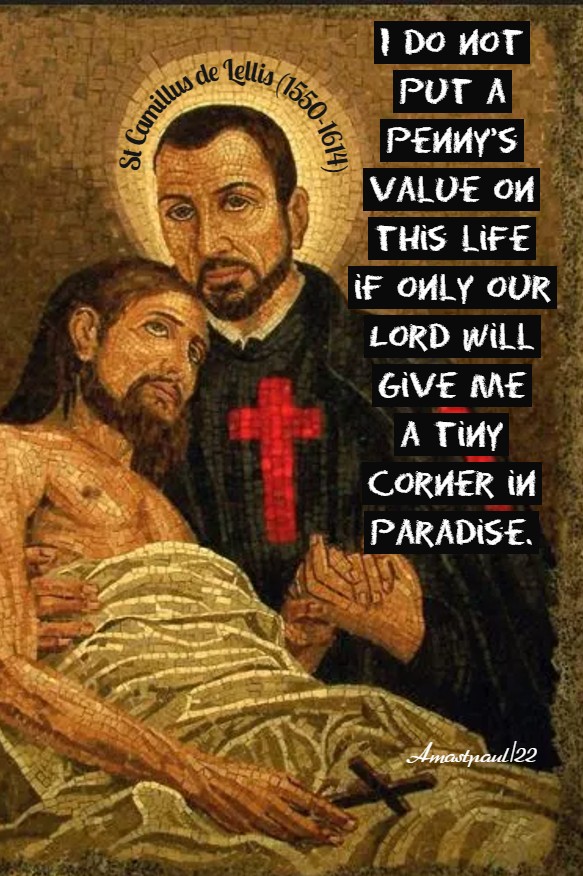
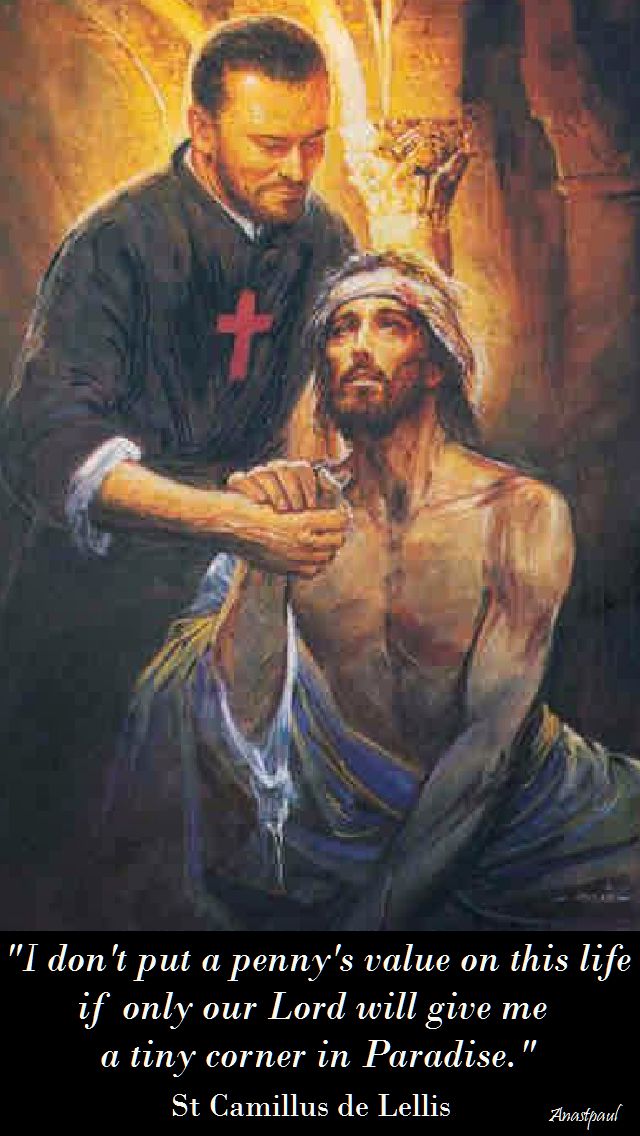
“I do not put a penny’s value on this life if only our Lord will give me a tiny corner in Paradise.”
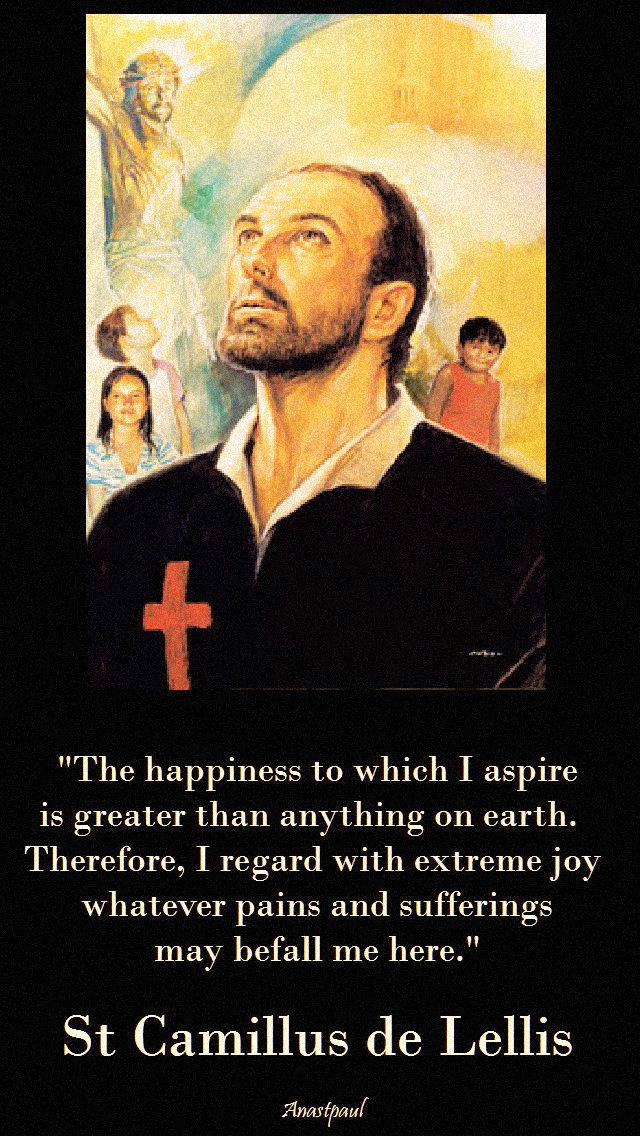
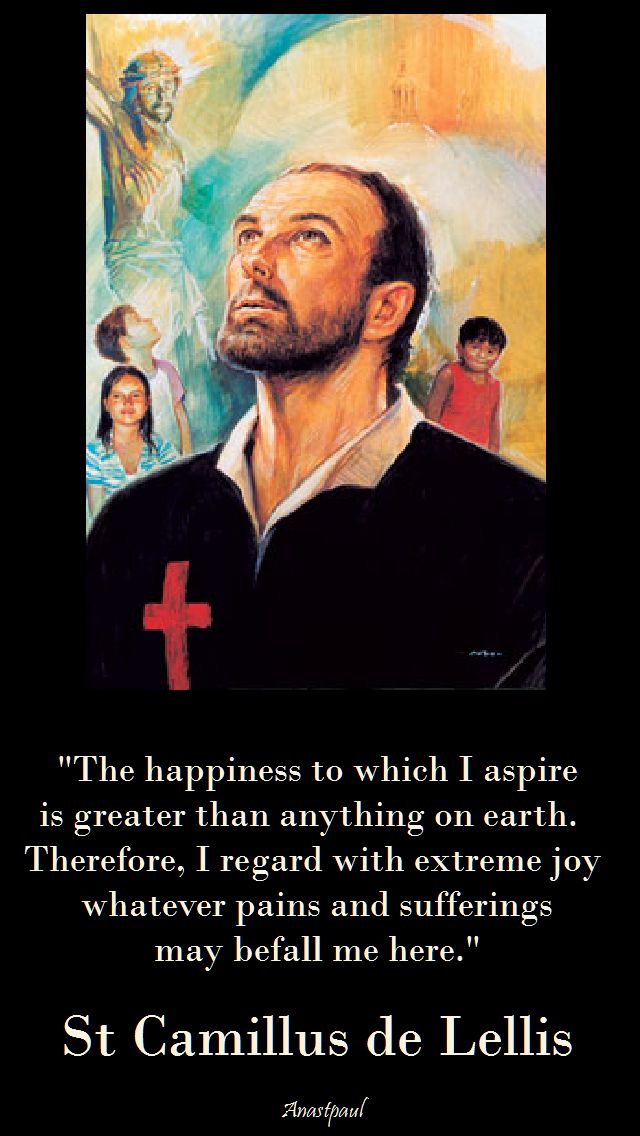
“The happiness to which I aspire is greater than anything on earth. Therefore, I regard with extreme joy, whatever pains and sufferings may befall me here.”
St Symphorosa and her seven sons / Also known as – The Martyrs of Tivoli – 8 Saints: A widow, St Symphorosa and her seven sons ( Crescens, Eugene, Julian, Justin, Nemesius, Primitivus and Stracteus) Martyred in Tivoli, Italy in the 2nd-century persecutions of Hadrian.
St Aemilian of Dorostorium St Alanus of Sassovivo St Alfons Tracki Blessed Angeline of Marsciano Bl Arnold of Amiens St Arnold of Arnoldsweiler St Arnoul the Martyr
St Goneri of Treguier St Gundenis of Carthage Bl Herveus St Marina of Ourense St Maternus of Milan St Minnborinus St Pambo of the Nitrian Desert St Philastrius of Brescia St Rufillus of Forlimpopoli
St Scariberga of Yvelines (c 495-c 550) Chaste wife of St Arnulf of Bishop of Tours, Nun, Recluse.
Martyrs of Silistria – 7 Saints: Seven Christians who were Martyred together. No details about them have survived but the names – Bassus, Donata, Justus, Marinus, Maximus, Paulus and Secunda. They were martyred in Silistria (Durostorum), Moesia (in modern Bulgaria), date unknown.
Quote/s of the Day – 26 September – “Month of the Seven Sorrows of Mary” – Readings: Numbers 11: 25-29; Psalm 19: 8, 10- 14; James 5: 1-6; Mark 9: 38-43, 45, 47-48
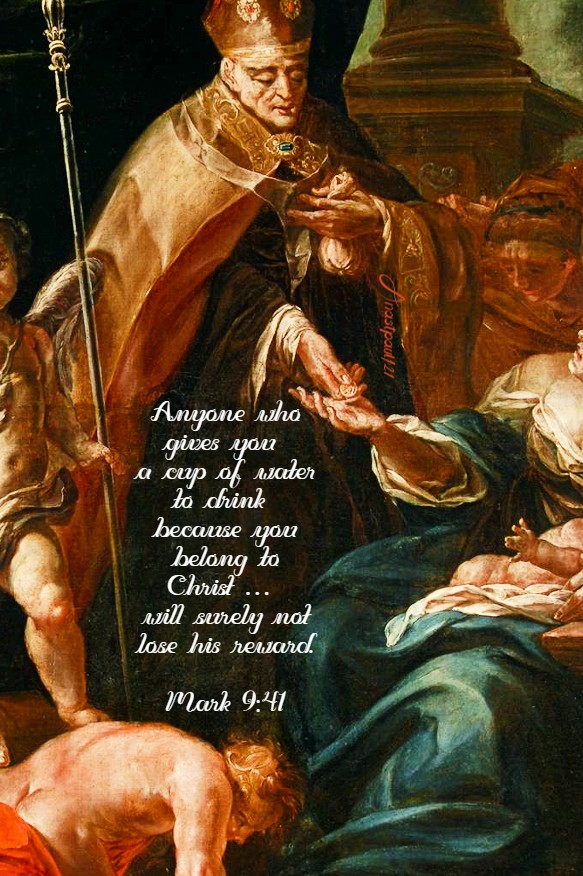
“Anyone who gives you a cup of water to drink because you belong to Christ … will surely not lose his reward … ”
Mark 9:41
“And whoever gives only a cup of cold water to one of these little ones to drink , … he shall not lose his reward.”
Matthew 10:42
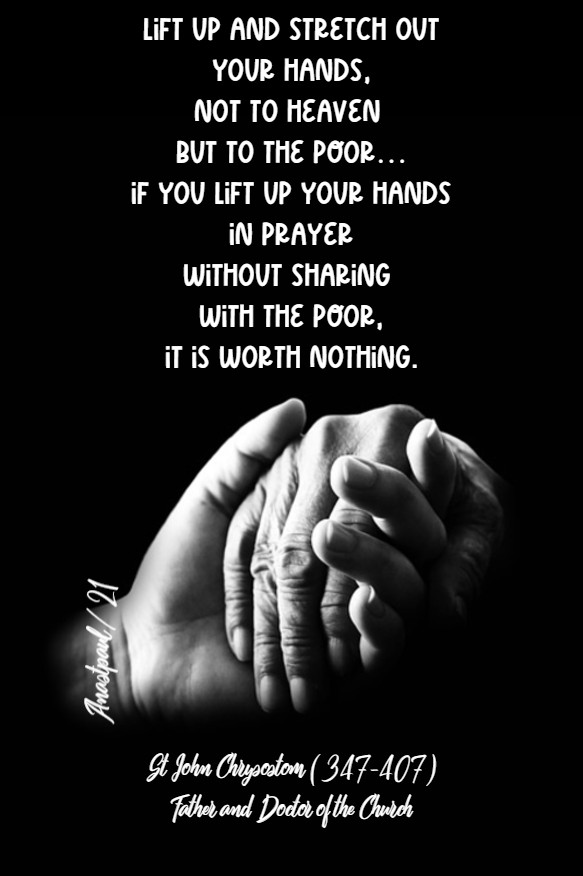
“ Lift up and stretch out your hands, not to heaven but to the poor… if you lift up your hands in prayer without sharing with the poor, it is worth nothing.”
St John Chrysostom (347-407) Father and Doctor of the Church
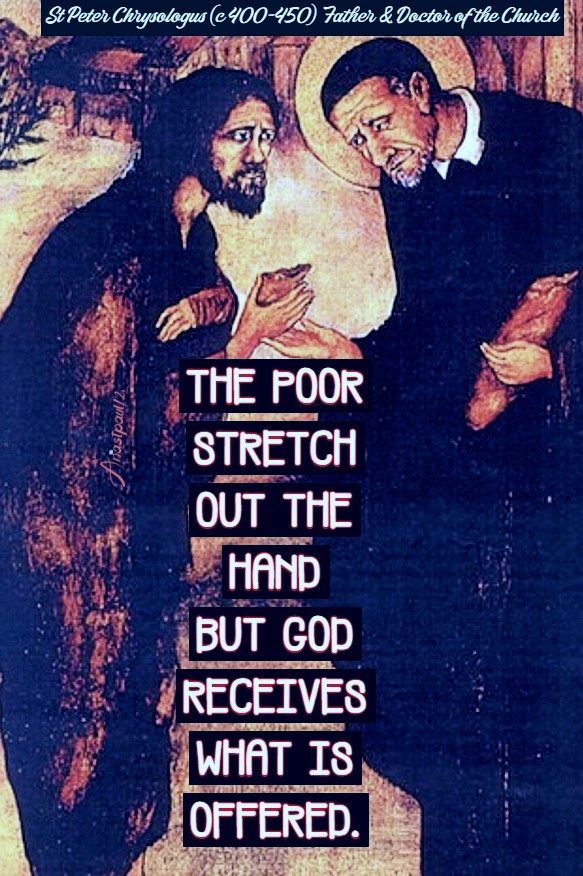
“The poor stretch out the hand but God receives what is offered.”
St Peter Chrysologus (c 400-450) “Golden Words” Father & Doctor of the Church
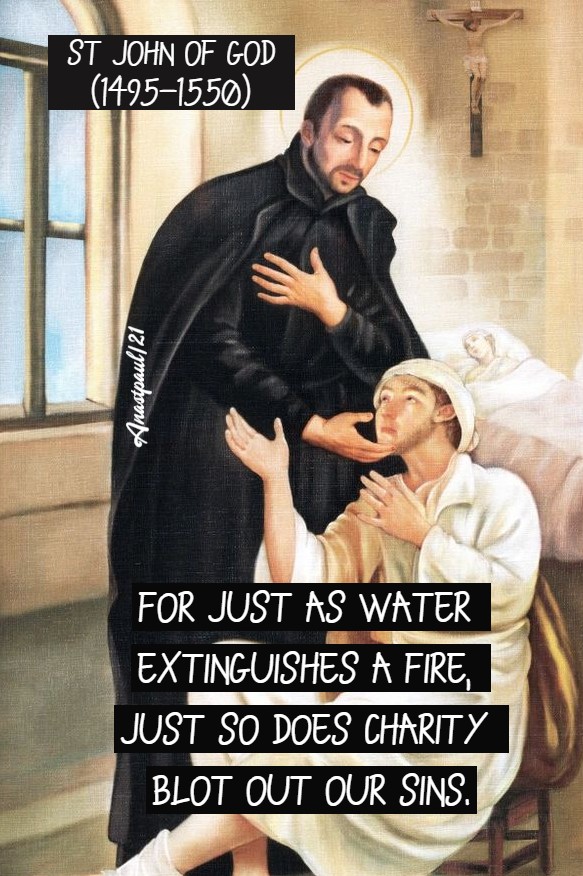
“For just as water extinguishes a fire, just so does charity blot out our sins.”
St John of God (1495-1550)
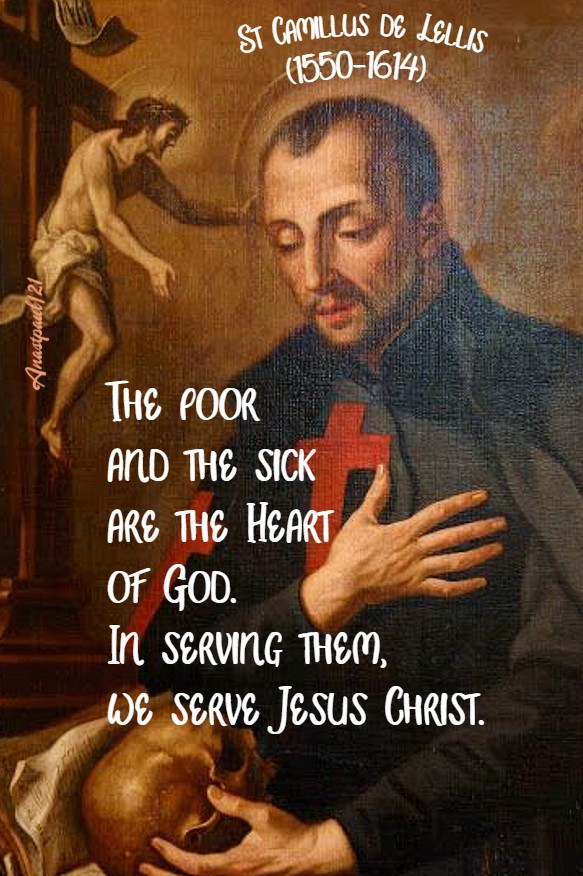
“The poor and the sick are the Heart of God. In serving them, we serve Jesus Christ.”
Quote/s of the Day – 14 July – “Month of the Most Precious Blood” – and the Memorial of Saint Camillus de Lellis MI (1550-1614) “The Giant of Charity”
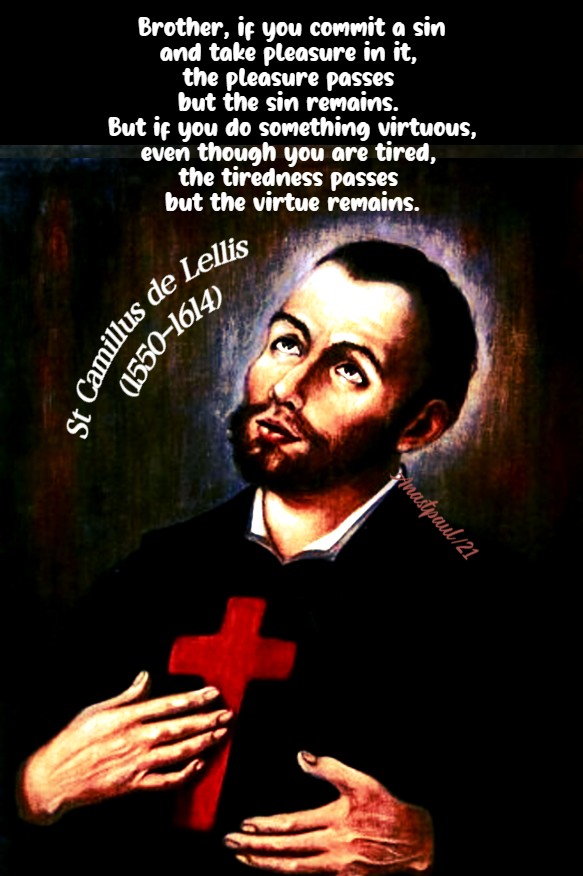
“Brother, if you commit a sin and take pleasure in it, the pleasure passes but the sin remains. But if you do something virtuous, even though you are tired, the tiredness passes but the virtue remains.”
“The poor and the sick are the Heart of God. In serving them, we serve Jesus Christ.”
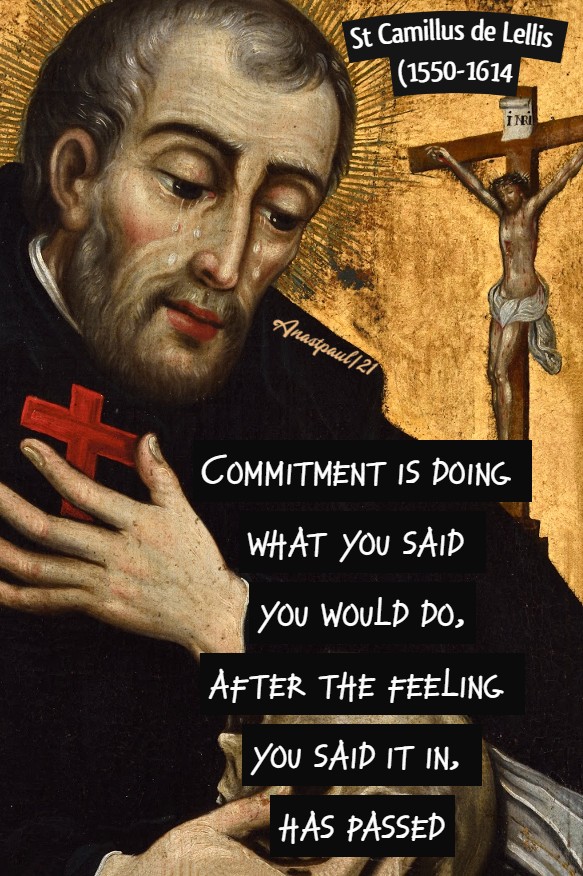
“Commitment is doing what you said you would do, after the feeling you said it in, has passed.”
One Minute Reflection – 14 July – “Month of the Most Precious Blood” – Readings: Exodus 3: 1-6, 9-12; Psalm: 103: 1b-2, 3-4, 6-7;: Matthew 11: 25-27 and the Memorial of Saint Camillus de Lellis MI (1550-1614) “The Giant of Charity”
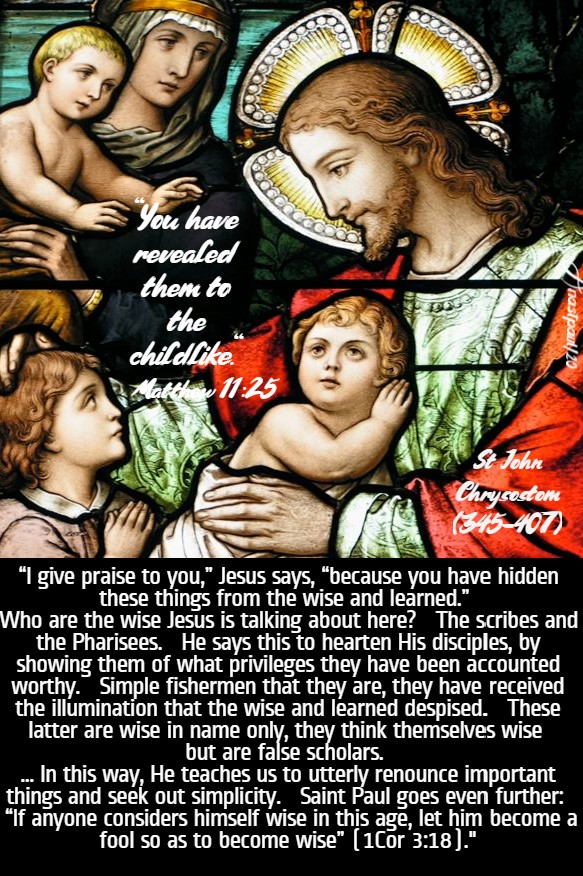
“You have revealed them to the childlike.” … Matthew 11:25
REFLECTION – “I give praise to you,” Jesus says, “because you have hidden these things from the wise and learned.” What? Is He glad at the loss of those who don’t believe in Him? Certainly not. How wonderful are God’s designs for people’s salvation! When they turn away from the truth and refuse to accept it, God never forces them but lets them be. Their wandering away stimulates them to find the path again. Returning to their senses, they hastily seek out the grace of the call to faith they had rejected before. As for those who had remained faithful, their devotion becomes even stronger like this. So Christ is glad these things are revealed to some but saddened they are hidden from others. This is made known when He weeps over the city (Lk 19:41). Saint Paul writes in the same spirit: “Thanks be to God! You were once slaves of sin but you have become obedient from the heart” to the Gospel (Rom 6:17). …
Who are the wise Jesus is talking about here? The scribes and the Pharisees. He says this to hearten His disciples, by showing them of what privileges they have been accounted worthy. Simple fishermen that they are, they have received the illumination that the wise and learned despised. These latter are wise in name only, they think themselves wise but are false scholars. That is why Christ did not say: “You have revealed them to the ignorant” but to “the childlike,” that is to say, simple, honest people. … In this way, He teaches us to utterly renounce important things and seek out simplicity. Saint Paul goes even further: “If anyone considers himself wise in this age, let him become a fool so as to become wise” (1Cor 3:18).” … St John Chrysostom (345-407) – Bishop of Constantinople, Father and Doctor of the Church – Sermons on Saint Matthew’s Gospel, no.38, 1
PRAYER – Lord God, in Your wisdom You created us, by Your Providence, You rule us. Penetrate our inmost being with Your holy light so that our way of life may always be one of faithful service and childlike trust in You. Grant that we may always follow behind Your Son and grasp His hand, to lead us to You. May we grow in faith and love daily, by the intercession of Saint Camillus de Lellis and may we be a light of love, to all around us, as he was. We make our prayer through our Lord Jesus with You in the unity of the Holy Spirit, God forever, amen.
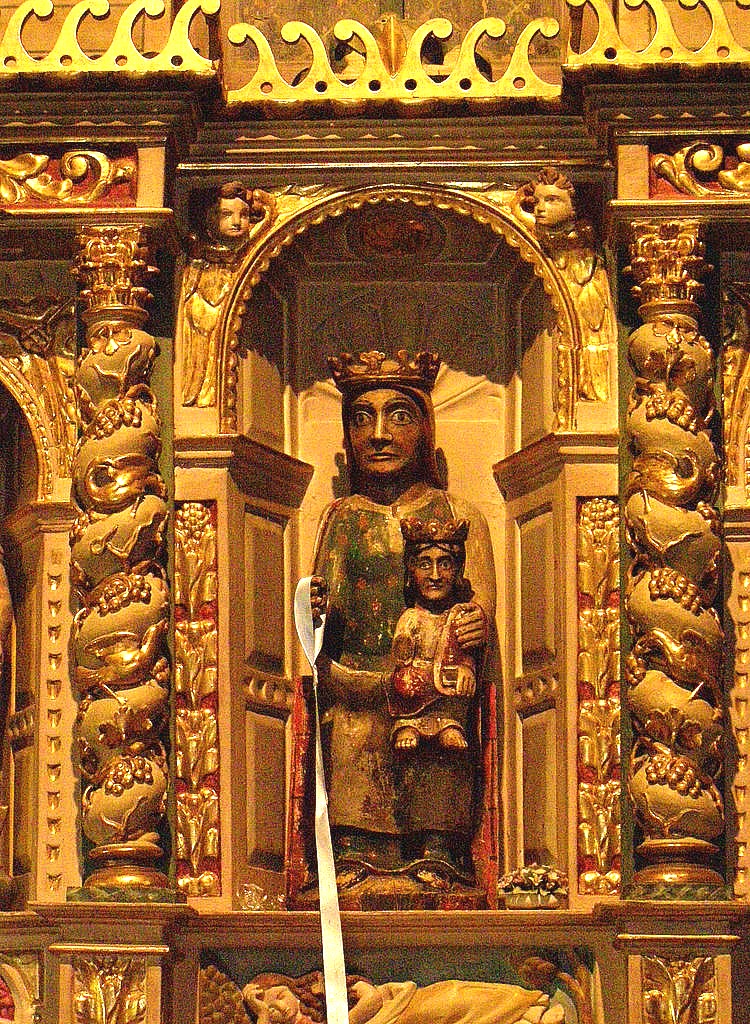
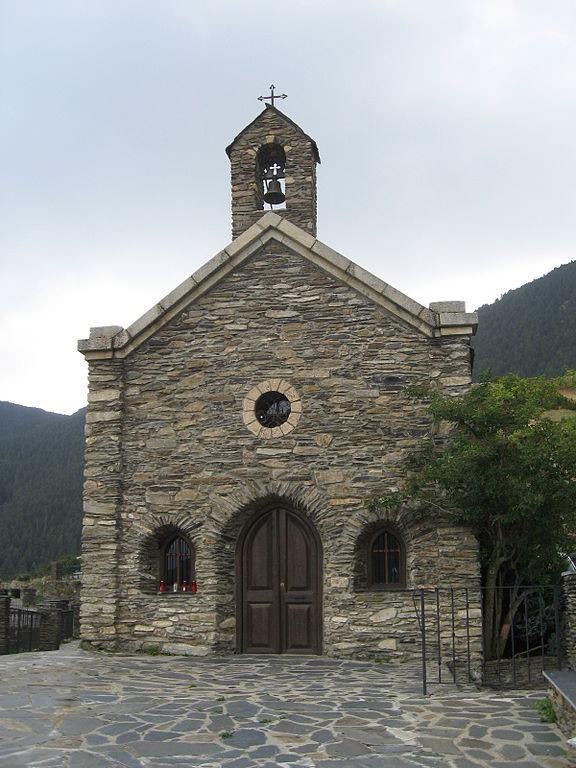
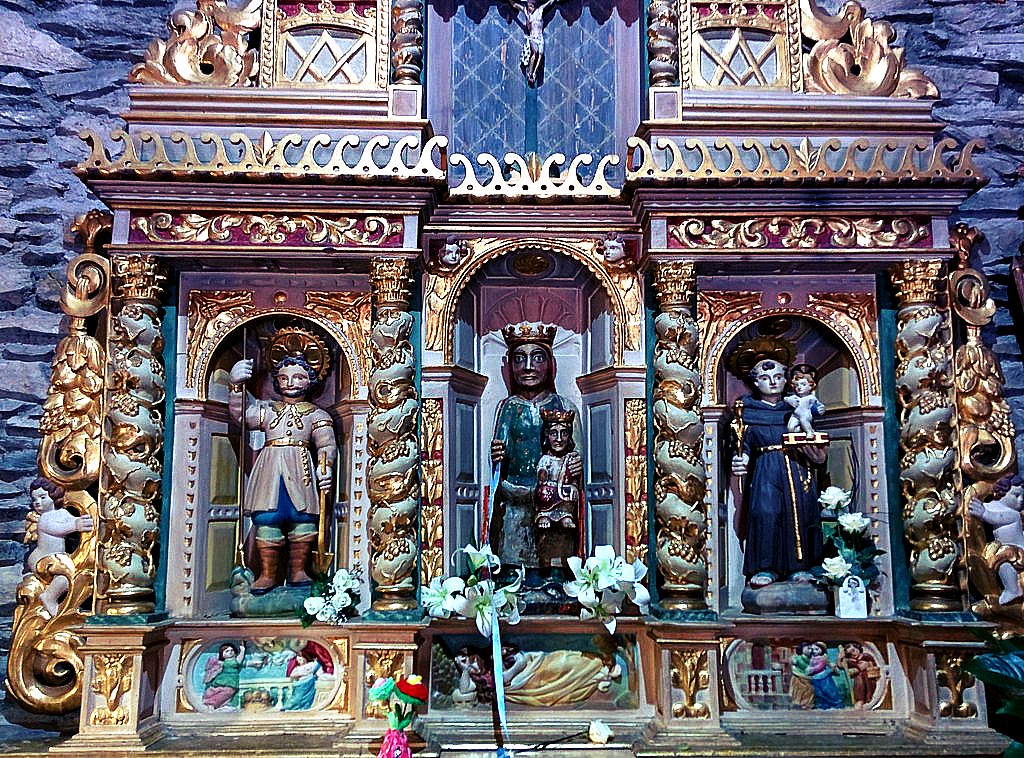
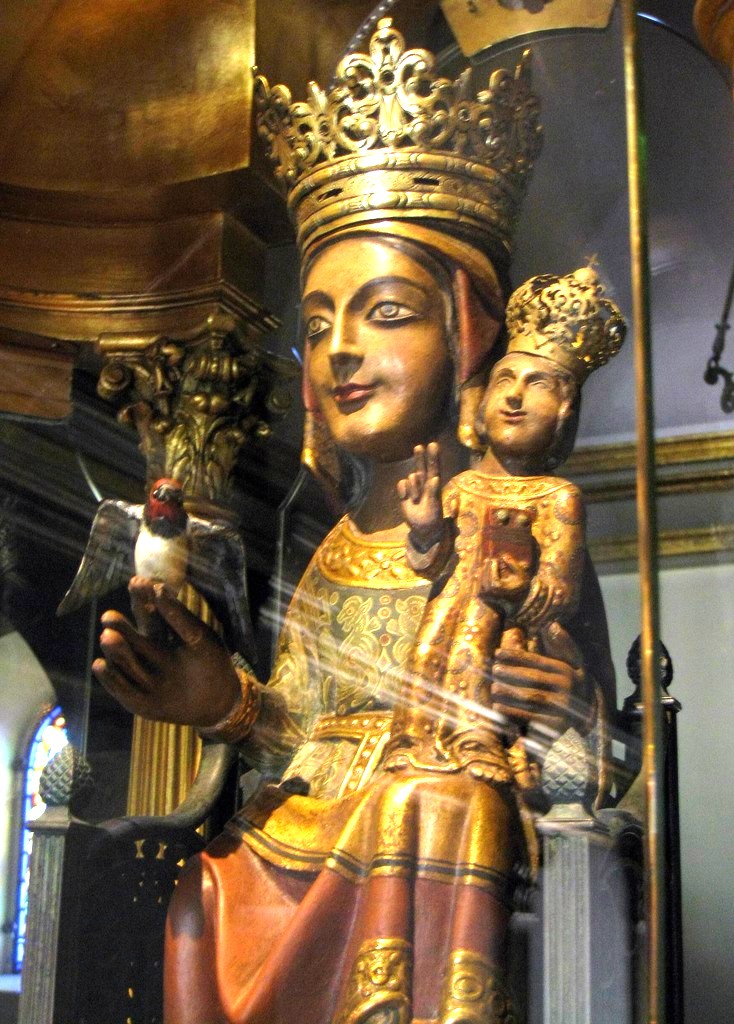
Mare de Déu de Canòlich / Mother of God of Canòlich, Canòlich, Sant Julià de Lòria, Andorra, Spain (1223) – 14 July and 4th Saturda\y of May:
On 14 July 1223, a shepherd was pasturing his flock near the village of Canòlich in southern Andorra, when suddenly a bird with brilliant plumage came to rest on an outcrop. The shepherd approached and caught the bird with no trouble and carried it to his house. The next day the bird had disappeared and again he found it in the field. The sequence recurred three times but the last time, the shepherd found an image of the Virgin Mary in a niche in the rock.
In response to this prodigy, the people of Sant Julià de Lòria Parish decided to build a Shrine to the Virgin where her Statue was found. Many miracles ensued at the Shrine and still do. Sadly now, nothing remains of that Church. The present Sanctuary, containing a baroque Altarpiece from a previous Shrine, dates from the 1970s. The Romanesque image of the Mother of God of Canòlich resides in the Parish Church of Sant Julià y San Germà in the urban centre of Sant Julià de Lòria: a wooden Statue from the late 1100s, with original polychrome, crowned by the Vatican in 1999.
On the last Saturday in May, parishioners gather in Sant Julià de Lòria for morning fireworks and Mass in the Virgin’s honour. Then the celebration — moves to Canòlich, for Masses at the Sanctuary and after Mass, dancing, and blessing and distribution of bread.
Bl Boniface of Canterbury St Colman of Killeroran St Cyrus of Carthage St Deusdedit of Canterbury St Donatus of Africa Bl Dorotea Llamanzares Fernández
Blessed Gaspar de Bono OM (1530– 1604) Priest, Friar of the Order of Minims Bl Giorgio of Lauria Bl Hroznata of Bohemia Bl Humbert of Romans St Idus of Ath Fadha St Ioannes Wang Kuixin St Just St Justus of Rome
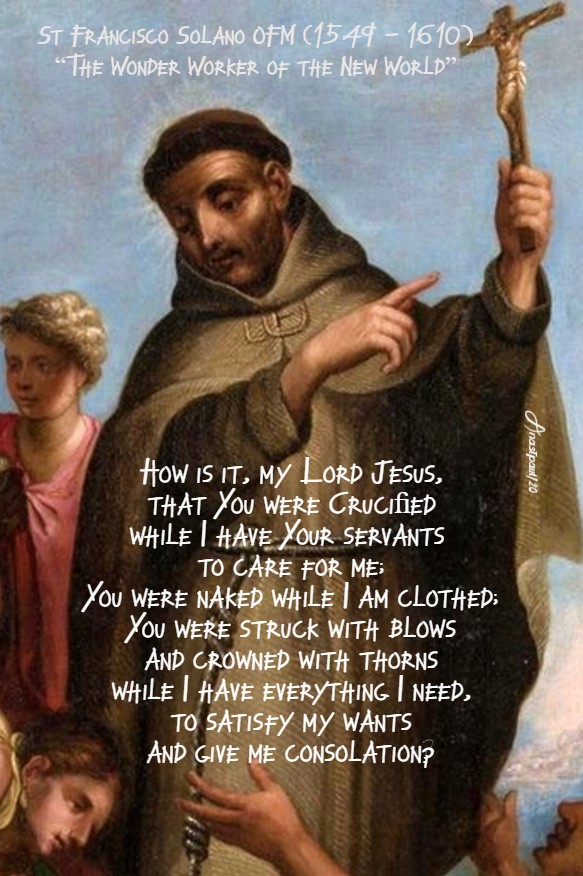
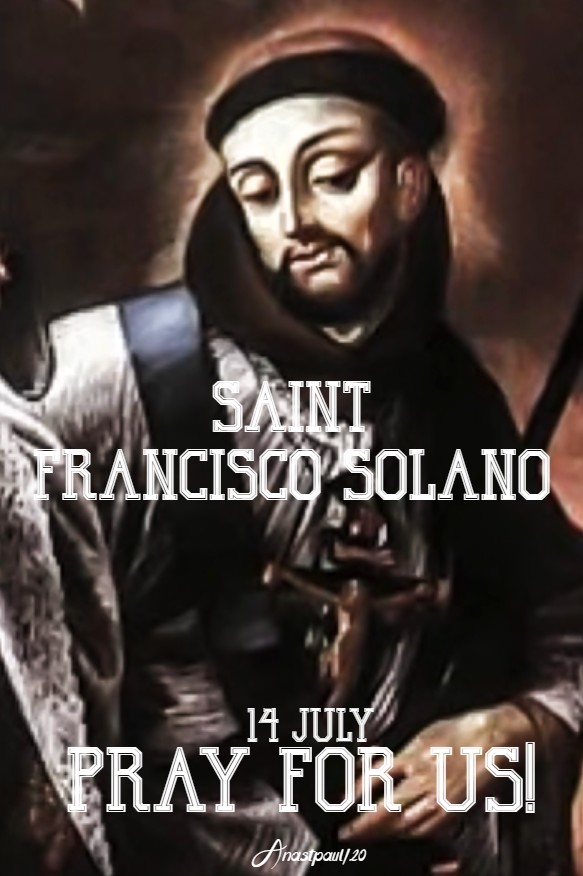
Quote/s of the Day – 14 July – The Memorial of Saint Francisco Solano OFM (1549 – 1610) “The Wonder Worker of the New World” and Saint Camillus de Lellis MI (1550-1614) “The Giant of Charity”
“How is it, my Lord Jesus, that You were Crucified while I have Your servants to care for me; You were naked while I am clothed; You were struck with blows and crowned with thorns while I have everything I need to satisfy my wants and give me consolation?”
St Francisco Solano OFM (1549 – 1610)
“The Wonder Worker of the New World”
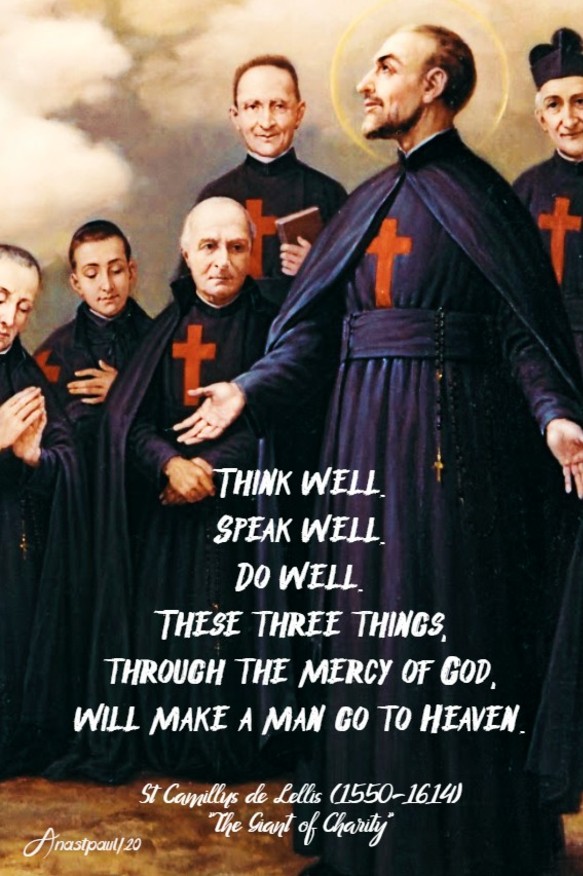
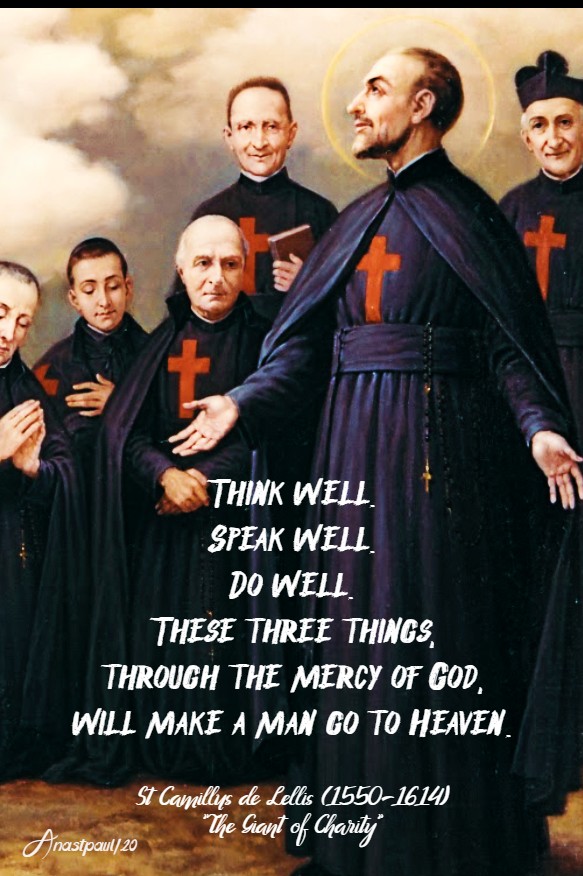
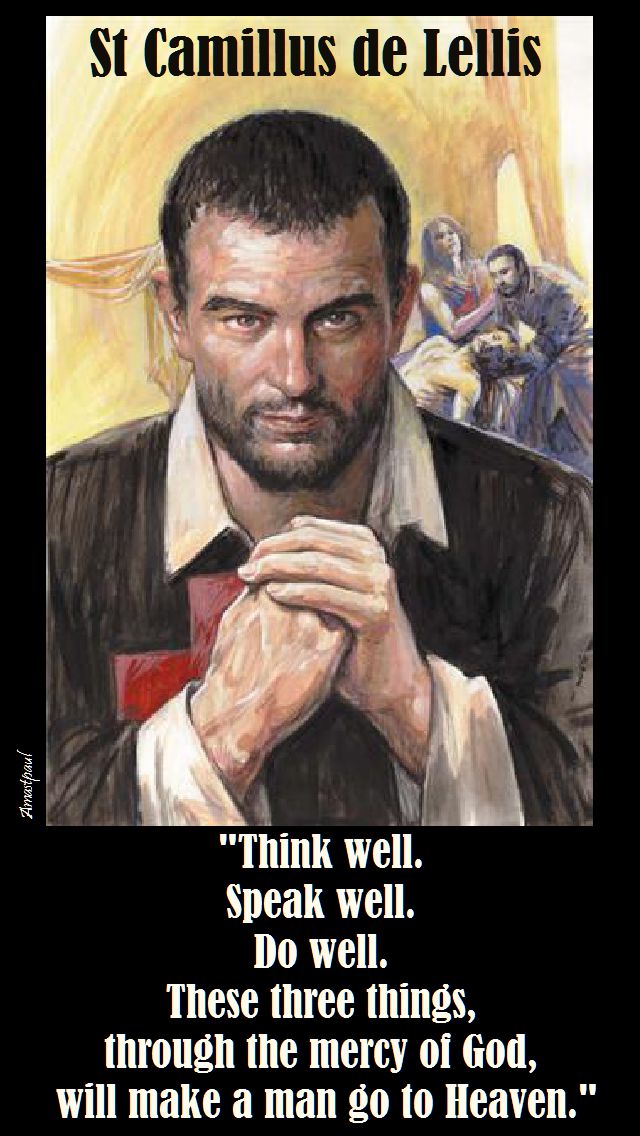
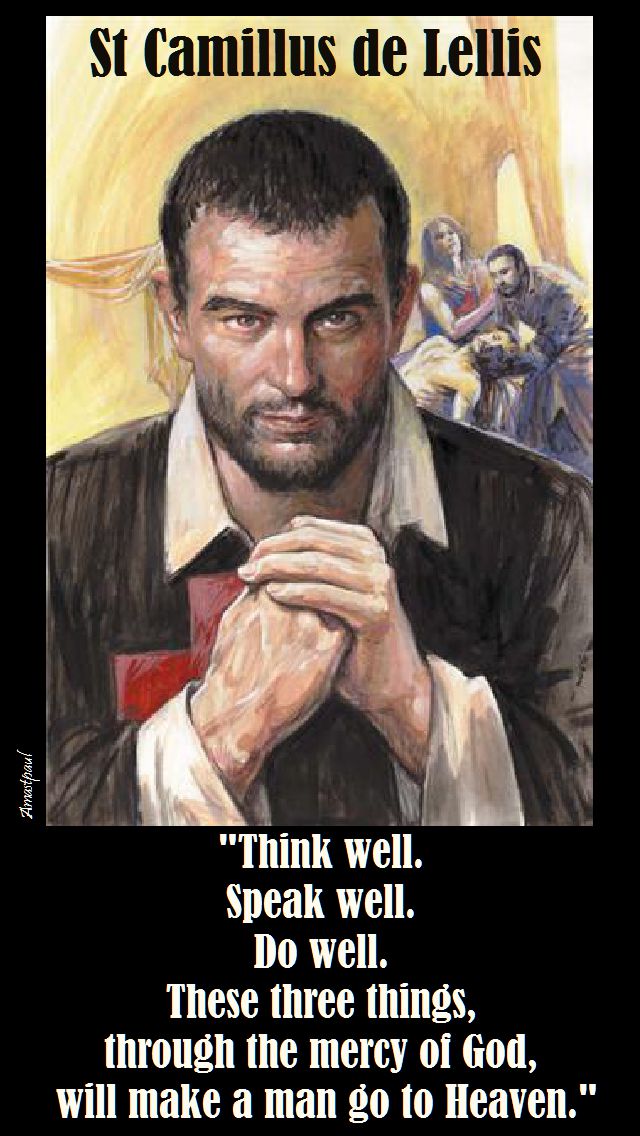
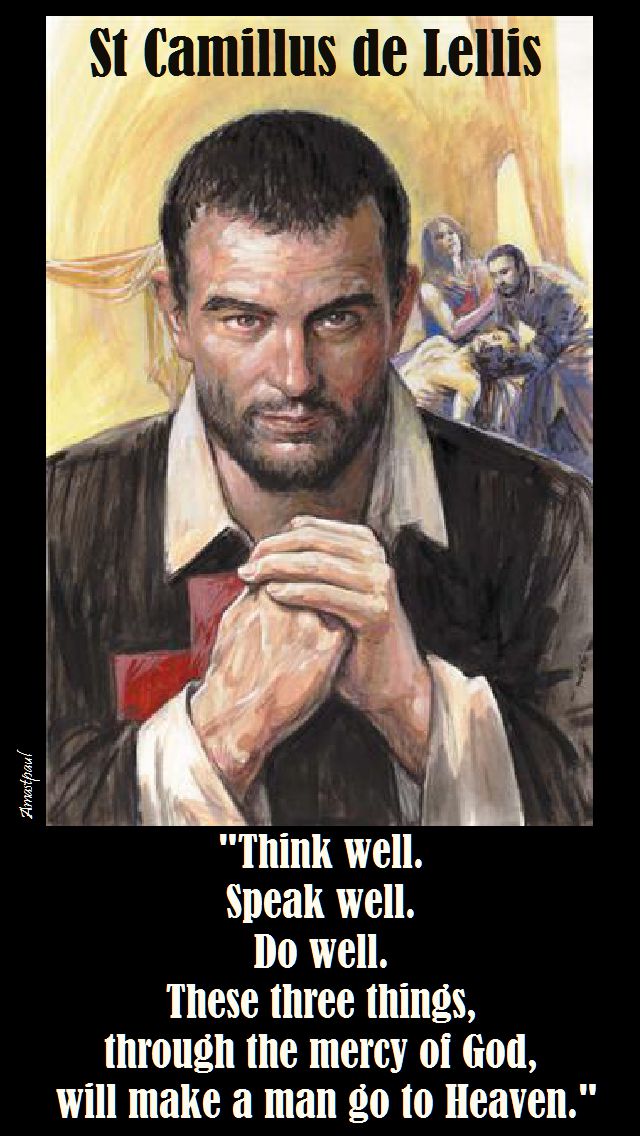
“Think well. Speak well. Do well. These three things, through the mercy of God, will make a man go to Heaven.”
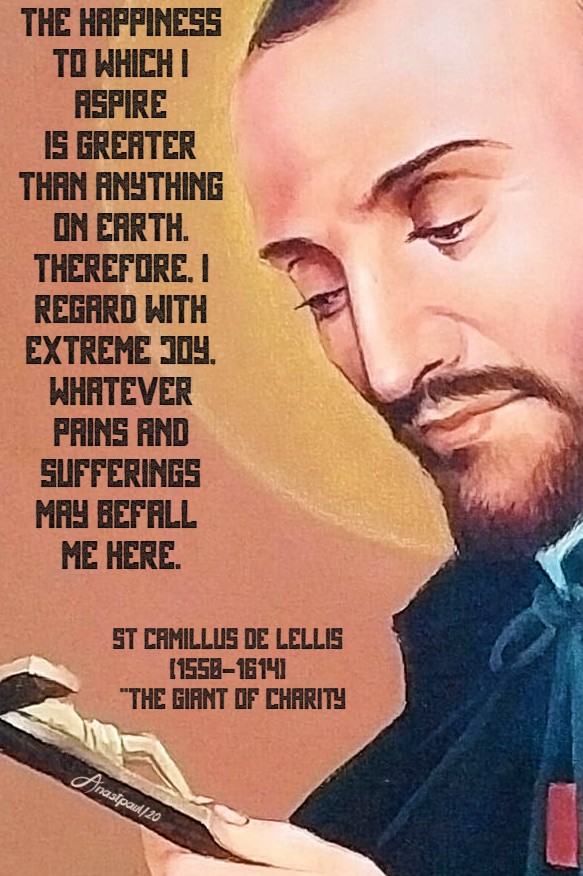
“The happiness to which I aspire is greater than anything on earth. Therefore, I regard with extreme joy, whatever pains and sufferings may befall me here.”
“I don’t put a penny’s value on this life if only our Lord will give me a tiny corner in Paradise.”
St Camillus de Lellis (1550-1614)
“The Giant of Charity”
One Minute Reflection – 14 July – “Month of the Most Precious Blood” = Tuesday of the Fifteenth week in Ordinary Time, Readings: Isaiah 7:1-9, Psalm 48:2-8, Matthew 11:20-24 and the Memorial of St Francisco Solanus y Jiménez OFM (1549 – 1610) Priest – “The Wonder Worker of the New World” and St Camillus de Lellis MI (1550-1614) “The Giant of Charity”
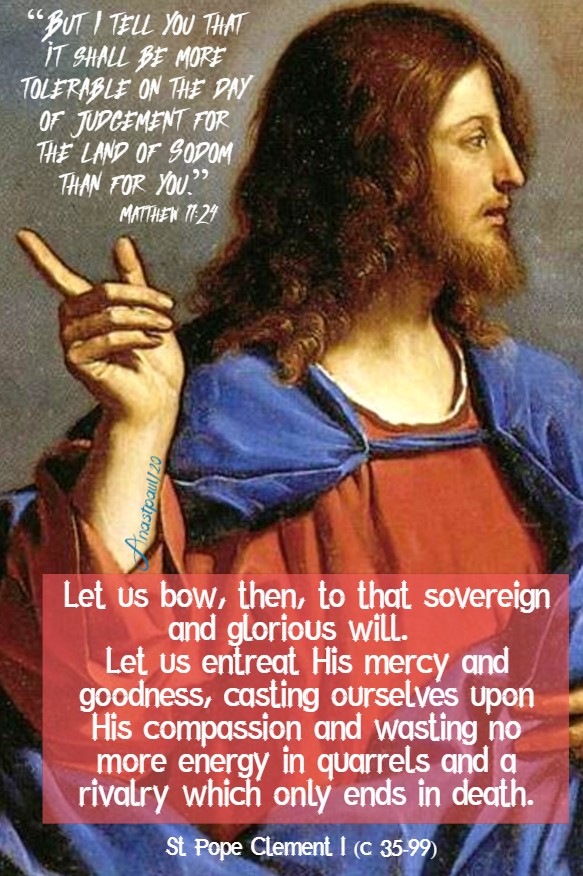
“But I tell you that it shall be more tolerable on the day of judgement for the land of Sodom than for you.”… Matthew 11:24
REFLECTION – “Let us fix our thoughts on the blood of Christ and reflect how precious that blood is in God’s eyes, inasmuch as its outpouring for our salvation, has opened the grace of repentance to all mankind.
For we have only to survey the generations of the past, to see, that in everyone of them, the Lord has offered the chance of repentance to any, who were willing to turn to Him. When Noah preached repentance, those who gave heed to him were saved. When, after Jonah had proclaimed destruction to the people of Niniveh, they repented of their sins and made atonement to God with prayers and supplications, they obtained their salvation, notwithstanding, that they were strangers and aliens to Him.
All those, who were ministers of the grace of God, have spoken, through the Holy Spirit, of repentance.
The very Lord of all, Himself has spoken of it and even with an oath – By my life, the Lord declares, it is not the sinner’s death that I desire, so much as his repentance and, he adds, this gracious pronouncement, Repent, O house of Israel and turn from your wickedness. Say to the children of my people, though your sins may stretch from earth to heaven and though they may be redder than scarlet and blacker than sackcloth, yet if you turn wholeheartedly to me and say ‘Father’, I will listen to you as I would to a people that was holy.
Thus, by His own almighty will, He has confirmed his desire that repentance should be open to everyone of His beloved.
Let us bow, then, to that sovereign and glorious will. Let us entreat His mercy and goodness, casting ourselves upon His compassion and wasting no more energy in quarrels and a rivalry which only ends in death.” … St Pope Clement I (c 35-99) – From his Letter to the Corinthians (Chs 7, 4-8, 3; 8, 5-9, 1; 13, 1-4; 19, 2)
PRAYER – God our Father, we are Your children and You have set us aside to come home to You by the light of the way of Your divine Son. Fill us with knowledge of our need to turn to You in sorrow and repentance, that we may one day attain our final home with You. Grant we pray, that by the intercession of Saints Francisco Solanus and Camillus de Lellis, we may too become lights announcing Your love to all around us. We make our prayer through our Lord Jesus with You in the unity of the Holy Spirit, God forever, amen.
Our Lady of Dromon: Saint-Geniez, Alpes de Haute-Provence, Provence-Alpes-Côte d’Azur, France
In 1656, about 2.5 miles from the alpine village of Saint-Geniez, as 12-year-old herder Honoré was praying before a wooden cross on a stone mound, he heard the voice of the Blessed Virgin asking him to dig there to uncover chapels dedicated to her long ago. Excavations on the mountain located a crypt chapel dating back to around 1000, on the site of the ancient city of Theopolis. The upper chapel holds an alabaster statue of the Virgin and Child from the 1600s. The annual pilgrimage takes place on Bastille Day, 14 July.
Bl Angelina di Marsciano
Bl Boniface of Canterbury
St Colman of Killeroran
St Cyrus of Carthage
St Deusdedit of Canterbury
St Donatus of Africa
Bl Dorotea Llamanzares Fernández St Francisco Solano y Jiménez OFM (1549 – 1610) Priest – “The Wonder Worker of the New World”
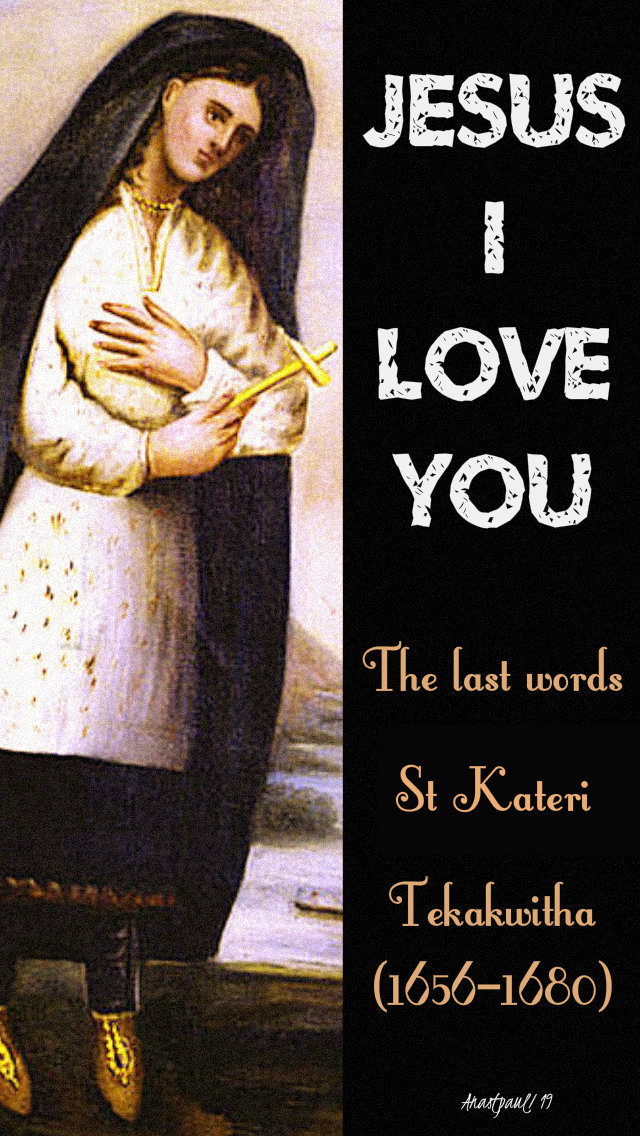
Quote/s of the Day – 14 July – Fifteenth Sunday in Ordinary Time, Year C, Luke 10:25–37 and the Memorial of Saint Camillus de Lellis MI (1550-1614) “The Giant of Charity” and Saint Kateri Tekakwitha (1656–1680) “Lily of the Mohawks”
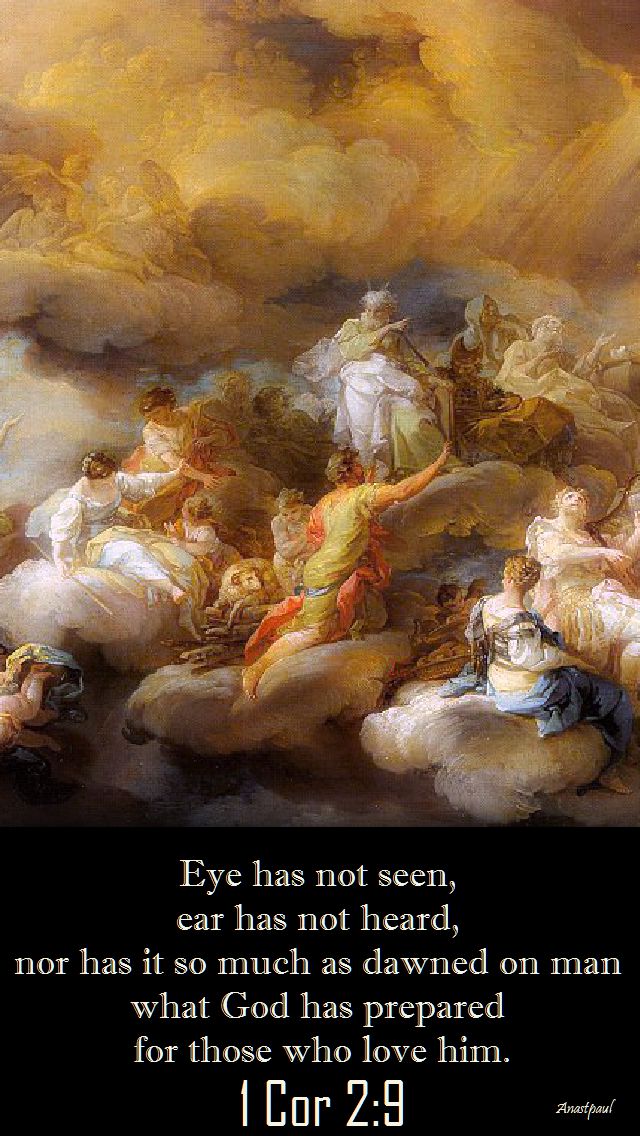
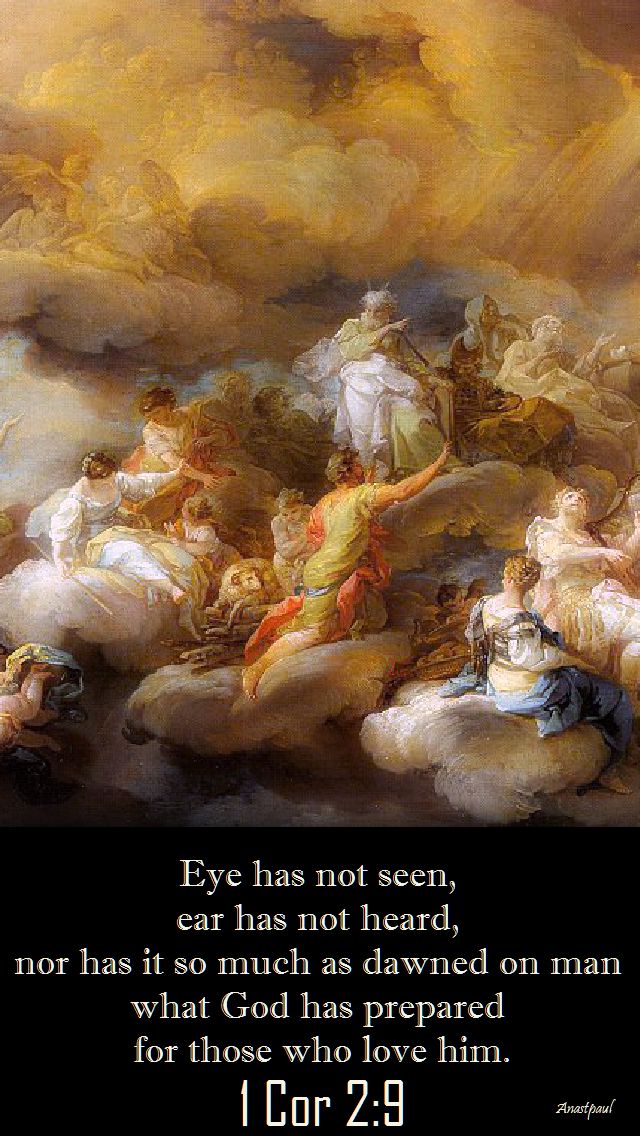
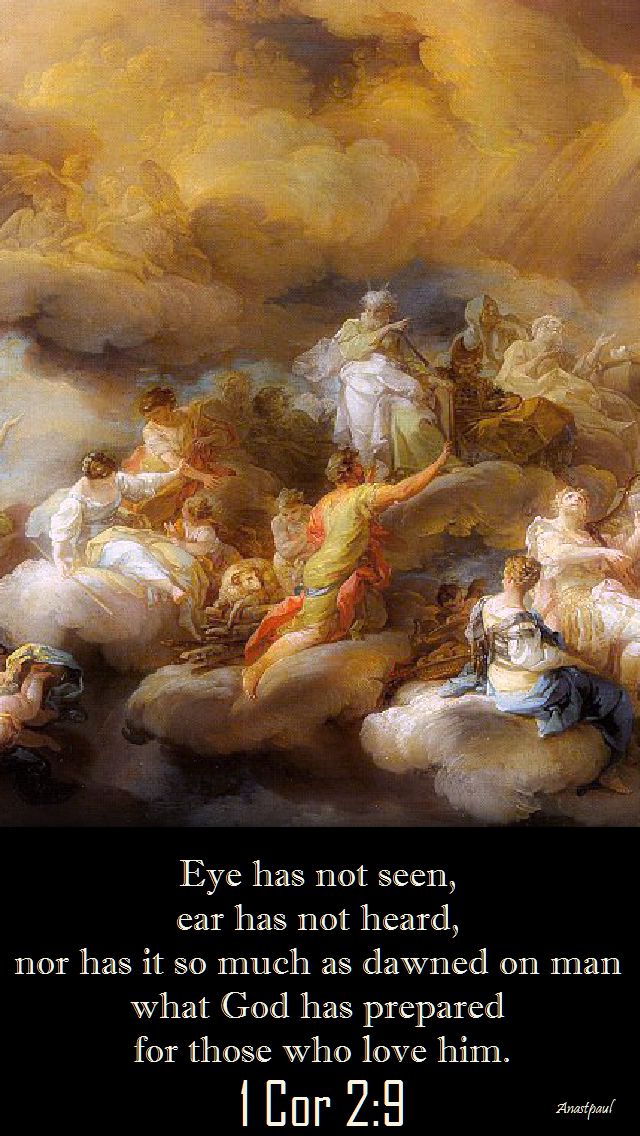
Eye has not seen, ear has not heard, nor has it so much as dawned on man what God has prepared for those who love him.
1 Corinthians 2:9
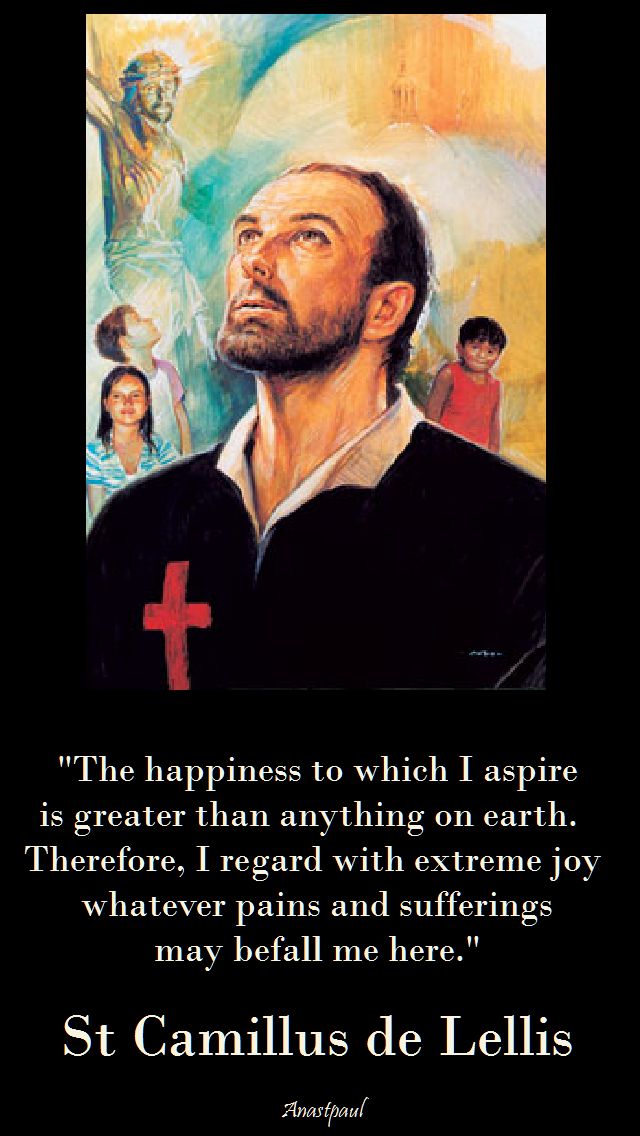
“The happiness to which I aspire is greater than anything on earth. Therefore, I regard with extreme joy, whatever pains and sufferings may befall me here.”
One Minute Reflection – 14 July – Fifteenth Sunday in Ordinary Time, Year C, Gospel: Luke 10:25–37 and the memorial of Saint Camillus de Lellis MI (1550-1614) “The Giant of Charity” and Saint Kateri Tekakwitha (1656–1680) “Lily of the Mohawks”
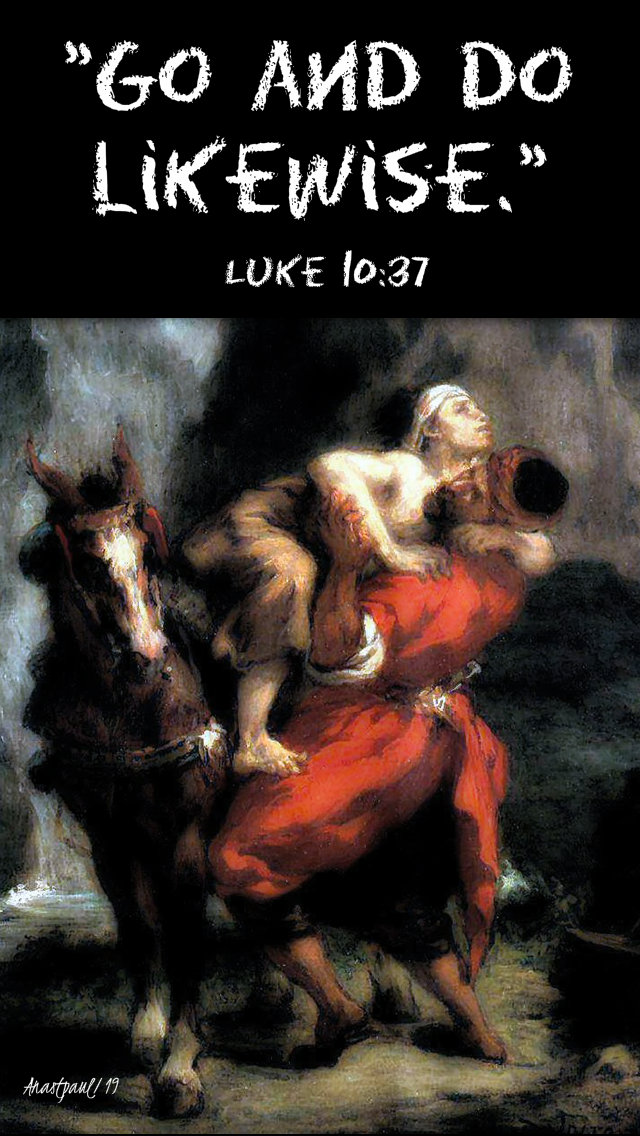
“Go and do likewise.”... Luke 10:37
REFLECTION – “In choosing these two Words addressed by God to His people and by putting them together, Jesus taught once and for all that love for God and love for neighbour are inseparable; moreover, they sustain one another. Even if set in a sequence, they are two sides of a single coin – experienced together they are a believer’s strength!
To love God is to live of Him and for Him, for what He is and for what He does. Our God is unmitigated giving, He is unlimited forgiveness, He is a relationship that promotes and fosters.
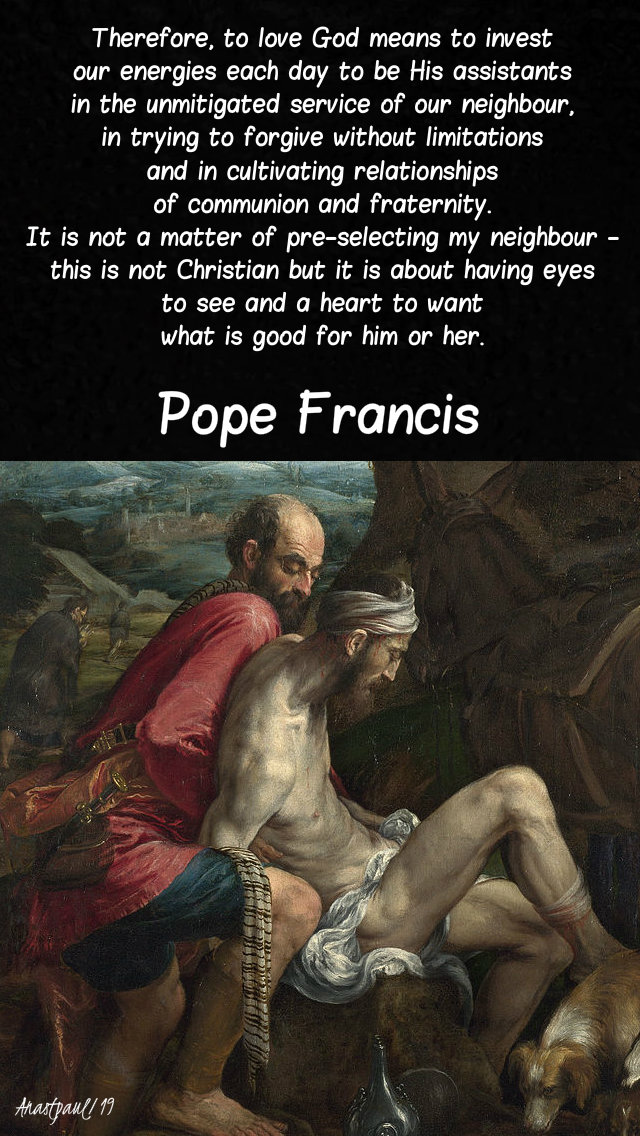
Therefore, to love God means to invest our energies each day to be His assistants in the unmitigated service of our neighbour, in trying to forgive without limitations and in cultivating relationships of communion and fraternity. It is not a matter of pre-selecting my neighbour – this is not Christian but it is about having eyes to see and a heart to want what is good for him or her. Today’s Gospel passage invites us all to be projected not only toward the needs of our poorest brothers and sisters but above all to be attentive to their need for fraternal closeness, for a meaning to life and for tenderness.”… Pope Francis (ANGELUS Sunday, 4 November 2018)
PRAYER – God our Father, we are Your children and You have set us aside to come home to You by the light of the way of Your divine Son. Grant we pray, that we may grow in faith and love for You and our neighbour daily, by the intercession of Saints Camillus and Kateri, may learn the gentleness and tenderness of love, to all around us. We make our prayer through our Lord Jesus with You in the unity of the Holy Spirit, God forever, amen.
Our Lady of Dromon: Saint-Geniez, Alpes de Haute-Provence, Provence-Alpes-Côte d’Azur, France
In 1656, about 2.5 miles from the alpine village of Saint-Geniez, as 12-year-old herder Honoré was praying before a wooden cross on a stone mound, he heard the voice of the Blessed Virgin asking him to dig there to uncover chapels dedicated to her long ago. Excavations on the mountain located a crypt chapel dating back to around 1000, on the site of the ancient city of Theopolis. The upper chapel holds an alabaster statue of the Virgin and Child from the 1600s. The annual pilgrimage takes place on Bastille Day, 14 July.
Bl Angelina di Marsciano
Bl Boniface of Canterbury
St Colman of Killeroran
St Cyrus of Carthage
St Deusdedit of Canterbury
St Donatus of Africa
Bl Dorotea Llamanzares Fernández
St Francis Solano
Bl Giorgio of Lauria
Bl Hroznata of Bohemia
Bl Humbert of Romans
St Idus of Ath Fadha
St Ioannes Wang Kuixin
St Just
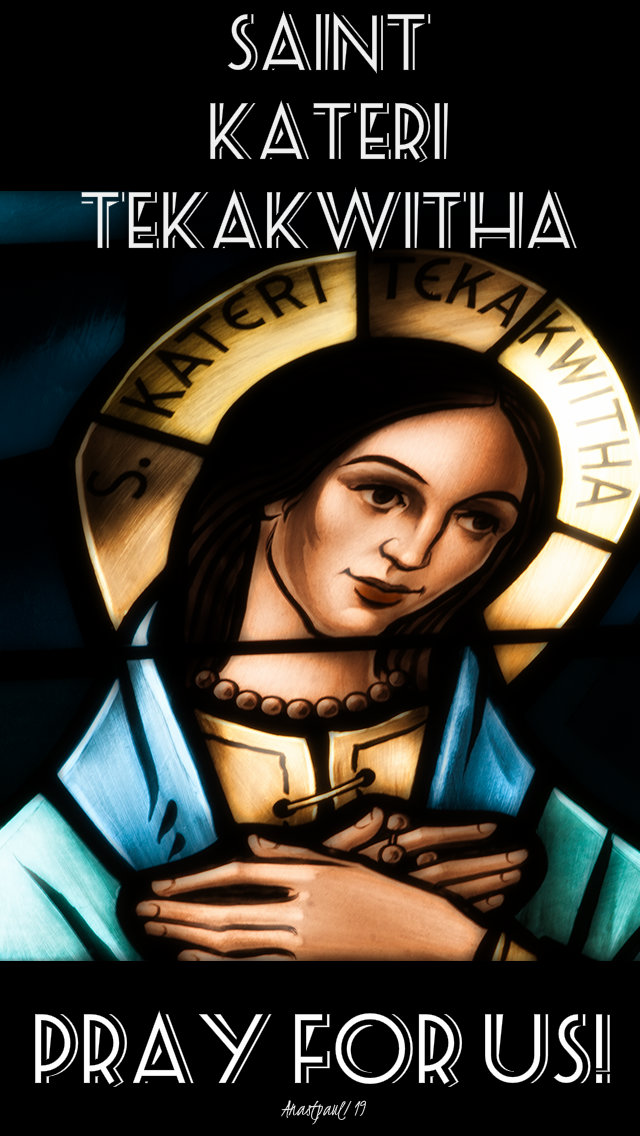
St Justus of Rome St Kateri Tekakwitha (1656–1680) (Optional Memorial USA)
St Liebert
St Marchelm
Bl Michael Ghebre
St Optatian of Brescia
St Papias of Africa
Bl Toscana of Verona
St Ulric of Zell
Quote/s of the Day – 14 September – Feast of the Exaltation of the Holy Cross
“In the Cross is salvation; in the Cross is life; in the Cross is protection against our enemies; in the Cross is infusion of heavenly sweetness; in the Cross is strength of mind; in the Cross is joy of spirit; in the Cross is excellence of virtue; in the Cross is perfection of holiness. There is no salvation of soul, nor hope of eternal life, save in the Cross.”
Thomas à Kempis (1380-1471) The Inner Life
“The road is narrow. He who wishes to travel it more easily must cast off all things and use the cross as his cane. In other words, he must be truly resolved to suffer willingly for the love of God in all things.”
St John of the Cross (1542-1591) Doctor of the Church
The everlasting God has in His wisdom foreseen from eternity the cross He now presents to you as a gift from His inmost heart. The cross He now sends you He has considered with His all-knowing eyes, understood with His divine mind, tested with His wise justice, warmed with loving arms and weighed with His own hands to see that it is not one inch too large nor one ounce too heavy for you. He has blessed it with His holy name, anointed it with His grace, perfumed it with His consolation, taken one last glance at you and your courage and then sent it to you from heaven, a special greeting from God to you, an alms of the all-merciful love of God.
St Francis de Sales (1567-1622) Doctor of the Church
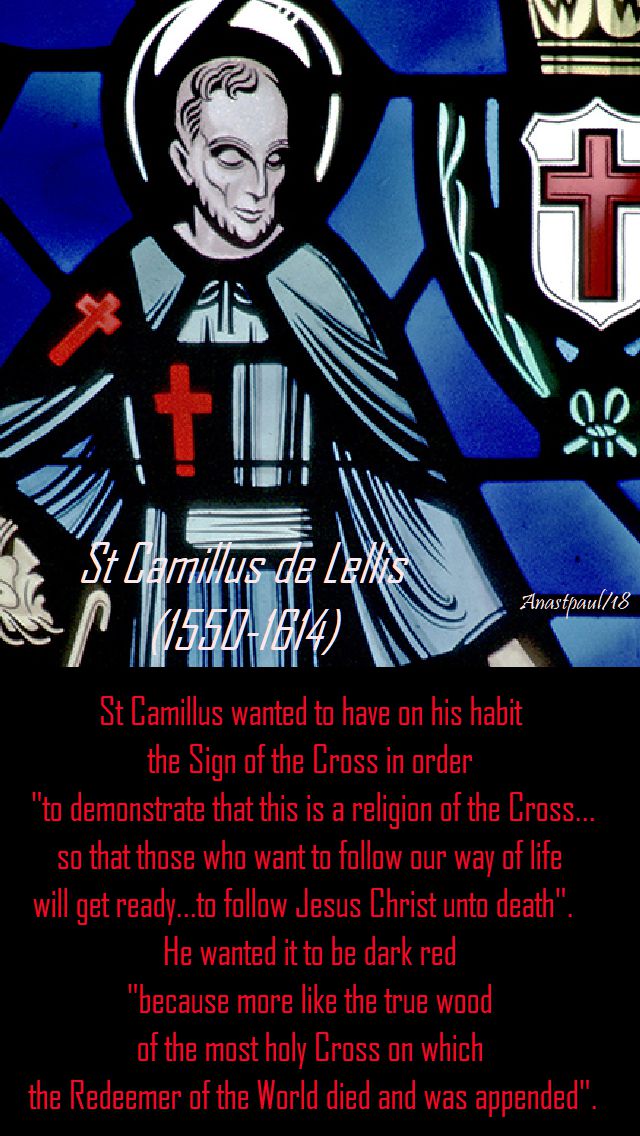
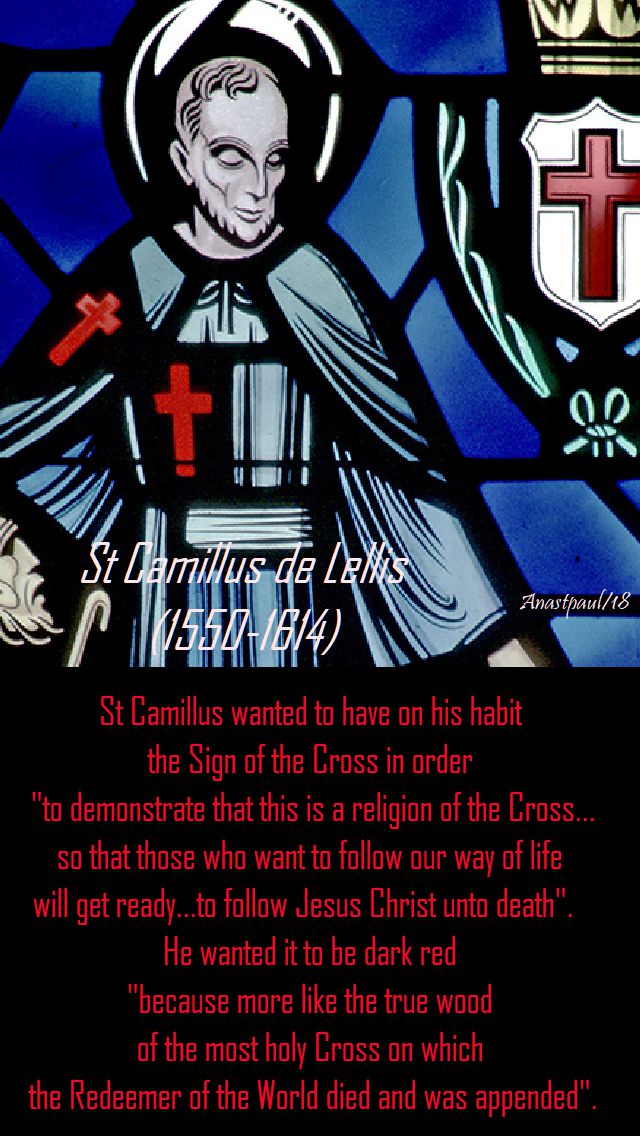
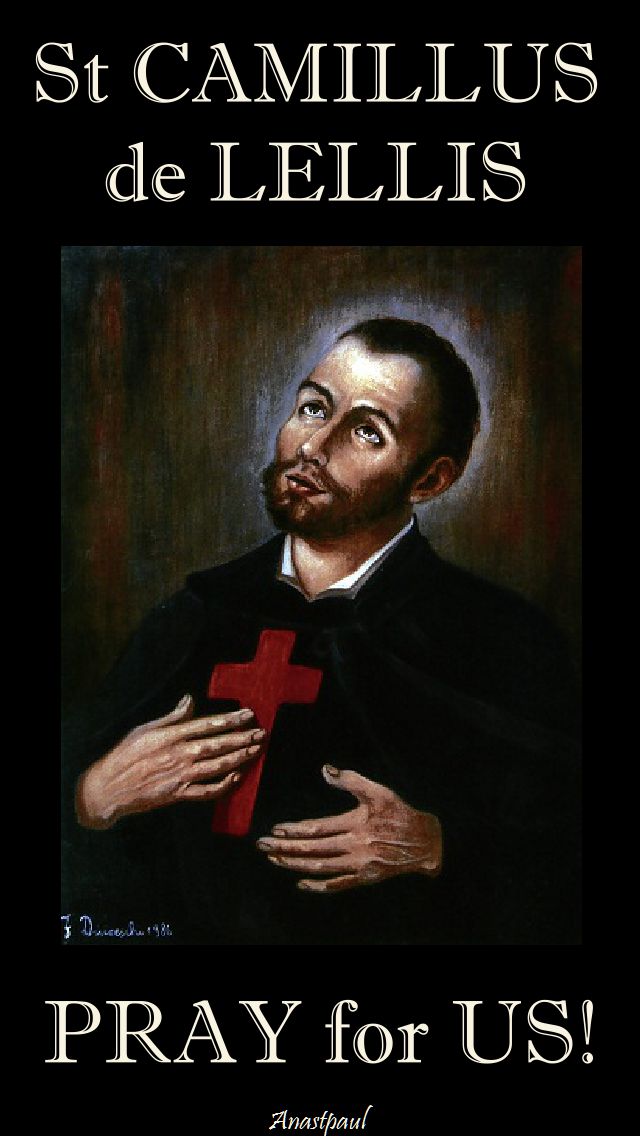
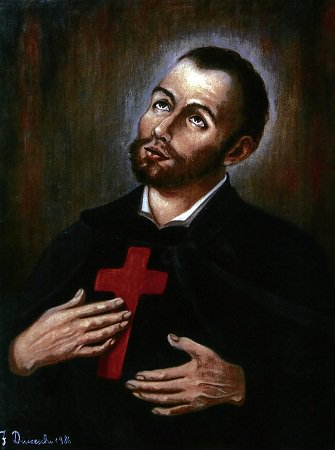
Camillus wanted to have on his habit the Sign of the Cross in order ‘to demonstrate that this is a religion of the Cross… so that those who want to follow our way of life will get ready… to follow Jesus Christ unto death’. He wanted it to be dark red ‘because more like the true wood of the most holy Cross on which the Redeemer of the World died and was appended’.
St Camillus de Lellis (1550-1614)
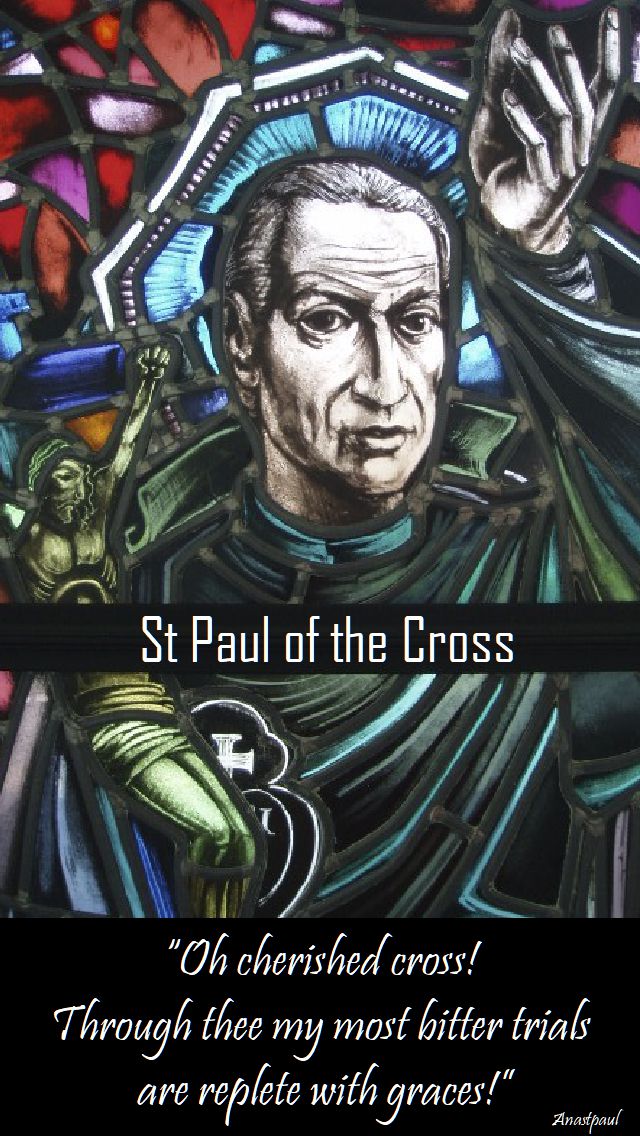
“Oh cherished cross! Through thee my most bitter trials are replete with graces!”
St Paul of the Cross (1694-1775)
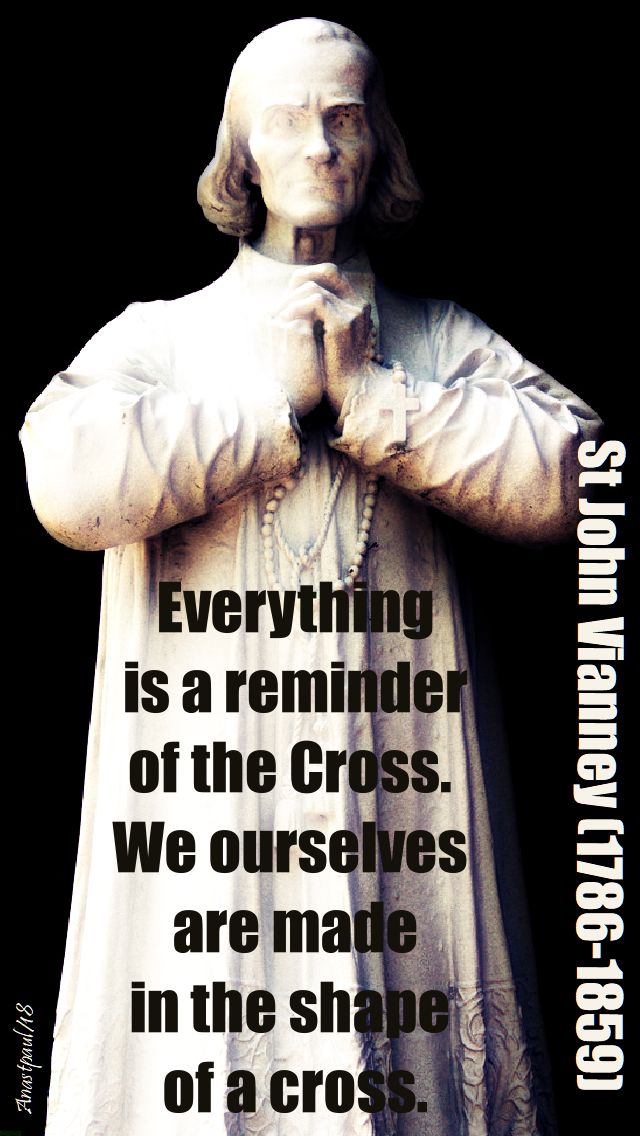
“Everything is a reminder of the Cross. We ourselves are made in the shape of a cross.”
St John Vianney (1786-1859)
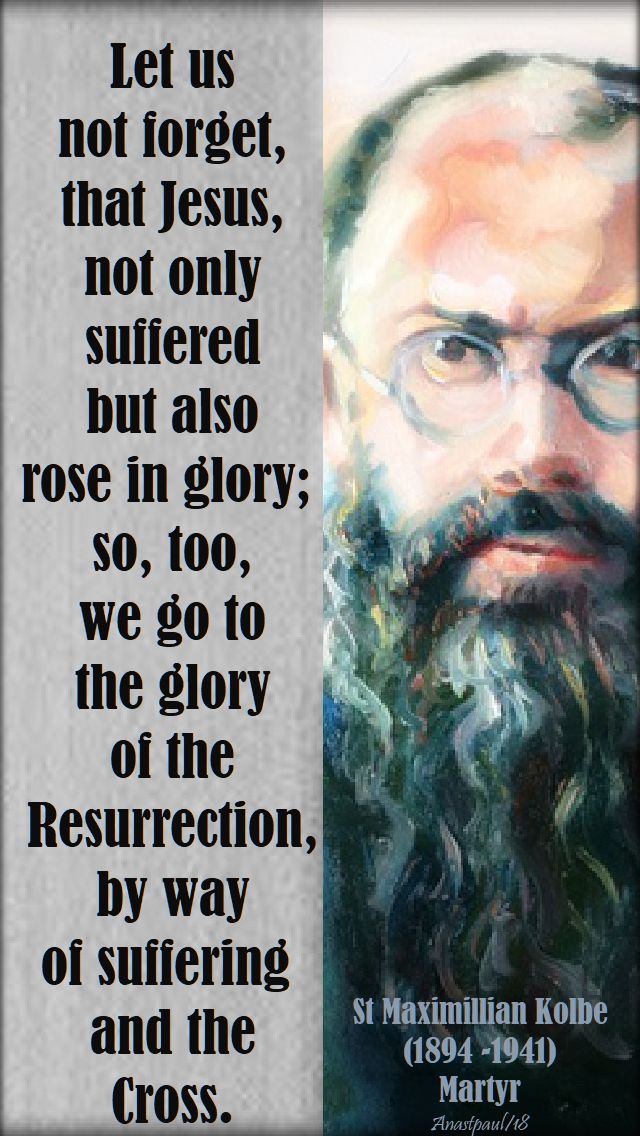
“Let us not forget, that Jesus not only suffered but also rose in glory; so, too, we go to the glory of the Resurrection, by way of suffering and the Cross.”
St Maximillian Kolbe (1894 -1941)
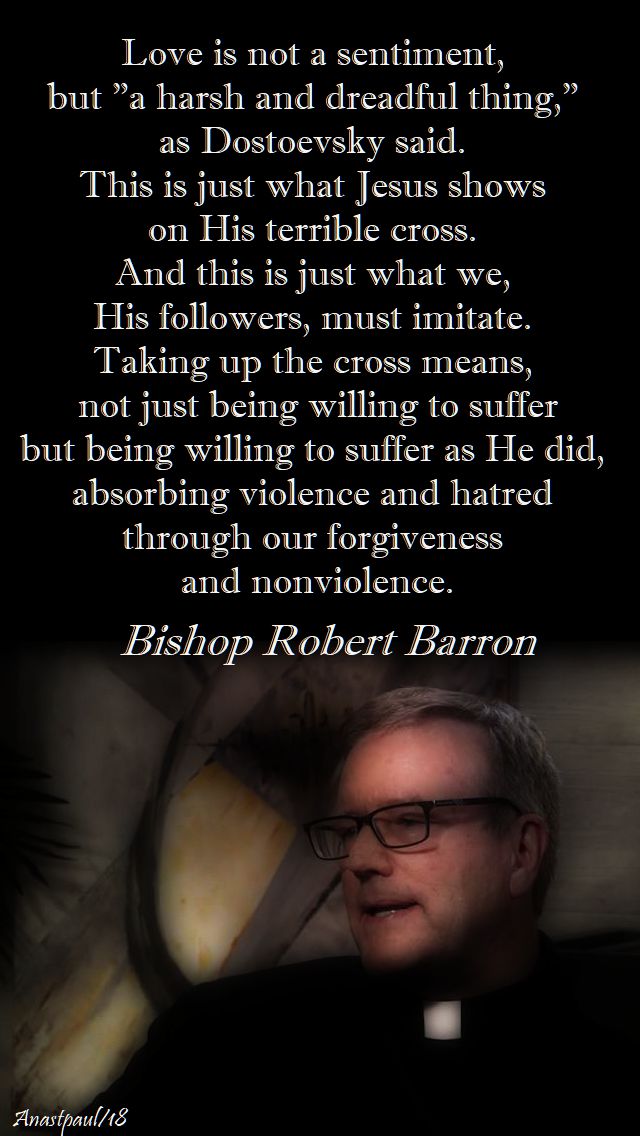
“There is line from the illuminator of the St John’s Bible that states: “We have to love our way out of this.” There is nothing wimpy or namby-pamby or blind about this conviction. When we love extravagantly, we are not purposely blinding ourselves to moral realities— just the contrary.
Love is not a sentiment, but “a harsh and dreadful thing,” as Dostoevsky said.
This is just what Jesus shows on His terrible cross. And this is just what we, His followers, must imitate. Taking up the cross means, not just being willing to suffer but being willing to suffer as He did, absorbing violence and hatred through our forgiveness and nonviolence.”
Thought for the Day – 14 July – The Memorial of St Camillus de Lellis (1550-1614) “The Giant of Charity”
Every day in the wards of hospitals or in the streets, wherever Camillus was in contact with the sick, he encountered Christ on the crucifix who became for him a daily partner. Not only did he think about Him and pray to Him but he also housed Him, fed Him, gave Him water to drink and clothed Him. He gave himself and in his self-giving he felt that he was the beneficiary. ‘This crucified Christ’, he exclaimed, ‘has helped me and comforted me a great deal and certainly, I do not merit all the graces, He has done me’. He attributed to Him the merit of founding the Institute: ‘In the foundation of this little plant a lion heart could have lost himself, as well as a miserable man such as I am, if the crucified Christ had not helped and comforted me’. The signs of the cross were also impressed on his afflicted body: – his leg with its sore, the corns on his feet, his kidney stones, the hernia in his groin and the tumour in his stomach. In his testament he declared his self-abandonment to the crucified Christ, to whom he commended himself like the prodigal son who went back to his father and the good thief who called for mercy.
The crucified Christ entered his life and was never to leave him. Camillus wanted to have on his habit the Sign of the Cross in order ‘to demonstrate that this is a religion of the Cross…so that those who want to follow our way of life will get ready…to follow Jesus Christ unto death’. He wanted it to be dark red ‘because more like the true wood of the most holy Cross on which the Redeemer of the World died and was appended’.
In the exercise of this very demanding and radical service to the sick, Camillus was guided by the Holy Spirit along the two fundamental lines of evangelical love: 1) recognising that we are serving Christ in the person of the sick and 2) being an expression of the merciful Christ who is serving the sick. Camillus really identified the suffering Christ in the sick to the point of calling them ‘my Lords and Masters’. Camillus brought about the complete service to the sick by concentrating on their spiritual and corporeal needs.
For the Order of the Ministers of the Infirm, the Fourth Vow, that is the vow along with the vows of poverty, chastity and obedience, to serve the sick with total commitment at the risk of one’s life, represents the special feature of their particular style of consecrated religious life. For Camillians serving the sick is the ‘locus theologicus’ where it fulfils and expresses its identity as a community of men, consecrated to God and entrusted with mission of establishing the Kingdom as a means of salvation for all the sick.
One Minute Reflection – 14 July – The Memorial of St Camillus de Lellis (1550-1614)
Eye has not seen, ear has not heard, nor has it so much as dawned on man what God has prepared for those who love him………1 Cor 2:9
REFLECTION – “The happiness to which I aspire is greater than anything on earth. Therefore, I regard with extreme joy, whatever pains and sufferings may befall me here.”………St Camillus de Lellis
PRAYER – Heavenly Father, keep our minds fixed on the surpassing joys stored up for us in heaven. And let us be willing to put up with all sufferings and pains that may come upon us for the reparation of sin. Grant that by the intercession of St Camillus de Lellis, we may grow in holiness, amen.
Saint of the Day – 14 July – St Camillus de Lellis M.I. (1550-1614) Priest and Founder, known as “The Giant of Charity”.
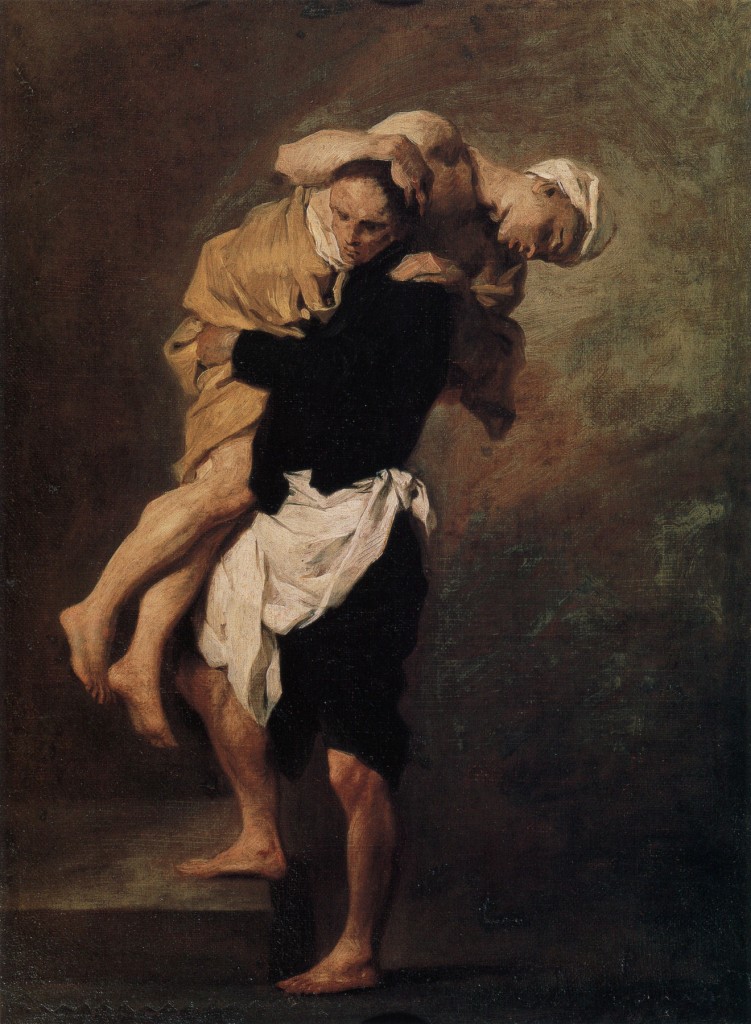
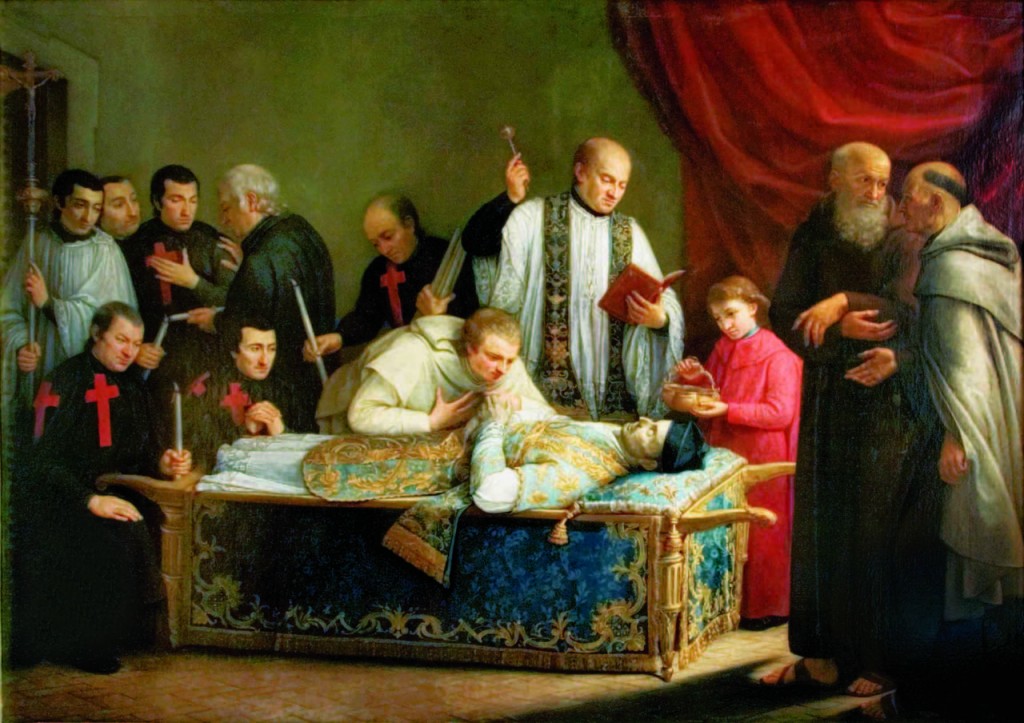
St Camillus assisting during the flooding of the Tiber
The early years of Camillus gave no sign of sanctity. At the age of nineteen he took service with his father, an Italian noble, against the Turks and after four years hard campaigning found himself, through his violent temper, reckless habits and inveterate passion for gambling, a discharged soldier and in such straitened circumstances that he was obliged to work as a labourer on a Capuchin convent which was then being built. A few words from a Capuchin friar brought about his conversion and he resolved to become a religious.
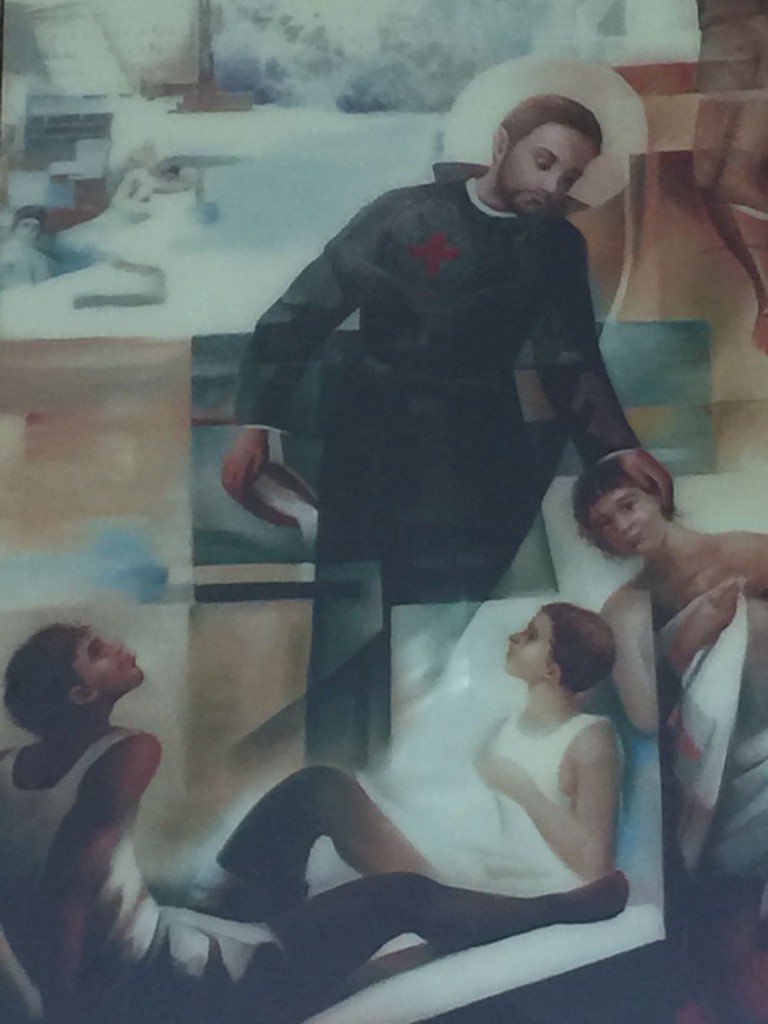
Thrice he entered the Capuchin novitiate but each time an obstinate wound in his leg forced him to leave. He repaired to Rome for medical treatment and there took St Philip as his confessor and entered the hospital of St Giacomo, of which he became in time the superintendent. The carelessness of the paid chaplains and nurses towards the suffering patients now inspired him, with the thought of founding a congregation to minister to patients. Members of his order worked in hospitals, prisons and in the homes of those afflicted by disease. The order’s original name, the “Fathers of a Good Death,” reflected the desire to aid in their spiritual salvation and prepare the dying to receive their last rites. Later known as the Order of the Ministers of the Sick, or simply as the “Camillians,” the group received papal approval in 1586 and was confirmed as a religious order in 1591. In addition to the traditional vows of poverty, chastity and obedience, they took a vow of unfailing service to the sick.
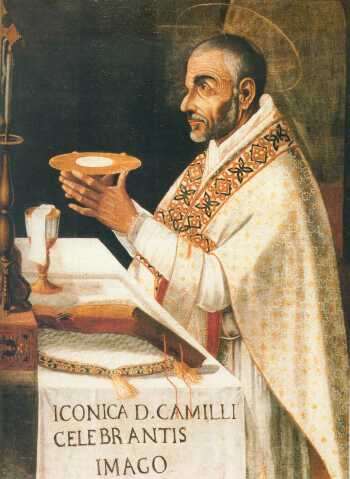
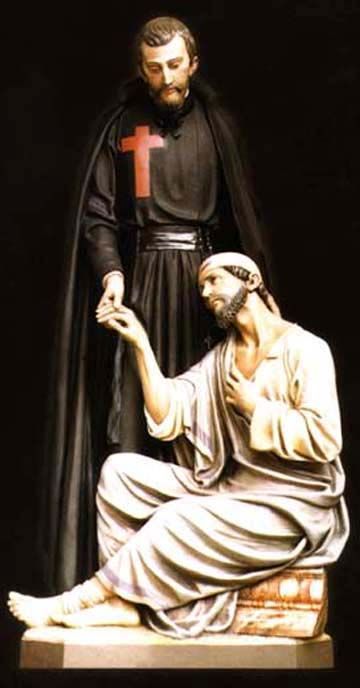
Summoned at every hour of the day and night, the devotion of Camillus never grew cold. With a woman’s tenderness he attended to the needs of his patients. He wept with them, consoled them and prayed with them. He knew miraculously, the state of their souls and St Philip saw angels whispering to two Servants of the Sick who were consoling a dying person. One day a sick man said to the Saint, “Father, may I beg you to make up my bed? it is very hard.” Camillus replied, “God forgive you, brother! You beg me! Don’t you know yet that you are to command me, for I am your servant and slave.”“Would to God,” he would cry, “that in the hour of my death one sigh or one blessing of these poor creatures might fall upon me!”
Camillus himself suffered physical ailments throughout his life. His leg wound failed to heal over the course of almost five decades, in addition to which he suffered from sores and severe kidney trouble. But he is said to have spent time with the sick even while unable to walk, by crawling from bed to bed.
The founder of the Ministers of the Sick lived to assist at a general chapter of his order in Rome during 1613 and to make a last visitation of many of their hospitals. Learning that he himself was incurably ill, Camillus responded: “I rejoice in what has been told me. We shall go into the house of the Lord.”
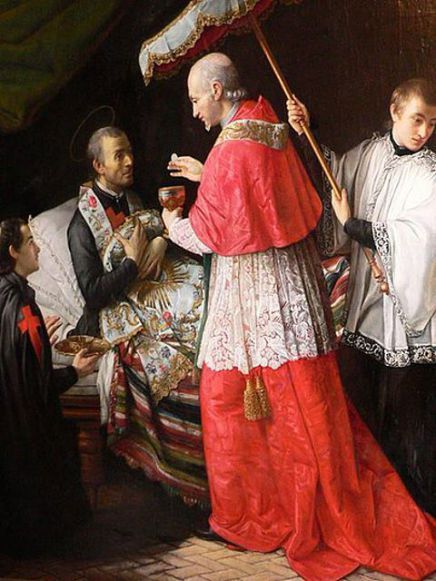
Receiving the Eucharist for the last time, he declared: “O Lord, I confess I am the most wretched of sinners, most undeserving of your favour but save me by your infinite goodness. My hope is placed in your divine mercy through your precious blood.”
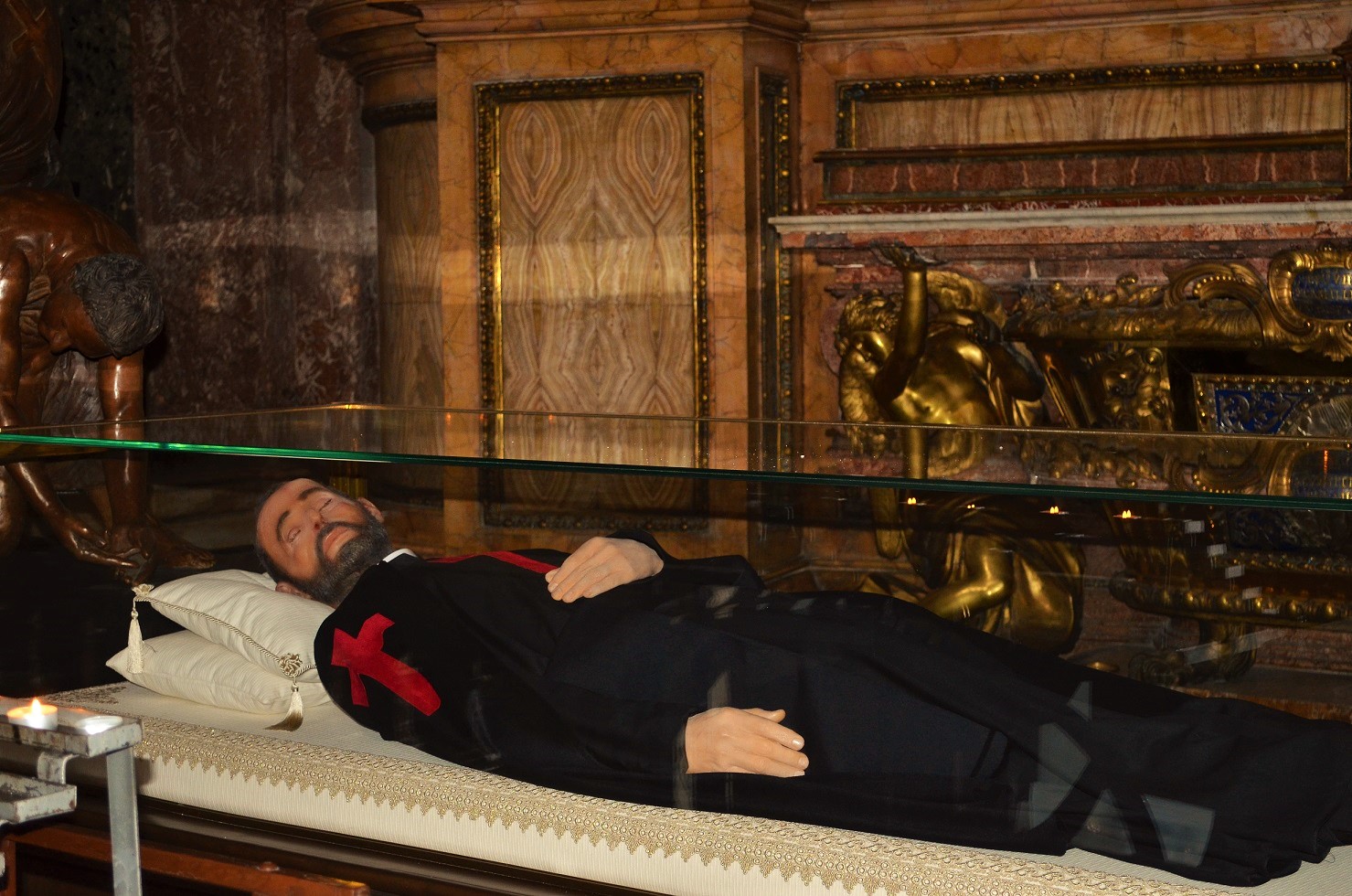
After giving his last instructions to his fellow Ministers of the Sick, St Camillus de Lellis died on 14 July 1614. He was Canonised by Benedict XIV in 1746 and later named – along with Saint John of God – as one of the two main co-patrons of nurses and nursing associations in 1930.
Quote/s of the Day – 23 April – Monday of the Fourth Week of Eastertide
“Speaking of Love, Life & Virtue”
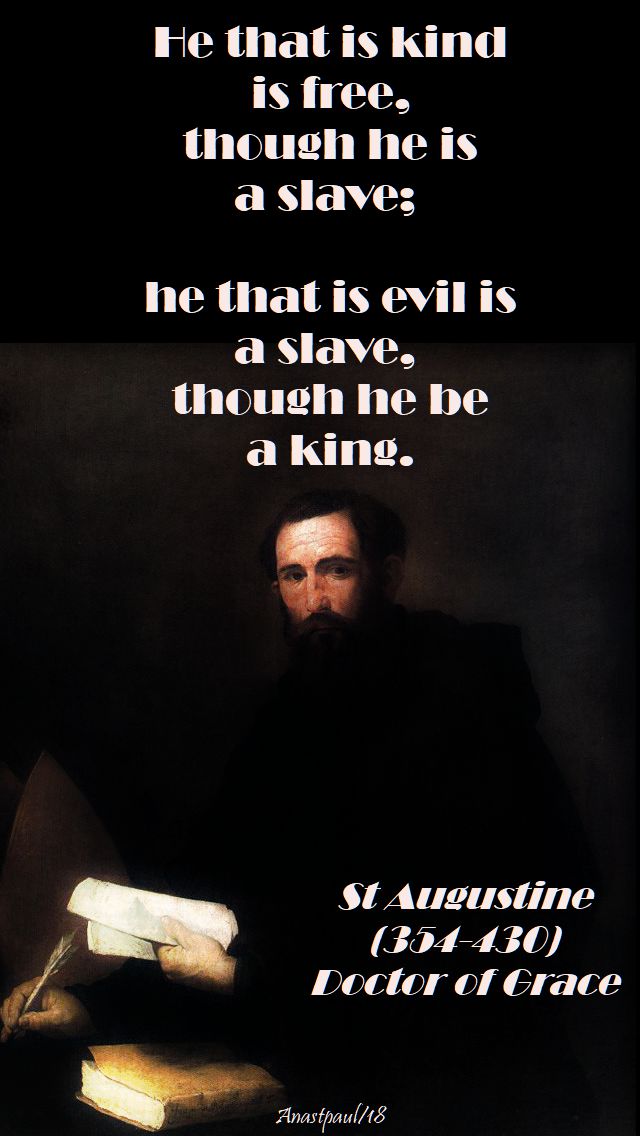
“He that is kind is free, though he is a slave; he that is evil is a slave, though he be a king.”
St Augustine (354-430) Doctor of Grace
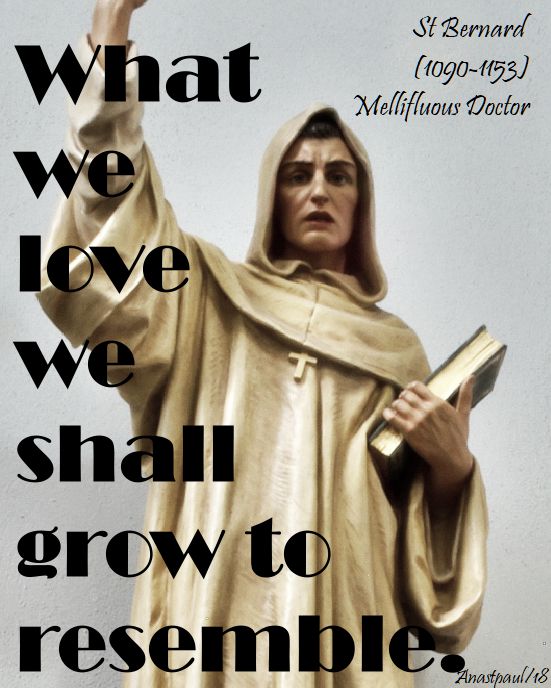
“What we love we shall grow to resemble.”
St Bernard of Clairvaux (1090-1153) Mellifluous Doctor
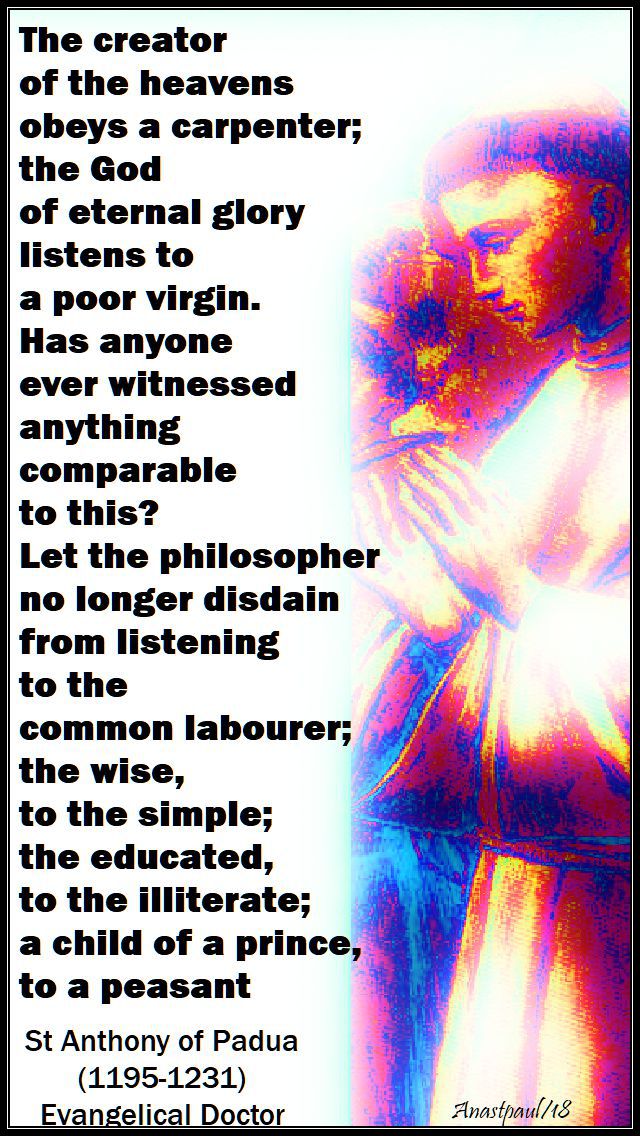
“The creator of the heavens obeys a carpenter; the God of eternal glory listens to a poor virgin. Has anyone ever witnessed anything comparable to this? Let the philosopher no longer disdain from listening to the common labourer; the wise, to the simple; the educated, to the illiterate; a child of a prince, to a peasant.”
St Anthony of Padua (1195-1231) Evangelical Doctor
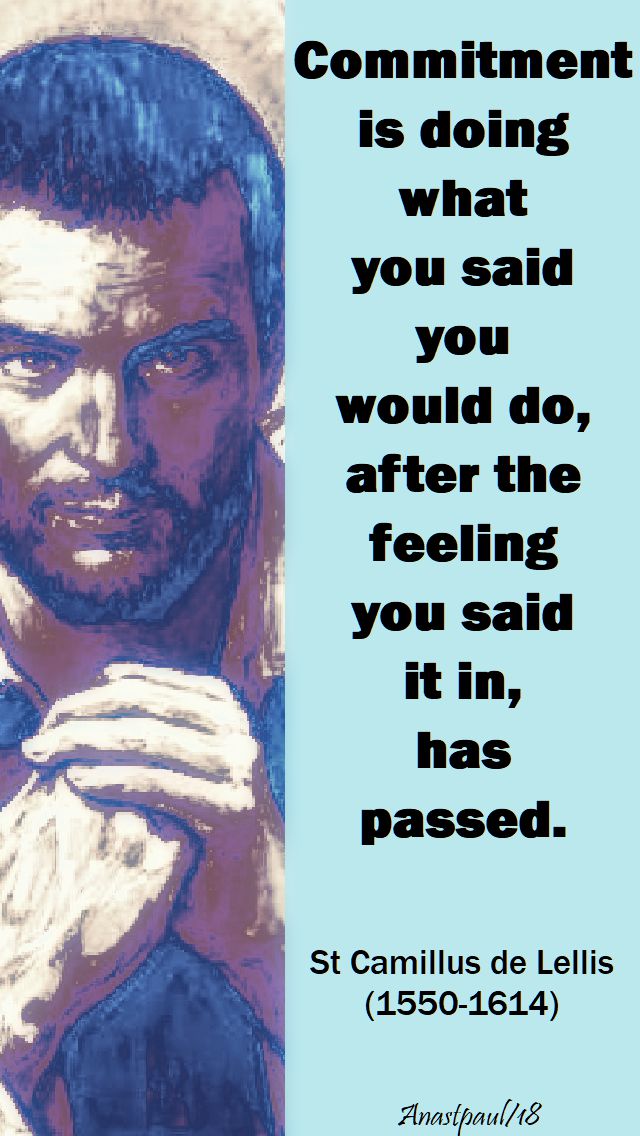
“Commitment is doing what you said you would do, after the feeling you said it in, has passed.”
St Camillus de Lellis (1550-1614)
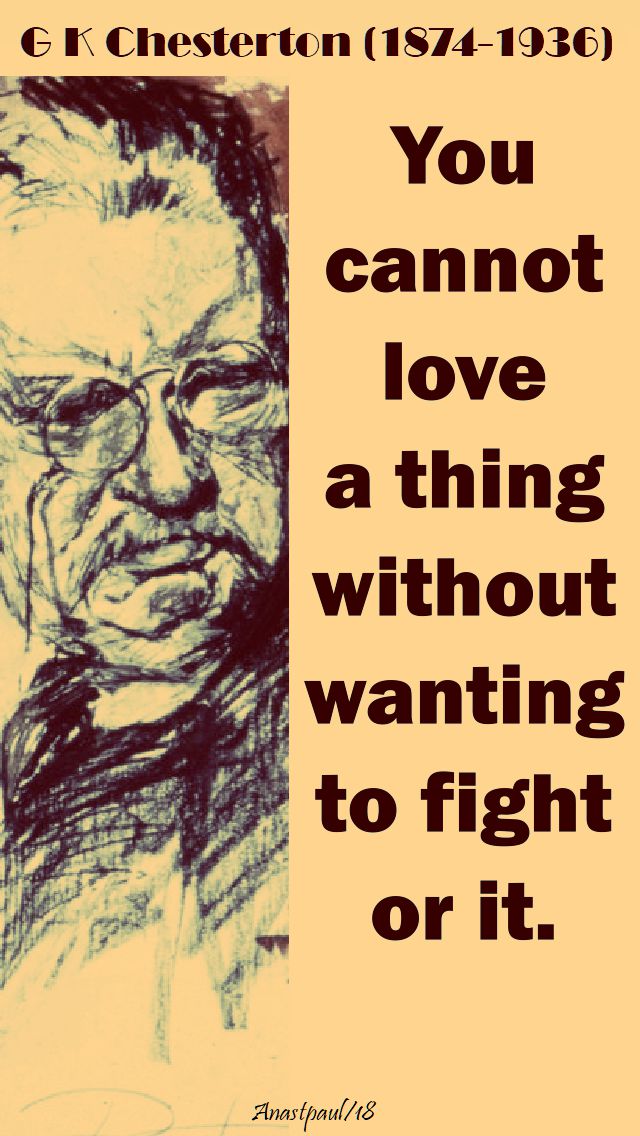
“You cannot love a thing without wanting to fight for it.”
G K Chesterton (1874-1936)
“You can’t go back and change the beginning but you can start where you are and change the ending.”
C S Lewis (1898-1963)
“The whole point of life is to learn to be a gift.”
Quote/s of the Day – 19 April – Thursday of the Third Week of Eastertide
“Speaking of: Becoming a Saint”
“Think well. Speak well. Do well. These three things, through the mercy of God, will make a man go to Heaven.”
St Camillus de Lellis (1550-1614)
“He who wishes for anything but Christ, does not know what he wishes; he who asks for anything but Christ, does not know what he is asking; he who works and not for Christ, does not know what he is doing.”
St Philip Neri (1515-1595)
“The great saint may be said, to mix all his thoughts with thanks. All goods look better, when they look like gifts.”
G K Chesterton (1874-1936)
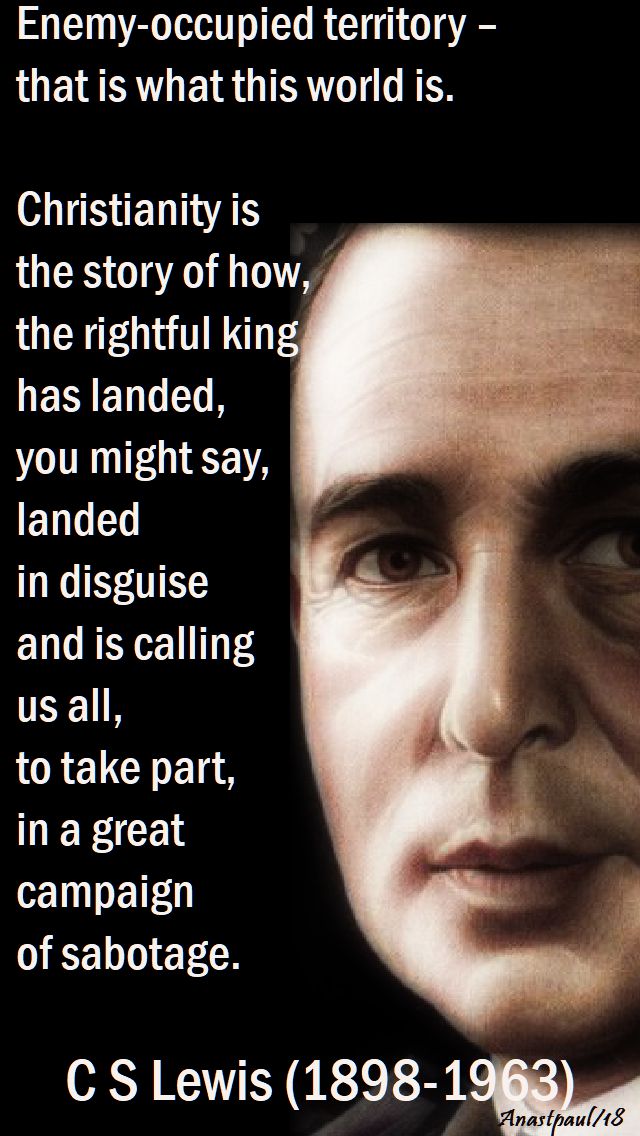
“Enemy-occupied territory – that is what this world is. Christianity is the story of how, the rightful king has landed, you might say landed in disguise and is calling us all, to take part, in a great campaign of sabotage.”
C S Lewis (1898-1963)
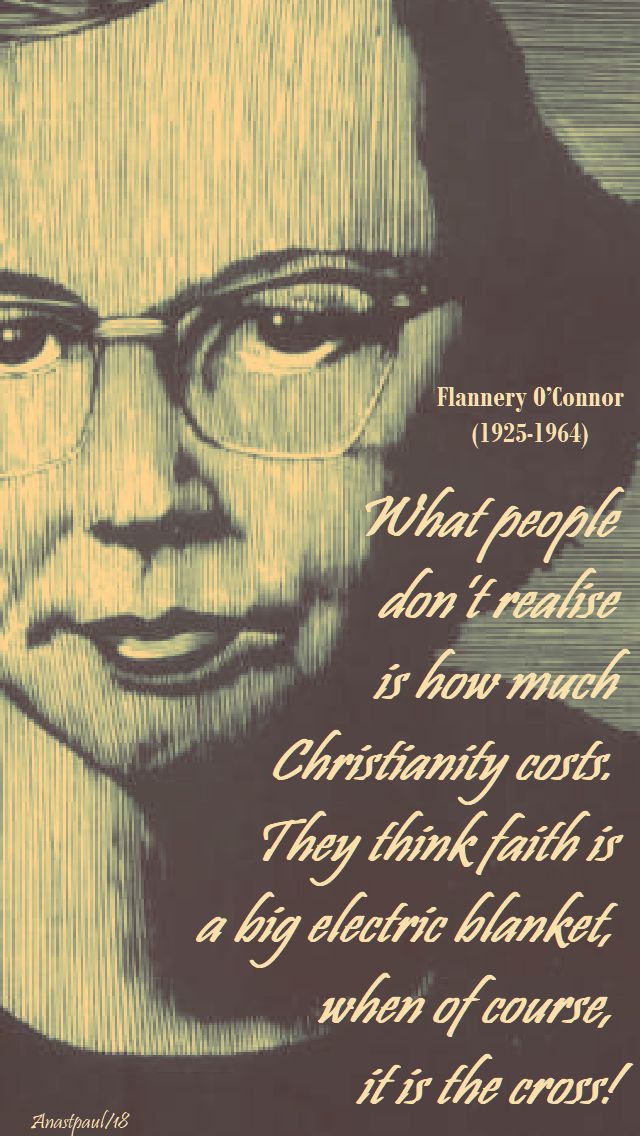
“What people don’t realise, is how much Christianity costs. They think faith is a big electric blanket, when of course, it is the cross.”
Flannery O’Connor (1925-1964)
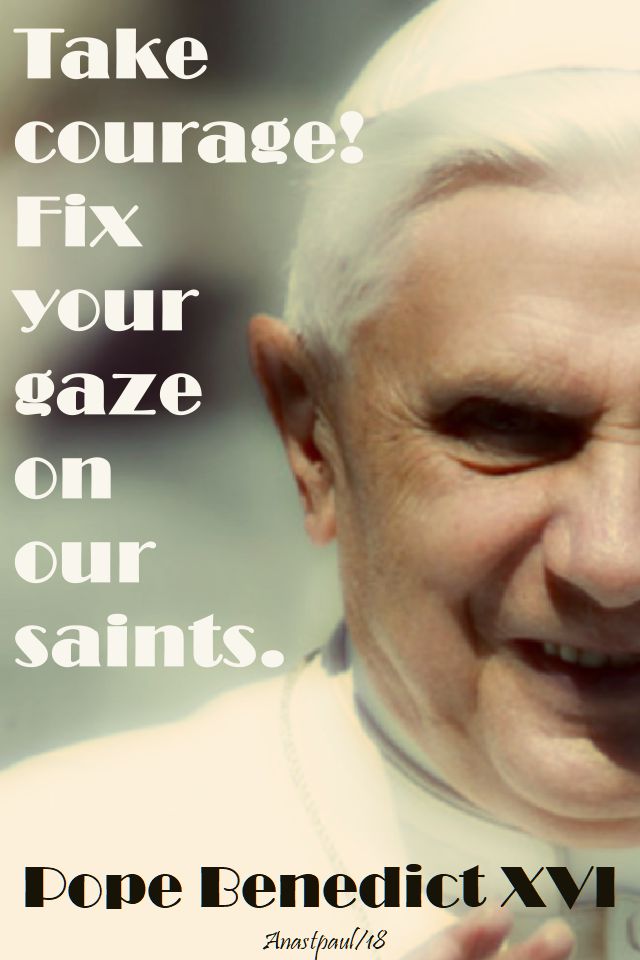
“Take courage! Fix your gaze on our saints.”
Pope Benedict XVI
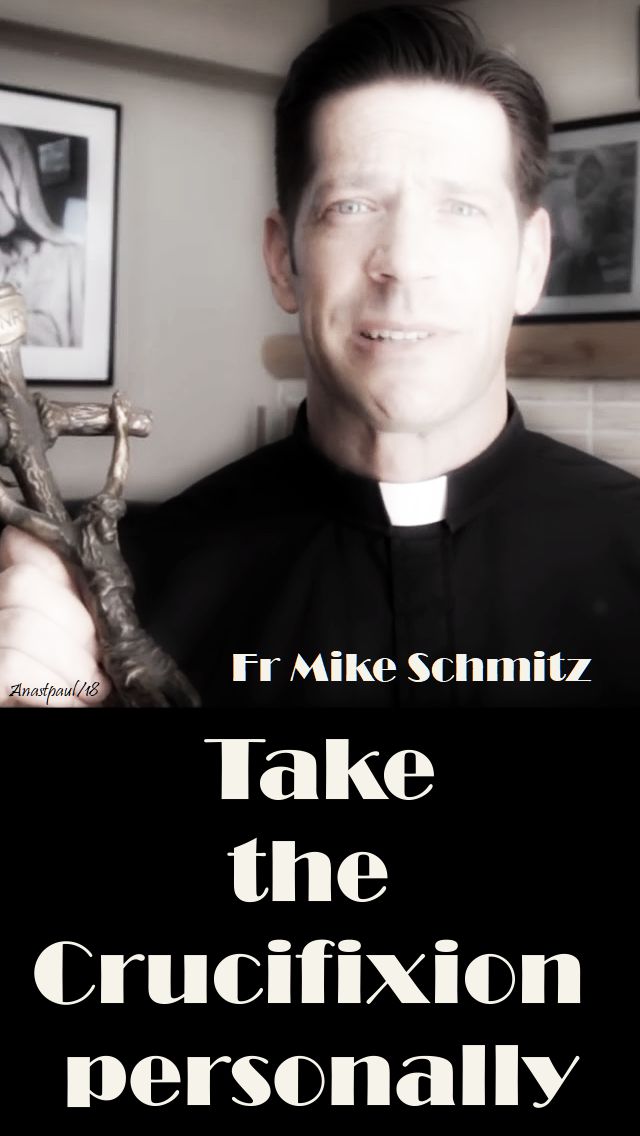
“Take the Crucifixion personally.”
“The road to holiness goes through your neighbour.”
It never ceases to amaze me how many saints we have, (all waiting to hear from us, by the way), who initially led lives totally against the precepts of natural moral order, Christ and Holy Scripture. But God is never far off – the ‘Hound of Heaven’ goes before and behind us. And God creates saints. Seemingly random meetings, words, in the case of St Camillus – a sermon by a Capachin and a meeting with St Philip Neri, alters everything, for we know that nothing is random – God has penetrated our selfishness, He becomes visible to our souls and once that happens we can only do our very best, try our hardest to do all for Him and as if everything depended on us. All human effort is the dispensing of God’s divine power and only God’s grace can make us like Himself.
Eye has not seen, ear has not heard, nor has it so much as dawned on man what God has prepared for those who love him………1 Cor 2:9
REFLECTION – “The happiness to which I aspire is greater than anything on earth. Therefore, I regard with extreme joy whatever pains and sufferings may befall me here.”………St Camillus de Lellis
PRAYER – Heavenly Father. keep my mind fixed on the surpassing joys stored up for me in heaven. And let me be willing to put up with all sufferings and pains that may come upon me. St Camillus de Lellis, pray for us, amen.
You must be logged in to post a comment.