Bl Dominic de Cubells St Donatus of Rome St Eustadius of Bourges St Festus of Valencia St Gelasius of Palestine Bl Giuseppina Nicoli St Hermes the Exorcist
St Offa of Benevento St Peter of Subiaco St Pinian St Potentian of Sens St Sabinian of Sens St Theophylact of Ohrid St Walembert of Cambrai St Wisinto of Kremsmünster St Zeno of Rome St Zoticus of Constantinople (Died c350) Priest
Martyrs of Catania – 10 Saints: A group of early Christians Martyred together, date unknown. The only other information to survive are ten of their names – Attalus, Cornelius, Fabian, Flos, Minervinus, Pontian, Quintian, Sextus, Simplician and Stephen. They were martyred in Catania, Sicily, Italy.
Martyrs of Rome – 10 Saints: A group of Roman women Martyred in an early persecution, date unknown. We known the names of ten of them – Dominanda, Donata, Hilaria, Nominanda, Paolina, Paulina, Rogata, Rustica, Saturnina and Serotina. Their relics were enshrined in the catacombs of Via Salaria, Rome, Italy.
Bl Dominic de Cubells St Donatus of Rome St Eustadius of Bourges St Festus of Valencia St Gelasius of Palestine Bl Giuseppina Nicoli St Hermes the Exorcist Saint Marius Aventicus (c 530-594) Bishop
St Offa of Benevento Bl Peter of Subiaco St Pinian St Potentian of Sens St Sabinian of Sens St Theophylact of Ohrid Bl Walembert of Cambrai Bl Wisinto of Kremsmünster St Zeno of Rome St Zoticus of Constantinople
Martyrs of Catania – 10 Saints: A group of early Christians Martyred together, date unknown. The only other information to survive are ten of their names – Attalus, Cornelius, Fabian, Flos, Minervinus, Pontian, Quintian, Sextus, Simplician and Stephen. They were martyred in Catania, Sicily, Italy.
Martyrs of Rome – 10 Saints: A group of Roman women Martyred in an early persecution, date unknown. We known the names of ten of them – Dominanda, Donata, Hilaria, Nominanda, Paolina, Paulina, Rogata, Rustica, Saturnina and Serotina. Their relics were enshrined in the catacombs of Via Salaria, Rome, Italy.
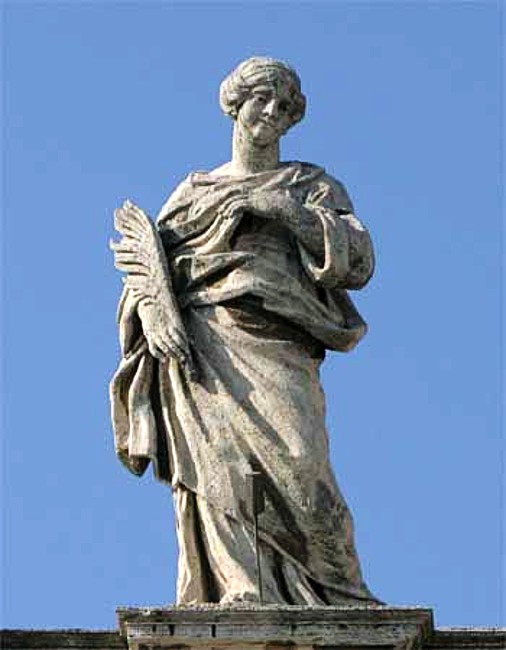
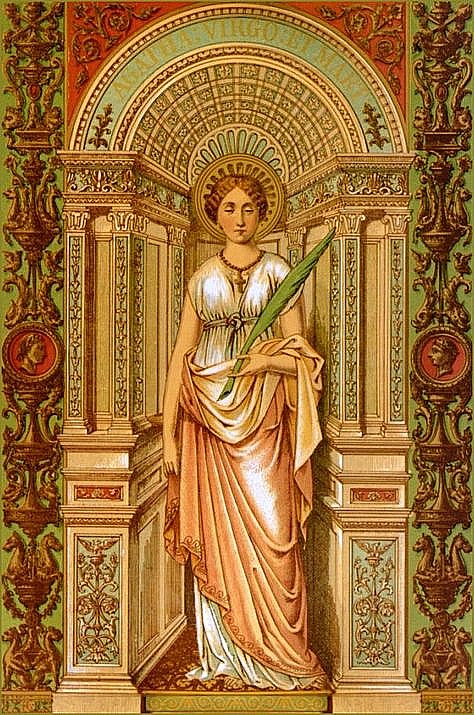
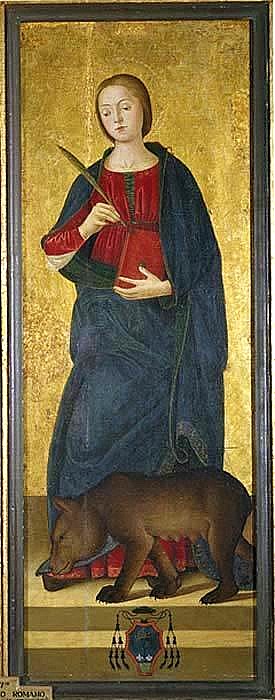
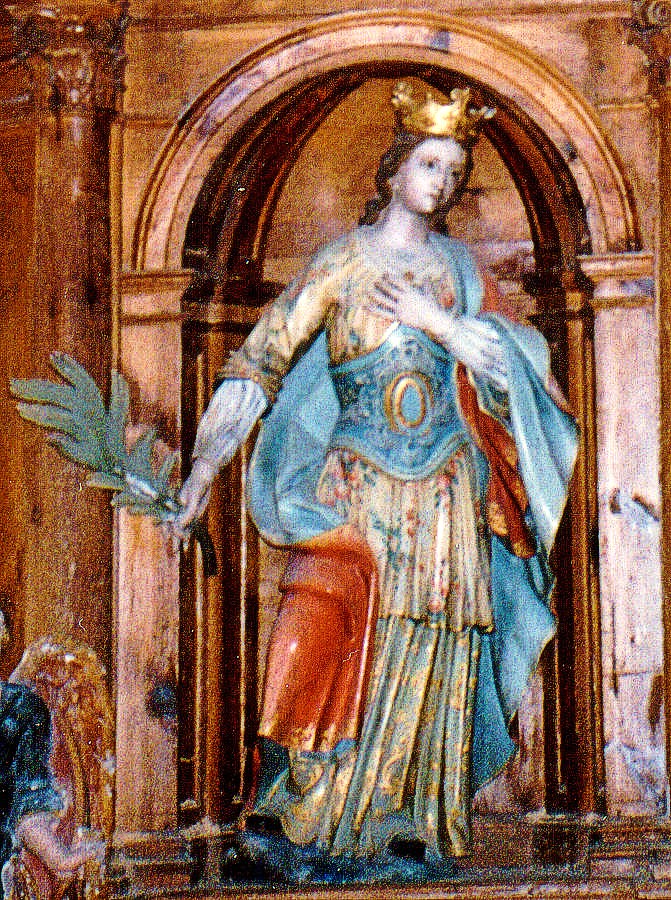
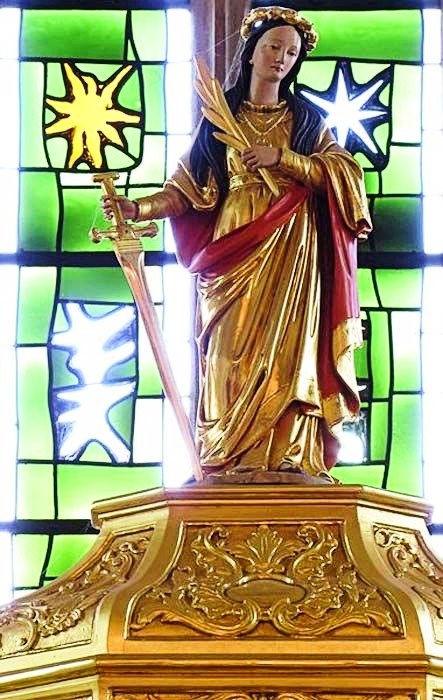
Saint of the Day – 31 December – Saint Columba of Sens (c 256-273) Virgin Martyr Born as Eporita in c257 in Spain and died by beheading in 273 at Sens, France near a fountain named d’Azon. Patronages – for rain, of bears. St Columba is a Colonnade Saint at St Peter’s – you can find her as Saint Number 40 on the North Colonnade.
St Columba on the North Colonnade
Columba was a virgin and martyr at Sens. Though little historical information is known, popular devotion made her one of the most famous and revered Martyrs in the Middle Ages.
The Roman Martyrology states: “At Sens in Lugdunense Gaul, now in France, Saint Colomba, Virgin and Martyr.”
Colomba is presented as belonging to a noble but pagan family of Spain and lived in the third century. To escape the cult of the gods, she left her family and went to Gaul (France) first to Vienne, where she received Baptism, then to Sens. It appears that her real name was Eporita and that she would later be called the Dove (the meaning of Columba) due to her innocence.
In Sens, she was arrested as a Christian in the ongoing persecution throughout the Roman Empire. The Emperor Aureliano Lucio Domizio (270-275), being present in Sens at that time, had Columba and others, brought before him,. In an attempt to make her renounce her Christian virginity, he proposed marriage to her. But then irritated by her refusal, he condemned her to be locked up in the amphitheater in a prostitution cell. When a young soldier arrived there to abuse her, a she-bear who had been kept in the amphitheater, intervened to protect her, putting the man to flight.
Since none of the soldiers, fearful of their lives, now wanted to take his place,Aureliano furiously ordered, that both the Virgin and the Bear be burned but a cloud coming from Africa, procured a providential rain, which extinguished the fire already prepared, while the bear ran away into the forests. The stubborn Emperor then sentenced Colomba to be beheaded, after one last attempt to make her change her faith.
The young woman, just sixteen years old, suffered Martyrdom not far from Sens and was buried by a Christian who, immediately invoking her intercession, recovered his sight. This happened in the second half of the third Century, in the years between 270 and 275, referring to the Emperor Aurelian, who found himself in Sens for his wars in Gaul.
Highly venerated in France at the time, in 620 King Lothair III founded the famous Royal Abbey of Sainte-Colombe-les-Sens on the Tomb of the Saint. In 623 the Bishop of Sens, St Wolf († 623) wanted to be buried at the Martyr’s feet; in 853 the Bishop Wessilone in Consecrating the new Church, found the relics of the two Saints united and had them wrapped in a precious shroud in oriental fabric. Pieces of this shroud were found in the nineteenth Century and are kept in the Treasury of the Cathedral.
The Abbey Church was built a third time and Consecrated in 1164 by Pope Alexander III, then destroyed in 1792 at the time of the French Revolution. The remains of the Abbey and Church complex were purchased in 1842 by the Nuns of the Holy Childhood of Jesus and Mary, who built their Mother House there, safeguarding the remains of the ancient crypt. The relics of St Columba had ,however ,in a803, been transferred to the Cathedral of Sens.
There are numerous Churches dedicated to the holy Martyr in France, Spain, Flanders, Germany and Italy, where her cult spread, most especially in Rimini. According to local traditions, some merchants who sailed in the Adriatic had, with them, a relic of the head of St Columba but were forced to land in Rimini, where the relic was welcomed by Bishop Stennio and placed in the Cathedral.
The Shrine of St Columba in Sens
In 1581 Msgr. Castelli, Bishop of Rimini, being Apostolic Nuncio to France, obtained, from the Monks of the Abbey of Sens, the relics of a rib and two teeth of the Martyr, which since the 18th Century, are preserved in a Reliquary bust now placed in the Malatesta TChurch the new Cathedral , which replaced the other, which was demolished in 1815 AND dedicated to the St Trinità and St Columba. There was talk of a translation of the body of Columba to Bari in the 17th Century but without any serious foundation.
Starting from the Geronymian Martyrology, up to the Roman one, the feast of St Columba is reported to be celebrated on 31 December. The popularity of the cult in France then slowly waned and an attempt to bring it back into widespread circulation in the 14th Century failed. In Sens, however, due to a local festival, concomitant with New Year’s Eve, St Columba’s feast was postponed to 27 July and is still honoured on this day as well as further devotions and celebrations, on the anniversary of the transfer of her relics and the dedication of her Church. All of these memorials are still observed with great devotion in Sens and the neighbouring area.
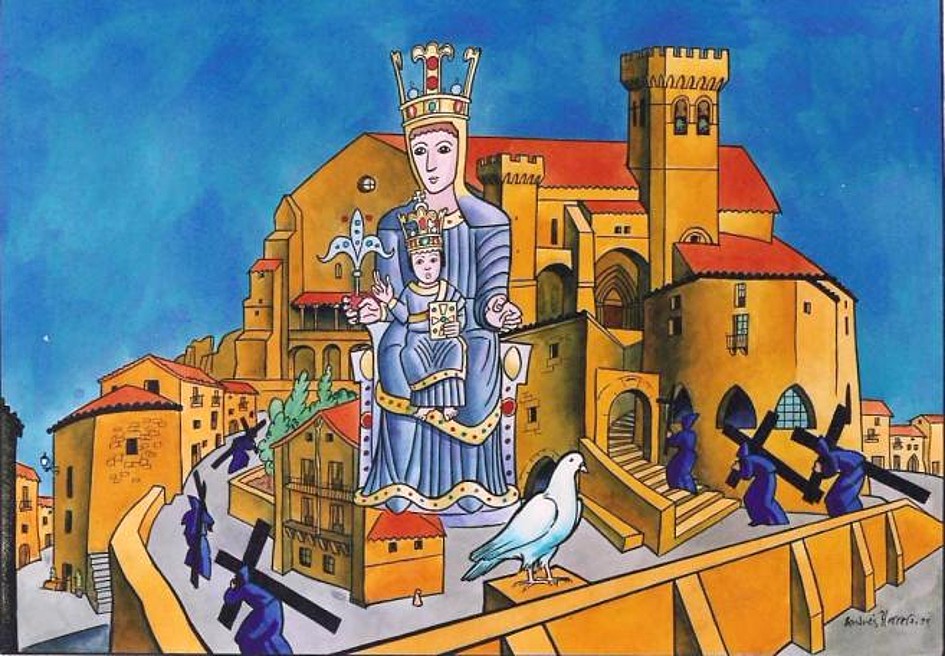
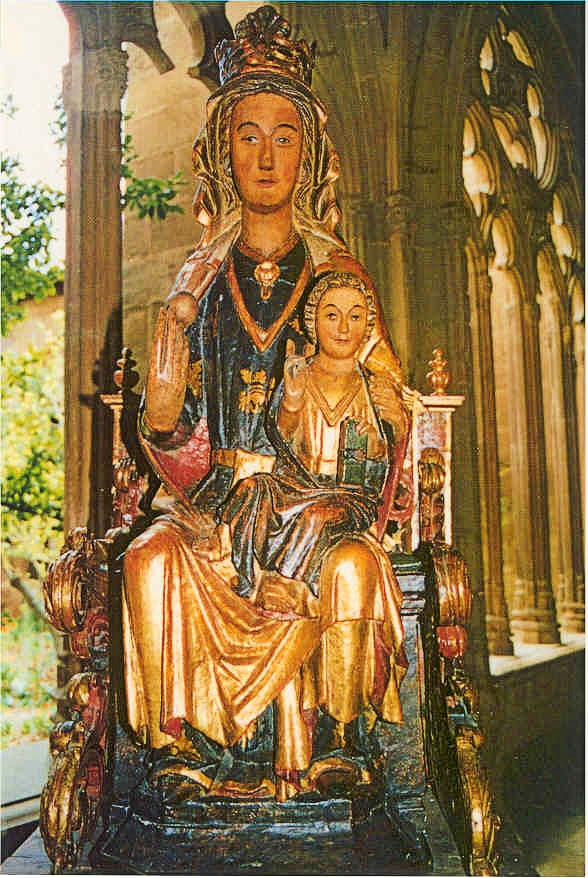
Santa María la Real de Uxue / Our Lady of Uxue (Uxue, Spain) (8th Century) – 31 December:
The Town of Uxue formed, according to legend, around the site of the discovery of the image of Our Lady of Uxue, whose site was designated by the flight of a dove. By the 8th century, the image was well-known. The settlement takes the form of a fortress and the 11th Century, Church of St Mary, is a medieval jewel of Romanesque art of Navarra, which is very popular and protected by successive Monarchs.
The strong medieval devotion to this image has remained to our times. Among the celebrations and devotions, are the festivities of an annual pilgrimage and the pilgrimage of the Brotherhood of the Twelve of Uxué. Uxué is a small medieval Town full of charm, located in the eastern middle of Navarra (north of Spain and on the border with France), 53 km from Pamplona and 20 km from Tafalla. Its location is unique, as it is located on the top of a mountain overlooking the Sierra de Uxué. With an altitude of 815 meters above sea level, Uxué constitutes an authentic watchtower from which on clear days you can see from the Pyrenean ridge to the north to the banks of the Ebro and the silhouette of the Moncayo to the south. The origins of this Town are unclear, the exact date of its foundation being unknown but the beginnings are attributed to the Virgin Mary accompanied by the Holy Spirit in the form of a dove.
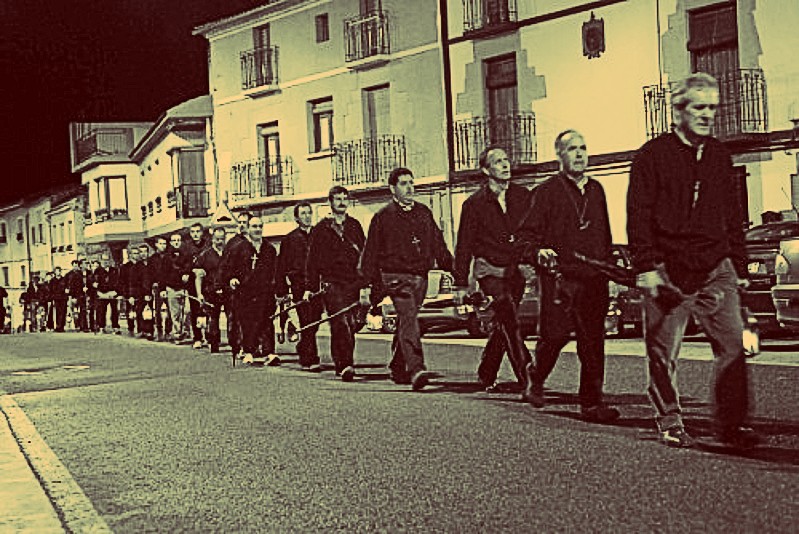
Legend has it that a dove went in and out of the hole in a rock. A boy who was herding sheep, moved by curiosity, approached with the intention of scare the dove away. But the dove continued with its insistent flapping, he approaches and found a beautiful Romanesque image of the Virgin Mary. This is how the Uxué was born. The name of the town comes from Uxua, the Basque language word for “dove“. Already before Roman domination, there was a Basque population scattered throughout the mountains, as recent archaeological discoveries attest. A Sanctuary honouring the Blessed Virgin was immediately built and has retained it’s popularity amongst the pious faithful across the ages. Many miraculous graces and cures have been granted there. A total of 44 members of the Brotherhood of the Twelve Apostles of Our Lady of Uxué, including the Chaplain, participate each year in their traditional night march to the sanctuary of the Virgin of Uxué. This Brotherhood has its origins in 1607 and therefore 2007 commemorated the fourth centenary of its foundation.
Blessed Alain de Solminihac OSA (1593-1659) Bishop of Cahors, Abbot, Reformer, Marian devotee most especially to Our Lady of Rocamadour, Apostle of the Holy Eucharist especially by his promotion of Adoration, he was also a member of the Compagnie du Saint-Sacrement. His Story: https://anastpaul.com/2019/12/31/saint-of-the-day-31-december-blessed-alain-de-solminihac-osa-1593-1659/ St Anton Zogaj St Barbatian of Ravenna St Columba of Sens (c 256-273) Virgin Martyr Bl Dominic de Cubells St Festus of Valencia St Gelasius of Palestine Bl Giuseppina Nicoli St Hermes the Exorcist
St Offa of Benevento Bl Peter of Subiaco St Pinian St Potentian of Sens St Sabinian of Sens St Theophylact of Ohrid Bl Walembert of Cambrai Bl Wisinto of Kremsmünster St Zoticus of Constantinople — Martyrs of Catania – 10 saints: A group of early Christians martyred together, date unknown. The only other information to survive are ten of their names – Attalus, Cornelius, Fabian, Flos, Minervinus, Pontian, Quintian, Sextus, Simplician and Stephen. They were martyred in Catania, Sicily, Italy.
Martyrs of Rome – 10 saints: A group of Roman women martyred in an early persecution, date unknown. We known the names of ten of them – Dominanda, Donata, Hilaria, Nominanda, Paolina, Paulina, Rogata, Rustica, Saturnina and Serotina. Their relics were enshrined in the catacombs of Via Salaria, Rome, Italy.
Martyred in the Spanish Civil War: • Blessed Leandro Gómez Gil • Blessed Luis Vidaurrázaga González





 AnaStpaul
You must be logged in to post a comment.