
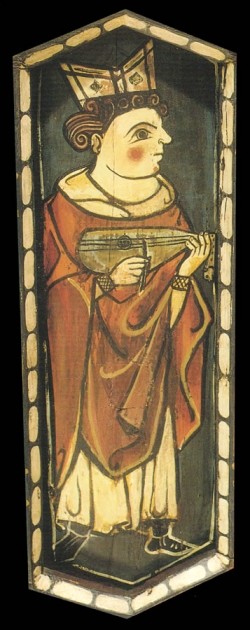
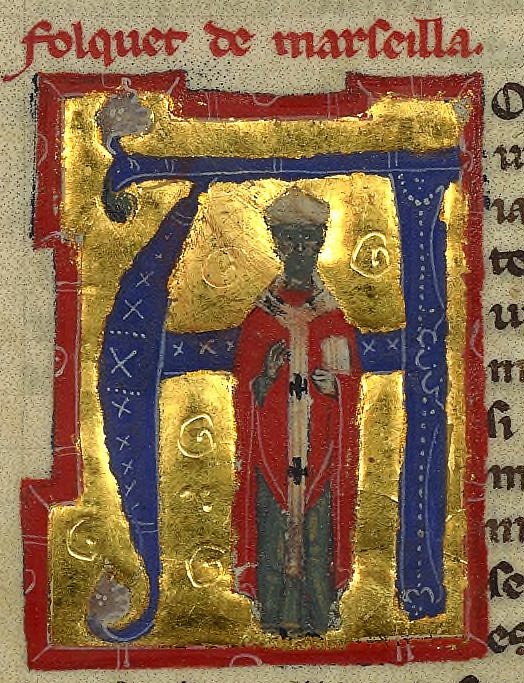
Saint of the Day – 25 December – Saintt Fulk of Toulouse (c1155-1231) Bishop, a fierce and untiring Defender of the Faith against heresies, Musician, Composer and Lyricist, Poet, Born in c1155 at Genoa, Italy and died in 1231 in Toulouse of natural causes. Also known as – Folquet, Folquet de Marseille, Folquet de Marselha, Foulques de Toulouse, Coots of Toulouse, the Minstrel Bishop.

Fulk was born into a Genoese merchant family but, in about 1180, he left his life as a merchant to become a singing and playing Minstrel Poet. He was widely respected and successful throughout Provence and Aragon. His works, which include love lyrics (often dedicated to his patron’s wife), crusading songs and religious poems and hymns, demonstrate a classical education and careful metrical forms.
In 1195, Fulk’s life and career abruptly changed, when he experienced a profound religious conversion and decided to renounce his former life. He joined the strict Cistercian Order, entering the Monastery of Thoronet (Var, France) and appears to have placed his wife and two sons in monastic institutions as well. He soon rose in prominence and was elected Abbot of Thoronet which allowed him to help found the sister house of Géménos to house women, quite possibly including his wife.
In 1205 Fulk was elected Bishop of Toulouse and immediately he took a very active role in combatting heresy. Throughout his Episcopal career, he sought to create and encourage outlets for religious enthusiasm which were Catholic, in an effort to woo believers away from preachers of heresy (primarily Cathar and Waldensian). In 1206 he created what would become the Convent of Prouille, to offer women a religious community which would rival (and, where necessary, replace) those of the Cathars. He participated in the initial preaching mission of Saint Dominic which was led by Dominic’s superior, Bishop Alphonsus Didacus of Osma. He continued to support this new form of preaching after Bishop Alphonsus Didacus’ death by assisting St Dominic and his followers, eventually allotting to the nascent Dominicans, property and a portion of the tithes of Toulouse, to ensure their continued success. In July 1215 Fulk issued a Diocesan letter instituting St Dominic’s Order of Preachers. In November 1215 he and Dominic, with Guy of Montfort, were in Rome at the Fourth Lateran Council.

Bishop Fulk had tumultuous relations with his Diocese, primarily on account of his support of the Albigensian Crusade which was popularly perceived as a war of aggression against the region. Hated by many Toulousains and by Count Raymond VI of Toulouse. he left Toulouse on 2 April 1211, after the crusaders laid siege to the City. Our Saint requested a release from his See but the Pope refused. Fulk spent much of the following decade outside his Diocese, assisting the crusading army and the Church’s attempts to bring order to the region. He was at the Council of Sens in 1223.
In 1229, after the Peace of Paris finally ended the crusade, Fulk returned to Toulouse and began to construct the institutions that were designed to combat heresy in the region. He helped to create the University of Toulouse and administered the newly created Episcopal Inquisition.
Fulk died in 1231 and was buried, beside the tomb of William VII of Montpellier, at the Abbey of Grandselves, near Toulouse, where his sons, Ildefonsus and Petrus had been Abbots.

 AnaStpaul
You must be logged in to post a comment.