St Acepsimas St Acheric of Vosges Bl Alphais of Cudot Bl Berardo dei Marsi Bl Berchtold of Engelberg St Caesarius St Cecilio Manrique Arnáiz St Clydog St Cristiolus St Domnus of Vienne St Elerius St Englatius St Florus of Lodeve St Gaudiosus of Tarazona St Germanus St Guenhael St Hermengaudius of Urgell St Hilary of Viterbo
St Sylvia Mother of St Gregory the Great, Pope St Theophilus St Valentine of Viterbo St Valentinian St Vitalis St William of Vosges St Winifred of Wales St Wulganus
Innumerable Martyrs of Saragossa: A large group of Christians martyred in Zaragoza, Spain by Dacian during the persecutions of Diocletian. Dacian ordered all Christians of the city into exile under pain of death; when they were assembled to leave, Dacian ordered imperial soldiers to massacre the lot of them. They were Martyred in 304.
St Acepsimas St Acheric of Vosges Bl Alphais of Cudot Bl Berardo dei Marsi Bl Berchtold of Engelberg St Caesarius St Cecilio Manrique Arnáiz St Clydog St Cristiolus St Domnus of Vienne St Elerius St Englatius St Florus of Lodeve St Francisco Colom González St Gaudiosus of Tarazona St Germanus St Guenhael St Hermengaudius of Urgell St Hilary of Viterbo
St Papulus St Pirmin St Quartus St Rumwold of Buckingham Blessed Simon Ballachi OP (c 1210-1319) Lay Brother of the Order of Preachers, Mystic. St Sylvia of Rome St Theophilus St Valentine of Viterbo St Valentinian St Vitalis St William of Vosges St Winifred of Wales St Wulganus
Innumerable Martyrs of Saragossa: A large group of Christians martyred in Zaragoza, Spain by Dacian during the persecutions of Diocletian. Dacian ordered all Christians of the city into exile under pain of death; when they were assembled to leave, Dacian ordered imperial soldiers to massacre the lot of them. They were Martyred in 304.
Saint of the Day – 3 November – Saint Hubert of Liege (c 656-727) the first Bishop of Maastricht, the “Apostle of the Ardennes,” spiritual student of Saint Lambert of Maastricht (c 635-c 700), excellent Preacher and devoted to the needs of the poor, widower and father to St Floribert of Liege. Born in c 656 at Maastricht, Netherlands and died on 30 May 727 at Fura (modern Tervueren), Brabant, Belgium of natural causes. Patronages – against dog bite, against hydrophobia, against mad dogs, against rabie. of archers, dogs, forest workers, furriers, hunters, huntsmen, hunting, Liege, Belgium, machinists, mathematician, metal workers, opticians, precision instrument makers, the Town of Saint-Hubert, Belgium, smelters, trappers . Also known as – Apostle of the Ardennes, Hubert the Hunter, Hubertus… Additional Memorial – 30 May (translation of relics).
Hubert likely was born in Toulouse about the year 656, the eldest son of Bertrand, Duke of Aquitaine. As a youth, Hubert was sent to the Court of Theuderic III at Paris, where his charm and agreeable manner ,led to his investment with the dignity of “Count of the Palace.” Hubert was a hunting enthusiast and spent a great deal of time in learning the skills of the sport.
About 682, Hubert married Floribanne, daughter of Dagobert, Count of Leuven. Their son, Floribert of Liège later would become Bishop of Liège and a Saint, in the footsteps of his father. Hubert soon followed his noble peers to the Austrasian Court and was warmly welcomed by Pepin of Herstal, Mayor of the Palace, who entitled him, almost immediately, Grand Master of the household.
Hubert’s wife had died giving birth to their son Floribert and his grief prompted him to retreat from the Court. He withdrew into the forests of the Ardennes and gave himself up entirely to hunting.
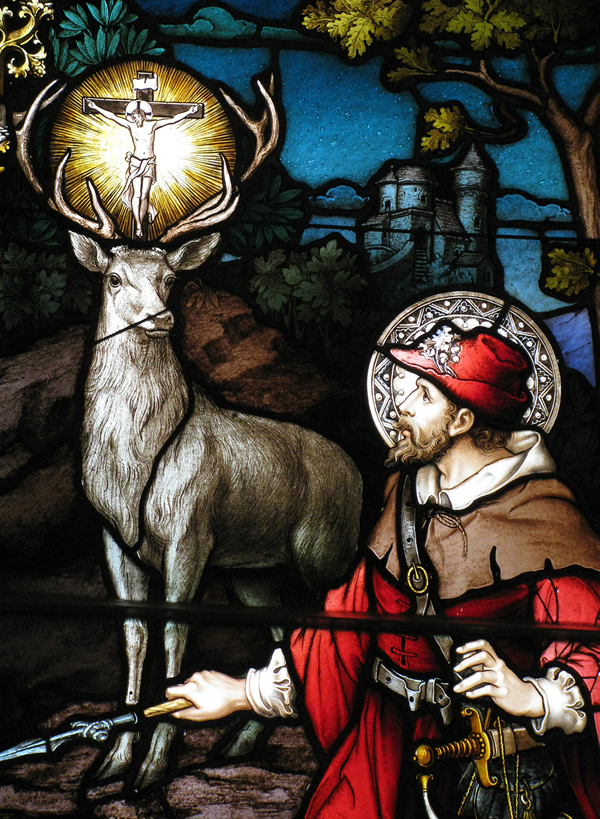
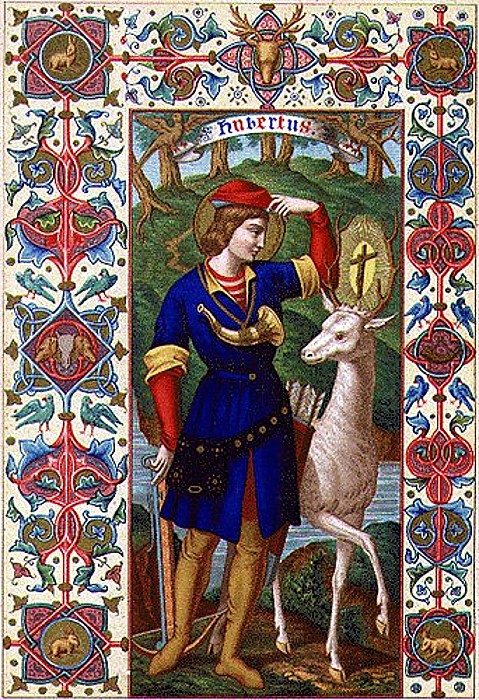
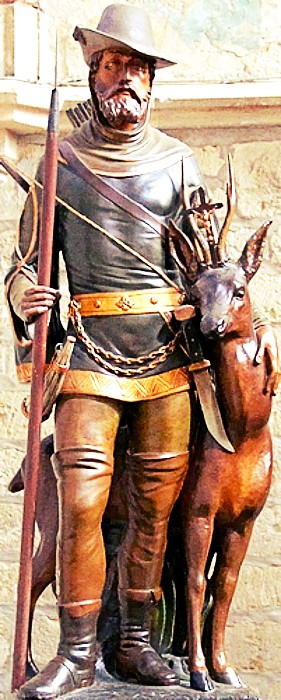
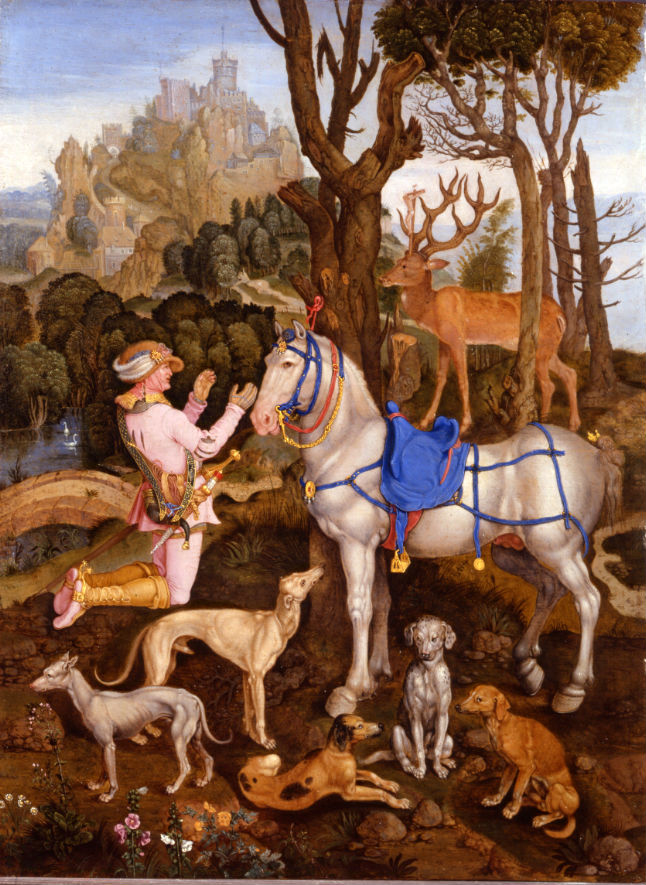
On a Good Friday morning, while the faithful were in Church, Hubert was hunting in the forest. As he pursued a magnificent stag or hart, the animal turned and Hubert was astounded to see a Crucifix floating between its antlers. He heard a Voice saying: “Hubert unless thou turnest to the Lord and leadest a holy life, thou shalt quickly go down into Hell.” Hubert dismounted and prostrated himself and after asking “Lord, what wouldst Thou have me do?” he wasitold, “Go and seek Lambert and he will instruct you.“
Hubert set out immediately for Maastricht, to meet Lambert, a Bishop who received him kindly and became his spiritual director. Hubert renounced all his very considerable honours and gave up his birthright to the Aquitaine to his younger brother, Odo, whom he made guardian of his infant son, Floribert. Having distributed all his personal wealth among the poor, he studied for the Priesthood, was Ordained and soon after, became one of St Lambert’s assistants in the administration of his Diocese. By the advice of St Lambert, Hubert made a pilgrimage to Rome in 708 but during his absence, Lambert was assassinated by the followers of Pepin. According to the hagiographies of Hubert, this act was simultaneously revealed to the Pope in a vision, together with an injunction to appoint Hubert Bishop of Maastricht.
Saint Hubert being Consecrated Bishop by Pope Sergius I
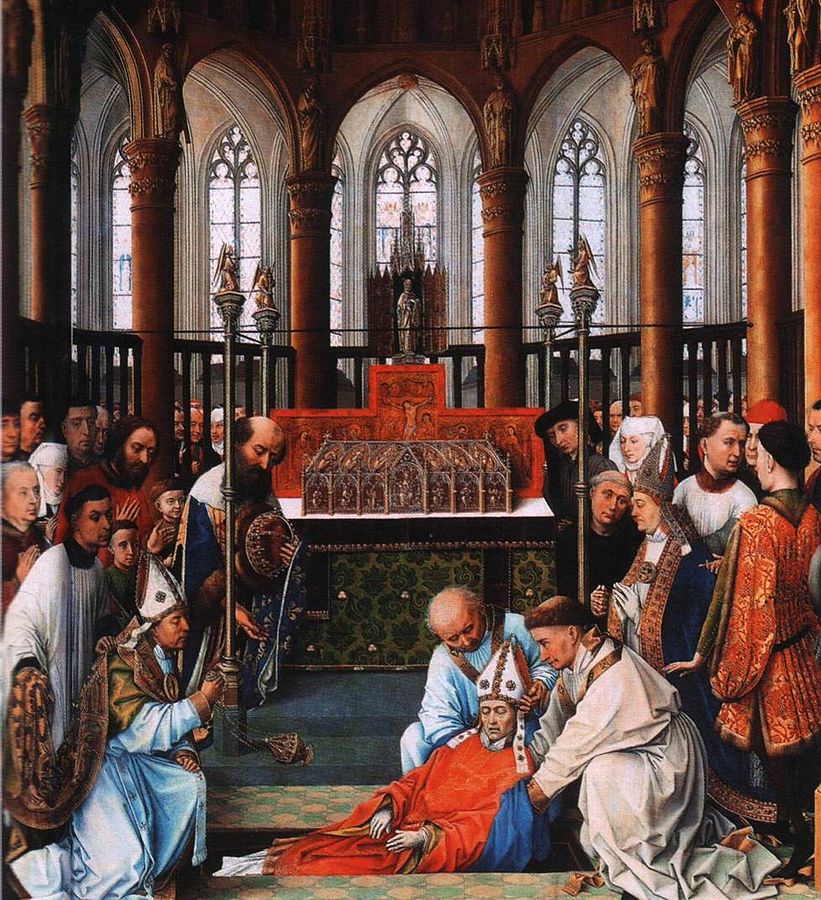
Hubert distributed his episcopal revenues among the poor, was diligent in fasting and prayer and became well known for his eloquence in the pulpit. In 720, in obedience to a vision, Hubert translated St Lambert’s remains from Maastricht to Liège with great pomp and ceremony, with several neighbouring Bishops assisting. A Basilica to enshrine the elics was built upon the site of Lambert’s Martyrdom and was Consecrated as a Cathedral the following year, the See being removed from Maastricht to Liège, then only a small village. This laid the foundation of the future greatness of Liège, of which Lambert is honoured as Patron and Hubert as Founder and first Bishop.
Th removal of St Lambert to the Cathedral of Lieges by Rogier van der Weyden
Hubert actively evangelised among pagans in the extensive Ardennes forests and in Toxandria, a district stretching from near Tongeren to the confluence of the rivers Waal and the Rhine.
Hubert died peacefully in a place called Fura, located 30 miles from Liège on 30 May 727 or 728. Initially he was buried in the collegiate St.Peter’s Church, Liège but his relics were exhumed in 825 and translated to the Benedictine Abbey of Amdain, the present-day Saint-Hubert, Belgium in the Ardennes. The Abbey became a holy destination for pilgrims, until Hubert’s coffin disappeared during the Reformation.
Hubert was widely venerated in the Middle Ages and partly because of his noble birth, several military orders were named after him – the Bavarian, the Bohemian International Order of St. Hubert and that of the Archbishop-Elector of Cologne.
Hubert, along with St Quirinus of Neuss, St Cornelius and St Anthony, was venerated as one of the Four Holy Marshals (Vier Marschälle Gottes) in the Rhineland. The St Hubertus Order, a chivalric order, was founded in 1444 .
Following Lamberts’ assassination, Hubert becomes Bishop of Maastricht, then of Liége but he was known as the Apostle of the Ardennes throughout his life, venturing much into the Forest and gaining the trust and the faith, of its people. Hubert became an important reference and intercessor, whenever matters of the Ardennes Forest and any other forest, are being discussed or considered in need of assistance.
The true meaning of the Jägermeister logo takes after the story of Saint Hubert’s vision. The Rrademark story of the Company is below, along with the logo:
“Only a legendary stag’s head would suffice, one with a Cross between its antlers. The stag that appeared to a wild hunter and converted him to Christianity. The same hunter who would later become the Patron Saint of all hunters – Saint Hubert. This stag remains today, as it always has been, the Jägermeister trademark. A symbol of the preservation of our quality and tradition.”
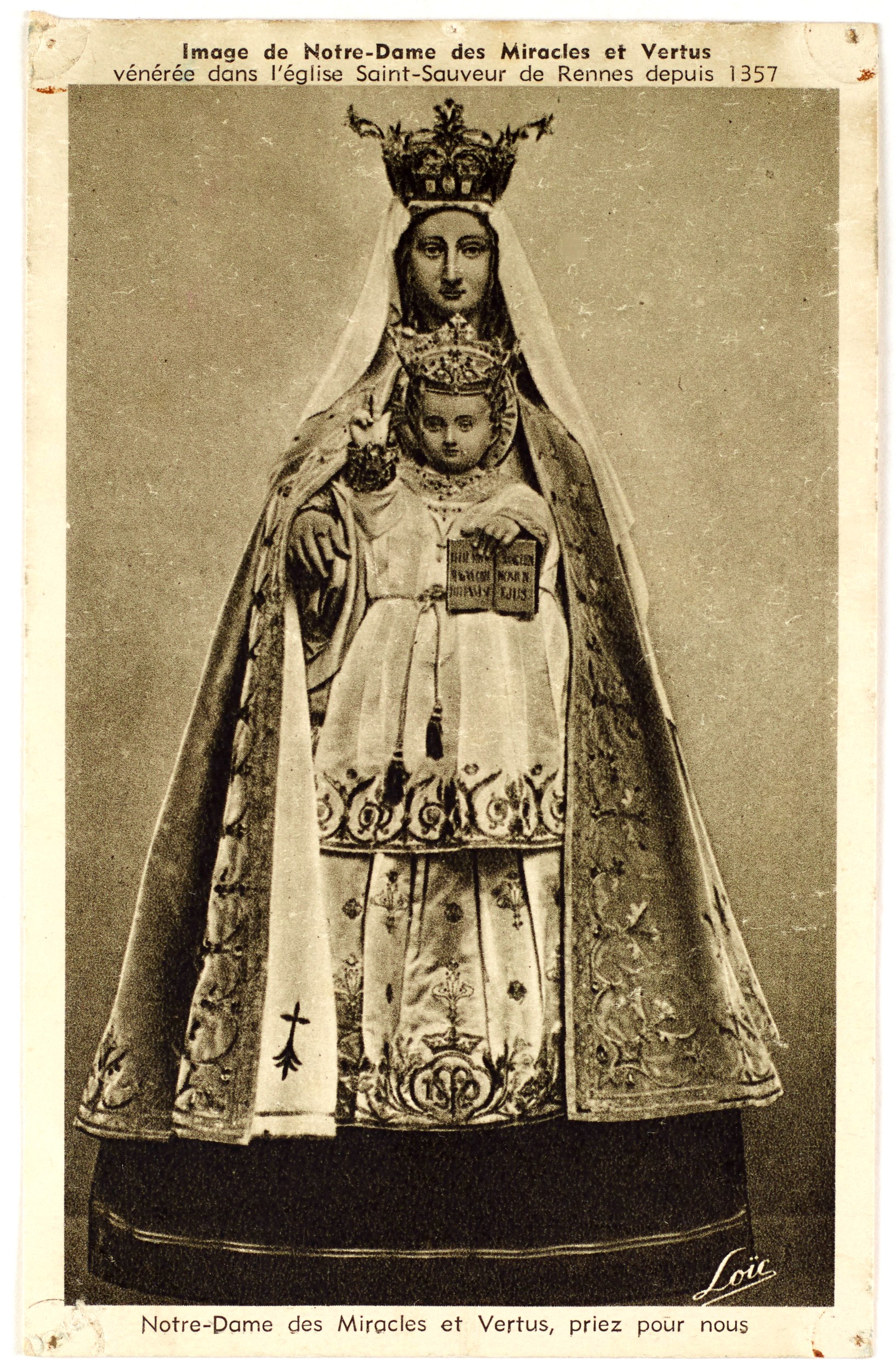
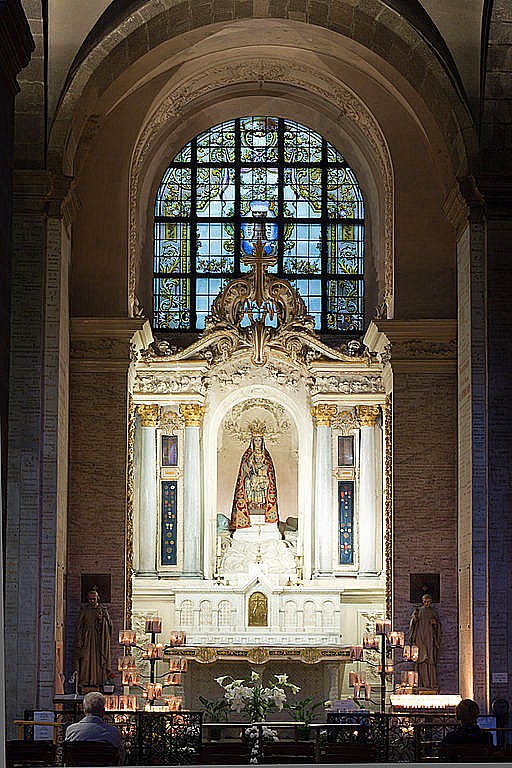
Notre-Dame des Miracles et Vertus / Our Lady of Miracles and Virtues, Rennes, France (14th Century) – 3 November:
The Statue of Our Lady of Miracles and Virtues, often simply called Our Lady of Miracles, is a depiction of Virgin and Child. Installed in 1876, it replaces the original Statue venerated since the fourteenth century and destroyed during the French Revolution. The original Statue was first mentioned in the fourteenth century , as part of a miracle that would have occurred during a siege of the City. It is created in 1445 and her hands were restored in 1522.
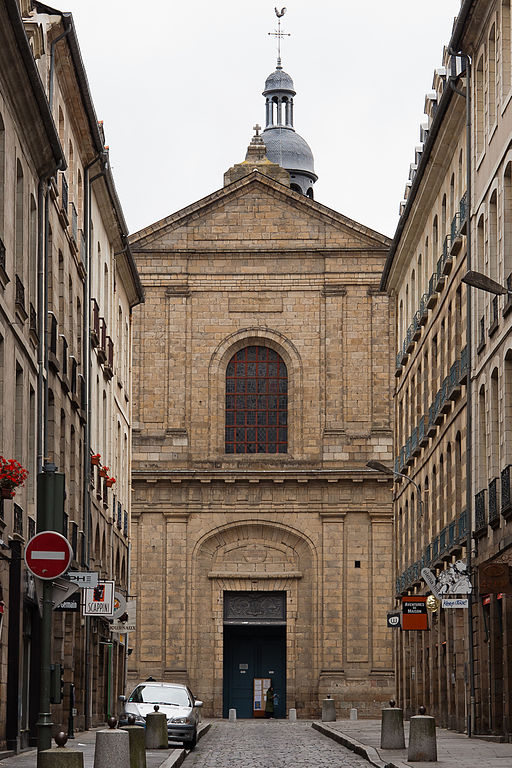
The English, having made a mine to ignite the Town, it is said that the candles in the Chapel were found miraculously alight; t he bells rung of themselves and the image of the Blessed Virgin was seen to stretch out its arms towards the middle of the Chapel where the mine had been concealed, which by that means, was discovered. The people rushed to the spot and so the plot was uncovred and the entire Town saved through the intervention of Our Lady of Rennes. Great was the rejoicing and deep the gratitude of the people. Known today as the Basilica of Saint Sauveur in Rennes, it is located in the heart of historic Rennes, which was once the capital of Brittany. It is situated at the termination of Saint-Sauveur Street on which its façade faces. As the original Gothic Church partially collapsed in the year 1682, the Classical style Church that can currently be seen, was constructed beginning in 1703 and Consecrated in August of 1719.
In the year 1793, during the French Revolution, the Church was made into a Temple of Reason and the miraculous Statue of Our Lady was destroyed. It was not until 1802, after the end of the Terror, that the Church was opened again to worship. The Church was made into a minor Basilica in 1916 by Pope Benedict XV. In 1634, the miracle of Our Lady’s intervention against the English invaders, was officially recognised by the Bishop of Rennes, Pierre Cornulier. There are many more miracles attributed to Our Lady, including the miraculous cure of Magdalene Morice in the year 1761. She had gangrene in her right foot which was instantly healed on Easter Sunday. The Statue of Our Lady of Miracles and Virtues currently displayed at the Basilica was placed there in February of 1876. In 1684 a boy of eleven left home for the City of Rennes in the hopes of enrolling at the Jesuit College of Thomas a Becket. The young Louis-Marie was an intelligent boy who was taken under the guidance of the Jesuit Priest, and it was at Rennes that he began to consider a possible vocation to the Priesthood. It was here, at the Shrine of Our Lady at Rennes, that Saint Louis-Marie de Montfort made the final decision to become a Priest.
St Acepsimas St Acheric of Vosges Bl Alphais of Cudot Bl Berardo dei Marsi Bl Berchtold of Engelberg St Caesarius St Cecilio Manrique Arnáiz St Clydog St Cristiolus St Domnus of Vienne St Elerius St Englatius St Florus of Lodeve St Francisco Colom González St Gaudiosus of Tarazona St Germanus St Guenhael St Hermengaudius of Urgell St Hilary of Viterbo St Hubert of Liege (c 656-727) Bishop, the “Apostle of the Ardennes” Bl Ida of Toggenburg St José Llorach Bretó St José Ruiz de la Torre St Libertine of Agrigento Bl Lorenzo Moreno Nicolás
St Papulus St Pierre-François Néron St Pirmin St Quartus St Rumwold of Buckingham St Sylvia of Rome St Theophilus St Valentine of Viterbo St Valentinian St Vitalis St William of Vosges St Winifred of Wales St Wulganus
Innumerable Martyrs of Saragossa: A large group of Christians martyred in Zaragoza, Spain by Dacian during the persecutions of Diocletian. Dacian ordered all Christians of the city into exile under pain of death; when they were assembled to leave, Dacian ordered imperial soldiers to massacre the lot of them. They were martyred in 304.
Martyred in the Spanish Civil War: • Blessed Cecilio Manrique Arnáiz • Blessed Francisco Colom González • Blessed José Llorach Bretó • Blessed José Ruiz de la Torre





 AnaStpaul
You must be logged in to post a comment.