Quote/s of the Day – 4 April – Thursday of the Fourth Week of Lent, Year C and the Memorial of St Isidore of Seville (560-636) Father & Doctor of the Church
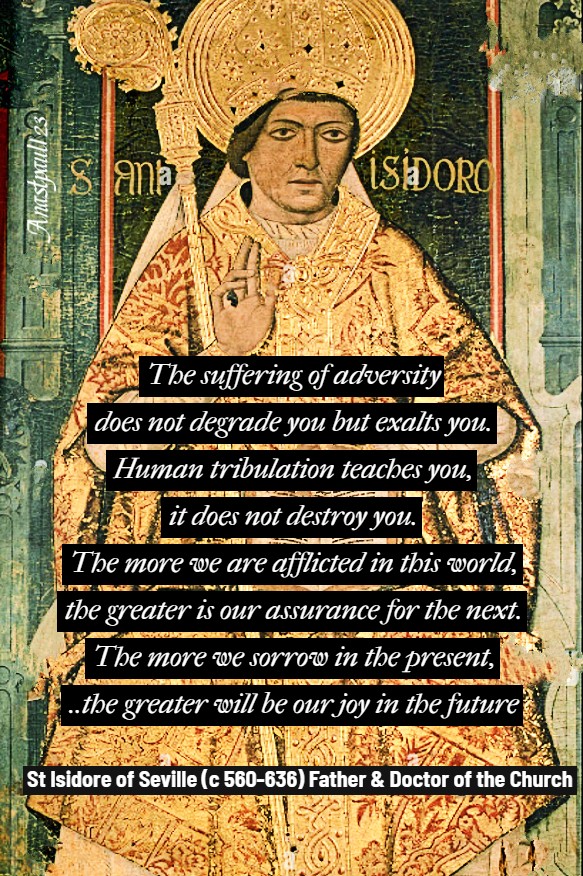
“The suffering of adversity does not degrade you but exalts you. Human tribulation teaches you, it does not destroy you. The more we are afflicted in this world, the greater is our assurance for the next. The more we sorrow in the present, ..the greater will be our joy in the future.”
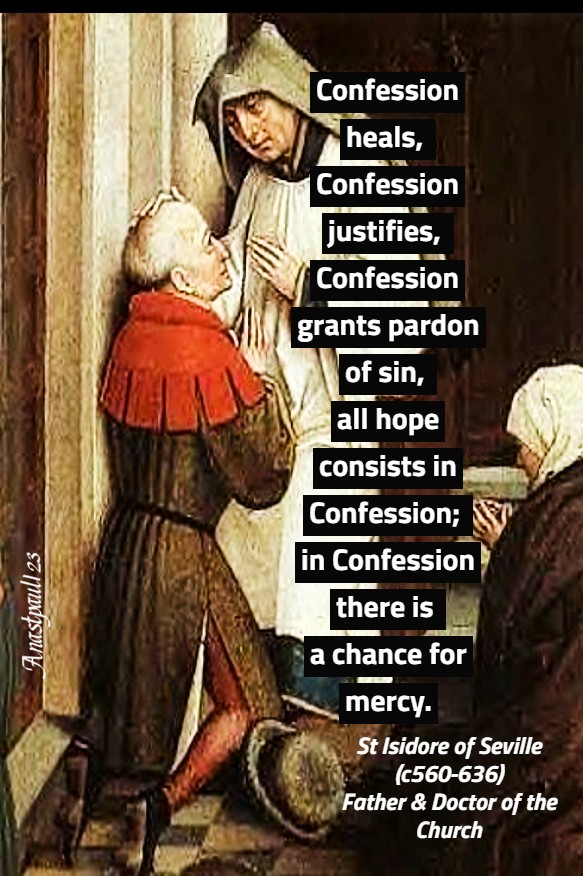
“Confession heals, Confession justifies, Confession grants pardon of sin, all hope consists in Confession; in Confession there is a chance for mercy.”
Quote/s of the Day -– 13 March – Wednesday of the First week of Lent, Year C and The Memorial of St Leander (c 534-c 600)
“This man of suave eloquence and eminent talent shone as brightly by his virtues as by his doctrine. By his faith and zeal the Gothic people have been converted from Arianism to the Catholic faith”
St Isidore of Seville (560-636) Doctor of the Church,
speaking of his brother St Leander, whom we celebrate today.
“The humble man receives praise, the way a clean window takes the light of the sun. The truer and more intense the light is, the less you see of the glass.”
Thought for the Day – 4 April – Easter Wednesday and the Memorial of St Isidore of Seville (560-636) Father & Doctor of the Church
The 76 years of Isidore’s life were a time of conflict and growth for the Church in Spain. The Visigoths had invaded the land a century and a half earlier and shortly before Isidore’s birth they set up their own capital. They were Arians—Christians who said Christ was not God. Thus, Spain was split in two: one people (Catholic Romans) struggled with another (Arian Goths). Isidore reunited Spain, making it a centre of culture and learning. The country served as a teacher and guide for other European countries whose culture was also threatened by barbarian invaders.
In 599, Isidore became bishop of Seville and for thirty-seven years led the Spanish church through a period of intense religious development.. Isidore also organised representative councils that established the structure and discipline of the church in Spain. At the Council of Toledo in 633 he obtained a decree that required the establishment of a school in every diocese. Reflecting the saint’s broad interests, the schools taught every branch of knowledge, including the liberal arts, medicine, law, Hebrew, and Greek. Isidore was an amazingly learned man and is called “The Schoolmaster of the Middle Ages.” The encyclopedia he wrote was used as a textbook for nine centuries in so many schools which he had founded. AND he required seminaries to be built in every diocese, wrote a Rule for religious orders and founded schools that taught every branch of learning. Isidore wrote numerous books, including a dictionary, an encyclopedia, a history of Goths and a history of the world—beginning with creation! He also wrote a dictionary of synonyms, brief biographies of illustrious men, treatises on theological and philosophical subjects. He completed the Mozarabic liturgy, which is still in use in Toledo, Spain. For all these reasons, Isidore has been suggested as patron of the Internet. Several others—including Anthony of Padua—also have been suggested.
Throughout his long life, Isidore lived austerely so that he could give to the poor and he continued his austerities even as he approached age 80. During the last six months of his life, he increased his charities so much that his house was crowded from morning till night with the poor of the countryside. But while Isidore had compassion for needy, he thought they were better off than their oppressors, as he explains in this selection:
“We ought to sorrow for people who do evil rather than for people who suffer it. The wrongdoing of the first leads them further into evil. The others’ suffering corrects them from evil. Through the evil wills of some, God works much good in others. Some people, resisting the will of God, unwittingly do His purpose. Understand then that so truly are all things subject to God that even those who oppose His law nevertheless fulfil His will.
Evil men are necessary so that through them the good may be scourged when they do wrong…Some simple men, not understanding the dispensation of God, are scandalised by the success of evil men. They say with the prophet: “Why does the way of the wicked prosper?” Those who speak thus should not wonder to see the frail temporal happiness of the wicked. Rather they should consider the final end of evil men and the everlasting torments prepared for them. As the prophet says: “They spend their days in wealth and in a moment they go down to hell.”
Shortly before his death, Isidore had two friends clothe him in sackcloth and rub ashes on his head so that he could come before God as a poor penitent. He died peacefully at Seville in 636.
Our society can well use Isidore’s spirit of combining learning and holiness. Loving, understanding and knowledge can heal and bring a broken people back together. We are not barbarians like the invaders of Isidore’s Spain. But people who are swamped by riches and overwhelmed by scientific and technological advances can lose much of their understanding love for one another.
St Isidore, pray for the whole Church, the whole world, for us all, amen!
Quote/s of the Day – 4 April – Easter Wednesday and the Memorial of St Isidore of Seville (560-636) Father & Doctor of the Church
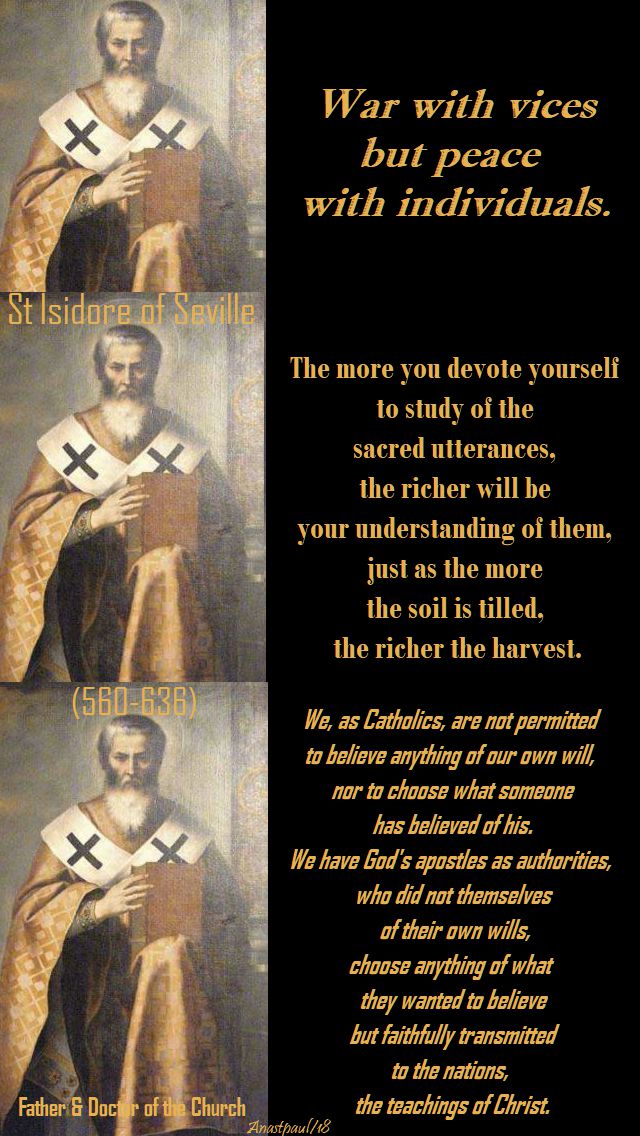
“War with vices but peace with individuals.”
“The more you devote yourself to study of the sacred utterances, the richer will be your understanding of them, just as the more the soil is tilled, the richer the harvest.”
“We, as Catholics, are not permitted to believe anything of our own will, nor to choose what someone has believed of his. We have God’s apostles as authorities, who did not themselves of their own wills, choose anything of what they wanted to believe but faithfully transmitted to the nations, the teachings of Christ.”
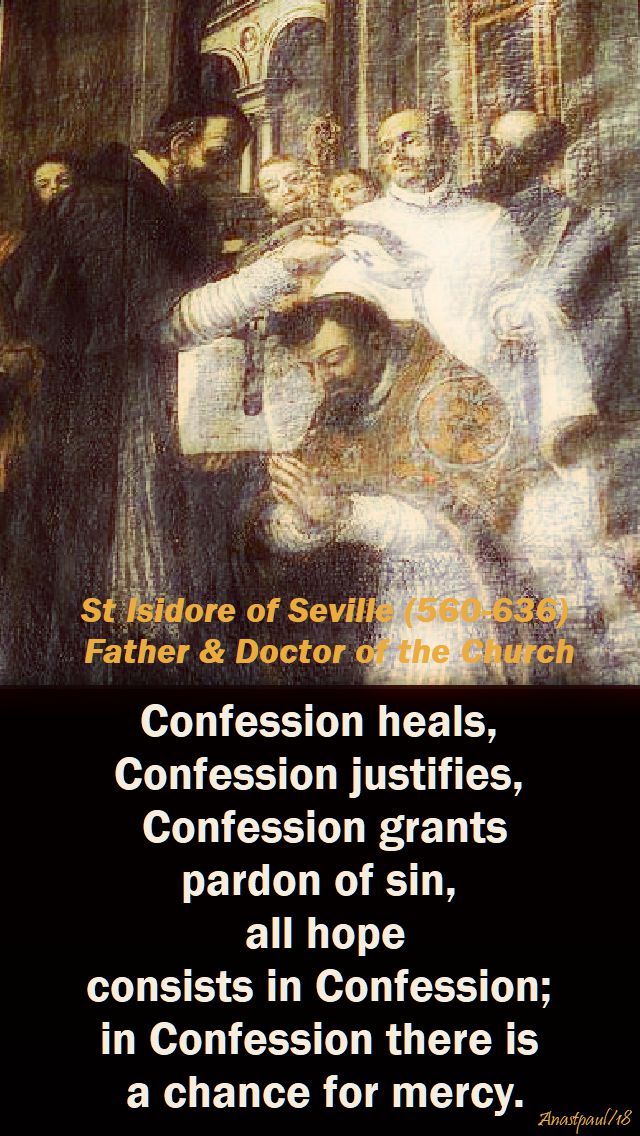
“Confession heals, Confession justifies, Confession grants pardon of sin, all hope consists in Confession; in Confession there is a chance for mercy.”
St Isidore of Seville (560-636) Father & Doctor of the Church
Saint of the Day – 4 April – St Isidore of Seville – Father and Doctor of the Church (560-636) Bishop, Confessor, Father, Doctor, Scholar, Writer, Teacher, Reformer and Evangelist – Patron of newsagents, the internet (not officially appointed), computer programmers and technicians, 2 Diocese, 13 Cities. He was, for over three decades, the Archbishop of Seville. The 19th-century historian Montalembert called him, in an oft-quoted phrase, “The Last Scholar of the Ancient World.” Born in Cartagena of a family that included three other sibling Saints–Leander, Fulgentius and Florentina–he was educated by his elder brother, Leander, whom he succeeded as the Bishop of Seville.
St Isidore of Seville is sometimes called “the schoolmaster of the Middle Ages” because his books and schools helped shape the education and culture of medieval Europe. For ten centuries, Isidore’s voluminous works were among those most quoted by other writers. And his establishment of cathedral schools laid a foundation for the medieval universities and for education in the West.
In 599, Isidore became bishop of Seville and for thirty-seven years led the Spanish church through a period of intense religious development. Isidore also organised representative councils that established the structure and discipline of the church in Spain. At the Council of Toledo in 633 he obtained a decree that required the establishment of a school in every diocese. Reflecting the saint’s broad interests, the schools taught every branch of knowledge, including the liberal arts, medicine, law, Hebrew, and Greek.
Isidore wrote many books, the most famous being the Etymologies, an encyclopedia of grammar, rhetoric, theology, history, medicine, and mathematics. He also wrote a dictionary of synonyms, brief biographies of illustrious men, treatises on theological and philosophical subjects, a history of world events since the creation and a history of the Goths, which is our only source of information about them. Throughout his long life, Isidore lived austerely so that he could give to the poor. But while Isidore had compassion for needy, he thought they were better off than their oppressors, as he explains in this selection:
We ought to sorrow for people who do evil rather than for people who suffer it. The wrongdoing of the first leads them further into evil. The others’ suffering corrects them from evil. Through the evil wills of some, God works much good in others. Some people, resisting the will of God, unwittingly do His purpose. Understand then that so truly are all things subject to God that even those who oppose His law nevertheless fulfil His will.
Evil men are necessary so that through them the good may be scourged when they do wrong…Some simple men, not understanding the dispensation of God, are scandalised by the success of evil men. They say with the prophet: “Why does the way of the wicked prosper?” Those who speak thus should not wonder to see the frail temporal happiness of the wicked. Rather they should consider the final end of evil men and the everlasting torments prepared for them. As the prophet says: “They spend their days in wealth and in a moment they go down to hell.”
Shortly before his death, Isidore had two friends clothe him in sackcloth and rub ashes on his head so that he could come before God as a poor penitent. He died peacefully at Seville in 636.
King Reccared abjures his heresy before St Isidore
“The more we are afflicted in this world,
the greater is our assurance in the next;
the more we sorrow in the present,
the greater will be our joy in the future.”





 In 599, Isidore became bishop of Seville and for thirty-seven years led the Spanish church through a period of intense religious development. Isidore also organised representative councils that established the structure and discipline of the church in Spain. At the Council of Toledo in 633 he obtained a decree that required the establishment of a school in every diocese. Reflecting the saint’s broad interests, the schools taught every branch of knowledge, including the liberal arts, medicine, law, Hebrew, and Greek.


 AnaStpaul
You must be logged in to post a comment.