St Crispin of Viterbo St Cyriaca of Nicomedia and Companions St Cyril of Trèves St Dunstan of Canterbury (909-988) Bishop of London, Worcester then Archbishop of Canterbury St Evonio of Auvergne
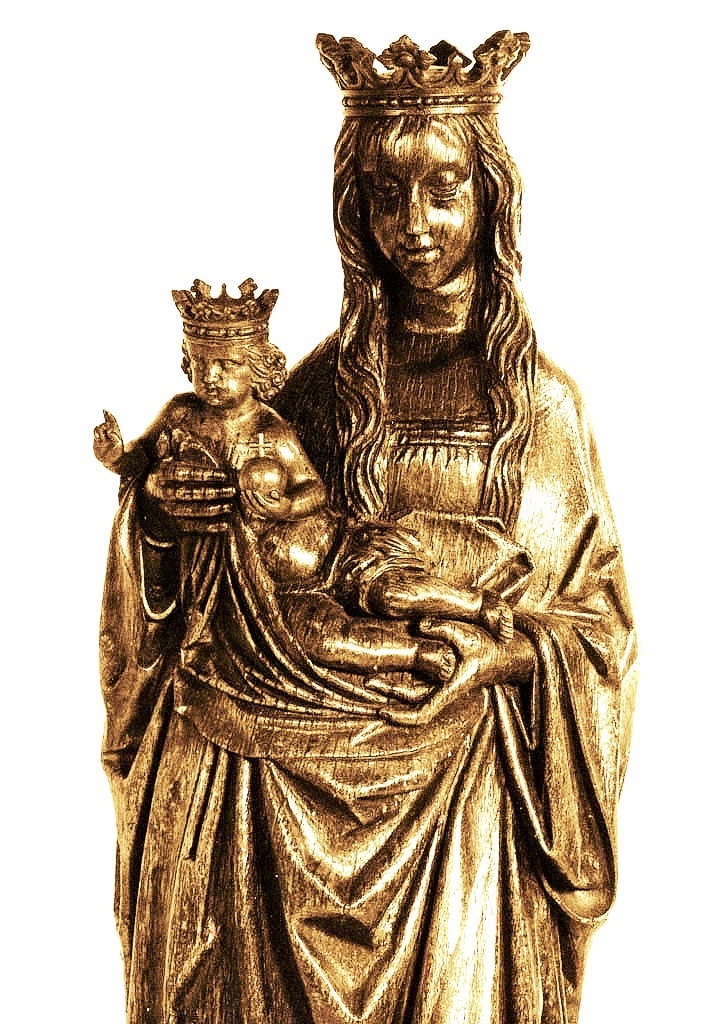
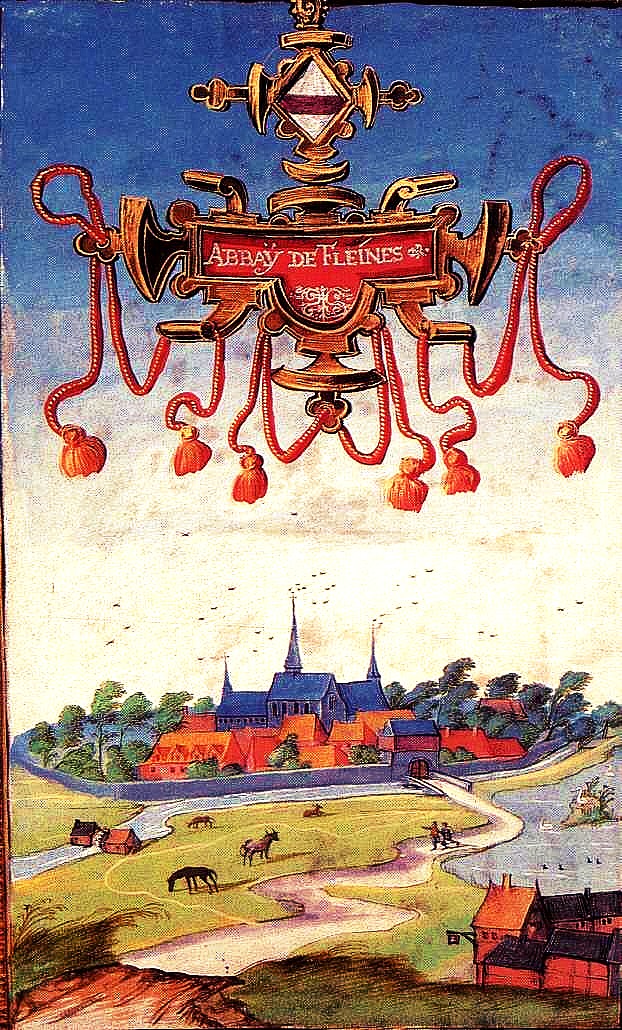
Notre-Dame de Flines / Our Lady of Flines, Douay (1279) – 20 May:
The Abbot Orsini writes: “Dedication of Our Lady of Flines, near Douay, by Peter, Archbishop of Rheims, in the year 1279. This Abbey of Nuns, of the Order of Citeaux, was given to Saint Bernard by Margaret de Dampierre, in the year 1234.”
Margaret de Dampiere, also known as Margaret of Constantinople, was a relative of the Count Guy de Dampier. It appears that Saint Bernard had recently established an Order of Nuns according to the Rule of his Order and in the year 1234, Margaret presented Saint Bernard with the Abbey located near Douay. Five years previous to this, Archbishop Peter of Rheims had dedicated the Shrine to Our Lady of Flines. This Shrine became a place of pilgrimage as a result of the miraculous cure of a child protégé of Margaret’s. The little one, unseen by Margaret’s coachman, had been seriously injured while playing about the stable-yard. The doctors pronounced her hopelessly lame for life. Margaret, however, was confident in Our Lady’s intercession and took the child to the neighbouring Shrine every Saturday and begged the Mother of God to be merciful to the child, as well as to the grieving parents. After the fifteenth visit, the little girl, with a happy cry, jumped from the arms of her mother. “I can walk straight, see?” and proved that Our Lady had indeed cured her in that instant. When Margaret de Dampiere died in 1280, she was buried in the centre of the choir. The renown of the Shrine continued to spread over time and resulted in many pilgrimages to Our Lady of Flines. The Blessed Virgin Mary proved the words of her loyal son Saint Bernard, “Never was it known that anyone who fled to thy protection, implored thy help, or sought thine intercession was left unaided” to be true. The Abbey was destroyed by the partisans of the French Revolution and there is now no trace of the once thriving and beautiful Convent and Shrine.
St Alcuin of York Blessed Augustine Novello OSA (1240– 1309) Priest and Friar of the Order of St Augustine. St Calocerus of Rome
St Alcuin of York
Bl Augustine Novello
St Calocerus of Rome St Pope Celestine V (1210-1296) Biography: https://anastpaul.wordpress.com/2017/05/19/saint-of-the-day-19-may-st-pope-celestine-v/
St Crispin of Viterbo
St Cyriaca of Nicomedia and Companions
St Cyril of Trèves
St Dunstan of Canterbury
St Evonio of Auvergne
St Hadulph of Saint-Vaast
Bl Humiliana de’ Cerchi St Ivo Hélory of Kermartin TOSF (1253-1303) An interesting man and Saint: https://anastpaul.wordpress.com/2018/05/19/saint-of-the-day-19-may-st-ivo-of-kermartin-1253-1303-advocate-of-the-poor/
Bl Jean-Baptiste-Xavier Loir
Bl Józef Czempiel
Bl Juan of Cetina
Bl Louis Rafiringa
Bl Lucinio Fontanil Medina
St Parthenius of Rome
Bl Peter de Duenas
Bl Peter Wright
St Philoterus of Nicomedia
St Pudens of Rome
St Pudentiana of Rome
St Theophilus of Corte St Maria Bernarda Bütler (1848-1924)
Saint of the Day – 19 May – St Ivo of Kermartin T.O.S.F. (1253-1303) also known Yvo or Ives – Priest, Franciscan Tertiary, known as the “Advocate of the Poor”, Civil Lawyer – born on 17 October 1253 at Kermartin near Treguier, Brittany and died on 19 May 1303 at Louannec, Brittany of natural causes following a sermon on Ascension Eve. Patronages – abandoned people, advocates, attorneys, barristers, lawyers, bailiffs, Brittany, canon lawyers, canonists, judges, jurists, notaries, orphans, children. Attributes – lawyer enthroned between rich and poor litigants, lawyer holding a book, with an angel near his head and a lion at his feet, lawyer surrounded by suppliants, holding a parchment and pointing upwards, lawyer surrounded by symbols of the Holy Spirit such as doves.
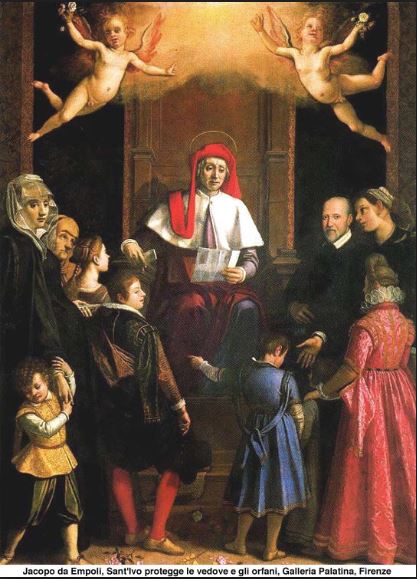
Born at Kermartin, a manor near Tréguier in Brittany, on 17 October 1253, Ivo was the son of Helori, lord of Kermartin and Azo du Kenquis. In 1267 Ivo was sent to the University of Paris, where he graduated in civil law. While other students partied, Ivo studied, prayed and visited the sick. He also refused to eat meat or drink wine. Among his fellow-students were the scholars Blessed Duns Scotus (1266-1308 – Doctor Subtilis -Subtle Doctor) and Roger Bacon OFM (1219-1292 – Doctor Mirabilis – Miraculous Doctor). He went to Orléans in 1277 to study canon law under Peter de la Chapelle, a famous jurist who later became bishop of Toulouse and a cardinal. On his return to Brittany, having received minor orders he was appointed an “official”, the title given to an ecclesiastical judge, of the archdeanery of Rennes (1280). He protected orphans and widows, defended the poor and rendered fair and impartial verdicts. It’s said that even those on the losing side, respected his decisions. Ivo also represented the helpless in other courts, paid their expenses and visited them in prison. He earned the title “Advocate of the Poor.” Although it was common to give judges “gifts,” Ivo refused bribes. He often helped disputing parties settle out of court so they could save money.
Meanwhile, he studied Scripture and there are strong reasons for believing the tradition held among Franciscans, that he joined the Third Order of St Francis sometime later at Guingamp. Ivo was ordained to the priesthood in 1284. He continued to practice law and once, when a mother and son couldn’t resolve their differences, he offered a Mass for them. They immediately reached a settlement.
The Widow of Tours
Tours was near Orleans, the bishop held his court there and Ivo, while visiting the court, lodged with a certain widow. One day he found his widow-landlady in tears. Her tale was that next day she must go to court to answer to the suit of a travelling merchant who had tricked her. It seemed that two of them, Doe and Roe, lodging with her, had left in her charge a casket of valuables, while they went off on their business but with the strict injunction, that she was to deliver it up again, only to the two of them jointly demanding it. That day, Doe had come back and called for the casket, saying that his partner Roe was detained elsewhere and she in good faith in his story, had delivered the casket to Doe. But then later came Roe demanding it, charging his partner with wronging him, and holding the widow responsible for delivering up the casket to Doe, contrary to the terms of their directions. And if she had to pay for those valuables it would ruin her. “Have no fear,” said young Ivo, “I will go to court tomorrow, for you.”
When the case was called before the Judge and the merchant Roe charged the widow with breach of faith, “Not so,” pleaded Ivo, “My client need not yet make answer to this claim. The plaintiff has not proved his case. The terms of the bailment were that the casket should be demanded by the two merchants coming together. But here is only one of them making the demand. Where is the other? Let the plaintiff produce his partner.” The judge promptly approved his plea. Whereupon the merchant, required to produce his fellow, turned pale and would have retired. But the judge, suspecting something from his plight, ordered him to be arrested and questioned; the other merchant was also traced and brought in and the casket was recovered, which, when opened, was found to contain nothing but old junk. In short, they had conspired to plant the casket with the widow and then to coerce her to pay the value of the alleged contents. Thus the young advocate saved the widow from ruin and the fame of his clever defence of the widow soon went far and wide.
Legacy
On the occasion of the 700th anniversary of the birth of St Ivo, St Pope John Paul II said, “The values proposed by St Ivo retain an astonishing timeliness. His concern to promote impartial justice and to defend the rights of the poorest persons invites the builders of Europe today to make every effort to ensure that the rights of all, especially the weakest, are recognised and defended.”
Saint Ivo is the patron of lawyers. As a result, many law schools and association of catholic lawyers have taken his names. For instance, the Society of St. Yves in Jerusalem (a Catholic Centre for Human Rights and Legal Aid, Resources and Development), the Conférence Saint Yves in Luxembourg (the Luxembourg Catholic Lawyers Association), or the Association de la Saint Yves Lyonnais.
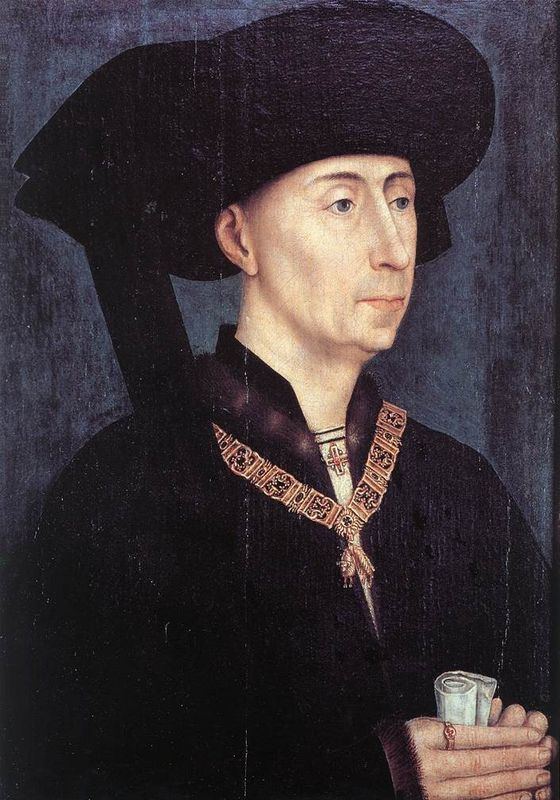
Ivo was Canonised in June 1347 by Clement VI at the urging of Philip I, Duke of Burgundy. At the inquest into his sanctity in 1331, many of his parishioners testified as to his goodness, that he preached regularly in both chapel and field and that under him “the people of the land became twice as good as they had been before”. The connection between religion and good behaviour was especially stressed in his sermons and he is reported to have “chased immorality and sin from the village of Louannec”.
Shortly after 1362, the future saint Jeanne-Marie de Maillé reported a vision of St Ivo, during which he told her, “If you are willing to abandon the world, you will taste here on earth the joys of heaven.”
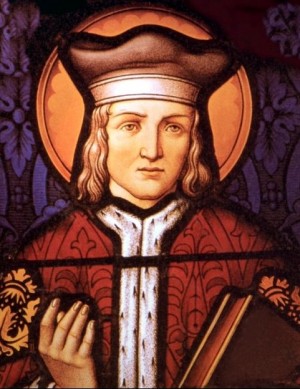
Ivo is often represented with a purse in his right hand (for all the money he gave to the poor during his life) and a rolled paper in the other hand (for his charge as a judge). Another popular representation of Ivo is between a rich man and a poor one. The churches of Sant’Ivo alla Sapienza and Sant’Ivo dei Bretoni in Rome are dedicated to him.
A 14th century engraving on St Ivo’s Shrine:
Sanctus Ivo erat Brito, Advocatus, et non latro Res miranda populo.
Saint Yvo was a Breton and a lawyer but not dishonest – An astonishing thing in people’s eyes.
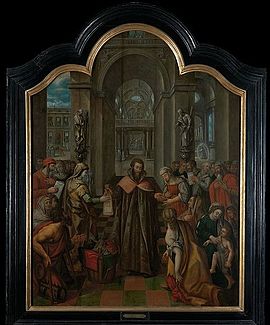
St Ivo giving alms to the poor by Josse van der Baren
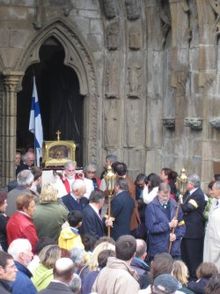
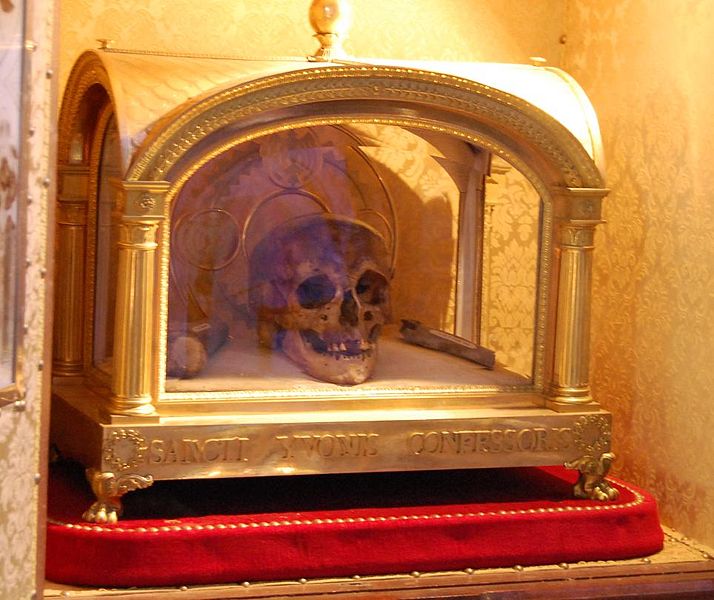
The relics of Saints Ivo and Tugdual in a procession at the gate of Tréguier’s cathedral in 2005. In the reliquary is the skull of Saint Ivo
Relic skull and reliquary of St Ivo in Tréguier, Brittany, France




 AnaStpaul
You must be logged in to post a comment.