Posted in MORNING Prayers, PRAYERS for VARIOUS NEEDS, QUOTES of the SAINTS, SAINT of the DAY

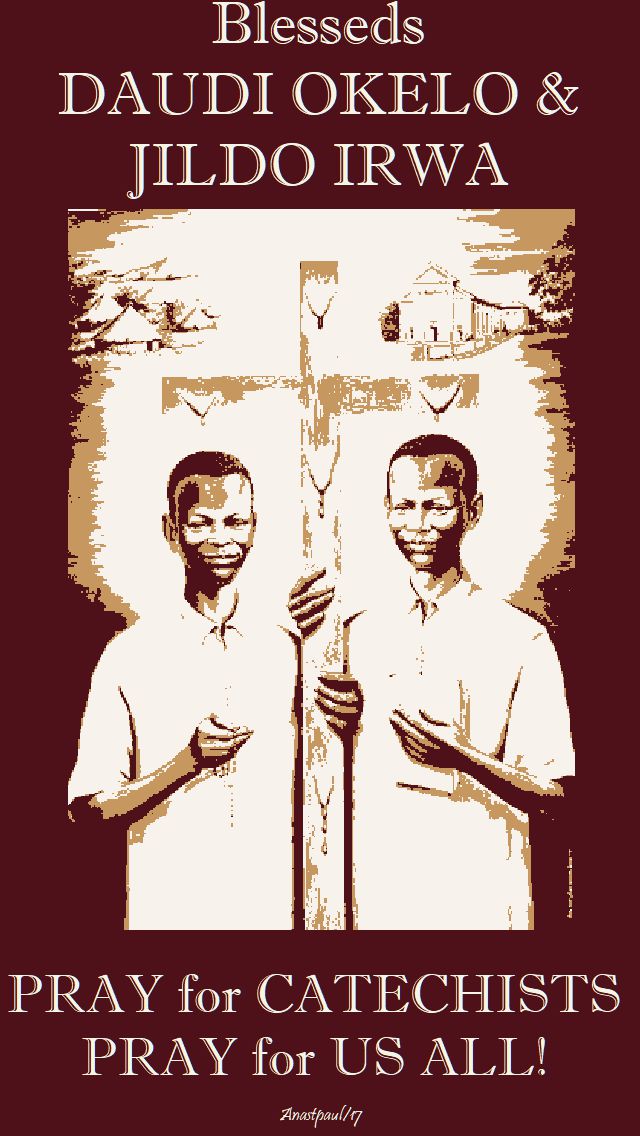
Thought for the Day – 20 October – The Memorial of Blesseds Daudi Okelo and Jildo Irwa – Ugandan Martyrs

Thought for the Day – 20 October – The Memorial of Blesseds Daudi Okelo and Jildo Irwa – Ugandan Martyrs

“My thoughts turn first of all to the two young catechists from Uganda, Daudi Okelo and Jildo Irwa.   These two courageous witnesses were no more than boys when, with simplicity and faith, they shed their blood for Christ and his Church.   With youthful enthusiasm for their mission of teaching the faith to their fellow countrymen, they set out in 1918 for northern Uganda.   It was there, as evangelisation was just beginning in that region, that they chose to embrace death rather than abandon the area and forsake their duties as catechists.   Truly, in their lives and witness we can see that they were “beloved by God and chosen by him” (cf. I Thes 1,4).

Daudi and Jildo are today raised to the glory of the altar.   They are given to the entire Christian community as examples of holiness and virtue and as models and intercessors for catechists throughout the world, especially in those places where catechists still suffer for the faith, sometimes facing social marginalisation and even personal danger. May the life and witness of these two dedicated servants of the Gospel inspire many men and women – in Uganda, in Africa and elsewhere – to answer with generosity the call to be a catechist, bringing knowledge of Christ to others and strengthening the faith of those communities that have recently received the Gospel of salvation.”

(Pope John Paul II on World Mission Sunday 20 October 2002)

“These two young catechists are a shining example of fidelity to Christ, commitment to Christian living and selfless dedication to the service of neighbour.   With their hope firmly set on God and with a deep faith in Jesus’ promise to be with them always, they set out to bring the Good News of salvation to their fellow countrymen, fully accepting the difficulties and dangers that they knew awaited them.   May their witness serve to strengthen you as you seek to bear true Christian witness in every aspect of your lives. Through their intercession may the Church be an ever more effective instrument of goodness and peace in Africa and in the world. God bless Uganda.”
(Pope John Paul II to Ugandan visitors – 21 October 2002)

Blesseds Daudi Okelo and Jildo Irwa, Pray for Catechists, pray for us all!bls daudi and jildo pray for us - 20 oct 2017.no2

A Prayer for Catechists

Loving God, Creator of all things,

You call us to be in relationship with You and others.

Thank You for calling me to be a catechist,
for the opportunity to share with others
what You have given to me.

May all those with whom I share the gift of faith
discover how You are present in all things.

May they come to know You, the one true God,
and Jesus Christ, whom Uou have sent.
May the grace of the Holy Spirit guide my heart and lips,
so that I may remain constant in loving and praising You.

May I be a witness to the Gospel and a minister of Your truth.
May all my words and actions reflect Your love.

Amen

CatechistsPrayer_520

Posted in FEASTS and SOLEMNITIES, MARIAN QUOTES, MORNING Prayers, QUOTES of the SAINTS, SAINT of the DAY, The APOSTLES & EVANGELISTS

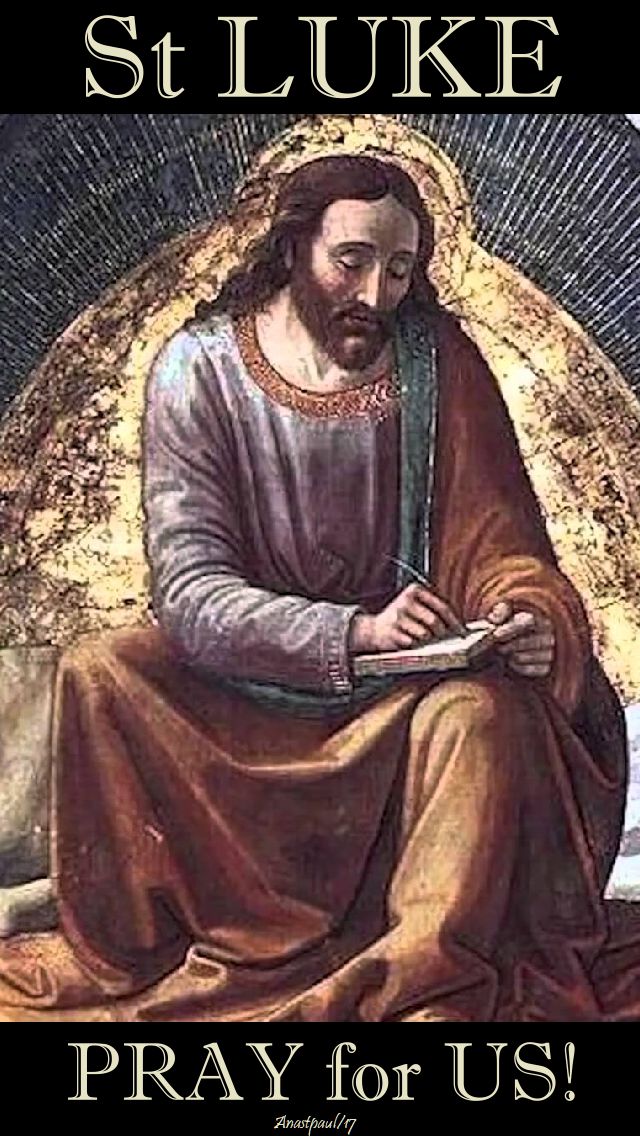
Thought for the Day – 18 October – The Feast of St Luke the Evangelist

Thought for the Day – 18 October – The Feast of St Luke the Evangelist

According to a pious tradition, Luke is thought to have painted the image of Mary, the Virgin Mother.   But the real portrait that Luke draws of Jesus’ Mother is the one that emerges from the pages of his work:   in scenes that have become familiar to the People of God, he draws an eloquent image of the Virgin.   The Annunciation, the Visitation, the Nativity, the Presentation in the Temple, life in the home of Nazareth, Jesus’ discussion with the doctors and his being lost and Pentecost have provided abundant material down the centuries for the ever new creations of painters, sculptors, poets and musicians.

What is most important however is to discover that, through pictures of Marian life, Luke introduces us to Mary’s interior life, helping us at the same time to understand her unique role in salvation history.

Mary is the one who says fiat, a personal and total “yes” to God’s invitation, calling herself the “handmaid of the Lord” (Lk 1: 38).   This attitude of total assent to God and unconditional acceptance of his Word represents the highest model of faith, the anticipation of the Church as the community of believers.

The life of faith grows and develops in Mary through sapiential meditation on the words and events of Christ’s life (cf. Lk 2: 19, 51).   She “ponders in her heart” to understand the deep meaning of his words, in order to assimilate it and share it with others.

The Magnificat hymn (cf. Lk 1: 46-55) shows another important aspect of Mary’s “spirituality”: she embodies the figure of the poor person, capable of putting all her trust in God, who casts down the mighty from their thrones and raises up the lowly.

Luke also describes the figure of Mary in the early Church, showing that she is present in the Upper Room as they await the Holy Spirit:  “All these [the 11 Apostles] with one accord devoted themselves to prayer, together with the women and Mary the mother of Jesus, and with his brethren” (Acts 1: 14).

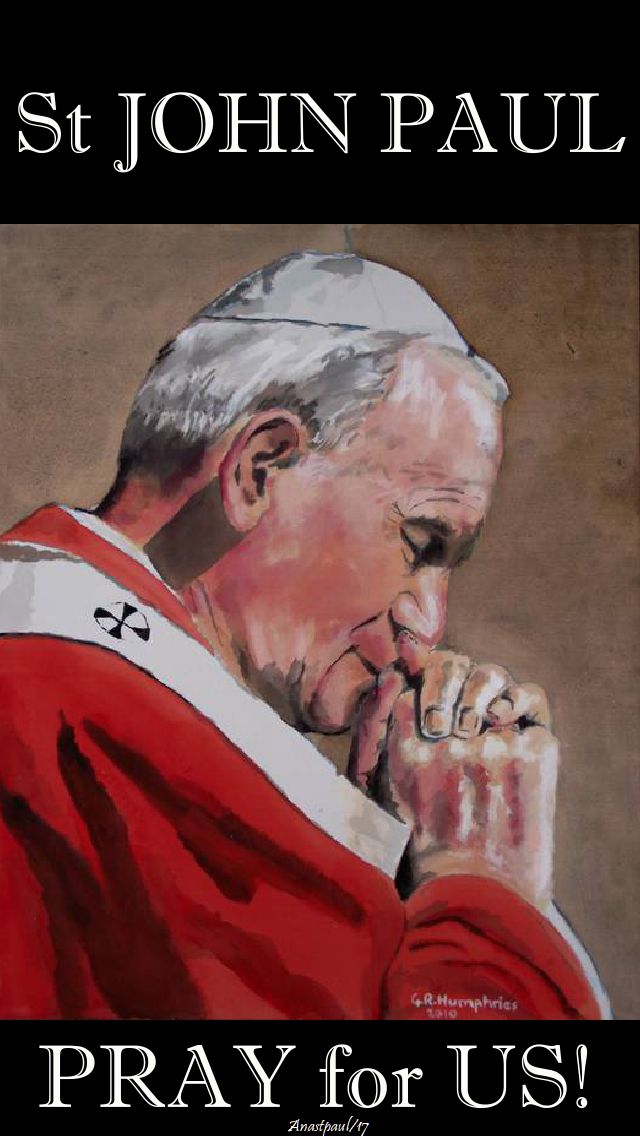
The group gathered in the Upper Room forms the original nucleus of the Church.   Within it Mary carries out a double role:  on the one hand, she intercedes for the birth of the Church through the Holy Spirit; on the other, she shares her experience of Jesus with the newborn Church. (St John Paul on the Feast of St Luke, Padua 2000 at the Shrine of St Luke)

Luke wrote as a Gentile for Gentile Christians.   His Gospel and Acts of the Apostles reveal his expertise in classic Greek style as well as his knowledge of Jewish sources.   There is a warmth to Luke’s writing that sets it apart from that of the other synoptic Gospels and yet it beautifully complements those works.   The treasure of the Scriptures is a true gift of the Holy Spirit to the Church and the Marian writings of St Luke are a great treasure to us all!

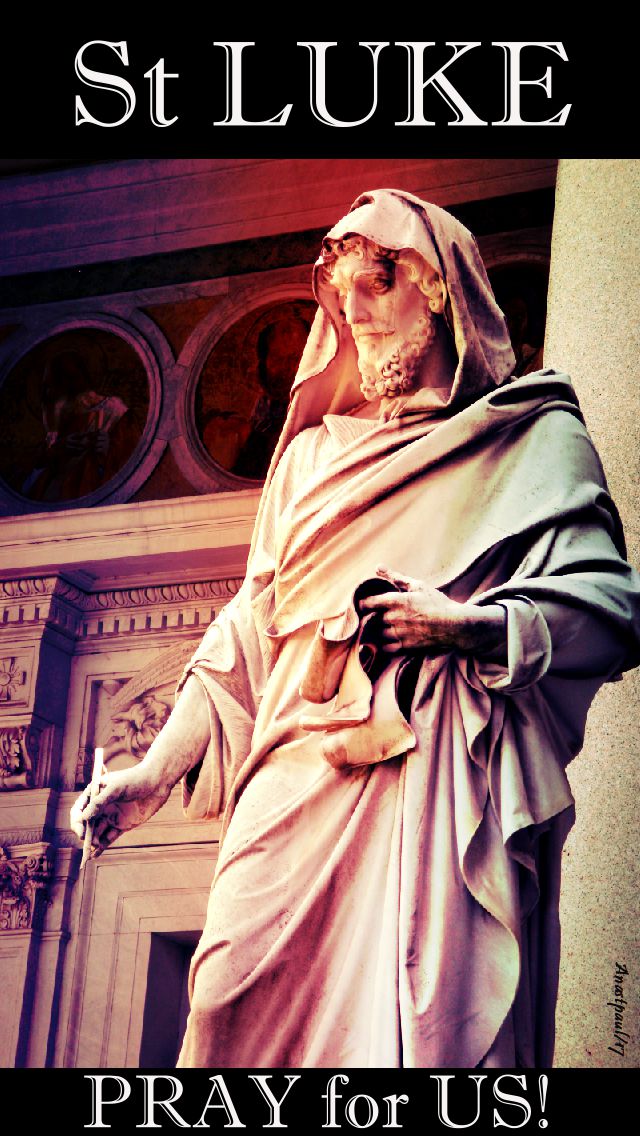
St Luke, pray for us.
Holy Mother of God, pray for us.
St John Paul, pray for us.st luke pray for us 18 oct 2017 - no 2HOLY MARY MOTHER OF GOD - PRAY FOR USst john paul pray for us

Posted in FEASTS and SOLEMNITIES, MORNING Prayers, QUOTES of the SAINTS, SAINT of the DAY, The APOSTLES & EVANGELISTS, The HOLY GHOST, Uncategorized

Quote/s of the Day – 18 October – The Feast of St Luke the Evangelist

Quote/s of the Day – 18 October – The Feast of St Luke the Evangelist

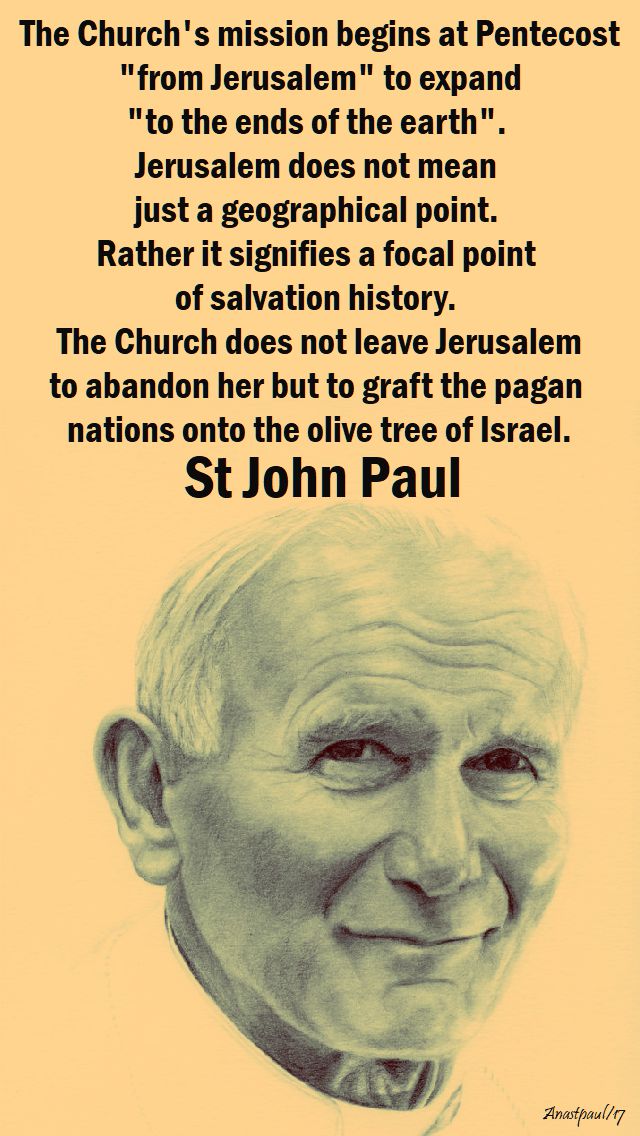
“The Church’s mission begins at Pentecost
“from Jerusalem” to expand “to the ends of the earth”.
Jerusalem does not mean just a geographical point.
Rather it signifies a focal point of salvation history.
The Church does not leave Jerusalem to abandon her
but to graft the pagan nations onto the olive tree of Israel.”the church's mission - 18 oct 2017

“We must abandon ourselves to the power of the Spirit,
who is able to infuse light and especially love for Christ;
we must open ourselves to the inner fascination that Jesus works
in the hearts of those who aspire to authenticity,
while fleeing from half measures.”

St John Paul on the Feast of St Luke, Padua 2000 at the Shrine of St Lukewe must abandon - st jp on the feast of st luke - 18 oct 2017

Posted in FEASTS and SOLEMNITIES, MORNING Prayers, SAINT of the DAY, The APOSTLES & EVANGELISTS, The WORD

One Minute Reflection – 18 October – The Feast of St Luke the Evangelist

One Minute Reflection – 18 October – The Feast of St Luke the Evangelist

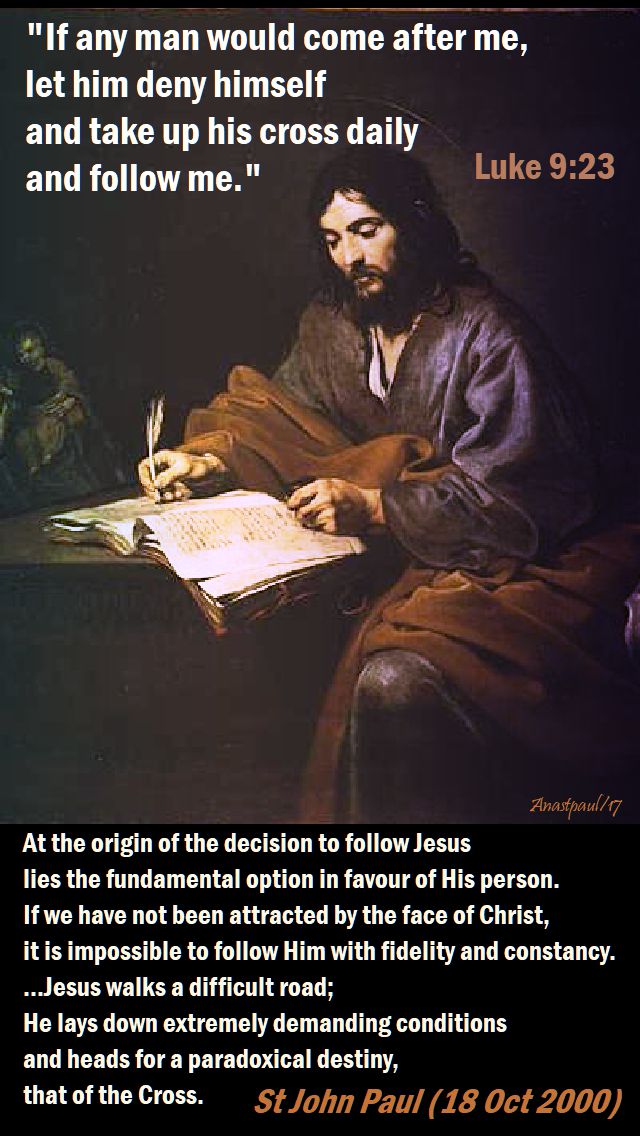
“If any man would come after me, let him deny himself and take up his cross daily and follow me.”…Luke 9: 23.

REFLECTION – “To be a Christian for Luke means to follow Jesus on the path that he takes.  It is Jesus Himself who takes the initiative and calls us to follow Him and He does it decisively, unmistakably, thus showing His extraordinary identity,   His mystery of being the Son who knows the Father and reveals Him.   At the origin of the decision to follow Jesus lies the fundamental option in favour of His person.   If we have not been attracted by the face of Christ, it is impossible to follow Him with fidelity and constancy. This is also because Jesus walks a difficult road;  He lays down extremely demanding conditions and heads for a paradoxical destiny, that of the Cross. Luke emphasises that Jesus does not like compromises and requires a commitment of the whole person, a decisive detachment from any nostalgia for the past, from family demands, from material possessions (cf. Lk 9: 57-62; 14: 26-33).”….St John Paul 18 Oct 2000at the origin of the decision - st john paul - feat of st luke 18 oct 2017

PRAYER – Lord God, You chose St Luke to reveal the mystery of Your love in his preaching and his writings. Grant, we pray, that we may grow in love for the Holy Face of Christ, His words and His directions, revealed to us in the Gospels, in the example of your saints. Today, on his feast, we especially look to St Luke, to guide, teach and pray for us. We make our prayer through our Lord Jesus Christ, with the Holy Spirit, one God with You, forever and ever, amen.st luke pray for us 18 oct 2017

Posted in MORNING Prayers, SAINT of the DAY, The WORD

One Minute Reflection – 11 October – The Memorial of St John XXIII (1881-1963)

One Minute Reflection – 11 October – The Memorial of St John XXIII (1881-1963)

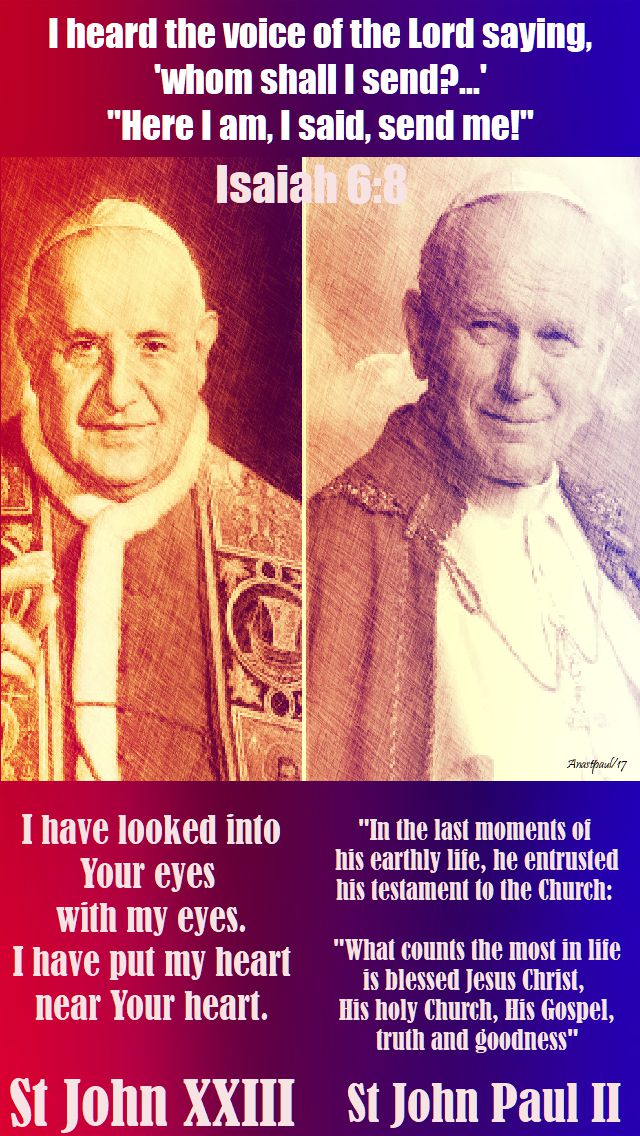
I heard the voice of the Lord saying, ‘whom shall I send?…’
“Here I am, I said, send me!” … Isaiah 6:8

REFLECTION – “I have looked into your eyes with my eyes. I have put my heart near your heart.” …St Pope John XXIII   “In the last moments of his earthly life, he entrusted his testament to the Church:  “What counts the most in life is blessed Jesus Christ, His holy Church, His Gospel, truth and goodness”. – St Pope John Paul IIi have looked into your eyes - st john 23 - 11 oct 2017

PRAYER – Help me my Lord, to discern through prayer and meditation, what You truly want of me.   Then enable me to offer it to You and indeed to offer myself and all I have to You. St John XXIII, pray for Holy Mother Church, pray for all the members of the Mystical Body, pray for our sons and daughters and for us all, pray for me! Amenst john 23 - pray for us - 11 oct 2017

Posted in CATHOLIC DEVOTIONS of the Month, DEVOTIO, MARIAN PRAYERS, MARIAN QUOTES, MARIAN TITLES, MORNING Prayers, QUOTES of the SAINTS, SAINT of the DAY, The BLESSED VIRGIN MARY, The HOLY ROSARY/ROSARY CRUSADE

Thought for the Day – 5 October – The Memorial of Blessed Bartholomew Longo – Apostle of the Holy Rosary

Thought for the Day – 5 October – The Memorial of Blessed Bartholomew Longo – Apostle of the Holy Rosary

Before entering the Shrine to recite the Holy Rosary with you, I paused briefly before the tomb of Bl Bartolo Longo and, praying, I asked myself:  “Where did this great apostle of Mary find the energy and perseverance he needed to bring such an impressive work, now known across the world, to completion? Was it not in the Rosary, which he accepted as a true gift from Our Lady’s Heart?”   Yes, that truly was how it happened!   The experience of the Saints bears witness to it:  this popular Marian prayer is a precious spiritual means to grow in intimacy with Jesus and to learn at the school of the Blessed Virgin always to fulfil the divine will.   It is contemplation of the mysteries of Christ in spiritual union with Mary as the Servant of God Paul VI stressed in his Apostolic Exhortation Marialis cultus (n. 46) and as my venerable Predecessor John Paul II abundantly illustrated in his Apostolic Letter Rosarium Virginis Mariae that today I once again present in spirit to the Community of Pompeii and to each one of you.   You who live and work here in Pompeii, especially you, dear priests, men and women religious and lay people involved in this unique portion of the Church, are all called to make Bl. Bartolo Longo’s charism your own and to become, to the extent and in the way that God grants to each one, authentic apostles of the Rosary.

To be apostles of the Rosary, however, it is necessary to experience personally the beauty and depth of this prayer which is simple and accessible to everyone.   It is first of all necessary to let the Blessed Virgin take one by the hand to contemplate the Face of Christ:  a joyful, luminous, sorrowful and glorious Face.   Those who, like Mary and with her, cherish and ponder the mysteries of Jesus assiduously, increasingly assimilate his sentiments and are conformed to him.   In this regard, I would like to quote a beautiful thought of Bl Bartolo Longo:  “Just as two friends, frequently in each other’s company, tend to develop similar habits”, he wrote, “so too, by holding familiar converse with Jesus and the Blessed Virgin, by meditating on the mysteries of the Rosary and by living the same life in Holy Communion, we can become, to the extent of our lowliness, similar to them and can learn from these supreme models a life of humility, poverty, hiddenness, patience and perfection” (I Quindici Sabati del Santissimo Rosario, 27th edition, Pompeii, 1916, p. 27: cited in Rosarium Virginis Mariae, n. 15).   POPE BENEDICT XVI – 19 October 2008

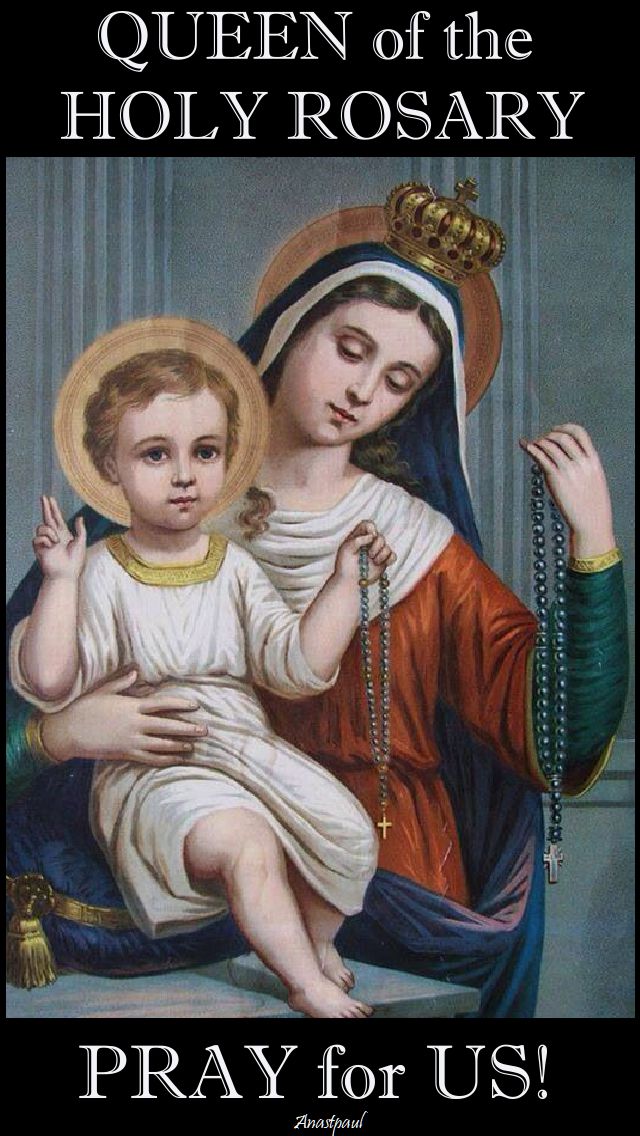
Queen of the Holy Rosary, Pray for us!queen of the holy rosary - pray for us - 5 oct 2017

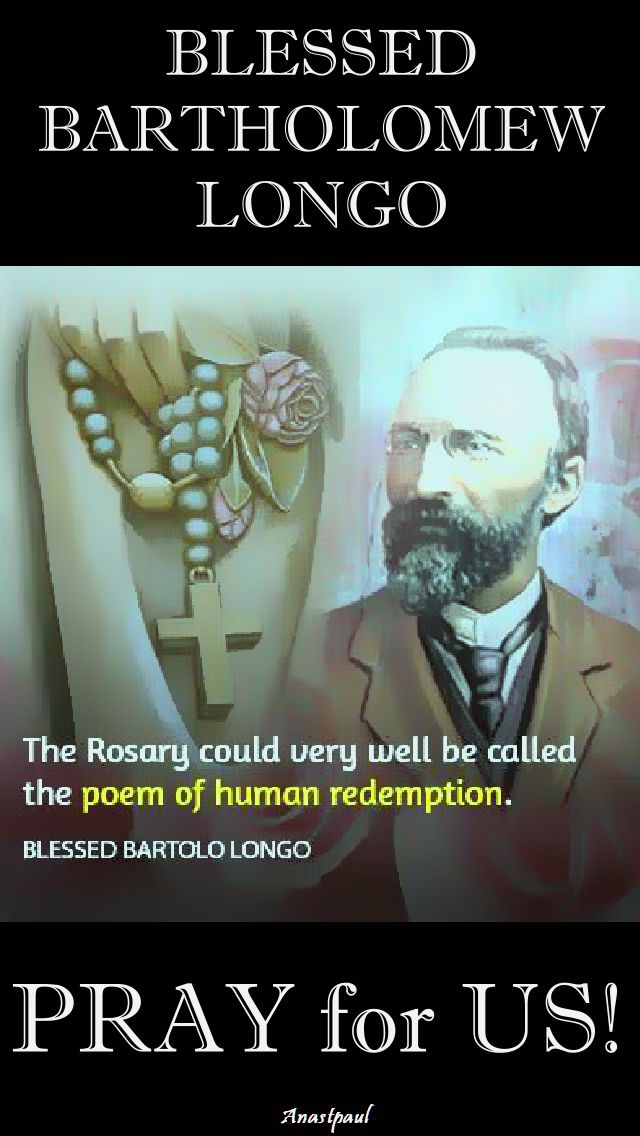
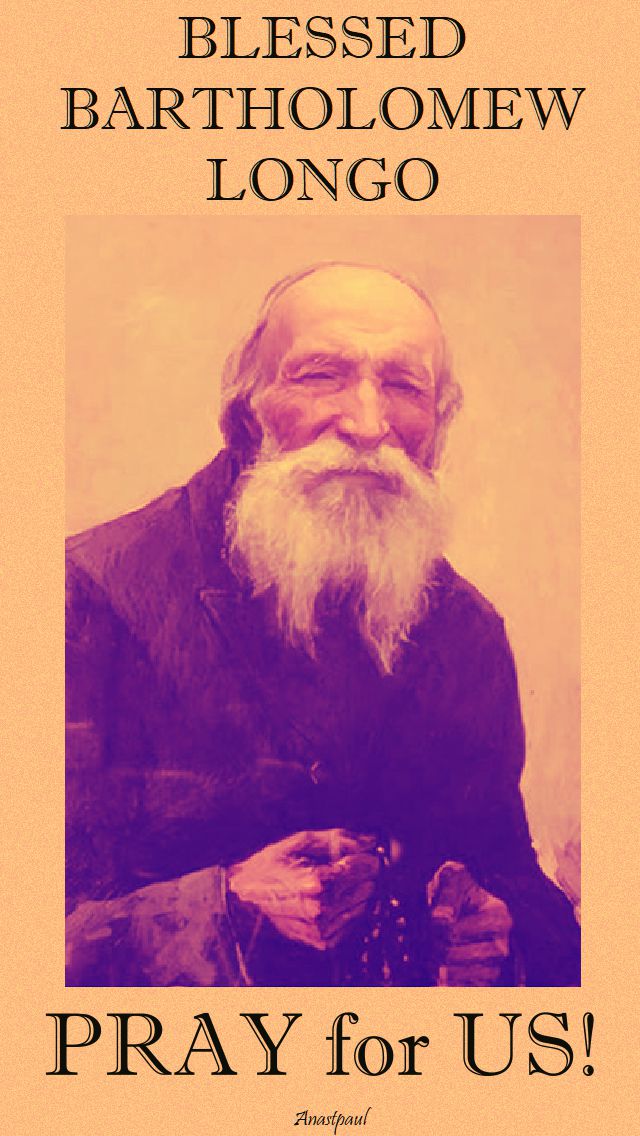
Blessed Bartholomew Longo, Pray for us!bl bartholomew longo pray for us 2


Posted in CATHOLIC DEVOTIONS of the Month, MARIAN PRAYERS, MARIAN QUOTES, MARIAN TITLES, MORNING Prayers, QUOTES of the SAINTS, SAINT of the DAY, The HOLY ROSARY/ROSARY CRUSADE, The WORD

One Minute Reflection – 5 October – The Memorial of Blessed Bartholomew Longo – Apostle of the Holy Rosary

One Minute Reflection – 5 October – The Memorial of Blessed Bartholomew Longo – Apostle of the Holy Rosary

Blessed is she who believed that there would be a fulfilment of what was spoken to her from the Lord……Luke 1: 45.luke 1-45 - 5 oct 2017

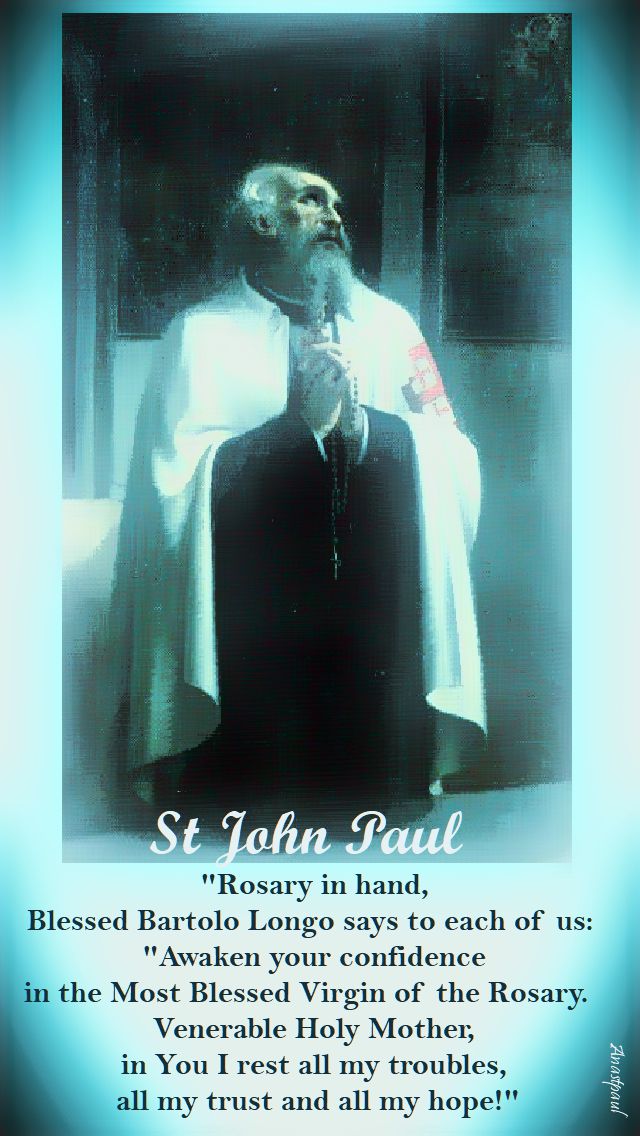
REFLECTION – “Rosary in hand, Blessed Bartolo Longo says to each of us: “Awaken your confidence in the Most Blessed Virgin of the Rosary.   enerable Holy Mother, in You I rest all my troubles, all my trust and all my hope!” – St Pope John Paul II in his homily during the beatification ceremony for Blessed Bartholomewrosary in hand - st john paul - 5 oct 2017

PRAYER – And we exult you, O Mary Assumed into Heaven, as we contemplate you who have been glorified and, in the risen Christ, have become the co-worker of the Holy Spirit in communicating divine life to mankind. In you we see the goal of holiness to which God calls all the Church’s members.   In your life we recognise the clear sign of the path to spiritual maturity and Christian holiness.   With you, with Blessed Bartholomew Longo and with all the saints, we glorify God the Trinity, who sustains our earthly pilgrimage and lives and reigns for ever and ever. Amen (by St Pope John Paul Nov 2000)bl bartolo longo pray for us - 5 oct 2017

Posted in MORNING Prayers, QUOTES of the SAINTS, QUOTES on CHARITY, SAINT of the DAY, The WORD

Thought for the Day – 1 October – The Memorial of Bl Luigi Maria Monti

Thought for the Day – 1 October – The Memorial of Bl Luigi Maria Monti

“I saw water flowing out from beneath the threshold of the temple… everything will live where the water goes” (Ez 47: 1, 9).
The image of water, which brings everything back to life, illuminates well the life of Bl Luigi Maria Monti, entirely dedicated to healing the physical and spiritual wounds of the sick and the orphaned.
He loved to call them “Christ’s poor ones”and he served them, enlivened by a living faith and sustained by intense and continual prayer. In his evangelical commitment, he was constantly inspired by the example of the Holy Virgin and placed the Congregation he founded under the sign of Mary Immaculate.

How relevant is the message of this new Blessed!
For his spiritual sons and for all believers, he is an example of faithfulness to God’s call and to the proclamation of the Gospel of charity.
He is a model of solidarity towards the needy and of affectionate entrustment to the Immaculate Virgin.”

“What does love look like?
It has the hands to help others.
It has the feet to hasten to the poor and needy.
It has eyes to see misery and want.
It has the ears to hear the sighs and sorrows of men.
That is what love looks like. (St Augustine)

“Have charity – first for our own souls and then for our neighbour.
For as water quenches fire, charity quenches sin.” (St John of God)

And so we are called!  “Mary, Mother of Christ and our Mother, is our strength and guide in this commitment.   May the new Blessed Luigi Maria Monti, whom we contemplate today in the glory of Heaven, intercede for us.   May it also be granted to us all that we one day find ourselves in Paradise, to experience together the joy of everlasting life. Amen!

(St John Paul at the Beatification of Bl Luigi Monti, Founder of the Sons of the Immaculate Conception, 9 November 2003)

bl luigi monti pray for us

Posted in DOCTORS of the Church, FATHERS of the Church, MORNING Prayers, QUOTES of the SAINTS, SAINT of the DAY, The HOLY CROSS

Quote/s of the Day – 25 September

Quote/s of the Day – 25 September

As they were looking on,
so we too gaze on His wounds as He hangs.
We see His blood as he dies.
We see the price
offered by the Redeemer,
touch the scars of His Resurrection.
He bows His head,
as if to kiss you.
His heart is made bare open,
as it were, in love to you.
His arms are extended
that He may embrace you.
His whole body is displayed
for your redemption.
Ponder how great these things are.
Let all this be rightly weighed in your mind:
as He was once fixed to the Cross
in every part of His body for you,
so He may now be fixed
in every part of your soul.

St Augustine (354-430) Father & Doctor

as they were looking on - st augustine - 25 sept 2017

There is no evil to be faced,
that Christ does not face with us.
There is no enemy, that Christ
has not already conquered.
There is no cross to bear,
that Christ has not already borne for us
and does not now bear with us.
And on the far side of every cross we find
the newness of life in the Holy Spirit,
that new life, which will reach its fulfillment,
in the Resurrection.
This is our faith.
This is our witness before the world.there is no evil to be faced - st john paul - 25 sept 2017

St John Paul (1920-2005)

Posted in MORNING Prayers, QUOTES of the SAINTS, SAINT of the DAY

Thought for the Day – 24 September – The Memorial of Bl Anton Martin Slomsek (1800-1862)

Thought for the Day – 24 September – The Memorial of Bl Anton Martin Slomsek (1800-1862)

“Teacher and educator, writer and poet, biographer and critic,
lover of his mother tongue and fighter for national equality,
patriot, speaker and preacher, ecumenical worker
and theological teacher of the Slovene people,
priest and bishop.   Slomsek’s personality is like a mosaic,
each stone has its own colour, its own function and size
but all together provide the image of a saint,
that is a person who is open to the breath of the Holy Spirit,
who prophetically understands the signs of the time and responds to them,
who understands how to use all natural and supernatural means
to realise the kingdom of God on earth.” …… Dr Franc Kramberger, Bishop of Maribor, Slovenia, 1999

“The new blessed also paid great attention to culture. Living in the middle of the last century, he was perfectly aware of the importance for the nation’s future of the intellectual formation of its inhabitants, especially the young.  For this reason, he combined pastoral action with commitment to the promotion of culture, which represents a nation’s wealth and is the patrimony of all Culture is the soil from which a people can draw the necessary elements for their growth and development.

Convinced of this, Slomsek worked to open various schools for young people and saw to the publication of books useful for human and spiritual formation.   He warned that if young people were corrupted, the fault could often be traced to the lack of adequate formation.   Families, schools and the Church, he taught, must join forces in a serious educational programme, each preserving its own area of autonomy, but all taking account of the values they share.

Only with a sound formation can men and women be prepared to build a world that is open to the perennial values of truth and love.”…St John Paul at the Beatification of Bl Anton (Sunday, 19 September 1999)

Bl Anton Martin Slomsek, Pray for us!

bl anton martin - pray for us.2

Posted in MORNING Prayers, QUOTES of the SAINTS, QUOTES on SUFFERING

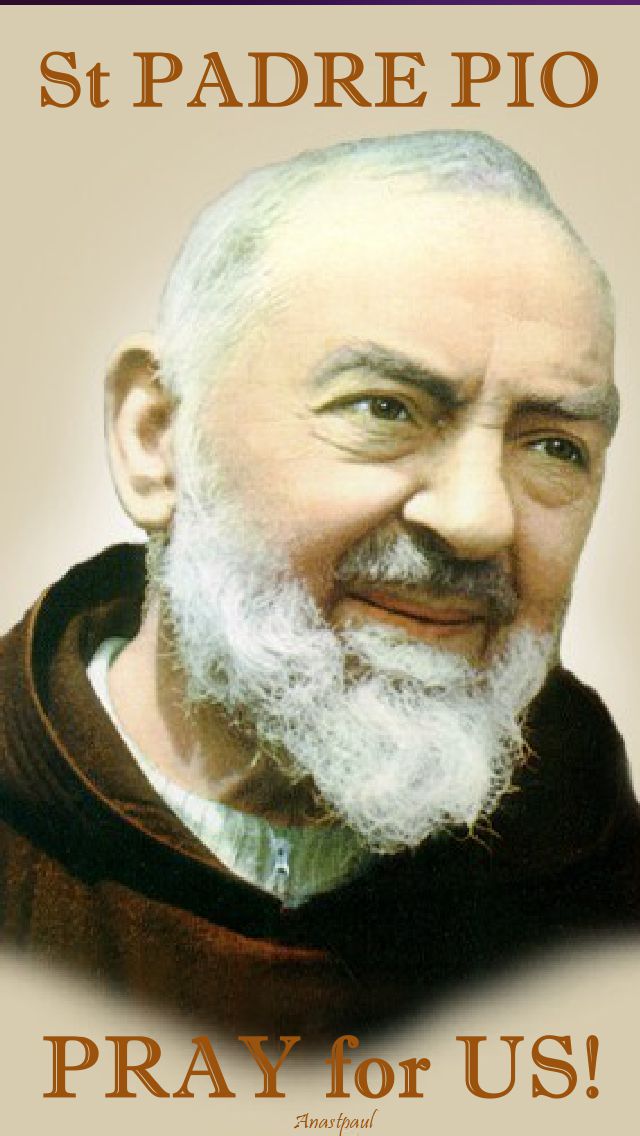
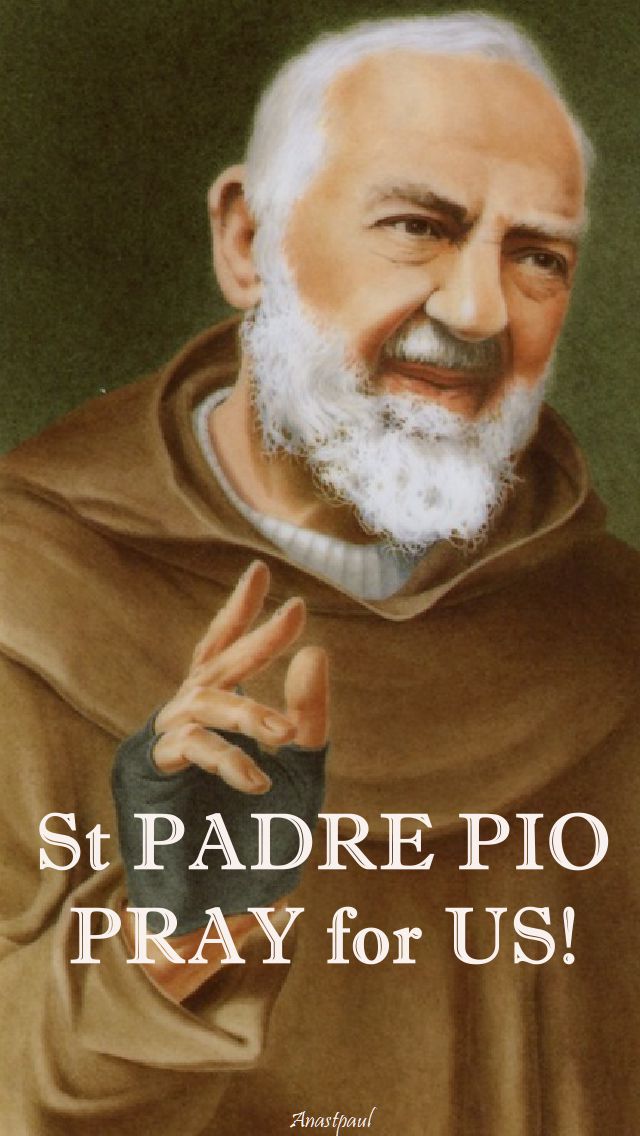
Thought for the Day – The Memorial of St Padre Pio (1887-1968)

Thought for the Day – The Memorial of St Padre Pio (1887-1968)

There can be no doubt that Padre Pio dedicated his life to prayer and suffering.   Every breath he took was a prayer—never for himself, always for others.   From the beginning of his life, he was able to easily travel from this world to the next, through deep prayer. He used this connection with God to recommend to him the prayers of his spiritual children.   This ability to make contact with the powerful presence of God through prayer enabled him to bless and pray with those in most need, wherever they were in the world. Padre Pio in prayer visited South America, the United States and parts of Europe.   Those he visited would know that Padre Pio was present by the unmistakable aroma of violets and roses.   Those who got closest to him noticed an odour of flowers emanating from the stigmata.   To this day, forty-six years after his death, people will still insist that they have caught the scent of roses after praying for someone through the intercession of Padre Pio.

Padre Pio’s priority was to be simply “a friar who prays.”   His intense prayer was offered up day and night for all his spiritual children and his religious community.   He had a filial love for our Blessed Lady and spent much of his day praying the rosary.   But Padre Pio was first and foremost a brother to the Capuchin Franciscan community of Our Lady of Graces friary.   Like the others, he daily lived the rule and life of the Order of Friars Minor.   The first chapter of the rule of Saint Francis outlines that the rule is simply to observe the Gospel of Jesus Christ, living in obedience and in chastity, without property. As a Capuchin Franciscan, he promised obedience and reverence to the pope and to his superiors in the Capuchin order.   No doubt it pained him greatly when the cult of sanctity built up around him, causing difficulties for the order with Church authorities.

Shortly before he died, the stigmata began to heal.   When his body was examined by the doctors, they found that fresh, white skin had grown over the healed wounds.   His life on earth was over, his earthly sufferings endured.   He was journeying to the house of the Father where he prays for us all today in the presence of God.

Referring to that day’s Gospel (Matthew 11:25-30) at Padre Pio’s canonisation Mass in 2002, Saint John Paul II said:  “The Gospel image of ‘yoke’ evokes the many trials that the humble Capuchin of San Giovanni Rotondo endured.   Today we contemplate in him how sweet is the ‘yoke’ of Christ and indeed how light the burdens are whenever someone carries these with faithful love.   The life and mission of Padre Pio testify that difficulties and sorrows, if accepted with love, transform themselves into a privileged journey of holiness, which opens the person toward a greater good, known only to the Lord.”

St Padre Pio pray for us!st pio pray for us - 2 - 23 sept 2017


Posted in franciscan OFM, MORNING Prayers, QUOTES of the SAINTS, SAINT of the DAY, The WORD

One Minute Reflection – 23 September – – The Memorial of St Padre Pio (1887-1968)

One Minute Reflection – 23 September – – The Memorial of St Padre Pio (1887-1968)

You need endurance to do the will of God and receive what he has promised….Hebrews 10:36

REFLECTION – “The life of a Christian is nothing but a perpetual struggle against self:
there is no flowering of the soul to the beauty of its perfection, except at the price of pain.”………St Pio of Pietrelcina (1887-1968)the life of a christian - st pio - 23 sept 2017

PRAYER – “And you, Blessed Padre Pio, look down from heaven upon us assembled in this square and upon all gathered in prayer before the Basilica of Saint John Lateran and in San Giovanni Rotondo. Intercede for all those who, in every part of the world, are spiritually united with this event and raise their prayers to you. Come to the help of everyone; give peace and consolation to every heart. Amen!” – from the homily of Pope John Paul II at the beatification of Padre PioST PADRE PIO - PRAY FOR US 23 sept 2017

Posted in CATHOLIC DEVOTIONS of the Month, MARIAN PRAYERS, MARIAN QUOTES, MARIAN TITLES, MORNING Prayers, QUOTES of the SAINTS, SAINT of the DAY, The BLESSED VIRGIN MARY

Quote/s of the Day – 15 September – The Memorial of Our Lady of Sorrows

Quote/s of the Day – 15 September – The Memorial of Our Lady of Sorrows

“When a woman is in travail, she has sorrow, because her hour has come;  but when she is delivered of the child, she no longer remembers the anguish, for joy that a child is born into the world’ (Jn. 16:21).   The first part of Christ’s words refer to the “pangs of childbirth” which belong to the heritage of original sin;  at the same time these words indicate the link that exists between the woman’s motherhood and the Paschal Mystery. For this mystery also includes the Mother’s sorrow at the foot of the cross – the Mother who through faith shares in her Son’s amazing “self-emptying”:  ‘This is perhaps the deepest ‘kenosis’ of faith in human history.”

St John Paulwhen a woman is in travail....st john paul

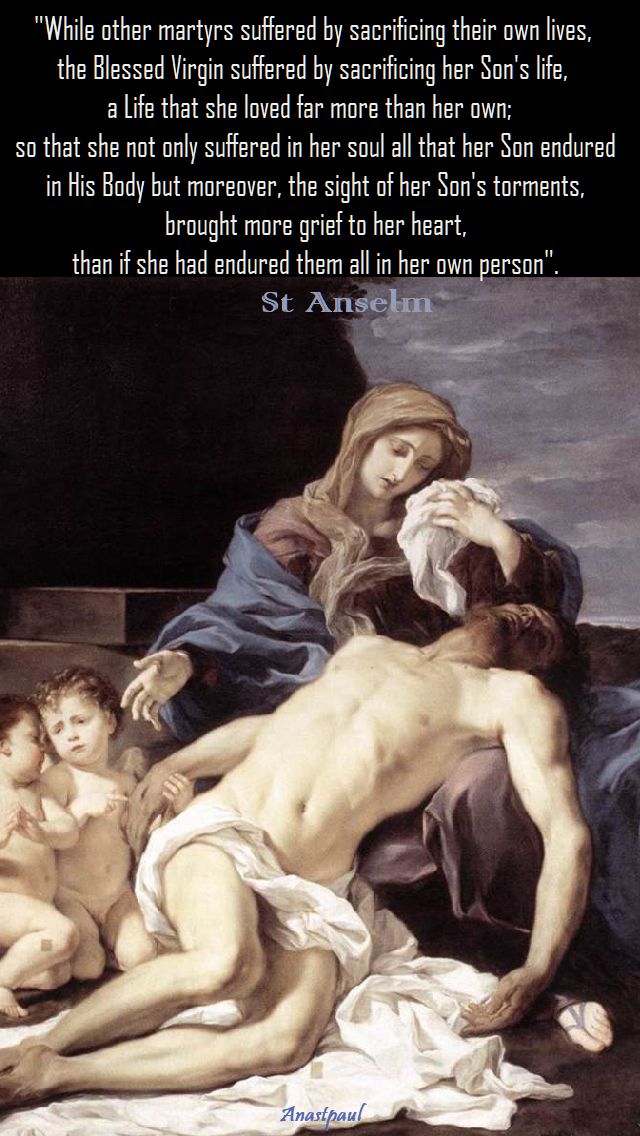
“While other martyrs suffered by sacrificing their own lives, the Blessed Virgin suffered by sacrificing her Son’s life, a Life that she loved far more than her own;  so that she not only suffered in her soul all that her Son endured in His Body but moreover, the sight of her Son’s torments, brought more grief to her heart, than if she had endured them all in her own person”.

St Anselmwhile other martyrs - st anselm

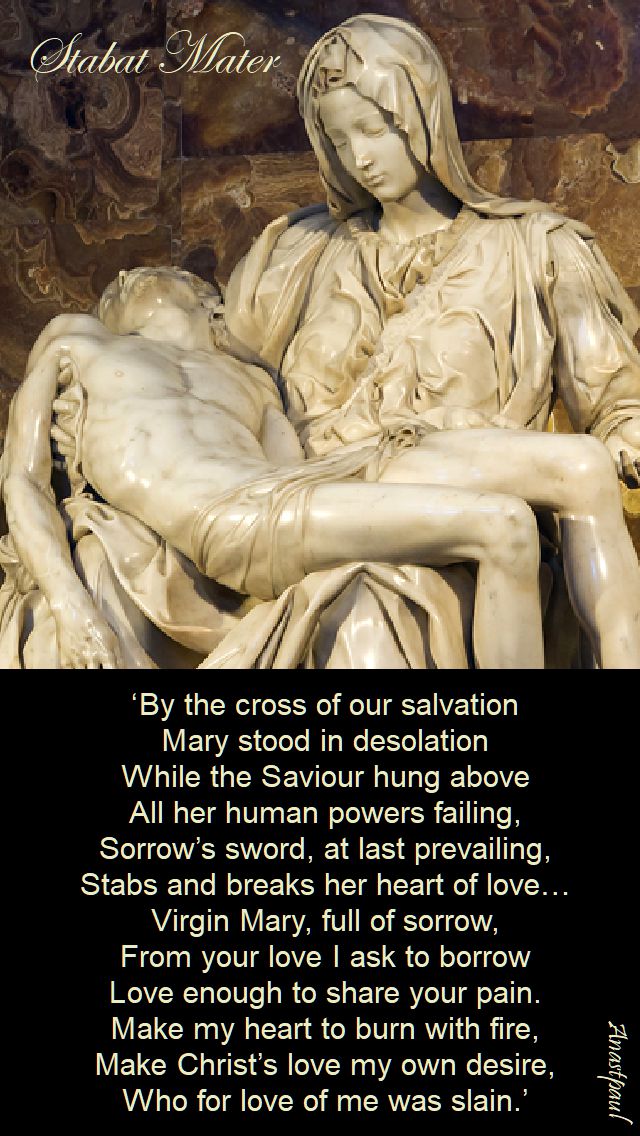
‘By the cross of our salvation
Mary stood in desolation
While the Saviour hung above
All her human powers failing,
Sorrow’s sword, at last prevailing,
Stabs and breaks her heart of love…
Virgin Mary, full of sorrow,
From your love I ask to borrow
Love enough to share your pain.
Make my heart to burn with fire,
Make Christ’s love my own desire,
Who for love of me was slain.’

Stabat Materstabat mater

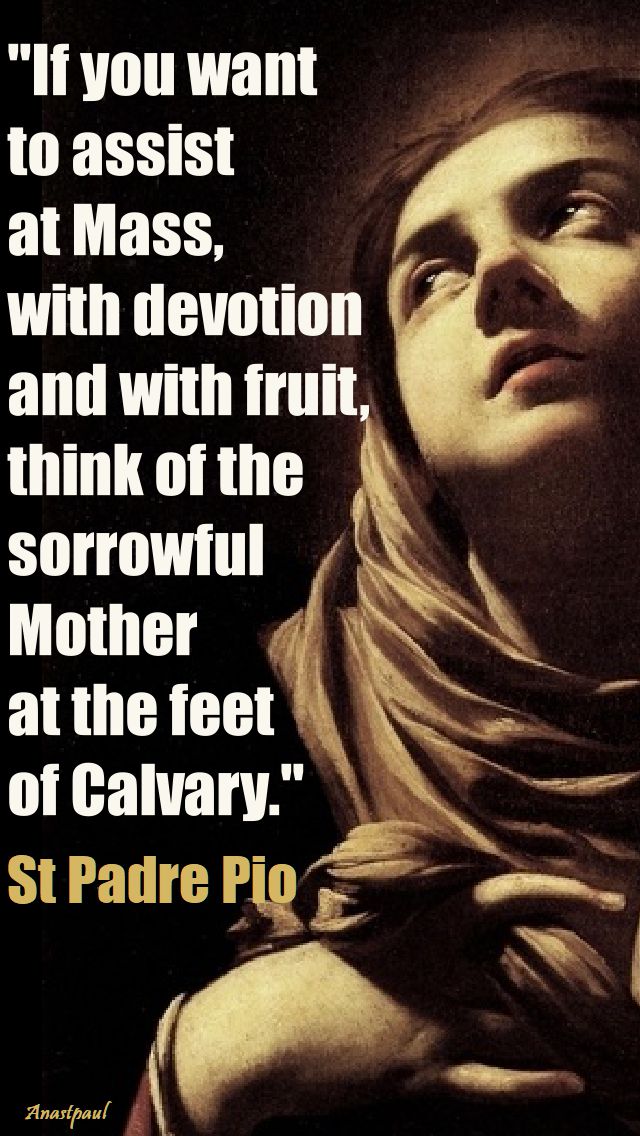
“If you want to assist at Mass, with devotion and with fruit, think of the sorrowful Mother at the feet of Calvary.”

St Padre Pioif you want to assist - st pio

Posted in MORNING Prayers, QUOTES of the SAINTS, The BLESSED VIRGIN MARY, The HOLY CROSS

Thought for the Day – 6 September

Thought for the Day – 6 September

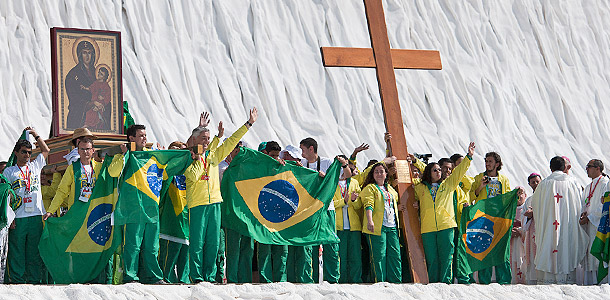
In 1984, at the close of the 1983 Holy Year of the Redemption at the Vatican, St Pope John Paul II entrusted to the young people of the world a simple, 12-foot wooden Cross, asking them to carry it across the world.   This is now the heart of every World Youth Day this  very simple, powerful, ancient Christian symbol:  two large planks of wood, known as the World Youth Day Cross, that many have called the “Olympic Torch” of the huge Catholic festival of young people.Cross-Icon-Brazilian-Pilgrims

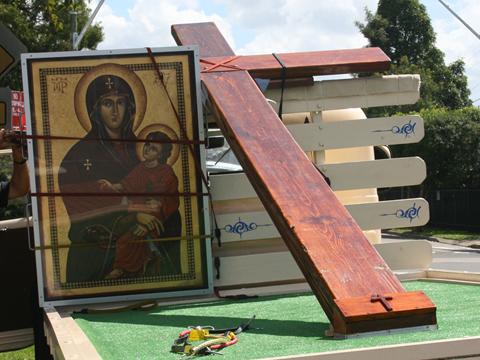
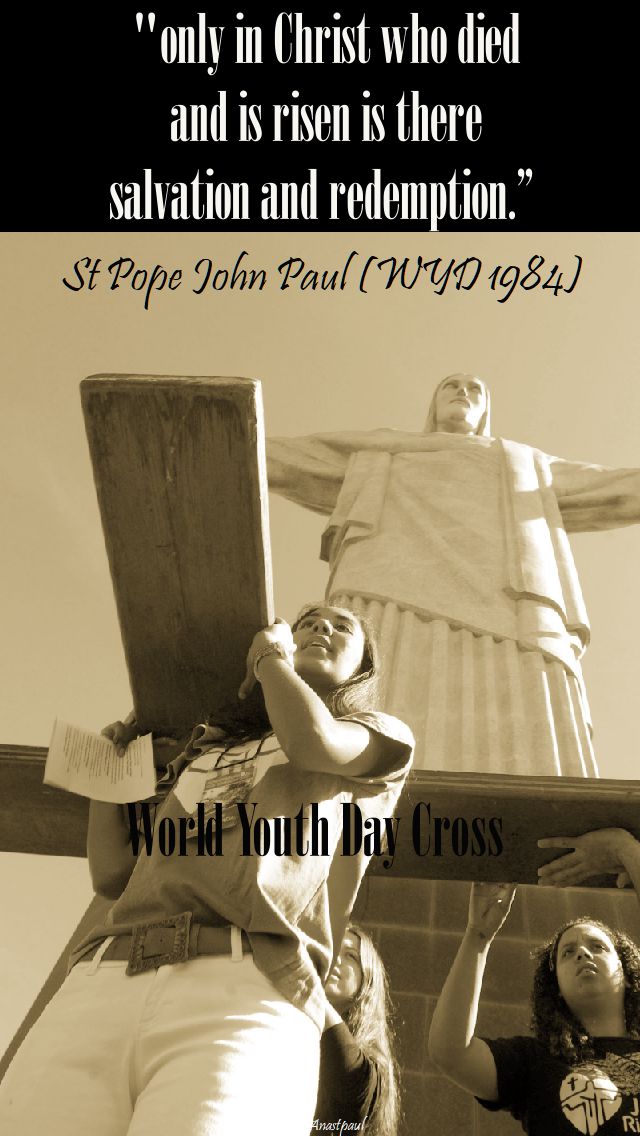
The World Youth Day cross has many names:  the Jubilee Cross, the Pilgrim Cross, the Youth Cross.   In 1984, at the close of the 1983 Holy Year of the Redemption at the Vatican, St Pope John Paul II entrusted to the young people of the world a simple, twelve-foot wooden Cross, asking them to carry it across the world as a sign of the love which the Lord Jesus has for humankind and “to proclaim to everyone that only in Christ who died and is risen is there salvation and redemption.”   Since that day, carried by generous hands and loving hearts, the Cross has made a long, uninterrupted pilgrimage across the continents, to demonstrate, as Pope John Paul II had said, “the Cross walks with young people and young people walk with the Cross.”

The cross does not journey alone.   Since 2003 it has been accompanied by an icon of the Blessed Virgin Mary. a copy of the Icon of our Lady known as the ‘Salus Populi Romani’. The original from which this Icon has been copied is considered by some to be from the eighth century and is housed in a chapel in the Basilica of St Mary Major in Rome.   St Pope John Paul II entrusted to the youth an icon of the Blessed Mother that would accompany the cross.   “It will be a sign of Mary’s motherly presence close to young people who are called, like the Apostle John, to welcome her into their lives.”wyd symbols

The World Youth Day Cross and Icon speak to us of the two focal points of the message of Christianity:   of the Cradle and of the Cross;  of Christ who was born of Mary and of Christ who was crucified for us;   of Christmas and Good Friday;  of the Incarnation and the Paschal Mystery.   The Icon and Cross, therefore, are potent symbols of the joy and suffering that we experience in our Christian pilgrimage.

Because we follow a crucified Christ, we enter into solidarity with the world’s suffering masses.   We experience the power and love of God through the vulnerable and suffering.   The Cross teaches us that what could have remained hideous and beyond remembrance is transformed into beauty, hope and a continuous call to heroic goodness.

To celebrate the Triumph of the Cross is to acknowledge the full, cruciform achievement of Jesus’ career.   Jesus asks us to courageously choose a life similar to his own.   Suffering cannot be avoided nor ignored by those who follow Christ.   Following Jesus implies suffering and a cross.   The mark of the Messiah is to become the mark of his disciples. (Fr Rosica)

only in christ - st john paul wyd 1984

Posted in CONSECRATION Prayers, SAINT of the DAY, The BLESSED VIRGIN MARY

Our Morning Offering – 26 August

Our Morning Offering – 26 August
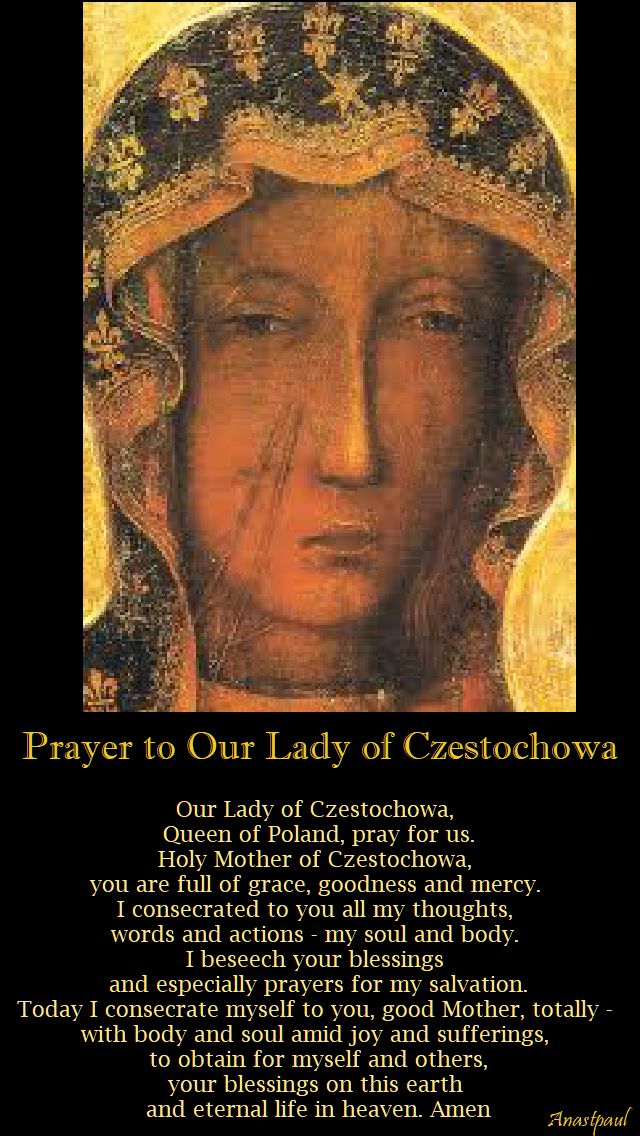
Prayer to Our Lady of Czestochowa

Our Lady of Czestochowa,
Queen of Poland, pray for us.
Holy Mother of Czestochowa,
you are full of grace, goodness and mercy.
I consecrated to you all my thoughts,
words and actions – my soul and body.
I beseech your blessings
and especially prayers for my salvation.
Today I consecrate myself to you, good Mother, totally –
with body and soul amid joy and sufferings,
to obtain for myself and others,
your blessings on this earth
and eternal life in heaven. Amen

prayer to our lady of czestochowa

Our Lady of Czestochowa, Queen of Poland, pray for us.

Posted in ART DEI, SAINT of the DAY, The APOSTLES & EVANGELISTS, The BLESSED VIRGIN MARY

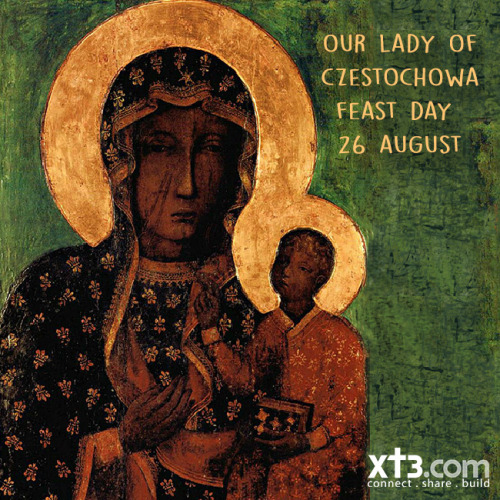
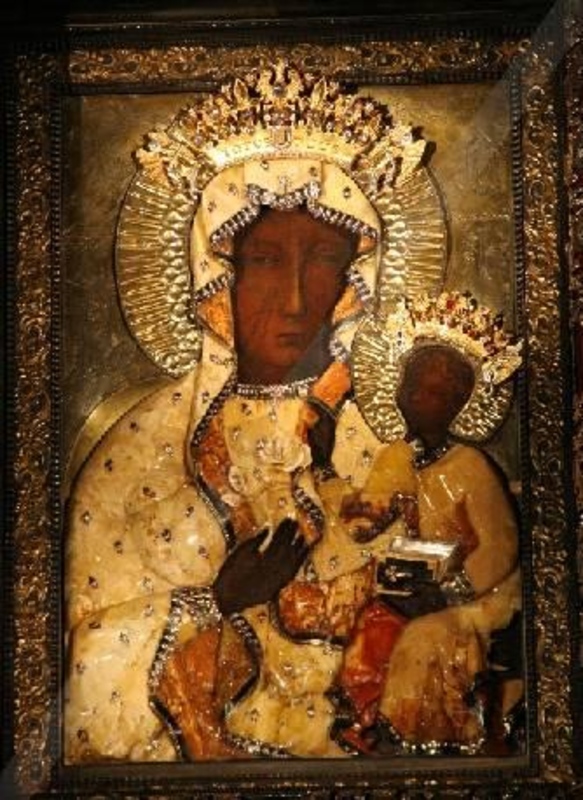
Blessed Feast of Our Lady of Czestochowa, Queen of Poland – 26 August

Blessed Feast of Our Lady of Czestochowa, Queen of Poland – 26 August – Also known as – The Black Madonna of Czestochowa, Czarna Madonna, Hodegetria, Imago thaumaturga Beatae Virginis Mariae Immaculatae Conceptae, Matka Boska Czestochowska, One Who Shows the Way.   Our Lady of Czestochowa is a revered icon of the Virgin Mary housed at the Jasna Góra Monastery in Częstochowa, Poland.   Several Pontiffs have recognised the venerated icon, beginning with Pope Clement XI who issued a Canonical Coronation to the image on 8 September 1717 via the Vatican Chapter.    Patron of Poland.

According to tradition, the icon of Jasna Góra (Bright Mountain) was painted by Luke the Evangelist on a tabletop built by Jesus Himself and the icon was discovered by St Helen, mother of Emperor Constantine and collector of Christian relics in the Holy Land.   The icon was then enshrined in the imperial city of Constantinople, where it remained for the next 500 years.

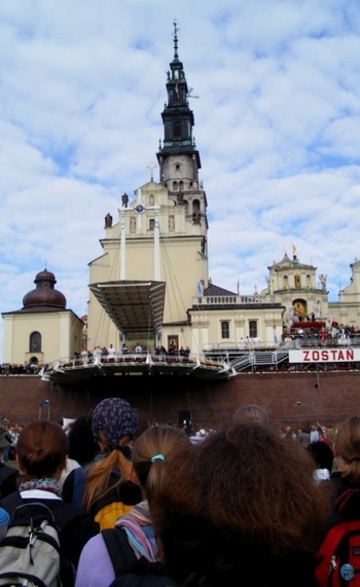
jasna gora monastery
JASNA GORA MONASTERY
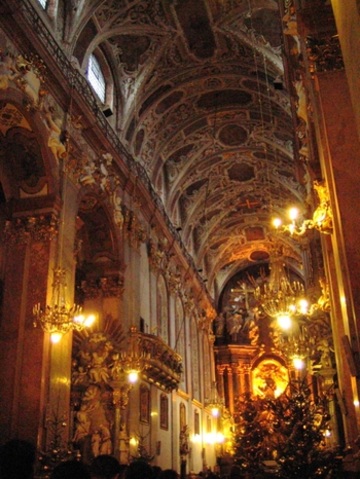
basilica of our lady of czestochowa at jasna gora
BASILICA OF OUR LADY OF CZESTOCHOWA AT JASNA GORA

In 803, the painting is said to have been given as a wedding gift from the Byzantine emperor to a Greek princess, who married a Ruthenian nobleman.   The image was then placed in the royal palace at Belz, where it remained for nearly 600 years.

History first combines with tradition upon the icon’s arrival in Poland in 1382 with a Polish army fleeing the Tartars, who had struck it with an arrow.

Legend has it that during the looting of Belz, a mysterious cloud enveloped the chapel containing the image.   A monastery was founded in Częstochowa to enshrine the icon in 1386 and soon King Jagiello built a cathedral around the chapel containing the icon.

However, the image soon came under attack once again.   In 1430, Hussites (pre-Reformation reformers) attacked the monastery, slashed the Virgin’s face with a sword, and left it desecrated in a puddle of blood and mud.

It is said that when the monks pulled the icon from the mud, a miraculous fountain appeared, which they used to clean the painting.   The icon was repainted in Krakow, but both the arrow mark and the gashes from the sword were left and remain clearly visible today.

The miracle for which the Black Madonna of Częstochowa is most famous occurred in 1655, when Swedish troops were about to invade Częstochowa.   A group of Polish soldiers prayed fervently before the icon for deliverance and the enemy retreated.   In 1656, King John Casimir declared Our Lady of Częstochowa “Queen of Poland” and made the city the spiritual capital of the nation.

The Virgin again came to the aid of her people in 1920, when the Soviet Russian Red Army gathered on the banks of the Vistula River, preparing to attack Warsaw.   The citizens and soldiers fervently prayed to Our Lady of Częstochowa and on September 15, the Feast of Our Lady of Sorrows, she appeared in the clouds above Warsaw.   The Russians were defeated in a series of battles later dubbed the “Miracle at the Vistula.”

During Nazi occupation, Hitler prohibited pilgrimages to Jasna Góra but many still secretly made the journey.   In 1945, after Poland was liberated, half a million pilgrims journeyed to Czestochowa to express their gratitude.   On September 8, 1946, 1.5 million people gathered at the shrine to rededicate the entire nation to the Immaculate Heart of Mary.   During the Cold War, Jasna Góra was a centre of anti-Communist resistance.  Czestochowa is regarded as the most popular shrine in Poland, with many Polish Catholics making a pilgrimage there every year.   A pilgrimage has left Warsaw every August 6 since 1711 for the nine-day, 140-mile trek.  Elderly pilgrims recall stealing through the dark countryside at great personal risk during the German Nazi occupation. Pope John Paul II secretly visited as a student pilgrim during World War II.   He was a fervent devotee of the Virgin Mary and of her icon at Czestochowa.   As pope, he made pilgrimages to pray before the Black Madonna in 1979, 1983, 1991 and 1997.   In 1991, he held his Sixth World Youth Day at Czestochowa, which was attended by 350,000 young people from across Europe.

The four-foot-high painting displays a traditional composition well known in the icons of Eastern Christians.   The Virgin Mary is shown as the “Hodegetria” (“One Who Shows the Way”).   In it the Virgin directs attention away from herself, gesturing with her right hand toward Jesus as the source of salvation.   In turn, the child extends his right hand toward the viewer in blessing while holding a book of gospels in his left hand.  The icon shows the Madonna in fleur-de-lis robes.

our lady of czestochowa

dressed in special robes at Jasna Gora Monastery
This image shows Our Lady dressed in special robes at Jasna Gora
Posted in CONFESSORS, franciscan OFM, INCORRUPTIBLES, PRIESTS, all CLERGY, QUOTES - J R R Tolkien and MORE, SAINT of the DAY

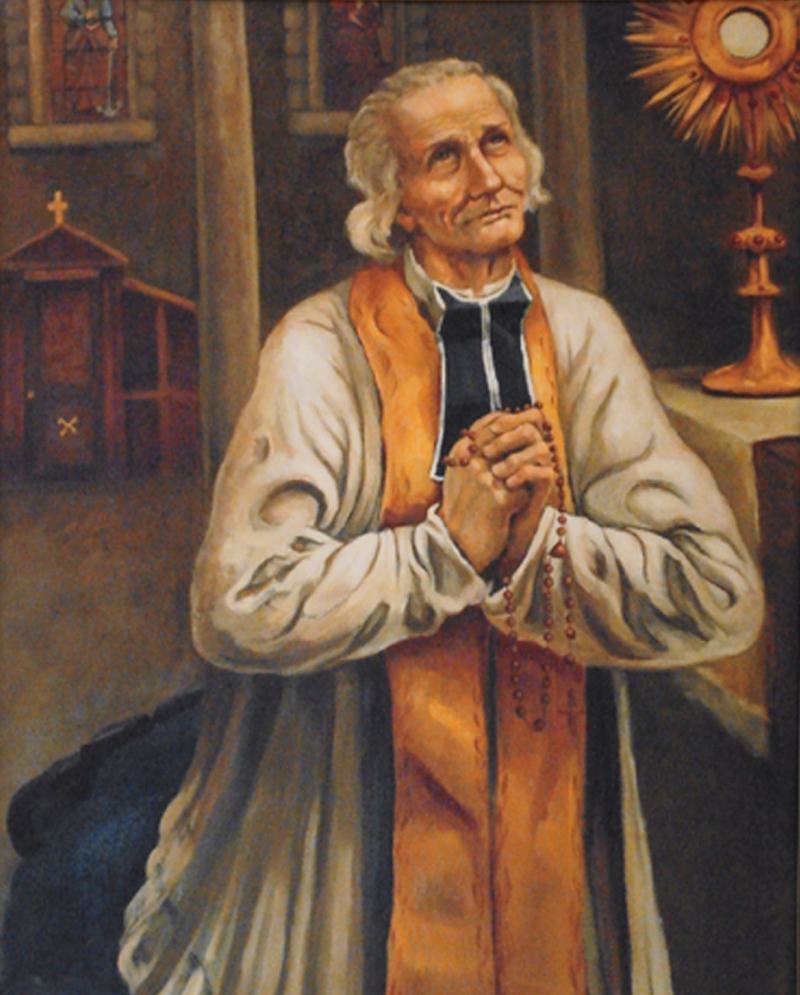
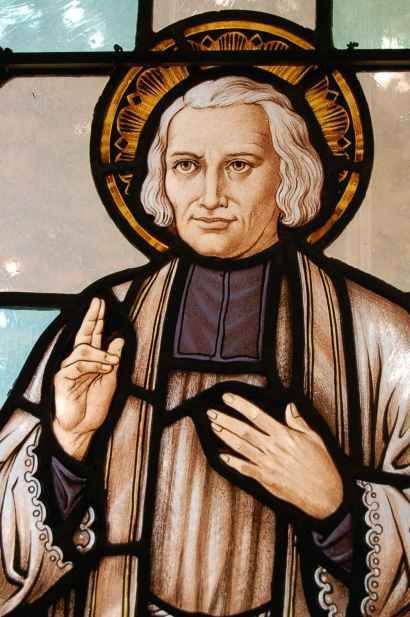
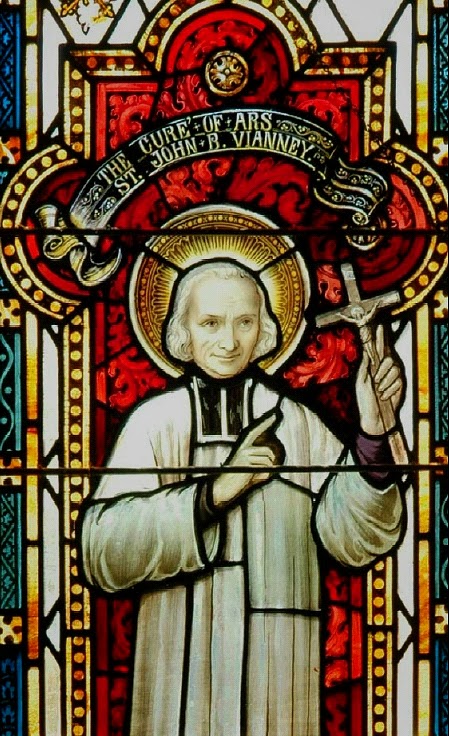
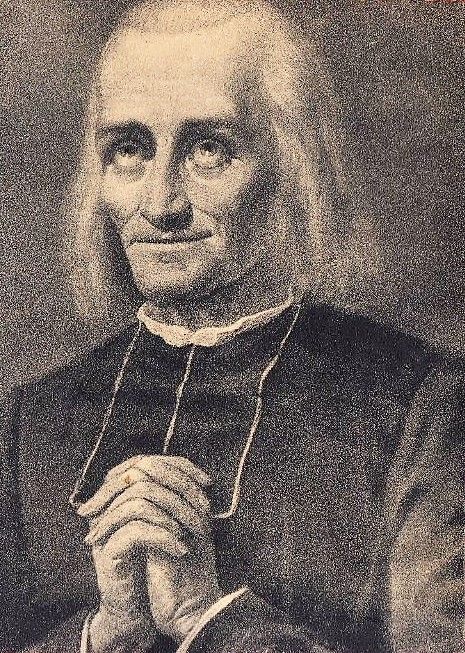
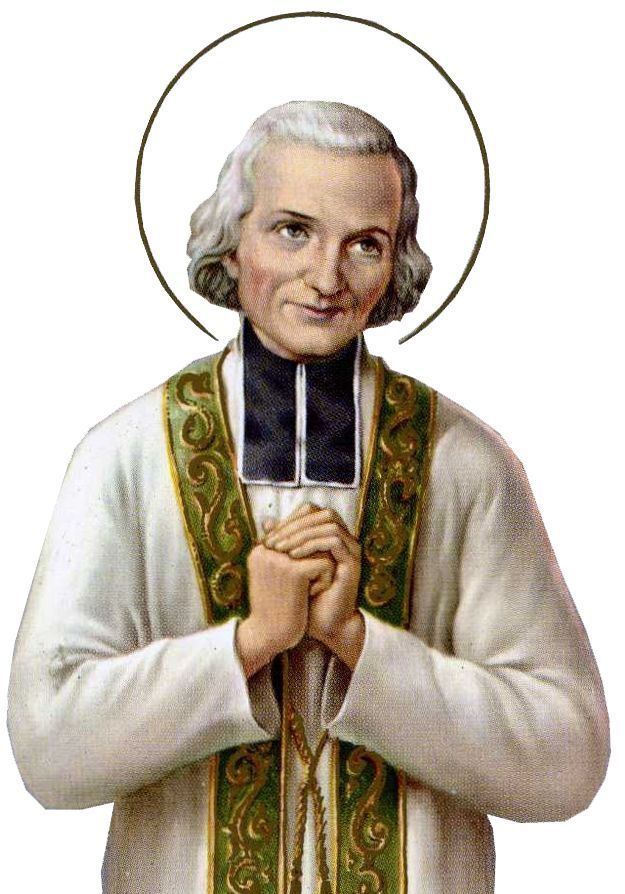
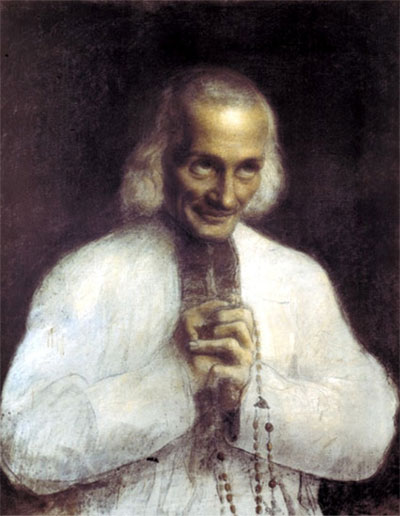
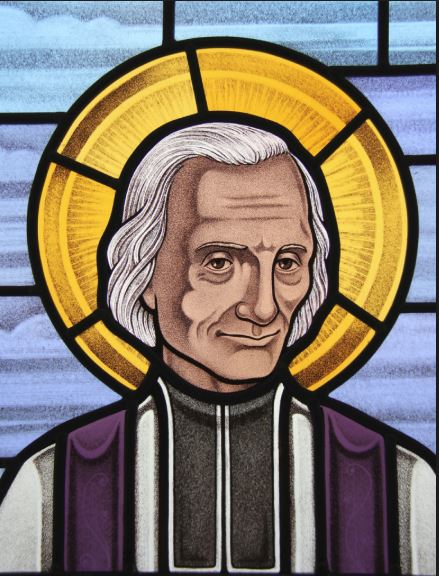
Saint of the Day – 9 August – St Jean-Baptiste Marie Vianney TOSF (1786-1859)- The Curé of Ars, Confessor

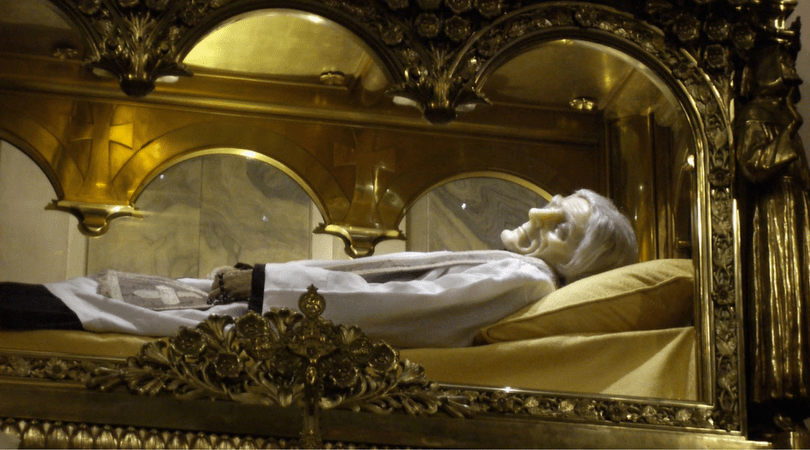
Saint of the Day – 9 August – St Jean-Baptiste Marie Vianney TOSF (1786-1859) – The Curé of Ars (Parish Priest of Ars) – Confessor Priest and Tertiary – (8 May 1786 at Dardilly, Lyons, France – 4 August 1859 at Ars, France of natural causes)   His body is interred in the Basilica of Ars.   He was Canonised on 31 May 1925 by Pope Pius XI.   Patronages – Confessors, Priests (proclaimed on 23 April 1929 by Pope Pius XI), Personal Apostolic Administration of Saint John Mary Vianney, Dubuque, Iowa, Archdiocese of, Kamloops, British Columbia, Diocese of, Kansas City, Kansas, Archdiocese of, Lafayette, Louisiana, Diocese of, Saint Paul and Minneapolis, Minnesota, Archdiocese of.  St John Vianney’s body is incorrupt.

St-John-Vianney

St John Vianney was born on 8 May 1786, in the French town of Dardilly, France (near Lyon) and was baptised the same day.   His parents, Matthieu Vianney and his wife Marie (Belize), had six children, of whom John was the fourth.   The Vianneys were devout Catholics, who helped the poor and gave hospitality to St Benedict Joseph Labre, the patron saint of tramps, who passed through Dardilly on his pilgrimage to Rome.

St Benedict Joseph Labre detail Icon and Jesus Crowns
St Benedict Joseph Labre

By 1790, the anticlerical Terror phase of the French Revolution forced many loyal priests to hide from the regime in order to carry out the sacraments in their parish.   Even though to do so had been declared illegal, the Vianneys traveled to distant farms to attend Masses celebrated by priests on the run.   Realising that such priests risked their lives day by day, Vianney began to look upon them as heroes.   He received his First Communion catechism instructions in a private home by two nuns whose communities had been dissolved during the Revolution.   He made his first communion at the age of 13 (normal in those times).   During the Mass, the windows were covered so that the light of the candles could not be seen from the outside.   His practice of the Faith continued in secret, especially during his preparation for confirmation.

The Catholic Church was re-established in France in 1802 by Napoleon Bonaparte, resulting in religious peace throughout the country, culminating in a Concordat.   By this time, Vianney was concerned about his future vocation and longed for an education.   He was 20 when his father allowed him to leave the farm to be taught at a “presbytery-school” in the neighbouring village of Écully, conducted by the Abbé Balley.   The school taught arithmetic, history, geography and Latin.   Vianney struggled with school, especially with Latin, since his past education had been interrupted by the French Revolution.   Only because of Vianney’s deepest desire to be a priest—and Balley’s patience—did he persevere.lovely - st john vianney glass

St Vianney’s studies were interrupted in 1809 when he was drafted into Napoleon’s armies. He would have been exempt, as an ecclesiastical student but Napoleon had withdrawn the exemption in certain dioceses because of his need for soldiers in his fight against Spain.   Two days after he had to report at Lyons, he became ill and was hospitalised, during which time his draft left without him.   Once released from the hospital, on 5 January, he was sent to Roanne for another draft.   He went into a church to pray and fell behind the group.   He met a young man who volunteered to guide him back to his group but instead led him deep into the mountains of Le Forez, to the village of Les Noes, where deserters had gathered.   St Vianney lived there for fourteen months, hidden in the byre attached to a farmhouse and under the care of Claudine Fayot, a widow with four children.   He assumed the name Jerome Vincent and under that name, he opened a school for village children.   Since the harsh weather isolated the town during the winter, the deserters were safe from gendarmes.   However, after the snow melted, gendarmes came to the town constantly, searching for deserters.   During these searches, Vianney hid inside stacks of fermenting hay in Fayot’s barn.

An imperial decree proclaimed in March 1810 granted amnesty to all deserters, which enabled Vianney to go back legally to Ecully, where he resumed his studies.   He was tonsured in 1811 and in 1812 he went to the minor seminary at Verrières-en-Forez.   In autumn of 1813, he was sent to the major seminary at Lyons.   Considered too slow, he was returned to Abbe Balley.   However, Balley persuaded the Vicar general that Vianney’s piety was great enough to compensate for his ignorance and the seminarian received minor orders and the subdiaconate on 2 July 1814, was ordained a deacon in June 1815 and was ordained priest on 12 August 1815 in the Couvent des Minimes de Grenoble.   He said his first Mass the next day and was appointed the assistant to Balley in Écully.

St-John-Vianney.5

Curé of Ars
In 1818, shortly after the death of Balley, Jean-Marie Vianney was appointed parish priest of the parish of Ars, a town of 230 inhabitants.    As parish priest, he realised that the Revolution’s aftermath had resulted in religious ignorance and indifference, due to the devastation wrought on the Catholic Church in France.   At the time, Sundays in rural areas were spent working in the fields, or dancing and drinking in taverns.  He spent time in the confessional and gave homilies against blasphemy and paganic dancing.   If his parishioners did not give up this dancing, he refused them absolution.   Abbe Balley had been St Vianney’s greatest inspiration, since he was a priest who remained loyal to his faith, despite the Revolution.   He felt compelled to fulfill the duties of a curé, just as did Balley, even when it was illegal.   With Catherine Lassagne and Benedicta Lardet, he established La Providence, a home for girls.   Only a man of vision could have such trust that God would provide for the spiritual and material needs of all those who came to make La Providence their home.french - st john vianney

Later years
Fr Vianney came to be known internationally and people from distant places began travelling to consult him as early as 1827.   “By 1855, the number of pilgrims had reached 20,000 a year.   During the last ten years of his life, he spent 16 to 18 hours a day in the confessional.   Even the bishop forbade him to attend the annual retreats of the diocesan clergy because of the souls awaiting him yonder”.  His work as a confessor is John Vianney’s most remarkable accomplishment.   In the winter months he was to spend 11 to 12 hours daily reconciling people with God.   In the summer months this time was increased to 16 hours.   Unless a man was dedicated to his vision of a priestly vocation, he could not have endured this giving of self day after day.st john vianney lg

Many people look forward to retirement and taking it easy, doing the things they always wanted to do but never had the time. But John Vianney had no thoughts of retirement.   As his fame spread, more hours were consumed in serving God’s people.   Even the few hours he would allow himself for sleep were disturbed frequently by the devil, who physically attacked and tormented St John and kept him from sleeping.

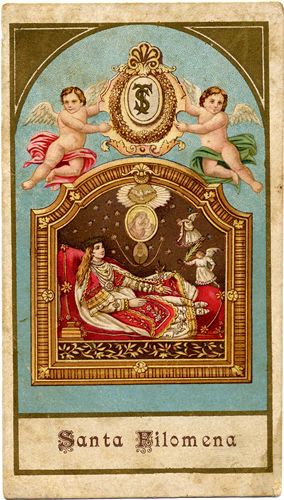
St Vianney had a great devotion to St. Philomena.   He regarded her as his guardian and erected a chapel and shrine in honor of the saint.   During May 1843, he fell so ill he thought that his life was coming to its end.   St John Vianney attributed his cure to her intercession.

st philomena

He yearned for the contemplative life of a monk and four times ran away from Ars, the last time in 1853.  St John Vianney read much and often the lives of the saints, and became so impressed by their holy lives that he wanted for himself and others to follow their wonderful examples.   The ideal of holiness enchanted him.   This was the theme which underlay his sermons.  “We must practice mortification. For this is the path which all the Saints have followed,” he said from the pulpit.   He placed himself in that great tradition which leads the way to holiness through personal sacrifice. “If we are not now saints, it is a great misfortune for us:  therefore we must be so.   As long as we have no love in our hearts, we shall never be Saints.”   The Saint, to him, was not an exceptional man before whom we should marvel but a possibility which was open to all Catholics.   Unmistakably did he declare in his sermons that “to be a Christian and to live in sin is a monstrous contradiction. A Christian must be holy.”   With his Christian simplicity he had clearly thought much on these things and understood them by divine inspiration, while they are usually denied to the understanding of educated men.   He was a champion of the poor as a Franciscan tertiary and was a recipient of the coveted French Legion of Honour.St.-John-Vianney.8

On 4 August 1859, Vianney died at the age of 73.   The bishop presided over his funeral with 300 priests and more than 6,000 people in attendance.   Before he was buried, Vianney’s body was fitted with a wax mask.

On 3 October 1874 Pope Pius IX proclaimed him “venerable”;  on 8 January 1905, Pope Pius X declared him Blessed and proposed him as a model to the parochial clergy.   In 1925 John Mary Vianney was canonized by Pope Pius XI, who in 1929 made him patron saint of parish priests.

In 1959, to commemorate the centenary of John Vianney’s death, Pope John XXIII issued the encyclical letter Sacerdotii nostri primordia.   St Pope John Paul II visited Ars in person in 1986 in connection with the anniversary of Vianney’s birth and referred to the great saint as a “rare example of a pastor acutely aware of his responsibilities … and a sign of courage for those who today experience the grace of being called to the priesthood.”snip - st john vianney

In honour of the 150th anniversary of Vianney’s death, Pope Benedict XVI declared a Year of the Priest, running from the Feast of the Sacred Heart 2009–2010.   The Vatican Postal Service issued a set of stamps to commemorate the 150th Anniversary.   With the following words on 16 June 2009, Benedict XVI officially marked the beginning of the year dedicated to priests, “…On the forthcoming Solemnity of the Most Sacred Heart of Jesus, Friday 19 June 2009 – a day traditionally devoted to prayer for the sanctification of the clergy –, I have decided to inaugurate a ‘Year of the Priest’ in celebration of the 150th anniversary of the dies natalis of John Mary Vianney, the Patron Saint of parish priests worldwide…” In the Holy Father’s words the Curé d’Ars is “a true example of a pastor at the service of Christ’s flock.”

There are statues and stained glass windows of St John Vianney in many French churches and in Catholic churches throughout the world.   Also, many parishes founded in the twentieth and twenty-first centuries are named after him.   Some relics are kept in the Church of Notre-Dame de la Salette in Paris.st john vianney relics

Posted in DOCTORS of the Church, MORNING Prayers, QUOTES of the SAINTS, SAINT of the DAY

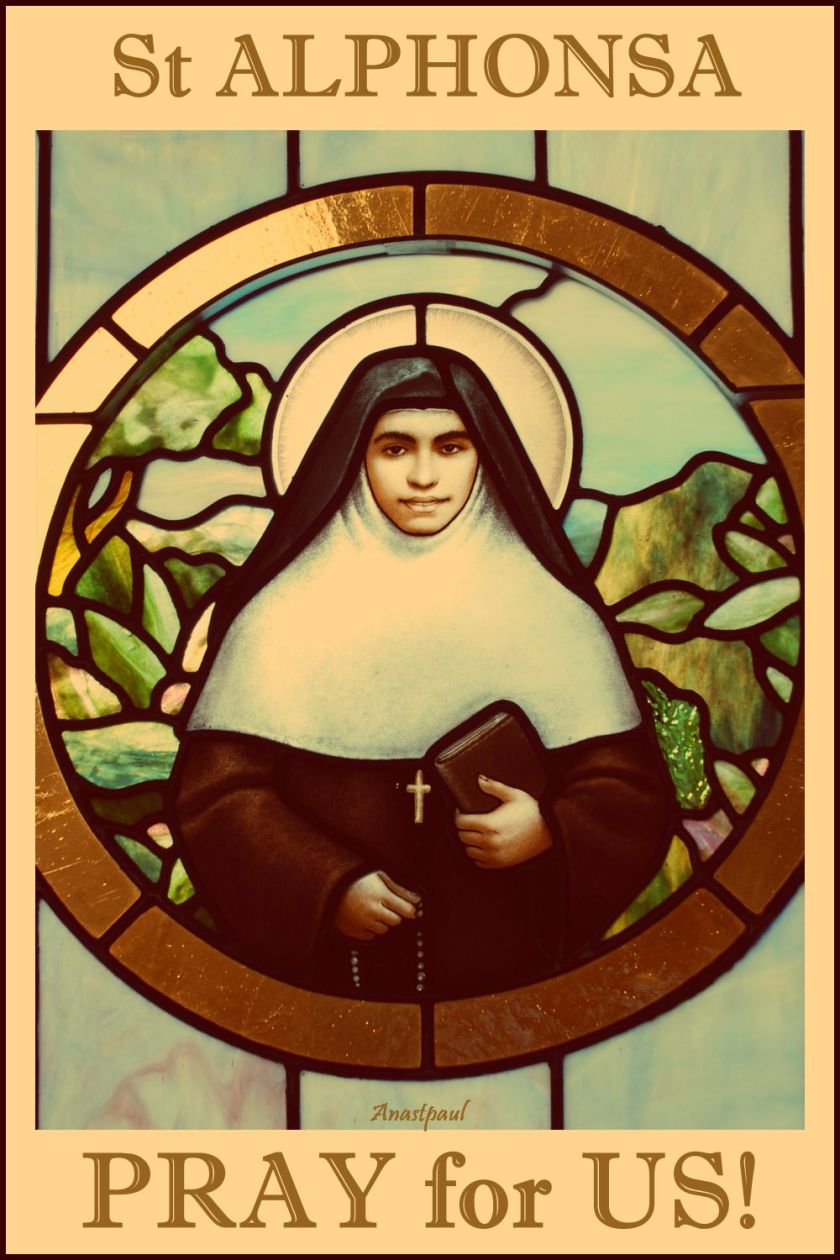
Thought for the day – 28 July – the Memorial of St Alphonsa of the Immaculate Conception

Thought for the day – 28 July

“From early in her life, Sister Alphonsa experienced great suffering.   With the passing of the years, the heavenly Father gave her an ever fuller share in the Passion of His beloved Son.   We recall how she experienced not only physical pain of great intensity but also the spiritual suffering of being misunderstood and misjudged by others.   But she constantly accepted all her sufferings with serenity and trust in God, being firmly convinced that they would purify her motives, help her to overcome all selfishness and unite her more closely with her beloved divine Spouse.   She wrote to her spiritual director:  “Dear Father, as my good Lord Jesus loves me so very much, I sincerely desire to remain on this sick bed and suffer not only this but anything else besides, even to the end of the world.   I feel now that God has intended my life to be an oblation, a sacrifice of suffering” (20 November 1944).   She came to love suffering because she loved the suffering Christ.   She learned to love the Cross through her love of the crucified Lord.

…Every one who has been baptised into Christ has discovered a pearl of “great value” and a “treasure” worth all that one has in life .   For all the baptised share in the very life of the Blessed Trinity and are called to be “light” and “salt” for the world .”…St Pope John Paul at the Beatification of St Alphonsa, 8 February 1986.

Let us be that “light” and that “salt”!

St Alphonsa of the Immaculate Conception, pray for us!

st alphonsa pray for us 2

Posted in MORNING Prayers, PRAYERS of the SAINTS

Our Morning Offering – 20 July

Our Morning Offering – 20 July

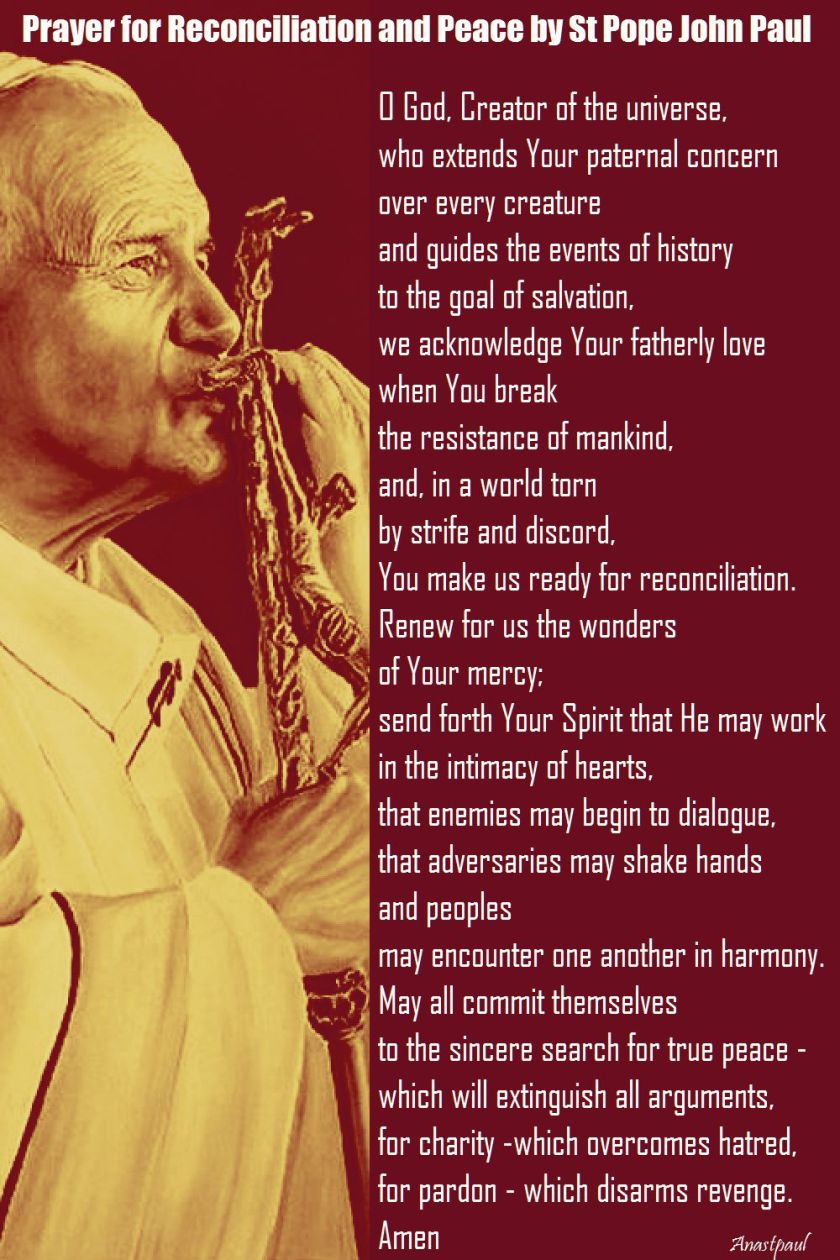
Prayer for Reconciliation and Peace
St Pope John Paul

O God, Creator of the universe,
who extends Your paternal concern
over every creature
and guides the events of history
to the goal of salvation,
we acknowledge Your fatherly love
when You break the resistance of mankind,
and, in a world torn by strife and discord,
You make us ready for reconciliation.
Renew for us the wonders of Your mercy;
send forth Your Spirit that He may work
in the intimacy of hearts,
that enemies may begin to dialogue,
that adversaries may shake hands and peoples
may encounter one another in harmony.
May all commit themselves
to the sincere search for true peace –
which will extinguish all arguments,
for charity -which overcomes hatred,
for pardon – which disarms revenge.
Amen

prayer for reconciliation and peace by st john paul

Posted in EUCHARISTIC Adoration, MORNING Prayers, PAPAL ENCYLICALS, QUOTES of the SAINTS, SAINT of the DAY, The HOLY EUCHARIST / The HOLY MASS, The WORD

One Minute Reflection – 18 July

One Minute Reflection – 18 July

Lo, I am with you always, to the close of the age……Matthew 28:20

REFLECTION – “For the most holy Eucharist contains the Church’s entire spiritual wealth:  Christ Himself, our Passover and living bread.   Through His own flesh, now made living and life-giving by the Holy Spirit, He offers life to men………The sacrifice of Christ and the sacrifice of the Eucharist are one single sacrifice.”…….St John Paul (Ecclesia de Eucharistia 1 &12)

through his own flesh - st john paul

PRAYER – Lord, let me live each day in joy – for You are with us to end of time.   We have the joy of receiving Your Body and thus we live in You and You in us.   Help us to give thanks and praise for the Holy Mass and Your saving Passion.   St Bruno of Segni, your great love of the Holy Sacrament, led you to zealous efforts to spend your life in growing in others, understanding of the great Eucharistic grace we receive, please pray for us, amen.

st bruno of segni pray for us

Posted in EUCHARISTIC Adoration, MORNING Prayers, PRAYERS of the SAINTS, The HOLY EUCHARIST / The HOLY MASS

Our Morning Offering – 18 July

Our Morning Offering – 18 July

Eucharistic Lord Jesus
St Pope John Paul – Cremona,Italy, June 21,1992

Lord Jesus,
who in the Eucharist make Your dwelling among us
and become our travelling companion,
sustain Our Christian communities
so that they may be ever more open to listening
and accepting Your Word.
May they draw from the Eucharist
a renewed commitment to spreading in society,
by the proclamation of Your Gospel,
the signs and deeds of an attentive and active charity.
Lord Jesus, in Your Eucharist
make Christian spouses
the “signs” of Your nuptial love among us:
make families communities of people who,
living in dialogue with God and each other,
do not fear life
and become responsible for sowing the seeds
of priestly, religious and missionary vocations.
Lord Jesus, from Your altar
illuminate this world with light and grace,
so that it may reject the seduction
of a materialistic conception of life,
and defeat the selfishness that threatens it,
the injustices that upset it,
and the divisions with which it is affliicted.
Lord Jesus: give us Your joy, give us Your peace.
Stay with us, Lord!
You alone have the words of eternal life! Amen

eucharistic lord jesus by st john paul


Posted in MORNING Prayers, QUOTES of the SAINTS, SAINT of the DAY

Thought for the Day – 7 July – Memorial of Blessed Peter To Rot “Defender of the Sacrament of Marriage” – a Saint for our times!

Thought for the Day – 7 July – Memorial of Blessed Peter To Rot “Defender of the Sacrament of Marriage” – a Saint for our times!

“Blessed Peter understood the value of suffering.   Inspired by his faith in Christ, he was a devoted husband, a loving father and a dedicated catechist known for his kindness, gentleness and compassion.   Daily Mass and Holy Communion and frequent visits to our Lord in the Blessed Sacrament, sustained him, gave him wisdom to counsel the disheartened and courage to persevere until death.   In order to be an effective evangeliser, Peter To Rot studied hard and sought advice from wise and holy “big men”. Most of all he prayed – for himself, for his family, for his people, for the Church. His witness to the Gospel inspired others, in very difficult situations, because he lived his Christian life so purely and joyfully.   Without being aware of it, he was preparing throughout his life for his greatest offering: by dying daily to himself, he walked with his Lord on the road which leads to Calvary (Cf. Mt. 10: 38-39).

During times of persecution the faith of individuals and communities is “tested by fire” (1Pt. 1: 7).   But Christ tells us that there is no reason to be afraid.   Those persecuted for their faith will be more eloquent than ever:  “it is not you who will be speaking; the Spirit of your Father will be speaking in you” (Mt. 10: 20).   So it was for Blessed Peter To Rot. When the village of Rakunai was occupied during the Second World War and after the heroic missionary priests were imprisoned, he assumed responsibility for the spiritual life of the villagers.   Not only did he continue to instruct the faithful and visit the sick, he also baptised, assisted at marriages and led people in prayer.

When the authorities legalised and encouraged polygamy, Blessed Peter knew it to be against Christian principles and firmly denounced this practice.   Because the Spirit of God dwelt in him, he fearlessly proclaimed the truth about the sanctity of marriage.   He refused to take the “easy way” (Cf. ibid. 7: 13) of moral compromise.  “I have to fulfil my duty as a Church witness to Jesus Christ”, he explained.   Fear of suffering and death did not deter him.   During his final imprisonment Peter To Rot was serene, even joyful. He told people that he was ready to die for the faith and for his people.”  EXCERPT from the HOMILY OF THE HOLY FATHER ST JOHN PAUL II (Sir John Guise Stadium, Port Moresby, Tuesday, 17 January 1995 on the Beatification of Blessed Peter To Rot)

Blessed Peter To Rot – Pray for us that we too may, in all circumstances and at every opportunity defend the sanctity of the sacrament of marriage without fear and without moral compromise!

bl peter to rot - pray for us 2

Posted in QUOTES of the SAINTS, SAINT of the DAY

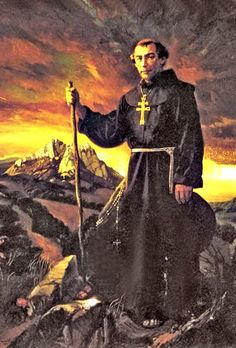
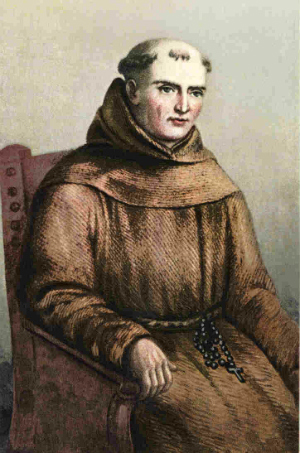
Saint of the Day – 1 July – St Junipero Serra O.F.M., Apostle of California – 1 July

Saint of the Day – 1 July – St Junipero Serra  O.F.M., Apostle of California- 1 July – Priest, Religious Friar, Missionary, Theologian, Philospher, Teacher, Evangelist – (born Miguel Jose 24 November 1713 at Petra, Spanish Majorca as Miguel Jose Serra –  28 August 1784 of tuberculosis at Mission San Carlos, California of natural causes).  His remains are  buried at Carmel, Monterey, California.   Patronages – Vocations, Hispanic Americans, California.   Attributes Franciscan habit, wearing a large crucifix, or holding a crucifix accompanied by a young Native American boy.

st junipero serra.9

Miguel Jose Serra was born in Majorca, Spain.   At the young age of 16, he entered into service to God, joining the Order of Saint Francis and taking the name Junipero—in honour of Saint Juniper, the saintly friar companion of Saint Francis.   Ordained at age 24, Junipero studied in Parma, the capital of Majorca and taught philosophy and theology at the monastery of San Francisco at Lullian University for over a decade.   Serra was known as a brilliant, articulate scholar — a moving speaker and a clear, precise writer — but he did not remain long in academic life.   In 1749, at the age of 37, Junipero answered the call for missionaries and left Europe, heading to the New World Western mission territories.

Junipero left Cadiz, Spain and sailed for Vera Cruz, Mexico.   During the voyage, he suffered an insect bite which led to significant physical difficulties with his leg– an ailment which remained for the rest of his life.   Upon arrival in the New Work, he traveled by foot (as would become his custom, despite his physical limitations) to Mexico City to dedicate his mission vocation at the shrine of Mexico’s Our Lady of Guadalupe.   He then received his first assignment—the rugged, mountainous region of Mexico known as Sierra Gorda. Friar Junipero embraced his mission work, learning the language of the native Pame Indians and translating the Catechism for them.   He remained at Sierra Gorda for nine years, strengthening and building missions.

st junipero serra.13

Soon, word of Blessed Junipero’s commitment and skill spread and he was re-assigned. His next mission was to journey from Mexico City into the coastal villages and mining camps.   Again, despite his continuously infected and now ulcerated leg, he walked over 6,000 miles over eight years, preaching, converting, baptising and establishing missions. Before he was finished, Junipero would establish and oversee construction of 21 missions in California and Mexico.   He was appointed Superior of Baja California and later “padre president” of the region.   He linked his 21 missions—each a one-day 30 mile walk from each other—by a dirt road, named “El Camino Real.”

Throughout his mission work, Father Serra sought to protect the native peoples, who were often ill-treated by the Spanish settlers and rulers.   He struggled valiantly with military leaders, eventually becoming instrumental in the establishment of the “Regulations”—effectively, the first “bill of rights” for native peoples in the New World. He also spent time with the indigenous of the region, learning their language, teaching European farming techniques, animal husbandry, and arts and crafts.   During his homily at Serra’s beatification, Pope John Paul II said: “Relying on the divine power of the message he proclaimed, Father Serra led the native peoples to Christ. He was well aware of their heroic virtues—as exemplified in the life of Blessed Kateri Tekakwitha [July 14]—and he sought to further their authentic human development on the basis of their new-found faith as persons created and redeemed by God. He also had to admonish the powerful, in the spirit of our second reading from James, not to abuse and exploit the poor and the weak.”

Despite constant setbacks, ill health, cold, hunger and threat of bodily harm from military leaders and native Indians, Blessed Junipero never turned from his mission task.   He kept with determination to his watchword, “Always to go forward and never to turn back.”

Numerous miracles were attributed to the intercession of Friar Serra, recorded by his biographer, Palau:

“When he [Serra] was traveling with a party of missionaries through the province of Huasteca [in Mexico], many of the villagers did not go to hear the word of God at the first village where they stopped; but scarcely had the fathers left the place when it was visited by an epidemic, which carried away sixty villagers, all of whom, as the curate of the place wrote to the reverend father Junípero, were persons who had not gone to hear the missionaries.   The rumour of the epidemic having gone abroad, the people in other villages were dissatisfied with their curates for admitting the missionaries; but when they heard that only those died who did not listen to the sermons, they became very punctual, not only the villagers but the country people dwelling upon ranchos many leagues distant.
Their apostolic labours having been finished, they were upon their way back and at the end of a few days’ journey, when the sun was about to set, they knew not where to spend the night, and considered it certain that they must sleep upon the plain. They were thinking about this when they saw near the road a house, whither they went and solicited lodging.   They found a venerable man, with his wife and child, who received them with much kindness and attention and gave them supper.   In the morning, the Fathers thanked their hosts and taking leave, pursued their way.   After having gone a little distance they met some muleteers, who asked them where they had passed the night.   When the place was described, the muleteers declared that there was no such house or ranch near the road, or within many leagues.   The missionaries attributed to Divine Providence the favour of that hospitality and believed without doubt that these hosts were Jesus, Mary, and Joseph, reflecting not only about the order and cleanness of the house (though poor) and the affectionate kindness with which they had been received, but also about the extraordinary internal consolation which their hearts had felt there.” 

At the age of 70, and after traveling 24,000 miles, Father Junípero Serra died at Mission San Carlos Borromeo and is buried there under the sanctuary floor.   He was beatified by Pope John Paul II on 25 September1988 and is Canonised by Pope Francis on 23 September 2015 in the Basilica of the National Shrine of the Immaculate Conception in Washington.   The zeal with which Blessed Junipero lived his life inspires us each to serve the Lord with the entirety of our hearts, souls and lives.   What a difference we might make in the world if we were to embrace our apostolic calling with the same vigour and commitment that Blessed Junipero did!

st junipero serra.2st junipero serrast junipero serra.11st junipero serra.4

Posted in QUOTES of the SAINTS, SAINT of the DAY

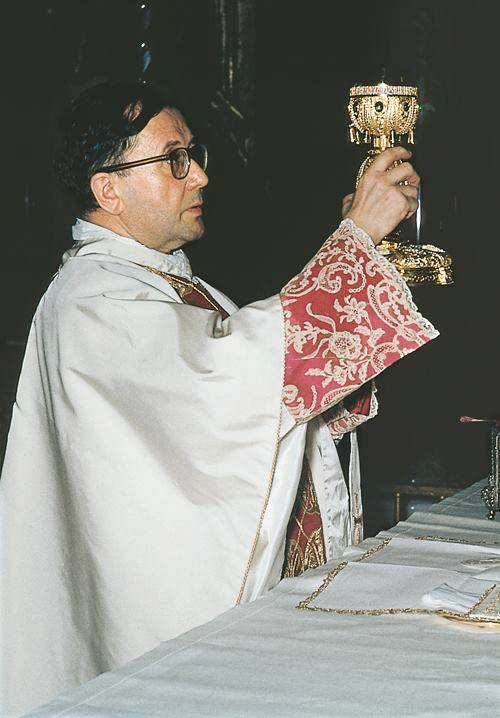
Saint of the Day – 26 June – Josemaría Escrivá de Balaguer y Albás

Saint of the Day – 26 June – Josemaría Escrivá de Balaguer y Albás – (9 January 1902 at Barbastro, Spain Died– 26 June 1975 of natural causes in his office in Rome, Italy; his body is interred at Prelatic Church of Our Lady of Peace at Viale Bruno Buozzi 75, Rome, Italy) – Priest, Founder Writer, Teacher, Doctor of Civil Law and Theology – known as “The Saint of Ordinary Life”.; St Josemaria was Beatified on 17 May 1992 by Pope John Paul II: the beatification miracle involved the cure in 1976 of Carmelite Sister Concepcion Boullon Rubio from the nearly-fatal cancerous form of lipomatosis following prayers by her family for the intercession of Father Josemaria and was Canonised on 6 October 2002 by Pope John Paul II: the canonization miracle involved saving a surgeon’s hands from a career-ending disease. Patron of Opus Dei and of Ordinary Life.

1312215965_stjosemariaprayercard-127878617_1458725696

St Josemaria founded Opus Dei, an organization of laypeople and priests dedicated to the teaching that everyone is called to holiness by God and that ordinary life can result in sanctity.   He was canonised during 2002 by Pope John Paul II, who declared Saint Josemaría should be “counted among the great witnesses of Christianity.”
His principal work was the initiation, government and expansion of Opus Dei.  Escrivá’s best-known publication is The Way, which has been translated into 43 languages and has sold several million copies.

St Josemaria Escrivá and Opus Dei have aroused controversy, primarily concerning allegations of secrecy, elitism, cult-like practices and political involvement with right-wing causes, such as the dictatorship of General Franco in Spain (1939–1975).   After his death, his canonisation attracted considerable attention and controversy, by some Catholics and the worldwide press.   Several journalists who have investigated the history of Opus Dei, among them Vatican analyst John L. Allen, Jr., have argued that these accusations are unproven or have grown from allegations by enemies of Escrivá and his organization.   Cardinal Albino Luciani (later Pope John Paul I), John Paul II, Benedict XVI, Francis, Oscar Romero and many Catholic leaders have endorsed Escrivá’s teaching concerning the universal call to holiness, the role of laity and sanctification of ordinary work.   According to Allen, among Catholics, Escrivá is “reviled by some and venerated by millions more”.

Early life
José María Mariano Escrivá y Albás was born to José Escrivá y Corzán and his wife, María de los Dolores Albás y Blanc on 9 January 1902, in the small town of Barbastro, in Huesca, Aragon, Spain, the second of six children and the first of two sons.   José Escrivá was a merchant and a partner of a textile company which eventually became bankrupt, forcing the family to relocate during 1915 to the city of Logroño, in the northern province of La Rioja, where he worked as a clerk in a clothing store.   Young Josemaría first felt that “he had been chosen for something”, it is reported, when he saw footprints left in the snow by a monk walking barefoot.

With his father’s blessing, Escrivá prepared to become a priest.   He studied first in Logroño and then in Zaragoza, where he was ordained as deacon on Saturday, 20 December 1924.   He was ordained a priest, also in Zaragoza, on Saturday, 28 March 1925. After a brief appointment to a rural parish in Perdiguera, he went to Madrid, the Spanish capital, during 1927 to study law at the Central University.   In Madrid, Escrivá was employed as a private tutor and as a chaplain to the Foundation of Santa Isabel, which comprised the royal Convent of Santa Isabel and a school managed by the Little Sisters of the Assumption.

Mission as the founder of Opus Dei
A prayerful retreat helped him to discern more definitely what he considered to be God’s will for him and, on 2 October 1928, he “saw” Opus Dei (English: Work of God), a way by which Catholics might learn to sanctify themselves by their secular work.   He founded it during 1928 and Pius XII gave it final approval during 1950.   According to the decree of the Congregation for the Causes of Saints, which contains a condensed biography of Escrivá, “[t]o this mission he gave himself totally. From the beginning his was a very wide-ranging apostolate in social environments of all kinds. He worked especially among the poor and the sick languishing in the slums and hospitals of Madrid.”

During the Spanish Civil War, Escrivá fled from Madrid, which was controlled by the republicans, via Andorra and France, to the city of Burgos, possessed by the nationalist forces of General Francisco Franco.   After the war ended during 1939 with Franco’s victory, Escrivá was able to resume his studies in Madrid and complete a doctorate in law, for which he submitted a thesis on the historical jurisdiction of the Abbess of Santa María la Real de Las Huelgas.

The Priestly Society of the Holy Cross, affiliated with Opus Dei, was founded on Sunday, 14 February 1943.   Escrivá relocated to Rome during 1946.  The decree declaring Escrivá “Venerable” states that “in 1947 and on Monday, 16 June 1950, he obtained approval of Opus Dei as an institution of pontifical right.   With tireless charity and operative hope he guided the development of Opus Dei throughout the world, activating a vast mobilization of lay people … He gave life to numerous initiatives in the work of evangelisation and human welfare;  he fostered vocations to the priesthood and the religious life everywhere… Above all, he devoted himself tirelessly to the task of forming the members of Opus Dei.”\

Later years
According to some accounts, at the age of two he suffered from a disease (perhaps epilepsy) so severe that the doctors expected him to die soon but his mother had taken him to Torreciudad, where the Aragonese locals venerated a statue of the Virgin Mary (as “Our Lady of the Angels”), thought to date from the 11th century.   Escrivá recovered and as the director of Opus Dei during the 1960s and 1970s, promoted and oversaw the design and construction of a major shrine at Torreciudad.   The new shrine was inaugurated on 7 July 1975, soon after Escrivá’s death and to this day remains the spiritual center of Opus Dei, as well as an important destination for pilgrimage.   By the time of Escrivá’s death during 1975, the members of Opus Dei numbered some 60,000 in 80 countries.   As an adult, Escrivá suffered from type 1 diabetes and, according to some sources, also epilepsy.

During 1950, Escrivá was appointed an Honorary Domestic Prelate by Pope Pius XII, which allowed him to use the title of Monsignor.   During 1955, he received a doctorate of theology from the Pontifical Lateran University in Rome.   He was a consultor to two Vatican congregations (the Congregation for Seminaries and Universities and the Pontifical Commission for the Authentic Interpretation of the Code of Canon Law) and an honourary member of the Pontifical Academy of Theology.   The Second Vatican Council (1962–65) confirmed the importance of the universal call to holiness, the role of the laity, and the Mass as the basis of Christian life.

During 1948 Escrivá founded the Collegium Romanum Sanctae Crucis (Roman College of the Holy Cross), Opus Dei’s educational center for men, in Rome. During 1953 he founded the Collegium Romanum Sanctae Mariae (Roman College of Saint Mary) to serve the women’s section (these institutions are now joined into the Pontifical University of the Holy Cross.)   Escrivá also established the University of Navarre, in Pamplona, and the University of Piura (in Peru), as secular institutions affiliated with Opus Dei. Escrivá died on 26 June 1975, aged 73.

Three years after Escrivá died, the then Cardinal Albino Luciani (later Pope John Paul I) celebrated the originality of his contribution to Christian spirituality.   The Statue below is at St Peter’s the Vatican.

St Josemaria and the Blessed Virgin Mary 
Pope John Paul II stated on Sunday, 6 October 2002, after the Angelus greetings:  “Love for our Lady is a constant characteristic of the life of Josemaría Escrivá and is an eminent part of the legacy that he left to his spiritual sons and daughters.”   The Pope also said that “St. Josemaría wrote a beautiful small book called The Holy Rosary which presents spiritual childhood, a real disposition of spirit of those who wish to attain total abandonment to the divine will”.

When Escrivá was 10 or 11 years old, he already had the habit of carrying the rosary in his pocket.   As a priest, he would ordinarily end his homilies and his personal prayer with a conversation with the Blessed Virgin.   He instructed that all rooms in the offices of Opus Dei should have an image of the Virgin.   He encouraged his spiritual children to greet these images when they entered a room.   He encouraged a Marian apostolate, preaching that To Jesus we go and to Him we return through Mary”. While looking at a picture of the Virgin of Guadalupe giving a rose to San Juan Diego, he commented:  “I would like to die that way.”   On 26 June 1975, after entering his work room, which had a painting of the Virgin of Guadalupe, he slumped on the floor and died.

st josemaria 3200px-Univnavarrefairlovest josemaria 12

Teachings and legacy
The significance of Escrivá’s message and teachings has been a topic of debate, by Catholics and others.   The Protestant French historian Pierre Chaunu, a professor at the Sorbonne and president of the Academy of Moral and Political Sciences, said that “the work of Escrivá de Balaguer will undoubtedly mark the 21st century.   This is a prudent and reasonable wager.   Do not pass close to this contemporary without paying him close attention”.   The Catholic theologian Hans Urs von Balthasar, who was appointed cardinal by Pope John Paul II (but died during 1988 before his investiture), dismissed Escrivá’s principal work, The Way, as “a little Spanish manual for advanced Boy Scouts” and argued that it was quite insufficient to sustain a major religious organization. However, the monk and spiritual writer Thomas Merton declared that Escrivá’s book “will certainly do a great deal of good by its simplicity, which is the true medium for the Gospel message”.

Critics of Opus Dei have often argued that the importance and originality of Escrivá’s intellectual contributions to theology, history and law, at least as measured by his published writings, has been grossly exaggerated by his devotees.   However, various officials of the Catholic church have spoken well of Escrivá’s influence and of the relevance of his teachings.  In the decree introducing the cause of beatification and canonisation of Escrivá, Cardinal Ugo Poletti wrote during 1981:  “For having proclaimed the universal call to holiness since he founded Opus Dei during 1928, Msgr. Josemaría Escrivá de Balaguer, has been unanimously recognized as the precursor of precisely what constitutes the fundamental nucleus of the Church’s magisterium, a message of such fruitfulness in the life of the Church.”  Sebastiano Baggio, Cardinal Prefect of the Congregation for Bishops, wrote a month after Escrivá’s death:  “It is evident even today that the life, works, and message of the founder of Opus Dei constitutes a turning point, or more exactly a new original chapter in the history of Christian spirituality.”   A Vatican peritus or consultor for the process of beatification said that “he is like a figure from the deepest spiritual sources”. Franz König, Archbishop of Vienna, wrote in 1975:

“The magnetic force of Opus Dei probably comes from its profoundly lay spirituality.   At the very beginning, in 1928, Msgr. Escrivá anticipated the return to the Patrimony of the Church brought by the Second Vatican Council … [H]e was able to anticipate the great themes of the Church’s pastoral action in the dawn of the third millennium of her history.”

The “absolutely central” part of Escrivá’s teaching, says American theologian William May, is that “sanctification is possible only because of the grace of God, freely given to his children through his only-begotten Son and it consists essentially in an intimate, loving union with Jesus, our Redeemer and Saviour.”

Escrivá’s books, including Furrow, The Way, Christ is Passing By and The Forge, continue to be read widely and emphasize the laity’s calling to daily sanctification (a message also to be found in the documents of Vatican II).   Pope John Paul II made the following observation in his homily at the beatification of Escrivá:

“With supernatural intuition, Blessed Josemaría untiringly preached the universal call to holiness and apostolate.   Christ calls everyone to become holy in the realities of everyday life.   Hence work too is a means of personal holiness and apostolate, when it is done in union with Jesus Christ.”

John Paul II’s decree Christifideles omnes states:  “By inviting Christians to seek union with God through their daily work — which confers dignity on human beings and is their lot as long as they exist on earth — his message is destined to endure as an inexhaustible source of spiritual light regardless of changing epochs and situations”   St Josemaria pray for us!
st josemaria 14st-josemaria-escriva-sylvia-castellanosst josemaria 13st josemaria 11

Posted in DOCTORS of the Church, FEASTS and SOLEMNITIES, SACRED and IMMACULATE HEARTS, The BLESSED VIRGIN MARY

Quote/s of the Day – 24 June – The Solemnity of the Birthday of St John the Baptist and the Feast of the Immaculate Heart of Mary

Quote/s of the Day – 24 June 2017 – The Solemnity of the Birthday of St John the Baptist and the Feast of the Immaculate Heart of Mary

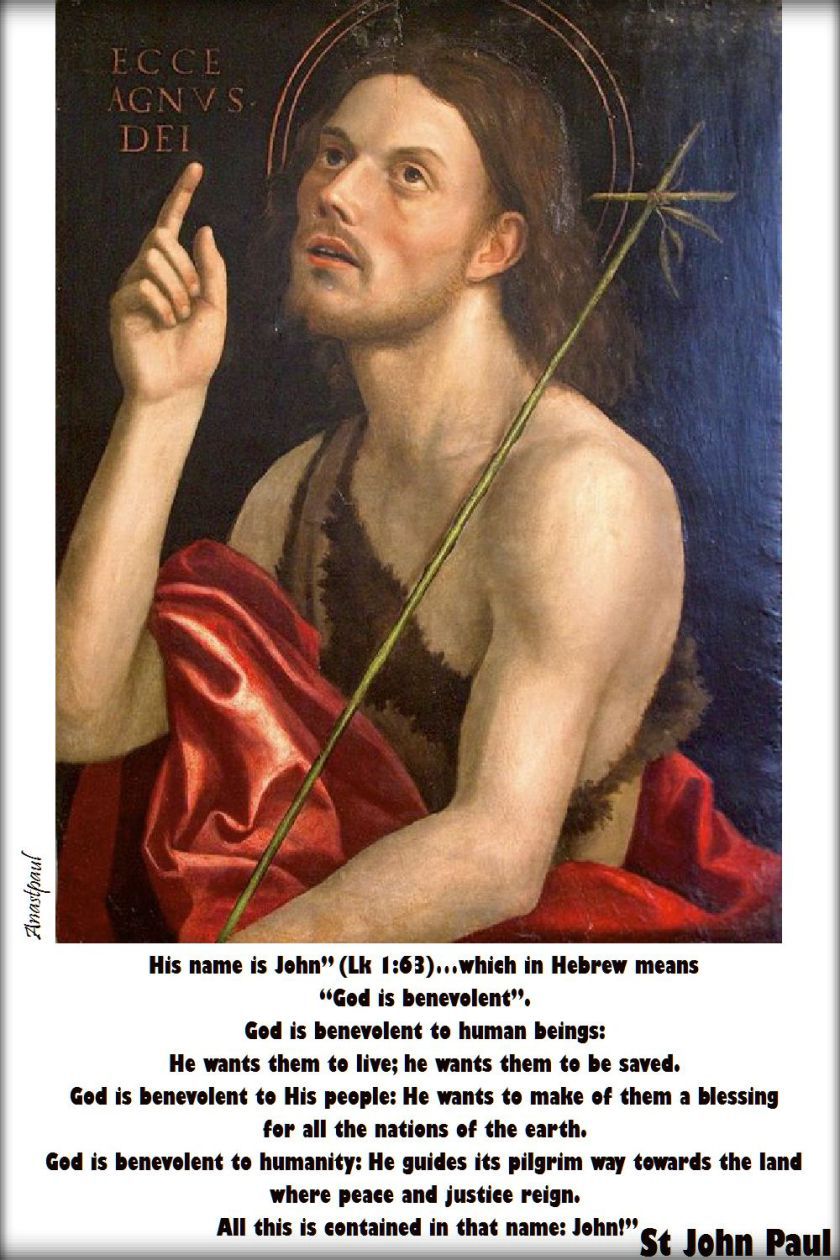
“His name is John” (Lk 1:63)…which in Hebrew means “God is benevolent”. God is benevolent to human beings:  He wants them to live; he wants them to be saved. God is benevolent to His people:  He wants to make of them a blessing for all the nations of the earth.   God is benevolent to humanity:  He guides its pilgrim way towards the land where peace and justice reign.   All this is contained in that name: John!”…St John Paul (24 June 2001)his-name-is-john-st-john-paul - 24 june 2017


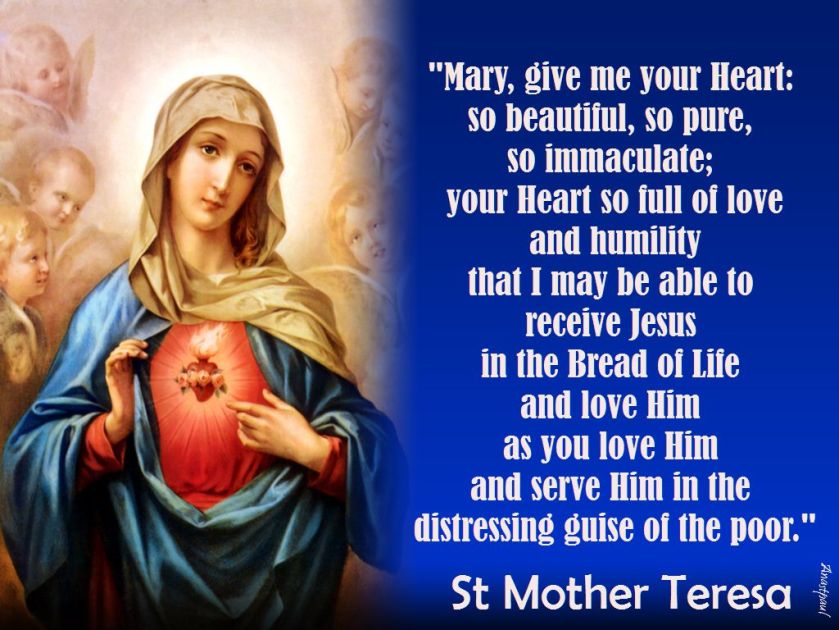
“Mary, give me your Heart: so beautiful, so pure, so immaculate; your Heart so full of love and humility that I may be able to receive Jesus in the Bread of Life and love Him as you love Him and serve Him in the distressing guise of the poor.”
–St Mother Teresa

mary give me your heart-st mother teresa


Posted in CATHOLIC DEVOTIONS of the Month, DOCTORS of the Church, EUCHARISTIC Adoration, FEASTS and SOLEMNITIES, MORNING Prayers, QUOTES of the SAINTS, SACRED and IMMACULATE HEARTS

Quote/s of the Day – The Solemnity of the Body and Blood of Christ

Quote/s of the Day – The Solemnity of the Body and Blood of Christ

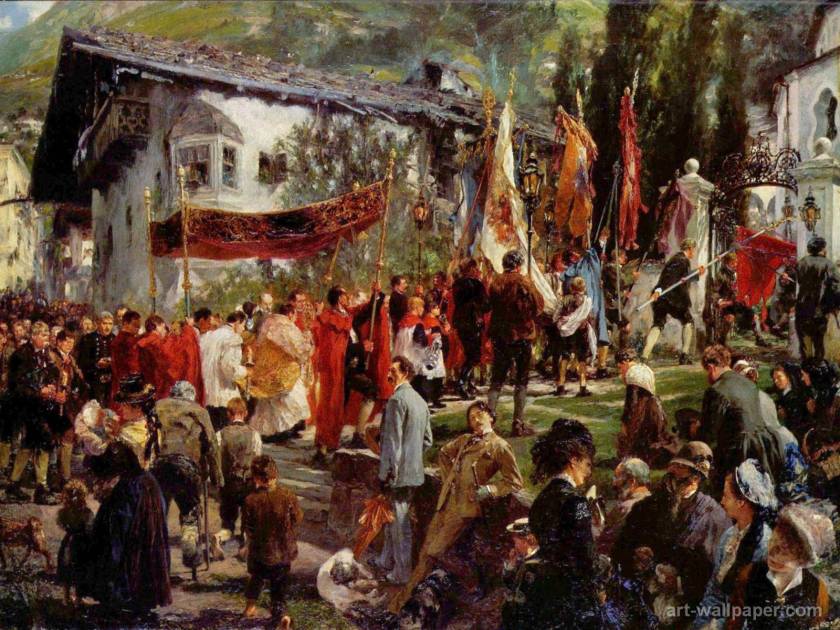
“How I loved the feasts!….
I especially loved the processions in honour
of the Blessed Sacrament.   What a joy it was
for me to throw flowers beneath the feet of God!…
I was never so happy as when I saw my roses
touch the sacred Monstrance…”
– from St. Therese’s Autobiography Story of A Soul

how i loved the feast..st t of l

“It is invaluable to converse with Christ
and leaning against Jesus’ breast like His beloved disciple,
we can feel the infinite love of his Heart.
We learn to know more deeply the One who gave Himself totally,
in the different mysteries of His divine and human life,
so that we may become disciples and in turn enter into
this great act of giving, for the glory of God
and the salvation of the world.   Through adoration,
the Christian mysteriously contributes to the
radical transformation of the world and to the sowing of the Gospel.
Anyone who prays to the Saviour draws the whole world with him
and raises it to God.   Those who stand before the Lord
are therefore fulfilling an eminent service.
They are presenting to Christ all those who do not know Him
or are far from Him;  they keep watch in His presence on their behalf!”

– from St Pope John Paul II’s 1996 letter to the Bishop of Liege,
written on the occasion of the 750th anniversary of the first celebration of the Feast of Corpus Christi

those who stand before the lord

“When you have received Him,
stir up your heart to do Him homage, 
speak to Him about your spiritual life,
gazing upon Him in your soul where He is present
for your happiness;  welcome Him as warmly as possible,
and behave outwardly in such a way, that your actions
may give proof to all of His Presence.”
– St. Francis de Sales

when you have received Him - st francis de sales

Posted in DOCTORS of the Church, EUCHARISTIC Adoration, FEASTS and SOLEMNITIES, MORNING Prayers, PAPAL ENCYLICALS, PRAYERS of the CHURCH, PRAYERS of the SAINTS, QUOTES of the SAINTS

Blessed and Holy Feast of Corpus Christi! 18 June 2017

Blessed and Holy Feast of Corpus Christi! 18 June 2017

come let us adore him- 18 june 2017

“The solemnity of Corpus Christi originated within a very precise cultural and historical context.   Its aim was to proclaim openly the faith of the People of God in Jesus Christ’s real, living presence in the Blessed Sacrament of the Eucharist.”

CC_homeCorpusChristiProcession

Pope Benedict XVI explains the history of this feast, which dates back to the 13th century, as follows:

St Juliana of Cornillon had a vision which “presented the moon in its full splendour, crossed diametrically by a dark stripe.   The Lord made her understand the meaning of what had appeared to her.   The moon symbolised the life of the Church on earth, the opaque line, on the other hand, represented the absence of a liturgical feast (…) in which believers would be able to adore the Eucharist so as to increase in faith, to advance in the practice of the virtues and to make reparation for offences to the Most Holy Sacrament. (…)

Jacques Pantaléon of Troyes was also won over to the good cause of the Feast of Corpus Christi during his ministry as Archdeacon in Lièges.   It was he who, having become Pope with the name of Urban IV in 1264, instituted the Solemnity of Corpus Christi on the Thursday after Pentecost as a holiday of obligation for the universal Church.

Until the end of the world

Detail of the reliquary containing the corporal with traces of the Eucharistic miracle that occurred in Bolsena in 1263. It is kept in the Cathedral of Orvieto, Italy.

Detail of the reliquary containing the corporal with traces of the Eucharistic miracle that occurred in Bolsena in 1263. It is kept in the Cathedral of Orvieto, Italy.

In the Bull of its institution, entitled Transiturus de hoc mundo, (11 Aug. 1264), Pope Urban even referred discreetly to Juliana’s mystical experiences, corroborating their authenticity.   He wrote: “Although the Eucharist is celebrated solemnly every day, we deem it fitting that at least once a year it be celebrated with greater honour and a solemn commemoration.

“Indeed we grasp the other things we commemorate with our spirit and our mind but this does not mean that we obtain their real presence.   On the contrary, in this sacramental commemoration of Christ, even though in a different form, Jesus Christ is present with us in his own substance.   While he was about to ascend into Heaven he said ‘And lo, I am with you always, to the close of the age’ (Matthew 28:20).”
The Pontiff made a point of setting an example by celebrating the solemnity of Corpus Christi in Orvieto, the town where he was then residing.   Indeed, he ordered that the famous Corporal with the traces of the Eucharistic miracle which had occurred in Bolsena the previous year, 1263, be kept in Orvieto Cathedral — where it still is today.

While a priest was consecrating the bread and the wine he was overcome by strong doubts about the Real Presence of the Body and Blood of Christ in the sacrament of the Eucharist.   A few drops of blood began miraculously to ooze from the consecrated Host, thereby confirming what our faith professes.

Texts that move the heart

Urban IV asked one of the greatest theologians of history, St Thomas Aquinas — who at that time was accompanying the Pope and was in Orvieto — to compose the texts of the Liturgical Office for this great feast.   They are masterpieces, still in use in the Church today, in which theology and poetry are fused.   These texts pluck at the heartstrings in an expression of praise and gratitude to the Most Holy Sacrament, while the mind, penetrating the mystery with wonder, recognizes in the Eucharist the Living and Real Presence of Jesus, of His Sacrifice of love that reconciles us with the Father and gives us salvation.

In the words of St. Thomas:

“How inestimable a dignity, beloved brethren, divine bounty has bestowed upon us Christians from the treasury of its infinite goodness!   For there neither is nor ever has been a people to whom the gods were so nigh as our Lord and God is nigh unto us.

“Desirous that we be made partakers of His divinity, the only-begotten Son of God has taken to Himself our nature so that having become man, He would be enabled to make men gods.  Whatever He assumed of our nature He wrought unto our salvation. For on the altar of the Cross He immolated to the Father His own Body as victim for our reconciliation and shed His blood both for our ransom and for our regeneration. Moreover, in order that a remembrance of so great benefits may always be with us, He has left us His Body as food and His Blood as drink under appearances of bread and wine.

“O banquet most precious!   O banquet most admirable!   O banquet overflowing with every spiritual delicacy!   Can anything be more excellent than this repast, in which not the flesh of goats and heifers, as of old, but Christ the true God is given us for nourishment?   What more wondrous than this holy sacrament! In it bread and wine are changed substantially, and under the appearance of a little bread and wine is had Christ Jesus, God and perfect Man.   In this sacrament sins are purged away, virtues are increased, the soul is satiated with an abundance of every spiritual gift.   No other sacrament is so beneficial.   Since it was instituted unto the salvation of all, it is offered by Holy Church for the living and for the dead, that all may share in its treasures.

“My dearly beloved, is it not beyond human power to express the ineffable delicacy of this sacrament in which spiritual sweetness is tasted in its very source, in which is brought to mind the remembrance of that all-excelling charity which Christ showed in His sacred passion? Surely it was to impress more profoundly upon the hearts of the faithful the immensity of this charity that our loving Savior instituted this sacrament at the last supper when, having celebrated the Pasch with His disciples.   He was about to leave the world and return to the Father.   It was to serve as an unending remembrance of His passion, as the fulfillment of ancient types — this the greatest of His miracles.   To those who sorrow over His departure He has given a unique solace.”

“Eucharistic springtime”

I would like to affirm with joy that today there is a “Eucharistic springtime” in the Church.   How many people pause in silence before the Tabernacle to engage in a loving conversation with Jesus!   It is comforting to know that many groups of young people have rediscovered the beauty of praying in adoration before the Most Blessed Sacrament.
John Paul II said in his Encyclical Ecclesia de Eucharistia: “In many places, adoration of the Blessed Sacrament is also an important daily practice and becomes an inexhaustible source of holiness. The devout participation of the faithful in the Eucharistic procession on the Solemnity of the Body and Blood of Christ is a grace from the Lord which yearly brings joy to those who take part in it. Other positive signs of Eucharistic faith and love might also be mentioned” (no. 10).

In remembering St Juliana of Cornillon let us also renew our faith in the Real Presence of Christ in the Eucharist.   As we are taught by the Compendium of the Catechism of the Catholic Church, “Jesus Christ is present in the Eucharist in a unique and incomparable way.   He is present in a true, real and substantial way, with his Body and his Blood, with his Soul and his Divinity.   In the Eucharist, therefore, there is present in a sacramental way, that is, under the Eucharistic Species of bread and wine, Christ whole and entire, God and Man” (no. 282).

Dear friends, fidelity to the encounter with Christ in the Eucharist in Holy Mass on Sunday is essential for the journey of faith but let us also seek to pay frequent visits to the Lord present in the Tabernacle!   In gazing in adoration at the consecrated Host, we discover the gift of God’s love, we discover Jesus’ Passion and Cross and likewise his Resurrection.

Source of joy
It is precisely through our gazing in adoration that the Lord draws us towards Him into His mystery in order to transform us as He transforms the bread and the wine.

The Saints never failed to find strength, consolation and joy in the Eucharistic encounter. Let us repeat before the Lord present in the Most Blessed Sacrament the words of the Eucharistic hymn Adoro te devote, “Devoutly I adore Thee: Make me believe ever more in you, Draw me deeply into faith, into Your hope, into Your love”.

BENEDICT XVI, General Audience, November 17, 2010

corpus christi 3

Posted in MORNING Prayers, QUOTES of the SAINTS, SAINT of the DAY, The WORD

One Minute Reflection – 17 June

One Minute Reflection – 17 June

“Do not store up for yourselves
treasures on earth,
where moth and decay destroy
and thieves break in and steal.
But store up treasures in heaven,
where neither moth nor decay destroys,
nor thieves break in and steal.
For where your treasure is,
there also will your heart be.”….Matthew 6:19-21

matthew 6 19-21

REFLECTION – Reflecting on his own priestly vocation, Pope John Paul II wrote in 1996 that Brother Albert had played a role in its formation …..“because I found in him a real spiritual support and example in leaving behind the world of art, literature and the theater and in making the radical choice of a vocation to the charity” ………..St John Paul speaking of St Albert Chmielowski (Gift and Mystery: On the Fiftieth Anniversary of My Priestly Ordination)

PRAYER – Father of goodness, make me realise and understand that each and all of my brothers represent the face of Jesus and that He is the only way to You for us all!  Help me to extend all of myself to my neighbour in loving imitation of Your Son.   St Albert Chmielowski, pray for us that we too may be a light in the darkness of this world, to all who call out to us in their pain and suffering.   And please pray for us! Amen
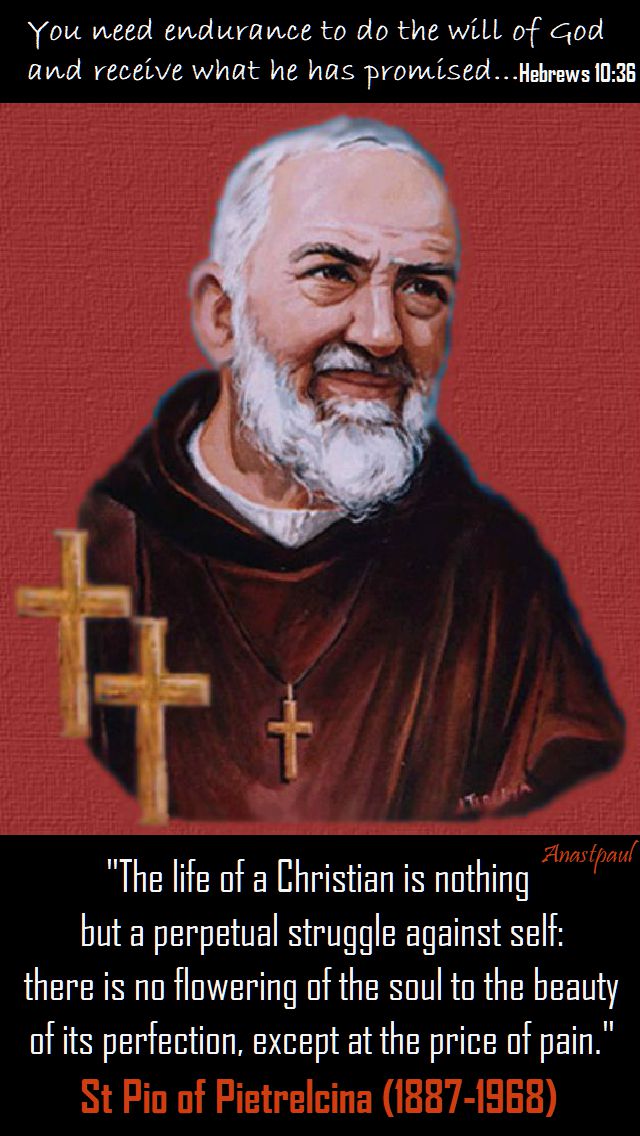
st albert chmielowski pray for us

Posted in SAINT of the DAY

Saint of the Day – 17 June – St Albert Chmielowski T.O.S.F. (The 19th-century Polish saint who was influenced by St. Francis of Assisi later influenced Pope St. John Paul II.)

Saint of the Day – 17 June – St Albert Chmielowski T.O.S.F.  (The 19th-century Polish saint who was influenced by St. Francis of Assisi later influenced Pope St. John Paul II.)   (20 August 1845 at Igoalomia (Aigolonija), Poland as Adam Hilary Bernard Chmielowski – 25 December 1916 at Krakow, Poland, of natural causes).   Canonised on 12 November 1989 by Pope John Paul II at Saint Peter’s Square, Rome.   Professed religious of the Third Order of St Francis and the founder of both the Servants of the Poor and Sisters Servants of the Poor.  Also known as:  Adam Chmielowski, Adam Hilary Bernard Chmielowski, Brat Albert, Brother Albert, Brother of Our Lord, Brother of Our God, Our God’s Brother.   Patronages – Painters, Servants of the Poor, Sisters Servants of the Poor, Franciscan tertiaries, Soldiers
Volunteers, Harvests, Travellers, Puławy, Diocese of Sosnowiec.   Attributes – priest’s attire or Franciscan robe.

SAINT ALBERT CHMIELOWSKI 5

Adam Chmielowski was born into an aristocratic family in Igołomia, a village outside of Krakow, in 1845.   Then, Poland formally didn’t exist – the once-mighty Polish state was partitioned between Austria, Prussia and Russia in 1772, 1773 and 1795.   Yet the Polish people refused to accept this and many rebelled against the oppressors.

One such upheaval was the January Insurrection of 1863-1864, directed against the Russian Empire, in which the Poles fought bravely yet were brutally suppressed.   Not yet 18, Adam took part.   During one battle, a Russian grenade killed Adam’s horse and badly damaged his leg, which was amputated.   Adam, however, didn’t take pity on himself; he stoically taught himself to function with a wooden limb and offered up the dismemberment to God for the cause of Polish independence.

After the uprising, Adam decided to pursue a career in painting and was accepted at the prestigious Academy of Fine Arts in Munich, where he studied with many famous Polish painters.   Upon returning to Poland, Adam worked as a painter 1870-1885.   In total, he produced 61 paintings.   He quickly became one of the most feted Polish artists, living briefly in Warsaw and then in artsy, intellectual Krakow.   Adam’s social circle consisted of the best-known Polish artists, actors and writers.

Yet Adam Chmielowski wasn’t happy with this glitzy life of celebrity.   At one point, he was even hospitalized for depression.   Adam remained a devout Catholic and his paintings — including his masterpiece, the unfinished Ecce Homo, which depicts the mocked Christ — often dealt with religious themes.

rsz_ecce_homo_courtesy_of_the_albertine_nuns_at_st_albert_shrine

He knew that he needed to grow closer to God.   Adam briefly thought of becoming a Jesuit but his enthusiasm fizzled after entering the novitiate.   He kept asking God what he wanted of him.

Nineteenth-century Krakow was a city of social inequality.   In Adam’s day, more than a fifth of its population consisted of the unemployed, who were frequently homeless.   The filthy, lice-infested city homeless shelter had terrible sanitary conditions.   The Church in Krakow, especially the Vincentians and other orders, aided the poor.   However, this was insufficient.   At this time, Adam became increasingly attracted to St. Francis of Assisi.   This medieval champion of the poor’s ministry resonated with Krakow’s socioeconomic problems.   Eventually, Adam welcomed the homeless into his own apartment.   In 1887, Adam Chmielowski became a Third Order Franciscan and took vows at the hands of Krakow Archbishop Cardinal Albin Dunajewski, taking the name Albert.   He began to call himself “Brother Albert” and wore a gray habit.

The following year, Brother Albert realized that to bring Krakow’s poor lasting change, the city’s homeless shelter would need reform.   He negotiated an agreement with the city government, making him the institution’s caretaker.   To finance the improvements, Brother Albert auctioned off his paintings.   In addition to improving the material conditions, he banned alcohol in the shelter.   He asked the poor to work (making exceptions for the elderly and those with disabilities), teaching them practical skills and lectured on the Catechism and the Gospels.

Eventually, Brother Albert founded two religious orders, the Albertine Brothers and Sisters, devoted to the poor.   They set up homes for the poor, sick and elderly in 20 Polish cities.   Brother Albert worked to help as many poor persons as possible until his death in 1916, amidst World War I.   During that bloody conflict, he sent Albertine Brothers and Sisters to the trenches to aid war invalids.   After his death, thousands of Kracovians visited his tomb, convinced that he died a saint.

Today, the Albertines run homes for the poor and sick all over the world.   Visitors to Krakow can make a pilgrimage to the Albertine-run Ecce Homo Shrine, which features a museum devoted to St. Albert and the famous titular painting.

St. Albert Chmielowski greatly inspired St. John Paul II.   In 1938, when Karol Wojtyła started his studies in Polish literature at the Jagiellonian University, he was a young, promising actor, playwright and poet.   Yet his calling to serve God and the Church was stronger than his love for the arts.   In this, he found inspiration in his fellow artist St. Albert Chmielowski.

ALBERT

In 1949, the young Father Karol Wojtyła wrote a play about him titled Our God’s Brother.   A Kracovian urban legend had it that Brother Albert met Vladimir Lenin (who lived in Krakow after being expelled from Russia) and debated him on how to best alleviate poverty.   The play features imagined dialogues between the saint and the communist revolutionary (called “the Stranger”), powerfully showing the difference between the Christian and Marxist approach:   The former argues that poverty can be overcome by seeing God’s image in the individual, while the latter reduces all to class struggle and argues that the rich must be violently overthrown.   After his election as pope, John Paul beatified St. Albert in 1983 and canonised him in 1989.

St Albert Chmielowski, Pray for us!


Posted in CATHOLIC Quotes, DOCTORS of the Church, MORNING Prayers, QUOTES of the SAINTS, The MOST HOLY & BLESSED TRINITY

One Minute Reflection – 11 June – The Solemnity of the Holy Trinity

One Minute Reflection – 11 June – The Solemnity of the Holy Trinity

Brothers and sisters, rejoice.
Mend your ways, encourage one another,
agree with one another, live in peace,
and the God of love and peace will be with you.
Greet one another with a holy kiss.
All the holy ones greet you.
The grace of the Lord Jesus Christ
and the love of God
and the fellowship of the Holy Spirit be with all of you………..2 Corinthians 13:11-13

REFLECTION – “The one, holy, catholic and apostolic Church is the People of God, the Body of Christ and the Temple of the Holy Spirit.   These three biblical images point to the Trinitarian dimension of the Church.   In this dimension are found all disciples of Christ, who are called to live it ever more deeply and in an ever more intense communion.”…..St John Paul

the one holy - st john paul

PRAYER – God our Father, who by sending into the world. the Word of truth and the Spirit of sanctification, made known to the human race your wondrous mystery, grant us, we pray, that in profession the true faith, we may acknowledge the Trinity of eternal glory and adore your Unity, powerful in majesty. T  hat we, as your chosen may too live our lives in total unity with all the peoples of Christ’s Church.   Through our Lord Jesus Christ, your Son, who lives and reigns with you in the unity of the Holy Spirit, one God, for ever and ever. Amen