Posted in FEASTS and SOLEMNITIES, LENT, LENT 2024, MARIAN TITLES, SAINT of the DAY, The PASSION

EMBER FRIDAY – FAST and ABSTINENCE, Nuestra Señora de la Peña / Our Lady of the Rock (1434), The Feast of the Sacred Lance and Nails – Friday after the 1st Sunday in Lent, St Peter Damian and the Saints for 23 February

In a Leap Year, the Vigil of St Matthias, Apostel, is not announced today because it is transferred to the 24th.

St Alexander Akimetes
St Boswell
St Dositheus of Egypt
St Felix of Brescia
St Florentius of Seville
St Giovanni Theristi (1049–1129) Monk
Bl John of Hungary

St Martha of Astorga
St Medrald

St Milo of Benevento (Died c1077) Bishop
St Ordonius
St Polycarp of Rome
St Romana

St Zebinus of Syria

Posted in MARIAN TITLES, SAINT of the DAY, The APOSTLES & EVANGELISTS

A Day of Fasting, The Vigil of the Apostle Saint Matthias, Nuestra Señora de la Peña / Our Lady of the Rock, Spain (1434), St Peter Damian (1007-1072) and Memorials of the Saints – 23 February

Thursday after Ash Wednesday – A Day of Fasting

The Vigil of the Apostle Saint Matthias

St Peter Damian OSB (1007-1072) Cardinal Bishop of Ostia, Benedictine Monk, Confessor, Theologian, Reformer, Writer, Teacher, Preacher, Poet, Papal Envoy, Doctor of the Church. Dante placed him in one of the highest circles of Paradiso as a great predecessor of Saint Francis of Assisi. Peter was acclaimed as “one of the most accomplished Latinists of his time, one of the greatest writers of medieval Latin.
The wonderful St Peter here:
https://anastpaul.wordpress.com/2017/02/21/saint-of-the-day-21-february-st-peter-damian/
AND:
https://anastpaul.com/2019/02/21/saint-of-the-day-21-february-st-peter-damian-osb-1007-1072-doctor-of-the-church/

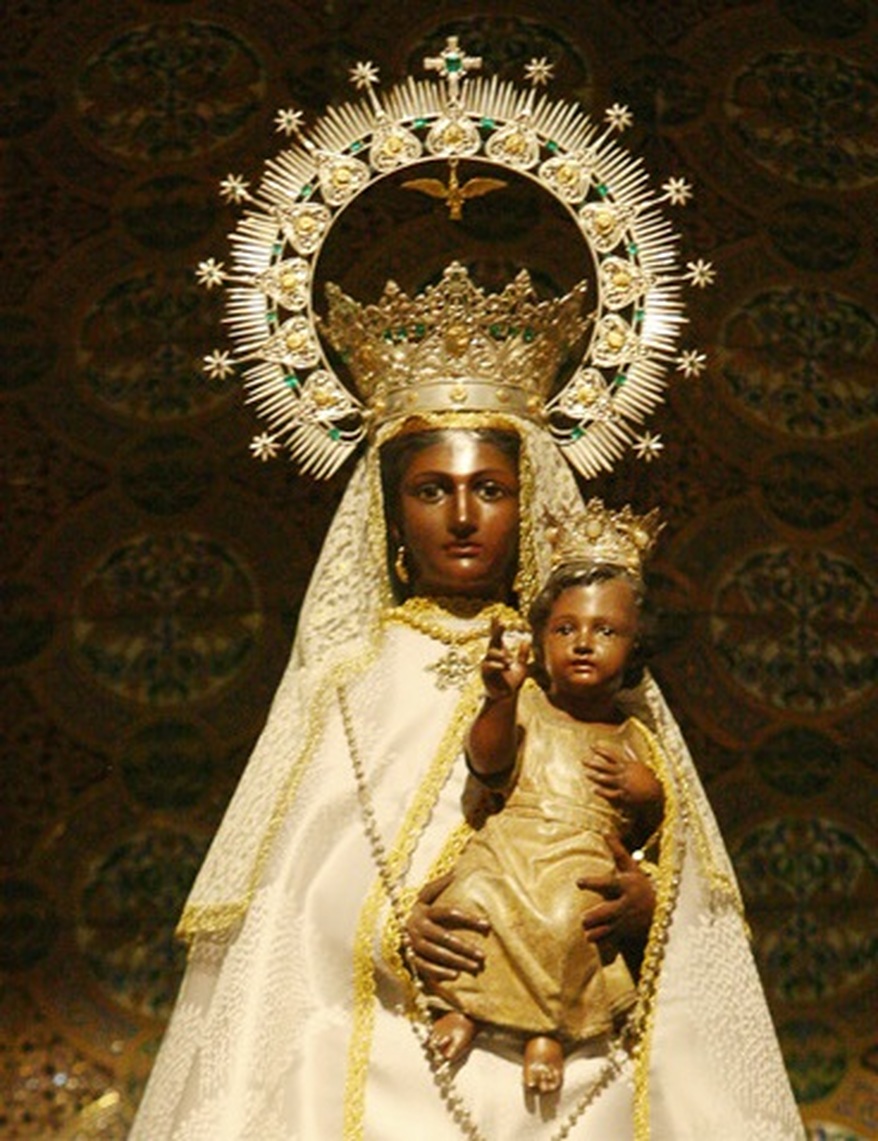
Nuestra Señora de la Peña / Our Lady of the Rock, Pena de Francia, near Salamanca, Spain (1434) – 23 February:
HERE:

https://anastpaul.com/2021/02/23/our-lady-of-the-rock-pena-de-francia-near-salamanca-spain-1434-and-memorials-of-the-saints-23-february/
St Alexander Akimetes
St Boswell
St Dositheus of Egypt
St Felix of Brescia
St Florentius of Seville
St Giovanni Theristi (1049–1129) Monk
Bl John of Hungary

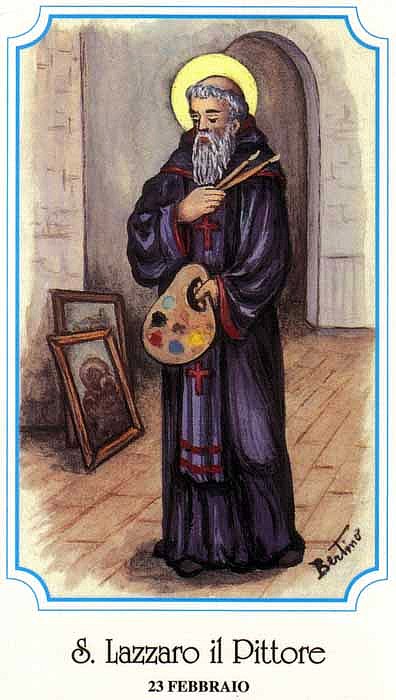
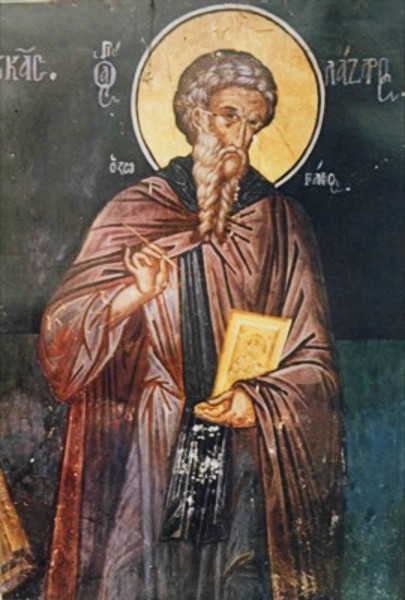
St Lazarus Zographos (c 810-c 867) Priest, Monk known as “the Painter and the Iconographer.” Lazarus lived before and during the second period of Byzantine Iconoclasm.
The Roman Martyrology states of him today: “St Lazarus, a Monk, whom the Iconoclast Emperor Theophilus ordered to be put to torture for having painted holy images. His hand was burned with a hot iron but, being healed by the power of God, he painted anew the holy images which had been defaced and finally rested in peace.”
Biography:

https://anastpaul.com/2022/02/23/saint-of-the-day-23-february-st-lazarus-zographos-810-865/

St Martha of Astorga
St Medrald
St Milburga (Died 715) Abbess
Bl Milo of Benevento
St Ordonius
St Polycarp of Rome
St Romana

St Serenus the Gardener (Died 307) Martyr. Serenus was by birth a Grecian. He left his family estate, friends and country to serve God in celibacy, penance and prayer. With this design he bought a garden in Sirmium in Pannonia, which he cultivated with his own hands and lived on the fruits and herbs it produced.
His Life and Death:

https://anastpaul.com/2019/02/23/saint-of-the-day-23-february-st-serenus-the-gardener-died-307-martyr/

St Willigis of Mainz (c 940-1011) Archbishop of Mainz, Reformer, builder of the Cathedral of Mainz and many Churches, bridges and roads throughout his Diocese, de facto Regent of Germany during the minority of Otto III, to whom he was Guardian.
About St Willigis:

https://anastpaul.com/2021/02/23/saint-of-the-day-23-february-saint-willigis-of-mainz-c-940-1011-archbishop/

St Zebinus of Syria

Martyrs of Syrmium – 73 Christians who were Martyred together in the persecutions of Diocletian. We know no details about them, and only six of their names – Antigonus, Libius, Rogatianus, Rutilus, Senerotas and Syncrotas.
Posted in Against ICONOCLASM, SAINT of the DAY

Saint of the Day – 23 February – St Lazarus Zographos (810 -865)

Saint of the Day – 23 February – St Lazarus Zographos (810 -865) surnamed Zographos (Greek for ‘painter’) Priest abd Monk known as “the Painter and the Iconographer.” Born at Mount Caucasus in Armenia on 17 November 810 in Armenia and died in 865 in Rome. Lazarus lived before and during the second period of Byzantine Iconoclasm. Also known as – Lazarus the Painter, the Iconographe, Lazarus of Constantinople, Lazzaro…

The Roman Martyrology states of him today: “St Lazarus, a Monk, whom the Iconoclast Emperor Theophilus ordered to be put to torture for having painted holy images. His hand was burned with a hot iron but, being healed by the power of God, he painted anew the holy images which had been defaced and finally rested in peace.

Lazarus was noted to possess the virtues of love for Christ, asceticism, prayer and rejection of the vanities of the world. He was further recognised for his acts of self-control, discipline and alms-giving He was Ordained a Priest and in his lifetime, he was highly regarded and well-known for his frescos. He used faith and ritual as a means to transcribe his inner contemplation onto the images he painted. Thus, his ability to paint iSacred images was seen as a gift given by God.

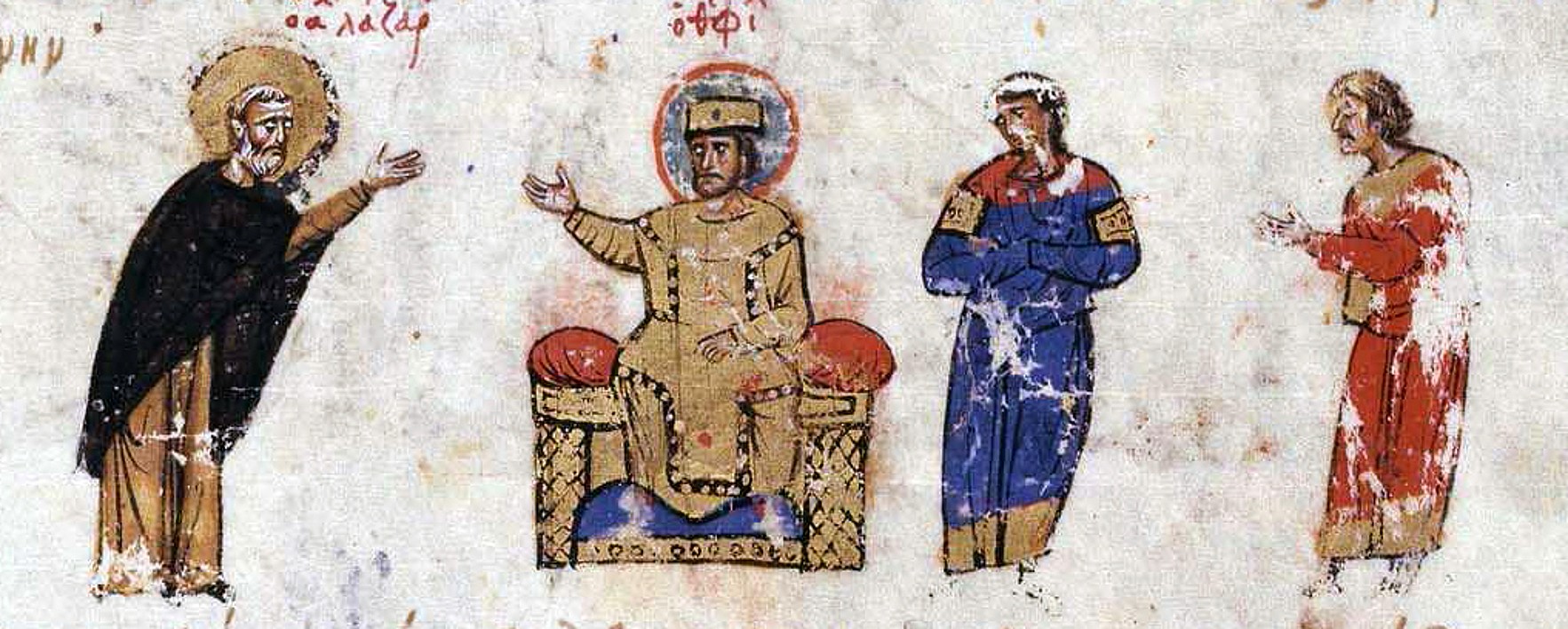
During the reign of Theophilus (829–842), an iconoclast Emperor opposed to all Sacred images, Lazarus stubbornly continued his craft of painting and began restoring images defaced by heretics. Theophilus sought out Lazarus, who was then famous for his artworks and intended to make an example of him. After being asked several times to cease painting, Lazarus was brought before the Emperor. Lazarus refused to destroy any of the images he painted. The Emperor soon found that Lazarus was above flattery and bribery. He was then threatened with the death penalty, which at the time was not an uncommon outcome for those who favoured icons (iconodules). However, Lazarus, being a holy man of the cloth, could not be put to death and so, he was instead thrown in prison.

St Lazarus before Emperor Theophilus

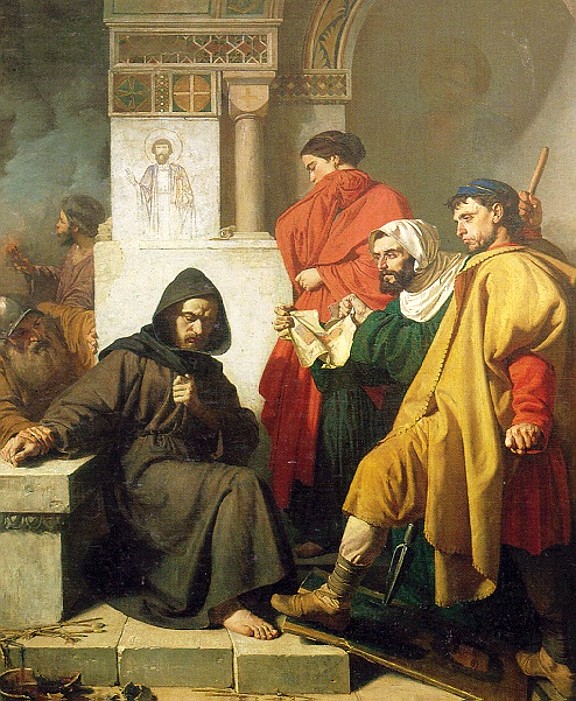
During his imprisonment he was subjected to such “severe torture that flesh melted away along with his blood.” He was left to die of his wounds but miraculously recovered. He then began to paint holy images on panels from his prison cell. Hearing of this, Theophilus gave orders to have “sheets of red hot iron to be applied to the palms of his hands ,where, as a result, he lost consciousness and lay half dead.” It is also said his hands were burned with red-hot horseshoes until his flesh melted to the bone.

As Lazarus lay on his deathbed, the Empress Theodora, an iconodule, convinced Theophilus to release Lazarus from prison. Lazarus found refuge at Tou Phoberou, a secluded Church of St John the Baptist. The Church is believed to have functioned as an Monastery which housed as many as one-hundred and seventy Monks.

After the death of Theophilus in 842, his wife, Theodora asked Lazarus to forgive her husband’s actions, to which he replied “God is not so unjust, O, Empress, as to forget our love and labours on His behalf.” Lazarus served as a model of perseverance for those who had suffered from iconoclast persecution.

St Lazarus and the Iconoclasts by Domenico Morelli (1855)

After the restoration of the icons in 843, Lazarus was again free to pursue his painting. Despite his previous wounds which the Almighty had completely healed, Lazarus was said to have painted a large fresco of St John at the Phoberos Monastery. The painted fresco was known to have the power to perform cures and miracles. That same year, he also famously restored a portrait of Christ known as the Christ of the Chalke, over the Chalke Gate, a ceremonial entrance of the Great Palace of Constantinople. Neither of these two works survive today.

Lazarus was also accredited with the mosaic decoration of the apse of the Hagia Sophia, within the pilgrim accounts of Antony, Archbishop of Novgorod during a visit to Constantinople. Antony described the mosaic as depicting the Mother of God holding a Child Christ flanked by two angels, which was noted to have been seen by both Emperor Basil l and Michael III (842–867) before his death the same year. However, these accounts are dated several centuries later in c. 1200.

In 856, Lazarus was sent as a diplomat for Michael III, Theophilos and Theodora’s son, who sent him as an Emissary to visit Pope Benedict III, to discuss the possibility of reconciliation between the Catholic Church of Rome and the Eastern Church of Constantinople, who at this time, had very strained relations. In 865, during his second mission to the Pope, Lazarus died at Rome on 28 September, although others dispute this date. He was buried in the Monastery of Evanderes, near Constantinople.

Posted in MARIAN TITLES

The Vigil of the Apostle Saint Matthias, Nuestra Señora de la Peña / Our Lady of the Rock, Pena de Francia, near Salamanca, Spain (1434) and Memorials of the Saints – 23 February

The Vigil of the Apostle Saint Matthias

St Peter Damian OSB (1007-1072) Cardinal Bishop of Ostia, Benedictine Monk, Confessor, Theologian, Reformer, Writer, Teacher, Preacher, Poet, Papal Envoy, Doctor of the Church. Dante placed him in one of the highest circles of Paradiso as a great predecessor of Saint Francis of Assisi. Peter was acclaimed as “one of the most accomplished Latinists of his time, one of the greatest writers of medieval Latin.” (Memorial)
A lot about St Peter here:
https://anastpaul.wordpress.com/2017/02/21/saint-of-the-day-21-february-st-peter-damian/
AND:
https://anastpaul.com/2019/02/21/saint-of-the-day-21-february-st-peter-damian-osb-1007-1072-doctor-of-the-church/

Nuestra Señora de la Peña / Our Lady of the Rock, Pena de Francia, near Salamanca, Spain (1434) – 23 February:
HERE:

https://anastpaul.com/2021/02/23/our-lady-of-the-rock-pena-de-francia-near-salamanca-spain-1434-and-memorials-of-the-saints-23-february/

St Alexander Akimetes
St Boswell
St Dositheus of Egypt
St Felix of Brescia
St Florentius of Seville
St Giovanni Theristi (1049–1129) Monk
Bl Giovannina Franchi
Bl John of Hungary
St Josephine Vannini (1859-1911)
Bl Juan Lucas Manzanares
St Lazarus Zographos (c 810-c 867) Priest, Monk known as “the Painter and the Iconographer”
St Martha of Astorga
St Medrald
St Milburga
Bl Nicolas Tabouillot
St Ordonius
St Polycarp of Rome
Bl Rafaela Ybarra de Villalongo
St Romana

St Serenus the Gardener (Died 307) Martyr. Serenus was by birth a Grecian. He left his family estate, friends and country to serve God in celibacy, penance and prayer. With this design he bought a garden in Sirmium in Pannonia, which he cultivated with his own hands and lived on the fruits and herbs it produced.
His story:

https://anastpaul.com/2019/02/23/saint-of-the-day-23-february-st-serenus-the-gardener-died-307-martyr/

Bl Stefan Wincenty Frelichowski

St Willigis of Mainz (c 940-1011) Archbishop of Mainz, Reformer, builder of the Cathedral of Mainz and many Churches, bridges and roads throughout his Diocese, de facto Regent of Germany during the minority of Otto III, to whom he was Guardian.
About St Willigis:

https://anastpaul.com/2021/02/23/saint-of-the-day-23-february-saint-willigis-of-mainz-c-940-1011-archbishop/

St Zebinus of Syria

Martyrs of Syrmium – 73 Christians who were Martyred together in the persecutions of Diocletian. We know no details about them, and only six of their names – Antigonus, Libius, Rogatianus, Rutilus, Senerotas and Syncrotas.