St Leudomer St Modesto of Sardinia St Saturius of Soria St Theophilus of Bulgaria
St Thomas de Cantilupe of Hereford (c1218-1282) Bishop of Hereford, Confessor, learned Scholar, known for his care of the poor and his protection of them against feudal landlords, Miracle-worker, Chancellor of Oxford University, Lord Chancellor of England. Thomas de Cantilupe was the last Englishman Canonised before the Reformation. An amazing Life and in death, a wondrous Miracle-worker: https://anastpaul.com/2021/10/02/saint-of-the-day-2-october-saint-thomas-de-cantilupe-of-hereford-c-1218-1282/
St Ursicinus II (Died 760) Bishop
Martyred in Nagasaki, Japan: A husband, wife and two sons, who were all martyred together in the persecutions in Japan. They were beheaded on 2 October 1622 in Nagasaki, Japan and Beatified by Pope Pius IX on 7 May 1867. Blessed Andreas Yakichi Blessed Franciscus Yakichi Blessed Lucia Yakichi Blessed Ludovicus Yakichi
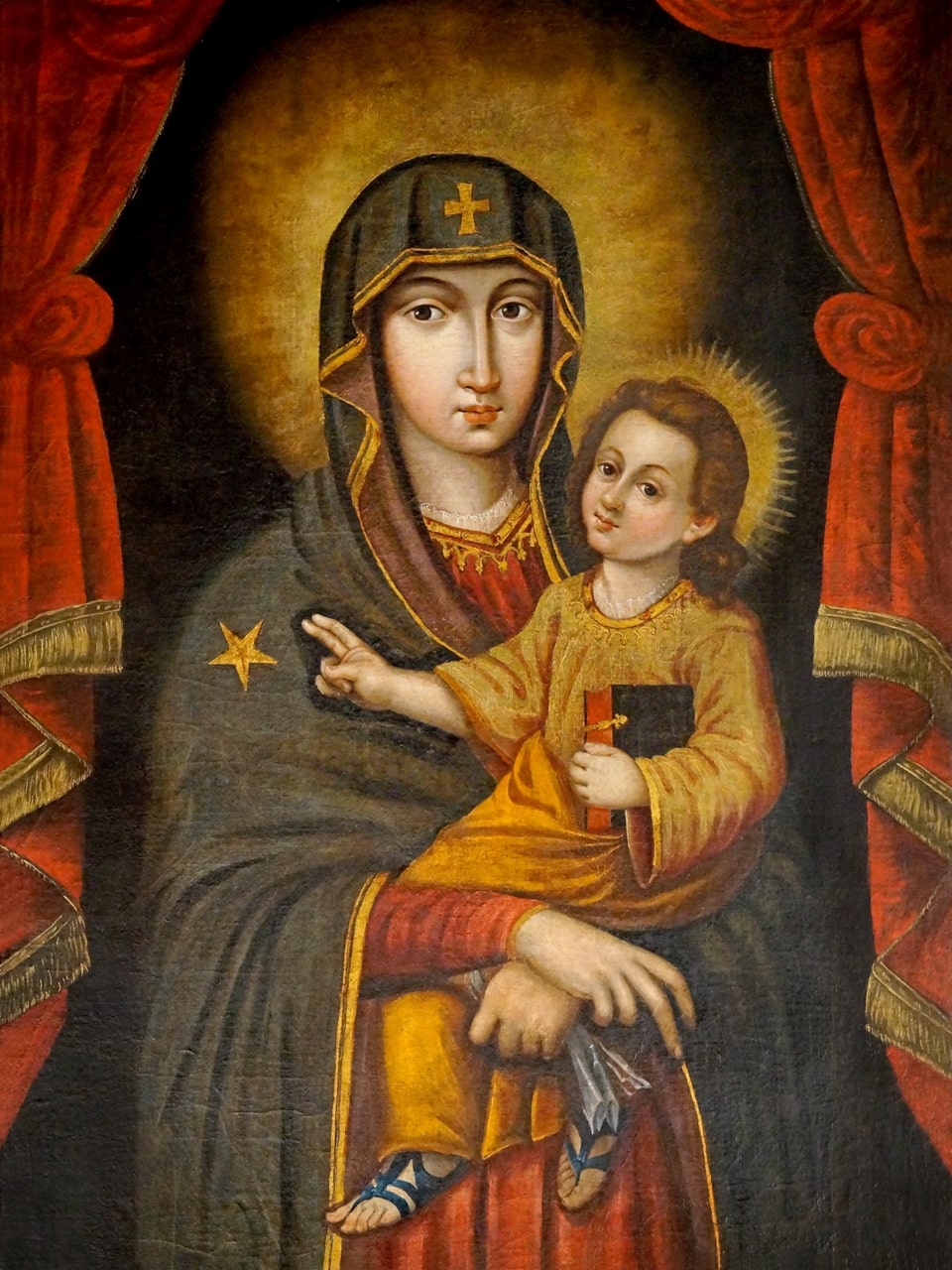
Matka Boża Różańcowa / Our Lady of the Rosary, Krakow, Poland (1600s) – First Sunday of October, 2 October:
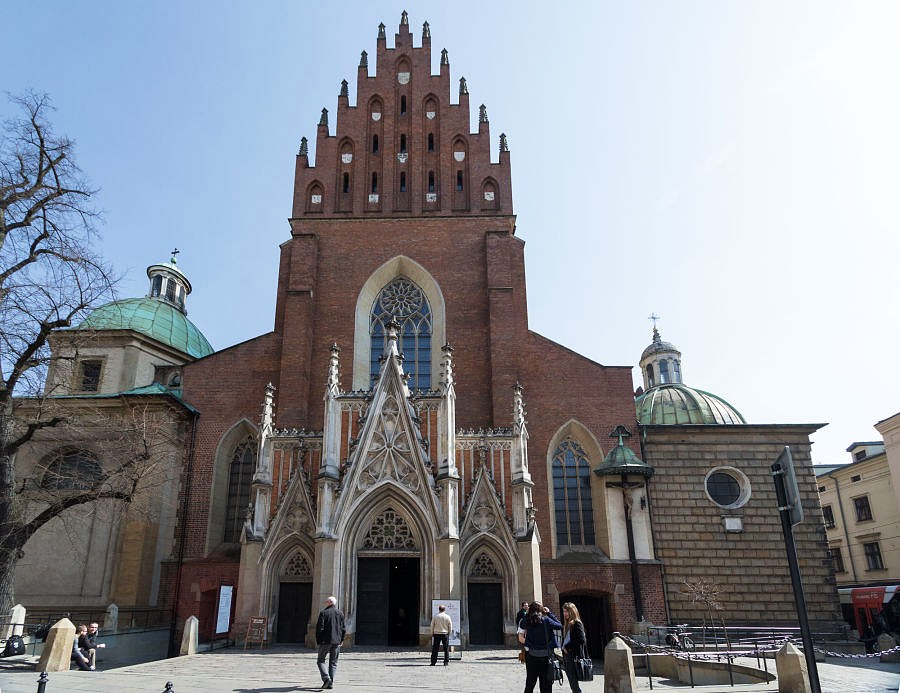
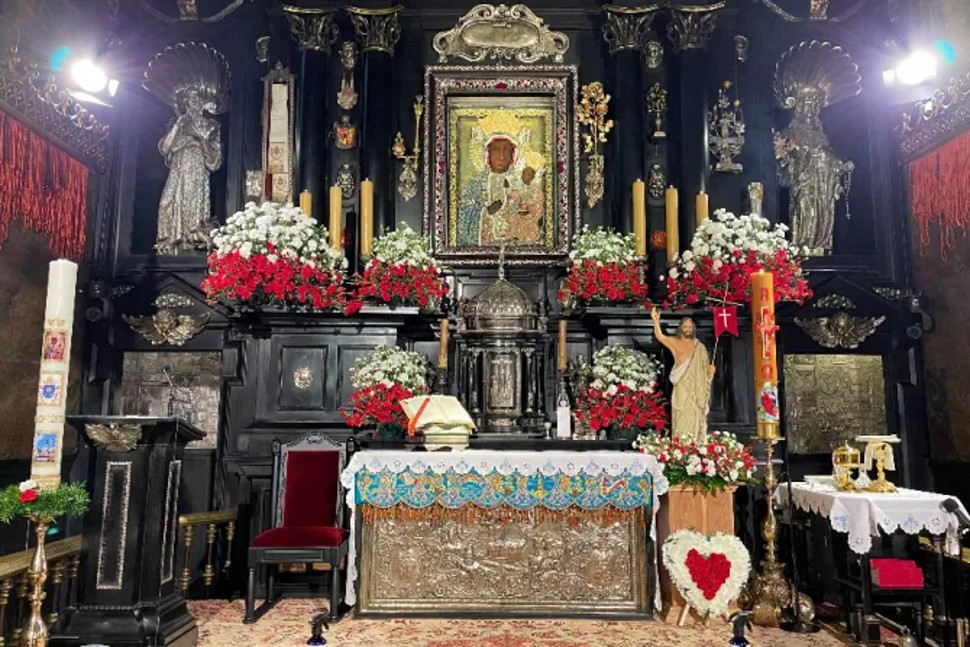
In the Dominican Basilica of the Trinity in Cracow is a large Chapel dedicated to the Mother of God of the Rosary. The icon on its main Altar, crowned on 2 October 1921, is a copy of the ancient Salus Populi Romani (Health of the Roman People) image in the Basilica of St Mary Major of the Snows in Rome — the icon Pope Gregory the Great carried in procession to end the plague of 597. During the Battle of Lepanto (7 October 571), when ships of a coalition of Christian countries routed the Turkish navy off Greece, Pope Pius V prayed the Rosary with a large group of faithful before the Roman icon. The old image thus became associated with the newer devotion of the Rosary and with saving Europe from Ottoman rule.
Churches throughout Catholic Europe were dedicated to Our Lady of the Rosary and copies of the Salus Populi Romani proliferated. Cardinal Maciejowski brought such a copy from Rome to Cracow in 1600. The image played a part in the “Polish Lepanto” in 1621, when at Khotyn, Ukraine (then Chocim, Poland) an allied force of Poles, Lithuanians and Ukrainians faced a Turkish army twice its size. On 3 October, the Bishop of Krakow led an hours-long Rosary procession with the holy icon. The entire population joined in. When the Turks gave up their attack and signed a treaty, Our Lady of the Rosary gained another victory. Her feast is celebrated in Krakow on the first Sunday of October.
The Swedish deluge contributed to the destruction of the original image of the Mother of God. T he cult, however, was so strong that a copy of the previous painting was quickly funded. The present one comes from the 50s and 60s of the 17th century. Numerous votive offerings made on the occasion of receiving favours have also survived from that time. The oldest exhibited in the Church are dated to 1703, the older ones are in the Archdiocese Museum. The love for the Blessed Mother is also evidenced by the silver dress donated in the 1770s by the Działyński family,and the sceptre of Our Lady of the “Pious Gregory of Pierzchno” foundation at the turn of the 17th and 18th centuries.
St Leudomer St Maria Antonina Kratochwil St Modesto of Sardinia St Saturius of Soria St Theophilus of Bulgaria St Thomas de Cantilupe of Hereford (c 1218-1282) Bishop St Ursicinus II — Martyred in Antioch, Syria: Martyred in one of the early persecutions, date unknown. St Cyril of Antioch St Primus of Antioch St Secundarius of Antioch
Martyred in Nagasaki, Japan: A husband, wife and two sons, who were all martyred together in the persecutions in Japan. They were beheaded on 2 October 1622 in Nagasaki, Japan and Beatified by Pope Pius IX on 7 May 1867. • Blessed Andreas Yakichi • Blessed Franciscus Yakichi • Blessed Lucia Yakichi • Blessed Ludovicus Yakichi
Martyred in the Spanish Civil War: • Blessed Elías Carbonell Molla • Blessed Enrique Sáiz-Aparicio • Blesssed Felipe González de Heredia Barahona • Blessed Francisco Carceller Galindo • Blessed Isidoro Bover Oliver • Blessed Juan Carbonell Molla • Blessed Juan Iñiguez de Ciriano Abechuco • Blessed Manuel Borrajo Míguez • Blessed María Francisca Ricart Olmos • Blessed Mateu Garrolera Masferrer • Blessed Pedro Artolozaga Mellique • Blessed Pedro Salcedo Puchades
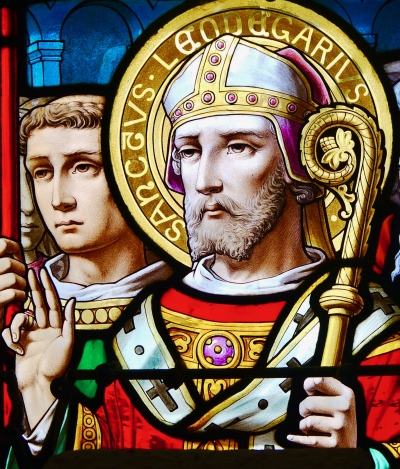
Saint of the Day – 2 October – Saint Leodegar of Autun (c 625-679) Bishop of Autun, France and Martyr, Monk, Abbot, Reformer, apostle of the poor – born in c 615 in Autun, Saône-et-Loire, Burgundy, France and died on 2 October 679 by being murdered in 678 in the woods in Sarcing, Somme, Picardie, France. Patronages – Millers, invoked against blindness, Eye disease, Eye problems, Sore eyes and 5 cities. He was the son of Saint Sigrada, his mother and the brother of Saint Warinus and is also known as St Leodegarius and St Leger.
Leodegar was the son of a high-ranking Burgundian nobleman, Bodilon, Count of Poitiers and Paris and St Sigrada of Alsace, who later became a nun at Sainte-Marie de Soissons.
He spent his childhood in Paris at the court of Clotaire II, King of the Franks and was educated at the palace school. When he was older he was sent to Poitiers, where there was a long-established Cathedral school, to study under his maternal uncle, Desiderius (Dido), Bishop of Poitiers. At the age of 20 his uncle made him an Archdeacon.
Shortly afterwards he became a Priest and in 650, with the Bishop’s permission, became a Monk at the Monastery of St Maxentius in Poitou. He was soon elected Abbot and initiated reforms including the introduction of the Benedictine rule.
Around 656, about the time of the usurpation of Grimoald in Austrasia and the banishment of the boy-heir Dagobert II, Leodegar was called to the Neustrian court by the widowed Queen Bathilde to assist in the government of the united kingdoms and in the education of her children. Then in 659 he was named to the See of Autun, in Burgundy. He again undertook the work of reform and held a council at Autun in 661. The council denounced Manichaeism and was the first to adopt the Trinitarian Athanasian Creed. He made reforms among the secular clergy and in the religious communities and had three baptisteries erected in the city. The Church of Saint-Nazaire was enlarged and embellished and a refuge established for the indigent. Leodegar also caused the public buildings to be repaired and the old Roman walls of Autun to be restored. His authority at Autun placed him as a leader among the Franco-Burgundian nobles.
Meanwhile, in 660 the Austrasian nobles demanded a king and young prince Childeric II was sent to them through the influence of Ebroin, the mayor of the palace in Neustria. The queen withdrew, from a court that was Ebroin’s in all but name, to an abbey she had founded at Chelles, near Paris. On the death of King Clotaire III in 673, a dynastic struggle ensued, with rival claimants as pawns; Ebroin raised Theoderic to the throne but Leodegar and the other Bishops supported the claims of his elder brother Childeric II, who, by the help of the Austrasians and Burgundians, was eventually made king. Ebroin was interned at Luxeuil and Theoderic sent to St Denis.
Leodegar remained at court, guiding the young king. In 673 or 675, however, Leodegar was also sent to Luxeuil. The cause, a protest against the marriage of Childeric and his first cousin, is a hagiographic convention; as a leader of the Austrasian and Burgundian nobles, Leodegar was easily represented as a danger by his enemies. When Childeric II was murdered at Bondi in 675, by a disaffected Frank, Theoderic III was installed as king in Neustria, making Leudesius his mayor. Ebroin took advantage of the chaos to make his escape from Luxeuil and hasten to the court. In a short time Ebroin caused Leudesius to be murdered and became mayor once again, still Leodegar’s implacable enemy.
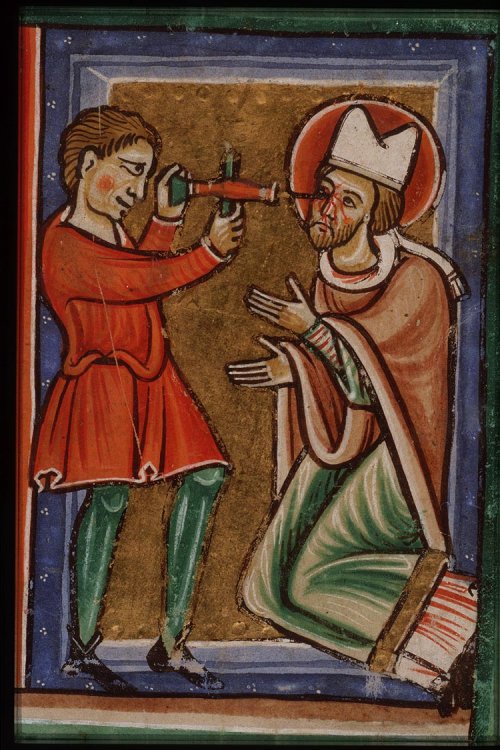
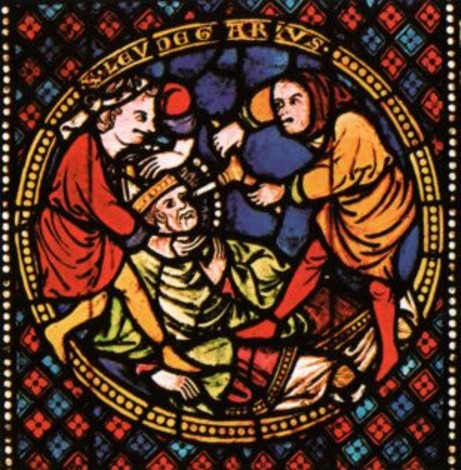
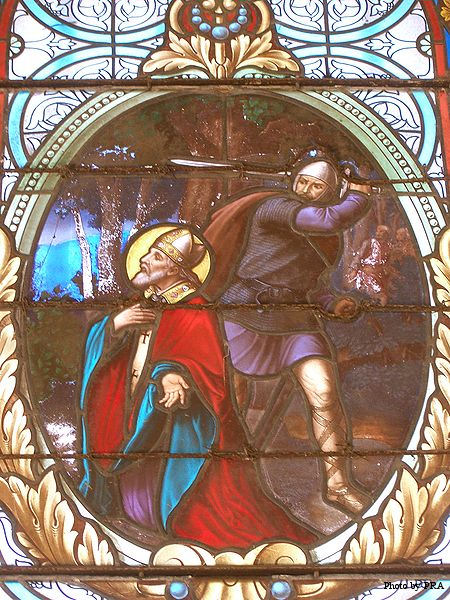
About 675 the Duke of Champagne, the Bishop of Châlons-sur-Marne and the Bishop of Valence, stirred up by Ebroin, attacked Autun and Leodegar fell into their hands. At Ebroin’s instigation, Leodegar’s eyes were gouged out and the sockets cauterized and his tongue was cut out. Some years later Ebroin persuaded the king that Childeric had been assassinated at the instigation of Leodegar. The Bishop was seized again and, after a mock trial, was degraded and condemned to further exile, at Fécamp, in Normandy. Near Sarcing he was led out into a forest on Ebroin’s order and beheaded.
A dubious testament drawn up at the time of the council of Autun has been preserved as well as the Acts of the council. A letter which he caused to be sent to his mother after his mutilation is likewise extant.
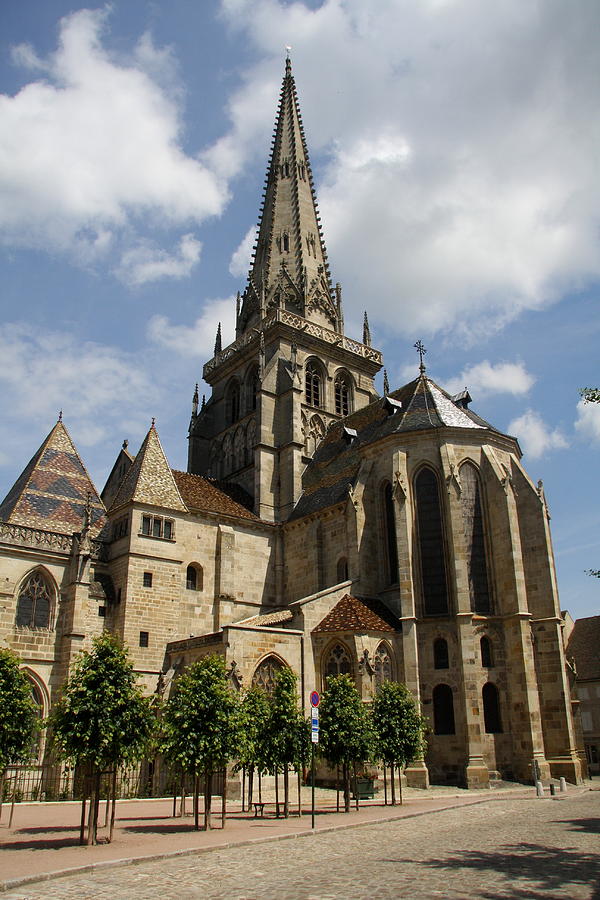
In 782, his relics were translated from the site of his death, Sarcing in Artois, to the site of his earliest hagiography – the Abbey of St Maxentius (Saint-Maixent) near Poitiers. Later they were removed to Rennes and thence to Ebreuil, which place took the name of Saint-Léger in his honour. Some relics are still kept in the Cathedral of Autun and the Grand Séminaire of Soissons. In 1458 Cardinal Rolin caused his feast day to be observed as a holy day of obligation.
Auton Cathedral
For sources to his biography, there are two early Lives, drawn from the same lost source (Krusch 1891) and also two later ones (one of them in verse).
Historically there was a custom among wealthy British merchants to sell in May, spend the summer outside of London, then to return on St Leger’s Day. This gave rise to the saying used in regards to financial trading markets, “Sell in May and go away and come on back on St Leger’s Day.”
St Alfonso del Rio St Andrea Ximenez Blessed Antoine Chevrier TOSF (1825-1879) About Blessed Antoince: https://anastpaul.com/2018/10/02/saint-of-the-day-2-october-blessed-antoine-chevrier-t-o-s-f-1825-1879/ St Beregisius St Eleutherius of Nicomedia Bl Georges-Edme René St Gerinus St Leodegar of Autun OSB (c 625-679) Bishop and Martyr St Leudomer St Maria Antonina Kratochwil St Modesto of Sardinia St Saturius of Soria St Theophilus of Bulgaria St Ursicinus II — Martyred in Antioch, Syria: Martyred in one of the early persecutions, date unknown. St Cyril of Antioch St Primus of Antioch St Secundarius of Antioch
Martyred in Nagasaki, Japan: A husband, wife and two sons, who were all martyred together in the persecutions in Japan. They were beheaded on 2 October 1622 in Nagasaki, Japan and Beatified by Pope Pius IX on 7 May 1867. • Blessed Andreas Yakichi • Blessed Franciscus Yakichi • Blessed Lucia Yakichi • Blessed Ludovicus Yakichi
Martyred in the Spanish Civil War: • Blessed Elías Carbonell Molla • Blessed Enrique Sáiz-Aparicio • Blesssed Felipe González de Heredia Barahona • Blessed Francisco Carceller Galindo • Blessed Isidoro Bover Oliver • Blessed Juan Carbonell Molla • Blessed Juan Iñiguez de Ciriano Abechuco • Blessed Manuel Borrajo Míguez • Blessed María Francisca Ricart Olmos • Blessed Mateu Garrolera Masferrer • Blessed Pedro Artolozaga Mellique • Blessed Pedro Salcedo Puchades




 AnaStpaul
You must be logged in to post a comment.