Saint of the Day – 14 March – St Matilda of Saxony (c 894-968) – Queen, Apostle of Prayer and Almsgiving, Foundress – Patronages – of death of children, disappointing children, falsely accused people, large families, people ridiculed for their piety, queens, second marriages, widows. Medieval chroniclers like Liutprand of Cremona and Thietmar of Merseburg celebrated Matilda for her devotion to prayer and almsgiving. Her first biographer depicted her leaving her husband’s side in the middle of the night and sneaking off to church to pray. St. Matilda founded many religious institutions, including the canonry of Quedlinburg, which became a center of ecclesiastical and secular life in Germany under the rule of the Ottonian dynasty. She also founded the convents of St. Wigbert in Quedlinburg, in Pöhlde, Enger, and Nordhausen, likely the source of at least one of her vitae.
Born in Saxony, Mathilda was the daughter of Thierri, a prince of considerable importance. From an early age, Mathilda demonstrated great piety and love for the Lord and was raised by her pious grandmother, Maud, the abbess of Enford, in the cloister. There, as she grew up, she practiced daily prayer and penance and learned a love of labour and spiritual reading. Mathilda would have been more than content to spend her life dedicated to religious pursuits. However, her father arranged her marriage to Henry, the son of the Duke of Saxony. Within seven years, Henry found himself the King of Germany, and Mathilda, the queen.
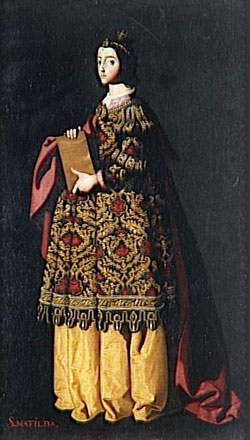
King Henry demonstrated through his actions that he was a God-fearing and pious spouse. His equity and courage won him the respect of his subjects and he encouraged and financed Mathilda’s longing to live a life of charitable service to others. While Henry ruled his kingdom, Mathilda devoted herself to penance and spent her days visiting the poor and sick, offering them consolation and comfort. She also founded schools to provide education to all, visited incarcerated prisoners and worked for the conversion of souls. Overall, her life was relatively a simple one, despite her royalty, with her primary focus on daily prayer.
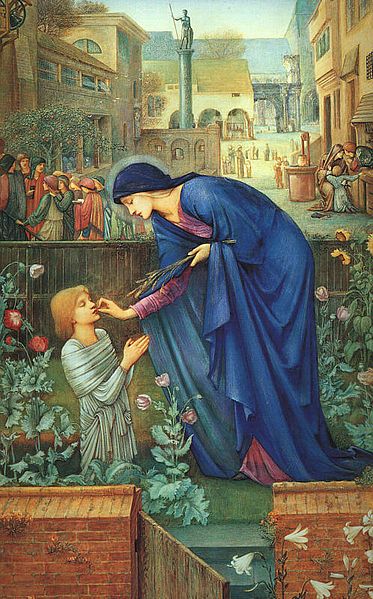
After seventeen years, Henry died of apoplexy, and Mathilda, looking to the Lord, gave up her royal vestments and jewels, laying them on the alter of the Lord. Divesting herself of her title, she stepped aside for her children, with the eldest, Otho, becoming king. Henry became Duke of Bavaria and the youngest, Bruno, the Archbishop of Cologne.
However, all was not smooth prior to the coronation, with Henry contesting his brother’s rightful place as heir. Mathilda, for her part, always partial to Henry, sided with him, her words creating significant discord between the brothers. Eventually, the brothers reconciled, but turned against their mother, stripping her of her dowry,and accusing her publicly of mismanaging the royal funds in service to her charities. Saint Mathilda accepted the punishment gracefully, recognising her sinfulness in siding with one son above another, repenting and offering herself wholly to the Lord in reparation.
The persecution and suffering of Mathilda was long and cruel but she patiently bore this all, until her son reconciled with her. Her dowry restored, Mathilda was allowed to move back into the royal court. However, instead, she chose to live in the Benedictine monastery of Quedlinbourg, using her funds to serve the poor and extend the religious communities in the region dedicated to charity. he founded five monasteries, and built many churches.
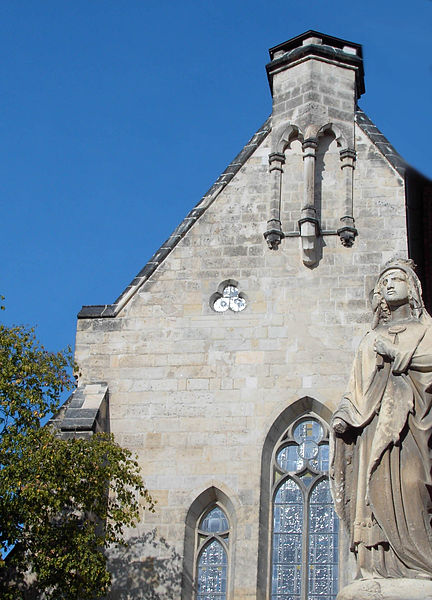
Saint Mathilda grew ill and realized that death was upon her. In the presence of her community at the monastery, she made a public confession, donned sackcloth and covered herself with ashes. She further received last sacraments from William, Archbishop of Mayence, her nephew. Her body remains at Quedlinburg, where she is buried beside her husband. She is venerated there today.





 AnaStpaul
You must be logged in to post a comment.