St Felix of Como (Died 390) the first Bishop of Como. Felix was a friend of Saint Ambrose, who praised him for his missionary activity and Ordained him a Priest in 379 and Consecrated him as Bishop in 386. St Ambrose sent him to evangelise the City of Como, as a testimony to the great missionary drive of the Church of Milan. St Felix is honoured as a zealous shepherd of souls. More about St Felix: https://anastpaul.com/2021/10/08/saint-of-the-day-8-october-saint-felix-of-como-died-390/
St Felix of Como (Died 390) the first Bishop of Como. Felix was a friend of Saint Ambrose, who praised him for his missionary activity and Ordained him a Priest in 379 and Consecrated him as Bishop in 386. St Ambrose sent him to evangelise the City of Como, as a testimony to the great missionary drive of the Church of Milan. St Felix is honoured as a zealous shepherd of souls. More about St Felix: https://anastpaul.com/2021/10/08/saint-of-the-day-8-october-saint-felix-of-como-died-390/
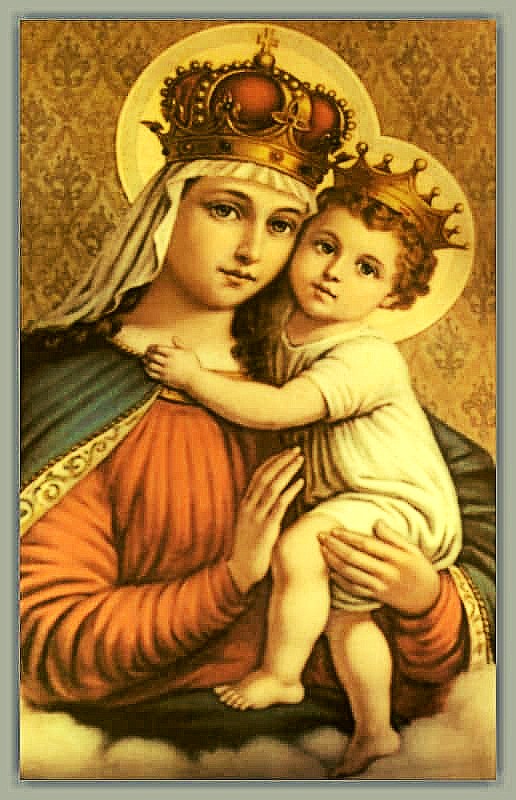
Notre-Dame du Bon Remède / Our Lady of Good Remedy, France (1197) – 8 October:
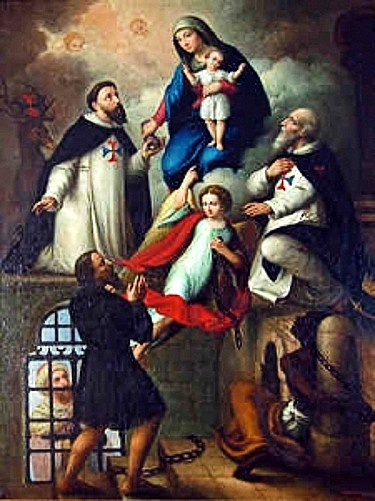
In 1197, a Sorbonne Doctor of Theology and newly Ordained Priest, Jean de Matha, while saying his first Holy Mass, saw a vision of an Angel with a red and blue cross on his chest and his hands resting on the heads of two captives. The following year, St Jean founded a religious order dedicated to the redemption of Christians held as slaves by Moslems — the Hospitaler Order of the Most Holy Trinity and of Captives, commonly called the Trinitarians. On their habit, Jean placed the Cross he had seen on the Angel,and, as their Patron, he gave them Notre-Dame du Bon Remède, a popular devotion in his Provençal homeland. Now devoted largely to education and evangelisation, for three centuries they raised funds and travelled from Europe into Africa to buy thousands of captives’ freedom with Our Lady’s help. A painting (right) in the Trinitarian Motherhouse of Cerfroid in northern France, shows Our Lady of Good Remedy giving a bag of money to St Jean/John of Matha, while a grateful freedman and St Felix of Valois, look on. The Order celebrates her feast day 8 October.
800 years ago Christians were being captured and sold into slavery by the thousands, and nobody knew what to do about it. Then, in the year 1198, a man had an idea. St. John of Matha founded the Trinitarians to go to the slave markets, buy the Christian slaves and set them free. To carry out this plan, the Trinitarians needed large amounts of money. So, they placed their fund-raising efforts under the patronage of Mary. They were so successful that, over the centuries, the Trinitarians were able to free thousands and thousands of people and to return them safely home. In gratitude for her miraculous assistance, St. John of Matha honoured Mary with the title of “Our Lady of Good Remedy.” Devotion to Mary under this ancient title is widely known in Europe and Latin America and the Church celebrates her feast day on 8 October. Our Lady of Good Remedy is often depicted as the Virgin Mary handing a bag of money to St. John of Matha. When in need – for whatever reason but especially where you have had difficulty obtaining help – invoke the aid of Our Lady of Good Remedy and you will surely experience the power of her intercession.
St Amor of Aquitaine St Artemon of Laodicia St Badilo St Benedicta of Laon St Benedicta of Origny-sur-Oise St Evodius of Rouen St Felix of Como (Died 390) Bishop St Gratus of Chalons
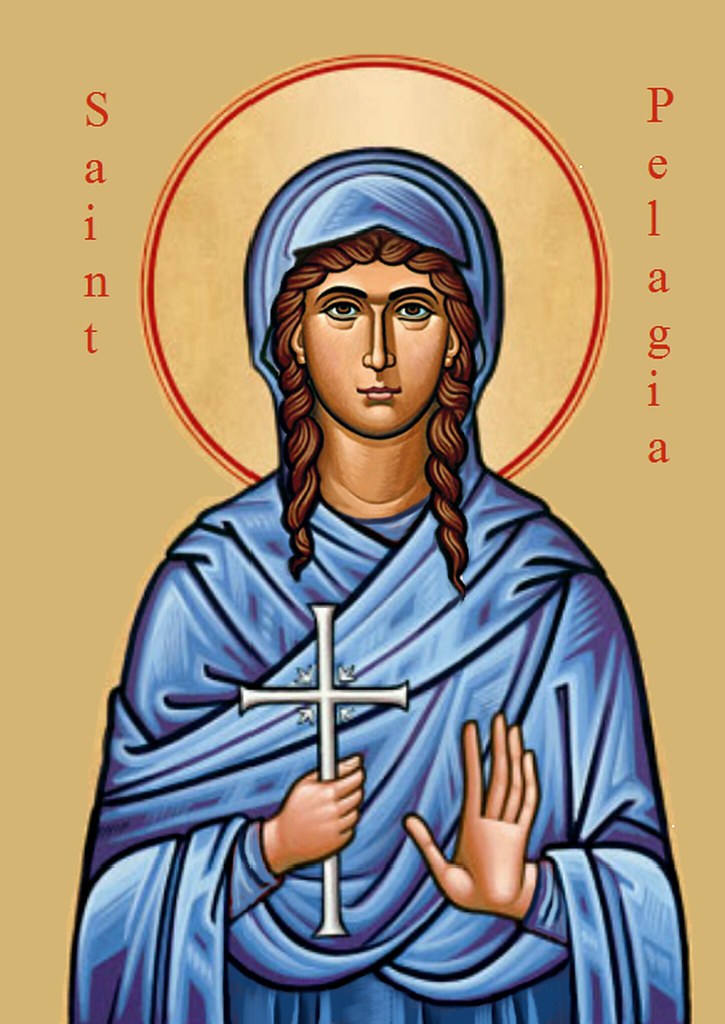
Saint of the Day – 8 October – St Pelagia the Penitent (Fourth or Fifth Century) Hermit – also known as Pelagia of Antioch, The Beardless Hermit, Marina (the Latin equivalent of “Pelagia”), Margarita. Patronage – actresses.
Like St Mary Magdalen and St Mary of Egypt, St Pelagia inspired Christians of the Middle Ages as an enchanting icon of repentance. Storytellers probably spun her winsome tale from an anonymous factual illustration embedded in one of St John Chrysostom’s homilies on St Matthew’s Gospel. He told of a nameless actress of Antioch, famous for her glamour and notorious for her wickedness, who suddenly repented, was baptised and afterwards embraced the austere life of a hermit.
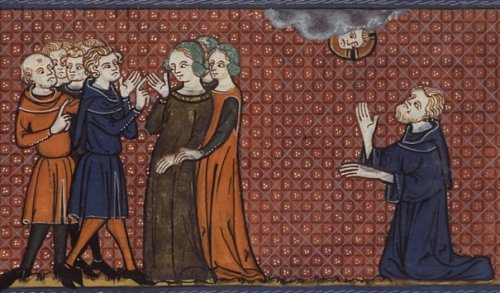
Pelagia among her courtesans, as Saint Nonnus prays for her
Later a gifted writer who pretended to be St James, a Deacon working for St Nonnus of Edessa, named the actress Pelagia and created the story that still speaks to our spirit.
As he told it: “One day Pelagia, dressed provocatively and surrounded by an entourage of her fans, passed by a group of Bishops sitting at St Julian’s tomb near Antioch. All but one Bishop was scandalised by her evil charms. But Pelagia’s carefully appointed beauty touched St Nonnus and led him to a spiritually disturbing conclusion. He said to the other Bishops:
. . .we have vast promises in the supernatural heights stored up with our hidden Lord who cannot be seen. It is He we should please but we fail to do so; it is for Him that we should adorn our bodies and souls but we totally fail to do so. We should take pains over ourselves in order to scrub away the dirt of sins, to become clean from evil stains but we have paid no attention to our souls, in the attempt to adorn them with good habits so that Christ may desire to dwell in us. What a reproach to us, seeing that we have not taken pains to make ourselves pleasing to God nearly as much as this prostitute . . . has taken pains to please men—in order to captivate them, leading them into perdition by her wanton beauty. . . . Maybe we should even go and become the pupils of this lascivious woman.”
The next day, the story continues, Pelagia made a rare appearance in Church where she heard Nonnus preach on judgement and salvation. His words stabbed her heart. On the spot Pelagia repented and was converted to Christ.
Then she demanded that Nonnus baptise her, a request he happily obliged. A Deaconess named Romana took Pelagia under her wing, until one day, after giving away all her possessions, Pelagia slipped away. She hid herself in Jerusalem, where disguised as a man, she became a Hermit on the Mount of Olives. Word about the holiness of the monk “Pelagios” spread throughout the Holy Land. And when it was discovered upon her death that the Hermit was the repentant prostitute Pelagia, she was honoured and loved even more.



 AnaStpaul
You must be logged in to post a comment.