One Minute Reflection – 11 December – Monday of the Second Week of Advent, Within the Octave of the Immaculate Conception of the Blessed Virgin Mary, Mother of God – St Pope Damasus I (c305-384) Confessor. – 1 Peter 5:1-4, 10-11; Matthew 16:13-19 – Scripture search here: https://www.drbo.org/
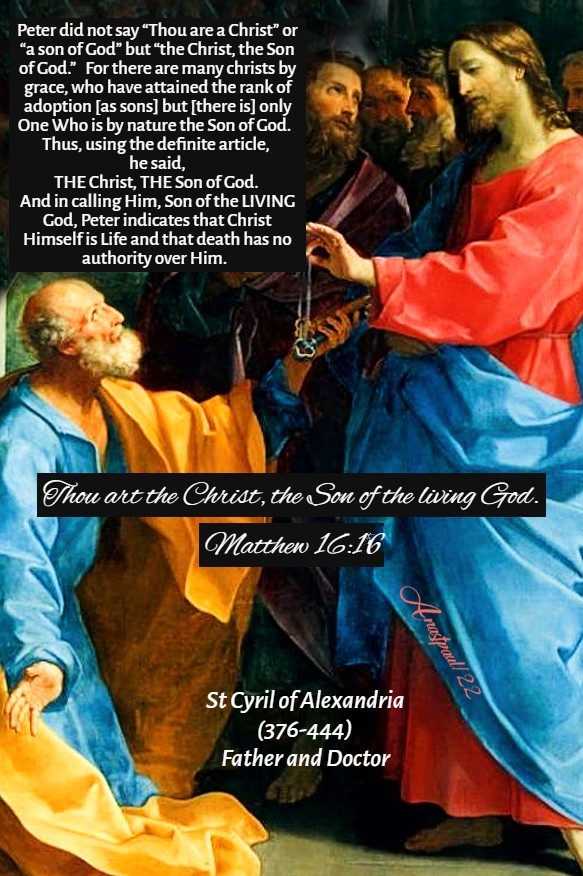
“Thou art the Christ, the Son of the living God.” – Matthew 16:16
REFLECTION – “Peter did not say “Thou are a Christ” or “a son of God” but “the Christ,the Son of God.” For there are many christs by grace, who have attained the rank of adoption [as sons] but [there is] only One Who is by nature the Son of God. Thus, using the definite article, he said, THE Christ, THE Son of God. And in calling Him, Son of the LIVING God, Peter indicates that Christ Himself is Life and that death has no authority over Him. And even if the flesh, for a short while, was weak and died, nevertheless, it rose again, since the Word, Who dwelled in it, could not be held under the bonds of death.” – St Cyril of Alexandria (376-444) Known as “The Pillar of Faith” Archbishop of Alexandria, Father and Doctor Incarnationis (Doctor of the Incarnation) (Fragment 190).
PRAYER – Look forgivingly on Thy flock, Eternal Shepherd and keep it in Thy constant protection, by the intercession of blessed Damasus Thy Sovereign Pontiff, whom Thou didst constitute Shepherd of the whole Church. Through Jesus Christ, Thy Son our Lord, Who lives and reigns with Thee, in the unity of the Holy Ghost, God, world without end. Amen (Collect).
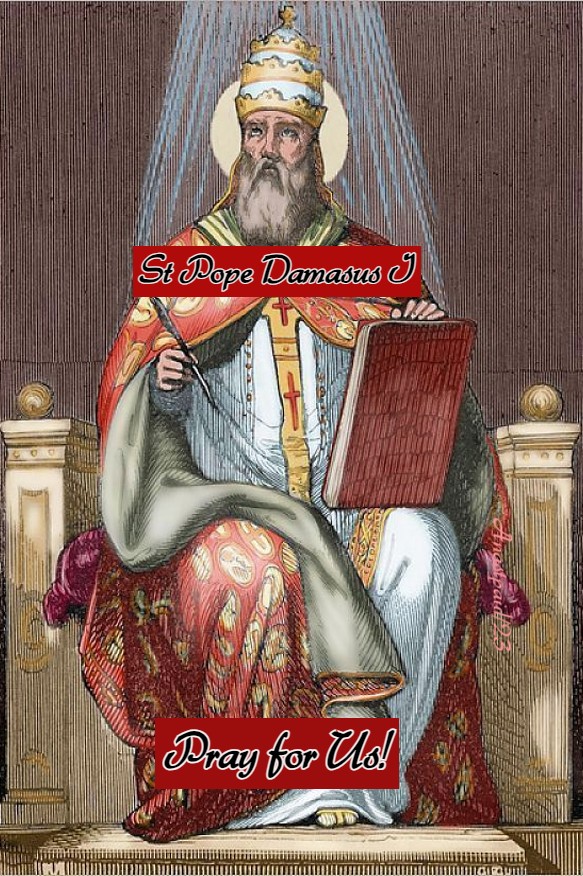
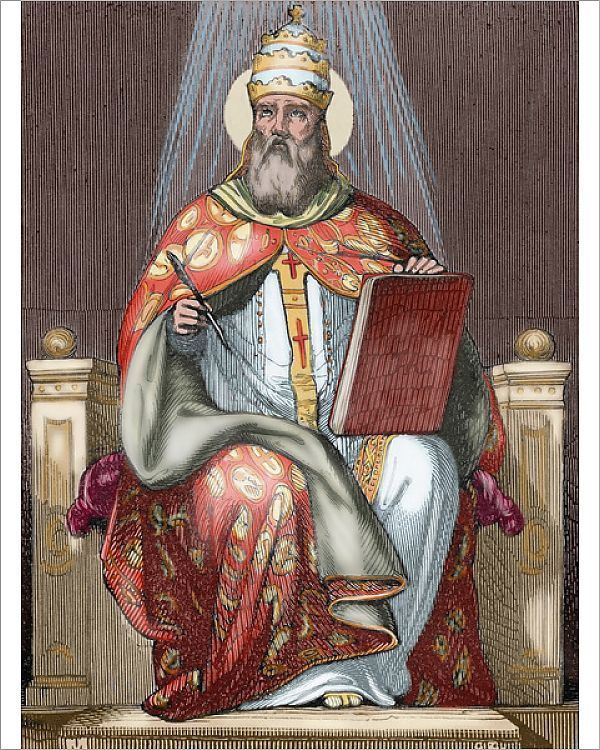
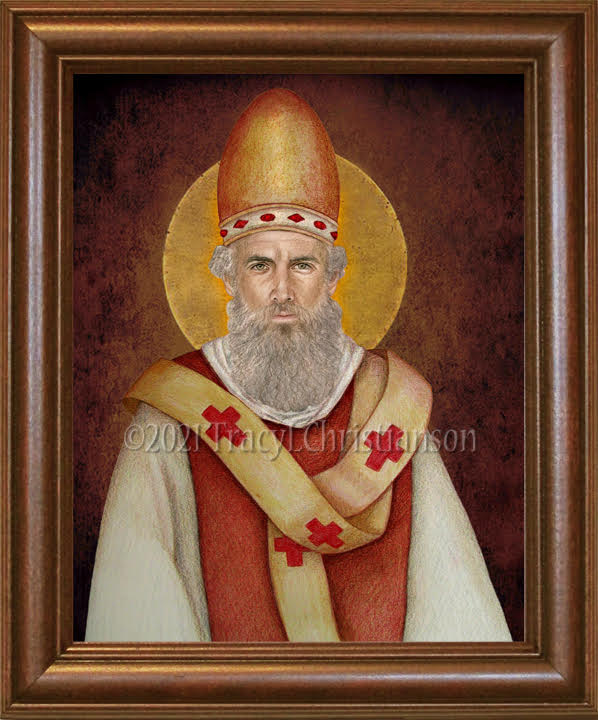
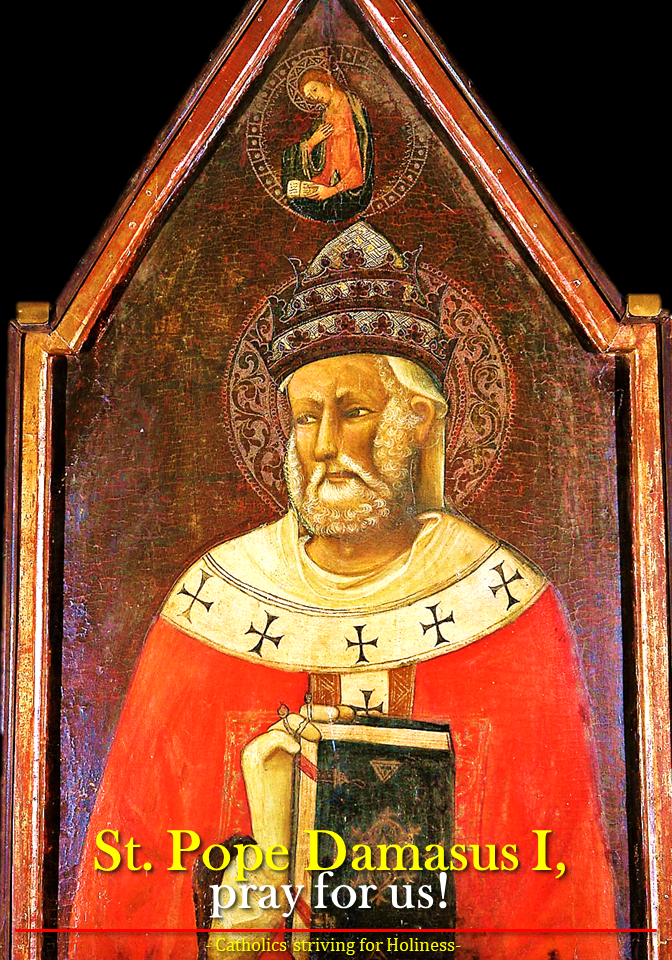
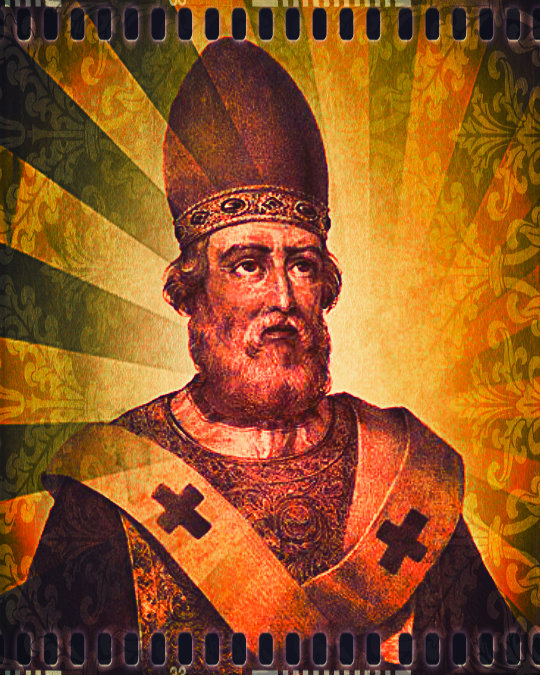
Saint of the Day – 11 December – Saint Damasus I (c305-384) Bishop of Rome from 366-his death on 11 December 384. Pope Damasus was a Poet, a Confessor and Defender of Orthodoxy and a Reformer of morals amongst many other qualities. Born in c306 in Rome, Italy of Spanish descendancy and died in 384 in the same City of natural causes. He was initially buried in the Mark and Marcellianus Catacombs in Rome and in …. his bones were re-interred in the Church of San Lorenzo in Damaso, Rome. Patronage – of Archeologists.
The Roman Martyrology reads: “St Rome, St Damasus, Pope and Confessor, who condemned the heresiarch Apollinaris and restored to his See, Peter, Bishop of Alexandria who had been driven from it. He also discovered the bodies of many holy Martyrs and wrote verses in their honour.”
Today is the Feast of Pope St Damasus I, who was elected in October of 366, at roughly the age of 60 and died on this day in 384. He served as Deacon at the Church of St Lawrence Outside-the-Walls. He was elected to the Papacy in the midst of controversy, since a small group of the Clergy supported another candidate, Ursicinus; the followers of this schismatic seized control of the Liberian Basilica (now St Mary Major) and could only be repressed with violence and the exile of the anti-Pope.
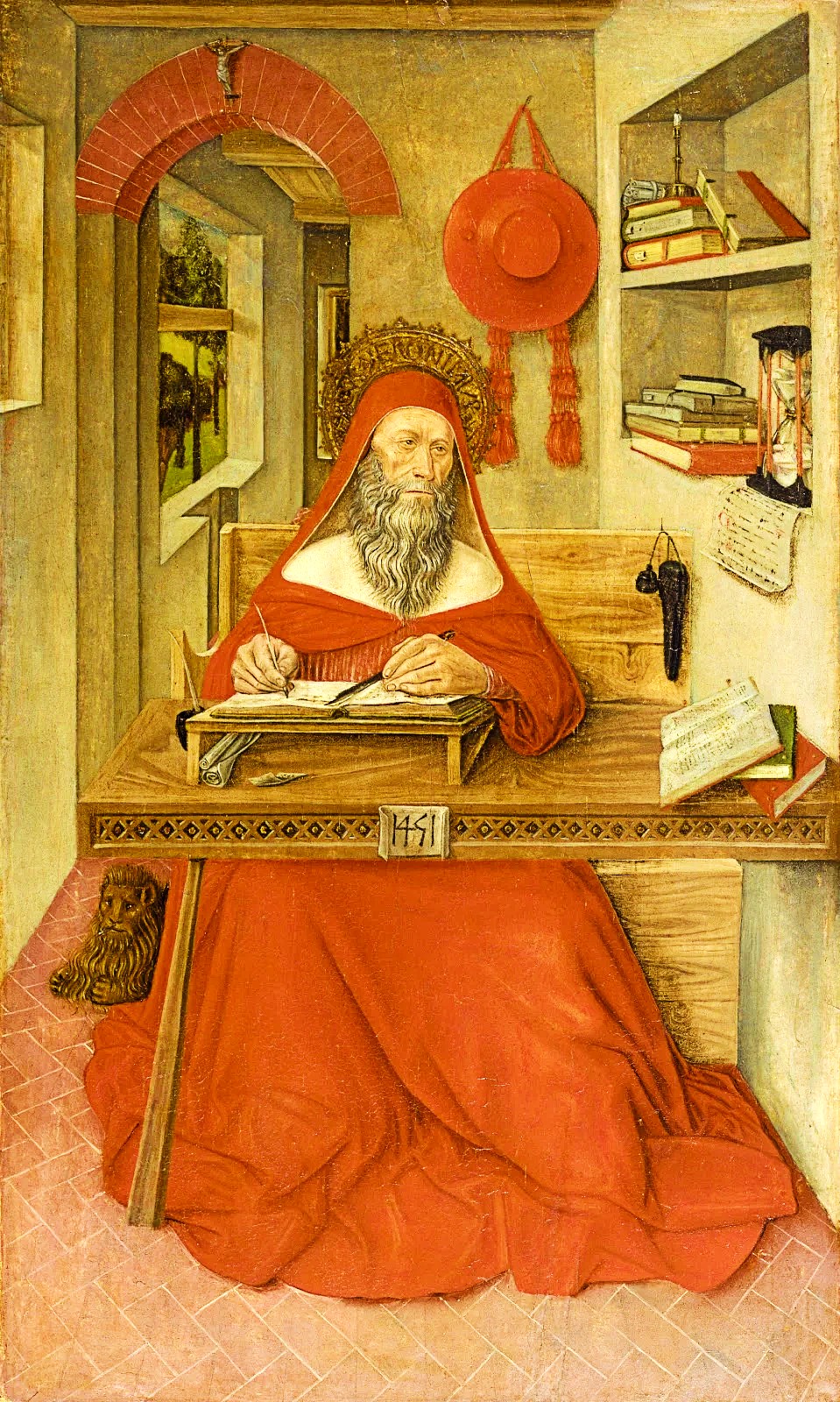
St Damasus was a strenuous Defender of the Orthodox Christian faith, holding Synods in Rome to condemn the heresies of Macedonius and Apollinaris, sending legates to the First Council of Constantinople and excommunicating the Arian bishop of Milan, Auxentius, who was later succeeded by St Ambrose. It was at his (St Ambrose’) behest that St Jerome revised the Latin text of the Gospels and it is in a letter to him that St Jerome famously describes the need for such a revision by saying, “There are as many versions (of the Sacred Scriptures) as there are copies.” Pope Damasus then befriended St Jerome and employed him as his Secretary, a position he held for many years. They worked together on exegetical matters but, perhaps Damasus’ most important contribution to the Church, was that he commissioned Jerome to revise the existing Latin translation of the Gospels based on the original Greek. This was to become the Sacred Scripture translation which was later called “The Vulgate.” St Jerome is traditionally represented as a Cardinal because of the time he spent in Rome as Damasus’ Secretary.
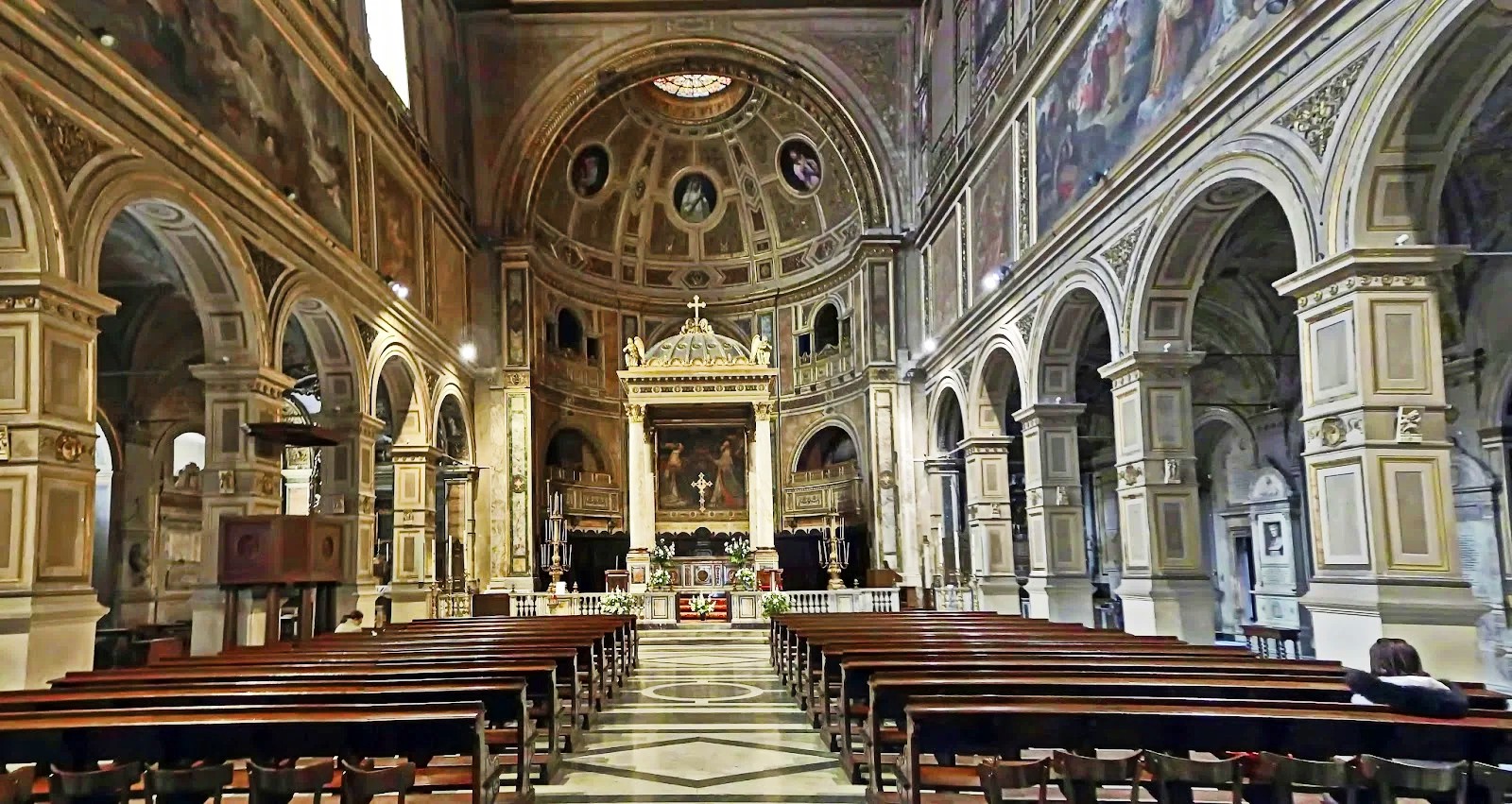
Our Saint is today, venerated too, as the Patron Saint of Archeologists and, particularly those who work in the field of early Christian archeology, because of his great encouragement of devotion to the Roman Martyrs and his efforts to preserve their memories. He built a Church in honour of St Lawrence within his own house in the centre of Rome, now known as “San Lorenzo in Damaso” and also a Shrine at the Catacomb of St Sebastian, where the bodies of Ss Peter and Paul were once kept and the Baptistery of the ancient Basilica of St Peter. Within many of the Roman Catacombs, he had the areas around the Martyrs’ graves restored to make them more accessible to pilgrims ..
As a young man, Damasus had worked in the Papal Archives (the first reference to a Papal Archive), where he read about the lives and deaths of the Martyrs. Now that the persecutions were over, he worked tirelessly to promote the Martyr cult. He encouraged pilgrimages to the Catacombs and re-opened them, after they had been closed by Emperor Diocletian. He restored them, built staircases and skylights, all with the aim of demonstrating that the real splendour of Rome was not pagan but Christian.
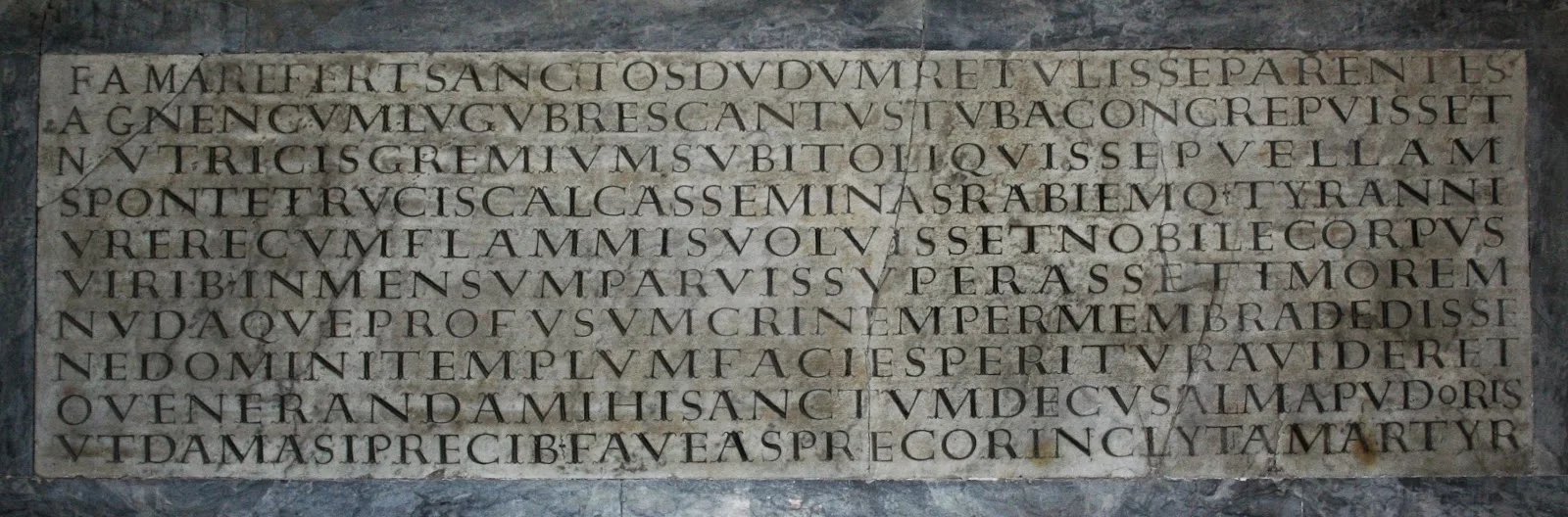
Damasus also decorated the graves of many Martyrs with Epitaphs, composed by himself and carved into marble, with a special kind of lettering invented for the purpose. This Font, in which the bars of the letters are alternately thick and thin, with curved serifs at the corners, is known as either “Philocalian” lettering from its inventor, a friend of his named Furius Dionysius Filocalus, or “Damasian” after himself. We have a total of about 70 of these Inscriptions; about 40 of the originals are preserved, while the rest are recorded in various sources, although the stones themselves have been lost.
One of the best preserved of these is at the Church of St Agnes Outside-the-Walls on the Via Nomentana, the High Altar of which rests over her Gravesite. As seen in the photograph below, only the upper left corner is missing.
After recounting the Martyrdom and burial of St Agnes (including the story that when her clothes were torn off, her hair miraculously grew to cover her exposed body), the final line asks the “renowned Martyr to favour the prayers of Damasus.” These Inscriptions are particularly valuable witnesses to the authenticity of various Martyrs and the Liturgical devotion paid to them, since we know that Pope Damasus took care to inform himself about the Martyrdoms as best he could. At the grave of Ss Peter and Marcellinus, who were killed in the persecution of Diocletian in 304, he placed an Epitaph in which he gives the story of their deaths and then notes that he learned the details when he was a boy, by interviewing the Martyrs’ own executioner!Being himself born in the very heart of the persecution and. therefore. a young Cleric in Rome in the early years of the peace of the Church, he must also have known many who had actually, themselves, witnessed the Martyrdoms of Sts Agnes, John and Paul and Sebastian, just to name a few.
Pope Damasus’ relationship with the Eastern Church was unhappy. There, St Basil the Great (329-379) fought to restore orthodoxy on the basis of a refined new explanation of the Nicene Doctrine. Like the West, in general,, Damasus did not understand the new development and when Antioch was divided between rival Bishops, the Pope stubbornly clung to the support of Paulinus, the unrepresentative leader of a reactionary group, instead of Meletius, on whom the Eastern hope of unity rested . When Meletius died in 381, Damasus refused to enter into Church communion with his successor, Flavian. In desperation, Basilios described the Pope as improbably arrogant, who did nothing to contribute to the constructive détente between East and West that was now underway.
The second Ecumenical Council took place in Constantinople from May to July 381. Originally, it was an Eastern Council, where only about 150 Eastern Bishops participated. Pope Damasus was not present but when the Council decisions were later presented to him, he approved them and the Council was thus considered Ecumenical. Here the Doctrine of the Trinity was established for good and the Council adopted a powerful declaration of the deity of the Holy Ghost, directed against the Macedonians and the Pneumatomas (who rejected the deity of the Holy Ghost). The Council also condemned the Arians and Semi-Arians.
It was Pope Damasus I who introduced the Doxology Gloria Patri (Glory be to the Father) at the end of the Hymns. He was also the first to take over the title of Pontifex Maximus (High Priest) from the Roman Emperors. He also authorised the Ambrosian Rite and introduced the use of the Hebrew term “Hallelujah” (Latin: Alleluia ).
Damasus died on 11 December 384 in Rome and was first interred in the Catacomb of Mark and Marcellianus, near the Catacomb of Domitilla, on the Via Ardeatina, in a burial place he had prepared for his mother and sister, Irene. Later, his Relics were transferred to the Church of St Lorenzo in Damaso, which he had built himself. There, after being forgotten for a long time, they were found again in 1645. His Feast has been celebrated on 11 December since the 7th Century.
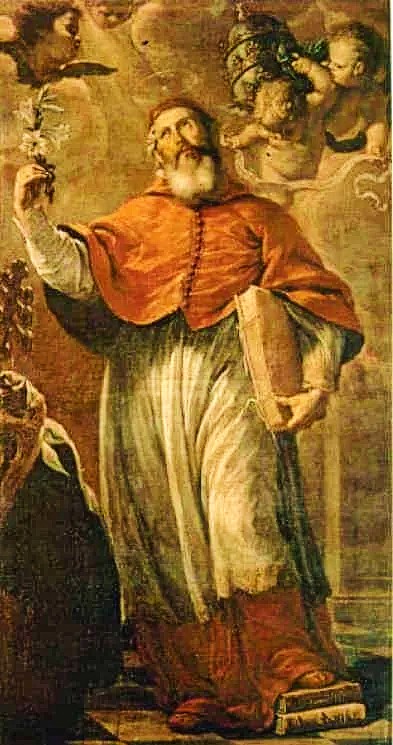
Bl Hugolinus Magalotti Blessed Jean Laurens O. Praem.(1548-1613)
Blessed Jerome Ranuzzi OSM (c 1410-c 1468) “The Angel of Good Counsel,” “The Blessed Bachelor,” Priest and Friar of the Order of the Servants of Mary, the Servites, Theologian, Adviser both spiritual and secular, renowned for his learning and scholarship, Penitent and Hermit with a great love of solitude and silence. His body is incorrupt and is still available for veneration in St Mary of the Servites, Urbano, Italy. His cult was confirmed on 1 April 1775 by Pope Pius VI with the title of Blessed. The Roman Martyrology states: “In Sant’Angelo in Vado always in the Marches, Blessed Girolamo, Priest of the Order of the Servants of Mary, who in solitude and silence reached the wisdom of holiness.” Biography: https://anastpaul.com/2021/12/11/saint-of-the-day-11-december-blessed-jerome-ranuzzi-osm-c-1410-c-1468-the-angel-of-good-counsel/
St Pens St Sabinus of Piacenza Blessed Severin Ott O.Praem. (1627-1708) Priest and Friar of the Norbertines or Premonstratensians.
Martyrs of Saint Aux-Bois – 3 Saints: Two Christian missionaries and one of their local defenders who faith in the persecutions of governor Rictiovarus – Fuscian, Gentian and Victoricus. They were beheaded in 287 in Saint Aux-Bois, Gaul (in modern France).
Martyrs of Rome – 3 Saints: Three Christians murdered in the persecutions of Diocletian for giving aid to Christian prisoners – Pontian, Practextatus and Trason. They were imperial Roman citizens. They were martyred in c 303 in Rome, Italy.
Bl Hugolinus Magalotti Bl Jean Laurens Blessed Jerome Ranuzzi OSM (c 1410-c 1468) “The Angel of Good Counsel,” “The Blessed Bachelor,” Priest and Friar of the Order of the Servants of Mary, the Servites Bl Kazimierz Tomasz Sykulski
Bl Martín Lumbreras Peralta Bl Martino de Melgar Bl Melchor Sánchez PérezPens Bl Pilar Villalonga Villalba Bl Severin Ott Martyrs of Saint Aux-Bois – (3 saints): Two Christian missionaries and one of their local defenders who faith in the persecutions of governor Rictiovarus – Fuscian, Gentian and Victoricus. They were beheaded in 287 in Saint Aux-Bois, Gaul (in modern France).
Martyrs of Rome – (3 saints): Three Christians murdered in the persecutions of Diocletian for giving aid to Christian prisoners – Pontian, Practextatus and Trason. They were imperial Roman citizens. They were martyred in c 303 in Rome, Italy.
Bl Martín Lumbreras Peralta Bl Martino de Melgar Bl Melchor Sánchez PérezPens Bl Pilar Villalonga Villalba Bl Severin Ott Martyrs of Saint Aux-Bois – (3 saints): Two Christian missionaries and one of their local defenders who faith in the persecutions of governor Rictiovarus – Fuscian, Gentian and Victoricus. They were beheaded in 287 in Saint Aux-Bois, Gaul (in modern France).
Martyrs of Rome – (3 saints): Three Christians murdered in the persecutions of Diocletian for giving aid to Christian prisoners – Pontian, Practextatus and Trason. They were imperial Roman citizens. They were martyred in c 303 in Rome, Italy.
Quote of the Day – 11 December – The Memorial of St Pope Damasus I (c 305-384)
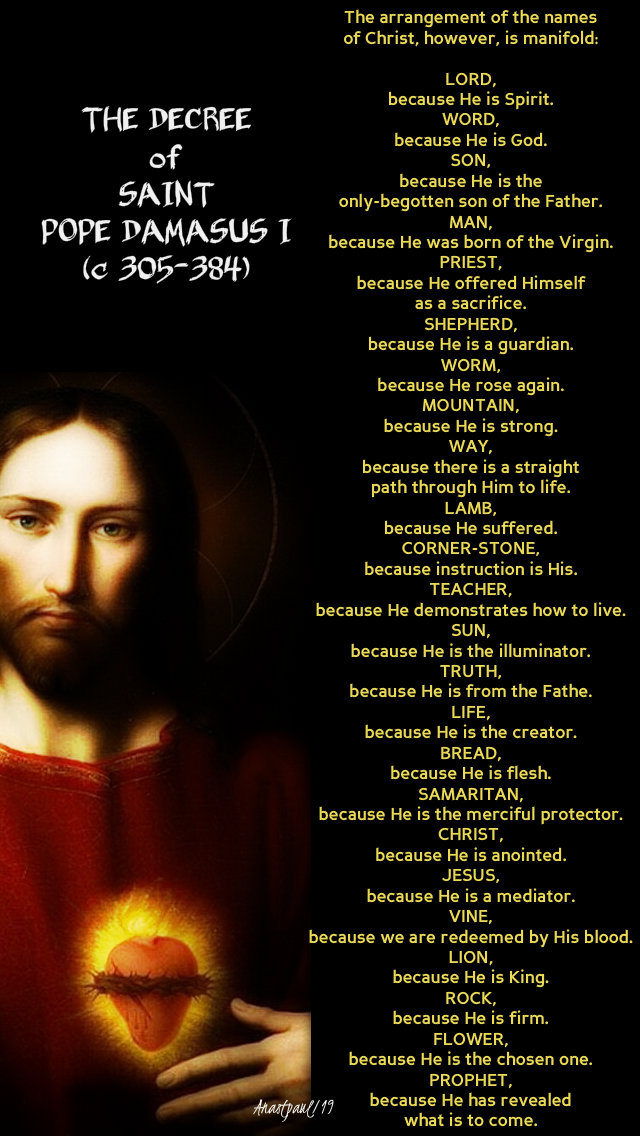
The arrangement of the names of Christ, however, is manifold:
LORD, because He is Spirit. WORD, because He is God. SON, because He is the only-begotten son of the Father. MAN, because He was born of the Virgin. PRIEST, because He offered Himself as a sacrifice. SHEPHERD, because He is a guardian. WORM, because He rose again. MOUNTAIN, because He is strong. WAY, because there is a straight path through Him to life. LAMB, because He suffered. CORNER-STONE, because instruction is His. TEACHER, because He demonstrates how to live. SUN, because He is the illuminator. TRUTH, because He is from the Fathe. LIFE, because He is the creator. BREAD, because He is flesh. SAMARITAN, because He is the merciful protector. CHRIST, because He is anointed. JESUS, because He is a mediator. VINE, because we are redeemed by His blood. LION, because He is King. ROCK, because He is firm. FLOWER, because He is the chosen one. PROPHET, because He has revealed what is to come.
St Aithalas of Arbela
St Apseus of Arbela
Bl Arthur Bell
Barsabas of Persia
St Cian
St Daniel the Stylite
Bl David of Himmerod
Bl Dominic Yanez
St Eutychius the Martyr
St Fidweten Bl Francesco Lippi O.Carm (1211-1291)
Bl Hugolinus Magalotti
Bl Jean Laurens
Bl Kazimierz Tomasz Sykulski St María Maravillas de Jesús OCD (1891-1974) St Maria’s Story: https://anastpaul.com/2018/12/11/saint-of-the-day-11-december-st-maria-maravillas-de-jesus-ocd-1891-1974/
Bl Martín Lumbreras Peralta
Bl Martino de Melgar
Bl Melchor Sánchez PérezPens
Bl Pilar Villalonga Villalba
Bl Severin Ott
Martyrs of Saint Aux-Bois – (3 saints): Two Christian missionaries and one of their local defenders who faith in the persecutions of governor Rictiovarus – Fuscian, Gentian and Victoricus. They were beheaded in 287 in Saint Aux-Bois, Gaul (in modern France).
Martyrs of Rome – (3 saints): Three Christians murdered in the persecutions of Diocletian for giving aid to Christian prisoners – Pontian, Practextatus and Trason. They were imperial Roman citizens. They were martyred in c 303 in Rome, Italy.
Thought for the Day – 11 December – The Memorial of St Pope Damasus I (c 305-384)
To his secretary Saint Jerome (343-420), Damasus was “an incomparable person, learned in the Scriptures, a virgin doctor of the virgin Church, who loved chastity and heard its praises with pleasure.”Damasus seldom heard such unrestrained praise. Internal political struggles, doctrinal heresies, uneasy relations with his fellow bishops and those of the Eastern Church marred the peace of his pontificate.
The son of a Roman priest, possibly of Spanish extraction, Damasus started as a deacon in his father’s church and served as a priest in what later became the basilica of San Lorenzo in Rome. He served Pope Liberius (352-366) and followed him into exile.
When Liberius died, Damasus was elected bishop of Rome but a minority elected and consecrated another deacon, Ursinus, as pope. The controversy between Damasus and the antipope resulted in violent battles in two basilicas, scandalising the bishops of Italy. At the synod that Damasus called on the occasion of his birthday, he asked them to approve his actions. The bishops’ reply was curt: “We assembled for a birthday, not to condemn a man unheard.” Supporters of the antipope even managed to get Damasus accused of a grave crime—probably sexual—as late as 378. He had to clear himself before both a civil court and a Church synod.
As pope, his lifestyle was simple in contrast to other ecclesiastics of Rome and he was fierce in his denunciation of Arianism and other heresies. A misunderstanding of the Trinitarian terminology used by Rome threatened amicable relations with the Eastern Church and Damasus was only moderately successful in dealing with that challenge.
During his pontificate, Christianity was declared the official religion of the Roman state, and Latin became the principal liturgical language as part of the pope’s reforms. His encouragement of Saint Jerome’s biblical studies led to the Vulgate, the Latin translation of Scripture which 12 centuries later the Council of Trent declared to be “authentic in public readings, disputations, preaching.”
The history of the papacy and the Church is inextricably mixed with the personal biography of Damasus. In a troubled and pivotal period of Church history, he stands forth as a zealous defender of the faith who knew when to be progressive and when to entrench.
Damasus makes us aware of two qualities of good leadership – alertness to the promptings of the Spirit and service. His struggles are a reminder that Jesus never promised His Rock protection from hurricane winds nor His followers immunity from difficulties. His only guarantee is final victory. Never forget this!
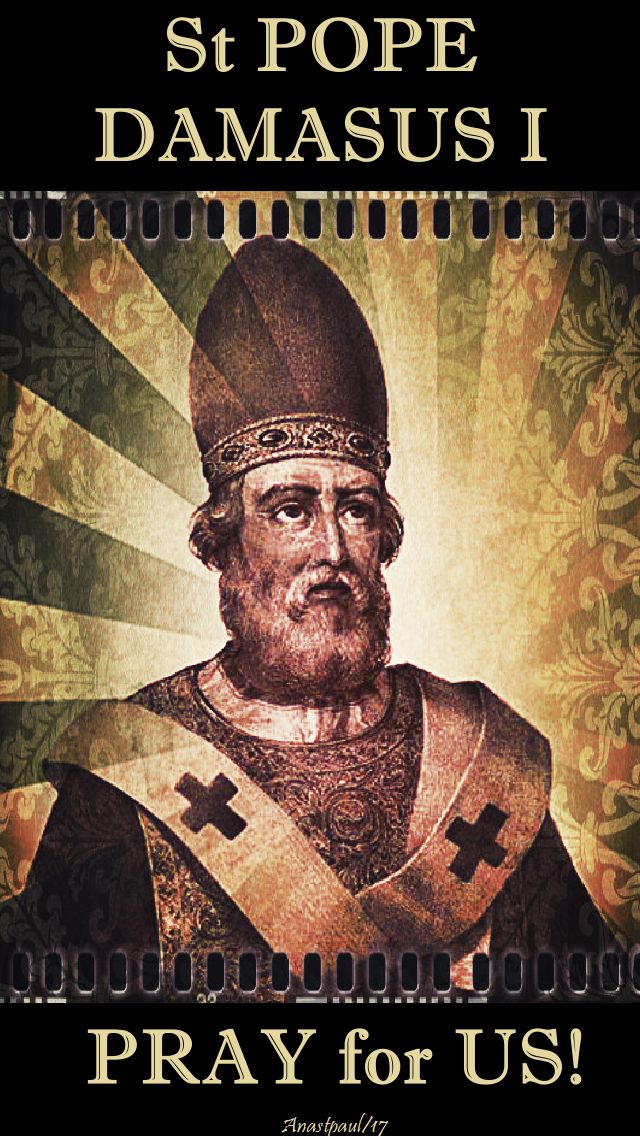
St Pope Damasus, Pray for the Church, Pray for us All!
Quote of the Day – 11 December – The Memorial of St Pope Damasus I (c 305-384)
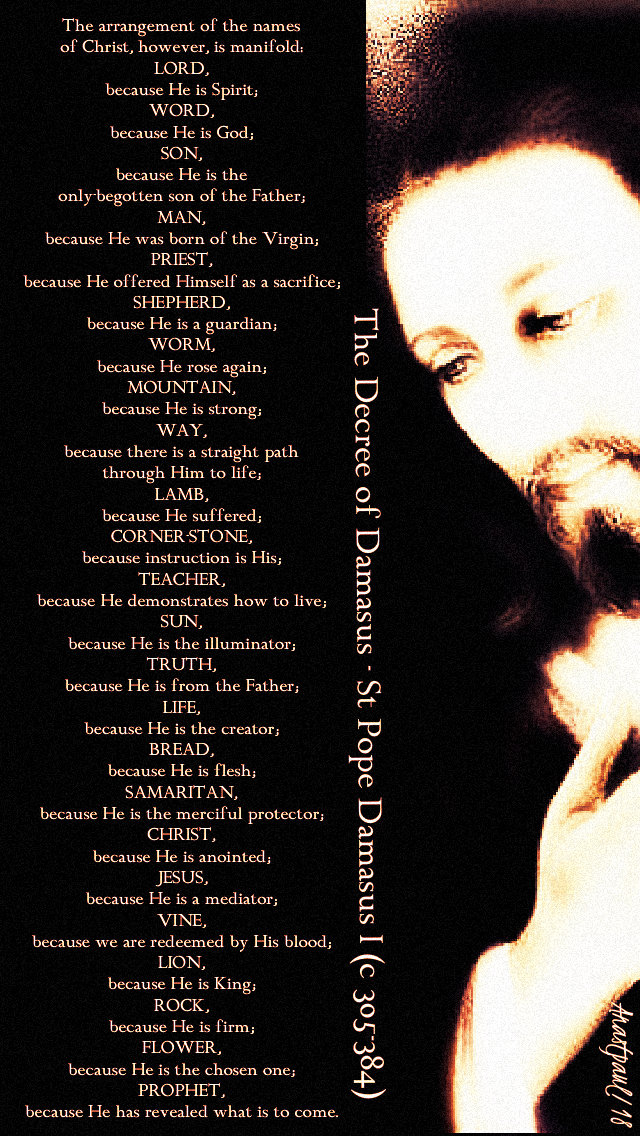
The arrangement of the names of Christ, however, is manifold: LORD, because He is Spirit; WORD, because He is God; SON, because He is the only-begotten son of the Father; MAN, because He was born of the Virgin; PRIEST, because He offered Himself as a sacrifice; SHEPHERD, because He is a guardian; WORM, because He rose again; MOUNTAIN, because He is strong; WAY, because there is a straight path through Him to life; LAMB, because He suffered; CORNER-STONE, because instruction is His; TEACHER, because He demonstrates how to live; SUN, because He is the illuminator; TRUTH, because He is from the Father; LIFE, because He is the creator; BREAD, because He is flesh; SAMARITAN, because He is the merciful protector; CHRIST, because He is anointed; JESUS, because He is a mediator; VINE, because we are redeemed by His blood; LION, because He is King; ROCK, because He is firm; FLOWER, because He is the chosen one; PROPHET, because He has revealed what is to come.
from the Decree of Damasus (attributed to St Pope Damasus I)
Thought for the Day – 11 December – The Memorial of St Pope Damasus I (c 305-384)
The history of the papacy and the Church is inextricably mixed with the personal biography of Damasus. In a troubled and pivotal period of Church history, he stands forth as a zealous defender of the faith who knew when to be progressive and when to entrench.
And it is to him that we owe our gratitude for the translation of the Scriptures, which influenced so mightily the next 1700 years and still do. Through St Jerome, he provided THE genuine treasure for the Church.
Damasus makes us aware of two qualities of good leadership: alertness to the promptings of the Spirit and service.His struggles are a reminder that Jesus never promised His Rock protection from hurricane winds nor His followers immunity from difficulties. His only guarantee is final victory. (Partially thanks to Fr Don Miller OFM)
One Minute Reflection – 11 December – The Memorial of St Pope Damasus I (c 305-384)
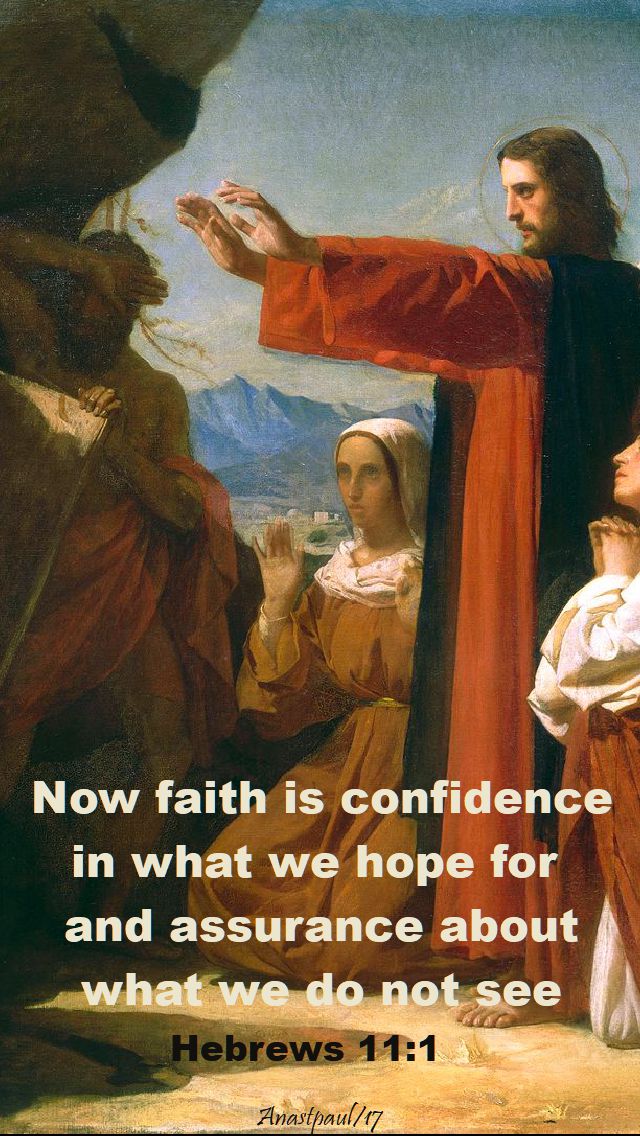
Now faith is confidence in what we hope for and assurance about what we do not see…Hebrews 11:1
REFLECTION – “He who walking on the sea could calm the bitter waves, who gives life to the dying seeds of the earth; He who was able to loose the mortal chains of death and after three days’ darkness could bring again to the upper world the brother for sister Martha: He, I believe, will make Damasus rise again from the dust.”……………St Pope Damasus I
PRAYER – Jesus, my Lord and my God, grant us the grace of faith to believe that all that You have said will be fulfilled. And fill us with Your Holy Spirit of love so that we may translate that belief into practice, by obeying Your commands every day. St Pope Damasus, you proved your love for Christ and His Church, please pray that we may always be faithful and filled with a like zeal for the Church and Bride of Christ, amen.
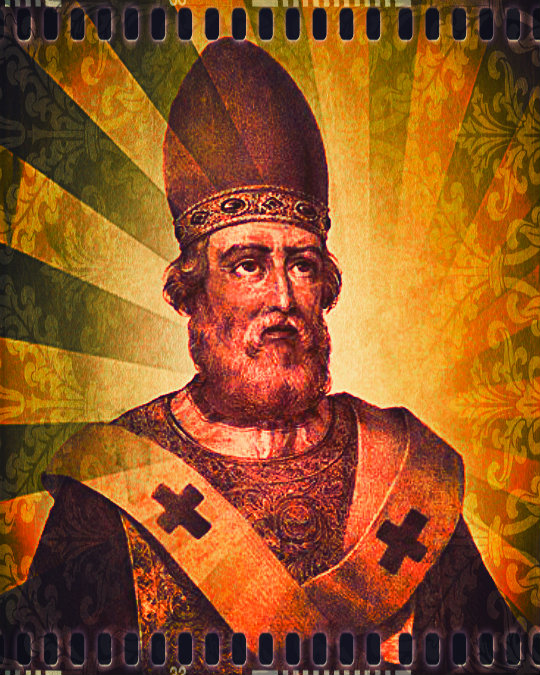
Saint of the Day – 11 December – St Pope Damasus I (c 305-384) Priest and Pope – ( c 305 in Rome, Italy – 11 December 384 in Rome, Italy of natural causes). Patronage – archeologists. He was buried in the Mark and Marcellianus catacombs in Rome and his bones re-buried in the church of San Lorenzo in Damaso.
The son of a Roman priest, possibly of Spanish extraction, Damasus started as a deacon in his father’s church and served as a priest in what later became the basilica of San Lorenzo in Rome. He served Pope Liberius (352-366) and followed him into exile.
When Liberius died, Damasus was elected bishop of Rome; but a minority elected and consecrated another deacon, Ursinus, as pope. The controversy between Damasus and the antipope resulted in violent battles in two basilicas, scandalising the bishops of Italy. At the synod that Damasus called on the occasion of his birthday, he asked them to approve his actions. The bishops’ reply was curt: “We assembled for a birthday, not to condemn a man unheard.” Supporters of the antipope even managed to get Damasus accused of a grave crime—probably sexual—as late as 378. He had to clear himself before both a civil court and a Church synod.
As pope, his lifestyle was simple in contrast to other ecclesiastics of Rome and he was fierce in his denunciation of Arianism and other heresies. A misunderstanding of the Trinitarian terminology used by Rome threatened amicable relations with the Eastern Church and Damasus was only moderately successful in dealing with that challenge.
He appointed St Jerome as his confidential secretary. Invited to Rome originally to a synod of 382 convened to end the schism of Antioch, Jerome made himself indispensable to the pope and took a prominent place in his councils. Jerome spent three years (382–385) in Rome in close intercourse with Pope Damasus and the leading Christians. Writing in 409, Jerome remarked, “A great many years ago when I was helping Damasus, bishop of Rome with his ecclesiastical correspondence, I was also helping to write his answers to the questions referred to him by the councils of the east and west…”
Sts Jerome and Damasus
In order to put an end to the marked divergences in the western texts of that period, Damasus encouraged the highly respected scholar Jerome to revise the available Old Latin versions of the Bible into a more accurate Latin on the basis of the Greek New Testament and the Septuagint, resulting in the Vulgate. Jerome devoted a very brief notice to Damasus in his De Viris Illustribus, written after Damasus’ death: “he had a fine talent for making verses and published many brief works in heroic metre. He died in the reign of the emperor Theodosius at the age of almost eighty”.
The letters from Jerome to Damasus are examples of the primacy of the See of Peter:
Yet, though your greatness terrifies me, your kindness attracts me. From the priest I demand the safe-keeping of the victim, from the shepherd the protection due to the sheep. Away with all that is overweening; let the state of Roman majesty withdraw. My words are spoken to the successor of the fisherman, to the disciple of the cross. As I follow no leader save Christ, so I communicate with none but your blessedness, that is with the chair of Peter. For this, I know, is the rock on which the church is built! This is the house where alone the paschal lamb can be rightly eaten. This is the ark of Noah and he who is not found in it shall perish when the flood prevails. But since by reason of my sins I have betaken myself to this desert which lies between Syria and the uncivilised waste, I cannot, owing to the great distance between us, always ask of your sanctity the holy thing of the Lord. Consequently I here follow the Egyptian confessors who share your faith and anchor my frail craft under the shadow of their great argosies. I know nothing of Vitalis; I reject Meletius; I have nothing to do with Paulinus. He that gathers not with you scatters; he that is not of Christ is of Antichrist!”
During his pontificate, Christianity was declared the official religion of the Roman state, and Latin became the principal liturgical language as part of the Pope’s reforms. His encouragement of Saint Jerome’s biblical studies led to the Vulgate, the Latin translation of Scripture which 12 centuries later the Council of Trent declared to be “authentic in public readings, disputations, preaching.”
Saint of the Day – 11 December – St Pope Damasus I – c305-384) Priest and Pope
Pope St. Damasus I was elected as the 37th Pope in October 366. He was opposed by Ursicinus, antipope and was accussed of adultery but exonerated by Emperor Gratian himself. By a Roman synod of 44 bishops, the accusers were excommunicated. Damasus defended the Church against multiple schisms. In two Roman synods (368 and 369) he condemned the heresies of Apollinarianism and Macedonianism.
Damasus had an extraordinary devotion to Christian martyrs and went to great legnths to maintain and restore Roman catacombs. He had a great devotion to St. Laurence and to honour the saint, Damasus built a church in his own house, now the Basilica of San Lorenzo in Damaso. Pope St. Damasus I built many of the great churches in Rome. One of his most notable achievements was his commission to St. Jerome to revise the Latin translation of Sacred Scripture on the basis of the original Greek and from this came the Latin Vulgate which became the official Bible of the Church.
Pope St. Damasus I died in 384 and was the last pope interred at the Cemetery of Callixtus. He is buried alongside his mother, Laurentia, and sister, Irene.
Video – Apostleship of Prayer – https://www.youtube.com/watch?v=KUCrMs1XyFA











 AnaStpaul
You must be logged in to post a comment.