
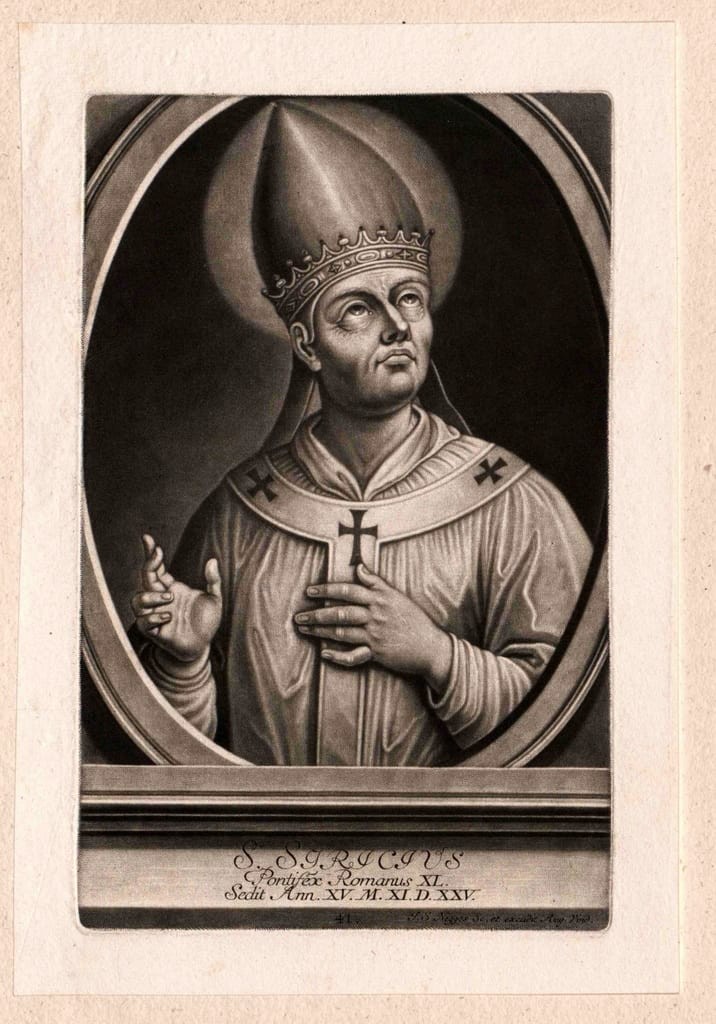
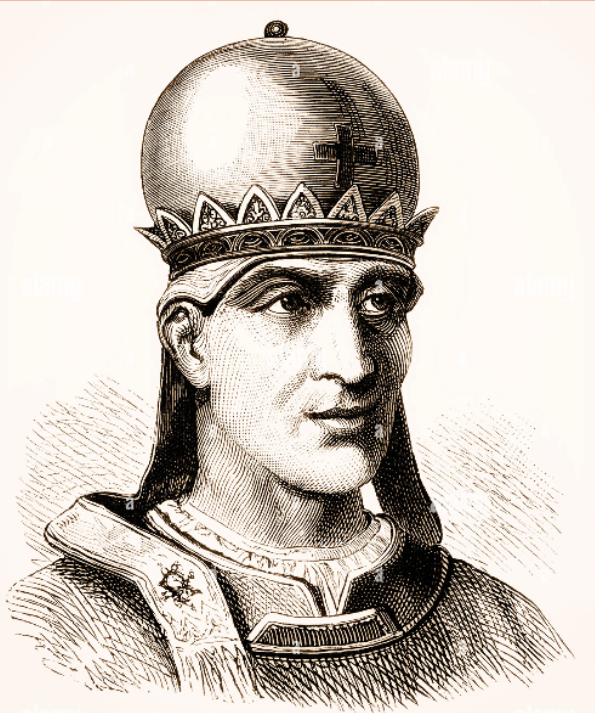
Saint of the Day – 26 November – St Pope Siricius (c334-399) the 38th Bishop of Rome from December 384 until his death on 26 November 399, Confessor, Defender of the Faith against heresies, Reformer of clerical discipline, Born in Rome and died there of natural causes aged around 64. In response to inquiries from Bishop Himerius of Tarragona, Siricius issued the Directa Decretal, containing Decrees of Baptism, Church discipline and other matters. His are the oldest completely preserved Papal Decrees. He is sometimes said to have been the first Bishop of Rome to call himself “Pope or Papa” – the word derived from the Greek, Papa, meaning Father.
The Roman Martyrology reads today: “At Rome, St Siricius, Pope and Confessor, celebrated for his learning, piety and zeal for religion, who condemned various heretics and published salutary laws concerning Ecclesiastical discipline.”
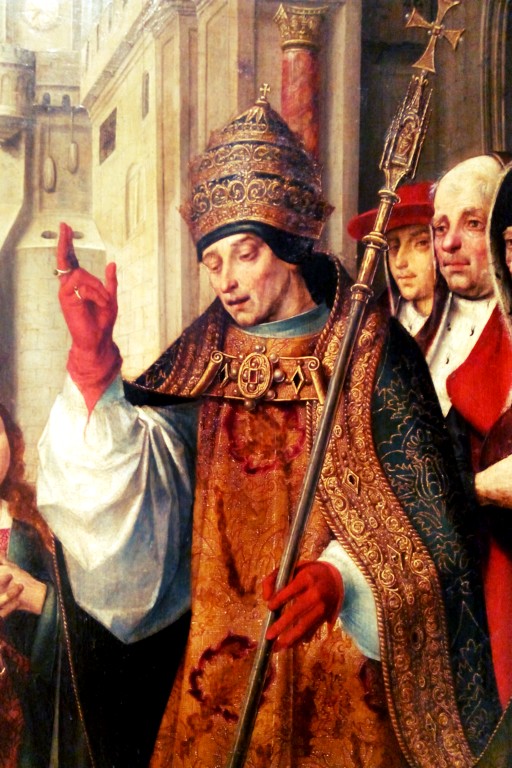
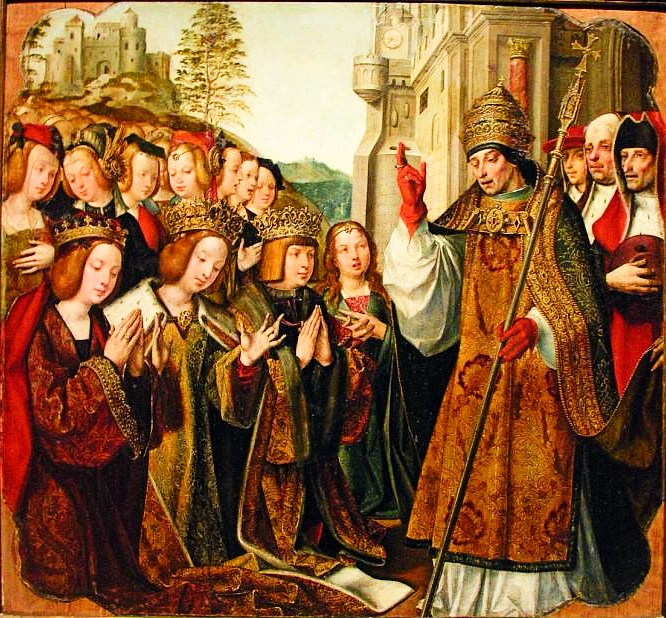
Saint Siricius was, a Roman and the son of Tiburtius. He entered the service of the Roman Church as a young man, most during the Pontificate of Liberius , first as Lector and later as Deacon. He was also a Deacon under Pope Damasus.
Although the antipope. Ursinus again stood as a candidate, in December 384 (the 15th?) Siricius was unanimously elected as Damasus’ successor. The election was confirmed with apparent satisfaction by the Emperor Valentinian II (375-392) in an edict of 25 February 385, probably mostly to cut off any intrigues in the Ursinian camp.
The Emperor gave further evidence of his approval by providing funds for the restoration and expansion to approximately its present size, of St Paul’s Basilica . The Pope Consecrated it in 390. A modern column outside the northern colonnade commemorates his Consecration of the Basilica.
The Church Father and Doctor, St Jerome or Hieronymus, had a justified hope of becoming Pope Damasus’ successor himself but he was banished from Rome, in an action Siricius must have, at least consented to. The disappointed Jerome describes the Pope as a simple man, gullible and easily deceived, while St Paulinus of Nola complained about his haughty unapproachability. In reality, he was an experienced and powerful Pope and, although he was as conscious as Damasus of the primacy of Rome and his own role as Peter ‘s successor, he was inevitably overshadowed by the contemporary St Ambrose, Bishop of Milan (340-397).
Siricius was probably not the first Pope to issue decretal speeches but his are the oldest preserved. A decretal speech is a directive or an authoritative decision on disciplinary matters. They were no longer in a tone of fraternal exhortation but held in the same authoritative style of imperial edicts and like them, had the same legal force as laws. The oldest preserved decretal speeches are from 11 February 385 and addressed to Himerius, Bishop of Tarragona in Spain, who had brought fifteen questions aconcerning Ecclesiastical discipline to Damasus I. They open with the demand that the Pope, or rather the Apostle Peter present in the papacy, bears the heavy burden of giving categorical rules in matters of Ecclesiastical discipline and Liturgical ordinances.
Siricius confirmed that Arians who were re-admitted to the Catholic Church were not to be re-Bbaptised and that Baptism could only be performed, in exceptional cases, at times other than Easter and Pentecost which had, nevertheless, previously been an old custom. Furthermore, he gave rules for age and qualifications before Ordination, insisted on Clerical abstinence and celibacy and gave rules for the discipline of penance. Siricius demanded that these general Decrees (decretalia generalia) which should be as binding as decisions (cwith a series of Canons) from Synods, should be communicated to the neighbouring Provinces in Africa, Spain and Gaul.
On 6 January 386, a Synod was held in Rome “at the Relics of the Apostle Peter” attended by 80 Bishops. A number of disciplinary decisions were made and the Pope sent nine Canons which were adopted at the Synod, to Africa and other Churches. They decided, inter alia that no Bishop should be Consecrated without “the knowledge of the Apostolic See” or by just a single Consecrator. Similarly, Siricius responded to requests from the Bishops of Gaul, with a series of Canons .
We believe that Siricius was the first Pope to reserve the exclusive right to use the title Pope/Papa. The word can also be seen as an anagram made from the initials of the words Petri Apostoli Potestatem Accipens (“He who has received power from the Apostle Peter”).
Siricius was no opponent of asceticism, as is sometimes misleadingly claimed. But around 388 the Monk Jovinian, who had had a great reputation for his strict life, came to Rome. Now, he began to assert that, after all, an austere life was a waste and that vows, chastity, fasting and good works, were of little use. In addition, he claimed that the Virgin Mary had lost her virginity when she gave birth to the Saviour. As a consequence of this vision, Jovinian, himself gave up his ascetic life and began to persuade many mMnks and Nuns to give up asceticism and get married. Shocked lay people asked the Pope to intervene. Siricius then held a Synod which condemned Jovinian’s theories and excommunicated him and his leading followers. The Pope sent three Priests to Milan to tell Saint Ambrose about the Synod. Ambrose himself held a Synod praising the Pope for his care and repeating the condemnation of Jovinian.
Later, the Pope condemned the view of Bonosus, bishop of Naissus that the Blessed Virgin had given birth to Joseph’s child after the birth of the Lord, leaving it to the bishop of Illyria, to judge the man himself.
The Pope also received a delegation from the East asking him to put an end to the long-standing schism over the Episcopate of Antioch. For years, two Bishops and their successors had been quarreling over the Episcopate. Siricius granted their plea to recognise the last survivor, Flavian, as a true Bishop and readmitted him to communion. On the Pope’s advice, a Council at Caesarea in Palestine,recognised that Flavian and not Evagrius, was the rightful Bishop.
In the mid-390s, Siricius incurred the wrath of St Jerome. St Jerome, who had now settled in Bethlehem and his friends in Rome, were enraged by the Pope’s positive attitude towards Bishop John of Jerusalem (died 417) and, towards Rufinus of Aquileia (died 410), both of whom, were at this time in St Jerome’s deepest displeasure.
During Siricius’ Pontificate, the great St Augustine became the Bishop of Hippo and wrote his Confessions.
The Eastern Emperor Theodosius I, who was very religious, came under the strong influence of St Ambrose. In 384 he issued a ban on pagan feasts and in 391 pagan sacrifices were banned. Violation of the ban was declared crimen maiestatis, treason. It led to a pagan revolt led by Rome. But Theodosius crushed the rebel army in a battle at Aquileia in 384, after which all the temples of Rome were closed and all the Senators forcibly Baptised. Christianity had finally and definitively, become the state religion. For Christianity, 392 is a special year. Then Emperor Theodosius announced that he would tolerate only one religion in his vast Empire. Both Christian heresy and pagan worship were banned.
Siricius died on 26 November 399 and was buried in the Basilica of Silvester near the Catacomb of Priscilla.
Although he was venerated as a Saint in the earliest Centuries, he was not included in the first edition (1584) of the Roman Martyrology, due to the criticism of Jerome and Paulinus of Nola. His name was added in 1748 by Pope Benedict XIV, who wrote a treatise to prove his holiness.

 AnaStpaul
You must be logged in to post a comment.