St Alcmund of Hexham Bl Alexander of Milan St Augustalus St Balin St Carissima of Albi St Chiaffredo of Saluzzo Bl Claude-Barnabé Laurent de Mascloux St Desiderio of Benevento St Dinooth Bl Eugenia Picco St Eupsychius of Caesarea St Eustace of Beauvais St Evortius of Orleans (Died c340) Bishop St Faciolus St Festo of Benevento Bl François d’Oudinot de la Boissière St Giovanni of Lodi St Goscelinus of Toul St Gratus of Aosta St Grimonia of Picardy St Hiduard Bl John Duckett Bl John Maki Bl John of Nicomedia Bl Ludovicus Maki Soetsu Madalberta Bl Maria of Bourbon Blessed Marko Križevcanin (c1588-1619) Priest Martyr St Melichar Grodecký St Memorius of Troyes St Pamphilus of Capua Bl Ralph Corby
Martyrs of Noli: Four Saints: Christians who became soldiers and were martyred together for their faith. A late legend makes them member of the Theban Legend who escaped their mass martyrdom but that’s doubtful – Paragorius, Partenopeus, Parteus and Severinus. They were born in Noli, Italy and martyred in Corsica, France. Attribute – soldiers with a banner of NoliM
Vigil of the Nativity of the Nativity of the Blessed Virgin Mary, instituted by Pope Gregory II (722):
The day destined for the parturition of Saint Anne and for the birth of her, who was consecrated and sanctified to be the Mother of God, had arrived – a day most fortunate for the world. This birth happened on the eighth day of September, fully nine months having elapsed since the Conception of the soul of our most holy Queen and Lady.
Saint Anne was prepared by an interior voice of the Lord, informing Her, that the hour of her parturition had come. Full of the joy of the Holy Spirit at this information, she prostrated herself before the Lord and besought the assistance of his grace and his protection for a happy deliverance.
Presently she felt a movement in her womb similar to that which is proper to creatures being born to the light. The most blessed child Mary was at the same time, by divine providence and power, ravished into a most high ecstasy. Hence Mary was born into the world without perceiving it by her senses, for their operations and faculties were held in suspense. As She had the use of her reason, she would have perceived it by her senses, if they would have been left to operate in their natural manner at that time. However, the Almighty disposed otherwise, in order that the Princess of heaven might be spared the sensible experience, otherwise connected with birth. she was born pure and stainless, beautiful and full of grace, thereby demonstrating, that she was free from the law and the tribute of sin. Although she was born substantially like other daughters of Adam, yet her birth was accompanied by such circumstances and conditions of grace, that it was the most wonderful and miraculous birth in all creation and will eternally redound to the praise of her Maker.
At twelve o-clock in the night this divine child issued forth, dividing the night of the ancient Law and its pristine darknesses from the new day of grace, which now was about to break into dawn. She was clothed, handled and dressed like other infants, through she excelled all mortals and even all the angels in wisdom. Her mother did not allow her to be touched by other hands than her own but she, herself, wrapped her in swaddling clothes: and in this Saint Anne was not hindered by her present state of incapacity, for she was free from the toils and labours, which mothers endure in such circumstances.
So then Saint Anne received in her arms she, who was her Daughter but at the same time, the most exquisite treasure of all the universe, inferior only to God and superior to all other creatures. (The City of God, by Venerable Mary of Jesus of Agreda OIC (1602-1665) [Her body is incorrupt].
St Alcmund of Hexham Bl Alexander of Milan St Augustalus St Balin St Carissima of Albi St Chiaffredo of Saluzzo Bl Claude-Barnabé Laurent de Mascloux
St Desiderio of Benevento St Dinooth Bl Eugenia Picco St Eupsychius of Caesarea St Eustace of Beauvais St Evortius of Orleans St Faciolus St Festo of Benevento Bl François d’Oudinot de la Boissière
St Giovanni of Lodi St Goscelinus of Toul St Gratus of Aosta St Grimonia of Picardy St Hiduard Bl Ignatius Klopotowski Bl John Duckett Bl John Maki Bl John of Nicomedia Bl Ludovicus Maki Soetsu Madalberta Bl Maria of Bourbon St Marko Križevcanin St Melichar Grodecký St Memorius of Troyes St Pamphilus of Capua Bl Ralph Corby
St Sozonte Blessed Thomas Tsuji SJ (1570-1627) Priest of the Society of Jesus, Martyr.
St Tilbert of Hexham — Martyrs of Noli: Four Christians who became soldiers and were martyred together for their faith. A late legend makes them member of the Theban Legend who escaped their mass martyrdom but that’s doubtful – Paragorius, Partenopeus, Parteus and Severinus. They were born in Noli, Italy and martyred in Corsica, France. Attribute – soldiers with a banner of Noli.
Martyred in the Spanish Civil War: • Blessed Antoni Bonet Sero • Blessed Ascensión Lloret Marcos • Blessed Gregorio Sánchez Sancho • Blessed Félix Gómez-Pinto Piñero
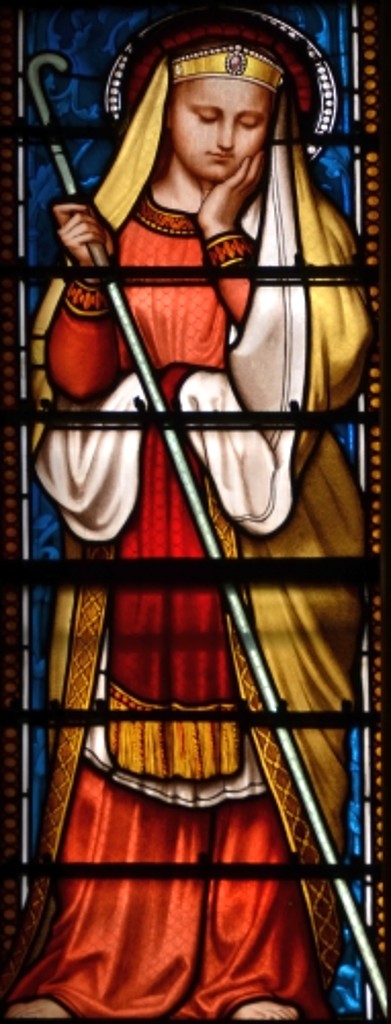
Saint of the Day – 7 September – Saint Regina (3rd Century) Virgin Martyr – also known as Sainte Reine (in French). Patronages – poor people, shepherdesses, torture victims.
Saint Regina was the daughter of a pagan aristocrat named Clement, in Alise, Burgundy. When her mother died in childbirt,. Regina’s father placed her upbringing, in the care of a Christian nurse attached to the family, who, secretly baptised her. Regina was driven from her family’s home because of her faith and lived as a poor, prayerful shepherdess, together with her governess. She worked in the fields by day, tending sheep, to help support the household. In the fields, Regina grew closer to the Lord, meditating and contemplating His love and mercy and praying to better emulate the lives of the holy saints and martyrs.
At the age of fifteen, Regina caught the eye of the prefect of Gaul, Olybrius, a man of great importance . He became obsessed with the young woman and was determined to take her as his bride. He delighted in her noble upbringing but was deeply disturbed to find that she was practising the Christian faith. At that time, Christians were being violently persecuted and killed, under the direction of the Emperor Decius. Olybrius attempted to persuade her to deny her faith, so as to not only save her from persecution but to secure her as a wife. She declined, refusing to recant her faith and professing it all the louder. In retaliation, Olybrius had her imprisoned.
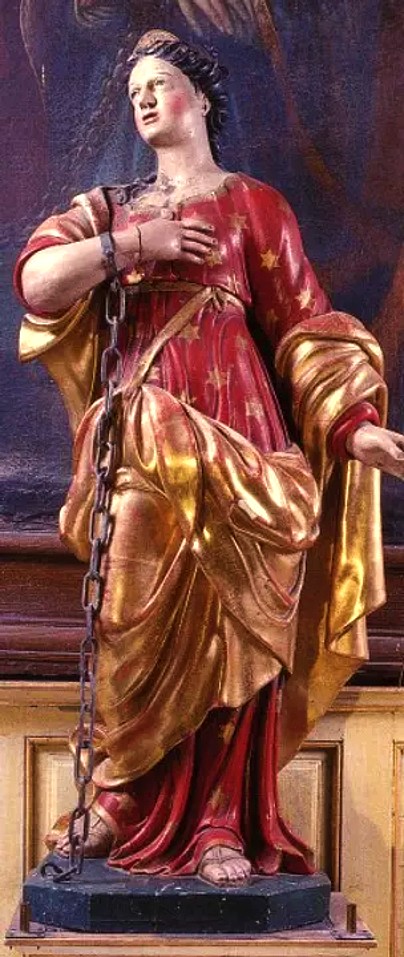
Regina was chained to the walls of a dark prison cell by means of an iron belt that was bolted to the wall. There she was left while Olybrius participated in several military campaigns against invading barbarians, returning to his daily activities. After an absence of some time, he returned, hoping she may have changed her mind. On the contrary, her imprisonment had served to strengthen her resolve to live like the saints and martyrs and maintain her chastity for the Lord. She refused to sacrifice to idols and he angrily ordered her tortured. Regina courageously withstood whippings and scourging over the back of a wooden horse, raking with iron combs, burning with hot pincers and torches, and crucifixion. None of these could cause her to doubt the Lord or recant her faith and as she continued to praise God. Lastly, she was beheaded, ending her life and her conversion of many witnesses present who observed a solitary dove hovering atop her head during her torture.
The relics of Saint Regina are enshrined in Flavigni Abbey, having been translated there in c 864. Since that time, numerous miracles have been attributed to their presence and frequent pilgrimages are made by the faithful to venerate them.
Given the accounts of her Martyrdom, in art, Saint Regina is portrayed as a maiden bound to a cross with torches applied to her sides, imprisoned with a dove appearing on a shining cross, scourged with rods, or in a boiling cauldron. She is greatly venerated at Autunand Dijon, France and in southern Germany.
Honoured in many Martyrologies, Regina’s feast is celebrated today, or in the Archdiocese of Paderborn on 20 June. In the past, a procession was held in her honour in the town of Dijon. The history of the translation of Regina was the subject of a 9th-century account.
There are many places in France named Sainte-Reine after her.
St Alcmund of Hexham Bl Alexander of Milan St Augustalus St Balin St Carissima of Albi St Chiaffredo of Saluzzo Bl Claude-Barnabé Laurent de Mascloux St Cloud (522-c 560) Biography: https://anastpaul.com/2017/09/07/saint-of-the-day-7-september-st-cloud/ St Desiderio of Benevento St Dinooth Bl Eugenia Picco St Eupsychius of Caesarea St Eustace of Beauvais St Evortius of Orleans St Faciolus St Festo of Benevento Bl François d’Oudinot de la Boissière Blessed Giovanni Battista Mazzucconi (1826-1855) Martyr His Life and Death: https://anastpaul.com/2019/09/07/saint-of-the-day-7-september-blessed-giovanni-battista-mazzucconi-1826-1855-martyr/ St Giovanni of Lodi St Goscelinus of Toul St Gratus of Aosta St Grimonia of Picardy St Hiduard Bl Ignatius Klopotowski Bl John Duckett Bl John Maki Bl John of Nicomedia Bl Ludovicus Maki Soetsu Madalberta Bl Maria of Bourbon St Marko Križevcanin St Melichar Grodecký St Memorius of Troyes St Pamphilus of Capua Bl Ralph Corby St Regina (3rd Century) Virgin Martyr St Sozonte Bl Thomas Tsuji St Tilbert of Hexham — Martyrs of Noli: Four Christians who became soldiers and were martyred together for their faith. A late legend makes them member of the Theban Legend who escaped their mass martyrdom but that’s doubtful – Paragorius, Partenopeus, Parteus and Severinus. They were born in Noli, Italy and martyred in Corsica, France. Attribute – soldiers with a banner of Noli.
Martyred in the Spanish Civil War: • Blessed Antoni Bonet Sero • Blessed Ascensión Lloret Marcos • Blessed Gregorio Sánchez Sancho • Blessed Félix Gómez-Pinto Piñero





 AnaStpaul
You must be logged in to post a comment.