
Sunday Reflection – 21 January 2018 – 3rd Sunday in Ordinary Time Year B
Fr Raneiro Cantalamessa OFM “This is My Body”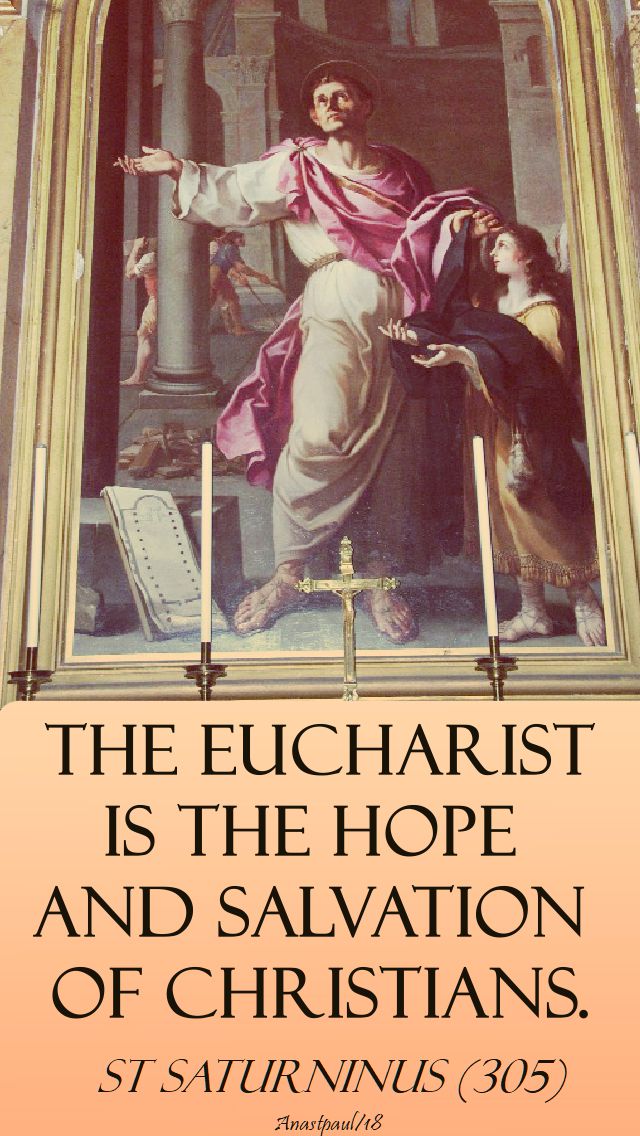
“What the Sunday celebrations of the Eucharist represented for Christians at the time of the persecutions is shown in a moving way in the acts of the North African Martyrs, Saturninus and companions, who died under the Diocletian persecution in 305.*
They were the first martyrs of the Eucharist. Their words and example might constitute a strong call and the starting point for an examination of conscience for us modern Christians.
To the Roman judge who accused them of having transgressed the emperor’s order not to hold meetings and hand out the Scriptures, the martyrs responded one after the other:
” A Christian cannot live without the Eucharist and the Eucharist without the Christians. Don’t you know that the Christian exists for the Eucharist and the Eucharist for the Christian?”
“Yes, I participated with the brothers in the meeting, I celebrated the mysteries of the Lord and I have with me, written in my heart, the divine Scriptures… The Eucharist is the hope and salvation of Christians.”**
* Acta ss. Saturnini et sociorum martyrum (ca.304), 9, 11 (ed PT Ruinart, Acta martyrum 1959). A phrase of these acts: “Sine dominico non possumus” is sometimes translated: ‘We cannot live without Sunday.’ A suggestive translation but unfortunately inexact. The neuter noun dominicum indicates the ‘celebration of the Lord’s Mysteries’, ‘the Lord’s Banquet’, namely ‘the Lord’s Supper’ of 1 Cor 11:20.
The term recurs with such meaning in the African writers of the time – Tertullian, Ad Uxorem, 2,4; Cyprian, De opere et eleemosynis, 15.
The accent is therefore on the Eucharist, not on Sunday, the latter is included indirectly, inasmuch as the Lord’s Supper, was celebrated as a rule and for a certain period exclusively, on Sunday. The complete meaning of dominicum is, therefore, that of “Sunday celebration of the Lord’s supper.”
** Acta, 10-13.
 AnaStpaul
You must be logged in to post a comment.