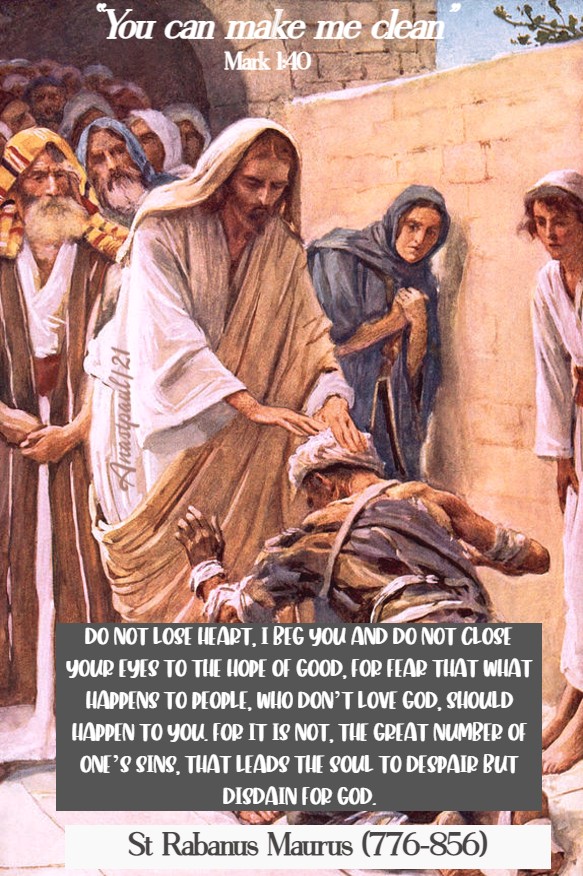
REFLECTION – “You must never fail to trust in God, nor despair of His mercy. I should not like you to doubt, or despair of becoming better. For even if the devil were able to throw you down, from the heights of virtue, to the depths of wickedness, how much more, can God recall you to the summit of goodness. And, not just bring you back to the state you were in before your fall but He can make you much happier, than you seemed to be before. Do not lose heart, I beg you and do not close your eyes to the hope of good, for fear that what happens to people, who don’t love God, should happen to you. For it is not, the great number of one’s sins, that leads the soul to despair but disdain for God. As the Wise man says: “It is the characteristic of the impious to despair of salvation and hold it in contempt since they have fallen into the pit of sin” (cf. Prv 18,3 Vg).
Therefore, every thought that takes our hope away, follows on from a lack of faith, like a heavy stone around our neck, it forces us to be always looking downwards, to the earth and doesn’t allow us to raise our eyes to the Lord. But those with a brave heart and enlightened mind, know how to release their necks from this horrid weight. “Behold, as the eyes of servants are on the hand of their masters, as the eyes of a maid are on the hands of her mistress, so our eyes are on the Lord our God till he have pity on us” (Ps 123,2). – St Rabanus Maurus OSB (776-856) Archbishop, Monk, Abbot,Theologian, Poet – Three books dedicated to Bonosus, Bk 3, 4
PRAYER – To those who love You, Lord, You promise to come with Your Son and make Your home within them. If You will, You can make us clean, come then with Your purifying grace and make our hearts a place where You can dwell. May the prayers of intercession of Saints Cyril and Methodius, help us to reach our everlasting home with You. Through Christ our Lord, with the Holy Spirit, God now and forever, amen.
St Abraham of Harran
St Antoninus of Sorrento
St Auxentius of Bithynia
St Conran of Orkney
St Eleuchadius
St Juan García López-Rico O.SS.T. (1561-1613)
St Nostrianus of Naples
St Theodosius of Vaison
St Valentine of Terni
Bl Vicente Vilar David
St Vitale of Spoleto
—
20 Mercedarians of Palermo
Martyrs of Alexandria – 16 saints
Martyrs of Rome
Felicula
Vitalis
Zeno
Martyrs of Terni: Three Christians who gave proper burial to Saint Valentine of Terni. Martyred in the persecutions of Aurelius.
273 in Terni, Italy – Apollonius, Ephebus, Proculus.
Martyrs of Alexandria: A group of Christians murdered in various ways for their faith in Alexandria, Egypt. We know the names and a few details about 16 of them – Agatho, Agatone, Ammonio, Ammonius, Antonius, Bassiano, Bassianus, Cirione, Cyrio, Dionysius, Dionysius, Lucio, Moses, Moses, Proto and Tonione.
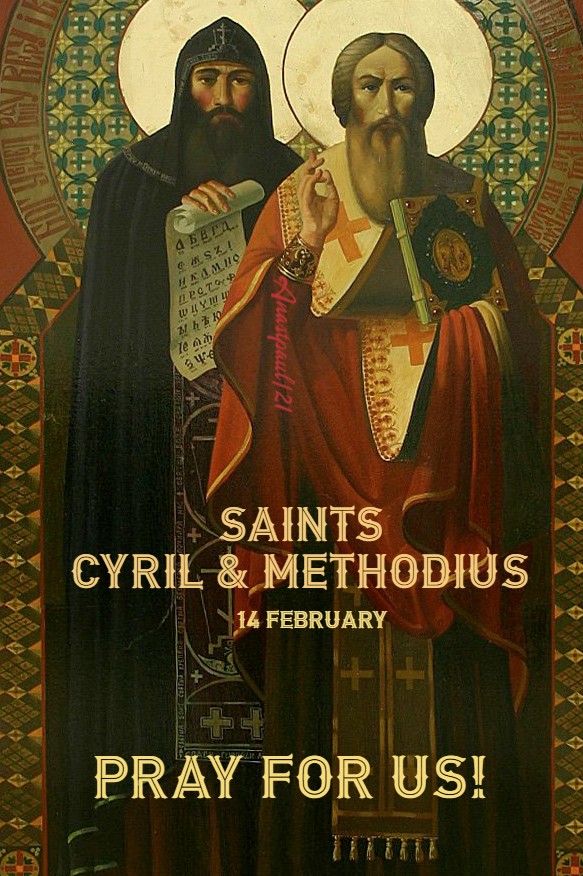
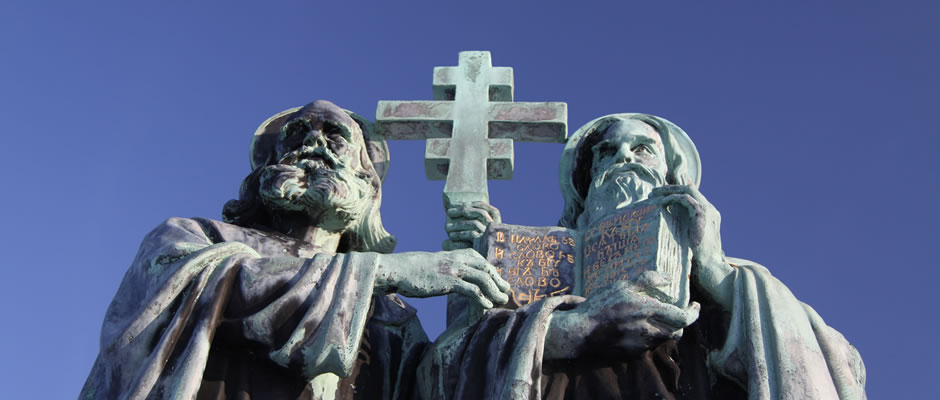
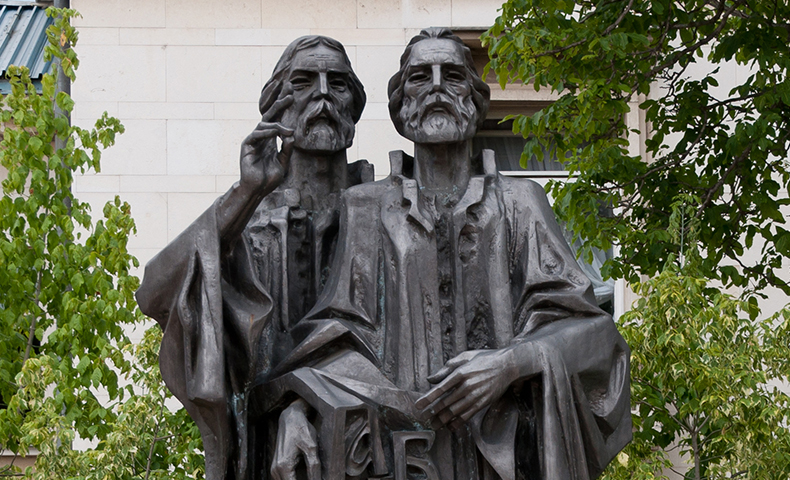
Saints of the Day – 14 February – Sts Cyril (827-869) & Methodius (826-885) Bishops, Confessors, Theologians, Missionaries, Writers, Preachers, Patrons of Europe, Apostles to the Slavs. Sts Cyril & Methodius were two brothers who were Byzantine Christian theologians and Christian missionaries. Through their work they influenced the cultural development of all Slavs, for which they received the title “Apostles to the Slavs”. They are credited with devising the Glagolitic alphabet, the first alphabet used to transcribe Old Church Slavonic. After their deaths, their pupils continued their missionary work among other Slavs. In 1880, Pope Leo XIII introduced their feast into the calendar of the Roman Catholic Church. In 1980, St Pope John Paul II declared them co-patron saints of Europe, together with Benedict of Nursia.
St Cyril’s Patronages – against storms, ecumenism, Slavic peoples (given in 1863 by Pope Pius IX), unity of the Eastern and Western Churches, Bohemia, Bosnia, Bosnia-Herzegovina, Bulgaria, Carinthia, Austria, Carniola, Circassia, Croatia, Czech Republic, Czechoslovakia, Dacia, Dalmatia, Europe (given in 1980 by St Pope John Paul II), Khazaria, Krain, Krajna, Kranjska, Moravia, Pannonia, Russia, Silesia, Slovenia, Yugoslavia, Ljubljana, Slovenia, archdiocese of, Maribor, Slovenia, archdiocese of, Saints Cyril and Methodius of Toronto, Ontario, diocese of. St Methodius’s Patronages – against storms, ecumenism, Slavic peoples (given in 1863 by Pope Pius IX), unity of the Eastern and Western Churches, Bohemia, Bosnia, Bosnia-Herzegovina, Bulgaria, Carinthia, Austria, Carniola, Circassia, Croatia, Czech Republic, Czechoslovakia, Dacia, Dalmatia, Europe (given in 1980 by St Pope John Paul II), Khazaria, Krain, Krajna, Kranjska, Moravia, Pannonia, Russia, Silesia, Slovenia, Yugoslavia, Ljubljana, Slovenia, archdiocese of, Maribor, Slovenia, archdiocese of, Saints Cyril and Methodius of Toronto, Ontario, diocese of.
Methodius and Cyril (born Constantine) were born into a prominent Christian family in Thessalonica. As the area in which they were raised was a popular spot for Slavic people to settle in, traditions tells us that the holy brothers grew up familiar with the Slavic language (Slavonic). While we know their father was a prominent officer in the army, little is known of their young lives. History has recorded that Methodius, the elder brother, rose to the position of an important civil authority, who likely dealt in law and trade. His brother, Cyril, was trained as a scholar, professor and philosopher who gained renown in Constantinople.
After some years in public service, Methodius grew tired of worldly affairs and retired, seeking out solace and contemplation in a monastery. Eventually, Cyril joined him there, refusing a district to govern, preferring quiet devotion to the Lord. Together they lived in peace until the Byzantine emperor, having received a request for missionaries by the Moravian prince Rastislav, sent the brothers as missionaries to modern-day Ukraine. Being familiar with the language and well-acquainted with administration and politics, they were the perfect choice for such a mission. And given Rastislav’s desire for independence from Germany, Eastern missionaries (such as Methodius and Cyril) could help him gain independence over Church affairs.
Cyril and Methodius firmly believed that the Liturgy should be celebrated in the native language of the people, for greater inclusion in the Mass—a tradition which continues today. At that time, many were committed to only celebrating Mass in Greek or Latin, but these holy brothers dedicated themselves to proving otherwise. Prior to their departure for Moravia, they created a script for Slavonic (which had not previously existed). Known as Glagolithic, this written script is considered the precursor to Cyrillic (named after Saint Cyril). The creation of this script would allow the translation of Scripture and Liturgy into the language of the people.
Upon their arrival, Cyril immediately began translating the Liturgy into Slavonic. This created anxiety in the German priests, who saw the use of language as the next step to Slavic independence, and they actively worked against the translation. As neither Cyril nor Methodius was ordained a bishop, they travelled to Rome with their candidates for the priesthood to see the pope. After an audience, the pope approved the use of the Slavonic language in services, ordaining the local priests and securing the presence of Catholicism in the region.
Sadly, Constantine never returned to Moravia. He entered the monastery, taking the name Cyril and not long after died. Methodius was stricken with grief and wished for nothing more than live the remainder of his days in the monastery but honoured a promise made to his brother and returned to finish their missionary work. Due to the political upheaval in Moravia, he was forbidden to return there. However, upon his ordination as bishop, he was invited to modern-day Serbia and Croatia, where he assumed the bishopric of Sirmium. There he continued to say Mass and administer baptisms in the native, Slavonic tongue.
Again, falling victim to the anxiety of the German priests and bishops, Saint Methodius was imprisoned and only released following Moravian independence from German and intervention from the pope. Again, Methodius traveled to Rome, meeting with the Pope, and explaining how important it was to celebrate the Liturgy in the tongue people understood. Instead of condemning him, as the German bishops had hoped, the pope gave him permission to use Slavonic in the Mass, in Scripture reading and in the office. He also made him head of the hierarchy in Moravia.
Memorial Plaque to Sts Cyril & Methodius in Skopje
Saint Methodius, despite constant criticism and backlash, never stopped translating. It is said that he had translated the Bible and the works of the Church Fathers into Slavonic before his death.




 AnaStpaul
You must be logged in to post a comment.