Quote/s of the Day – 24 May – “The Month of the Blessed Virgin Mary” and the Feast of Our Lady, Help of Christians/Auxilium Christianorum and the Feast Day of Saint Vincent of Lérins (Died c445) Confessor
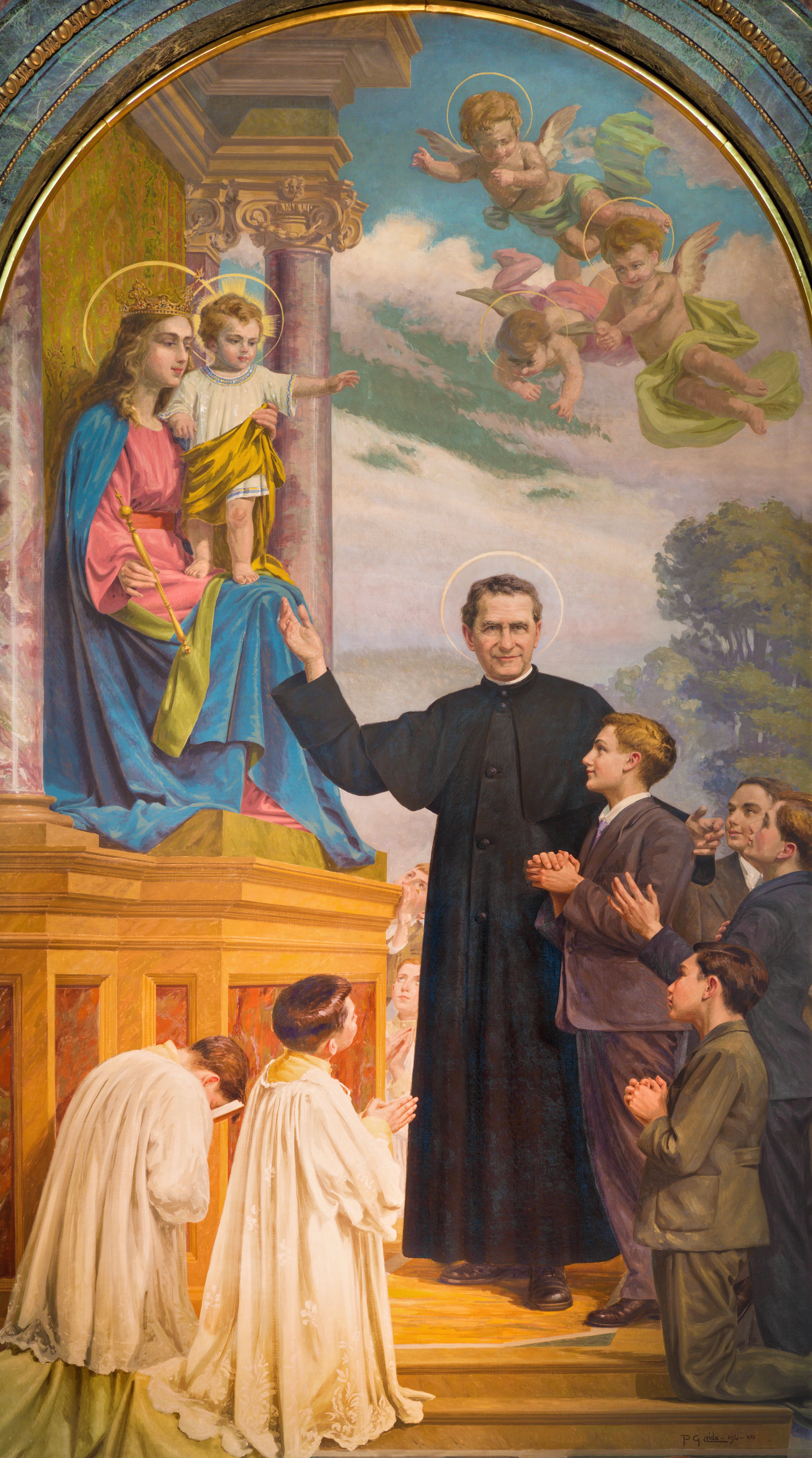
Most Holy Virgin Mary, Help of Christians By St John Bosco (1815-1888)
Most Holy Virgin Mary, Help of Christians, how sweet it is to come to thy feet imploring thy perpetual help. If earthly mothers cease not to remember their children, how can thou, the most loving of all mothers, forget me? Grant then to me, I implore thee thy perpetual help in all my necessities, in every sorrow and especially in all my temptations. I ask for thy unceasing help for all who are now suffering. Help the weak, cure the sick, convert sinners. Grant through thy intercession, many vocations to the religious life. Obtain for us, O Mary, Help of Christians, that having invoked thee on earth we may love and eternally thank thee in Heaven. Amen
Quote/s of the Day –7 April – “The Month of the Resurrection and the Blessed Sacrament” – Low Sunday, The Octave Day of Easter – 1 John 5:4-10, John 20. 19-31 – Scripture search here: https://www.drbo.org/
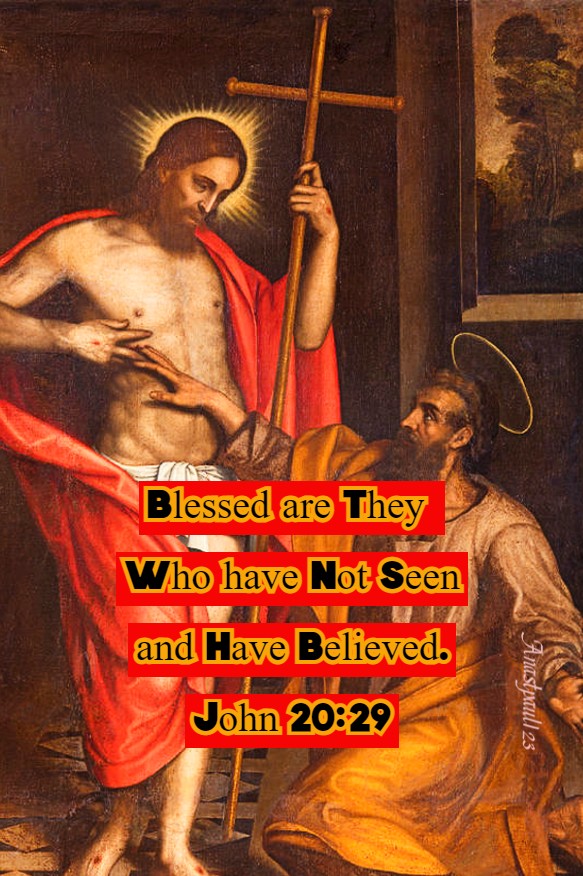
“ Blessed are they who have not seen and have believed.”
John 20:29
“He asks for our faith and offers us salvation. What He offers us, is so precious that what He asks of us, is as nothing!”
St Augustine (354-430) Father & Doctor of Grace
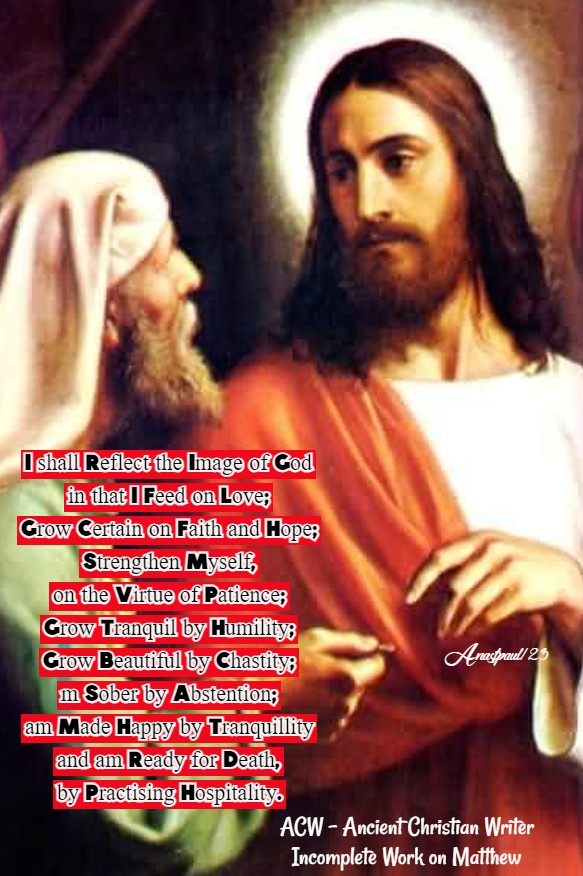
“I shall reflect the image of God in that I feed on love; grow certain on faith and hope; strengthen myself, on the virtue of patience; grow tranquil by humility; grow beautiful by chastity; am sober by abstention; am made happy by tranquillity and am ready for death, by practising hospitality.”
ACW – Ancient Christian Writer Incomplete Work on Matthew (Homily 40)
“True piety admits no other rule than that, whatsoever things have been faithfully received from our fathers, the same are to be faithfully consigned to our children and that, it is our duty, not to lead religion whither we would but rather, to follow religion whither it leads and that, it is the part of Christian modesty and gravity, not to hand down our own beliefs or observances to those who come after us but, to preserve and keep what we have received, from those who went before us.”
St Vincent of Lérins (Died c445) Author of the ‘Commonitorium.’
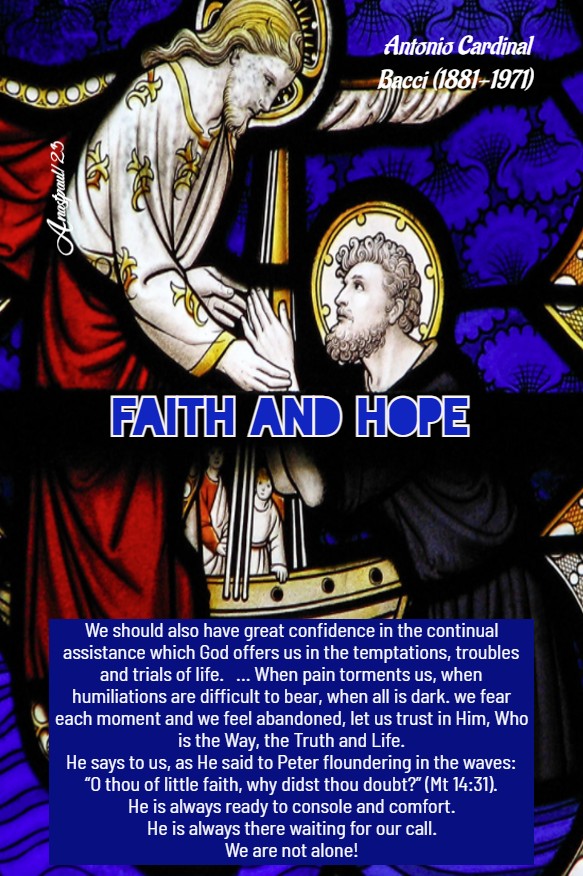
“We should also have great confidence in the continual assistance which God offers us in the temptations, troubles and trials of life. When pain torments us, when humiliations are difficult to bear, when all is dark. we fear each moment and we feel abandoned, let us trust in Him, Who is the Way, the Truth and Life. He says to us, as He said to Peter floundering in the waves: “O thou of little faith, why didst thou doubt?” (Mt 14:31). He is always ready to console and comfort. He is always there waiting for our call. We are not alone!”
Quote/s of the Day – 24 May – The Memorial of Saint Vincent of Lérins (Died c445) Confessor, Monk, Writer, the Author of the ‘Commonitorium.’
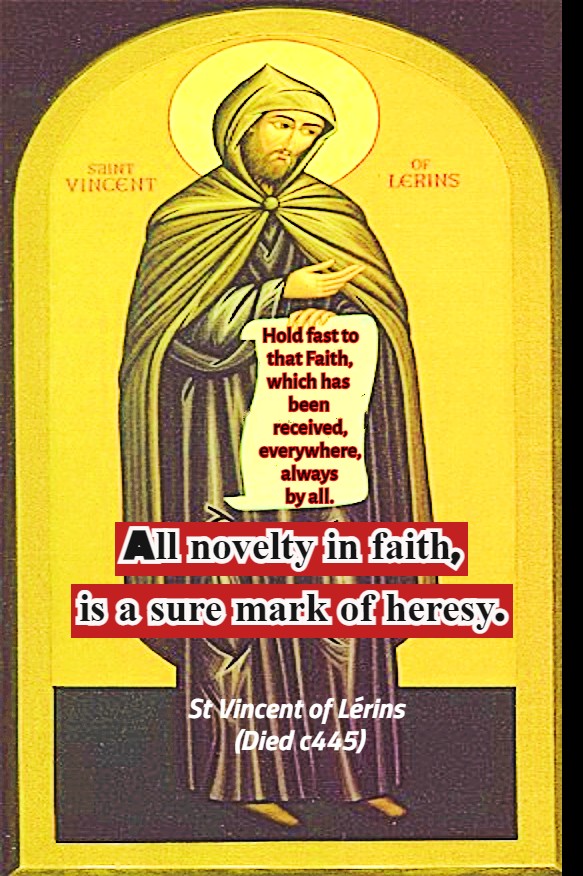
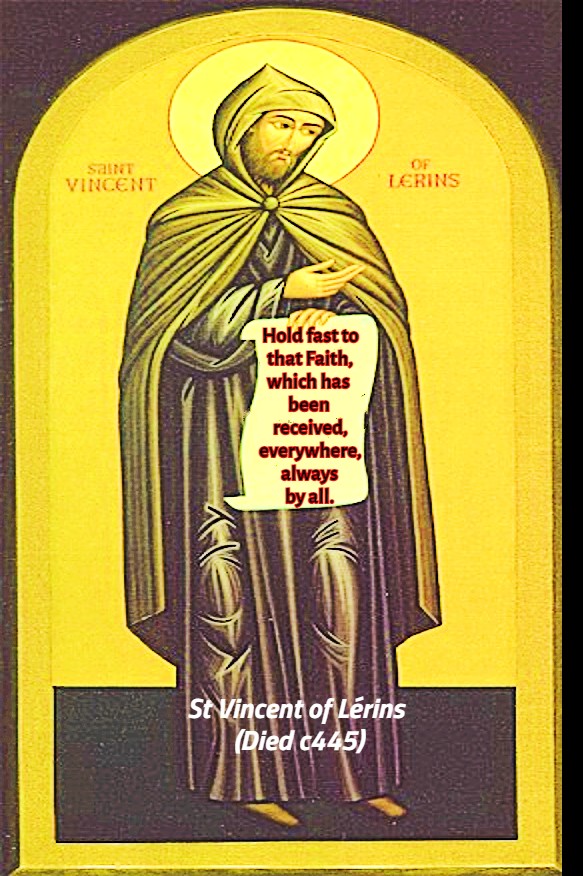
“Hold fast to that Faith, which has been received, everywhere, always by all.”
“All novelty in faith, is a sure mark of heresy.”
“True piety admits no other rule than that, whatsoever things have been faithfully received from our fathers, the same are to be faithfully consigned to our children and that, it is our duty, not to lead religion whither we would but rather, to follow religion whither it leads and that, it is the part of Christian modesty and gravity, not to hand down our own beliefs or observances to those who come after us but, to preserve and keep what we have received, from those who went before us.”
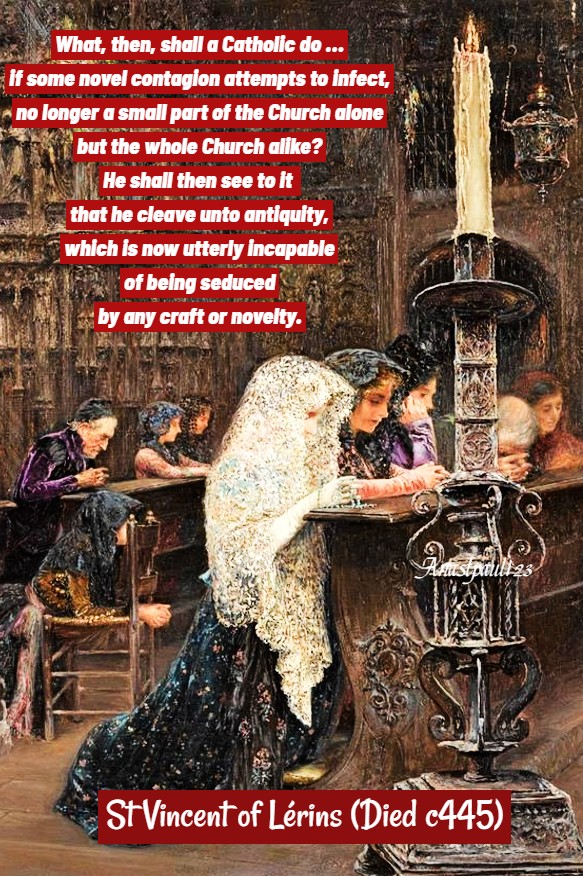
“What, then, shall a Catholic do … if some novel contagion attempts to infect, no longer a small part of the Church alone but the whole Church alike? He shall then see to it that he cleave unto antiquity, which is now utterly incapable of being seduced by any craft or novelty.”
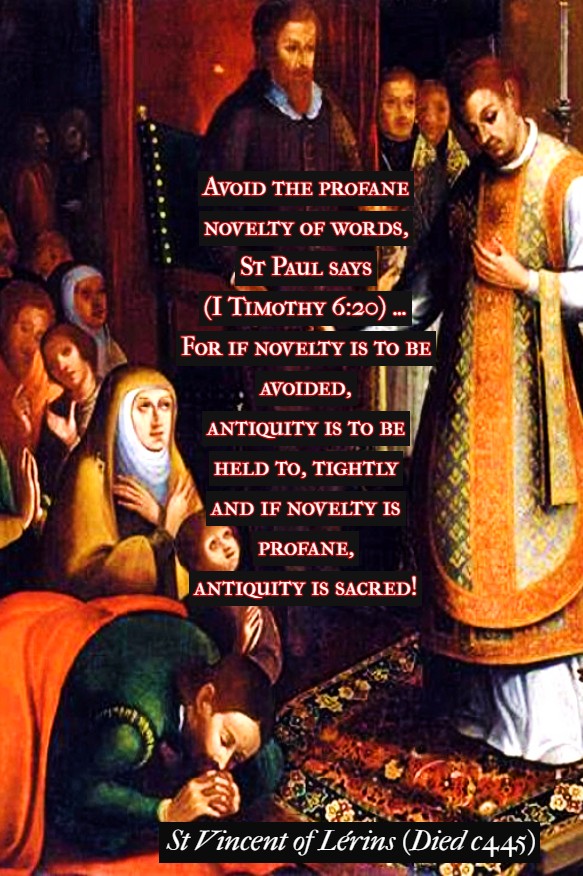
“Avoid the profane novelty of words, St Paul says (I Timothy 6:20) … For if novelty is to be avoided, antiquity is to be held to, tightly and if novelty is profane, antiquity is sacred!”
St Vincent of Lérins (Died c445) Author of the ‘Commonitorium.’
Saint of the Day – 24 May – Saint Vincent of Lérins (Died c445) Confessor, Monk, Writer, the author of the ‘Commonitorium.’ Born in Toulouse, France and died in c445 in Lerins, France of natural causes.
After the Church was given the green light with the Edict of the Emperor Constantine and was able to come out into the open, becoming part of the new society which was born from the ashes of the secular Roman empire, many Christians felt a more yearning desire for “detachment from world” and the reference to the “desert,” that is to say, to the quiet and solitude of the contemplative life.
This yearning was translated into various forms of eremitucal, monastic or community life. St Jerome lived for a long time in a cave near Betlem; St Paulinus of Nola stripped himself of all his wealth to live in a small room next to the tomb of the Martyr St Felix. Many chose the real desert, such as St Antony Abbot; others put the sea between themselves and the tumultuous society and took refuge on a small island.
Among the main monastic refuges of the Fifth Century was the Island of Lérins, in the Mediterranean, right opposite of Cannes in France. Founded by St Honoratius, future Bishop of Arles, the Monastery of Lérins became a seedbed for Bishops, Saints and Writers. Let us recall St Eucherius who, before becoming the Archbishop of Lyons, stayed for a long time on the islet with his wife and children and wrote two books there with significant titles: In Praise of Solitude and Contempt for the World. He is remembered for his letters advocating extreme self-abnegation.
But the most famous name which came out of this “nurse of saints” is our Saint today St Vincent of Lérins. Born to a noble family, he is believed to be the brother of St Lupus of Troyes. In his early life he engaged in secular pursuits; it is unclear whether these were civil or military, although the term he uses, “secularis militia,” may imply the latter. He entered Lérins Abbey on Île Saint-Honorat, where, under the pseudonym Peregrinus, he wrote the Commonitorium in c434, about three years after the Council of Ephesus. Vincent defended the Blessed Virgin as the Mother of God, against the heretical teachings of the condemned Nestorius. St Eucherius of Lyon called him a “conspicuously eloquent and knowledgeable” holy man.
We do not have much information about his life. His fame is linked to a booklet on the tradition of the Church, entitled Commonitorium, which St Robert Bellarmine defined as “a golden book.” It is a manual of rules of conduct to be followed in order to fully experience the Gospel message. In 434 (the year in which the precious booklet was published), the Monk provided future Theologians with the famous canon of orthodoxy, i.e. the yardstick for judging the goodness of a Theological affirmation: “Quod ubique, quod semper, quod ab omnibus creditum est” – “Let us hold fast to what has been believed everywhere, always and by everyone.”
However, Vincent hoped for progress: “It is necessary for understanding to grow and to progress very vigorously,” Living during the years of the Church’s struggle against the Pelagian heresy, Vincent of Lérins, born in northern France, perhaps in Belgium and landed definitively in Lérins, in whose peace he died around 450, with his writings provided a very effective weapon against “the frauds and snares of heretics.”
His relics are preserved at Lérins. Hid work is still quoted by Popes and Theologians.
Our Lady of China: Our Lady of China is a title for the Virgin Mary in China who is believed to have appeared at the small village of Donglu in 1900. In Chinese she is called Zhōnghuá Shèngmǔ. She is also known as Our Lady of Donglu.
St Afra of Brescia Bl Benedict of Cassino
St David, King of Scotland (1085-1183) King David was a social and religious Reformer, a man of great administrative skills, apostle of charity and of holy piety. He transformed his Kingdom by the widespread introduction of Catholic Churches and Monasteries, thus also assisting in the international diplomatic influence of his country, it’s farming and agricultural wealth and it’s education. He was the main force and instrument of God in Christianising Scotland. St David’s life: https://anastpaul.com/2020/05/24/saint-of-the-day-24-may-st-david-king-of-scotland-1085-1183/
Bl Diego Alonso St Donatian of Nantes St Gennadius of Astroga St Hubert of Bretigny St Joanna the Myrrhbearer Bl John del Prado Bl John of Montfort Bl Juan of Huete St Manahen St Marciana of Galatia St Meletius the Soldier Bl Nicetas of Pereslav St Palladia St Patrick of Bayeux
St Rogatian of Nantes St Sérvulo of Trieste St Simeon Stylites the Younger
St Susanna Martyr (Died 2nd Century) One of a group of wives of 2nd century Martyred soldiers under the command of Saint Meletius. Following the death of the soldiers, the wives and children were Martyred, as well.
Martyrs of Istria: A group of early Martyrs in the Istria peninsula. We know little more than some names – Diocles, Felix, Servilius, Silvanus and Zoëllus.
Bl Thomas Vasière St Vincent of Lérins (Died c445) Monk, Ecclesiatical Writer St Vincent of Porto Romano
Martyrs of Plovdiv: 38 Christians Martyred together in the persecutions of Diocletian and Maximian. We don’t even known their names. They were beheaded in Plovdiv, Bulgaria.









 AnaStpaul
You must be logged in to post a comment.