Thought for the Day – 9 May – “Mary’s Month” Meditations with Antonio Cardinal Bacci (1881-1971)
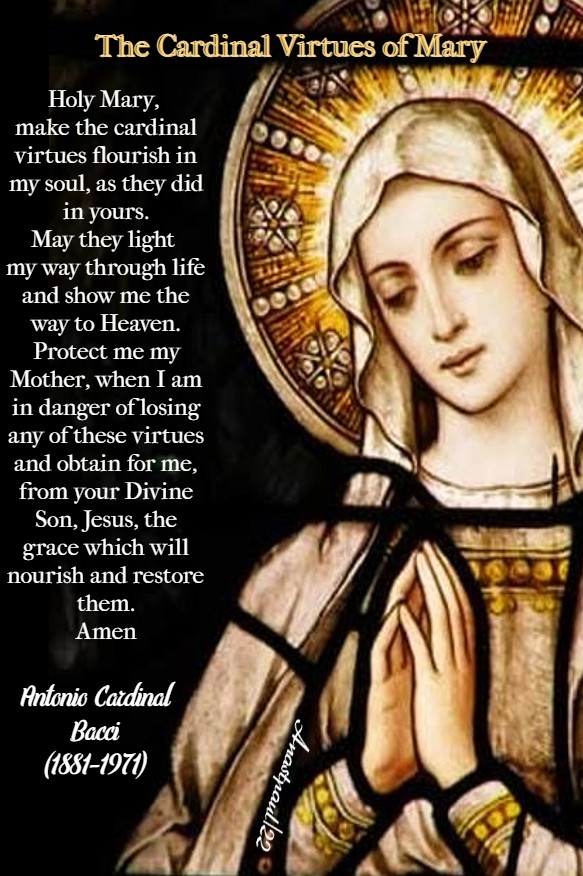
The Cardinal Virtues of Mary
“Mary’s soul has been appropriately styled, ‘the Garden of all the Virtues.’
In it, the three theological virtues were wonderfully interwoven with the four cardinal virtues of, justice, prudence, temperance and fortitude.
As St John Chrysostom observed, justice is nothing else but the perfect observance of all the commandments. (Homil 12 super Matth).
The Blessed Virgin obeyed all the commandments in her relations with God, to Whom she dedicated herself, from the moment when she gained the use of reason.
She obeyed them in her relations with her Son, Jesus Christ, for she reared and instructed Him with loving maternal care, even though she knew that He was God and had no need of her attention.
She fulfilled them in her relations with men, for whose salvation, she united her sufferings and her merits, to the infinite sufferings ad merits of our Saviour.
Furthermore, Mary was prudence itself.
This virtue shone forth in all her words and in all her actions.
When the Angel appeared in human form and told her that she was to be the Mother of God, she was not flattered nor complacent.
She thought calmly about the mystery which had been announced to her and asked the Angel how it could come to be, since she had already consecrated her virginity to God.
She pronounced her Fiat only when she was reassured by the Angel that through the intervention of the Holy Spirit, she would be a virgin mother.
This was the beginning of the miracle of the Incarnation.
When she was greeted by St Elizabeth as the Mother of the Lord, she did not boast about her distinction but composed a hymn of gratitude, in which she attributed her glory to God alone.
Mary’s prudence, is equally evident in her words of gentle reproof to Jesus after He had been lost and found again, in the company of the Doctors.
It is again obvious at the wedding celebrations in Cana, when she knew well, how to snatch the first miracle from the heart of Jesus.
Mary possessed the virtue of temperance also, both in her external behaviour and in her perfect internal control over all her faculties.
This was the result of her immunity from original sin, which has created such grave moral disorder in our poor human nature.
This virtue, was further perfected, by the purity and holiness of her daily life.
Finally, the virtue of fortitude was Mary’s to an heroic degree.
But her fortitude was always calm and controlled.
The elderly Simeon had foretold that the sword of sorrow would pierce her heart.
Her whole life was interwoven with suffering and privation.
From the manger in Bethlehem, to the flight into Egypt, from the Circumcision, when Jesus first shed His blood, to the Hill of Calvary, where He gave all He had for our salvation.
Mary offered her sufferings along with those of her divine Son for our redemption.
Her fortitude never wavered but was always serene, for her mind and heart were in constant communication with God.”
Antonio Cardinal Bacci



 AnaStpaul
You must be logged in to post a comment.