Blessed Augustine Gazotich OP (1262-1323) Bishop of Lucera, Croatia, of the Order of Preachers. He was also noted for being the guide for Dante Alighieri as the poet travelled through Croatia. His reputation for personal holiness remained noted long after his death; this resulted in Pope Innocent XII confirming the late Bishop’s Beatification in 1700. Biography: https://anastpaul.com/2018/08/03/saint-of-the-day-3-august-blessed-augustine-gazotich-o-p-1262-1323/
St Benno of Einsiedeln (Died 940) Bishop
St Dalmatius St Euphronius of Autun St Gamaliel St Gaudentia Bl Godfrey of Le Mans Bl Gregory of Nonantula St Hermellus St Nicodemus St Senach of Clonard (Died 6th Century) One of the Twelve Apostles of Ireland St Trea of Ardtree
Quote of the Day – 3 August – The Finding of the Relics of St Stephen, Protomarty – Acts 6:8-10; 7:54-60. Matthew 23:34-39
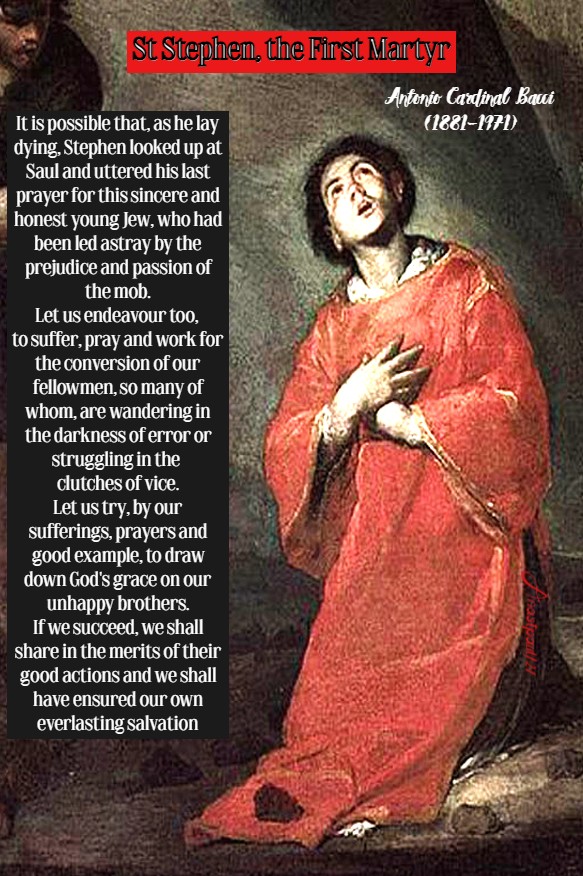
“It is possible that, as he lay dying, Stephen looked up at Saul and uttered his last prayer for this sincere and honest young Jew, who had been led astray by the prejudice and passion of the mob. … Let us endeavour too, to suffer, pray and work for the conversion of our fellowmen, so many of whom, are wandering in the darkness of error or struggling in the clutches of vice. Let us try, by our sufferings, prayers and good example, to draw down God’s grace on our unhappy brothers. If we succeed, we shall share in the merits of their good actions and we shall have ensured our own everlasting salvation.”
One Minute Reflection – 3 August – “The Month of the Immaculate Heart of Mary” – The Finding of the Relics of St Stephen, Protomartyr – Acts 6:8-10; 7:54-60. Matthew 23:34-39
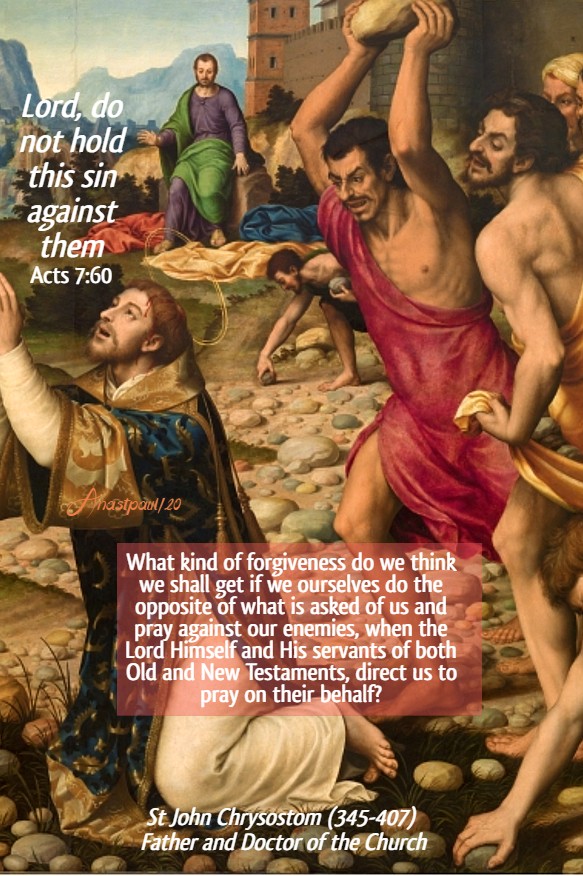
“Lord, do not hold this sin against them” – Acts 7:60
REFLECTION – “Let us imitate our Lord and pray for our enemies … He was Crucified and yet, at the same time, prayed to His Father for the sake of those who were crucifying Him. But how could I possibly imitate our Lord, one might ask? If you want to, you can. If you weren’t able to do it how could He have said: “Learn from me for I am meek and humble of heart”? (Mt 11:29) …
If you have difficulty in imitating our Lord, at least imitate him who is also His servant, His Deacon – I would speak of Stephen. Just as Christ, in the midst of those crucifying Him, without considering the Cross, without considering His own predicament, pleaded with the Father, on behalf of His tormentors (Lk 23:34), so His servant, surrounded by those who were stoning him, attacked by all, crushed beneath a hail of stones and, without taking any account of the suffering they were causing him, said: “Lord, do not hold this sin against them” (Acts 7:60). Do you see how the Son spoke and how His servant prayed? The former said: “Father, forgive them for they know not what they do,” and the latter said: “Lord, do not hold this sin against them.” Moreover, to make us realise the fervour with which he was praying, he did not just pray, as he stood beneath the blows of the stones but, he spoke on his knees with sincerity and compassion …
Christ said: “Father, forgive them for they know not what they do.” Stephen cried out: “Lord, do not hold this sin against them.” Paul, in his turn, said: “I offer up this sacrifice for my brethren, my kin according to race” (cf. Rm 9:3). Moses said: “If you would only forgive their sin! And if you will not, then strike me out of the book that you have written!” (Ex 32:32). David said: “May your hand fall on me and my kindred,” (2 Sam 24:17). … What kind of forgiveness do we think we shall get if we ourselves do the opposite of what is asked of us and pray against our enemies, when the Lord Himself and His servants, of both Old and New Testaments, direct us to pray on their behalf?” – St John Chrysostom (345-407) Father and Doctor of the Church – Sermon for Good Friday “The Cross and the bandit”
PRAYER – Grant us, we beseech Thee, O Lord, to imitate what we celebrate, so that we may learn to love, even our enemies; because we keep the anniversary of the invention of Him, Who knew how to plead even for His persecutors with our Lord, Jesus Christ, Thy Son, Who with |Thee. lives and reigns with Thee, in the unity of the Holy Ghost, God, world without end. Amen (Collect).
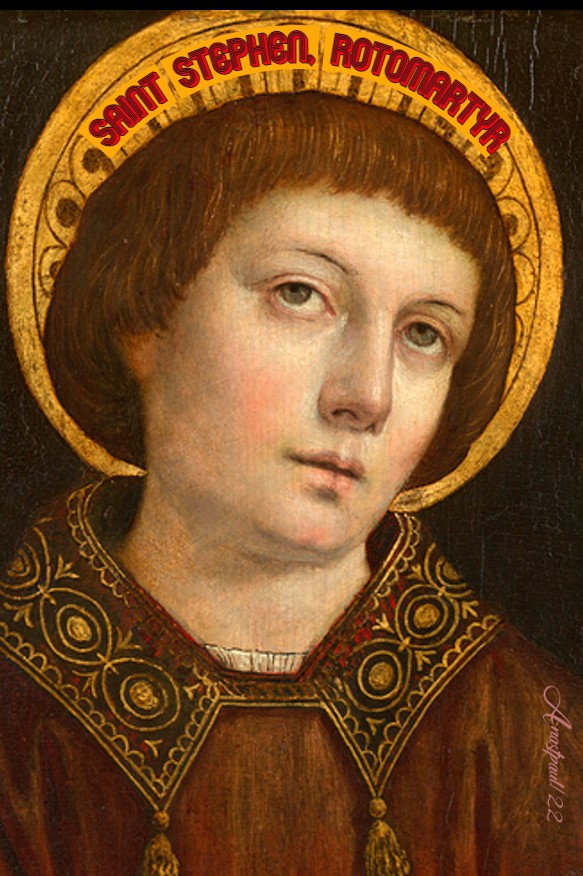
Saint of the Day – 3 August – The Finding of the Relics of St Stephen, Protomartyr. St Stephen, the ProtoMartyr (c 05-c 34) – 26 December the Second Day in the Octave of Christmas. The Roman Martyrology reads today: “At Jerusalem, the finding of the body of most blessed Saint Stephen, the first Martyr and of the Saints Gamaliel, Nicodemus and Abibo, through a Divine revelation made to the Priest Lucian, in the time of the Emperor Honorius.”
The Finding of the Relics of St Stephen, the ProtoMartyr By Fr Francis Xavier Weninger SJ (1805-1888)
After St Stephen, the First Martyr, had been stoned to death by the Jews for having uncontestably proved that Christ, Whom they had Crucified, was the true Messiah, some pious men, filled with deep sorrow, buried him with all due reverence. Foremost among these was St Gamaliel, who had formerly been a rabbi and later a disciple of St Paul. He arranged everything, so that the body of St Stephen was carried, during the night, by some Christians, from the spot in which it lay, to his country-seat, which was a few miles from Jerusalem.
The burial of St Stephen
“In the course of time and in consequence of the persecution of the Christians in Juda, the location of his tomb was forgotten, until it pleased the Almighty to reveal it, in the time of the Emperor Honorius. There lived, at that period, in the place where St Stephen was buried, a Priest of the Church of Jerusalem, named Lucian. St Gamaliel appeared to this holy man in his sleep and disclosed to him where the bodies of St Stephen, St Nicodemus, his son St Abibon and his own body, were lying, telling him, at the same time, to inform St John, Bishop of Jerusalem, of this fact and to say that it was the will of God that he should exhume them for the benefit of many men. Lucian awakening and fearing it was but a dream, or perhaps even a delusion from Satan, did not tell the Bishop but humbly prayed to God that, if it were a revelation from on high, He would grant him a repetition of the vision. To this effect, Lucian continued in prayer and fasting for eight days, when Gamaliel again appeared to him and repeated all he had said before.
Lucian did not yet obey but, to be more certain, fasted and prayed eight days more. St Gamaliel appeared to him for the third time and, with a severe countenance, reproving him for not believing his words, commanded him to make the Bishop acquainted with the facts immediately, in order that the faithful might no longer be deprived of the benefits which they would obtain by the intercession of St Stephen and the other Saints.
After this third apparition, Lucian could no longer doubt and, betaking himself to the Bishop of Jerusalem, he communicated to him all that had happened. The joy of the holy Bishop was exceedingly great. He called the Bishops and Priests of the neighbouring Churches and, accompanied by them and a great number of Christians, he went to the place indicated and had the satisfaction of finding four coffins, on which were engraven the names of the Saints abovementioned – St Stephen, St Nicodemus, St Abibon, St.Gamaliel. When the coffins were reverently opened, there issued from them a fragrance as if the place had been filled with blooming flowers.
St Stephen mourned by Saints Gamaliel and Nicodemus
More than seventy persons, some of whom were sick and others possessed by evil spirits, were instantly restored to health, or relieved of their torments, upon touching the Sacred Relics, especially those of St Stephen. The body of the Protomartyr was carried with great solemnity to Jerusalem, and deposited in the Church of Sion, the oldest and largest Church in that City.
During the reign of Theodosius the Younger, it was transported to Constantinople, and thence to Rome in the reign of Pope Pelagius I. The rearkable discovery of the relics of St Stephen and the miracles, which had been wrought at their touch, were soon known all over the Christian world. The heretics, who, at that time persecuted the Church, were ashamed and the faithful strengthened in the True Faith and animated in their veneration for the Protomartyr.
All Countries and Cities applied for portions of the Relics and many were favoured with them, to the great benefit of the people. Many received only some of the earth in which the holy body had rested; others, a piece of linen which had touched his coffin but, by the pious use of them, as many miracles were wrought as by the relics themselves.
In St Augustine, we have an indisputable witness of this, as he lived at the time of the discovery. Among other things, he tells us, in the twenty second book of the “City of God,” of many great miracles wrought, in his presence, by these relics, in the city of Hippo, of which he was bishop, as also in adjacent Countries. A few of these we will here relate.
A blind woman’s sight was immediately restored, by touching her eyes with a flower, which, at her request, had been laid on the Relics of St Stephen. Lucillus, a Bishop, was cured of a dangerous fistula by devoutly carrying the Sacred Relics. Eucharius, a Priest, arose again to life, when they placed upon his corpse, a tunic which had rested on St Stephen’s body. Two men suffering with gout were cured by the same. A lad who was killed by being run over by a carriage, was not only restored to life, but his broken limbs were healed. A nun who had died, retuned to life and health, when her habit was laid upon her, ,after it had touched the Sacred Relics. Eleusinus placed the corpse of his child upon the spot where the Relics of the Saint had rested, and immediately, the child lived again. Upon the head of Marial, a hardened Jew, his brother-in-law–a Christian–laid a flower, which had been on the Altar near the Relics and the next day the Jew requested to be Baptised. Two sisters, who were afflicted with epilepsy, were instantly cured by these relics. Many other miracles are narrated by St Augustine and he concludes with these words: “If I alone were to relate what I know of the miraculous cures performed by St Stephen at Calama and in its neighbourhood, I should have to write many books and yet, not be able to collect all of them!”
What does a non-Catholic think or say on reading or hearing these and many other things which the holy Fathers have written of the Sacred Relics? He rejects all these histories and accuses St Augustine and other great teachers, of falsehood and superstition. But, if he believes even one of these miracles, how can he, according to the doctrines of his religion, condemn the veneration of Relics and the invocation of the Saints!?”
For us, who believe in the powerful intercession of our Saints through their holy Relics, let us pray:
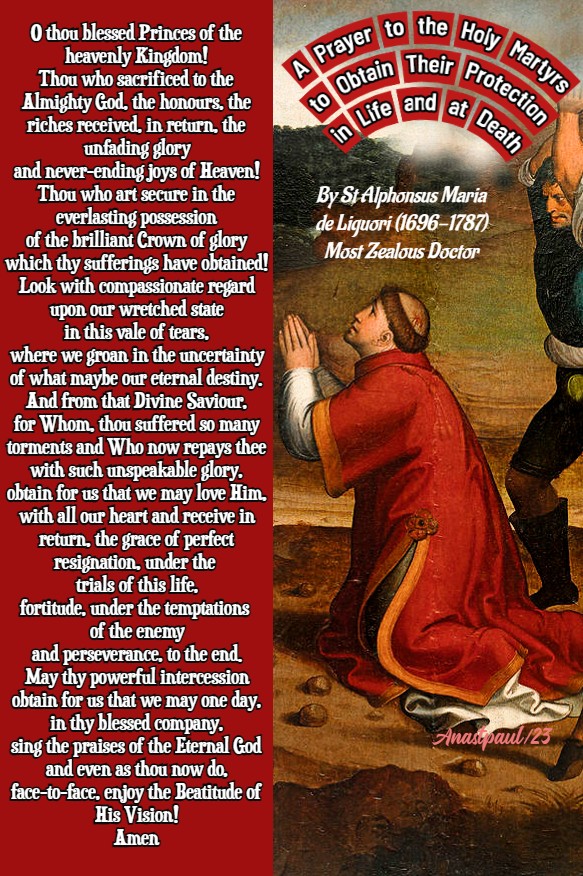
A Prayer to the Holy Martyrs to Obtain Their Protection By St Alphonsus Maria de Liguori (1696-1787)
O thou blessed Princes of the heavenly Kingdom! Thou who sacrificed to the Almighty God, the honours, the riches received, in return, the unfading glory and never-ending joys of Heaven! Thou who art secure in the everlasting possession of the brilliant Crown of glory which thy sufferings have obtained! Look with compassionate regard upon our wretched state in this vale of tears, where we groan in the uncertainty of what maybe our eternal destiny. And from that Divine Saviour, for Whom, thou suffered so many torments and Who now repays thee with such unspeakable glory, obtain for us that we may love Him, with all our heart and receive in return, the grace of perfect resignation, under the trials of this life, fortitude, under the temptations of the enemy and perseverance, to the end. May thy powerful intercession obtain for us that we may one day, in thy blessed company, sing the praises of the Eternal God and even as thou now do, face-to-face, enjoy the Beatitude of His Vision! Amen
Blessed Augustine Gazotich OP (1262-1323) Bishop of Lucera, Croatia, Of the Order of Preachers. He was also noted for being the guide for Dante Alighieri as the poet travelled through Croatia. His reputation for personal holiness remained noted long after his death; this resulted in Pope Innocent XII confirming the late Bishop’s Beatification in 1700. Biography: https://anastpaul.com/2018/08/03/saint-of-the-day-3-august-blessed-augustine-gazotich-o-p-1262-1323/
St Dalmatius St Euphronius of Autun St Gamaliel St Gaudentia Bl Godfrey of Le Mans Bl Gregory of Nonantula St Hermellus St Nicodemus St Senach of Clonard (Died 6th Century) One of the Twelve Apostles of Ireland St Trea of Ardtree







 AnaStpaul
You must be logged in to post a comment.